
How to Improve ROI With Ad Creative Testing
Key takeaways
- Creative iteration: Creative files changed on 93% of consecutive launches among advertisers who went on to run six or more ad sets.
- Test structure: Keep the audience constant and change one creative variable at a time so you can identify what affected performance.
- Test duration: Run variants simultaneously for at least three to five days or until each receives at least 1,000 impressions before comparing results.
- Winner metric: Combine CTR and conversions, but judge the winner on the conversion event tied to the campaign objective.
- Test cycle: Scale winning creative, use its performance to inform the next test, and refresh when fatigue starts to affect results.
Ad creative testing should tell you which creative is more likely to generate the conversion you’re targeting, beyond simply which one gets more clicks.
Blockchain-Ads campaign data also shows how frequently active advertisers iterate on creative. Among advertisers who went on to run six or more ad sets, creative files changed on 93% of consecutive launches in their first campaigns.
Getting a useful result requires more than adding extra banners to an ad set. You need:
- Enough creative variations to test.
- A structure that isolates creatives from other variables.
- Sufficient budget and time to produce a readable result.
- A conversion event that tells you which version actually performed better.
This guide covers how to structure, fund, measure, and refresh your creative tests. You’ll be able to identify which creatives improve acquisition performance and make better decisions about what to scale.
What Should Ad Creative Testing Tell You?
Ad creative testing compares different ad versions to determine which performs better against a defined campaign goal. The goal is to learn what changes performance so you can decide what to scale, change, or stop running.
To achieve this goal, isolate the creative from other variables that could affect the result. If you change the creative, audience, budget, and targeting at the same time, you may see a difference in performance, but you won't know which change caused it.
Instead, keep the audience and campaign conditions consistent while testing a specific creative variable. Different creative testing methods can focus on the visual, headline, copy, call to action, or format. But each test should isolate the element you want to learn about. You can also see how the available ad formats compare in performance before deciding which one would be the variable in your test.
This approach makes each test useful beyond identifying a winning ad. It gives you evidence about which creative choices affect acquisition performance and what to test next.
How Many Ad Creatives Should You Test?
When deciding how many ad creatives to test, there isn't a fixed number that works for every campaign. The useful number depends on how many variations you can give enough delivery to evaluate against your chosen conversion event.
Start with the creative ideas your hypothesis requires. If you're testing one headline against another, you may only need two variants. If you're comparing several distinct creative concepts, you may need more. In either case, each variation needs enough opportunity to deliver before you compare the results.
Your available budget therefore limits creative volume. Adding more variations without increasing the resources available to the test can spread delivery across too many ads and leave you without enough evidence to decide.
Choose the number of creatives after defining what you're testing, the conversion event you'll use to judge them, and how much delivery you can support. If adding another variation would make the result harder to read, leave it for the next test.
How to Structure a Creative Testing Framework That Isolates One Variable
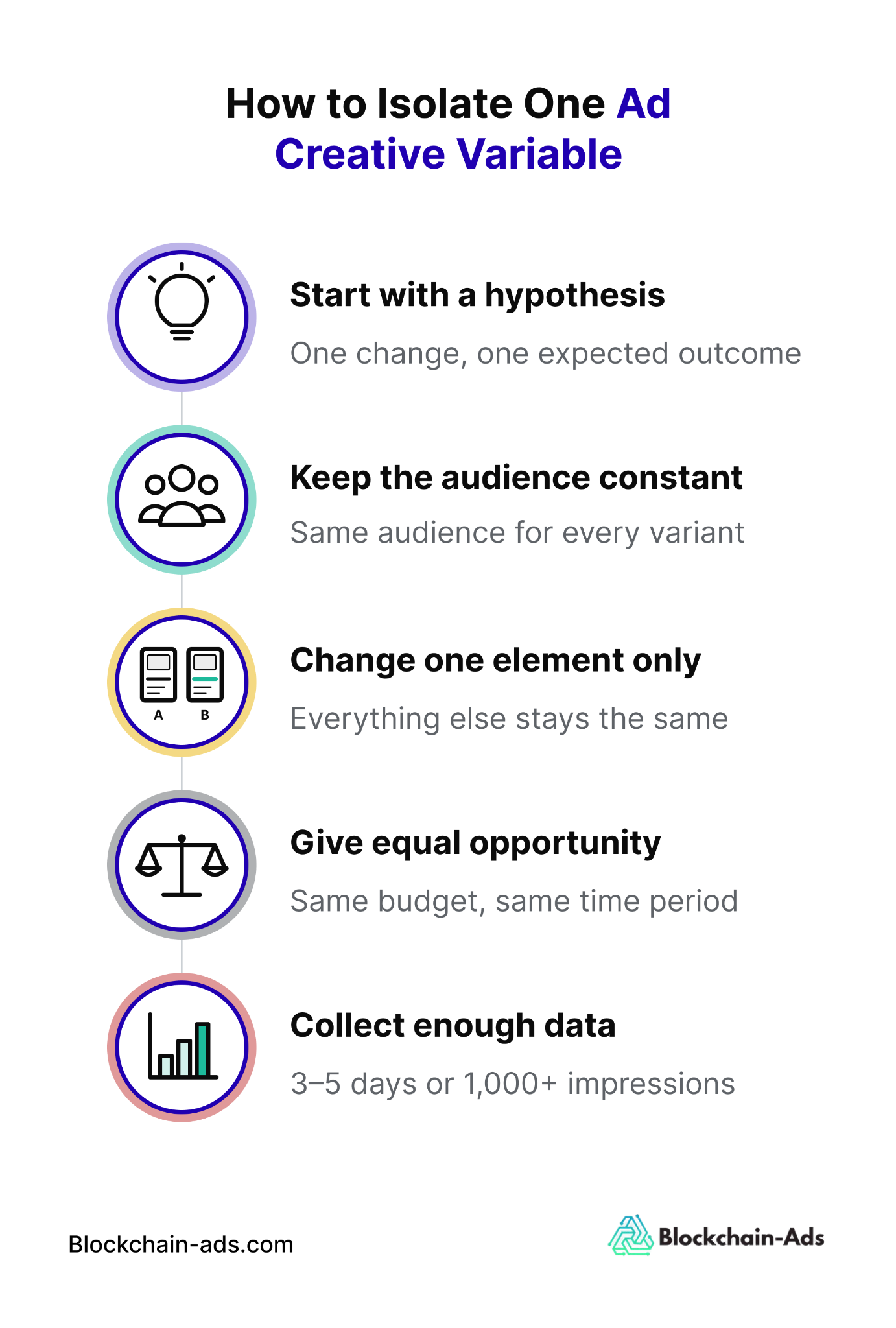
A creative testing framework gives each test a specific question to answer. When A/B testing ads, keep the campaign conditions consistent and change one creative variable at a time. The same principle applies when testing programmatic creative: isolate the creative change so you can interpret the result.
Here’s how to structure the test:
1. Start with a Hypothesis
Define what you want to learn before launching the test. Your hypothesis should connect a specific creative change to the campaign outcome you expect it to affect.
For example, you might test whether showing the product earlier in a video increases sign-ups. You could also test whether a benefit-focused headline produces more qualified conversions than a feature-focused version.
Your hypothesis should also specify the element you're testing, such as the headline, visual, copy, call to action, or format.
2. Keep the Audience Constant
Run each creative against the same audience so differences in audience quality don't distort the result. If you build a programmatic audience for the campaign, keep that audience consistent across the creative variants you're comparing.
Blockchain-Ads recommends keeping the audience, campaign objective, budget, and schedule consistent when you set up an A/B test. The creative variable you're testing should be the difference between the variants.
With those campaign conditions held constant, you can attribute performance differences more confidently to the creative rather than to who saw the ad.
3. Change the Creative You Want to Test
Keep the remaining creative elements consistent with your hypothesis. For example, if you're testing the headline, use the same visual, copy, and call to action across both versions.
Also, keep each variation within the platform's creative specs so differences in format or asset requirements don't introduce another variable.
If the visual, headline, and copy all change together, a winning variation tells you that the ad performed better. However, it doesn't show which change drove the difference.
4. Give Each Variant the Same Opportunity to Spend
Set up separate variants with equal budgets and run them over the same period. On Blockchain-Ads, you can duplicate the original campaign and change the creative element you want to compare.
Keep the objective, audience, budget, and schedule consistent between the original and duplicate. This creates comparable conditions for judging the result.
5. Let the Test Collect Enough Data
Avoid choosing a winner based on early performance. Blockchain-Ads recommends running both variations simultaneously for at least three to five days or until each has received at least 1,000 impressions before comparing the results.
Those thresholds are a starting point, so don’t use them as a guarantee that every test will produce a useful result. The amount of budget behind the test also affects whether it generates enough performance data to make a decision, which we'll look at next.
How Much Should an Ad Creative Test Spend?
Your test budget needs to give each creative enough delivery to produce a result you can use. If you spread spend too thinly across multiple variations, the test may end before enough conversion data accumulates to distinguish a winner.
There isn't one daily budget that makes every creative test readable. Your required spend depends on factors such as the conversion event you're measuring and its expected cost. It also depends on the number of variations and how much data each variation needs before you can decide.
Treat the test as its own allocation within your broader paid media budget. That way, the spend needed to read the result isn't competing unpredictably with the rest of the campaign.
To determine how much a test needs to spend, work backward from the conversion event rather than choosing a test budget in isolation. Estimate how much spend each creative needs to generate enough opportunities for that event, then multiply it by the number of variations you're testing.
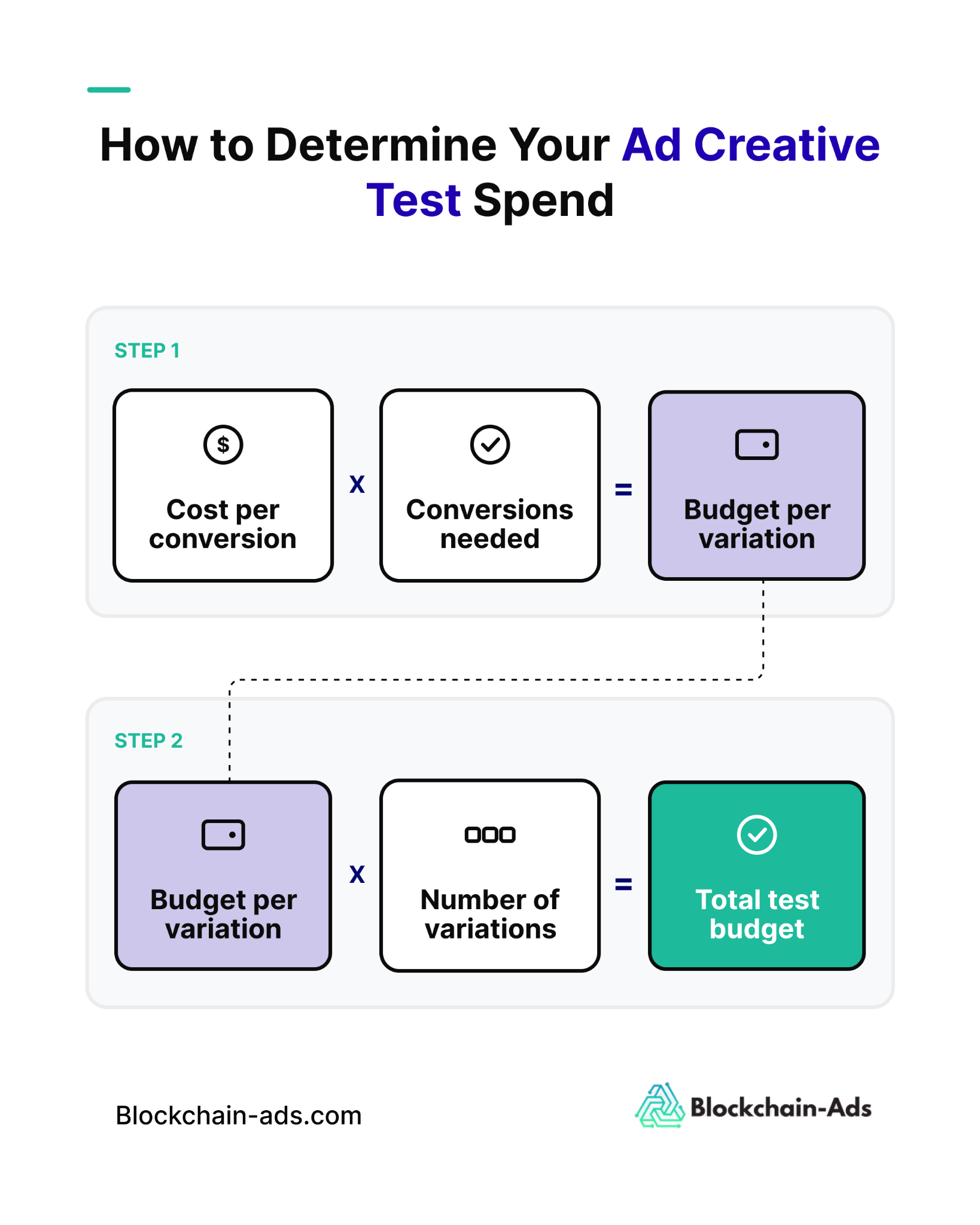
Start with the expected cost of the conversion event, then consider how many conversions each variation would need before you’d be comfortable making a decision. This gives you a working estimate of the spend required per creative.
For example, suppose your expected cost for the conversion event is $40, and you want each variation to generate five conversions before making an initial comparison. That gives you a working estimate of $200 per variation. If you're testing three variations, you'd plan around $600 for the test.
This is a planning estimate, so don’t use it as a minimum test budget or a guarantee that five conversions will produce a conclusive result. Use your own conversion costs and the amount of data you need to make the decision.
Apply the same estimate to each variation in the test. If the total is more than your available test budget, reduce the number of variations rather than cutting the spend available to each one.
The goal is to fund a test you can read, so avoid increasing creative volume if doing so leaves each variation without enough delivery to evaluate.
Use CTR and Conversions to Judge Creative Performance
For ad creative performance testing, judge CTR alongside the conversion event tied to your campaign objective. Together, they show whether the creative attracts clicks and whether those clicks progress to the action you're trying to drive.
CTR shows whether a creative is generating clicks, but it doesn't tell you what those users do afterward. Two creatives can therefore produce similar click performance while differing on the conversion event you're actually trying to drive.
When CTR and conversion performance move in different directions, prioritize the metric tied to your campaign objective. A higher CTR with weaker conversion performance means more clicks aren't translating into the target action. Check whether the creative is attracting the wrong intent or whether the post-click experience, including the landing pages for the audience you built, is preventing those users from converting.
A lower CTR with stronger conversion performance can mean fewer people are clicking, but those who do are more likely to complete the target action. In that case, don't reject the creative based on CTR alone if the conversion event you're buying has improved.
If both improve, you have stronger evidence that the creative is improving performance across the click and conversion stages. If neither improves, don't scale the variation based on creative performance alone.
The conversion event you use will depend on the campaign objective, such as:
- Registration
- Subscription
- Qualified lead
- First purchase
- Account verification
- Another measurable action tied to the campaign goal
Define the event before launching the test so the metric used to choose the winner doesn't change after you see the results.
Tracking also needs to be in place before the test starts. In Blockchain-Ads campaign data, advertisers with conversion tracking installed before launch recorded a conversion on their first delivered ad set 66% of the time. While those who added tracking later recorded only 29%.
Our pump.fun case study shows how both can improve through iteration. After we rebuilt the creative around the first phase's performance, CTR increased from 0.27% to 0.71%. The click-to-active-wallet rate also increased from 2.1% to 4.6%.
Turn Winning Creatives Into the Next Test
Once a test produces a clear winner, scale the stronger creative and use what you learned to form the next hypothesis. In other words, identify which creative choice worked, then test whether you can improve on it.
For example, if a benefit-focused headline beats a feature-focused version on your chosen conversion event, keep the winning headline and test another element, such as the visual. If the variation with the new visual performs better, it becomes the new control for the next round.
This iterative approach also shows up in real campaigns. Databricks tested two subject lines and three messaging variations in a LinkedIn campaign. One variation generated almost twice the click-through rate and conversions of the others, with Databricks reporting 2x higher conversions at half the CPA. The team used what it learned from the experiment to inform subsequent tests.
You can turn those insights into a repeatable creative testing cycle:
- Identify the winning creative.
- Record what changed and how performance differed.
- Keep the winning element as the control.
- Choose the next creative element to test.
- Run the new variation under comparable conditions.
For each test, record the hypothesis, creative variable, audience, spend, test period, CTR, conversion result, and winning variation. This gives you a record you can use to compare later tests. It will show you whether a creative idea continues to perform when you test it again or apply it to another variation.
Keep a record of losing creatives because they can show which messages, visuals, or formats failed to improve performance. This record helps you avoid repeating tests and gives future hypotheses more evidence to build on.
Refresh Creatives When Performance Starts to Decline
A winning creative won't necessarily remain the winner as exposure increases. Repeated exposure can make an audience less responsive to an ad it has seen repeatedly, so monitor performance to detect and fix ad fatigue, sometimes described as creative fatigue.
Watch performance alongside frequency rather than refreshing creatives on a fixed schedule. If CTR or conversion performance declines as the same audience receives more impressions, the creative may need another variation.
Don't treat lowering frequency as a replacement for creative testing. If a previously successful ad continues to lose performance, use what you learned from the winning version to develop the next variation and test it against the current control.
That keeps the testing cycle moving:
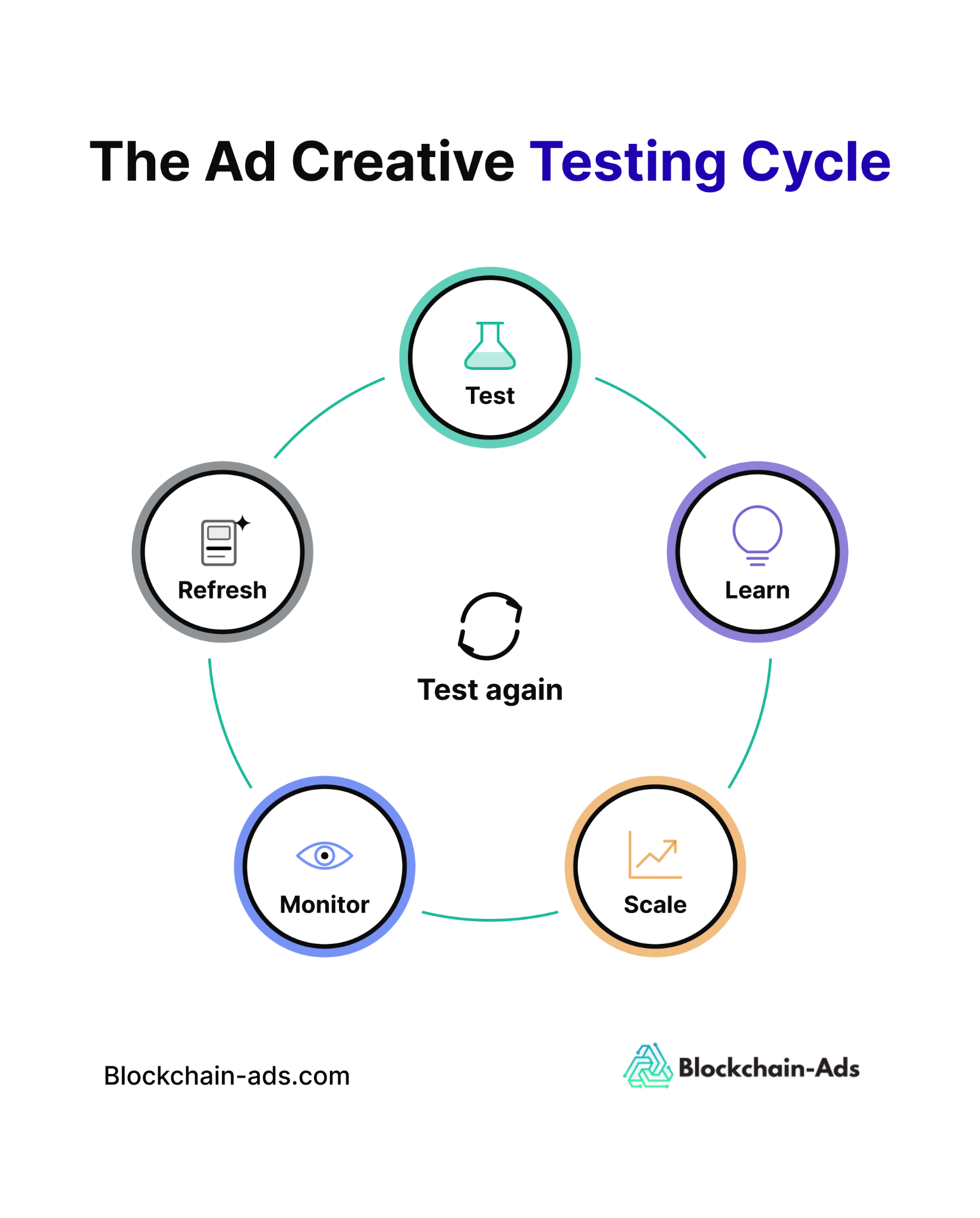
Test → learn → scale → monitor → refresh → test again.
Where AI Fits Into Ad Creative Testing
AI can increase the number of creative ideas you produce, but it doesn't change how you determine whether a variation works. AI-generated ads still need to be evaluated against the campaign objective and conversion event.
For AI ad creative testing, use AI to increase production speed without changing the test structure:
- Choose the creative element you want to test.
- Generate variations of that element with an AI tool.
- Review them for brand fit, compliance, and accuracy.
- Select the variations that represent distinct testable ideas.
- Run them under the same campaign conditions.
- Compare CTR and conversion performance.
- Use the results to decide what to scale and what to generate next.
Blockchain-Ads supports Performance Max campaigns alongside those controlled and automated creative-testing options.
Blockchain-Ads also offers Flux campaigns for display and native advertising. Flux uses your brand assets and copy to generate a fresh creative for each impression and learns from how those combinations perform.
That's different from a controlled A/B test. A/B testing isolates a creative variable so you can compare defined variants, while Flux automates creative variation and learning at the impression level.
This type of dynamic creative optimization can automate how creative combinations are generated and refined. On the other hand, controlled testing remains useful when you need to isolate a specific variable.
For conventional AI creative tools, keep the decision rule the same. Use AI to generate and iterate on ideas, then let conversion performance determine which ideas deserve more spend.
Ad Creative Testing Checklist
Use these ad creative testing best practices before launch so each test has a defined purpose and enough resources to produce useful data. They also give you a clear rule for what happens after the results come in:
- Hypothesis: What specific question should this test answer?
- Variable: Which creative element are you changing?
- Audience: Are the variants reaching the same audience?
- Creative volume: Does each variation test a distinct idea worth comparing?
- Budget: Can each variation receive enough spend to produce a readable result?
- Duration: Can the test run long enough to collect enough performance data?
- Conversion event: Which campaign action will determine the winner?
- CTR: How will click performance help you interpret the conversion result?
- Winner: What result will justify scaling one variation?
- Next test: What will you test after identifying the winner?
- Fatigue: Which performance changes will trigger a creative refresh?
Run Measurable Creative Tests with Blockchain-Ads
On Blockchain-Ads, you can run controlled A/B tests and compare click and conversion performance in campaign reports. Then, scale the creative that best matches your campaign objective.
Whether you use self-serve or managed, you can apply the same testing process. With managed service, the Blockchain-Ads Design Team can also produce campaign creatives at no additional fee.
Request access to launch and measure your next campaign on Blockchain-Ads, and turn creative testing into a repeatable acquisition process.
Raphael is a B2B SaaS and technical SEO writer covering digital advertising, Web3, fintech, and growth strategy.
View full profile →