The 8 Best Native Advertising Platforms (Native Ad Networks) in 2026
Key takeaways
- Platform fit: Check industry eligibility, minimum spend, and formats before choosing a native advertising platform.
- Regulated industries: Blockchain-Ads supports crypto, iGaming, and finance campaigns, subject to verification.
- Small budgets: MGID's minimum deposit is $100, though meaningful testing requires more.
- Premium inventory: Teads and Life360 Ads specialize in native placements across publisher content.
- Buying options: Self-serve, managed, and programmatic models differ in control and requirements.
Native advertising platforms vary in who they reach, what they cost, and which industries they accept. Choosing poorly can mean paying for unsuitable traffic or building a campaign that won't get approved.
Comparing native advertising companies therefore takes more than looking at reach and features. We scored eight current options to help you match publisher inventory, targeting, buying model, and eligibility to your acquisition goals.
The Best Native Advertising Platforms at a Glance
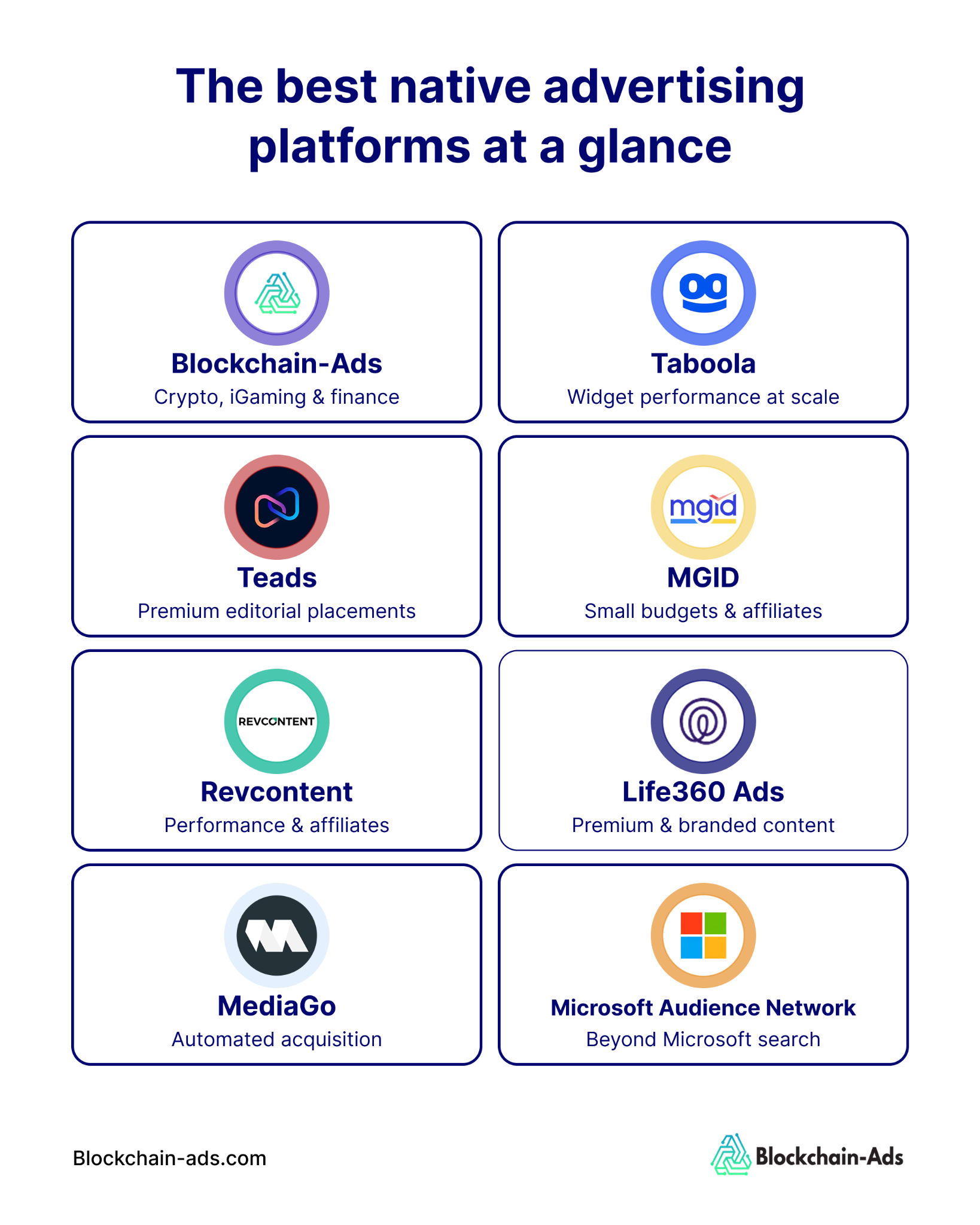
The best native advertising platforms range from specialist acquisition tools for regulated industries to lower-budget testing networks and premium editorial inventory.
The top native advertising platforms differ in eligibility and funding as much as inventory. Confirm both before committing to creative production.
How We Scored Each Native Ad Platform
We rated native ad platforms from 1 to 5 on six weighted criteria, prioritizing campaign suitability rather than advertised reach.
The scale runs from 1 (major limitations) through 3 (capable with tradeoffs) to 5 (strong fit). Overall scores are weighted averages, not measured conversion-performance benchmarks.
Pricing scores reflect budget accessibility and buying flexibility. Vertical scores reflect documented eligibility and approval requirements for the covered industries, with limited public documentation treated as uncertainty rather than a confirmed prohibition.
The 8 Best Native Ad Networks, Reviewed
These native ad networks differ in the audiences, placements, and buying conditions they offer.
Platform information last verified: October 22, 2026. Pricing, inventory availability, and advertising policies may change.
Blockchain-Ads
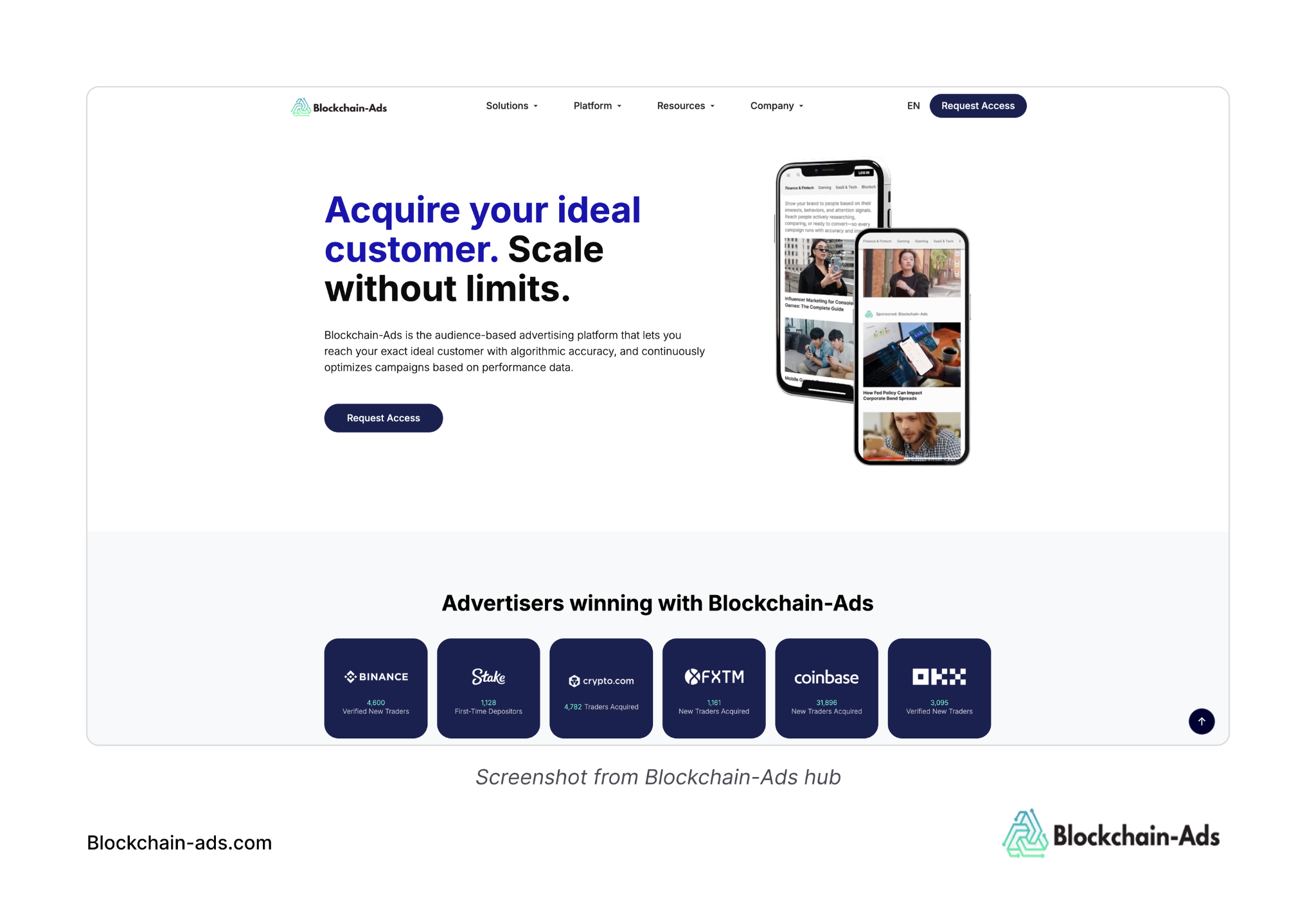
Blockchain-Ads sells native placements through a self-serve DSP, with a managed option. Its native advertising inventory includes in-feed, in-article, and recommendation-widget formats across publisher content.
Interest, on-site behavior, and on-chain activity help you build audiences beyond page context. The platform accepts crypto, iGaming, and finance campaigns subject to verification and measures conversions through pixel, Google Tag Manager, or server-to-server tracking.
In a Coinbase-affiliated campaign, native in-feed ads ran alongside display placements across Southeast Asia. The six-month campaign acquired 31,896 traders and generated $8.13 million in attributed trading volume. Those results were from native and display ad formats.
Limitations: A $10,000 minimum deposit and $360 daily budget put small tests out of reach; managed campaigns require $30,000 monthly. Audience-based buying is also less suitable if you need a guaranteed placement on one publisher.
Score: 4.20/5. Publishers 4 | Targeting 5 | Formats 4 | Measurement 5 | Pricing 2 | Verticals 5.
Taboola (Realize)
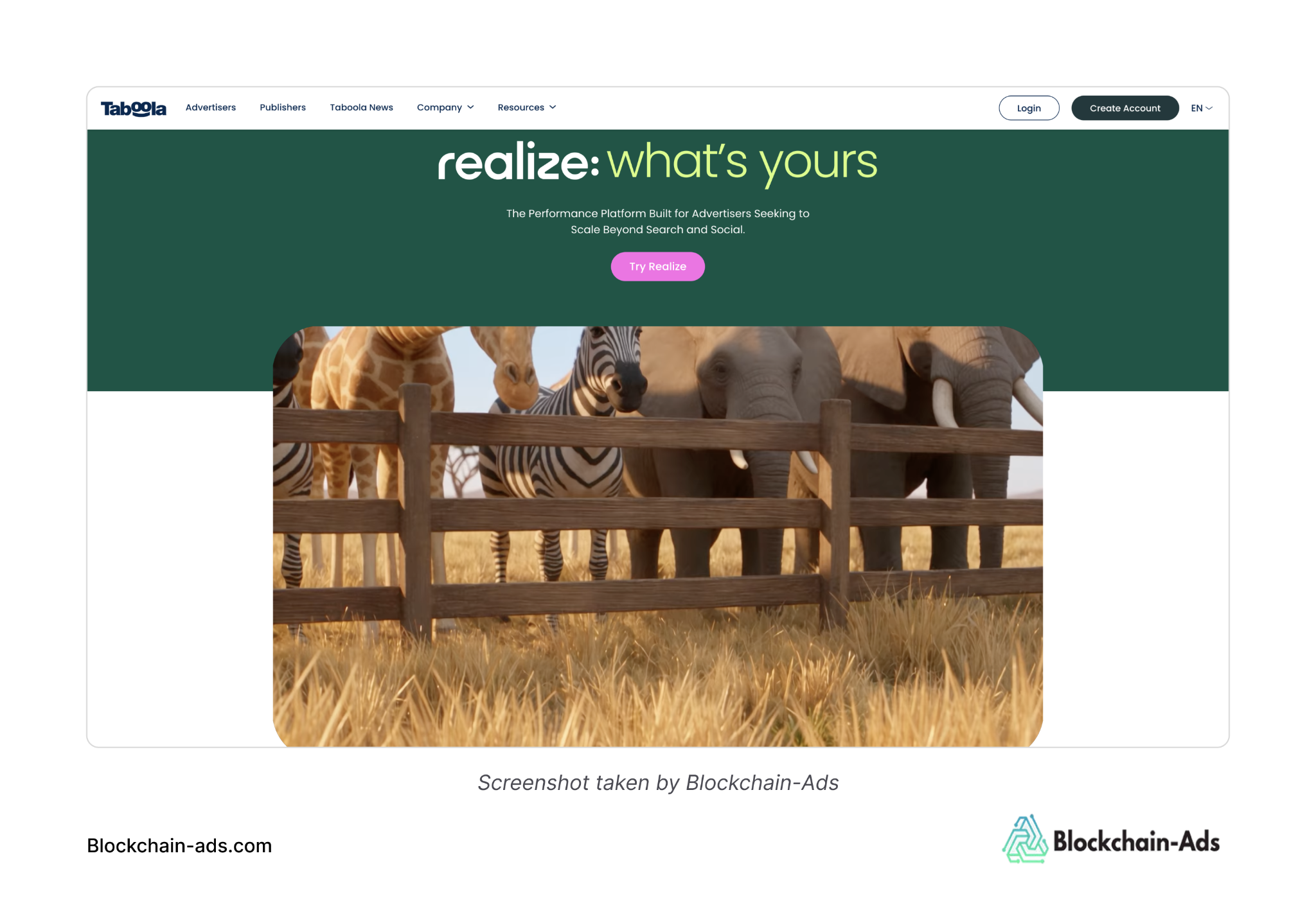
Taboola Realize offers self-serve and supported buying across publisher recommendation widgets and other native content placements. You can combine contextual and behavioral signals with publisher data, automated bidding, retargeting, and conversion tracking.
Its scale suits teams with tested landing pages and creatives that want to expand beyond search and social. Placement reporting helps identify which publishers warrant continued spending.
Limitations: Crypto, gambling, and financial campaigns may require additional approvals depending on product and geography. It doesn’t disclose any universal minimum deposit publicly, and widget performance requires regular creative and placement checks.
Score: 3.75/5. Publishers 5 | Targeting 4 | Formats 4 | Measurement 4 | Pricing 3 | Verticals 2.
Teads (Formerly Outbrain)
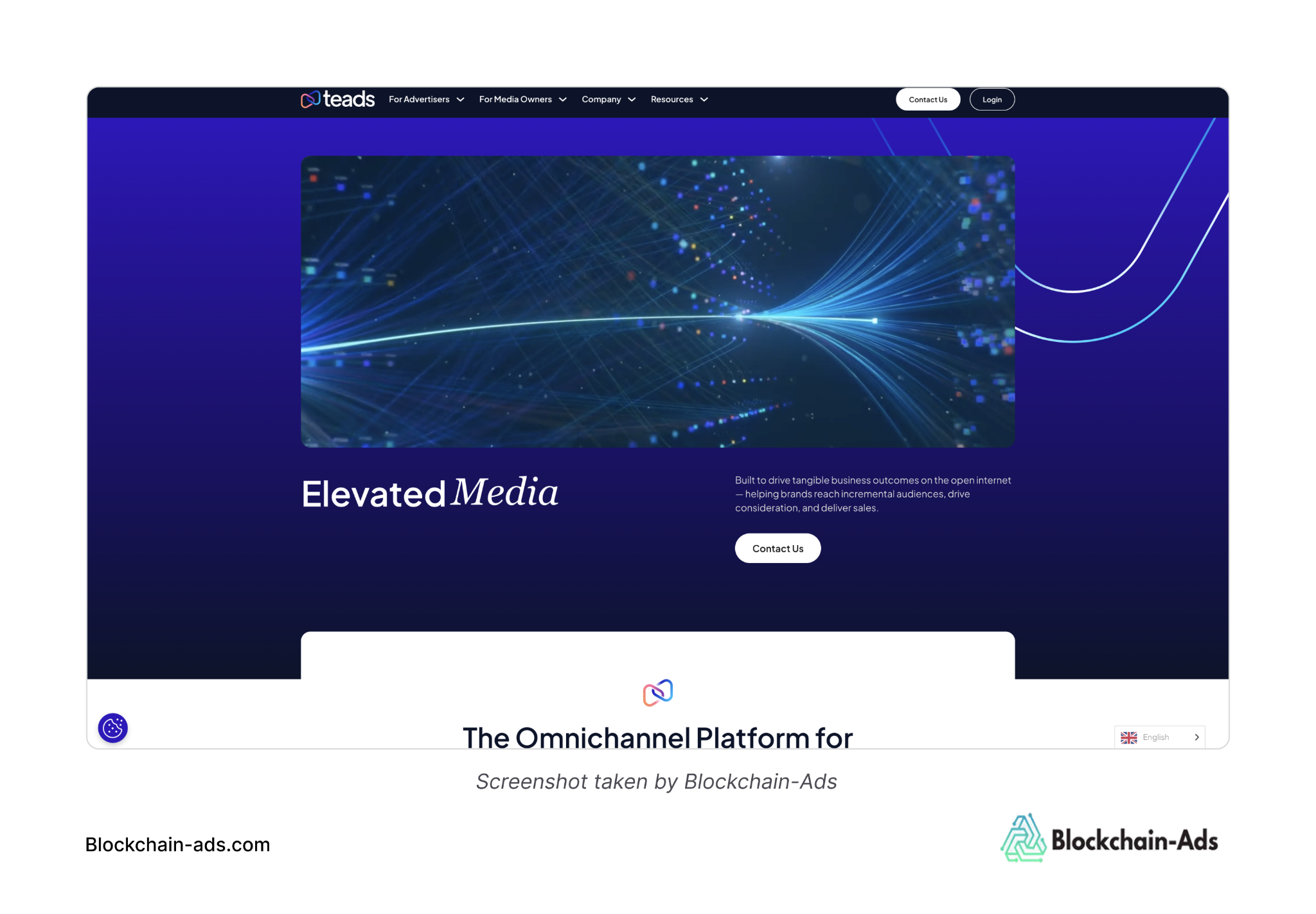
Teads combines Outbrain's content recommendation inventory with premium editorial in-feed, in-article, and native video placements. You can buy through direct, managed, or programmatic channels and use contextual, demographic, interest, and intent targeting.
Choose it when publisher environments and contextual fit matter as much as acquisition volume. Measurement and optimization tools support performance campaigns without limiting the product to recommendation widgets.
Limitations: Certain crypto exchanges may qualify, but ICOs and token sales face restrictions. Gambling and financial products require country- and product-specific checks. There is no verified universal minimum spend; confirm terms and approval before planning.
Score: 3.90/5. Publishers 5 | Targeting 4 | Formats 5 | Measurement 4 | Pricing 3 | Verticals 2.
MGID
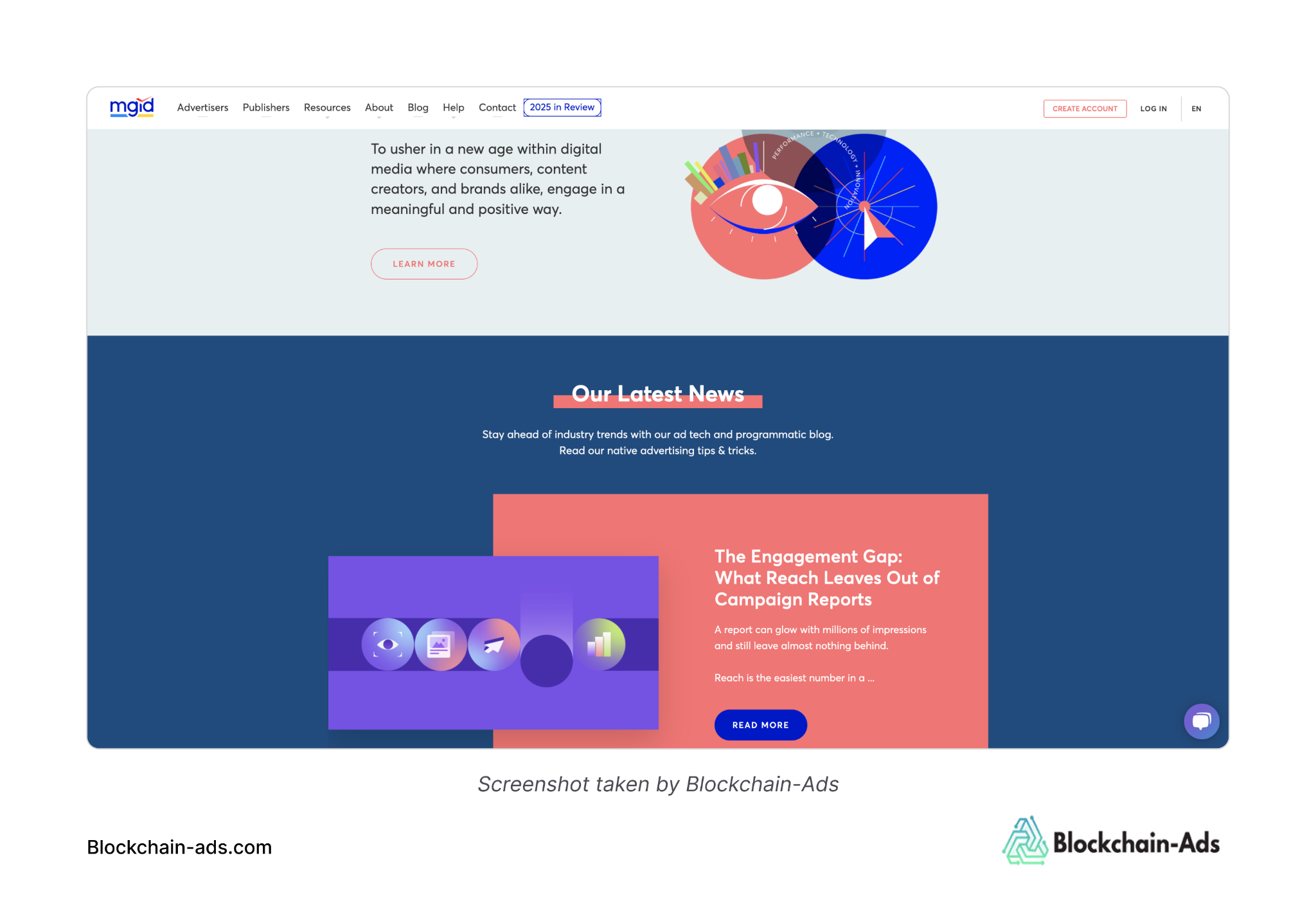
MGID provides self-serve CPC buying across recommendation widgets and native content placements. You can select geographies, devices, and audiences, then adjust bids or exclude individual widgets. Pixel, Google Tag Manager, and server-to-server tracking support conversion optimization.
Its $100 minimum deposit suits smaller accounts, although MGID recommends at least $650 for initial testing. The platform works best when you can compare offers and creatives across traffic sources.
Limitations: Crypto, gambling, and finance are restricted categories with licensing, disclosure, and regional requirements. A low deposit doesn’t guarantee enough conversions to judge performance.
Score: 3.65/5. Publishers 3 | Targeting 4 | Formats 3 | Measurement 4 | Pricing 5 | Verticals 3.
Revcontent
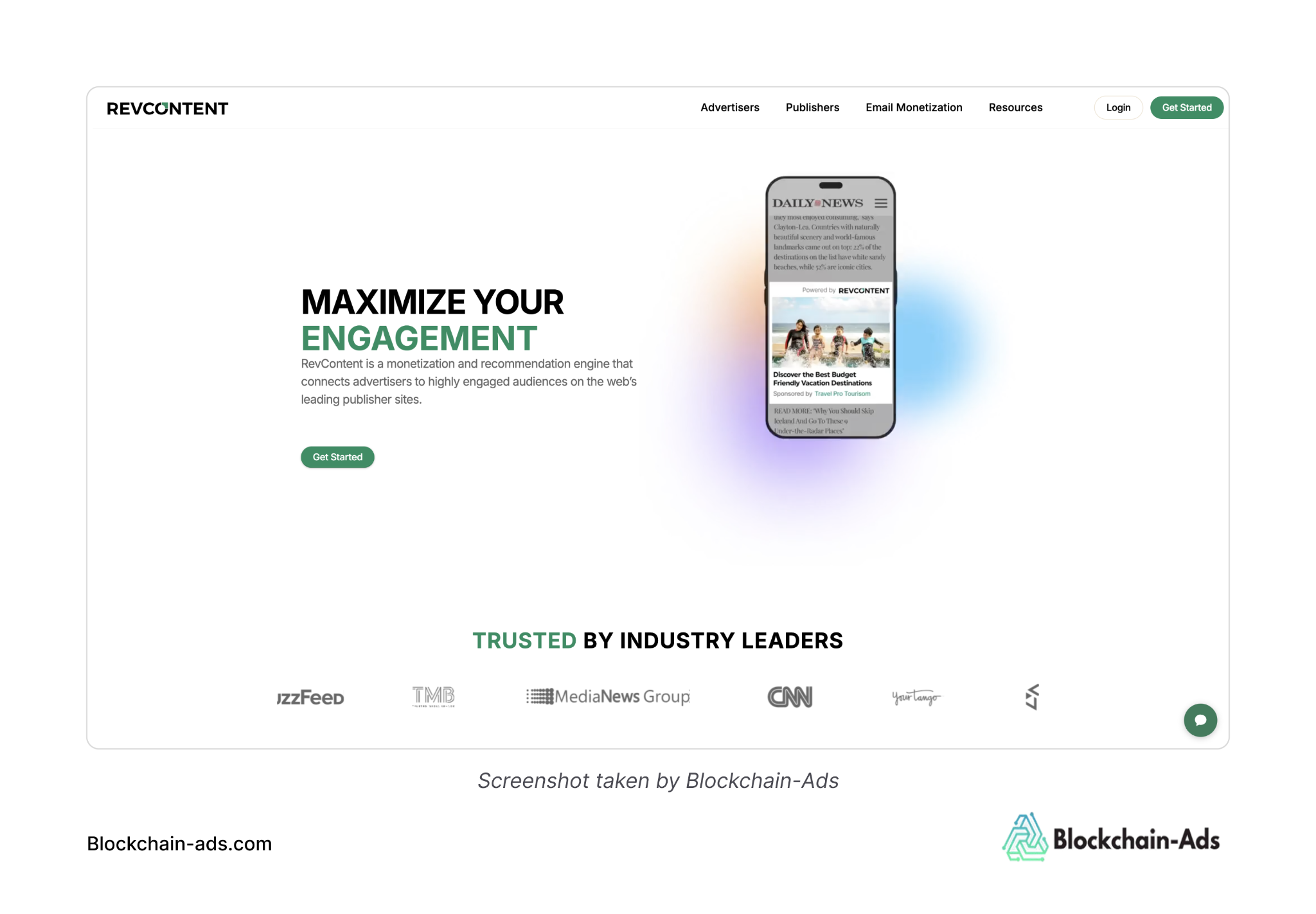
Revcontent provides native recommendation placements with self-serve buying and account support. CPC and viewable CPM (vCPM) options sit alongside geographic, device, language, and widget targeting. You can adjust bids, block placements, and measure conversions through pixels or server-to-server postbacks.
Revcontent lists no minimum deposit, but each campaign needs a daily budget of at least $50.
Limitations: Licensed crypto, gambling, and financial offers face geographic and disclosure requirements; ICOs, token sales, and misleading investment claims are prohibited. Placement optimization demands active monitoring, and conventional visitor retargeting isn't available.
Score: 3.45/5. Publishers 3 | Targeting 3 | Formats 3 | Measurement 3 | Pricing 5 | Verticals 4.
Life360 Ads (Formerly Nativo)
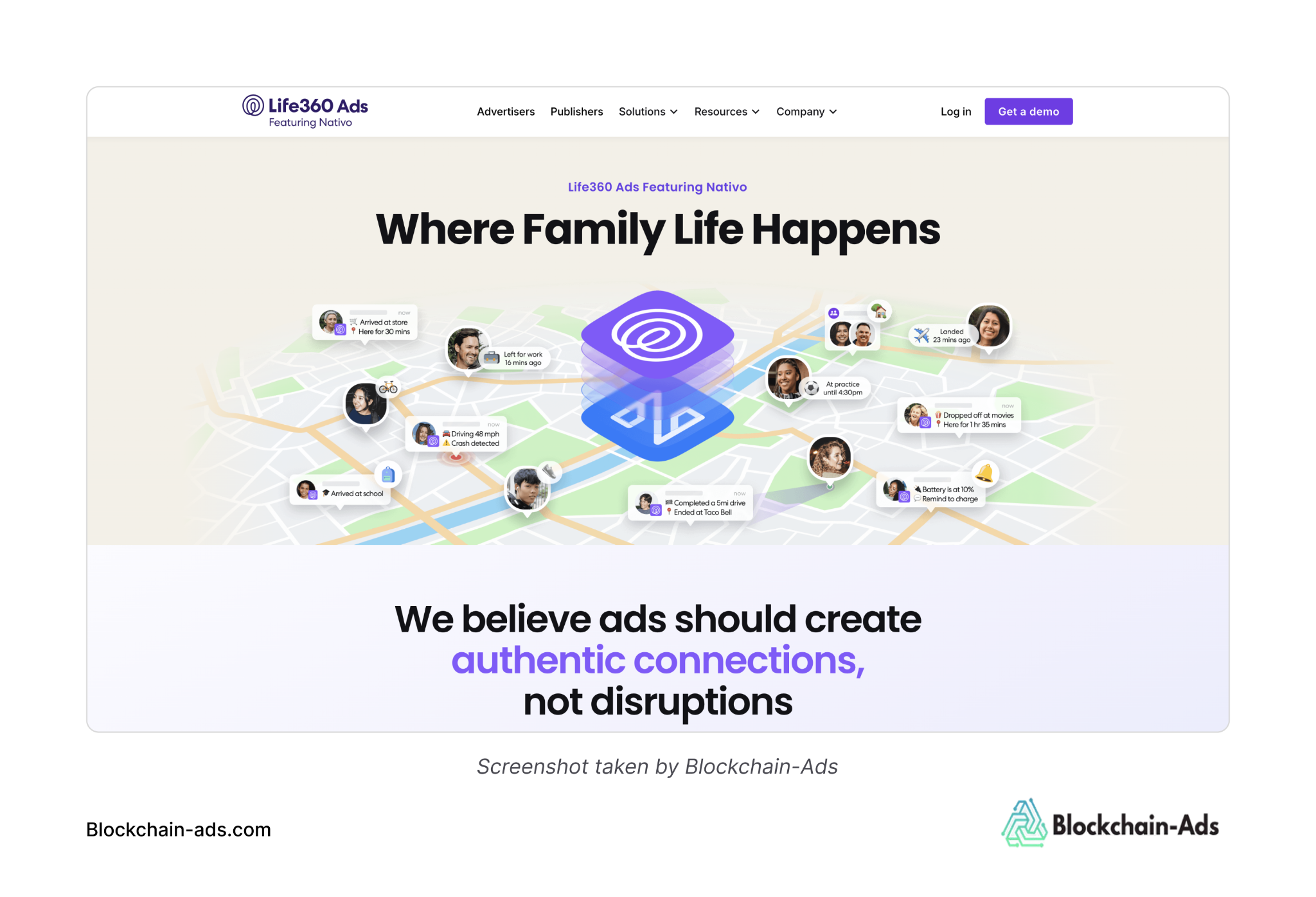
Life360 acquired Nativo in January 2026, adding premium native articles, in-feed display, native video, and mobile-first stories to its advertising business. Buying options include self-serve, managed, and programmatic.
Targeting on this platform combines contextual, geographic, and behavioral signals. Conversion tracking and optimization serve both content engagement and acquisition campaigns. Self-service native has no minimum spend, making entry more flexible than some premium alternatives.
Limitations: Life360 Ads identifies financial services and investment-related advertiser categories, but its public policies don't confirm general approval for crypto exchanges or iGaming operators. Check product eligibility and publisher restrictions before launching.
Score: 4.35/5. Publishers 5 | Targeting 4 | Formats 5 | Measurement 4 | Pricing 5 | Verticals 3.
Microsoft Audience Network
Microsoft Audience Network extends self-serve advertising into native placements on MSN, Edge, Outlook, and publisher partners. Search-intent, browsing, demographic, and contextual signals support targeting, while Universal Event Tracking (UET) measures conversions.
It is a natural extension for teams already using Microsoft Advertising. Content and property targeting can help keep placements aligned with the audience you're trying to acquire.
Limitations: Crypto exchanges and gambling operators require approval in eligible markets, and financial products face additional rules. There is no publicly stated universal native minimum deposit, and you can set campaign budgets.
Score: 3.85/5. Publishers 4 | Targeting 4 | Formats 3 | Measurement 5 | Pricing 4 | Verticals 3.
MediaGo
MediaGo's DSP offers self-serve CPC native buying and automated optimization. Image-and-headline ads run on publisher websites and mobile environments, with targeting by geography, language, device, browser, operating system, and content category.
Conversion-based optimization, publisher exclusions, and pixel or postback reporting help performance teams refine delivery. Its API documents a $20 minimum daily campaign budget, which isn't the same as a confirmed account deposit.
Limitations: Public policies don't clearly establish crypto, gambling, or financial-ad eligibility. Confirm approval before funding and monitor publisher performance closely.
Score: 3.50/5. Publishers 3 | Targeting 4 | Formats 3 | Measurement 4 | Pricing 5 | Verticals 2.
The Best Native Ad Network for Each Use Case
The best native ad networks depend on what you're advertising, where you want to appear, and how much you can spend.
The best native ad networks for advertisers aren't always the highest-scoring overall. An otherwise strong option may not approve your product or support a viable test at your budget.
What a Native Advertising Platform Does
What is a native advertising platform? It's a tool for placing sponsored content on websites, feeds, or apps using layouts that match surrounding content.
Native advertising networks connect buyers to publisher inventory and handle bidding, targeting, and reporting. Native content distribution can include sponsored links, articles, images, or videos.
Unlike display banners, these placements blend into the publisher layout, so ensure that you compare native ads vs. display ads, especially for creative requirements and placement selection.
Native Ad Formats: In-Feed, Widgets, Video, and In-App
Native ad formats are defined largely by placement:
- In-feed: Sponsored posts among articles or feed items.
- Recommendation widgets: Sponsored links beside or below related content.
- In-article: Ads embedded within editorial pages.
- Native video advertising: Video integrated into feeds or articles.
- Native in-app advertising: Ads adapted to an app's content interface.
Teads and Life360 Ads offer native video alongside their content placements. MGID and Microsoft also offer video advertising, although availability within native inventory depends on the format and campaign setup. Blockchain-Ads’ native inventory covers in-feed, in-article, and recommendation-widget formats, and video runs as a separate channel.
For in-app advertising, Blockchain-Ads documents native in-app inventory, while Teads and Life360 Ads offer mobile advertising options. Microsoft also runs native placements within properties such as Outlook. Check each platform's inventory specifications before assuming that all mobile or video placements qualify as native.
Native Ad Networks vs. Programmatic Native
A native ad exchange automates inventory transactions between buyers and sellers, while a network packages placements and campaign tools for advertisers. Programmatic native buying uses a DSP to bid across eligible inventory instead of relying solely on one network's publisher relationships.
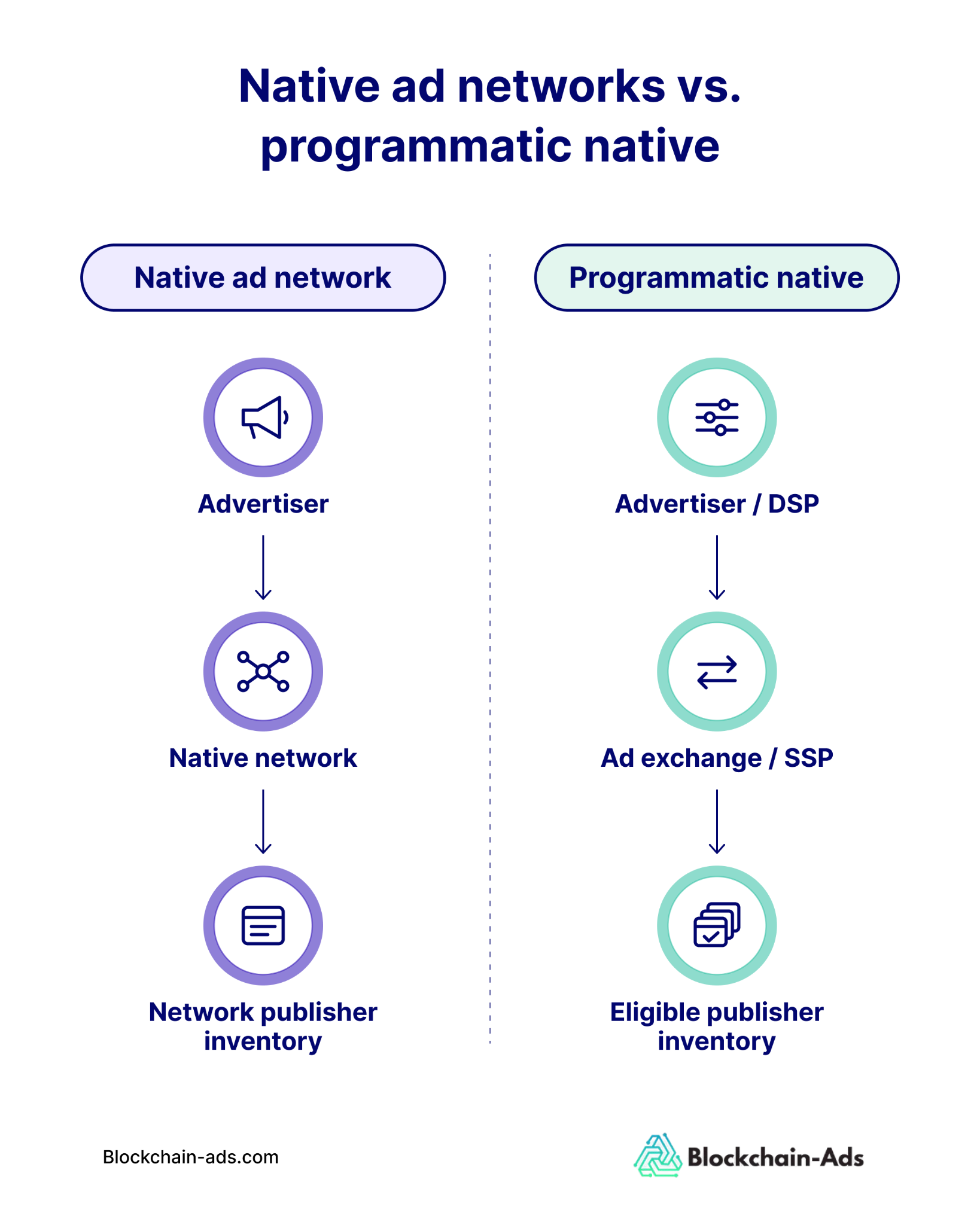
Supply-side platforms and technologies such as TripleLift and Sharethrough make native inventory available to programmatic buyers. Some native advertising software also combines network inventory with DSP-style buying. Compare actual inventory access, audience controls, and placement transparency rather than choosing based on the platform's label.
How to Buy Native Ads
To learn how to buy native ads online, start with platform eligibility and the conversion you want to measure. Then:
- Check approval: Confirm product, country, and licensing rules before funding.
- Set an objective: Choose a registration, purchase, deposit, or other conversion.
- Build audiences: Select geographies, devices, and contextual or behavioral signals.
- Prepare creatives: Match images, headlines, and landing pages to placement rules.
- Test tracking: Verify pixel or server-to-server conversion events.
- Fund and launch: Set bids, daily limits, and review submissions.
- Optimize: Use ad creative testing to identify which headlines and images drive conversions, then exclude weak placements.
When you buy native ads traffic for regulated products, complete policy checks before preparing a full native advertising campaign.
What Native Ads Cost and How They're Priced
Native advertising cost depends on the bidding model, target market, industry, audience competition, and publisher placement. Most platforms offer CPC pricing, while some also support CPM or viewable CPM buying.
The main native advertising pricing models are:
- CPC (cost per click): You pay when someone clicks your ad. This suits campaigns focused on driving visits to a landing page.
- CPM (cost per thousand impressions): You pay per thousand impressions, making it useful when exposure and reach are your primary goals.
- vCPM (viewable CPM): You pay based on viewable impressions rather than all served impressions, where the platform supports this model.
The same native campaign can cost differently across verticals, geographies (GEOs), and placements. Competitive finance audiences may attract higher bids than broader consumer audiences, while premium editorial inventory can cost more than general recommendation widgets. Narrow targeting can also increase competition for eligible impressions.
Minimum funding requirements are separate from CPC or CPM rates:
- MGID requires a $100 initial deposit.
- MediaGo's API specifies a $20 daily minimum.
- Revcontent documents a $50 daily campaign minimum.
- Blockchain-Ads requires $10,000 to activate an account and at least $360 in daily campaign spending.
Your native ads budget should cover more than account activation. Build a paid media budget that funds creative tests, placement evaluation, and enough conversions to decide whether to scale.
FAQs
What happened to Outbrain?
Outbrain acquired Teads in February 2025, and the combined company adopted the Teads name in June 2025. Advertisers looking for Outbrain's native advertising products should now evaluate Teads, which combines content recommendation inventory with other native and video formats.
What happened to Yahoo Gemini?
Yahoo shut down Gemini, its native advertising platform, in 2023 and moved its native inventory to Taboola under a long-term partnership. By October 2023, advertisers could access Yahoo's native placements through Taboola.
How much does native advertising cost?
The answer to how much native advertising costs depends on your pricing model, targeting, and platform requirements. MGID has a $100 minimum deposit, Revcontent requires at least $50 in daily campaign budget, and Blockchain-Ads requires a $10,000 account deposit and $360 daily minimum.
Which native ad networks accept crypto and gambling ads?
Blockchain-Ads explicitly supports crypto and iGaming advertisers, while Revcontent, MGID, Teads, and Microsoft permit certain regulated campaigns under specific conditions. Confirm whether your product, licenses, landing page, and target countries meet the network's requirements. For example, permission to advertise cryptocurrency exchanges doesn't necessarily extend to token sales or other crypto products.
Which native advertising platform is best for small budgets?
MGID is a practical starting point because its minimum deposit is $100, although it recommends at least $650 for testing. Revcontent is another option, with a $50 minimum daily campaign budget.
Can you run native ads aligned with search terms?
Yes, some native platforms use search-intent signals to reach relevant audiences. For example, Microsoft Audience Network uses search activity and other behavioral signals to target audiences. However, native ads generally don't appear in response to an exact keyword search, so don't treat intent-based native targeting as equivalent to search advertising.
Are native ads better than Facebook ads?
The native ads vs. Facebook ads decision depends on your audience and campaign objective. Native advertising appears within publisher content, while Facebook Ads primarily reach people within Meta's social environment. Compare conversion quality, acquisition costs, creative requirements, and advertising eligibility through controlled tests rather than assuming one channel will perform better.
Is there a complete list of native ad networks?
No single list of native ad networks is permanently complete because advertising products, partnerships, and buying models change. Start with platforms that support your industry, budget, and required formats, then verify their current offerings before adding them to your media plan.
Choose a Native Advertising Platform You Can Scale With
Shortlist two eligible platforms and calculate the test spend needed to produce meaningful conversion data. Agree on your acceptable acquisition cost, tracking setup, and a clear rule for scaling or stopping before launch.
For crypto, iGaming, or finance campaigns, request access to Blockchain-Ads to review eligible native inventory, available audiences, and the tracking setup you need to measure customer acquisition.
Raphael is a B2B SaaS and technical SEO writer covering digital advertising, Web3, fintech, and growth strategy.
View full profile →