
Is Cookieless Advertising Still the Future? What Works Now
Key takeaways
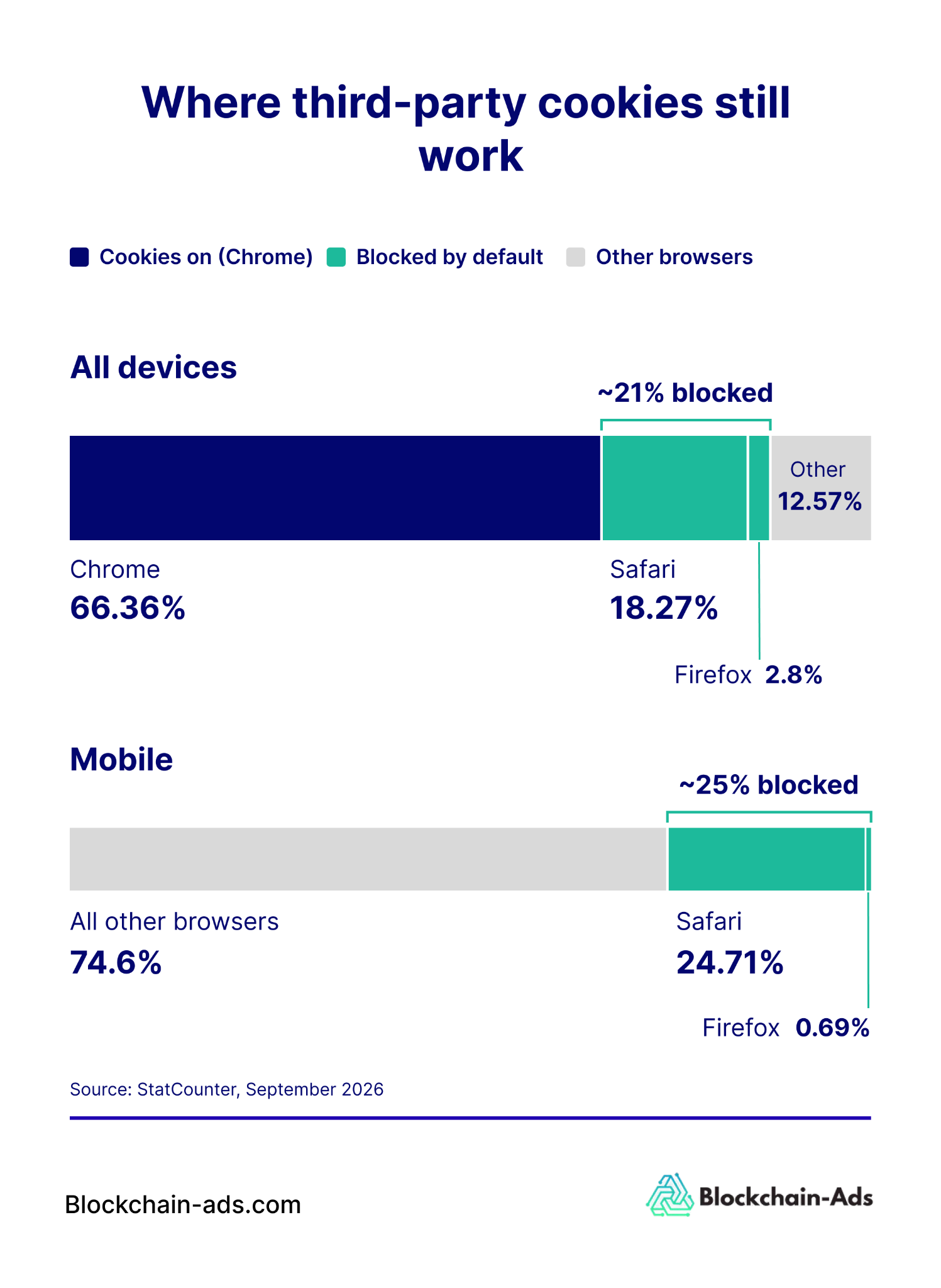
- Chrome kept third-party cookies, and Google retired the Privacy Sandbox, but Safari (18.27%) and Firefox (2.8%) already block those cookies by default, covering about 21% of global browser traffic and about 25% on mobile. Cookieless traffic is part of every campaign today.
- Contextual targeting, behavioral targeting, first-party data, and on-chain data are audience signals that never depended on third-party cookies.
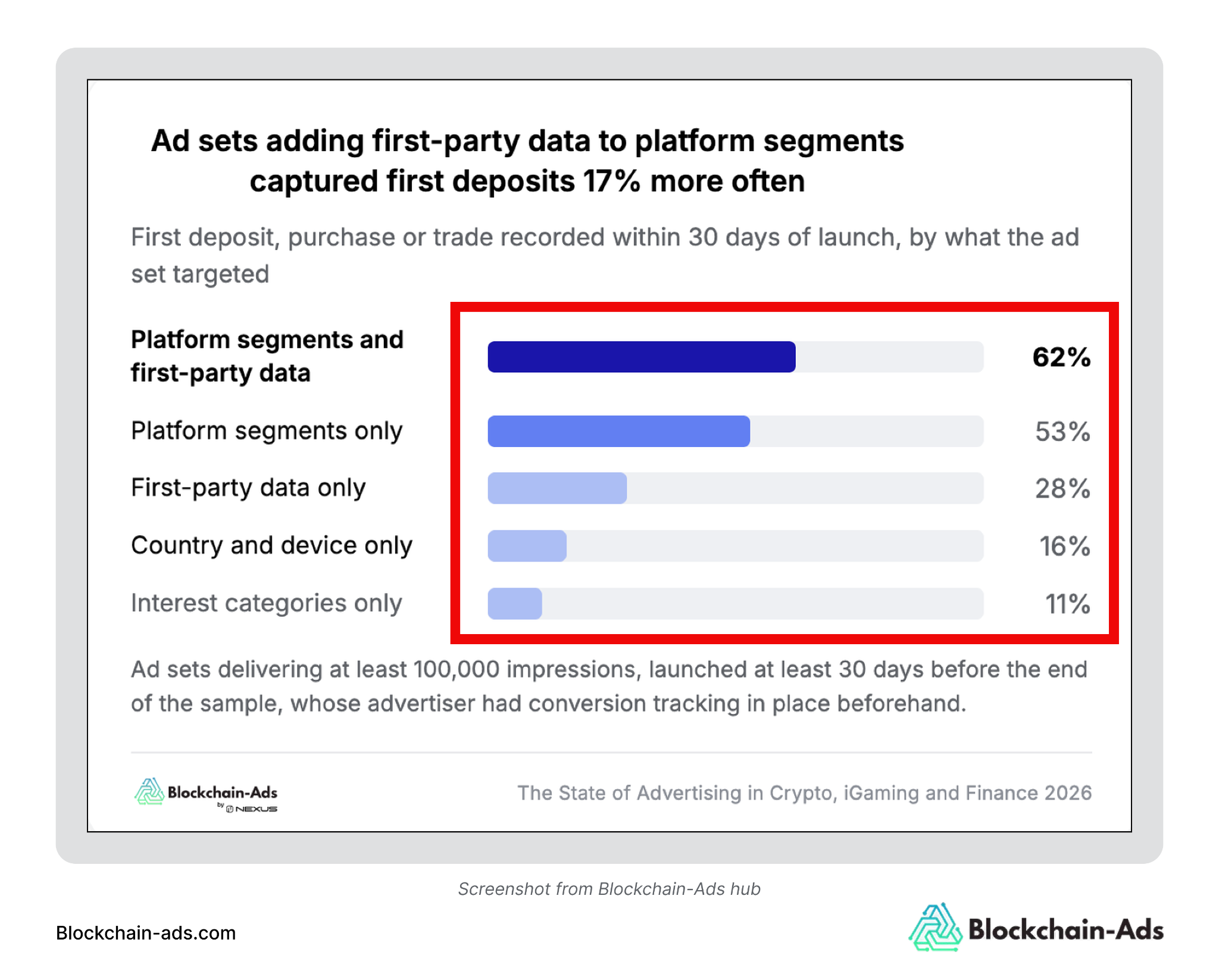
- Per The State of Advertising in Crypto, iGaming and Finance 2026, ad sets using platform audience segments recorded a first deposit, purchase, or trade 53% of the time, against 16% for country-and-device targeting.
- Measure conversions on tags you control, then test one cookie-independent audience against your current baseline on the same conversion event.
Chrome is keeping third-party cookies, and Google has retired the Privacy Sandbox tools built to replace them. Because Chrome carries about two-thirds of the world's browser traffic, many advertisers took that as the end of cookieless advertising.
However, the rest of the web tells a different story. Safari and Firefox both block third-party cookies by default, and together they carry about 21% of global browser traffic and about 25% on mobile. If your campaigns rely on those cookies, part of your audience is already undercounted, and your budget is quietly shifting away from it.
So what works now? The answer is to build audiences and measurement on signals that never needed third-party cookies, such as page content, on-site behavior, your own customer data, and on-chain activity.
This guide covers what changed in Chrome, where the cookie gap shows up in your data, which targeting methods work without third-party cookies, and what 2026 campaign data says about the results.
What Happened to Google’s Cookie Deadline?
In July 2024, Google dropped its plan to remove third-party cookies from Chrome and proposed a prompt that would let users choose instead. In April 2025, Google confirmed that Chrome would keep third-party cookies as they are, with no user-choice prompt and no removal date.
The replacement changed too. The Privacy Sandbox was Google's set of browser tools for targeting and measuring ads without third-party cookies.
On October 17, 2025, Google announced it would retire them, including
- Topics (interest-based targeting)
- Protected Audience (retargeting)
- Attribution Reporting (conversion measurement)
and seven others. Google said low adoption and feedback on the tools' expected value drove the decision.
For advertisers, this means rethinking any strategy that counted on the Privacy Sandbox replacing third-party cookies, because that plan is no longer moving forward. What Google retired was one way of doing cookieless advertising, built into the browser. The methods that remain run outside it, on page content, your own data, and on-chain activity.
Why Cookie-Based Audiences Are Already Lopsided
When third-party cookies are blocked, platforms lose the data that connects a person’s activity across sites. First-party cookies still work, but conversions that depend on cross-site tracking can go unrecorded, and the people behind them drop out of the data campaigns optimize on.
Mobile shows this most clearly, because Safari is the default browser on every iPhone. Say a campaign gets equal traffic from iPhone and Android users, and Safari stops some iPhone conversions from being recorded. Android then looks stronger than it really is. The optimization model learns only from recorded conversions, so budget drifts toward Android and away from iPhone depositors.
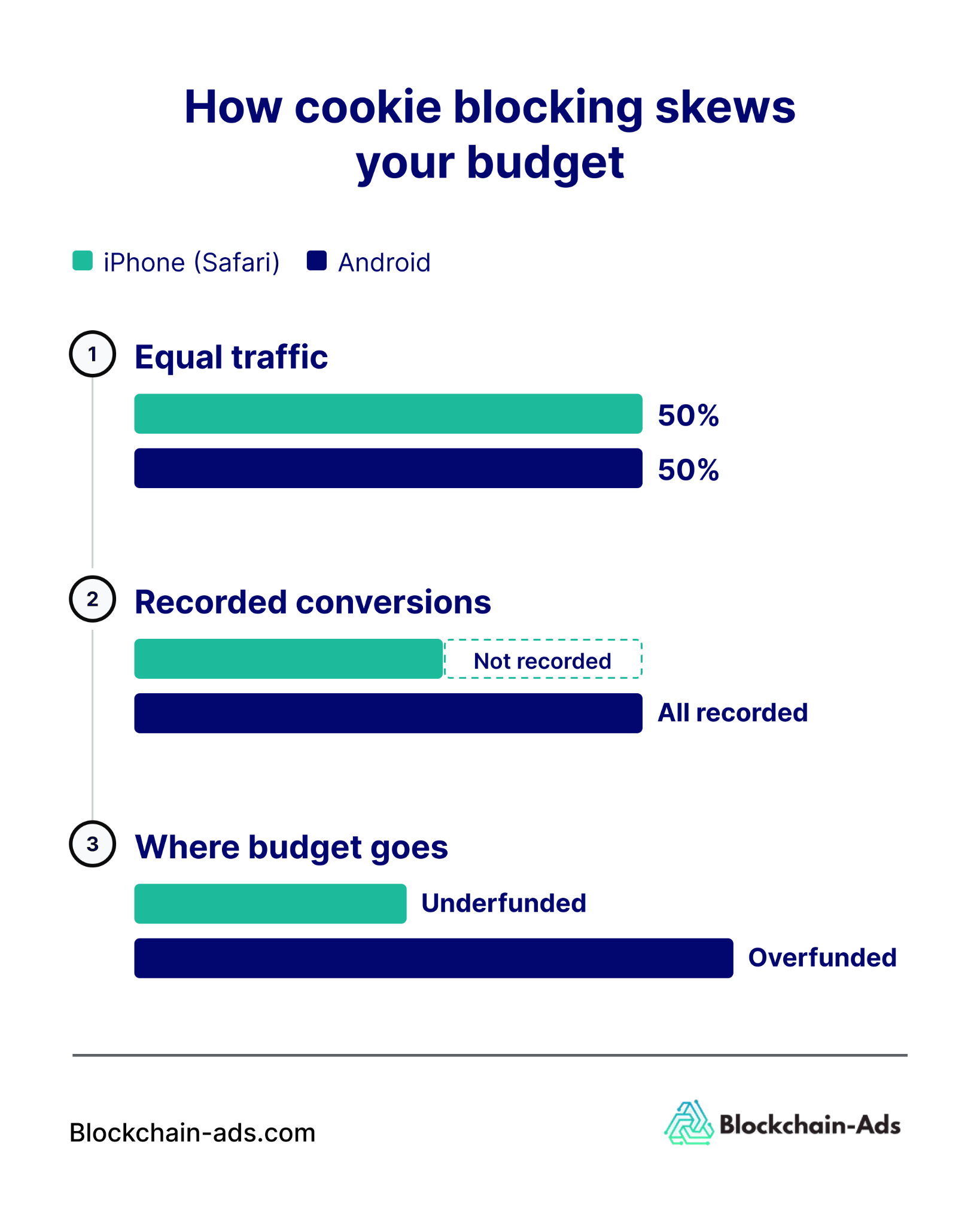
Cookie-independent signals close that gap by giving campaigns another way to identify and reach those people.
Four Cookieless Targeting Methods
Cookieless targeting means reaching and grouping audiences without relying on third-party cookies to identify or follow them across websites. The signal comes from something else, such as the content someone is viewing, the actions they take, data you collect directly, or their public blockchain activity.
Here’s how the four main methods compare:
Contextual Targeting
Contextual targeting places ads based on the content of the page or app where they appear. The page supplies the signal, so it works on every browser.
A sportsbook, for instance, can run ads beside match previews and team news. The same principle applies beyond the obvious topics: a crypto exchange may find its traders reading about interest rates, inflation, and market news, not just crypto coverage. To make it work, map the topics your customers read in the days before they convert.
The strength of contextual targeting is coverage. It can reach relevant environments even when the advertiser has never met the visitor. The tradeoff is that the page tells you very little about who that visitor is or what they have done before.
Behavioral Targeting
Behavioral targeting builds audiences from what people do on sites and pages, such as the content they read, the pages they return to, and the actions they complete.
Imagine a prospect who keeps reading exchange comparisons and fee breakdowns across different sites. Those actions reveal more about their intent than any demographic label could. Actions closer to a deposit carry more weight, so a fee page visit or a return visit within a week signals more intent than a single blog read.
The more relevant actions a person takes, the clearer the intent signal becomes. You can then group people who show similar behaviors and tailor campaigns to where they are in the buying process.
On Blockchain-Ads, behavioral and intent segments sit on top of the Interest Graph, which is built from the platform's own on-site behavioral signals, more than 4 billion a day, covering the articles people read, the topics they explore, and the content they engage with. Identifiers reach the platform only as one-way hashes and are matched to anonymous IDs in its identity graph, so the site showing the ad never sees an email or wallet address.
First-Party Data
First-party data is information you collect directly from your own audience. It includes pixel events, customer lists, sign-ups, and deposits.
Its value comes from showing what people actually do with your business. Someone who starts a sign-up, completes verification, and returns a few days later has shown more intent than someone who visits once and leaves. You can use these signals to build audiences, exclude existing customers, re-engage people who dropped off, or group users by actions linked to your conversion goal.
However, your first-party data only covers people who have already interacted with your business, so it cannot replace prospecting on its own. It works best alongside signals that help you find new people with similar behaviors or interests.
On-Chain Data
On-chain data is the public record of what a crypto wallet does: its transactions, its holdings, and the decentralized apps (dApps) it uses. This makes it particularly relevant for crypto and fintech campaigns, where wallet activity shows what people own, use, and transact with. It can define an audience without relying on a browser cookie.
On Blockchain-Ads, Blockchain Behavior segments target users based on on-chain signals such as wallet activity, holdings, and transaction history, drawn from more than 11 million active wallets across 82 chains. When someone connects their wallet on a partner site, the wallet is linked to the same anonymous ID as their other hashed identifiers, so the ad reaches them without exposing the wallet address.
It matters most when the product or the conversion happens on-chain. If your audience doesn't transact on a blockchain, skip this one.
Each of these signals sounds reasonable on paper. The next section shows how audience segments and first-party data performed against the targeting most campaigns use by default.
What the Numbers Say About Audience Signals
Our State of Advertising in Crypto, iGaming, and Finance 2026 provides one set of evidence, covering more than 200 advertisers, about 1,400 ad sets, and 1.4 billion impressions from Q1 2024 through Q2 2026. The report covers crypto, iGaming, and finance, and its findings show correlation rather than cause.
The report measures platform audience segments, meaning the pre-built audiences on Blockchain-Ads, such as Interest Graph and Blockchain Behavior segments, along with first-party data and conversion tracking. Industry research fills in first-party data adoption and contextual targeting. Here are seven numbers, five from the report and two from industry research:
- Audience segments beat location and device: Ad sets targeted with platform audience segments recorded a first deposit, purchase, or trade within 30 days 53% of the time, against 16% for ad sets targeted by country and device alone. Segments built on what people do reveal intent that location and device data miss.
- Specific segments beat broad interests: The same segments recorded a first deposit, purchase, or trade almost five times as often as ad sets targeted by broad interest categories alone, which managed 11%. Narrow behavioral signals give campaigns a clearer indication of intent.
- First-party data can strengthen audience performance: Ad sets combining platform segments with first-party data captured a first deposit 17% more often than platform segments alone, at 62% versus 53%. Your own customer data can add context that broader audience signals miss.
- Conversion tracking matters as much as audience selection: Advertisers that set up conversion tracking before launch captured a first deposit or trade 92% more often than those that added it afterward. A strong audience signal still needs reliable conversion data to guide optimization.
- More advertisers are measuring from day one: 54% of new advertisers set up conversion tracking before their first ad set in the first half of 2026, up from 26% in the second half of 2024. Measuring from launch is quickly becoming standard practice.
- First-party data is becoming more valuable: 71% of brands, agencies, and publishers were growing or planning to grow their first-party data. As third-party signals weaken, more advertisers are building audiences from data they collect directly.
- Contextual targeting remains a strong signal in privacy-sensitive markets: In half of U.S. privacy-regulated industries, contextual is the primary ad-targeting method. As access to user-level signals becomes more limited, the content around an ad provides a reliable targeting signal.
Three Checks to Run on Your Current Ad Campaigns
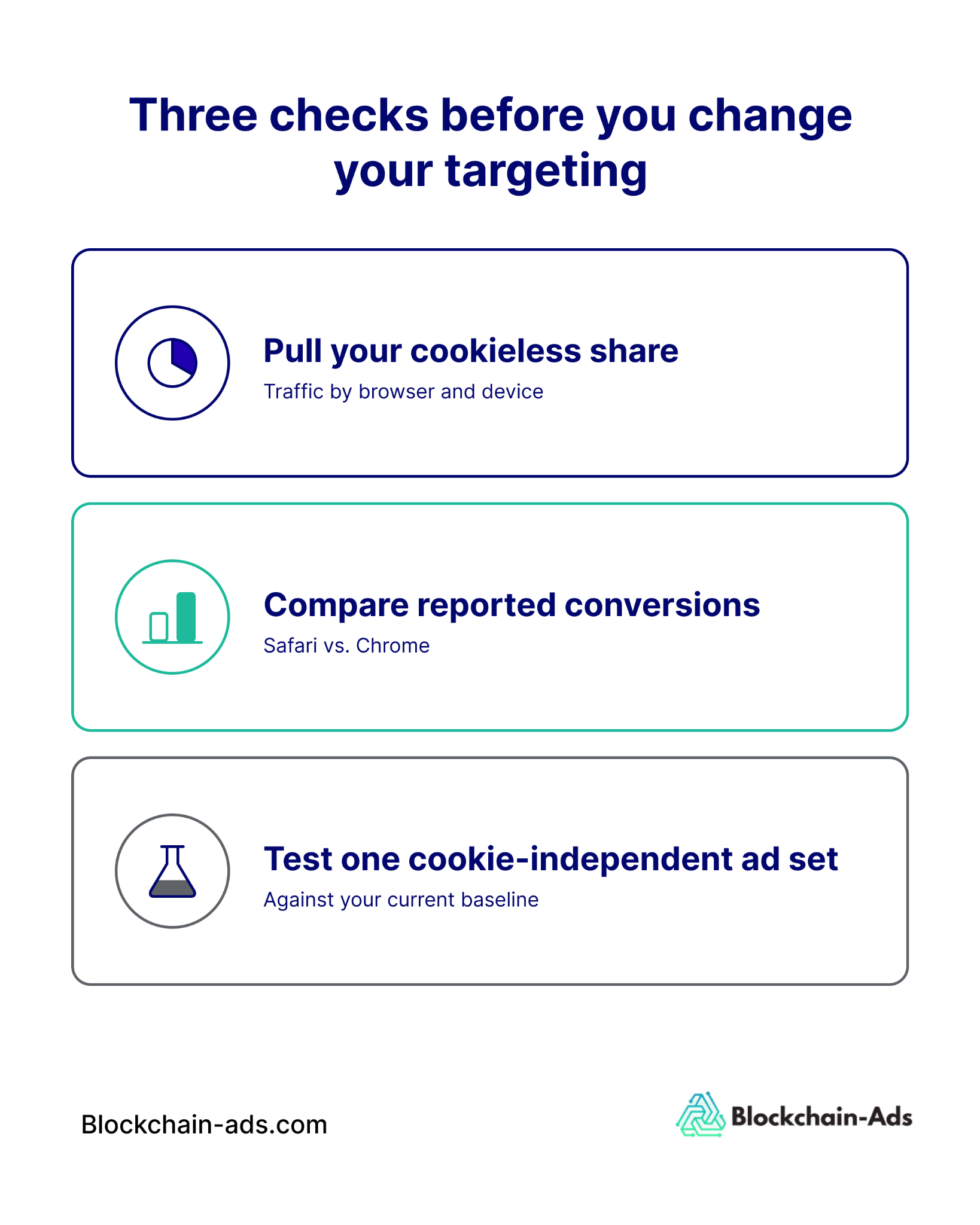
Before changing the targeting on your current campaigns, run these three checks:
- Pull your cookieless share: Break your traffic down by browser and device to see how much comes from environments that block third-party cookies by default. That number is the part of your audience your current setup may not see. Most analytics tools show this in a standard browser or device report, so the check takes minutes.
- Compare reported conversions on Safari against Chrome: If Safari reports fewer conversions but your traffic and backend deposits don't show the same gap, you have a reporting problem. Fix measurement before you move budget.
- Run one cookie-independent ad set against your current baseline: Keep the offer, creative, budget, and conversion event the same. Change only the audience, building it from contextual targeting, behavioral targeting, first-party data, or on-chain data.
How to Build Audiences Without Third-Party Cookies
A strong audience starts with knowing what you want that audience to do. Define the ideal conversion first, then choose the signals that can identify the people most likely to take that action. From there, layer in your own data, such as customer lists and the site activity your pixel records, and build a measurement path that does not depend on third-party cookies.
Start with the Conversion
Choose the conversion you want the campaign to optimize for, such as a funded account, first deposit, first trade, or first bet. Then set up tracking for that event before you launch the audience. In the State of Advertising report, 46% of advertisers who tracked from launch recorded a first deposit, purchase, or trade, against 24% of those who added tracking afterward. If you measure in the browser, install the pixel first so the platform has the event it needs to optimize and attribute.
Without a defined conversion, an audience test has no finish line, and you end up comparing clicks.
Choose Specific Segments over Broad Categories
Start with the behavior most closely tied to your conversion. If the goal is a first trade on an exchange, active crypto traders or users of rival exchanges are a sharper starting point than a broad finance interest. If the goal is a first deposit at a sportsbook, active sports bettors are a stronger bet than a general sports category.
Build a programmatic audience around that behavior and keep the definition specific enough to mean something. At the same time, the audience needs enough people to deliver impressions and support a fair test. You can still use country and device as filters, but the behavior should do the targeting work.
Add Your First-Party Data
Layer your own data onto the behavioral audience to include people you already know or exclude people you no longer need to reach.
Start with exclusions. For example, remove funded accounts from acquisition campaigns, separate registered-but-unfunded users from new prospects, and exclude recent depositors from welcome-offer campaigns. Every impression that goes to someone who has already converted is an impression that cannot reach a new prospect.
Then build smaller audiences around useful actions. For instance, prospects who started a sign-up, passed verification without funding, or reached the deposit page can be treated differently from everyone who has visited the site.
Audience targeting on Blockchain-Ads lets you combine first-party audiences with other segments, so you can bring your customer data into prospecting without relying on a third-party cookie. You can upload a hashed customer list to the platform only as one-way hashes, so Blockchain-Ads never stores a plain email, device ID, or wallet address.
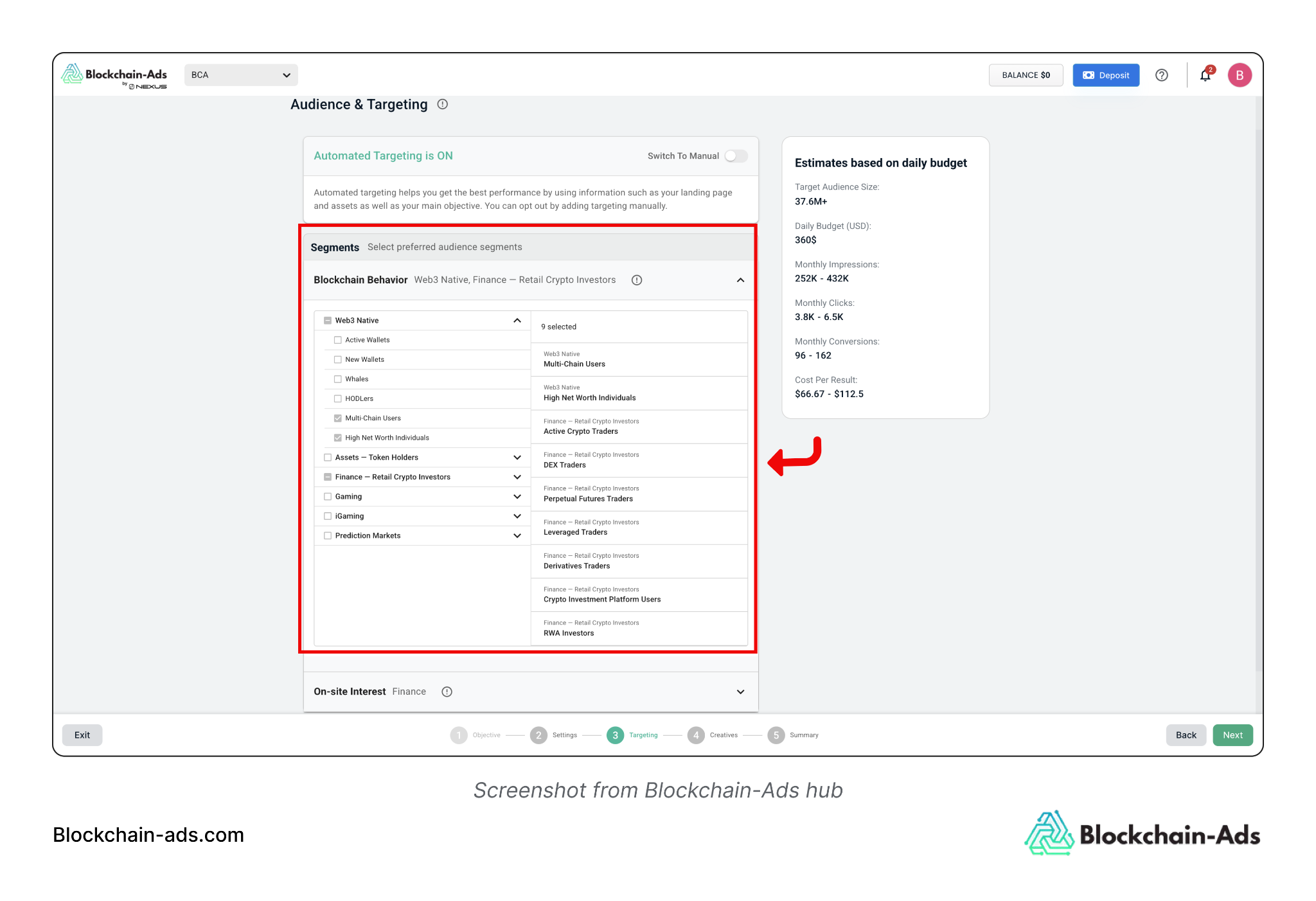
Choose the first-party list that matches the conversion you are trying to drive. A list built around one relevant action will usually give you a clearer audience than a list containing every site visitor.
Cookieless Retargeting
Cookieless retargeting builds re-engagement pools from impressions, clicks, and conversions recorded on the platform's own tags. On Blockchain-Ads, the tracking script hashes those signals in the visitor's browser before they reach the platform, and each hashed identifier is matched to an anonymous ID in its identity graph. When the next ad request comes in, the platform checks whether that anonymous ID belongs to your retargeting pool.
When those actions are recorded as separate signals, someone who reached your deposit page can get a different message from someone who read an introductory guide. The limit is pool size, because narrow definitions can leave too few people to keep ads delivering.
The strongest retargeting campaigns start from a well-built prospecting audience, because the pool is only as good as the people it first reached. Every one of these audiences also depends on conversion data the platform can actually see.
How to Measure Conversions Without Cookies
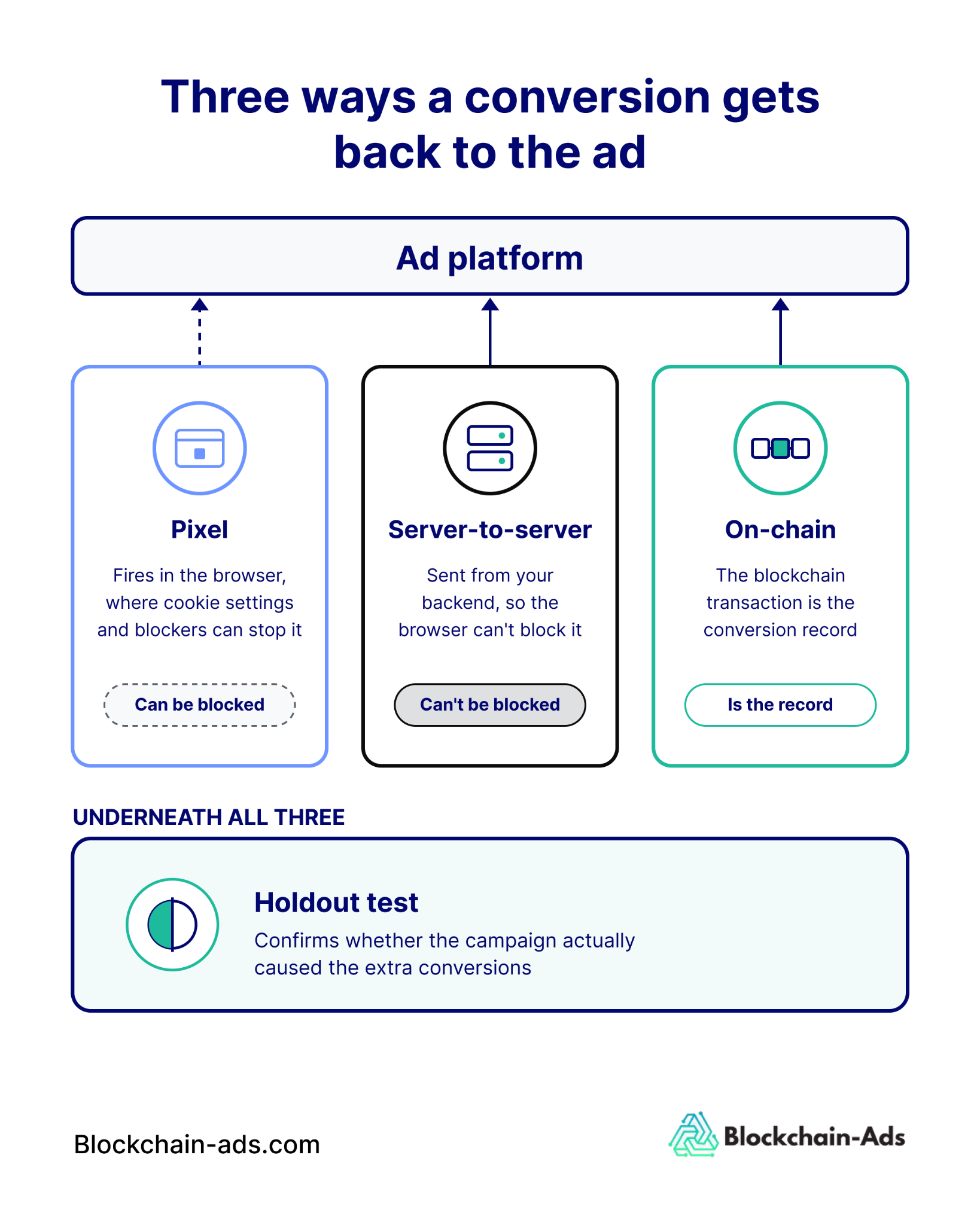
Measuring a cookieless campaign means giving conversions more than one way to get back to the ad that drove them. Browser tracking can miss events when cookies or scripts are blocked, so the measurement setup needs another path.
Start With Browser-Based Tracking
A pixel can connect an ad to a conversion when the browser allows the tracking script to run. When a blocker or browser setting prevents the script from firing, that conversion can go unrecorded.
Google's Attribution Reporting API was meant to provide another way to measure conversions without third-party cookies, but Google retired it with the rest of the Privacy Sandbox advertising tools.
Add Server-to-Server Tracking
Server-to-server tracking sends the conversion directly from your backend. The browser does not need to fire a script, so blockers and cookie settings do not decide whether the conversion reaches the platform.
This is useful for conversions that happen after the initial visit, such as a verified deposit, first trade, or first bet.
Use On-Chain Data When the Conversion Happens On-Chain
For crypto campaigns, the transaction itself can provide the conversion signal. On-chain attribution connects campaign activity to blockchain transactions without putting a browser cookie between the ad and the conversion. That gives you a conversion record outside the browser, which is most useful when the action you care about leaves a verifiable transaction on a supported blockchain.
Test Whether the Conversions Are Incremental
Tracking tells you which conversions were recorded. A holdout test tells you whether the campaign caused additional conversions.
Withhold the campaign from a comparable group and compare the same conversion event across both groups over the same period. If the exposed group converts more often, the difference shows the campaign's incremental effect.
Keep the holdout large enough to generate a reasonable number of conversions, and run the test through a full buying cycle. A one-week test will not tell you much when users typically take a month to fund an account.
With these measurement paths in place, every audience you test reports back on the same conversion event, so you can compare them fairly.
Where This Leaves Cookieless Advertising
Cookieless advertising is already part of every campaign, because campaigns cannot depend on a browser signal that is unavailable across part of the web. The answer is to build audiences around signals that remain accessible, from page content and user behavior to first-party and on-chain data.
With an advertising platform like Blockchain-Ads, you can combine these signals to reach specific audiences, build behavioral segments, retarget previous visitors, and measure conversions without relying on third-party cookies.
To ensure you’re maximizing your campaign's potential, book a verification call with our experts.
Frequently Asked Questions
Is Google Still Getting Rid of Third-Party Cookies?
For now, no. Chrome kept third-party cookies with no removal date, and Google retired the Privacy Sandbox tools meant to replace them. Safari and Firefox still block third-party cookies by default, though, so a share of every campaign's traffic is already cookieless. You still need audiences and measurement that work without them.
Does Contextual Targeting Work Without Cookies?
Yes. Contextual targeting reads the page, so it works on every browser without third-party cookies. That makes it a reliable way to reach new prospects in relevant environments. Its limit is that the page describes the topic rather than the reader, so pair it with behavioral or first-party signals for sharper targeting.
Can You Still Run Retargeting Without Third-Party Cookies?
Yes. Cookieless retargeting builds re-engagement pools from impressions, clicks, and conversions recorded on the ad platform's own tags, then matches visitors through hashed identifiers in the platform's identity graph. You can also tailor messages to recorded actions, such as a deposit page visit. The main limit is pool size, especially when the audience definition is narrow.
How Do You Measure Cookieless Ads?
Record conversions on tags you control: a pixel for on-site events, server-to-server tracking for conversions recorded in your backend, and on-chain events where relevant. Then run a holdout test to confirm the campaign added conversions. That gives your campaigns a measurement path that doesn't depend on browser cookies and a way to prove their results.
Freelance content writer/editor for B2B SaaS, AI, technology, partnerships brands.
View full profile →