In-House vs Agency for Paid Media: How to Decide
Key takeaways
- Pick your model using four signals: how steady your spend is, how many tests you run monthly, whether tracking is ready, and who reviews results weekly.
- Choose in-house: When spend has been steady for six months, a manager can challenge results, and paid acquisition is permanent work.
- Choose an agency: For launches, new channels, or seasonal pushes, someone in-house can set goals and hold it accountable.
- Choose managed service: When one platform drives most acquisition, your spend clears its minimum, and you need its specialists running campaigns.
Choosing between an in-house media buying team and an agency looks like a hiring decision. In practice, it decides who controls your budget, your tracking, and the tests that shape every campaign. A wrong choice can burn months of spending before anyone notices.
That matters even more for the crypto, iGaming, and finance industries. Whoever runs your ads has to understand the product, the audience, and each market's advertising rules before the first dollar goes out.
This guide compares the three ways to run paid media: an in-house team, an agency, and a platform's managed service. You'll see what each one costs, four questions that point to the right model, and what to set up before you spend.
Why this is a capability decision, not a staffing one
The in-house vs. agency debate usually comes down to control and cost. Both matter, but neither tells you whether your campaigns will improve after launch.
Running paid media is essentially turning business goals into daily decisions. Someone has to pick audiences, test creative, match landing pages to ads, define the conversion that counts, and move budget toward what works.
In regulated verticals, they also need to know which claims, markets, and formats each channel allows.
The work also continues long after launch, because offers change, creatives wear out, and tracking gets harder as data grows. The real question is who can make these decisions quickly and efficiently and produce results?
The three ways to run paid media
Each model puts the work in a different place. None is right for every business, so it helps to see what each one offers and know where they excel or fall short.
1. An in-house media buying team
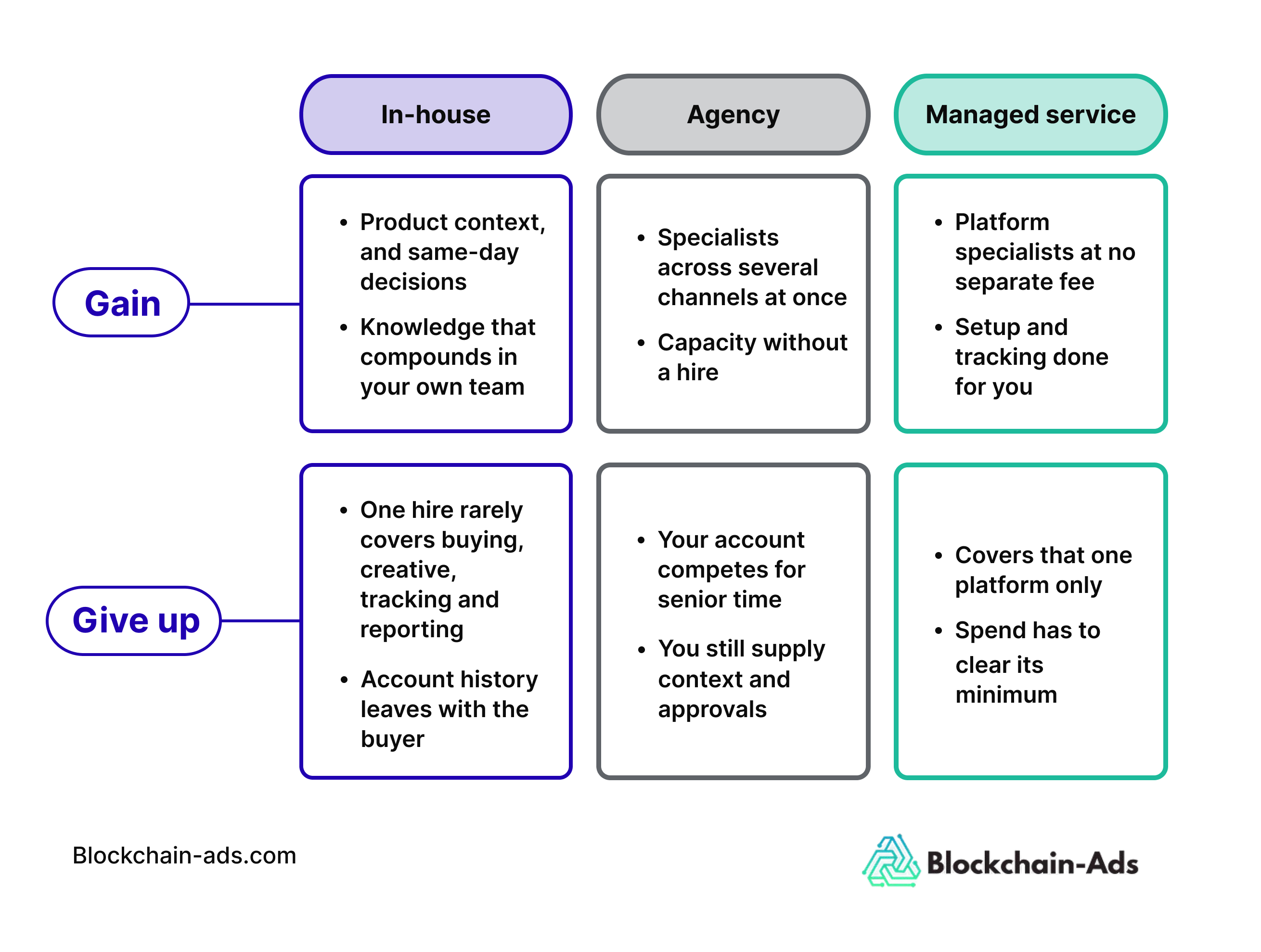
With an in-house team, you employ the people who plan, launch, and optimize your campaigns. They sit close to product, sales, and compliance, so they hear about changes first.
That closeness makes them fast: if a product issue appears on Monday, an internal buyer can pause or redirect spending the same day, without waiting on a handover.
The trade-off is scope, because one hire rarely covers campaign management, creative, tracking, landing pages, and reporting at once. Going in-house really means building a small team. It also carries key-person risk: when an experienced buyer leaves, the account history and testing lessons often leave too.
Best fit: paid acquisition is permanent work, and a manager can challenge the buyer's results and set clear priorities.
2. A paid media agency
An agency gives you an external team that runs campaigns for several clients. A good one brings specialists, a proven testing process, and experience with problems your team hasn't met yet.
Agencies are useful for a launch, a test on a new channel, or a period of fast growth. They give you specialist skills before you have the budget or time to hire for them.
The fee is only part of the cost, since someone inside your company still has to supply product context, approve offers, check reports, and hold the agency to its targets. The main risk is divided attention, as your account competes with other clients for senior time and creative resources.
External teams can deliver strong results when the goal is clear. On Blockchain-Ads, agencies running campaigns for OKX acquired 3,095 verified new traders at a $96.93 blended cost per acquisition (CPA) in two months. You can read how they did it in the OKX case study.
Best fit: you need specialist skills or extra capacity for a defined period, and someone in-house can hold the agency accountable.
3. A platform's managed service
With a managed service, the ad platform's own team runs your campaigns inside its product. They work with direct access to the platform's inventory, audience tools, and reporting.
This model fits when one specialist platform is central to your acquisition. It closes the gap between buying access to a platform and knowing how to get results from it.
On Blockchain-Ads, qualified accounts spending $30,000 or more a month get managed service at no additional fee. The team handles attribution setup, campaign structure and media plans, audience selection, creative production, and ongoing optimization. Our guide to self-service and managed service compares the two in detail.
The limit is reach, because a managed service covers only that platform and can't run your search or social campaigns. It also only helps if the platform reaches your audience and markets.
Best fit: one platform carries most of your acquisition, your spend clears its minimum, and you want its specialists running the day-to-day work.
What running paid media in-house actually requires
An in-house team works only when four foundations are in place. Without them, a new hire spends the first months building basics instead of acquiring customers.
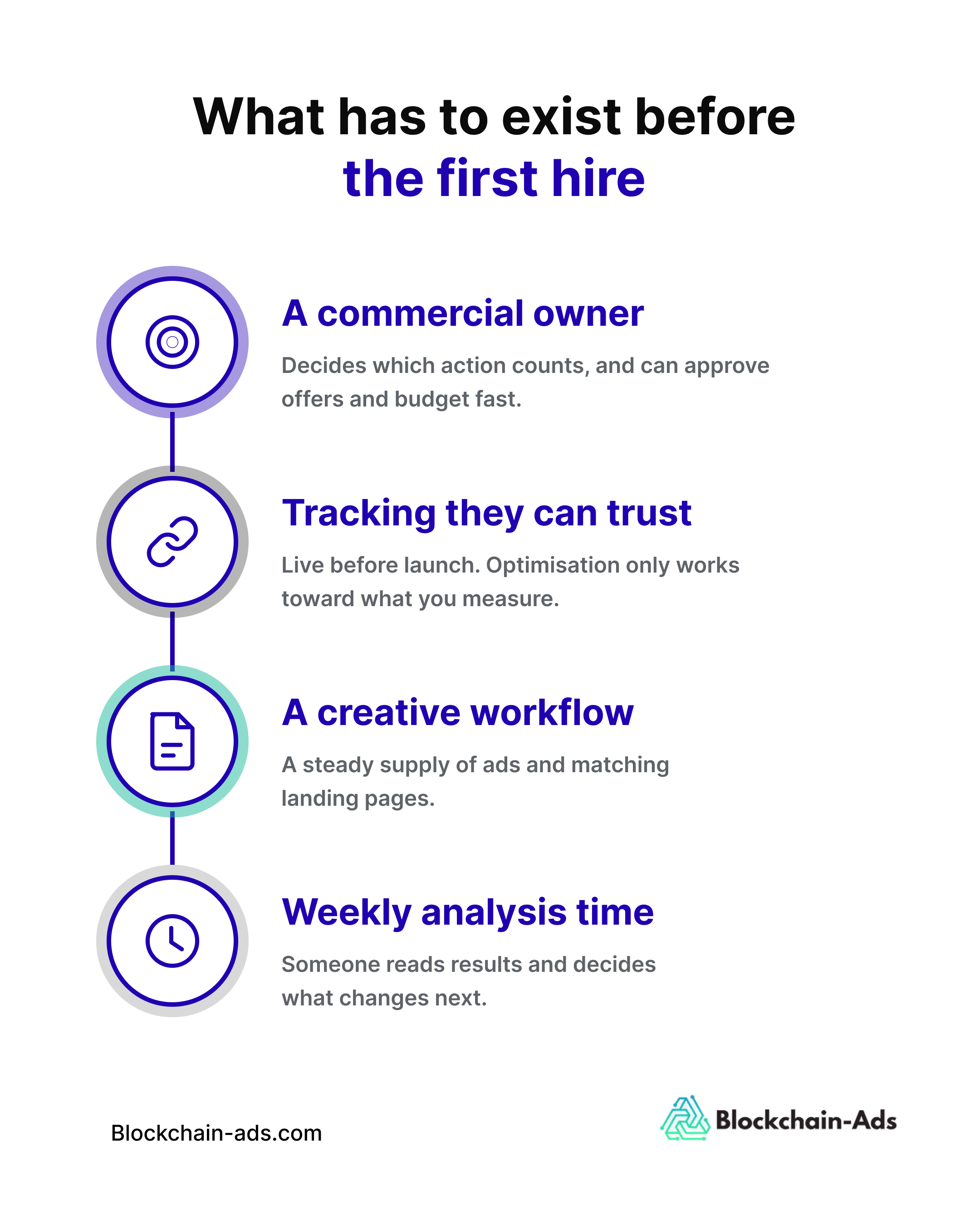
- A clear commercial owner: Someone must decide which action counts as success, whether that's a registration, a first deposit, a funded account, or a trade. They also need the authority to approve offers, landing pages, and budget changes quickly.
- Proper tracking the team can trust: Conversion tracking reports each conversion back to the ad platform back to the ad platform through a pixel on your site or a server-to-server connection. It needs to be live before launch, because optimization only works when it's aimed at an action you actually measure.
- A creative and landing-page workflow: Buyers need a steady supply of new ads, compliant claims, and landing pages that match each ad's message. Without that supply, they can only keep adjusting audiences around the same tired offer.
- Weekly analysis time: Someone has to read results every week and decide what changes next. A dashboard can show a cheap conversion, but it can't tell you whether that customer is worth anything.
If one of these is missing, you can still hire, but plan for a setup period. Treat the first few months as building capacity rather than buying results.
The four questions that settle the decision
Work through these four questions in order. Each one ends with a signal pointing to the model that fits, and the decision table afterward pulls your answers together.
1. Is your monthly spend steady enough to keep a full-time team busy?
Look at your last six months of spending, not just the current month. Steady spending gives an internal buyer enough work to learn your account and build on each test.
Uneven spending changes the math. When activity stops between launches or major events, a full-time specialist sits idle while an external team scales down with demand.
Then weigh your spend against the full cost of an in-house team, which the cost section below breaks down. At lower budgets, one buyer's salary can cost more than an agency's entire fee.
- Lean in-house if the spend has been steady for six months or more and you expect it to continue.
- Lean agency if the spend is seasonal, tied to launches, or likely to pause.
- Lean managed service if one platform carries most of your spend and you clear its minimum.
2. How many tests do you need to run each month?
Count the tests that lead to a decision, not the campaigns that simply stay live. A real test changes one thing: the audience, creative, landing page, bidding approach, or target country (often called the GEO).
The volume adds up quickly. In our State of Measured Acquisition 2026 report, advertisers who kept growing launched a median of five ad sets in their first month, each running about six days. They changed the creative in 93% of launches that kept the same audience. For a typical display program, that means about 20 new ads a month on one platform.
The pace paid off for advertisers tracking from launch. Of those who ran five or more ad sets in month one, 56% recorded a deposit or trade that month, against 30% of those who ran one. Multiply that workload by every channel and market you run, and remember that each test still needs setup, checks, reporting, and a decision.
- Lean in-house if one channel and a few markets keep testing within what your team can handle.
- Lean agency if you need to test several channels or specialist skills at the same time.
- Lean managed service if most testing happens on one platform and you need more hands than you have.
3. Is tracking ready before you spend more?
You can't manage paid media accurately if you can't see what happens after the click. Define the conversion that matters, such as a registration, first deposit, or funded account, before the buyer picks a campaign objective.
Tracking doesn't need to be perfect, but it does need to be in place early. In the same report, advertisers who tracked from their first ad set recorded a conversion on it 66% of the time. Those who added tracking later managed 29%. Early trackers were also nearly twice as likely to reach a deposit, purchase, or trade overall, at 46% against 24%.
If you're starting from zero, our help center shows you how to create a conversion and how to install server-to-server tracking.
- Lean in-house if your product and analytics teams can define conversions and give the buyer access to the data.
- Lean agency if you have a working tracking setup that's underused and a specialist could get more from it.
- Lean managed service if you need tracking set up for you. On Blockchain-Ads, the managed team installs and verifies it as part of the service.
4. Can someone inside the business review results every week?
This is the question most teams skip, yet every model needs a business owner who reviews results. That person asks why the CPA changed, why a segment scaled, and whether new customers are worth their cost.
They don't need to buy media themselves, but they do need enough commercial context to challenge reports, approve tests, and stop spending when results fall short.
Without this owner, an in-house buyer optimizes in isolation, and an agency reports into a vacuum. A managed service lightens the load because the platform team handles daily execution. It still needs you to set goals, approve changes, and share what customers do after they convert.
- Lean in-house if a marketing leader can work with the buyer directly and act on findings.
- Lean agency if your owner can challenge reports but has no time to manage daily execution.
- Lean managed service if your owner can set goals and approve changes while someone else runs operations.
In-house vs agency vs managed service: the decision table
Once you have your four answers, put them side by side. The column that matches most of your situation is your starting model.
The table points you to a starting model, not a performance forecast. If your answers split across columns, the next section is probably your answer.
When a hybrid model is the right answer
Many advertisers land between columns, and a split result usually means you should keep ownership in-house and bring in outside help for execution.
- In-house owner plus agency. One internal lead sets goals, owns tracking and reviews results, while an agency runs daily execution across channels. This suits teams with a clear strategy but an uneven workload.
- In-house team plus managed service. Your team runs the channels it knows best, and a platform's managed team runs campaigns on a specialist platform. This suits teams that need depth on one platform without making a new hire.
Either way, keep the ad accounts, creative files and raw data in your company's name. That lets you change partners, or bring the work in-house later, without starting over.
What each option really costs
Visible fees rarely tell the full story, so here's what each model costs once you add everything the work needs.
In-house
Salary is only the starting point for an in-house team. In the US, programmatic media buyers earn a median total pay of about $75,000 a year, according to Glassdoor. Benefits then add roughly 40% on top, since they make up about 30% of what private employers spend on each worker.
Then add tools, creative support, recruitment, onboarding and management time, plus the cost of rehiring if the buyer leaves. Your media budget sits on top of all of this.
Agency
Agencies usually charge a percentage of ad spend or a flat monthly retainer. Percentage fees commonly run from 10% to 20% of spend and fall as budgets grow. For accounts spending $30,000 to $100,000 a month, retainers often run from $5,000 to $15,000, and many agencies add a one-time setup fee.
The hidden costs sit inside your company and include meetings, briefing the agency on your product, approval delays and the time spent checking its reports against your own data. Media spend is almost always billed on top of the fee.
Managed service
A managed service changes the shape of the cost rather than removing it. You still fund the media, and the platform's minimum spend has to fit your budget.
At Blockchain-Ads, self-service starts at a $10,000 minimum deposit, and managed service starts at $30,000 in monthly spend with no additional fee. Our minimum deposit and daily budget guide covers the details.
A worked example at $30,000 a month
These are US benchmarks, and costs vary by market and seniority. What matters is the shape. At this spend level, one in-house buyer can cost more than an agency fee before you pay for the rest of the team.
Why the decision is harder in regulated industries
Crypto, iGaming and finance carry more risk than a typical campaign. Licensing, product eligibility, responsible-gambling rules, data use and ad approvals can all change which media plan is possible in each market.
Each model handles that risk differently. An in-house team keeps compliance close to your product and legal teams, which suits operators licensed in many markets. An agency can bring vertical experience, but it still depends on you for market rules and fast approvals.
A managed service helps when the platform already accepts your vertical and checks advertisers before they launch. On Blockchain-Ads, every advertiser completes a verification call before gaining access. Your legal obligations, market coverage and data ownership still stay with you.
Whichever model you choose, build compliance into the process from day one. Checking it after creatives are live and an offer has reached an ineligible audience is too late.
What to agree on before you sign
Whether you hire an agency or use a managed service, agree on these points in writing before any money is spent.
- Account ownership: ad accounts, tracking and creative files are registered to your company.
- Raw data access: you can see platform data directly, not only through your partner's reports.
- The conversion that counts: the exact event you'll use to judge performance.
- Reporting cadence: what you receive each week and who reviews it with you.
- Testing responsibilities: who proposes, approves, and reads each test.
- Exit terms: what gets handed over and when, if the relationship ends.
FAQs on in-house vs agency paid media
Is in-house paid media cheaper than an agency?
Not always, especially at lower budgets. At that level, one buyer's pay and benefits can exceed an agency's fee, and that buyer still needs creative and tracking support. In-house tends to pay off at steady, larger budgets, where the team's knowledge builds over time.
How much monthly spend justifies an in-house buyer?
There's no fixed threshold, but the comparison is simple. In the US, one buyer costs roughly $9,000 a month once benefits are included. That equals a 15% agency fee on about $60,000 of monthly spend. If your spend is steady and near or above that level, in-house is worth modeling seriously.
When should a company use an agency for paid media?
An agency fits a launch, a new channel, seasonal activity, or a specialist skill gap. It works best when someone in-house still sets conversion goals, supplies product context, and reviews the weekly reports.
Can a managed service replace a paid media agency?
For campaigns on that platform, it can. It won't cover other channels, markets, or creative needs beyond what the platform offers. Check the platform's reach, minimum spend, reporting, and compliance support before treating it as a full replacement.
Can an in-house team take over from an agency?
Yes, as long as you own the accounts and receive the conversion definitions, creative history, and reporting logic. The handover is easier when the agency documents each test and your team already reviews results every week.
Choose the model that fits where you are today
Each model involves a trade-off. An in-house team gives you context and direct control, while an agency adds execution depth across channels. A managed service gives you platform specialists without a separate retainer.
The four questions show which trade-off fits: steady spend, testing volume, tracking readiness, and who reviews results each week. If your answers split, keep ownership in-house and bring in outside help for execution.
If programmatic drives most of your acquisition and your spend clears $30,000 a month, managed service is worth a closer look. Request access to Blockchain-Ads to book a verification call and find out whether your account qualifies.
A professional content marketer with 3+ years of experience in iGaming and affiliate marketing.
View full profile →