
How to Calculate Customer Acquisition Cost and Set Your Target CPA
Key takeaways
- CAC formula: Divide your total acquisition costs by the number of new customers acquired during the same period.
- Customer event: A first deposit, funded account, or first trade can count as a customer, depending on your business.
- Cost scope: Media-only CAC counts ad spend; fully loaded CAC also includes agency fees, creative, technology, and other acquisition costs.
- Target CPA: Work backwards from what you can afford per customer, adjusting for the percentage of conversions that become customers.
- Performance check: Compare actual costs with your target for the same event and assess CAC against customer lifetime value.
Brian Balfour, founder and CEO of Reforge, says, “Average CAC is almost always useless.”
He argues that averaging CAC can hide major differences between channels, campaigns, and customer segments.
To calculate CAC accurately, you first need to decide what counts as a customer and which acquisition costs to include. From there, you can work out how much you can afford to spend on each conversion and set your target CPA.
This guide shows you how to calculate CAC, set a target CPA, compare acquisition costs with customer value, and identify where you can lower those costs.
P.S.: There’s a CAC and Target CPA Calculator below to do the math for you.
How to Calculate Customer Acquisition Cost?
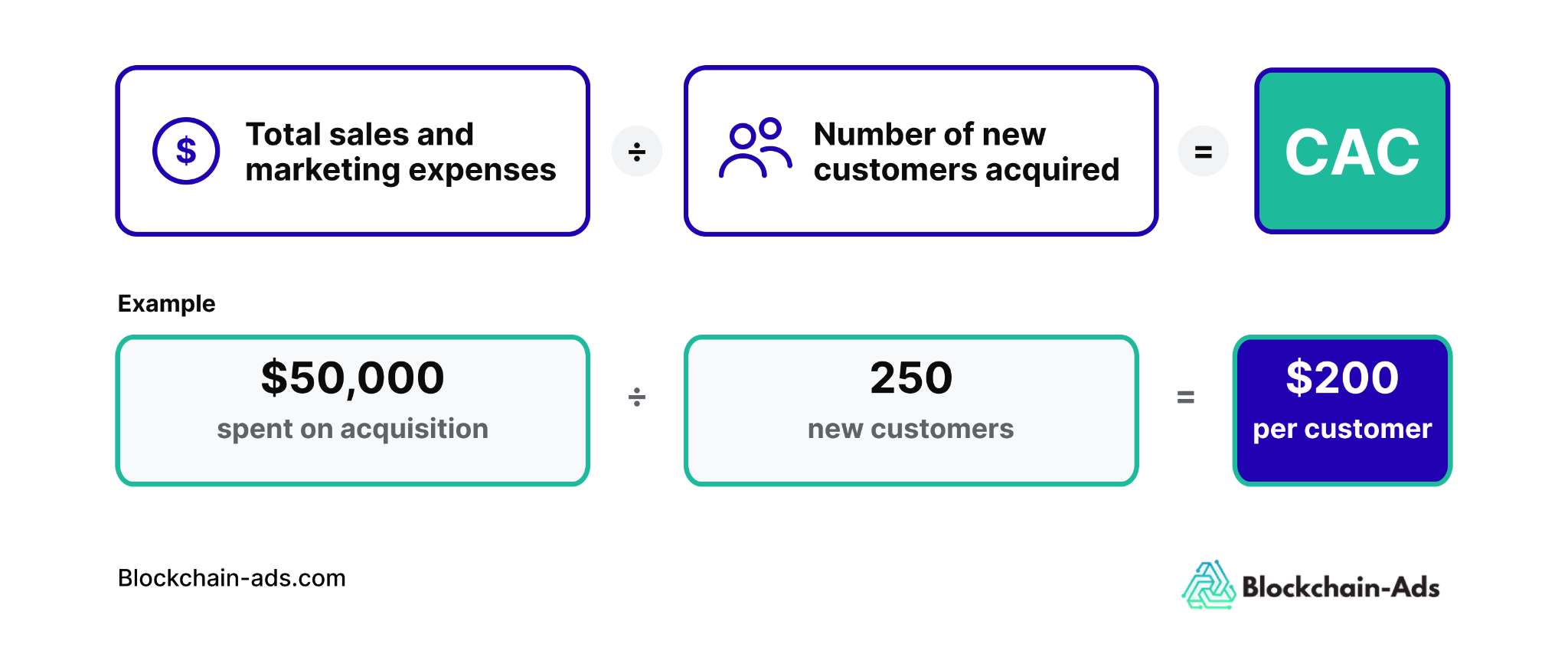
Customer acquisition cost (CAC) is the average amount a business spends to acquire one new customer during a specific period. It includes the costs associated with bringing customers to the point the business defines as an acquisition.
The formula is:
CAC = Total sales and marketing expenses / Number of new customers acquired
For example, if you spend $50,000 on customer acquisition and acquire 250 new customers:
CAC = $50,000 / 250 = $200 per customer
The formula is simple, but the inputs need to be consistent. Define what counts as a customer, decide which acquisition costs to include, and measure both over the same period.
Two common ways to calculate CAC are media-only CAC and fully loaded CAC. Media-only CAC counts your ad spend, while fully loaded CAC also factors in costs such as agency fees, affiliate commissions, and creatives.
What Should Count as a Customer in Your CAC Calculation?
Count someone as a customer when they reach the event your business recognizes as a completed acquisition. A registration or KYC completion might move someone down the funnel, but it doesn't automatically make them a customer.
For example:
- Crypto exchange: Verified user who makes their first trade
- Casino or sportsbook: First-time depositor
- Broker: New client who opens and funds an eligible brokerage account
- Affiliate: User who triggers the agreed CPA payout
Say you spend $50,000 and generate 2,000 registrations, but only 250 are first-time depositors. If a first-time deposit is your customer event, those 250 customers belong in the CAC denominator. Dividing by 2,000 would give you the cost per registration instead.
Tracking that event is just as important as defining it. Blockchain-Ads' State of Advertising research found that advertisers who set up conversion tracking before launch reached a first deposit or trade 46% of the time. By comparison, the rate was 24% for advertisers who added tracking later.
On Blockchain-Ads, you can create separate conversion events for actions such as sign-ups, deposits, and purchases. After that, you can optimize and report against the event that represents an acquired customer.
💡Read our measurement and attribution guide for a detailed breakdown of conversion tracking across the customer journey.
What Costs Should You Include in Customer Acquisition Cost?
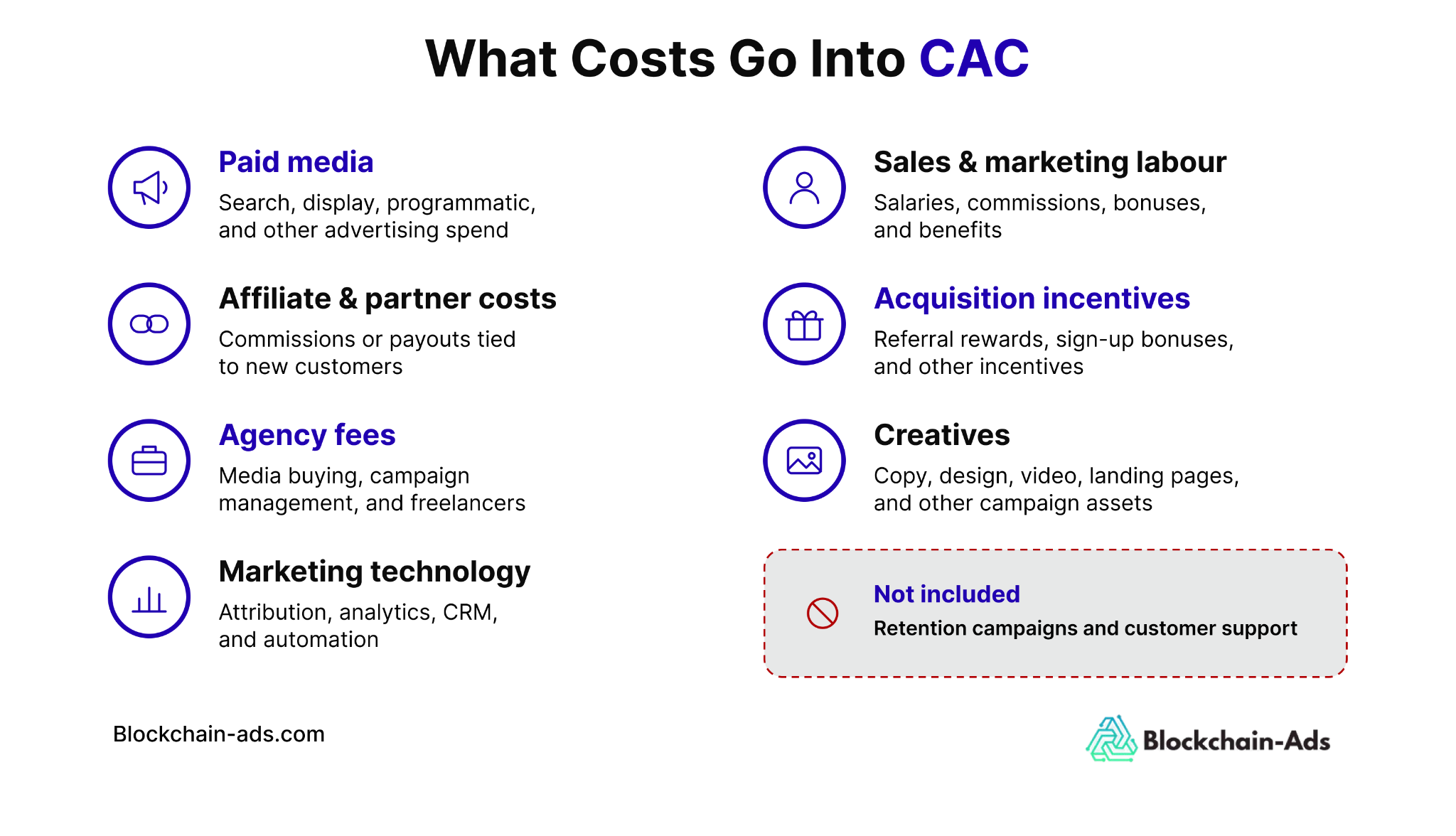
Include the costs your business incurs to acquire new customers. Advertising spend is the obvious one, but it is rarely the only cost involved.
Depending on how your acquisition operation works, your CAC can include:
- Paid media: Search, display, programmatic, and other advertising spend
- Affiliate and partner costs: Commissions or payouts tied to new customers
- Agency fees: Media buying, campaign management, and freelancers
- Marketing technology: Attribution, analytics, CRM, and automation
- Sales and marketing labour: Salaries, commissions, bonuses, and benefits
- Acquisition incentives: Referral rewards, sign-up bonuses, and other incentives
- Creatives: Copy, design, video production, landing pages, and other campaign assets
When your CAC includes all the relevant costs of acquiring a customer, including the people, tools, partners, and campaigns involved, it's known as fully loaded CAC.
Fully loaded CAC = Total acquisition costs / New customers acquired
Note: Costs related to existing customers, such as retention campaigns and customer support, don’t belong in fully loaded CAC.
Fully loaded CAC gives you the broader cost of acquiring a customer. To isolate what you spend on advertising, calculate paid CAC, also referred to as media-only CAC.
Paid CAC vs. Blended CAC
Not every customer comes from a paid campaign. Some arrive through organic search, referrals, direct traffic, partnerships, and other channels. Paid CAC isolates the economics of paid acquisition; blended CAC measures acquisition across the full channel mix.
Here’s how:
Paid CAC (or media-only CAC)
Paid CAC, also referred to as media-only CAC, measures how much you spend on paid media to acquire one customer through those campaigns.
Paid CAC = Paid media spend / New customers attributed to paid campaigns
For example, if you spend $20,000 on paid media and acquire 100 customers:
Paid CAC = $20,000 / 100 = $200 per customer
If another $5,000 covers the agency fees, creative, technology, and other acquisition costs associated with those customers, your fully loaded CAC would be $250 per customer. The difference comes from the costs included in each calculation.
Only paid-attributed customers belong in the paid CAC denominator. Adding organic or referral customers would lower the number on paper without making your paid campaigns more efficient.
Blended CAC
Blended CAC measures acquisition across your entire channel mix, including paid, organic, referral, direct, and partnerships.
Blended CAC = Total acquisition costs / Total new customers acquired
For example, if your total acquisition costs are $25,000 and you acquire 200 customers across all channels:
Blended CAC = $25,000 / 200 = $125 per customer
Note: Fully loaded CAC and blended CAC measure different things. Fully loaded CAC describes the costs included in your calculation. Blended CAC describes the acquisition sources included. A blended CAC can therefore also be fully loaded.
Paid CAC helps you track the economics of paid acquisition. Blended CAC shows what customer acquisition costs across your entire channel mix.
💡You can read our guide to crypto paid advertising to learn more about running campaigns around specific conversion goals.
How to Calculate Target CPA?
Cost per acquisition (CPA) is the average amount you spend on advertising to generate a specific conversion. This could be KYC completion, first deposit, funded account, or first trade.
The formula for calculating CPA is:
CPA = Total campaign spend / Number of conversions
Your target CPA is the average amount you are willing to pay for each conversion. Google Ads defines target CPA as the average amount an advertiser wants to pay for a conversion.
Unlike your actual CPA, which tells you what a conversion currently costs, target CPA gives you the cost you want your campaigns to work towards. Calculating it requires working backwards from what a customer is worth to your business.
1. Choose Your Conversion Event
Start with the conversion your campaign is optimizing for, such as a KYC completion, first deposit, funded account, or first trade. Your target CPA should apply to the same conversion event you use to measure campaign performance.
2. Determine What a Customer Is Worth
Next, establish how much value an acquired customer generates for your business. Customer lifetime value (CLV) estimates the value a customer generates over their relationship with your business. This gives you a basis for deciding how much you can afford to spend on acquisition.
The amount available for acquisition should also leave enough value to cover operating costs and the margin your business needs to retain.
3. Account for Other Acquisition Costs
Not all of your acquisition allowance can go towards advertising. Agency fees, affiliate commissions, creative, technology, and other acquisition costs also take up part of the amount available to acquire each customer.
Subtracting those costs gives you the maximum amount available for paid media per acquired customer.
4. Adjust for Your Conversion Rate
If your campaign conversion is also your customer event, the remaining media allowance can become your target CPA directly. If the campaign optimizes for an earlier event, account for the percentage of those conversions that eventually become customers.
Target CPA = Allowable media cost per customer x Conversion-to-customer rate
For example, with an allowable media cost of $150 per funded customer and a 40% KYC-to-funded-account conversion rate:
Target CPA = $150 x 40% = $60 per KYC completion
The campaign can therefore spend up to $60 per KYC completion on average while keeping the expected media cost of acquiring a funded customer within the $150 allowance.
Blockchain-Ads lets advertisers set a target CPA or conversion type during Smart Import when moving an existing campaign setup into the platform.
Use the Target CPA Calculator to enter your customer value, acquisition costs, and conversion rate and calculate the CPA your campaigns can support.
CAC vs. CPA: What’s the Difference?
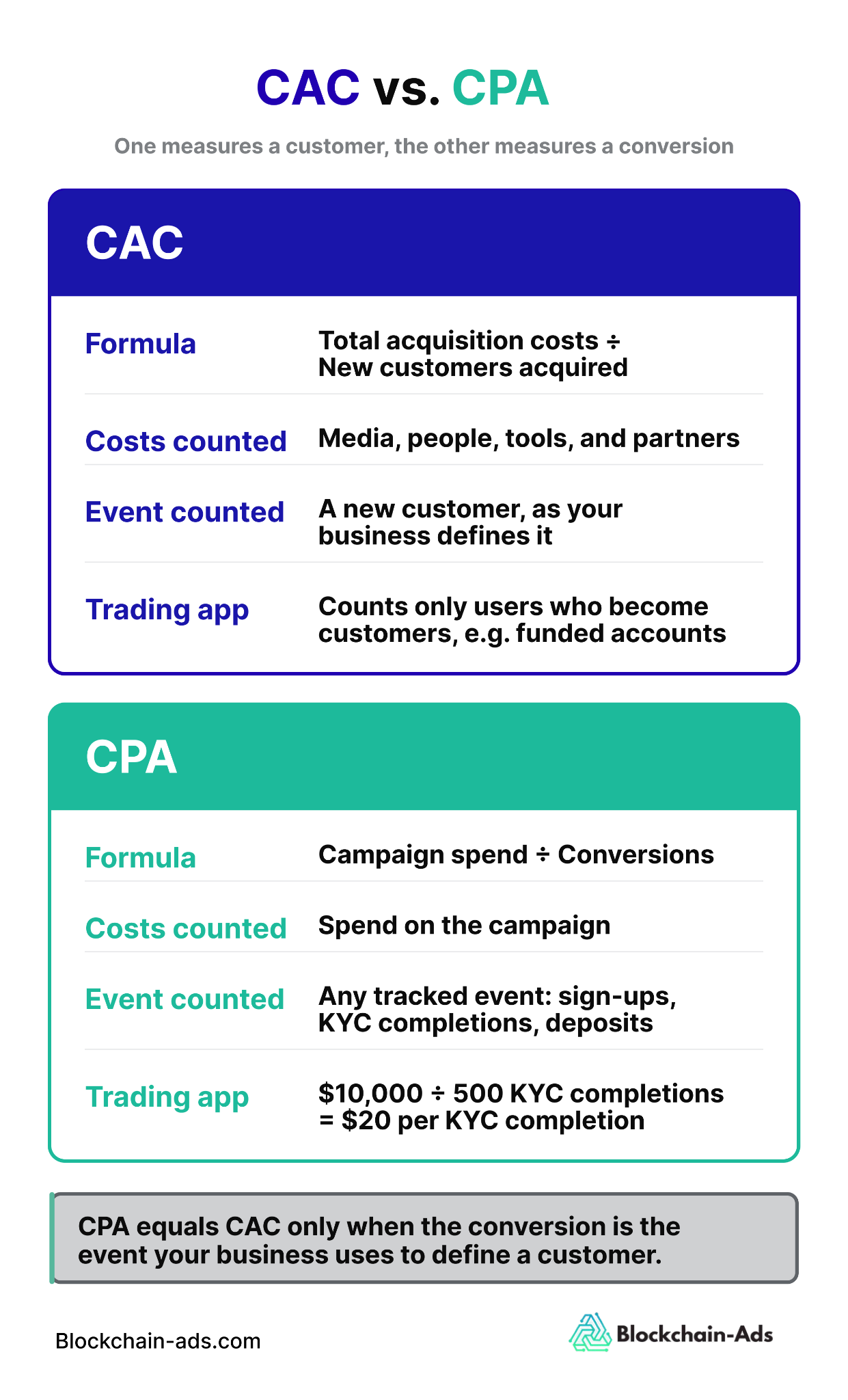
Now that you know how to calculate target CPA, the important distinction is what CPA measures compared with CAC. CPA measures the cost of a specific conversion, while CAC measures the total cost of acquiring a customer.
CAC = Total acquisition costs / New customers acquired
CPA = Campaign spend / Conversions
For example, if a trading app spends $10,000 on a campaign that generates 500 KYC completions:
CPA = $10,000 / 500 = $20 per KYC completion
If only 100 of those users fund their accounts, the $20 remains the CPA for a KYC completion. It isn't the cost of acquiring a funded customer.
Blockchain-Ads' 2026 data shows the median amount advertisers spent to generate one tracked conversion:
Advertisers in the dataset chose different conversion events, ranging from sign-ups and wallet connections to first deposits and trades. The figures therefore represent conversion costs rather than universal CAC benchmarks. A $304 conversion cost for one crypto advertiser could represent a different acquisition event from the same figure for another.
CPA becomes directly comparable with CAC when the measured conversion is also the event your business uses to define a customer. Otherwise, CPA measures the cost of a specific conversion, while CAC measures the cost of acquiring a customer.
Compare Actual CAC With Target CPA
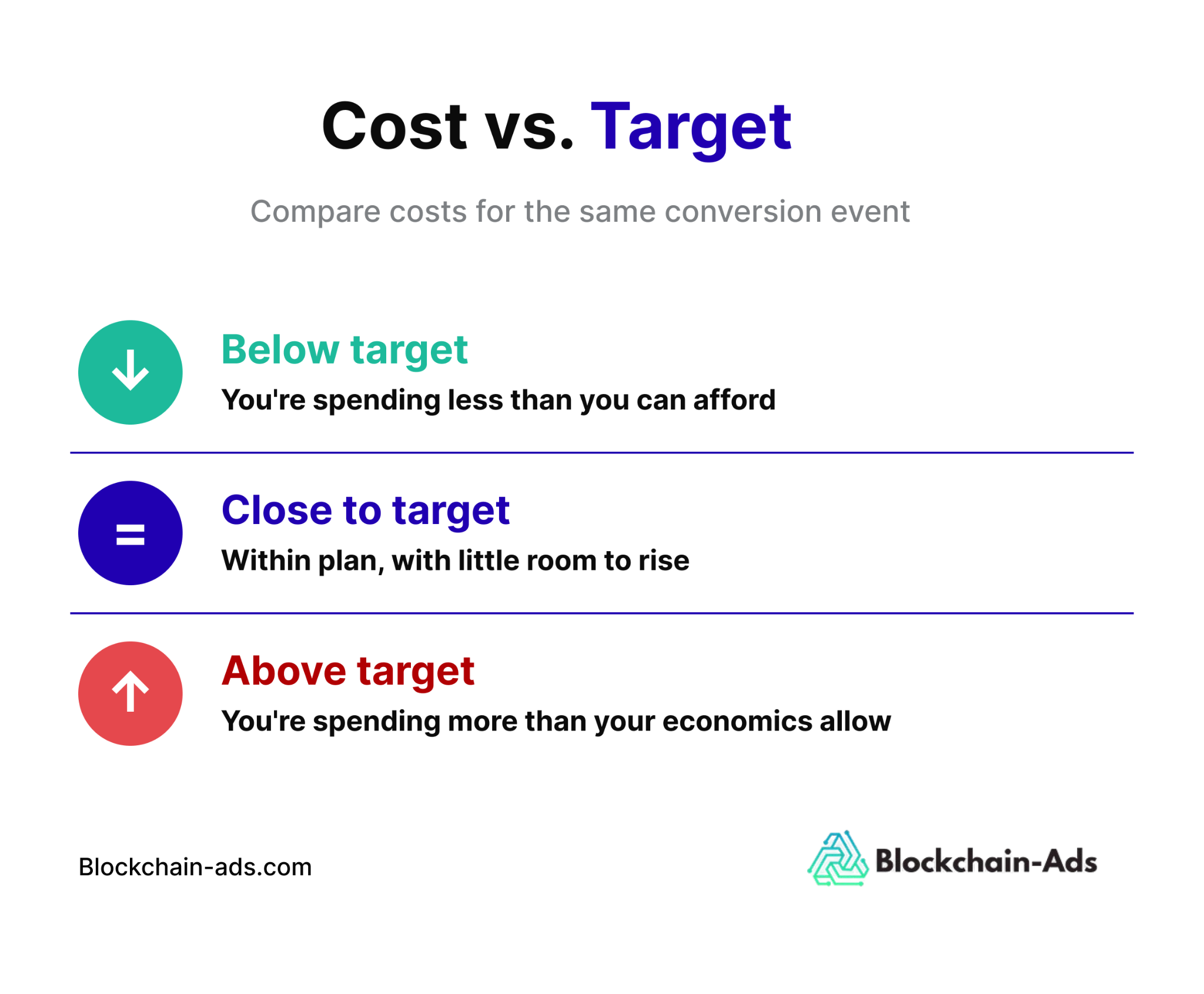
After setting your target CPA, compare it with the actual cost of the same conversion event. If your target is for an earlier conversion, such as KYC completion, compare it with your actual CPA for that event. If the target conversion is also the event you use to define a customer, compare it with your actual CAC.
The gap between your actual cost and target shows whether your acquisition performance fits the economics you worked out earlier:
- Actual cost is below target: You're generating the conversion or acquiring customers for less than the amount you can afford to spend.
- Actual cost is close to target: Your acquisition cost is within your planned range, but there is less room for costs to increase.
- Actual cost is above target: You're spending more than your economics allow. Look at your channels, audiences, conversion rates, and other acquisition costs to find where the gap is coming from.
Your target isn't the only check; you need to also consider your CAC. So, what is a good customer acquisition cost? It depends on the value those customers generate.
One way to check this is the LTV:CAC ratio:
LTV:CAC ratio = Customer lifetime value / Customer acquisition cost
According to HubSpot's LTV analysis, 3:1 is considered a healthy LTV:CAC ratio. This means you generate $3 in customer lifetime value for every $1 spent acquiring a customer.
Blockchain-Ads' Fairspin case study shows this relationship in practice. Fairspin acquired 782 first-time depositors at a $372 blended CPA, with reported player LTV reaching $2,000 over 180 days and campaign ROAS reaching 4x.
How to Lower Customer Acquisition Cost
Here’s how you can lower CAC:
- Find expensive segments: Acquisition costs can vary across markets, so compare performance by country instead of relying only on an account-wide CAC.
Google Ads recommends comparing geographic performance to identify costly locations. Break this down further by audience, creative, and format to find where acquisition costs are rising.
- Fix funnel drop-offs: Compare conversion rates between registration, KYC, deposit, funding, or first trade. If registrations are cheap but few users become customers, improving that conversion path can lower CAC without increasing media spend.
- Refine your targeting: Put more budget behind audiences that consistently reach your customer event. Blockchain-Ads' 2026 research found that ad sets combining platform segments with first-party data recorded first deposits 62% of the time, compared with 53% for platform segments alone.
- Review costs beyond media: Agency fees, affiliate commissions, creative, technology, and incentives also contribute to CAC. Cutting unnecessary acquisition costs can lower fully loaded CAC even when campaign CPA stays unchanged.
Breaking CAC down this way helps you identify the source of the problem before reducing budgets across the board.
💡For a detailed breakdown of using attribution data to find wasted ad spend, read The Attribution Playbook.
Calculate Your CAC and Target CPA
The question is simple: how much are you spending to acquire a customer, and does that cost make sense for your business?
You now have the numbers to answer it. Calculate your CAC using the right costs and customer event, work backwards from customer value to set your target CPA, and compare your actual acquisition cost with the target for the same event.
If acquisition is costing more than it should, break down performance by channel, audience, conversion event, and funnel stage to find where the extra cost is coming from.
Use the Customer Acquisition Cost and Target CPA Calculator to run these calculations with your own numbers and see where your acquisition performance stands.
Launch a campaign with Blockchain-Ads and optimize your spend around the conversions that drive revenue.
Frequently Asked Questions
Is Paid CAC the Same as Media-Only CAC?
In this guide, yes. Both refer to paid media spend divided by the number of customers acquired from paid campaigns.
Some businesses define paid CAC more broadly by including costs such as agency fees, creative, affiliate commissions, and tools. Check which costs are included before comparing paid CAC across teams or reporting periods.
Is Blended CAC the Same as Fully Loaded CAC?
No. Blended CAC describes which acquisition channels and customers are included, covering customers acquired through paid, organic, referral, partnership, and other sources.
Fully loaded CAC describes which costs are included in the calculation, such as media spend, salaries, tools, agencies, creative, and other relevant acquisition expenses. A blended CAC calculation can therefore also be fully loaded if it includes the complete acquisition cost base.
Why Can CAC Increase Even When CPA Decreases?
CPA can fall without CAC following it when the two measure different events. You might reduce the cost of KYC completions, but CAC can still rise if fewer of those users eventually fund their accounts or make their first trade.
Should You Calculate CAC Separately for Each Acquisition Channel?
Yes, if you can reliably attribute customers to their acquisition source. Channel-level CAC shows which channels are acquiring customers efficiently.
Compare it with blended CAC as well. A healthy blended CAC can hide an expensive paid channel when lower-cost organic or referral acquisition pulls the overall average down.
Srijan Sharma is a B2B writer specialising in SaaS, FinTech, MarTech, and data integration.
View full profile →