In-App Advertising for Prediction Market Apps
Key takeaways
- Traders are app-first; they trade, fund, and re-engage inside the app itself
- Match the conversion event to each campaign's goal, whether that's awareness, sign-ups, or trades
- Measure the full funnel to judge quality, and warm audiences up over time
If you're running acquisition for a prediction market app, you've probably noticed something. Your traders spend most of their time inside the app itself, trading, funding, and coming back to check a position.
That's not a small distinction to gloss over, as it shapes where your budget actually belongs and what each campaign should be aiming for. Blockchain-Ads has run acquisition campaigns for regulated platforms processing 4 billion signals a day, and the pattern holds consistently across prediction markets too.
This guide covers in-app ads for prediction markets and how to match each campaign to the right conversion event, as well as where full-funnel measurement fits in.
Why In-App Is a Core Channel for Prediction Markets
Most prediction market activity happens inside the app people have installed on their phone. The market starts moving, and the trader opens the app to react, all within a few seconds of that alert. This is where mobile advertising for prediction markets really earns its place in the funnel.
Funding follows the same pattern. Someone deciding to top up their account rarely plans that moment in advance. It tends to happen the second they see an opportunity worth acting on, and the app is what's sitting in their pocket when that happens.
Re-engagement works the same way too. A trader who hasn't opened the app in a week isn't likely to seek out a website to check their position. No, they're far more likely to respond to a push notification or an in-app prompt that brings them straight back into an active session.
Think about a specific election market a week before results come in. Interest builds gradually, then spikes hard in the final hours, right when a trader's most likely to act. Almost all of that late activity happens through the app people already have open.
Ignore this pattern, and your acquisition (and its spend) ends up following a wrong signal. A campaign judged only on web behavior is measuring a narrow slice of what traders actually do in the day-to-day. The funding, the re-engagement, and the trades are all happening somewhere else. In-app is just one piece of the wider prediction market advertising picture, but it's the piece most operators underweight.
This isn't a small reporting gap either. Depending on the platform and the audience, in-app activity can account for the majority of (total) trader engagement. This means that a campaign strategy built fully around web data is working from an incomplete picture of the funnel from the very start. Fixing that gap starts with treating in-app as a first-class channel.
How to Run In-App Ads for Prediction Market Platforms
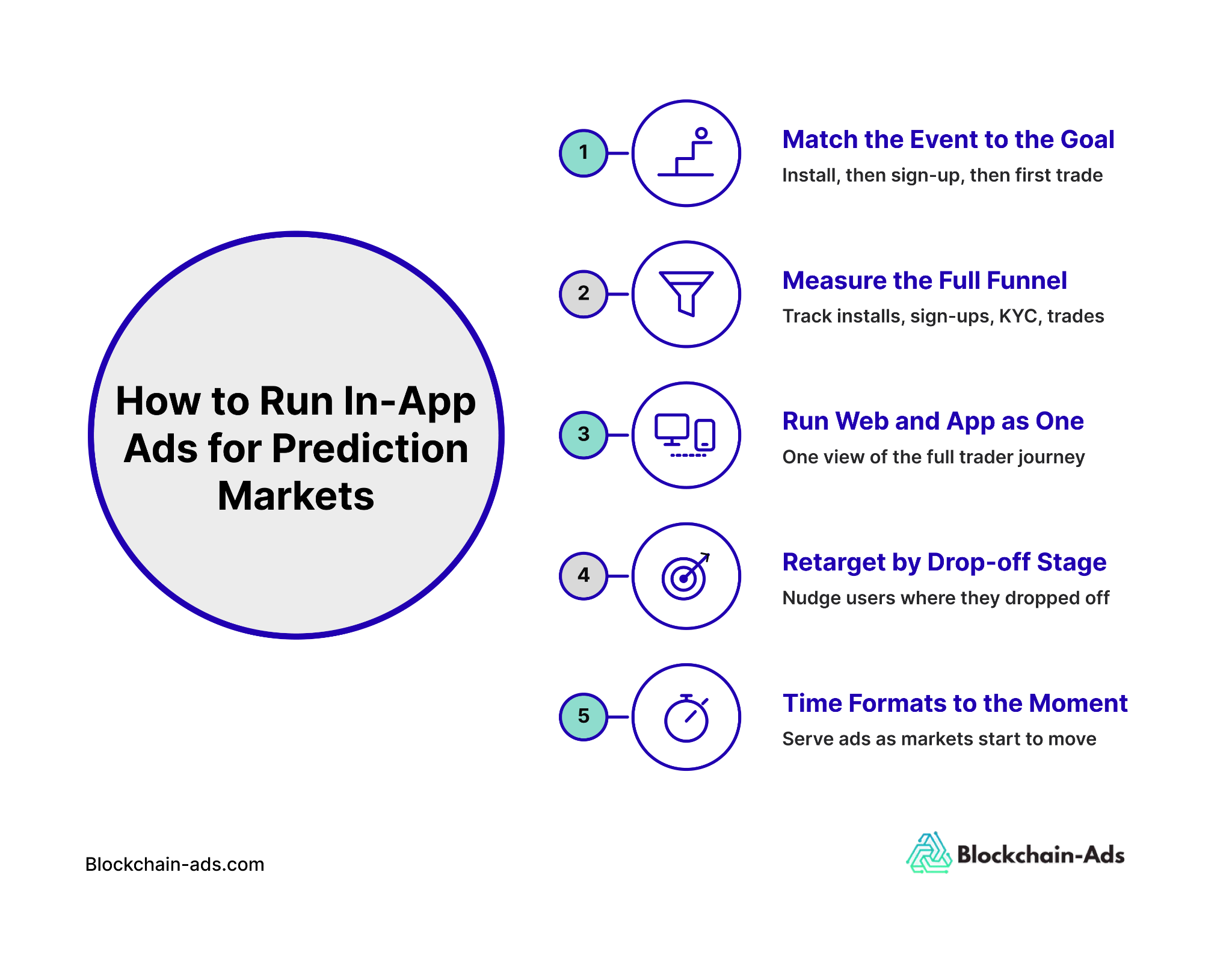
Running in-app well means treating each stage of the funnel on its own terms, matching the campaign to what that stage actually needs.
That sounds simple in theory, but it's the step most operators skip under pressure to launch quickly. A rushed setup tends to default to one conversion event across every audience, which is exactly the shortcut that causes the mistakes covered further down. Getting this right early saves a lot of budget wasted on campaigns optimizing for the wrong thing.
Match the Conversion Event to the Campaign Goal
Not every campaign should be optimized toward the deepest possible action. A cold audience that's never heard of your platform isn't ready to make a first trade the moment they see an ad.
Awareness campaigns work best when they optimize for something lighter, like an app install or a session start. Sign-up campaigns can push further, aiming at account creation once someone's shown real interest.
Trade-focused campaigns belong further down the funnel entirely, aimed at people who've already installed the app and started exploring what's on offer. Warming an audience first, then raising the bar on what you're optimizing for, tends to outperform asking for too much too soon.
Think of it as climbing a ladder rather than making a single jump. Each rung, from install to sign-up to funded account, gives the algorithm a clearer signal to optimize around.
Measure the Full Funnel
A single event (one that converts) in the funnel doesn't scratch the surface of what's happening in the overall picture. Instead, think tracking installs, sign-ups, KYC completion, and first trades together, which’ll show you traders that are actually likely to fund and stay active throughout.
For example, two campaigns can produce the same number of installs and still perform completely differently once you follow them a bit further. One might stall at sign-up, while the other converts through to funded, active traders.
What does this look like in actual practice? Say one campaign brings in 1,000 installs at a low cost, while another brings in 600 installs at a higher one. If the cheaper campaign only produces 20 funded traders and the pricier one produces 80, the real cost per funded trader tells a different story. Install numbers alone don't show that difference.
That's why judging a campaign's success on its first metric alone is risky. An install alone doesn't prove much, as that trader might have found the app through organic search (and with no ad required either).
Blockchain-Ads data shows it clearly: 46% who track from day one land a deposit or trade, against 24% who add it later. You could say the install is the easy part, and the challenging bit is exactly what measuring prediction market campaigns actually tracks from there.
Run Web and In-App as One Funnel
Splitting your web and app into separate campaigns really just creates two incomplete images instead of a single clear one. For instance, a trader might discover your platform on desktop, then they go and complete their first trade entirely inside the app days later.
Treating those as unrelated events means missing the connection between them. A single view across both surfaces shows the real path someone actually took.
This matters most when you're deciding where credit for a conversion belongs. Prediction market media buying decisions often hinge on which channel gets that credit in the first place.
Warm Audiences Through the Funnel
Traders are people. For instance, someone who installs the app today might not fund an account for another two weeks, and that gap is completely normal and expected. Retargeting is what carries them through. A person who opened the app but never signed up is a very different audience from someone who signed up but never funded. Each one needs a different nudge to move forward.
Ignoring that difference means you treat everyone the same way, wasting budget on people who need prediction market retargeting sequences built around exactly where they dropped off.
Pick Formats That Carry the Event Hook
The ad format should carry the precise moment a trader is in, right as a market starts to move. That timing is what gives, for example, an interstitial its overall weight, far more than showing the same ad at some random point in a session.
Rewarded ads do suit lighter asks well, so that's getting someone to open the app and check on a specific market. Native formats blend into the surrounding content, which is a natural fit for awareness campaigns that need to feel like part of the experience.
Video gives you room to explain something with more depth, like how a market works and why the timing matters right now. A rewarded video shown right as a major event kicks off tends to outperform the same creative shown a day earlier. The trader already has a reason to care in that exact moment. Timing the format to that moment usually matters more than the format itself.
Most of what makes a format work comes down to prediction market ad creatives built for that particular window.
Common In-App Mistakes for Prediction Market Apps
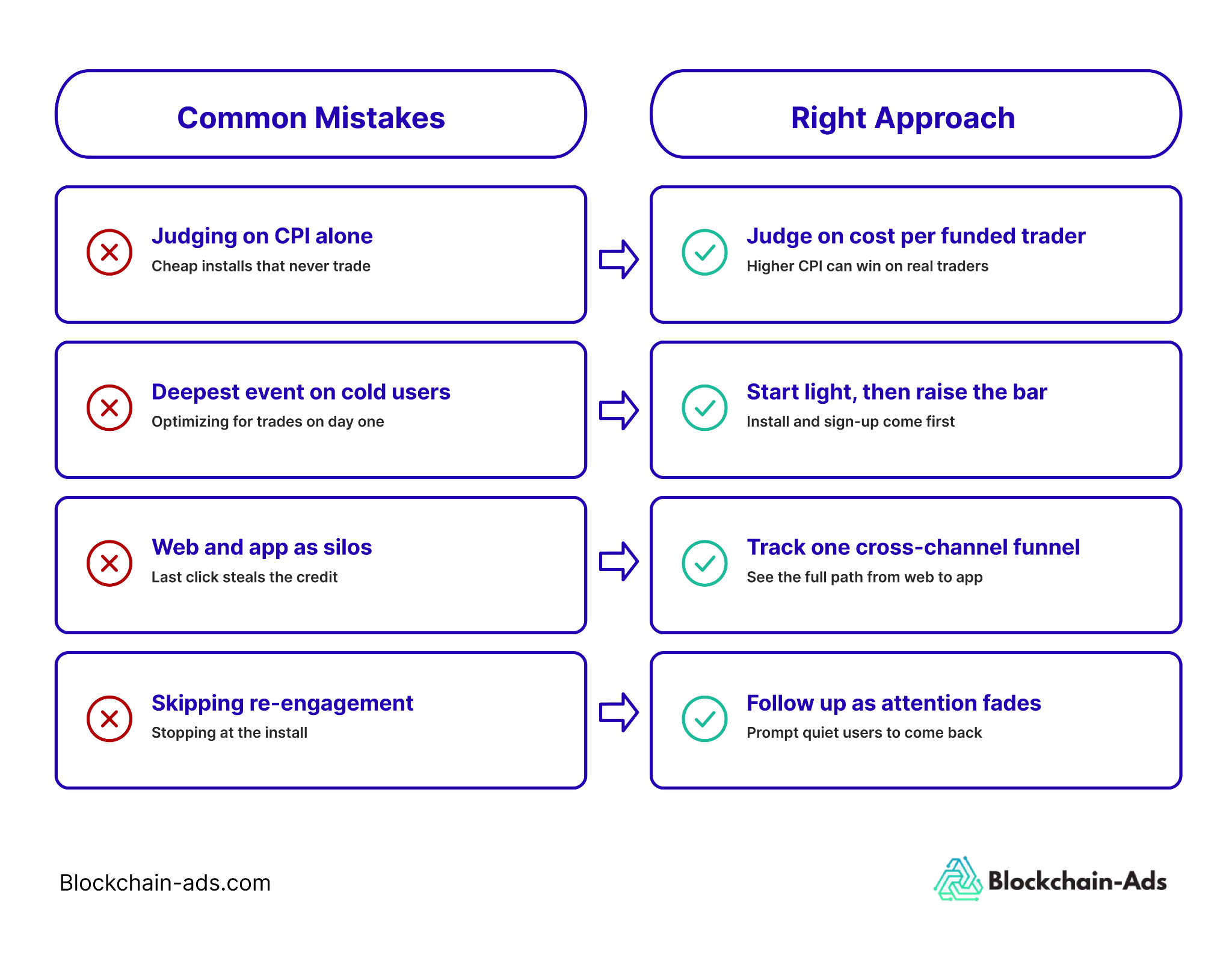
Even a well-funded campaign can underperform if it's built around the wrong assumptions. A few mistakes show up often enough in prediction market acquisition that they're worth naming directly.
Judging In-App on Cost per Install Alone
Cost-per-install (CPI) is easy to measure, which is exactly why it gets over-relied on. For example, a “cheap install” that never funds an account or even places a trade isn't actually a cheap result.
A campaign with a higher CPI but a stronger funded-trader rate is doing the actual job better, even though the top-line number looks worse on a dashboard. Reporting only on CPI hides that entirely.
Forcing the Deepest Conversion on Cold Audiences
Asking a brand-new audience to fund an account and place a trade on their very first interaction sets the bar too high, far too early. Most people need a lighter, lower-commitment first step before they're ready to take real financial action on a platform they've barely yet encountered.
This shows up most often when a campaign gets optimized straight to trade volume from day one. The algorithm ends up chasing a rare event across an unqualified audience, which drives costs up without actually producing more trades.
Running Web and App as Separate Silos
Treating web and app as two unrelated channels means losing the full picture of how someone moved through your funnel in the first place. So a trader who researched on desktop and converted in-app days later gets counted as two disconnected events.
Budget decisions made from that fragmented view often favor whichever channel happens to show the last click. This may mean overlooking the one that actually built interest in the first place.
Skipping Re-Engagement
An install and even a sign-up isn't the finish line. Traders who go quiet for a week or two haven't necessarily lost interest. They often just need the right prompt at the right moment to come back and take that next step.
A campaign that stops the moment someone installs is leaving a large share of eventual traders behind, simply because nobody followed up when their attention naturally faded.
Where to Run Prediction Market In-App Ads
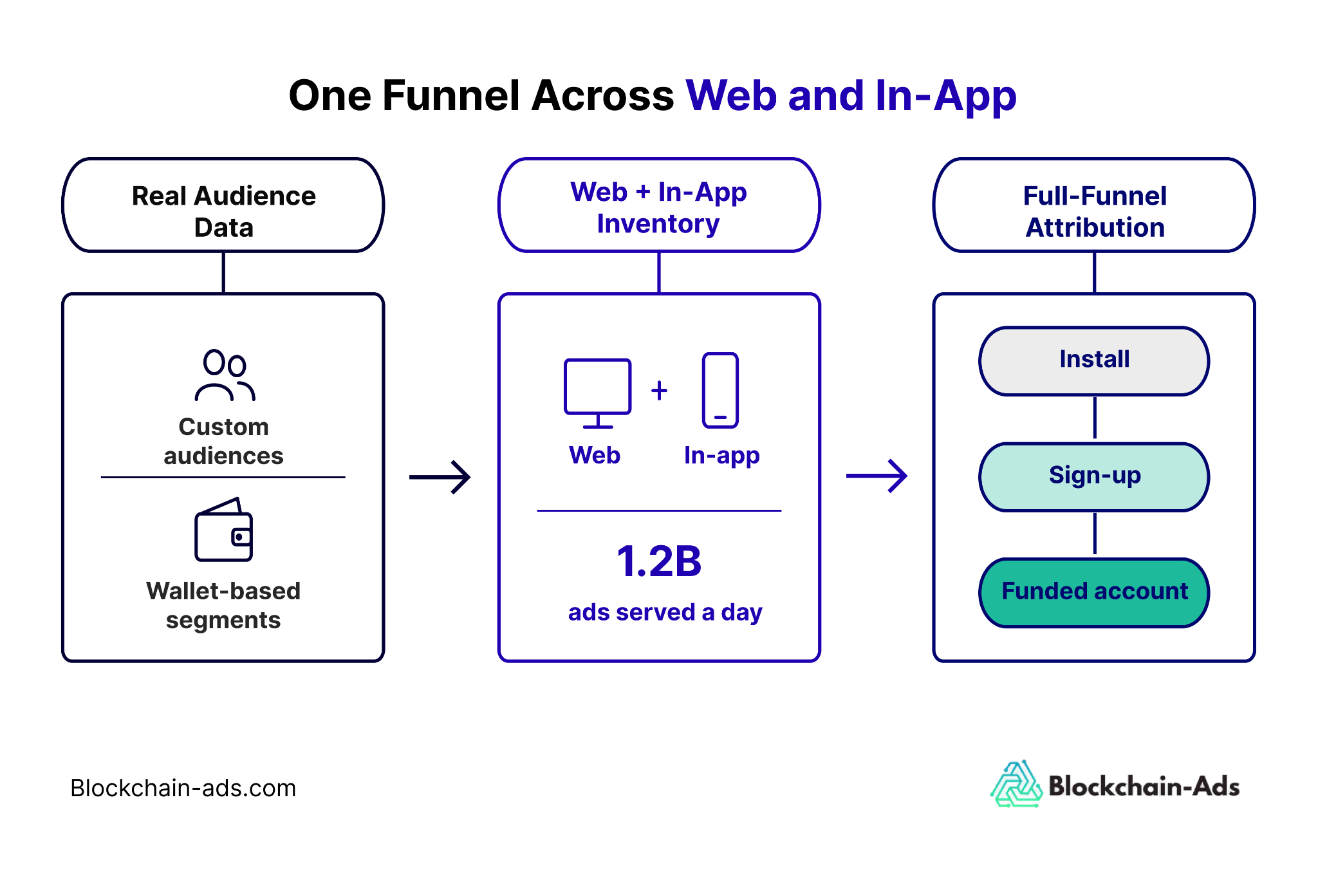
Blockchain-Ads runs prediction market app advertising full-funnel across both web and in-app inventory, rather than treating them as those separate channels we spoke about earlier. This is audience-based acquisition, proven through measured results tracked all the way across the funnel. Our data backs that as well: ad sets combining platform segments with first-party audiences convert at 62%, against 28% for first-party data alone.
Campaigns pull from custom audiences and wallet-based segments, so targeting reflects real trader behavior. Our infrastructure runs 1.2 billion ads a day across 78 supply partners. This gives campaigns a real scale to test against.
The testing happens at scale across formats, which means finding what converts doesn't rely on your guesswork (and a single test). In short, attribution follows the trader through the funnel. That's from the first install right along to a funded account.
Wallet-based segments matter here specifically because prediction market traders often hold assets across several platforms. Reaching someone based on real on-chain activity means targeting people who've already shown actual (financial) intent.
Our approach has produced real results in regulated verticals. For example, Coinbase acquired 31,896 new traders across Southeast Asia using the same wallet-based targeting, while TD Ameritrade generated 5,247 qualified wealth management leads at $160 CPA through the same full-funnel approach.
That combination, full-funnel reach, real audience data, and attribution, is what separates Blockchain-Ads from the wider field of prediction market advertising platforms.
The Bottom Line
Traders spend their time in the app, and acquisition spend needs to follow that pattern closely. So match each campaign's conversion event to its actual goal, whether that's awareness, sign-ups, or trades.
Don't forget to measure the full funnel rather than stopping at the first metric you can see. Warm audiences over time, too, since asking for too much too soon rarely pays off.
Run in-app acquisition that tracks all the way to a funded, active trader. Schedule a verification call to qualify for running full-funnel in-app ads for prediction markets apps.
Jamie is a digital marketer, writer, and editor with 12 years of experience creating online guides and reviews.
View full profile →