Prediction Market Media Buying: The Operator's Guide + Plan Template
Prediction market media buying starts with the constraint that you can only buy from channels and inventory your platform is eligible to run. From there, your job is to decide where to reach traders, how to buy that inventory, how much budget to allocate, and which trader action to optimize for.
This guide walks through those decisions in order: the channels available to prediction markets, how the buying itself works, and how to land on the right channel mix, buying method, and measurement approach for your acquisition goals.
You can also use our downloadable Prediction Market Media Plan Template to map your channels, budget allocation, campaign timing, and measurement plan before you launch. It’ll help you turn those decisions into a media buy you can test and optimize against trader acquisition results.
Prediction market media buying at a glance
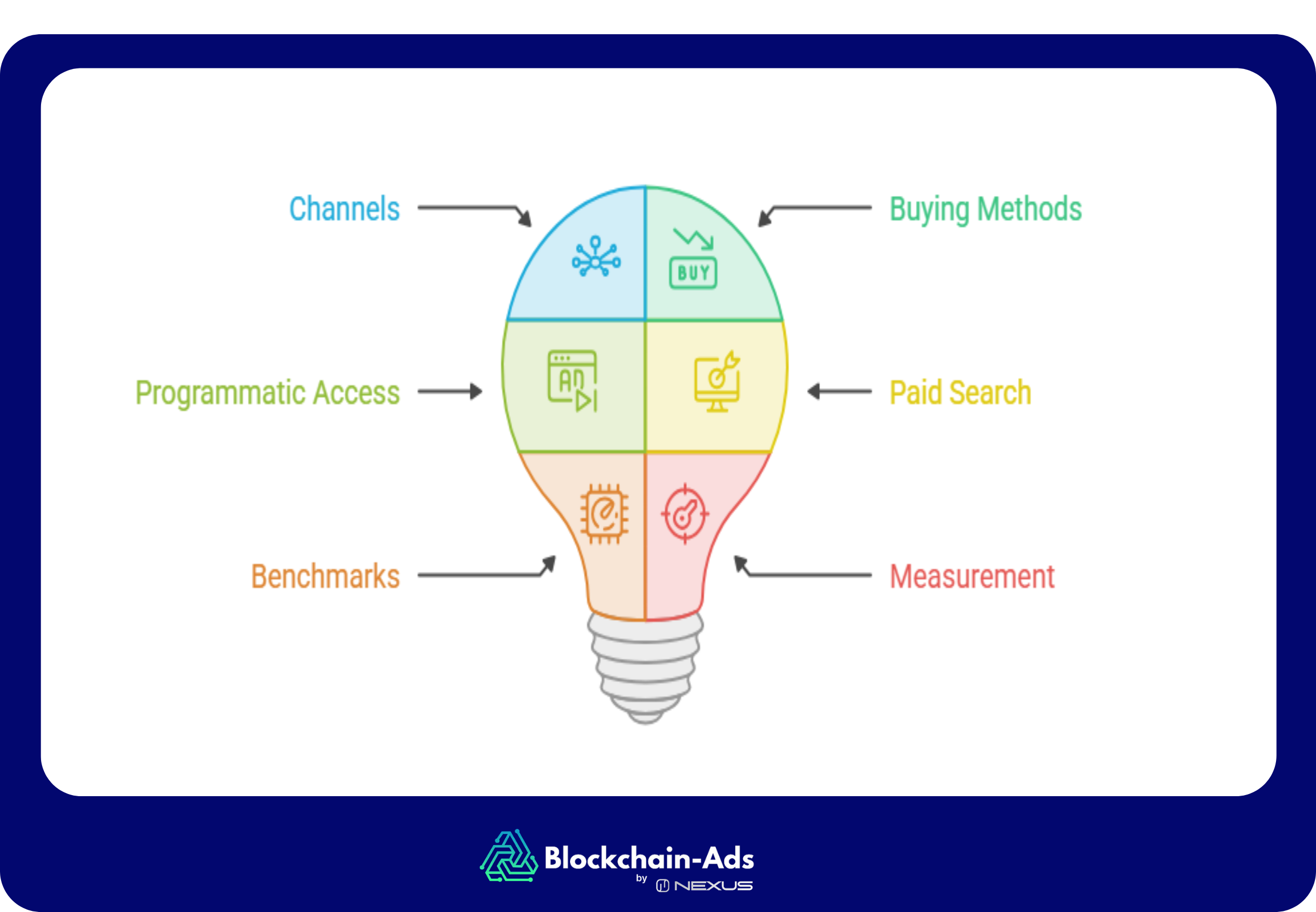
- Channels: Programmatic across web and in-app inventory, plus paid search for U.S. certified operators.
- How you buy: Demand-side platforms (DSPs) and real-time bidding, plus direct and private deals; self-serve or managed.
- Programmatic: Access depends on the DSP, inventory source, GEO, and operator eligibility.
- Paid search (Google, Microsoft/Bing): Available to certified U.S. prediction-market operators that meet each platform's approval and geographic requirements.
- Benchmarks: $22–$50 CPC, $197–$304 cost per conversion (BCA Labs Institute).
- Measure to: Your campaign goal, such as visits, sign-ups, funded traders, or trades.
What is media buying for a prediction market platform?
Media buying for a prediction market platform is the process of purchasing paid ad inventory to reach and acquire traders. That can include programmatic inventory across websites and apps, as well as paid search where the operator meets the platform's advertising requirements.
In practice, media buying for prediction markets depends on the channel. For example, you can buy programmatic media through DSPs using real-time bidding, private marketplaces, preferred deals, or other direct arrangements.
Your goal should go beyond buying impressions or clicks. Instead, choose inventory that can move traders toward your campaign's objective, whether that is a site visit, account sign-up, funded account, or trade.
The ad channels available to prediction markets
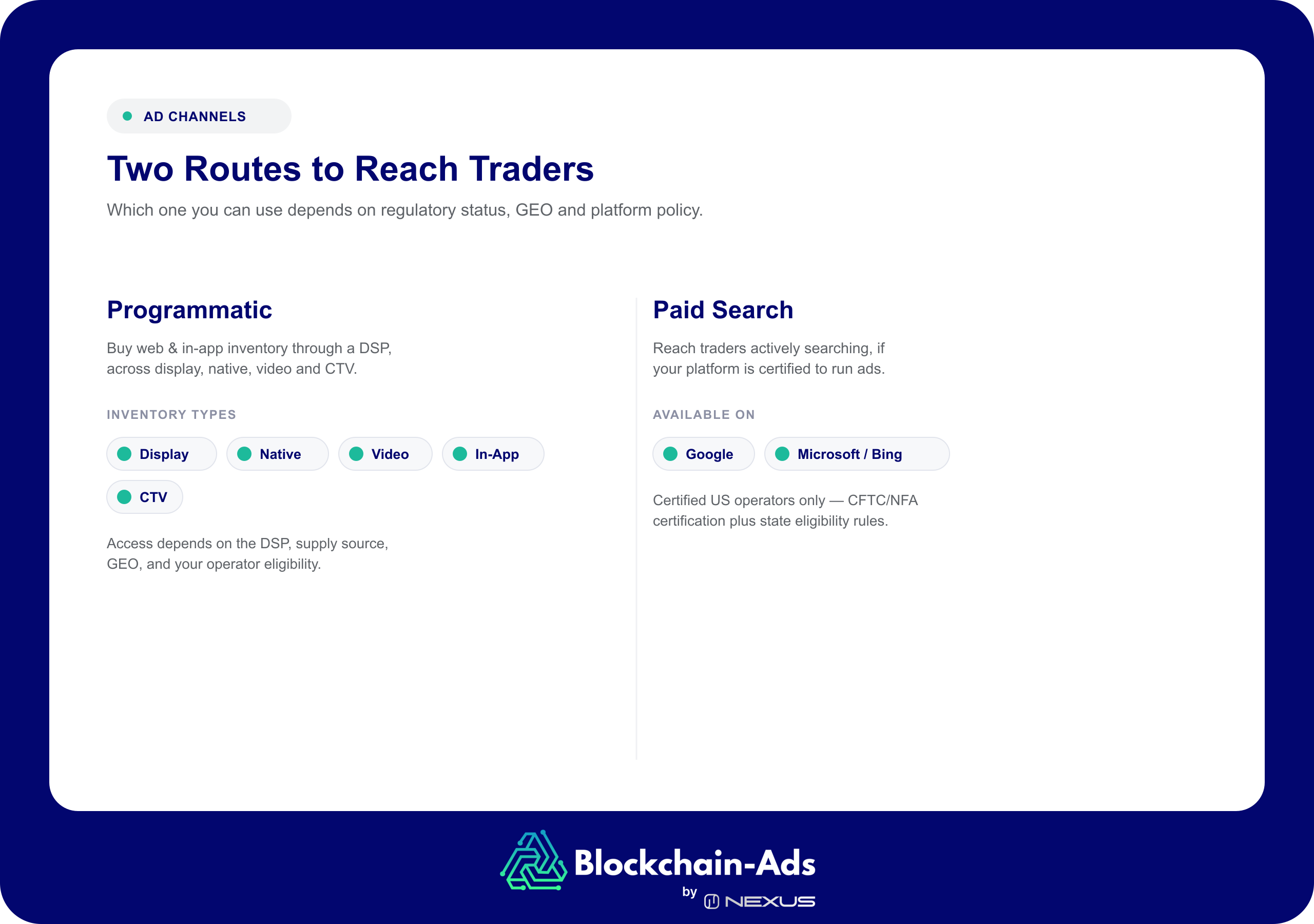
The two main paid-media routes within prediction market advertising are programmatic advertising and paid search. Which one you can use depends on your regulatory status, target GEOs, and the advertising platform's policies.
For a detailed comparison of available providers, see our guide to prediction market advertising platforms.
Programmatic advertising: Web and in-app
Programmatic advertising for prediction markets lets you buy inventory across websites and apps through a DSP, rather than relying on a single publisher or search engine. Depending on the platform and supply available, that inventory can include display, native, video, in-app, and CTV placements.
Blockchain-Ads, for example, provides programmatic access to display, native, video, in-app, and CTV inventory through our DSP, with campaigns reaching audiences based on interests, behavior, and on-chain activity. Access is limited to qualified advertisers and is subject to our compliance requirements.
Programmatic can provide a broader inventory mix than search alone. However, the prediction market ad inventory you can access still depends on the DSP, its supply partners, your GEO, and your eligibility to advertise there.
Paid search: Google and Microsoft/Bing
Paid search lets you, if you're eligible, reach traders when they are actively searching for relevant markets, events, or platforms. Access is more restricted than programmatic because Google and Microsoft apply specific certification and location requirements to prediction-market advertising.
Google currently allows prediction-market ads in the United States, excluding Michigan, Nevada, New York, and Ohio. Advertisers must receive Google's certification and be either an eligible CFTC-authorized Designated Contract Market or an NFA-authorized brokerage offering access to qualifying DCM products.
Microsoft also requires prediction-market advertisers to comply with its advertising network policies. For prediction-market campaigns specifically, you must also meet Microsoft’s CFTC or NFA certification requirements and current state eligibility rules.
If you're considering search as part of your media mix, check the Google Ads prediction market policy before allocating budget, and verify Microsoft's current state availability separately.
How media buying works, from DSPs to direct deals
Once you know which channels you're eligible to run, the next decision is how to buy that inventory and how much control you need over audience, placement, pricing, and optimization. That choice shapes which buying method fits your campaign goals, inventory requirements, and level of control.
For programmatic campaigns, that usually means buying through a DSP, though you can also access inventory through private or direct arrangements.
DSPs and real-time bidding
Automated bidding, where the DSP adjusts bids based on campaign signals and your goal, is the baseline for programmatic media buying. The DSP evaluates impressions available across publishers and exchanges and decides whether to bid on each one, based on your targeting, budget, campaign objective, and other settings.
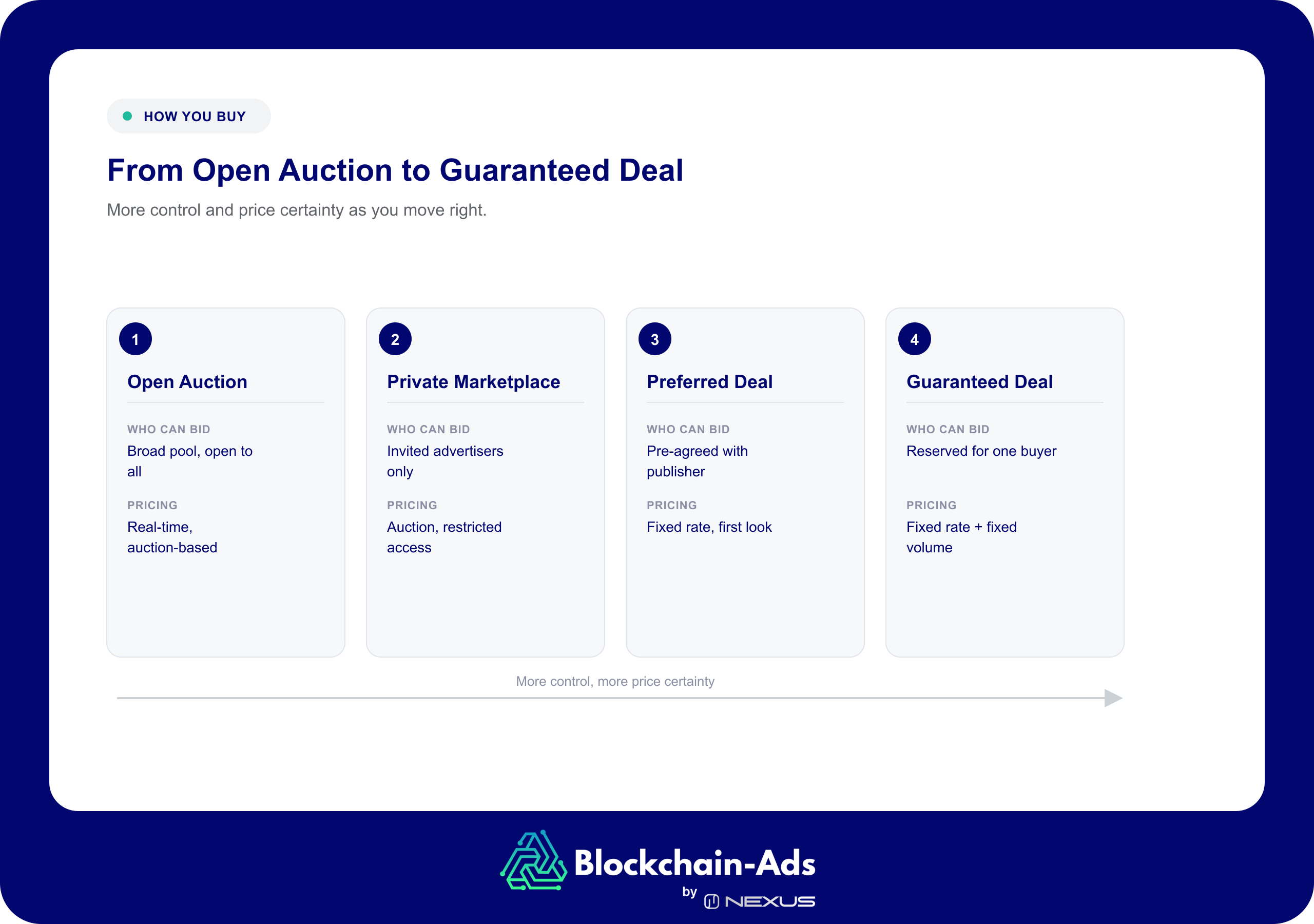
Not every buy has to run through an open auction. Depending on the inventory and buying arrangement, you can also use private marketplaces, preferred deals, or guaranteed deals.
These models differ in areas such as
- Who can bid: Open auctions are available to a broader pool of buyers, while private deals restrict access to selected advertisers.
- How pricing works: Pricing may be auction-based or agreed in advance.
- Whether inventory is guaranteed: Some deals reserve a fixed amount of inventory, while others don't.
Audience building and attribution
The value of the buying platform depends partly on how precisely you can define the traders you want to reach and how far you can track them after the impression or click.
With Blockchain-Ads, you can build audiences from interest, behavioral, first-party, and on-chain signals, then activate those audiences across supported inventory. You can also use first-party data from CRM uploads or the Blockchain-Ads pixel to build audiences from visitors and converters.
Attribution should then connect the media buy to the trader action you care about. We support conversion tracking for events such as sign-ups or first deposits through manual installation, Google Tag Manager, or server-to-server tracking, with optional wallet and transaction-value parameters for deeper reporting.
Self-serve or managed buying
You can run the media buy in-house if your team already has the time and expertise to manage campaign setup, audience selection, tracking, bidding, and optimization.
Blockchain-Ads supports both self-serve buying and managed service for qualified advertisers. Our managed team can handle attribution setup, campaign structure, media planning, audience selection, creative production, optimization, and scaling.
The better option depends on how much execution you want to keep in-house versus how much you want the buying platform to manage.
How to plan a prediction market media buy
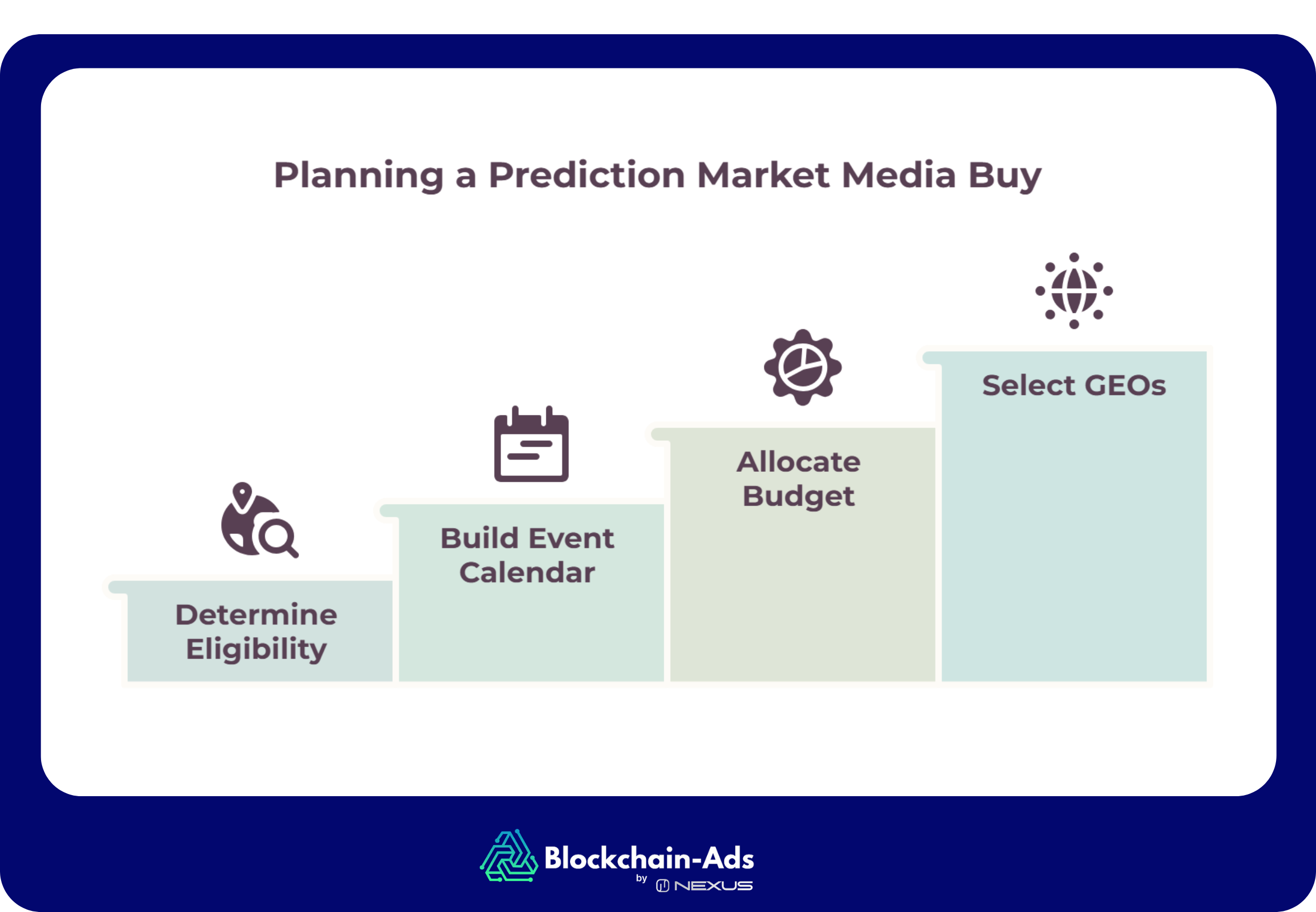
Your media plan should connect what you’re eligible to run with when demand is likely to rise, where you can acquire traders, and how much budget each stage of the campaign needs.
Our downloadable Prediction Market Media Plan Template includes the budget-allocation and event-calendar framework. Use it to map your eligible channels, target GEOs, campaign windows, budget split, and conversion goals, so you have a working plan to launch, measure, and adjust.
Start with eligibility: What can your prediction market run?
Start with the channels your regulatory status and target GEOs allow. Programmatic can give you access to web and in-app inventory through eligible DSPs, while paid search is available only to certified U.S. operators that meet Google or Microsoft’s platform-specific requirements.
If paid search isn’t available in a target market, that changes your media mix before you decide on budget. Your programmatic allocation may need to carry more of the acquisition work instead.
Build your event calendar
Prediction market demand is event-driven, so plan media in waves around the events most likely to drive trader activity.
Typically, an event calendar has three stages:
- Pre-event ramp: Build reach, bring prospective traders into the funnel, and create retargeting pools before interest peaks.
- Event peak: Increase acquisition spend while trader intent is highest. CPMs can run 2–3x above normal levels during peak demand periods.
- Post-event retargeting: Re-engage visitors and registered traders who didn’t complete the action you were optimizing for.
Your event calendar should also shape pacing. Rather than spreading the same daily budget evenly across the campaign, reserve enough spend for the windows when the event is most likely to influence trading activity.
Allocate your budget by funnel stage
A starting media-plan allocation is:
- Awareness: 20–30%
- Acquisition: 50–60%
- Retargeting: 10–20%
Use those ranges as a planning framework rather than a fixed rule. Your final split should change as campaign data shows which stage produces funded traders and trades at an acceptable cost.
If you don’t have access to U.S. paid search, shift more of the acquisition share into programmatic inventory rather than wasting budget spend in a channel you can’t use.
Decide on your GEO compliance and economics
GEO selection isn’t only about where prediction markets attract interest. You also need to know whether you can legally offer and advertise your product there, what inventory is available, and whether the acquisition economics justify the spend.
On Blockchain-Ads, GEO and a market's regulatory profile can affect CPMs, along with targeting depth, creative quality, and competition for the same audience. Our advertising policies also require campaigns to target only regions where the advertiser’s offer is legally eligible.
The best GEOs for prediction market advertising are the U.S., followed by Singapore, the UAE, South Korea, Canada, Australia, and the UK. Treat demand and advertisability as separate questions: strong trader interest in a GEO doesn’t automatically mean your platform can legally operate or advertise there.
What media buying costs, and how to measure it
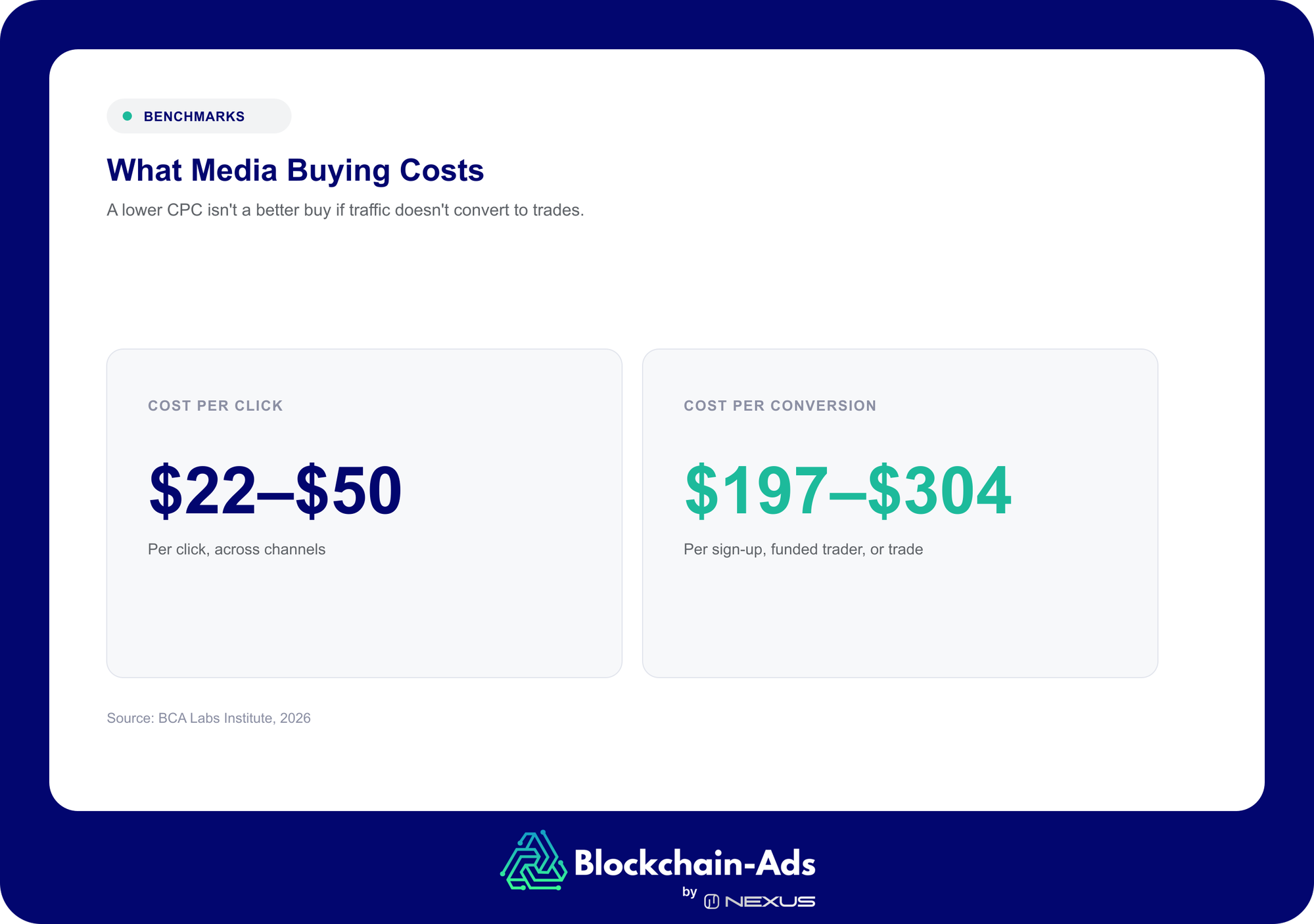
Prediction market media buying costs vary by channel, GEO, audience, inventory, competition, and the conversion event you’re optimizing for. As a working benchmark, BCA Labs Institute data puts CPC at $22–$50 and cost per conversion at $197–$304.
Those benchmarks are most useful when you compare them with the trader action you want to drive. A lower CPC doesn't necessarily mean a better media buy if the traffic doesn't progress to registration, funding, or trading activity.
Measure your buying costs against trader activity
Beyond traffic, also measure the cost of acquiring activity that matters to the platform.
Your primary conversion event should follow the campaign goal:
- Awareness: visits and sign-ups
- Acquisition: funded first trade
- Event campaigns: trades placed on the event
From there, measure the activity those traders generate, including funded traders, trades placed, and trading volume. If you can attribute transaction value back to the campaign, you can also assess revenue or ROAS instead of stopping at the initial conversion.
See our guide to measuring prediction market campaigns for how to track funded traders, trading activity, attribution, and campaign returns across the acquisition funnel.
Strategies beyond paid media
Media buying is one part of prediction market acquisition. Content, community, referral programs, affiliates, KOLs, and partnerships can also help you reach and acquire traders without relying entirely on paid inventory.
These strategies sit outside the media-buying plan we covered. However, they can support the plan by creating additional acquisition paths and helping you maintain demand between paid campaign windows. Our guide to prediction market marketing strategies demonstrates how to use these channels alongside paid acquisition.
Build your prediction market media buy around what you're eligible to run
A strong prediction market media buy starts with what your platform can actually run, then works backward from the trader action you want to drive. That means choosing eligible channels, matching inventory to the campaign goal, concentrating spend around the right event windows, and measuring performance beyond the click.
If programmatic is part of that mix, Blockchain-Ads lets you plan, buy, target, and optimize your prediction market campaigns from one DSP. Our platform combines audience intelligence, attribution, and real-time optimization so you can manage those decisions against the acquisition goal you set.
Request access to Blockchain-Ads to plan and run your next prediction market acquisition campaign.