How to Calculate and Improve Digital Marketing ROI
Digital marketing ROI tells you how much profit you make for every dollar you spend on marketing, which is why it sits at the center of every serious performance decision. When you understand it, you stop guessing, cut wasted spend, and double down on the campaigns that actually grow revenue.
Improving ROI comes down to a few essentials:
- Use clear formulas to calculate ROI and forecast ROI
- Track hard metrics like CPL, CLV, AOV, CTR, and close rates,
- Shift budget from low-performing channels and audiences into the ones that consistently hit your targets.
- Treat every campaign like an investment with a target return and a fixed testing window, and adjust fast when the numbers don’t add up.
Blockchain-Ads makes improving your ROI effective by providing accurate and transparent data that are auditable. It also integrates with Nexus AI to automatically analyze your campaign data and performance then shift budget to the most successful audiences, creatives and placements.
In this article, you’ll learn how to apply the core formulas to calculate your ROI. We’ll discuss the metrics that matter most, and how ROI looks across key channels.
What is Return on Investment in Digital Marketing?
Return on investment, ROI, is a crucial metric in digital marketing that helps you to measure the revenue or profit you gain from any marketing effort compared to the cost of those efforts.
Simply put, digital marketing ROI shows the amount of profit you make for every dollar (pound or euro) you spend in marketing.
It is important to note that the digital marketing ROI goes far beyond a number. It is a vital tool that enables you to make wise decisions over time. Knowing what is profitable and not helps you minimize wasteful spending. In the long run, it creates sustainable growth and great returns in your marketing efforts.
Importance of ROI in Digital Marketing
Most new marketers mainly focus on shallow metrics like impressions or clicks. While they are helpful, they don’t give the full story. Digital marketing ROI gives better clarity to your efforts and helps you build a better paid advertising strategy. Here are some of its importance:
1. Great Budget Allocation
Tracking your paid media ROI enables you to know where your money generates better returns. As such, you can allocate your budget effectively, spend more on effective campaigns, and cut back on those that are not pulling their weight.
2. Identifies the Most Profitable Channels
Digital marketing ROI helps you to compare various platforms objectively. Do Google Ads offer a better return than TikTok? Are your YouTube Ads outperforming Meta campaigns? This helps you invest in channels that generate the highest value to your business.
3. Enhances Your Marketing Strategy
Calculating ROI acts as a feedback that generates better performance over time and boosts your overall paid media strategy. You’ll learn the messaging approach that works best, high-converting audiences, and how to improve your bidding and targeting for better results.
4. Secure Stakeholder Buy-In
If you work in-house or manage clients, ROI acts as proof of performance. It turns your paid advertising campaigns into clear business results. This makes it easier to justify budgets and enlarge your marketing efforts.
How to Calculate ROI in Digital Marketing
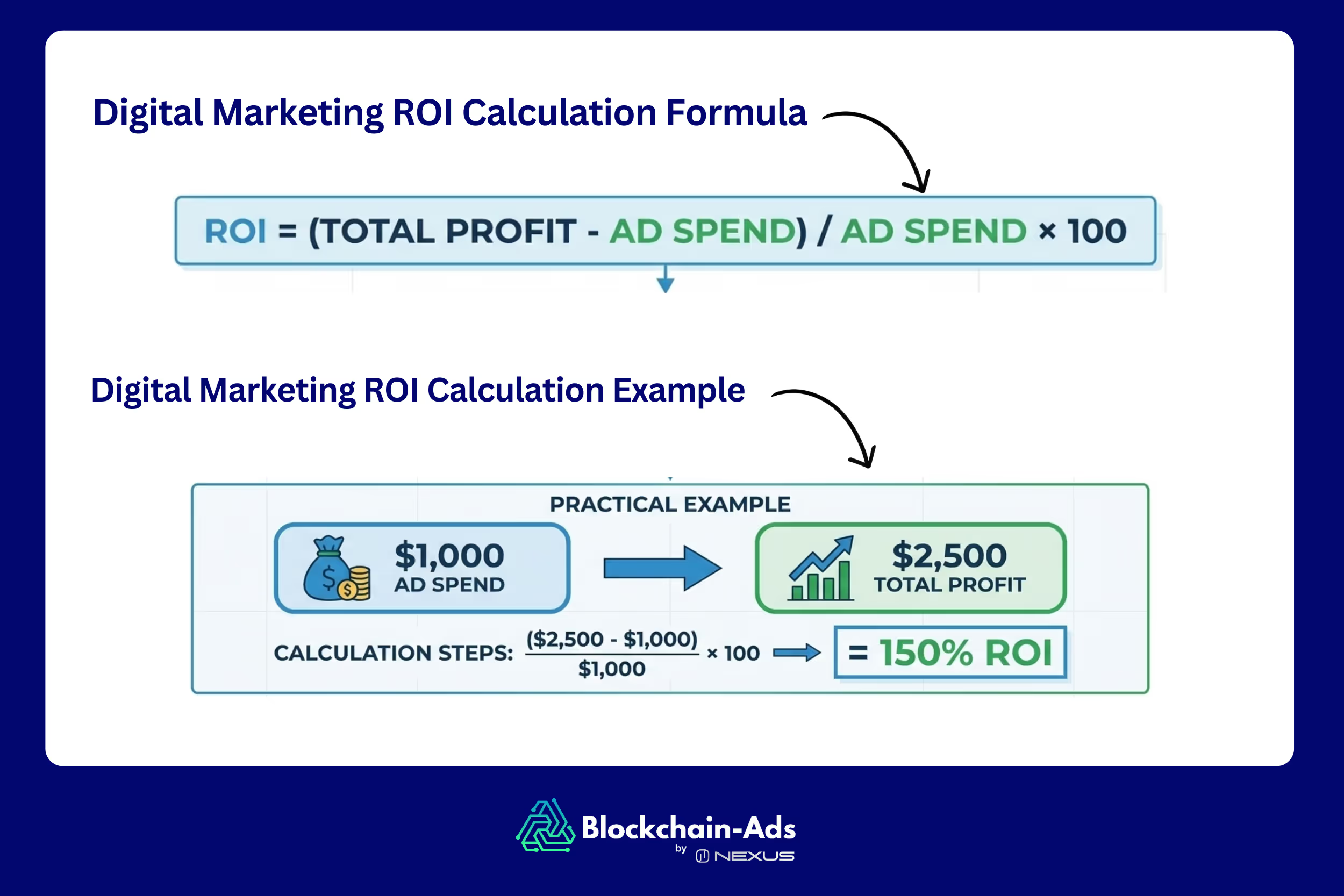
You can calculate the ROI for your digital marketing campaigns using the formula:
ROI = (TotalProfit−AdSpend)/AdSpend×100.
For example, if you spend $1,000 on a campaign and generate $2,500 in profit, your ROI is: (2,500−1,000)/1,000×100=150%. This means you earned 1.5 times your investment.
When you use a platform like Blockchain-Ads, this calculation becomes more accurate because your “Total Profit” can be tied to real, verifiable transactions instead of guesses. Blockchain-Ads uses blockchain-verified attribution and deterministic tracking to connect impressions, clicks, and on-chain events directly to revenue. This way, you know which campaigns, audiences, and creatives truly drove profit rather than relying on last-click assumptions.
An alternative is to express ROI as a ratio by dividing net profit by total costs. In the same example, you divide $1,500 net profit by $1,000 in ad spend to get 1.5, or a 1:1.5 ratio.
Alternative Formulas for Calculating Online Marketing ROI
Sometimes, the traditional digital marketing ROI formula might not work for your paid advertising campaign. You might lack access to net profit data or need to offer forecasts to leadership before getting approval for a certain strategy.
In these scenarios, we recommend that you use these two alternatives for evaluating internet marketing ROI:
I. Forecasted ROI
The forecasted ROI formula is:
Forecasted ROI = ([Predicted Return - Marketing Costs]/Total Marketing Costs) × 100.
Below is an illustration using this formula:
- Predicted Return: $20000
- Marketing Costs: $5,000
Forecasted ROI = ([20000 - 5,000]/ 5,000) × 100
(15,000/5,000) × 100
(3) × 100
Forecasted ROI = 300%
II. Forecasted ROI for Lead Generation
You can also calculate the ROI for your lead generation efforts using the formula below:
Forecasted ROI for Lead Generation = (Predicted Number of Leads × Average Lead-to-Customer Rate × Average Sale Price)
Now, let’s apply this formula in an example:
- Predicted Number of Leads: 20
- Average Lead-to-Customer Rate: 60%
- Average Sales Price: $1,000
Forecasted ROI for Lead Gen = 20 × 0.6 × 1,000
Forecasted ROI for Lead Generation = $12,000.
What’s a Good Digital Marketing ROI?
Every business is unique, so the bar varies across products and markets. In marketing terms, a great internet marketing ROI is 5:1, whereby sales or other business should be at least five times greater than the total paid advertising cost. An ROI of 10:1 is considered excellent, but a 2:1 is poor for most industries, due to the extra costs related to manufacturing and selling the product.
What Trends in Digital Marketing Could Impact ROI?
A few trends in the digital marketing industry can affect the ROI on your paid advertising campaigns. It is important to follow up on these trends and adapt a new approach to enhance effectiveness:
- AI and Automation: The shift to AI search has changed how customers discover products and services. As such, brands need to change their SEO and content strategies to remain visible.
- Growth in Shoppable Video & CTV Ads: These formats are gaining better traction by making the customer journey more interactive and immediate. They further lead to higher conversions.
- Data-Driven Insights and Automation: Marketing strategies are centred on data analytics and automation tools. Automated optimization of campaigns, ad spends, and personalised messaging is based on real-time data. This further enhances efficiency and ROI.
- Rise of Content-Centric SEO Strategies: The trend toward high-quality and SEO-optimized content continues to strengthen. In turn, content marketing boosts organic traffic and customer engagement. Thus, brands capture high-value traffic and improve their conversion rates.
Metrics to Track When Measuring Marketing ROI
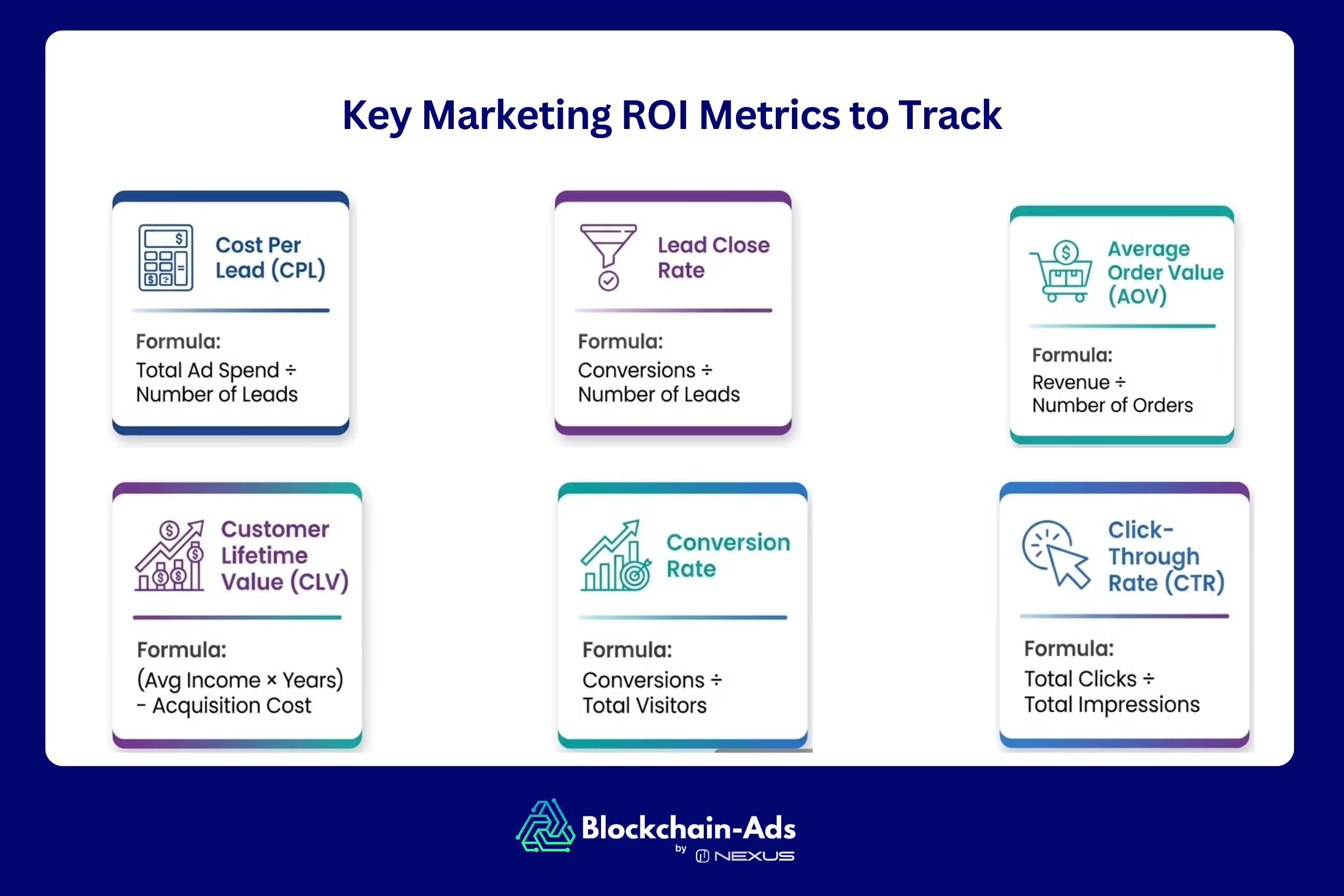
When calculating the return on investment for your digital marketing efforts, it is important to follow metrics. This includes those that relate to profit, revenue, and other actionable measures that are associated with your business goals.
Below are some important metrics for determining the internet marketing ROI:
Cost Per Lead (CPL)
If you are acquiring leads from your marketing campaign, you must ascertain the cost per lead. This metric shows you the total cost of acquiring a unit lead.
To determine the CPL, you divide the total cost of the digital marketing campaign by the number of leads acquired during your campaign.
CPL = Total amount spent on ads/ number of leads generated.
Comparing the CPL to what each lead offers you informs you on whether you’re acquiring a positive ROI.
Lead Close Rate
Also known as conversion rate, a lead close rate is a metric that helps you know the number of leads that become customers.
Lead close rate = Conversions/ number of leads
A lead close rate is important since leads only offer financial benefits if they close. Evaluating the number of leads you must close to achieve your ROI also helps you to set clear goals for your sales team.
It also indicates the value of the leads you’re getting. A low lead close rate means you should adjust your targeting approach to get better-qualified leads.
Determining the lead close rate by device, channel, demographic traits, and other attributes is also helpful. Plus, segmenting leads can inform you on the audiences and channels to focus on for the best ROI.
Average Order Value (AOV)
As mentioned earlier, an average order value helps you to calculate your ROI:
AOV = Revenue/number of orders
You may also need to track your total order value so that you can come up with great goals for increasing it. Increasing your AOV by a small portion can also boost your revenue significantly.
Click-Through Rate (CTR)
You must also know the CTRs for your email links, paid media, organic search results, and other campaigns.
To calculate the CTR, divide the total clicks by the number of impressions. The answer is the number of people who viewed your organic search listing or ad.
CTR = Total number of clicks / total number of impressions.
A low CTR means you should modify your targeting or adjust your copy. Higher CTRs have a positive correlation with ROI.
Consumer Lifetime Value (CLV)
A customer lifetime value (CLV) gives you a clear picture of your digital marketing ROI. It helps you know how valuable a customer is to your company over the total time they remain as your customer.
CLV = (Average income from one customer × the number of years they remain your customer) - cost per acquisition of a new customer.
Without calculating the CLV, you can spend $80 on acquiring a customer who makes a purchase worth $50 and think you have a negative ROI. However, it is a different story if they make ten $50 orders over the next 15 years.
Ascertaining the CLV also helps you to minimize the marketing costs. It will cost your business 10 times more to acquire a customer compared to maintaining one. Thus, a CLV helps you to focus on the total lifetime value of your customer rather than single purchases.
If you ascertain your average CLV, you’ll have a better idea of how much you can spend to get a new customer as you achieve your ROI goals.
For example, consider a customer who spends $200 per year, remains your client for 10 years, and the acquisition cost is $200. Your CLV calculation will be as follows:
($200 × 10) - $200 = $1,800
How to Improve Digital Marketing ROI?
To boost the digital marketing ROI, it’s crucial to implement practical strategies that suit your target audience and business objectives. Below are some effective measures on how to boost ROI in digital marketing:
- Use Data to Make Decisions
Most companies today have access to more data, and there are multiple tools that analyze this information. You can use digital marketing data to determine your ROI and use the ROI data to make accurate decisions.
Acquire the necessary data collection tools, such as Google Analytics 4. Then, set up the collection and analyzing processes. Use the data to make decisions, generate better results, and enhance your digital marketing ROI.
- Avoid Assumption Metrics
It is crucial to stay away from assumption metrics that don’t relate to the numbers that matter. While these metrics make your marketing efforts appear good, they don’t benefit your website objectives.
Some common assumption metrics include:
- Social media followers
- Site visitors
- Subscribers
Instead, divert your attention to engagement metrics that relate to ROI, know the content that drives results, and unveil growth opportunities.
Engagement metrics comprises of things such as:
- Conversion rate
- Repeat page views
- Comments per post
- Test and Adjust Your Campaigns
Digital marketing has various metrics that evaluate each aspect of your campaigns, and you can use the findings to make adjustments.
Test every aspect of your campaign, including the copy of your page design, targeting, and channels that you use.
A/B is the most practical testing model. The approach involves coming up with two versions of your landing page, ad, or other campaign element. Then, show the available versions to two groups of users and follow the performance to find which version works best.
Afterwards, maintain the winning version and try another element of your campaign. This approach can continuously improve your campaigns and give a better ROI over time.
- Establish ROI Goals
A great digital marketing ROI needs a set of clear goals. Establishing clear goals gives you something to target and guides your efforts. Always make SMART goals to boost the chances of success:
- Specific: Your goals should be as descriptive as possible. For instance, rather than setting a goal like “Increase ROI”, you can set a more specific goal like “Boost ROI by 50%”.
- Measurable: Come up with a process that will measure your progress towards your goals.
- Achievable: Goals can be inspiring, but ensure you can achieve them more realistically.
- Relevant: Ensure your ROI goals relate to your overall business objectives.
- Time-Bound: Set a deadline to offer motivation and responsibility for achieving your goals.
In addition, remember that ROI goals vary across multiple businesses. Goals vary based on your past ROI performance, costs, and related factors. A digital marketing agency can help you create more realistic goals.
Examples of Marketing ROI In Action
Digital marketing ROI varies across multiple channels, and you can improve it through tracking, strategic investments, and optimization. Below are examples of ROI on various industries:
Paid Advertising ROI
A paid advertising ROI is measured by comparing the revenue from an ad campaign against the amount you spend on the campaign. For example, if you spend $1,000 in a Google Ads and get $3,000 as profit, the ROI is 200%. This means the campaign generated twice your investment.
Social Media ROI
The social media ROI determines the effectiveness of paid media campaigns in generating revenue or certain business outcomes. An example is a small-sized business that invests in scheduling software to track bookings acquired from social media links. After utilizing $90 on the software, the entity earned a total income of $4,875 from 75 appointments booked via social platforms. Thus, it acquired a high ROI of over 5,300%.
Email Marketing
You can easily measure the profit from your email campaigns by comparing the revenue and costs. The formula for calculating the email marketing ROI is as follows:
Email marketing ROI = ([Revenue from email -cost of email]/cost of email) × 100.
For example, consider a business that spends $1000 annually on email marketing and acquires $5000 in sales from emails. In this case, the email marketing ROI will be:
ROI = ([5000-1000]/1000) × 100 = 400%.
This means the business earned an ROI of 400%, $4 for every $1 spent on email marketing. You can ascertain your total spend on email campaigns by adding:
- Email service provider fees
- Cost of creating content (design, copywriting)
- Staff wages on strategy and execution.
Content Marketing
Content marketing ROI determines the return on investment acquired from content efforts compared to the cost of producing and distributing the content. The main formula for calculating ROI is as follows:
Content Marketing ROI = ([Revenue from content - Cost of content]/Cost of content) × 100. For instance, consider a business that spends $5,000 in content marketing and earns $15,000 revenue. In this case, the ROI will be:
ROI = ([15,000-5000]/5000) × 100 = 200% Thus, the business earned a 200% ROI, or two times its investment. In other words, every $1 it spent on content generated $2 in total revenue.
Conclusion
Digital marketing is a crucial aspect for most businesses and pays out more than what it costs. You, however, need to measure its results to determine its effectiveness. Most marketing agencies will distract you with softer metrics, but the ROI matters for most businesses. The ROI of all marketing campaigns offers higher sales. Thus, your task is to run your calculation by comparing sales and overall growth throughout the campaign since results take time to build up.