How to Reach Paying Customers With Programmatic Media Buying
Key takeaways
- Conversion tracking: Setting up tracking before launch captured 128% more first-ad-set conversions than adding it later.
- Test budgets: Campaign tests funded at $500-$1,000 daily were 256% more likely to produce readable results.
- Audience targeting: Behavioral segments captured 231% more conversions than country-and-device targeting alone.
- Inventory quality: Evaluate viewability, invalid traffic, and supply paths alongside CPM to identify cost-effective inventory.
- Acquisition costs: Measure deposits, purchases, and trades to determine which programmatic campaigns bring in paying customers.
Blockchain-Ads' State of Advertising in Crypto, iGaming and Finance 2026 analyzed more than 200 advertisers and approximately 1,400 ad sets to understand what separated campaigns that reached paying customers from those that didn't.
When you're already spending at scale, generating more impressions or clicks isn't the hard part. The challenge is knowing which audiences, inventory, and campaign decisions are actually bringing in customers at a sustainable acquisition cost.
In this article, we'll share findings from the report as we explain five approaches to reaching paying customers with programmatic media buying. We'll also cover inventory selection, performance measurement, and campaign optimization.
What Is Programmatic Media Buying?
Programmatic media buying, also called DSP media buying, automates the purchase of digital ad inventory through demand-side platforms (DSPs). DSPs use audience data, bidding algorithms, and real-time auctions to evaluate available impressions and decide which ones to buy.
This turns media buying into an ongoing, data-driven process rather than a series of fixed placement decisions. Audience quality, supply paths, bidding decisions, and conversion measurement determine how effectively programmatic campaigns support that objective.
But how does it work?
How Does Programmatic Media Buying Work?
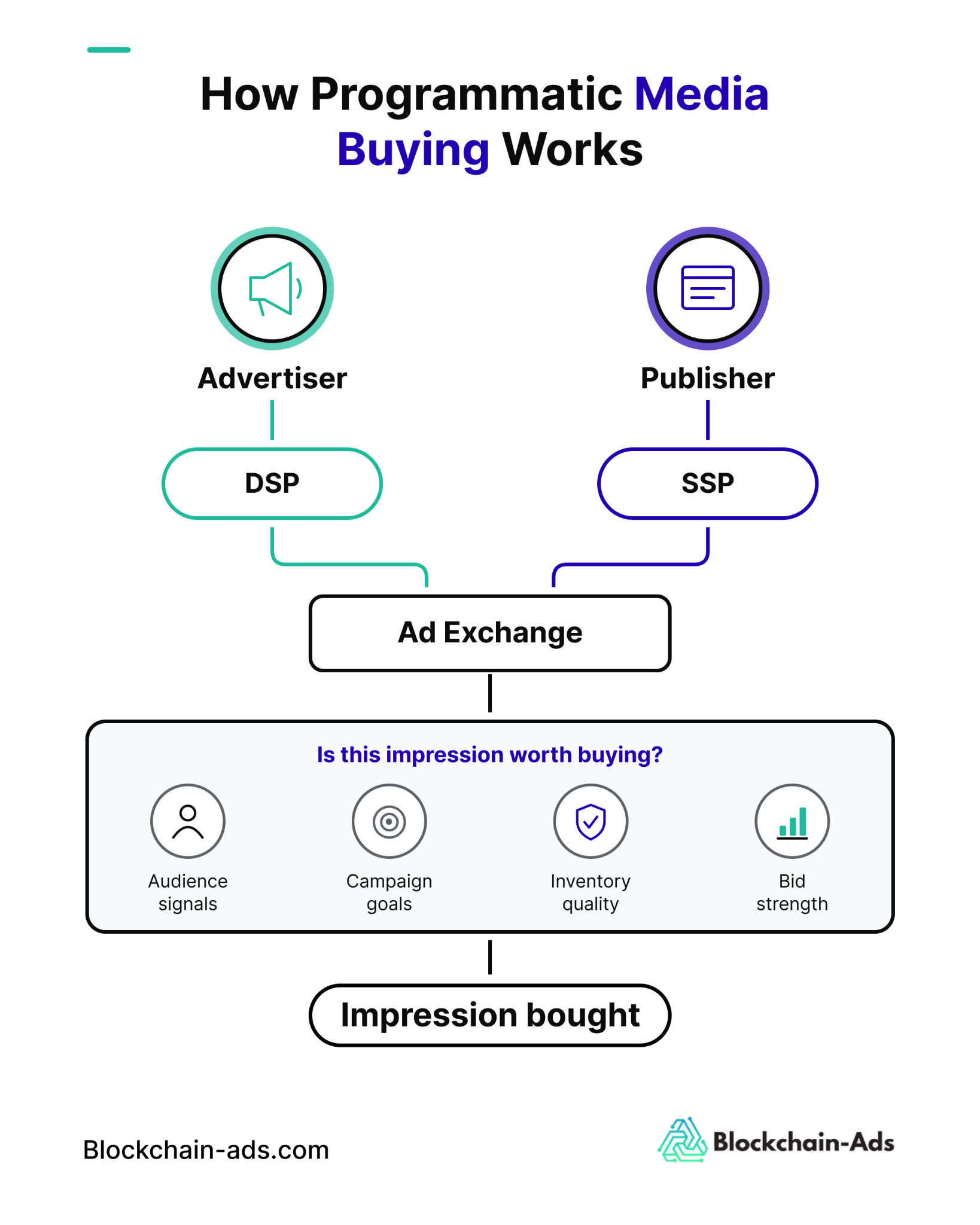
Programmatic buying connects advertisers with available inventory through demand-side platforms (DSPs), supply-side platforms (SSPs), and ad exchanges. The media buying process evaluates audience signals, campaign objectives, inventory quality, and bid competitiveness to determine which impressions are worth purchasing.
The Role of DSPs, Ad Exchanges, and Publishers
A DSP evaluates available ad inventory against an advertiser's targeting criteria and campaign goals. Supply-side platforms (SSPs) make publisher inventory available through ad exchanges, where eligible buyers compete for impressions.
The DSP handles the advertiser's buying decisions, while the SSP helps publishers manage and sell their inventory. Ad exchanges connect the two, allowing advertisers to access inventory from multiple publishers without negotiating each placement individually.
How Real-Time Bidding Works
Real-time bidding (RTB) evaluates individual ad opportunities as they become available. When someone visits a website or app, an eligible impression enters an auction. The DSP evaluates the available signals against the advertiser's targeting and bidding criteria, then submits a bid if the opportunity qualifies.
The auction determines which advertiser wins the impression, while campaign budgets and pacing controls govern spending over time.
RTB is one method of programmatic buying, and this guide stays on the buying side. For the wider ecosystem, see how programmatic advertising works.
What Are the Different Types of Programmatic Media Buying?
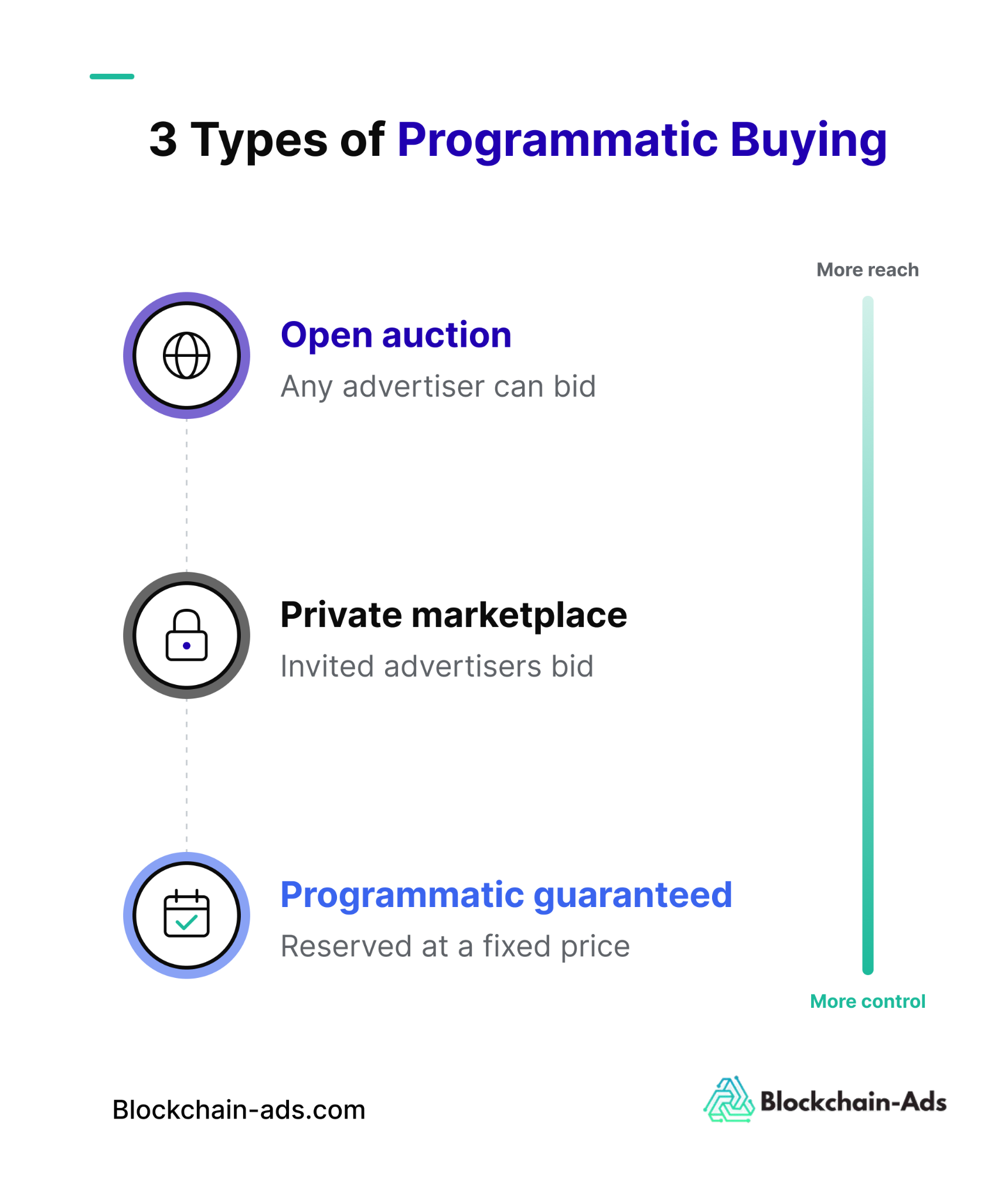
You can buy programmatic inventory through three main models, each offering different levels of inventory access, pricing control, and publisher commitments. For a deeper breakdown, see programmatic guaranteed vs. PMP vs. open auction. Here's how the three models compare at a glance:
Open Auction
Open auctions allow you to bid on available inventory in real time through a DSP. Publishers set pricing floors, while eligible advertisers compete for impressions based on their bids and targeting criteria.
This buying model uses RTB, but the two terms aren't interchangeable. RTB is the auction mechanism and can also be used in private marketplaces, where participation is restricted to invited advertisers.
If you're testing new audiences or scaling acquisition campaigns, open auctions offer broad inventory access and flexible spending.
Private Marketplace (PMP)
A private marketplace is an invitation-only auction where publishers offer selected inventory to approved advertisers. Publishers can set pricing floors and control which buyers participate.
PMPs give you access to curated inventory and greater control over publisher selection. According to the ANA's Q2 2025 Programmatic Transparency Benchmark, 87.8% of programmatic spending among participating advertisers went through PMPs, compared with 64.5% in the previous quarter.
The same study reported average CPMs of $7.15 for PMPs and $4.41 for open marketplaces. Before paying more for curated inventory, evaluate whether it delivers better-quality traffic and more paying customers. A higher CPM may be worthwhile if those impressions produce enough additional conversions to offset the higher media cost.
Programmatic Guaranteed
Programmatic Guaranteed lets you negotiate pricing, inventory, and delivery commitments directly with publishers while automating the transaction and ad delivery. Unlike auction-based buying, the inventory is reserved under agreed terms.
This model works well when you need predictable delivery, access to specific publisher inventory, or guaranteed reach during a defined period. Before committing to a fixed volume, assess whether the inventory and pricing support your acquisition goals.
Here's how the three buying models compare:
Traditional direct media buying involves negotiating placements, pricing, and delivery with individual publishers. Programmatic buying uses software to purchase eligible inventory across publishers, reducing the need to negotiate every placement separately.
Programmatic guaranteed combines both approaches by letting you negotiate inventory and pricing directly while automating ad delivery. This is the difference between direct vs. programmatic media buying. Your choice ultimately depends on your acquisition goals, budget flexibility, and how much control you need over inventory.
How to Reach Paying Customers With Programmatic Media Buying
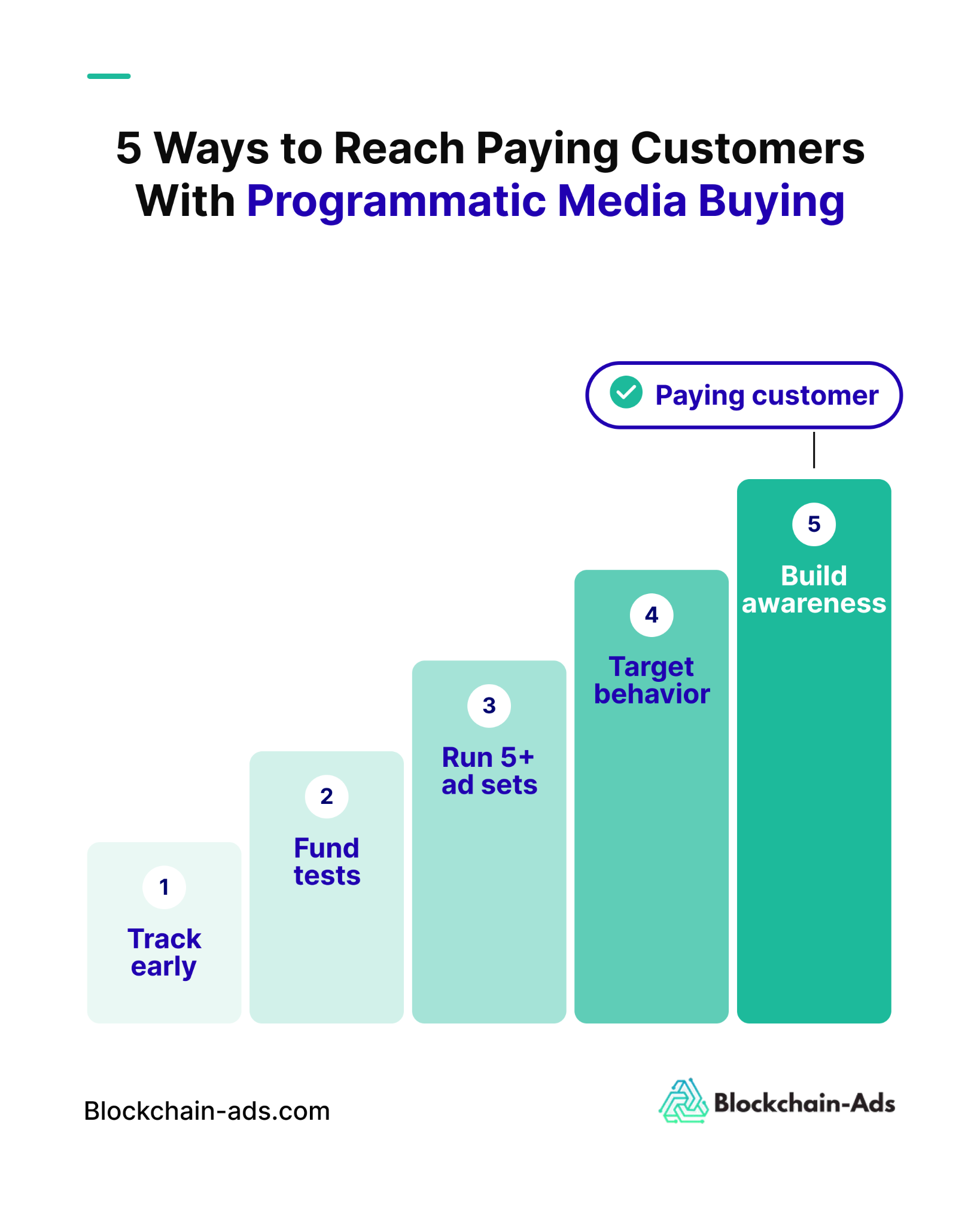
The buying model determines how you access inventory, but campaign setup determines how effectively you can measure and optimize acquisition. Data from Blockchain-Ads' State of Advertising 2026 report highlights five practices associated with reaching first deposits, purchases, and trades.
Here's how to apply them:
Set Up Conversion Tracking Before Launch
Your conversion tracking should capture the event that represents a paying customer. For crypto exchanges and brokers, this could be a funded account or first trade. Casinos typically track first deposits, while sportsbooks may use the first qualifying wager.
According to the Blockchain-Ads 2026 data, advertisers who configured conversion tracking before their first ad set captured 128% more conversions than those who added it later.
Before launching your first ad set, focus on three things:
- Define your acquisition event: Choose the deposit, purchase, or trade that represents a paying customer for your business.
- Verify conversion tracking: Confirm that your DSP receives the correct events and that duplicate conversions aren't inflating your results.
- Optimize for the right outcome: Use event-based optimization to align campaign delivery with your acquisition goal.
Set a consistent attribution window when comparing ad sets, particularly when registration and the final acquisition event happen on different days. Reconcile DSP-reported conversions with your backend records so registrations aren't mistaken for completed deposits, purchases, or trades.
Reliable tracking also gives you the data needed to calculate customer acquisition cost and identify which campaigns are bringing in paying customers.
Give Your Campaign Tests Enough Budget
Underfunded tests often end before they generate enough conversion data to evaluate an audience or creative.
The 2026 data shows tests spending $500-$1,000 per day were 256% more likely to produce a readable result than those spending under $250. Median daily test spend was $323.
Use these findings as a reference when you allocate a paid media budget, alongside your target acquisition cost and the number of audiences or creatives being tested. Give each test enough time to capture completed conversions, especially when registration, verification, and funding happen on different days. Don't stop a test based on clicks alone.
If a test isn't producing useful results, check:
- Delivery: Consistent underspending may indicate that bids are too low or targeting is too restrictive. Increasing the budget alone won't resolve either issue.
- Acquisition cost: Evaluate deposits, purchases, or trades against your allowable acquisition cost before committing more spend.
- Pacing: Check whether spending is distributed across your planned testing period or concentrated too early to evaluate performance reliably.
Keep other campaign settings stable when adjusting bids or budgets. Changing one variable at a time makes it easier to assess its effect on performance.
Run Multiple Ad Sets in Your First Month
Running several ad sets simultaneously lets you compare audiences, creatives, and bidding strategies under similar market conditions.
Blockchain-Ads' 2026 data shows advertisers who launched five or more ad sets in their first month were 87% more likely to reach a deposit or trade than those who ran only one.
To make parallel testing useful:
- Test one variable at a time: Compare audience segments using the same creative and conversion goal, or test different creatives within a single audience.
- Fund each ad set adequately: Avoid spreading your budget so thinly that individual tests cannot generate enough conversion data.
- Compare acquisition outcomes: Evaluate ad sets against the same conversion event and shift spending toward those acquiring paying customers at a sustainable cost.
Five ad sets aren't a mandatory threshold. The goal is to test meaningful variations simultaneously and identify which combinations deserve more budget.
Use Behavioral and First-Party Audience Data
Reaching more people won't necessarily bring in more paying customers. Behavioral targeting helps you build a programmatic audience around users whose interests and online activity indicate an interest in your product.
The 2026 data shows behavioral segments captured 231% more conversions than country-and-device targeting alone. Adding advertisers' first-party data increased conversion capture by a further 17%.
For example, a crypto exchange can target people interested in trading, then use registration data to retarget users who haven't funded their accounts. Keep these audiences separate and compare their acquisition costs against the same downstream conversion goal.
When using behavioral or first-party data, respect applicable consent and targeted-advertising opt-out requirements under U.S. state privacy laws.
Build Awareness Before Scaling Conversion Campaigns
Customers may need to understand your product before they're ready to register, deposit funds, or make a purchase. Awareness campaigns help you build a paid advertising funnel by developing an engaged audience for subsequent conversion campaigns.
In fact, advertisers who started with awareness campaigns captured 142% more conversions in their subsequent conversion ad sets than those running conversion-only campaigns.
For a trading platform, this could involve two stages:
- Build familiarity: Use video or display ads to introduce the platform and reach audiences interested in trading.
- Drive acquisition: Retarget engaged users with ads focused on completing registration, funding an account, or making their first trade.
Keep messaging consistent across both stages.
Pro tip: Include awareness and conversion spending when evaluating the cost of acquiring a paying customer. Compare the results with a conversion-only campaign before scaling the approach.
How to Choose Programmatic Inventory and Optimize Your Supply Path
Inventory selection affects both who sees your ads and how much you pay to reach them. Evaluate each format against your acquisition goal, then examine the supply paths delivering those impressions.
Choosing Inventory and Ad Formats
Different formats serve different purposes in an acquisition campaign. Choose based on how much information customers need before converting and where your intended audience is most likely to engage.
- Display and native ads: Suitable for reaching relevant audiences with a clear offer and driving traffic to a registration or product page.
- Video and connected TV (CTV): Useful for demonstrating a product or building familiarity before retargeting interested viewers.
- In-app and Telegram inventory: Offer additional ways to reach relevant mobile and community-based audiences where available placements match your targeting strategy.
Blockchain-Ads' inventory and supply partners provide access to 78 supply partners across more than 195 countries, including display, native, video, CTV, in-app, and Telegram inventory.
Broad coverage gives you more options to test, but it shouldn't determine where you spend. Compare formats and inventory sources using qualified traffic, downstream conversions, and acquisition cost.
Supply Path Optimization and Inventory Quality
The same impression may be available through multiple exchanges and resellers, each adding costs between the advertiser and publisher. Supply path optimization helps you identify unnecessary intermediaries and prioritize routes that deliver quality inventory at a sustainable price.
Start by checking three areas:
- Seller transparency: Review authorized sellers using ads.txt or app-ads.txt and use sellers.json to identify intermediaries.
- Traffic quality: Monitor invalid traffic and viewability. Manage publishers and placements using allow and block lists.
- Duplicate supply paths: Compare routes to the same inventory and remove those that add costs without improving delivery or conversion quality.
For example, two exchanges may offer the same publisher's inventory at different prices. Before choosing the cheaper route, compare their viewability, invalid traffic rates, and conversion performance.
Evaluate supply paths using effective CPM for qualified impressions alongside downstream conversion rates and CAC. A lower quoted CPM isn't necessarily the more economical option when fewer impressions reach real, viewable users.
How to Measure Programmatic Media Buying Performance
Media and acquisition metrics reveal which campaigns bring in paying customers at a sustainable cost. Focus on these measures to evaluate performance and guide optimization:
CPM, CPC, and CTR Benchmarks
CPM measures impression costs, CPC shows what you pay for each click, and CTR indicates how often impressions generate clicks. Understanding CPM vs. CPC vs. CPA helps you separate media efficiency from the cost of acquiring customers.
Blockchain-Ads' 2026 data reports the following median CPM, CPC, and CTR benchmarks:
Median CPC varies by industry, at $0.65 for crypto and $1.60 for iGaming. Compare your results with relevant industry benchmarks rather than relying solely on the overall median.
A higher CPM can still produce an acceptable CPC when CTR is strong. However, even an above-average CTR offers little value if users abandon registration or never fund their accounts.
Conversion Rates and Customer Acquisition Cost
The next question is how much of that traffic becomes paying customers. Measure conversion rates at the events that matter to your business, such as account funding, first deposits, purchases, or trades.
Suppose two campaigns each spend $5,000:
- Campaign A: 25 first deposits at a media-only CAC of $200.
- Campaign B: 10 first deposits at a media-only CAC of $500.
Campaign B could have a lower CPC and still be considerably more expensive at acquiring customers. Calculate media-only CAC by dividing campaign spend by the number of customers acquired.
Review conversion rates between registration and the final acquisition event to identify drop-offs. If two campaigns generate registrations at similar costs but one produces fewer deposits, investigate the funding process before changing your creatives or bids.
Bidding, Pacing, and Campaign Optimization
Use delivery and acquisition data together to decide whether a campaign needs a bid adjustment, additional budget, or a change in targeting.
Three performance patterns deserve attention:
- Consistent underspending: Check bid competitiveness and targeting restrictions before raising the daily budget.
- Rising traffic costs: Review what advertising costs by channel before assuming higher auction costs are unusual for the inventory you're buying.
- Increasing CAC: Examine conversion rates before scaling. More impressions or clicks won't justify additional spending if they aren't producing paying customers.
Change one major variable at a time and allow enough time for completed conversions to appear before evaluating the results. The objective is to increase profitable acquisitions rather than simply spend the entire campaign budget.
How to Run Programmatic Media Buying Campaigns With Blockchain-Ads
Blockchain-Ads brings audience targeting, inventory access, and campaign optimization into one platform. Start with the acquisition event you want to reach, then build your campaign around it.
1. Choose Your Acquisition Goal
Start with the action you want customers to complete. Blockchain-Ads offers four campaign objectives: Brand Awareness, Website Traffic, Sign-Ups/Downloads, and Sales/Deposits.
If you're acquiring customers for a trading platform or casino, Sales/Deposits is suited to campaigns focused on purchases or first deposits. Configure your conversion tracking before launch so you can measure the actions that matter to your business.
2. Build Your Target Audience
You can choose between two audience targeting options, depending on how much control you want over audience selection.
- Automated targeting: Uses your landing page, creatives, and campaign objective to identify relevant audiences.
- Manual targeting: Lets you select behavioral and interest-based segments, geographic locations, and custom audiences built from your own data.
Automated targeting is useful when you want the platform to identify relevant audiences. Choose manual targeting when you need greater control over specific audience segments or your own customer data.
3. Set Your Budget and Bids
Set your budget and CPC bids around your acquisition goal and the amount of data needed to evaluate performance. Budget decides how much you spend; the bid decides whether you win the impression. The Help Center covers budget and bidding in full.
Note: Blockchain-Ads requires a minimum daily budget of $360 per campaign.
Before launch, daily budget estimates show projected impressions, clicks, conversions, and cost per result. If delivery falls short after launch, review your CPC bid and targeting before increasing the budget.
4. Select Your Ad Formats
Choose formats based on the audience you're targeting and the action you want them to take. Blockchain-Ads supports display, native, and video ads, alongside other inventory options.
If you have creatives in all three formats, Performance Max campaigns let you run them within a single campaign. The platform adjusts delivery across eligible formats based on your campaign objective, reducing the need to manage a separate campaign for each format.
Your creatives and campaign details undergo a compliance review before the ads begin serving. Account for this review when planning your launch, particularly if you're promoting a time-sensitive offer.
5. Review Performance and Scale
Use HUB reporting to compare impressions, clicks, and conversions, but make scaling decisions against your acquisition event. A few inexpensive registrations aren't enough if your goal is a first deposit, purchase, or trade.
When a campaign consistently acquires customers within your target CAC, increase the budget gradually or test adjacent audiences. Change one major variable at a time so you can see what improves performance.
You can adjust budgets, CPC bids, audience targeting, and geographic settings through the platform's live campaign controls.
Qualified accounts can also use managed service at no added fee. Choose self-serve or managed based on how much of the setup and optimization you want to run in-house.
Common Programmatic Media Buying Mistakes
Even when impressions and clicks appear inexpensive, poor campaign decisions can increase acquisition costs. Avoid these mistakes when evaluating and scaling your campaigns:
Choosing Inventory Based on Low CPM or CPC
Cheap impressions and clicks offer little value when they rarely lead to deposits, purchases, or trades. Compare inventory sources by customer acquisition cost and reduce spending on placements that consistently attract low-converting traffic.
Before excluding a placement, check whether it has received enough traffic and conversions to make a meaningful comparison. A publisher with a higher CPM may still be worth keeping if it consistently delivers customers within your target acquisition cost.
Scaling Campaigns Based on Too Few Conversions
A few early conversions aren't enough to establish whether a campaign can sustain its acquisition cost at a higher budget. Review performance over a meaningful testing period, then increase spending gradually while monitoring conversion volume and CAC.
Changing Multiple Campaign Settings Simultaneously
Adjusting bids, budgets, audiences, and creatives together makes it difficult to determine which change affected performance. Identify the most likely cause, adjust the relevant setting, and evaluate the results before making another major change.
Turn Programmatic Traffic Into Customers
A successful programmatic campaign should tell you more than how many customers you acquired. It should reveal which audiences convert, what those customers cost, and how much additional demand you can capture before acquisition costs rise.
Those insights become more valuable with every campaign. Carry proven audiences and creatives into future tests, investigate where potential customers drop off, and expand spending only when the economics support it.
DSP media buying gets more precise with every campaign you run on the Blockchain-Ads DSP, because audience, conversion, and cost data stay connected.
Check if your business qualifies for Blockchain-Ads and explore your options for reaching paying customers through programmatic advertising.
Frequently Asked Questions
How Can You Measure Incremental Conversions From Programmatic Ads?
Run a holdout test comparing an audience exposed to your ads with a comparable group that doesn't see them. The difference in deposits, purchases, or trades helps estimate the additional customers generated by advertising, rather than counting every attributed conversion as incremental.
What Is a Good Frequency Cap for Programmatic Advertising?
There is no universal frequency cap. Set an initial limit based on your audience size and buying cycle, then compare conversion rates and acquisition costs across exposure levels. If repeated impressions increase spending without bringing in additional customers, consider lowering the cap.
How Can You Tell Whether Poor Results Come From Your Ads or Landing Page?
Compare CTR with post-click conversion rates. If people click but rarely register, check whether the landing page matches the ad's offer, loads quickly, and makes the next action clear. If registrations are healthy but deposits remain low, investigate verification and funding drop-offs before changing your creatives.
How Can You Prevent Ad Fatigue?
Review engagement and acquisition costs by creative and exposure frequency. If performance declines among frequently exposed users, test fresh messaging and reduce repeated exposure. Check other possible causes, such as changes in auction costs, before assuming ad fatigue is responsible.
How Do You Account for Delayed Conversions?
Choose an attribution window based on how long customers typically take to complete your target action. For example, a user may register immediately but fund their account several days later. Apply consistent windows across campaigns and allow enough time for delayed conversions to appear before comparing acquisition costs.
Srijan Sharma is a B2B writer specialising in SaaS, FinTech, MarTech, and data integration.
View full profile →