How to Build Paid Ad Funnels for Exchanges, Casinos, and Brokers
Key takeaways
- Event mapping: Build the funnel around visits, registrations, KYC, deposits, and trades instead of relying only on broad stage labels.
- Stage metrics: Use different events to judge different stages, so prospecting, registration, funding, and activation each have a clear success measure.
- Audience handoff: Move users into new audiences as they progress so later campaigns can target visitors, registrants, verified users, and depositors.
- Funnel rates: Measure the conversion rate between each event to identify whether users drop off at registration, verification, funding, or activation.
- Early tracking: Advertisers with tracking in place from launch reached a first deposit or trade 46% of the time versus 24% when tracking was added later.
A paid advertising funnel should show more than where someone sits between awareness and conversion. For an exchange, casino, or broker, it should show the measurable actions that move someone from seeing an ad to becoming an active customer.
Start by mapping the events that matter, such as visits, registrations, KYC completions, deposits, and first trades or wagers. Then assign the right audience and ad format to each stage, and measure how effectively users move from one event to the next.
This guide shows you how to build that funnel stage by stage. It covers how to create handoffs between campaigns and use conversion data to identify where users stop progressing.
What Is a Paid Advertising Funnel?
A paid advertising funnel is a sequence of paid campaigns built to move prospective customers through measurable stages of the acquisition journey.
Traditional advertising funnel stages such as awareness, consideration, and conversion help describe what a campaign is trying to achieve. However, they don't tell you whether a prospect moved closer to becoming a customer.
For an exchange, the measurable journey might look like:
Visit → registration → KYC → deposit → first trade
A casino might track:
Visit → registration → verification → first deposit → first wager
And a broker could use:
Visit → registration → KYC or account approval → funded account → first trade
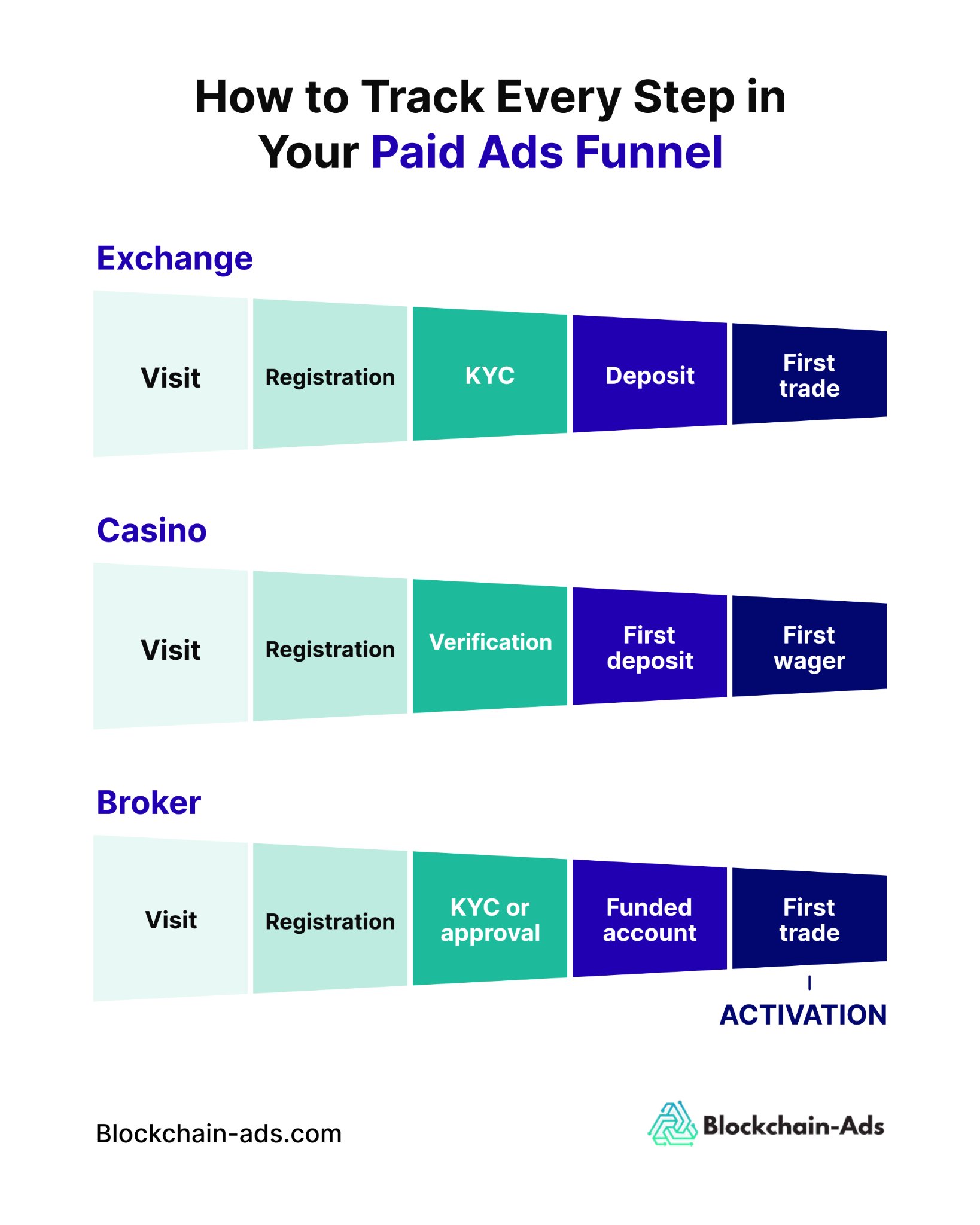
Your exact events will depend on your product and acquisition process. The key is to define what progression looks like before building campaigns around it.
This approach turns a generic paid ad funnel into something you can measure, and for each stage you define:
- Which event you'll use to judge that stage
- Who advances to the next stage
- What conversion rate do you need to watch between them
Start Your Paid Advertising Funnel with the Conversion Events
Map the actions a user needs to complete between seeing an ad and becoming an active customer. Do this before choosing audiences, formats, or budget because those decisions depend on the action you want each stage to drive.
You don't need a separate campaign for every event. Instead, identify the events that show meaningful progress and decide which one you'll use to judge each stage.
For example, use visits to measure whether prospecting campaigns are bringing users into the journey. The next campaign can focus on registrations, while later campaigns target registered or verified users and measure KYC completions, deposits, funded accounts, or first trades.
Tracking more than one event also lets you measure the handoffs between stages rather than seeing only the final conversion count. You can compare how many users reached an earlier event with how many completed the next one and identify where progression drops.
Build Each Advertising Funnel Stage Around One Job
Once you’ve mapped the events, give each stage of the paid media funnel a specific job. Define:
- Who the campaign should reach
- What action you want them to take
- Which event you’ll use to judge performance
- What moves them into the next stage
A simple structure looks like this:
The event changes with the job. If you judge every stage on deposits or trades, you lose visibility into whether earlier campaigns are moving users towards the next action.
Stage 1: Reach Qualified Prospects
Start by reaching new prospects who match the customer profile you want to acquire. You can use display, native, video, or Performance Max to introduce the offer and drive those users to the site.
Use visits or another relevant early event to judge this stage rather than expecting every prospecting ad set to generate a deposit or trade. Aim to bring qualified users into the funnel so later campaigns have an audience to move towards registration and conversion.
Advertisers that started with awareness recorded conversions in 46% of their later conversion ad sets, compared with 19% among advertisers that ran conversion ad sets only.
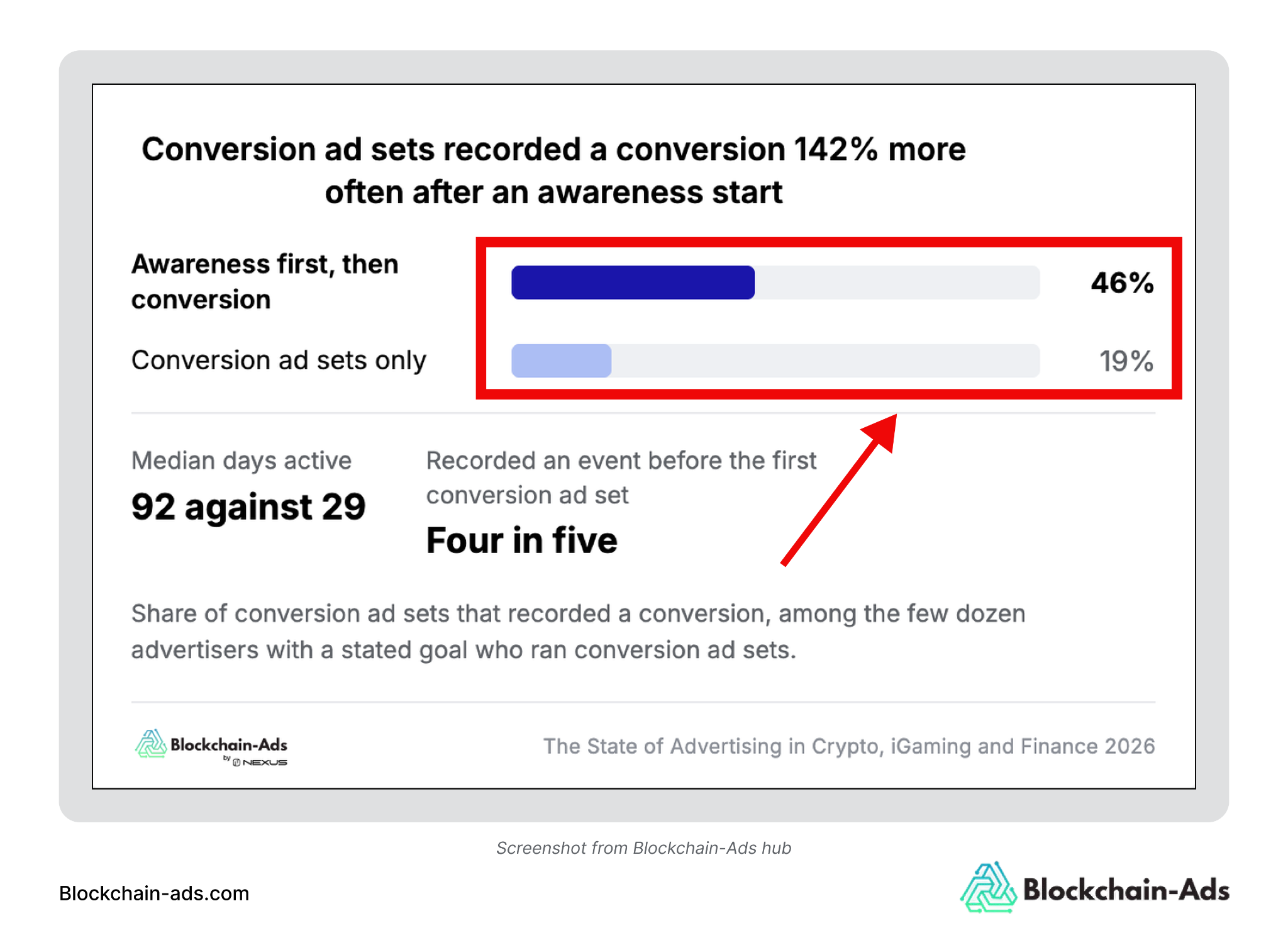
This pattern suggests an awareness-first structure was associated with more later-funnel conversions. However, the data doesn’t establish awareness as the cause.
When a prospect visits, clicks, or completes another qualifying action, use that event to decide whether to move them forward. Then place them into the appropriate audience group and campaign.
Stage 2: Turn Visits Into Registrations
Target users who have shown interest, such as site visitors, ad clickers, or other engaged users. At this stage, watch the registration event because it shows that a user has moved beyond browsing and started the onboarding process.
Measure the handoff with your visit-to-registration rate:
Visit-to-registration rate = registrations ÷ visits × 100
Use this rate to compare how effectively campaigns, audiences, or landing pages turn traffic into new accounts. For instance, a weak rate can signal that you need to investigate audience quality, message-to-page alignment, or friction in the registration process.
Once a user registers, remove them from account-creation campaigns and move them into the next audience pool. From there, focus on the next meaningful action, such as completing KYC, verifying the account, or making a first deposit.
Stage 3: Move Registered Users Through Verification and Funding
Use the event that best reflects progress in your onboarding flow. For an exchange or broker, that could be KYC completion, account approval, or first deposit. For a casino, it could be verification or first deposit.
Choose one primary event for the campaign based on the action you need users to complete next. You can still track the other events, but the primary event gives you a clear measure for judging that stage.
Measure the handoff with the rate that matches the step you are trying to improve:
Registration-to-KYC rate = completed KYC ÷ registrations × 100
KYC-to-deposit rate = depositors ÷ completed KYC × 100
If you don't track KYC as a separate stage, use the broader registration-to-deposit rate:
Registration-to-deposit rate = depositors ÷ registrations × 100
These rates show where progression weakens. For instance, strong registration volume with weak KYC completion points you towards the verification step. Similarly, strong KYC completion with weak deposit activity shifts attention to the funding step.
Use a clear campaign handoff rule: once a user completes the event that qualifies them for the next stage, exclude them from the current campaign and add them to the next audience pool.
For this stage, that could mean:
- A registrant moves into a KYC campaign
- A verified user moves into a deposit campaign
- A depositor moves into an activation campaign
Stage 4: Turn Funded Users Into Active Customers
Choose the event that represents activation for your product. For an exchange or broker, that is usually a first trade. For a casino, it could be a first wager or another event that marks the user as active.
At this stage, target users who have already completed the funding step but are not yet active on the platform. Judge the campaign on the activation event itself rather than on another deposit or registration.
Measure the final handoff with a rate such as:
Deposit-to-first-trade rate = first traders ÷ depositors × 100
or
Deposit-to-first-wager rate = first wagerers ÷ depositors × 100
Use this rate to see how effectively funded users become active customers. Here, a strong deposit volume with weak activation suggests that the issue sits after funding rather than earlier in the acquisition funnel.
Once a user completes the activation event, exclude them from acquisition campaigns built to drive that action. Move them into the retention or customer marketing journey instead of keeping them in the paid acquisition funnel.
Use Each Stage to Build the Next Audience
The events recorded throughout the funnel can also determine who your next campaign targets. As users visit, register, verify, deposit, or activate, place them into audiences that reflect how far they have progressed.
For example:
- Visitors: Retarget users who reached the site but did not register
- Registrants: Target users who created an account but have not completed verification
- Verified users: Target users who completed KYC but have not funded their account
- Depositors: Target funded users who have not made their first trade or wager
Use exclusions to keep each audience mutually exclusive. A registrant should no longer receive ads asking them to register, just as a depositor should no longer remain in a funding campaign.
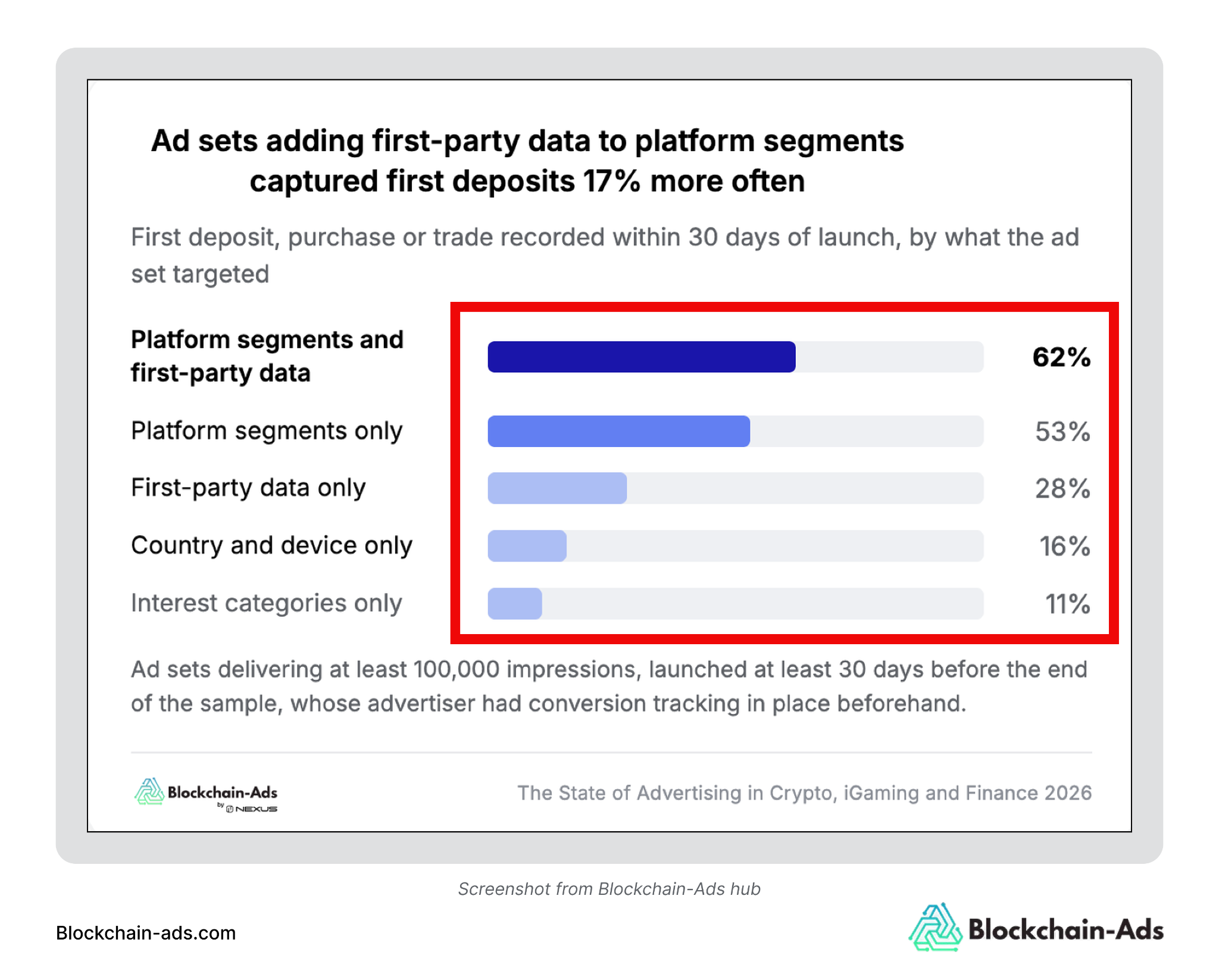
Your first-party audiences can then complement the broader segments used for prospecting. Ad sets combining platform segments with first-party data recorded a first deposit, purchase, or trade within 30 days 62% of the time. By comparison, ads set featuring platform segments alone only achieved this 53% of the time.
Advertisers in the same dataset added their own visitor, event, and customer data within 25 days after first using platform segments. You don't need to wait a fixed number of days, though. Add first-party audiences once you have enough relevant activity to make them useful alongside your prospecting segments.
Install the Data Layer Before You Launch
Set up tracking before you send traffic into the funnel. If you don’t record visits, registrations, KYC completions, deposits, and trades from the start, you lose visibility into how users move between stages.
Define the events first, then confirm that each one records correctly before launch. At minimum, check:
- Which event belongs to each funnel stage
- How each event will be tracked
- Whether the event fires correctly
- What conversion event should each campaign optimize for
- Whether users can be moved into the right audience after completing it
How early you set up tracking also matters. Advertisers that had tracking in place before launch recorded a first deposit or trade 46% of the time, compared with 24% among advertisers that added tracking later. Advertisers with tracking in place before launch recorded a conversion on their first delivered ad set 66% of the time, compared with 29% among advertisers that added tracking later.
These figures show why installing tracking early matters for measurement. You can see the events from the beginning instead of trying to reconstruct the funnel after campaigns are already running.
Blockchain-Ads lets you define separate conversion events along the same journey, such as a sign-up, deposit, or first trade, and report the resulting conversions at the campaign level. You can judge each campaign against the action it is meant to drive rather than treat every conversion as the same outcome.
Read the Funnel Using Stage-to-Stage Conversion Rates
Once the funnel is live, measure how many users move from one event to the next. These stage-to-stage rates show where progression is strong and where users drop off.
Track the transitions that match your funnel:
You do not need to track every rate in the table. Use the transitions that reflect the events in your own customer journey.
Read the rates together rather than looking only at the final conversion. For example, strong visit-to-registration performance with weak KYC completion points to a different problem from strong KYC completion with weak deposit activity.
Compare these rates across:
- Campaigns
- Audiences
- Markets
- Landing pages or onboarding flows
- Time periods
This approach creates a baseline for spotting whether a change improved one stage while weakening another.
Diagnose Where the Funnel Is Losing Users
Use the weakest stage-to-stage rate to decide where to investigate first. The goal is to isolate the part of the funnel that needs attention instead of changing audiences, creative, landing pages, and onboarding at the same time.
Treat these as starting points for investigation rather than automatic diagnoses. A weak registration rate, for example, does not tell you whether the problem comes from the audience, the ad, or the landing page until you compare those variables.
Change one part of the funnel at a time where possible, then watch the stage rate that should respond. If registration is weak, test changes that affect the visit-to-registration handoff before changing the deposit or activation campaign.
This keeps optimization tied to the stage where performance actually changed.
Put the Complete Paid Media Funnel Together
For full funnel advertising, map the stages, events, audiences, and handoff rules in one view.
Exchange Example
Casino Example
Broker Example
Use this map as the operating view for the paid funnel. It should tell you who each campaign targets, which action matters next, when a user moves forward, and which rate shows whether that handoff is working.
Build the Funnel Before You Buy the Traffic
A useful paid advertising funnel should make the next decision obvious. If users progress through one stage and stall at the next, you should know which campaign, audience, or part of the customer journey to investigate.
Blockchain-Ads can support that setup with prospecting and retargeting across display, native, video, and Performance Max, while tracking separate conversion events along the journey.
Request access to Blockchain-Ads to build and measure your paid acquisition funnel.
Raphael is a B2B SaaS and technical SEO writer covering digital advertising, Web3, fintech, and growth strategy.
View full profile →