Are Retargeting Ad Campaigns Worth It? What the Numbers Say and How to Run One
Key takeaways
- Retargeting is worth it: Warm audiences convert at about 5× the rate of cold audiences (5–10% vs. 1–2%).
- The wider data supports it: Retargeted users are 43% more likely to convert than first-time visitors.
- Segment by intent: Build audiences around what users did and tailor the next ad to that action.
- Measure the impact: Track conversions, CPA, revenue, frequency, and incrementality.
If you’re wondering whether retargeting is worth extra ad spend, our data makes a strong case for it.
For instance, warm retargeting audiences convert at roughly 5% to 10%, versus 1% to 2% for cold audiences. That’s a big gap, and it shows why people who already know your brand deserve a second look.
But does retargeting always pay off? And how do you build a campaign without wasting money on people who were never going to convert?
In this article, we cover:
- What the numbers say about retargeting and where it can improve acquisition
- How retargeting works, its main types, and real examples across industries
- How to build, optimize, and measure a retargeting campaign
What is Retargeting?
Retargeting is a form of advertising that reaches people who have already interacted with your brand but haven't completed the action you want.
For example, an interaction could mean viewing an ad, visiting your website, signing up, or taking another meaningful step toward conversion.
Instead of treating these people like new prospects, retargeting lets you re-engage them based on what they have already done.
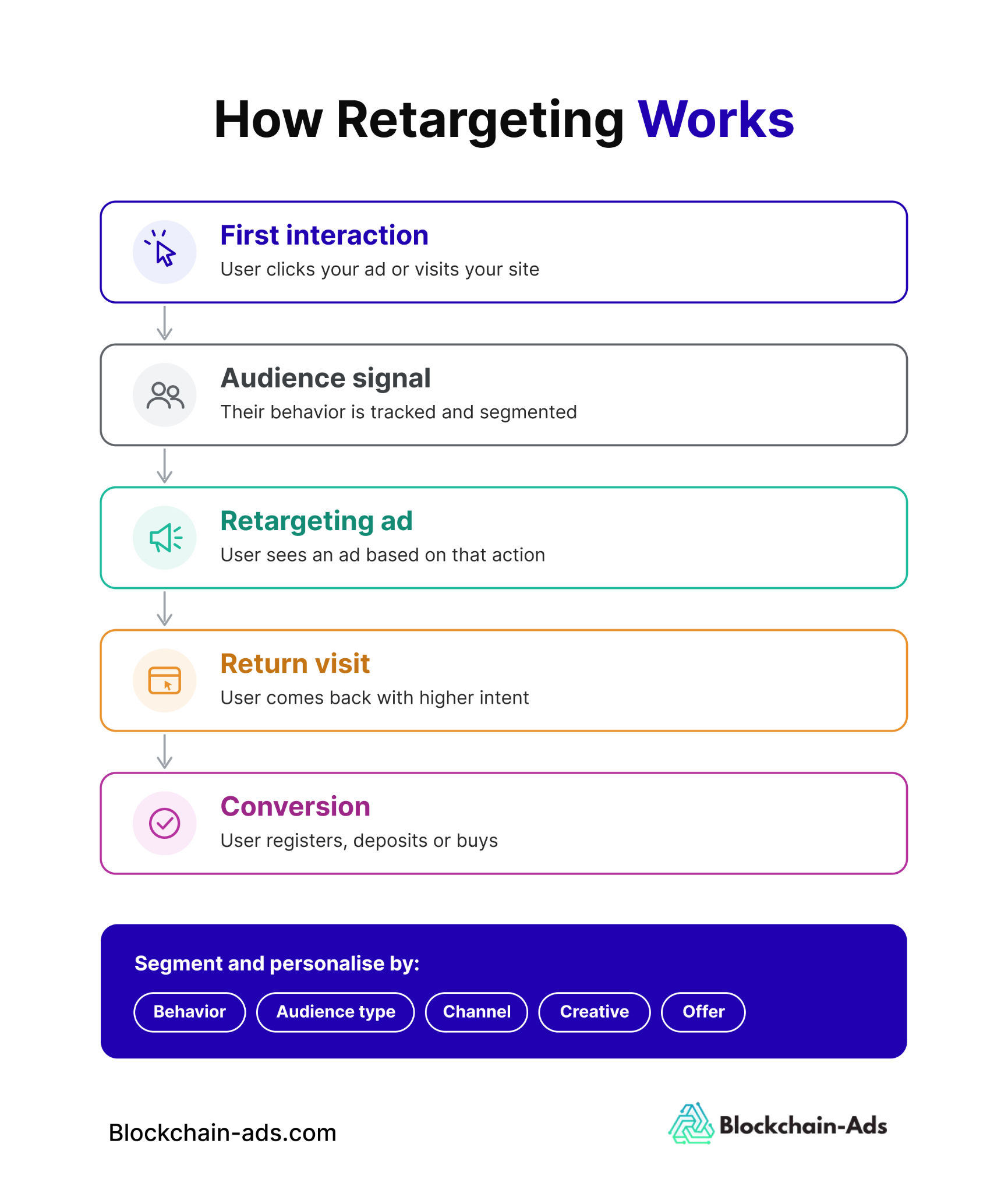
The customer journey looks like this: First interaction → Audience signal → Retargeting ad → Return visit → Conversion
The goal isn't to show someone another ad for its own sake. It is to use the information you already have about their interaction to make the next opportunity to convert more relevant.
How Does Retargeting Work?
Retargeting works in a simple loop: record an interaction, group the people who took it, and show them a follow-up ad.
First, a tracking pixel or conversion event logs what someone did, such as viewing a page, clicking an ad, or registering. The ad platform then sorts people into audiences by that action, so each segment gets a message matched to its last step.
Once an audience is large enough and the campaign is live, those users see your ads as they browse other sites and apps. Each person stays eligible for the length of your retargeting window. Anyone who completes the goal is excluded, so you stop paying to reach them.
Is Retargeting Worth It? What the Numbers Say
Most acquisition journeys do not end with the first interaction. Consumers typically engage with brands three or more times across digital channels before buying.
What does this look like in practice?
- A bettor can click an ad and leave midway.
- A fintech software buyer can visit a pricing page and need more time.
- A casino player can register without completing the next step.
Retargeting gives you another opportunity to move those people forward. The benefits include recovering missed conversions, improving acquisition efficiency, moving users further down the funnel, and making follow-up messaging more relevant.
1. Retargeting Can Improve Conversion Rates: Warm Audiences Convert at Roughly 5–10% vs. 1–2% for Cold Audiences
For media buyers, the biggest advantage of retargeting is that you are not starting from zero.
A cold prospect may have never heard of your product, but a retargeted user has already shown some level of interest. Knowing this gives you more information to work with.
You can adjust the message based on what happened during the first interaction. For instance, someone who visited your site can receive a stronger conversion message. And someone who registered can receive an ad focused on the next step.
Instead of creating interest from scratch, your campaign builds on the interest that is already there.
What the numbers say:
Blockchain-Ads campaign data shows warm retargeting audiences converting at roughly 5% to 10%, compared with 1% to 2% for cold audiences. That puts people who already know your brand at about five times the conversion rate of a first-time audience.
2. Retargeting Can Recover Missed Conversions: 30% of First-Time Depositors Came from Retargeting in One Campaign
Not everyone who shows intent converts immediately. That is normal, because buyers often pause when the timing is wrong, or they are not yet sure the offer fits.
Many want more information, time to compare alternatives, or answers about price and trust before they commit. Sometimes they simply need another reason to take the final step.
For example, a user might click an ad but never register. Another might register but never deposit. Those are two different problems, and retargeting lets you send each group a different message.
What the numbers say:
In one campaign on Blockchain-Ads, 25 of 84 first-time depositors came through retargeting, meaning retargeting accounted for 30% of all FTDs. The retargeting audience included users who clicked but didn't register and users who registered but didn't deposit.
That is a useful example because it shows retargeting doing more than generating additional clicks. It helped close gaps in the acquisition funnel.
A separate case study shows the same principle in a different industry. After using remarketing to reconnect with people who visited but didn’t convert, a furniture rental company reported a 31% increase in conversions, a 27% increase in conversion rate, and a 43% reduction in CPA.
3. Retargeting Can Move Users Further Down the Sales Funnel: One Campaign Saw 2.4× Higher Activation from Retargeted Cohorts
Retargeting shouldn't always be built around “come back to the website.” The best question is, what is the next valuable action? A user who has already registered does not need another registration ad. They need a message that helps them complete the next step.
This is where behavioral retargeting becomes particularly useful. You can separate audiences based on what they have already done and create a progression through the funnel.
What the numbers say:
In a crypto campaign, retargeted cohorts activated at 2.4× the rate of cold prospecting, after users had already shown intent but had not yet completed the target action.
The campaign used separate retargeting for users who had connected wallets but had not taken the next action and for users who had completed an earlier behavioral step without activating.
Retargeting is most useful when it moves someone from interest to action, rather than simply generating another visit.
4. Retargeting Can Improve Acquisition Efficiency: 41% of Conversions Came from 19% of Spend in One Campaign
Retargeting can make your acquisition budget work harder. That does not mean retargeting is always cheaper. A small audience can become expensive if you show ads too often, and poor creative can waste money regardless of the audience.
But when the audience is qualified and the message matches where they are in the funnel, the difference can be significant.
What the numbers say:
26% of customers will return to a website through retargeting to complete a purchase.
For example, a cryptocurrency exchange recently acquired 4,600 Verified New Traders at $91 CPA with Blockchain-Ads, but that's not the most interesting part: retargeting generated 41% of verified conversions while using 19% of total spend. Its CPA was $42, compared with $125 for cold prospecting.
5. Retargeting Can Make Personalization More Useful: One Industry Case Produced a 10× Higher Conversion Rate
Retargeting gives you context to make the next ad more relevant. First, segment users by their last meaningful action, such as the product they viewed, the page they visited, or the stage where they dropped off.
Then change the ad to match that action: show the product they viewed, reinforce the value for a pricing page visitor, or remind someone who started a form to complete it.
What the numbers say:
A marketing automation company used the personalized remarketing approach, and it generated a 10x higher conversion rate than traditional display remarketing, along with a 117% year-over-year increase in qualified leads.
Retargeting doesn't always need to drive an immediate purchase. It can move someone into an owned channel, such as an email list, where the brand can continue the relationship.
6. Retargeting Can Outperform Broad Audiences: One Campaign Saw a 4.5% Conversion Rate vs. 0.68% for New Visitors
If you put a prospect into the same bucket, you lose the information that makes retargeting valuable in the first place.
A person who has already interacted with your brand is different from a completely new visitor. And a person who has shown deeper intent is different from someone who bounced after a few seconds.
That is why audience segmentation should happen before creative production, not after.
What the numbers say:
A footwear brand reported a 4.5% conversion rate among users reached through its remarketing search ads, compared with 0.68% for new visitors. The company also reported that 15% of generic conversions were coming through those remarketing campaigns.
Your own segmentation should reflect the same idea. Instead of creating one giant “website visitors” audience, consider separating high-intent behaviors from weaker signals.
What These Benefits Mean for Your Acquisition Strategy
The numbers tell a consistent story across campaigns and sources.
Retargeting can help you:
- Convert people who already know your brand.
- Recover users who stopped before the desired action.
- Move users from one funnel stage to the next.
- Improve the efficiency of some acquisition spend.
- Make follow-up messaging more relevant.
- Separate high-intent users from broader audiences.
- Combine behavioral signals with first-party data.
But keep one important distinction in mind. A retargeted conversion is not automatically incremental. Someone may have converted without seeing the retargeting ad. If you use only last-touch attribution, the ad can receive credit for a conversion it influenced but didn't necessarily cause.
That is why the best retargeting strategy combines strong audience segmentation with proper measurement.
Types of Retargeting Ads
The right retargeting approach depends on who you are trying to bring back and what they did before they left. Most campaigns combine one or two of the types below:
Display Retargeting
Display retargeting keeps your brand in front of people who have already shown interest as they continue browsing websites and apps. Instead of letting that first interaction end when they leave, you can use display ads to bring them back with a message built around their next step.
With an advertising platform like Blockchain-Ads, you can build a warm audience from previous interactions and reach those users across display inventory with fresh creative.
Mobile Retargeting
Mobile retargeting focuses on users who interacted with your brand through mobile devices or apps. The message needs to match the mobile journey. Someone who installed an app but never completed registration needs a different prompt from someone who has already registered. Build mobile retargeting around the action the user started but did not finish.
Behavioral Retargeting
Behavioral retargeting uses previous actions to determine what a user should see next. Someone who only viewed your homepage, someone who visited a pricing page, and someone who abandoned checkout should not necessarily receive the same creative. The more meaningful the behavioral signal, the more specific your follow-up can be.
Website Retargeting
Website retargeting focuses on people who visited your site but did not complete the conversion goal. Don't treat every website visitor as the same audience. The key is to segment visitors by intent. A pricing-page visitor has given you a stronger signal than someone who bounced from the homepage.
Pixel-Based Retargeting
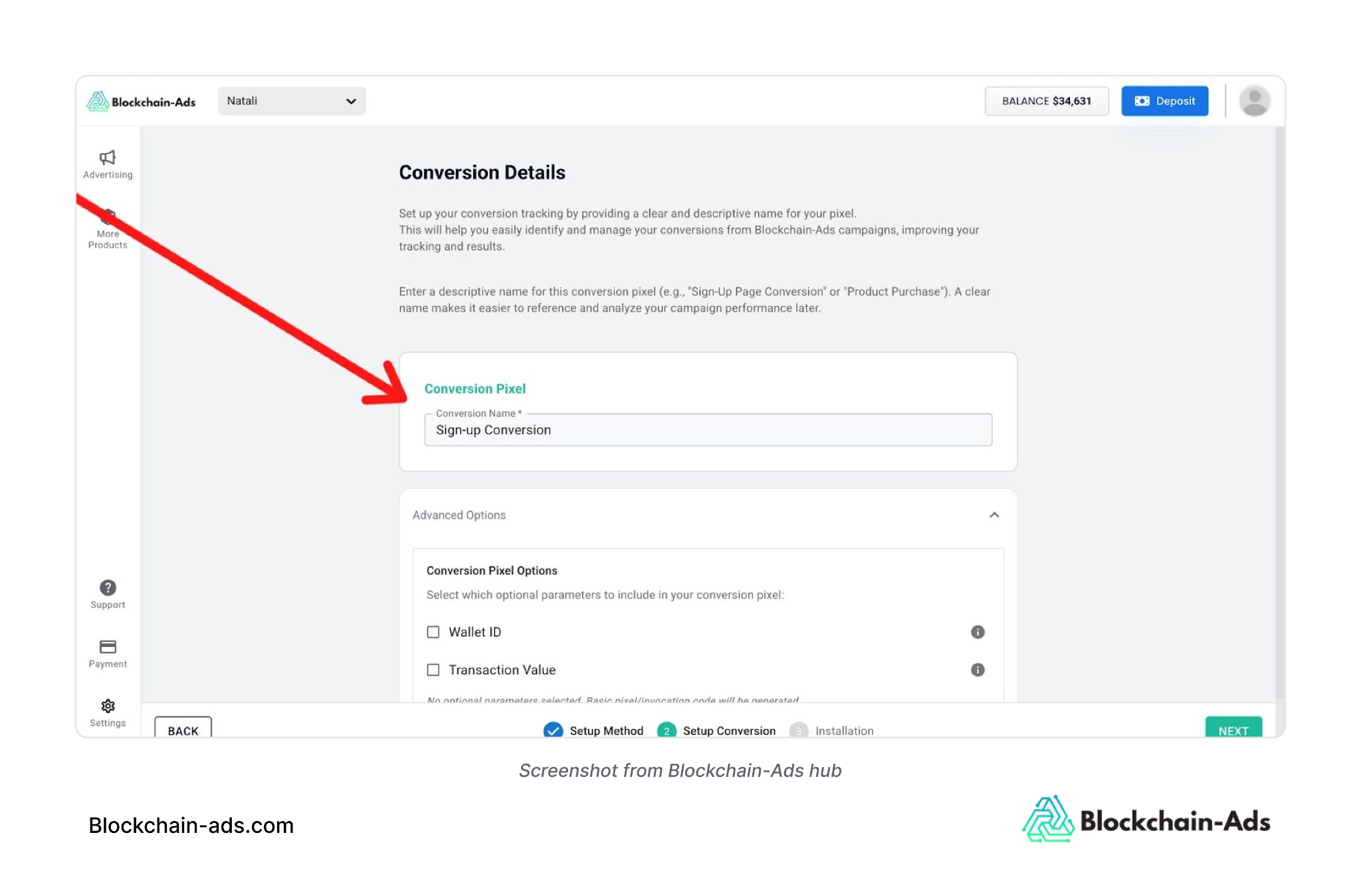
Pixel-based retargeting uses a tracking pixel to capture what visitors do on your website, such as the pages they view, products they browse, or actions they start but don't complete. That data lets you build audiences around specific actions and show each group a more relevant follow-up ad.
For example, you can retarget product viewers with that product, reach form abandoners with a completion message, or show cart abandoners an offer that brings them back.
With Blockchain-Ads, you can use pixel events to create custom retargeting segments and then run ads against those audiences.
How to Run a Retargeting Ad Campaign
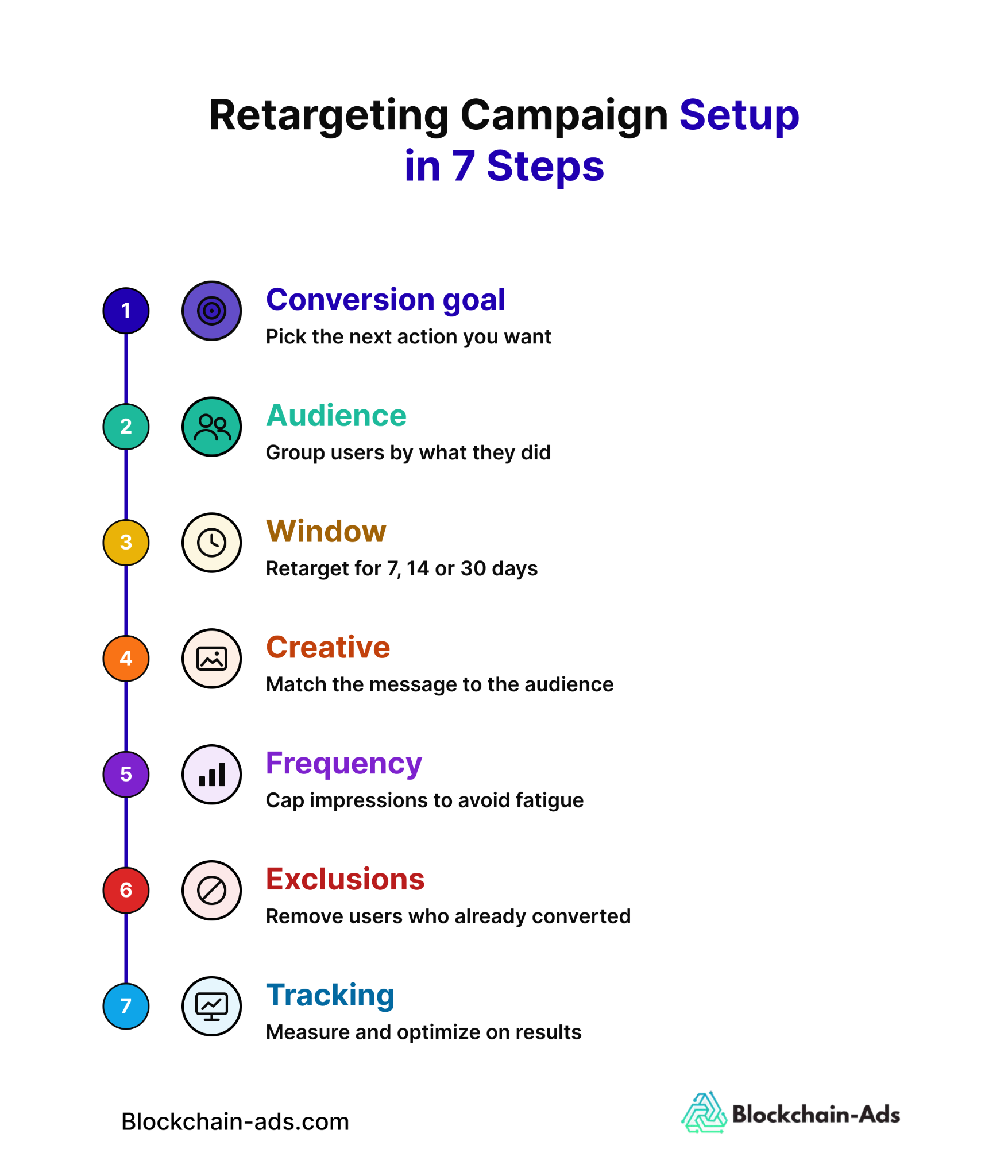
A retargeting campaign does not need to be complicated. Build the campaign in this order:
Conversion goal → audience → window → creative → frequency → exclusions → tracking
1. Define Your Conversion Goal
Decide what you want the campaign to accomplish before creating the audience. It could be a purchase, registration, first deposit, subscription, application, demo, account activation, or repeat purchase. Then ask, "What did this person do, and what should they do next?" From there, outline all your conversion goals and create action items for each.
2. Build Your Audience
Start with the user’s last meaningful action. You can build retargeting audiences from people who interacted with your ads, visited your website, or signed up or deposited. On Blockchain-Ads, an audience becomes available for retargeting once it passes roughly 15,000 users, so smaller brands may need a longer window to qualify.
Once you've mapped out your audience, segment them by intent. A visitor who only viewed a page shouldn't get the same ad as someone who registered but didn’t convert.
From there, create separate segments for each meaningful stage, then give each segment a message that moves it to the next action.
For example, retarget a product-page visitor with that product. Give a registered user a reason to complete the next step. And exclude users who have already completed the campaign goal. Blockchain-Ads lets you create custom audience segments and apply exclusions within its targeting setup.
3. Choose Your Retargeting Window
Your window determines how long someone remains eligible for retargeting after the original interaction. At Blockchain-Ads, we recommend a 7- to 30-day window as a starting point, with 60- to 90-day windows useful for smaller audiences. The right choice depends on the buying cycle. A user making a quick purchase decision may need only a short window. A longer consideration cycle may justify more time.
4. Create Dedicated Retargeting Creative
Don't simply show the prospecting ad again. For instance, if the first ad introduced the offer, the retargeting ad should address the next step. Use the user’s previous action to shape the message.
5. Set a Sensible Frequency
Retargeting requires staying visible without becoming annoying. One report suggests showing an ad 5–7 times to a warm audience is a reasonable range before repeated exposure becomes a concern.
Watch frequency alongside conversion rate and engagement. If the same audience keeps seeing an ad without responding, rotate the creative or adjust the audience.
6. Exclude Users Who Convert
Once someone completes the action your campaign is designed to drive, remove them from that campaign. A person who has already registered shouldn't keep seeing an ad asking them to register, and a depositor shouldn't stay in a first-deposit campaign.
7. Track the Outcome That Matters
You can't track what you don't measure. Clicks can tell you whether an ad attracts attention, but they cannot tell you whether the campaign created business value.
Track the conversion that matters to your business, along with:
- Conversion rate
- Cost per conversion
- Revenue or deposit value
- ROAS, where applicable
- Audience frequency
- Performance against prospecting
Blockchain-Ads' 2026 research also found that advertisers who set up conversion tracking before launch reached a first deposit or trade 92% more often than those who did not. The finding is an association, not proof that tracking itself caused the higher result.
5 Common Retargeting Ad Mistakes to Avoid
Retargeting can improve acquisition efficiency, but it is easy to waste spend if the campaign is built around the wrong audience, message, or measurement approach. Avoid these five common mistakes.
1. Retargeting Everyone with the Same Message
A website visitor who viewed one page is not necessarily as valuable as someone who reached the pricing page, registered an account, or abandoned a purchase.
Putting all of these users into one audience removes the behavioral information that makes retargeting useful in the first place. Instead, segment users by their last meaningful action and tailor the creative to that stage.
2. Showing the Prospecting Ad Again
Someone who has already interacted with your brand does not necessarily need another introduction. Repeating the same prospecting creative can make the campaign feel irrelevant and give the user no new reason to act.
Use the first interaction as context. If the prospecting ad introduced the product, the retargeting ad can address a specific benefit, objection, or next step.
3. Retargeting Users After They Convert
Few things waste ad spend faster than promoting an action someone has already completed.
Set up conversion-based exclusions so users leave the campaign once they reach the desired outcome. Someone who has registered shouldn’t keep seeing registration ads, and a customer who has already purchased shouldn’t be in a campaign designed to drive that first purchase.
4. Letting Frequency Climb Without Monitoring Performance
Retargeting depends on repeated exposure, but showing the same ad too many times can cause ad fatigue and waste impressions.
Monitor frequency alongside conversion rate, engagement, and cost per conversion. If frequency keeps rising while performance falls, refresh the creative, narrow the audience, or adjust the retargeting window.
5. Assuming Every Retargeted Conversion Was Caused by the Ad
A conversion attributed to a retargeting ad does not necessarily mean the ad caused the conversion. Someone who was already likely to buy may have converted without seeing the ad.
That is why last-touch attribution alone can make retargeting look more effective than it really is. Where possible, use holdout or control groups to estimate incrementality and compare retargeted users with a suitable group that did not receive the campaign.
The goal is to determine whether retargeting is creating additional conversions that would not have happened otherwise.
Retargeting Best Practices
Keep your retargeting campaign focused with these five rules:
- Segment by intent: Build audiences around what users actually did, not just the fact that they interacted with your brand.
- Use dedicated creative: Give retargeted users a new reason to act instead of repeating the prospecting ad.
- Set a clear window: Match the retargeting window to your buying cycle.
- Exclude converters: Remove users once they complete the action your campaign is designed to drive.
- Watch frequency and performance: If users keep seeing your ads without converting, refresh the creative or adjust the audience.
Make Retargeting Part of Your Acquisition Strategy
Retargeting gives you another opportunity to convert users who have already shown interest. Build your audience around what they did, tailor the message to their next step, and stop once they convert.
With Blockchain-Ads, you can build retargeting audiences and run dedicated retargeting campaigns across display inventory, bringing interested users back when they are ready to take the next step.
Request access to Blockchain-Ads to plan and run your next retargeting campaign.
Frequently Asked Questions About Retargeting Ad Campaigns
What Is a Retargeting Ad Campaign?
A retargeting ad campaign targets people who have already interacted with your brand but have not completed the desired action. That interaction might be an ad view, a website visit, a registration, a product view, or another meaningful behavior.
How Long Should a Retargeting Campaign Run?
The right window depends on your audience size and buying cycle. A 7- to 30-day window is a useful starting point, while 60 to 90 days can make sense when the audience is small or the decision cycle is longer. The goal is to reach people while their original interaction is still relevant.
How Often Should Someone See a Retargeting Ad?
No universal frequency works for every campaign. Watch frequency alongside engagement and conversion performance. If frequency rises while results decline, rotate your creative or adjust the audience instead of simply showing the same ad more often.
How Do You Measure Whether Retargeting Is Working?
Start with the business outcome you want to create. Track conversions, conversion rate, cost per conversion, revenue or deposit value, and ROAS where relevant. Where possible, use a holdout or control group to estimate incrementality, because a conversion attributed to a retargeting ad is not necessarily a conversion the ad caused.
Is Blockchain-Ads a Retargeting Ad Platform?
Yes. Blockchain-Ads supports retargeting as part of its broader audience-based advertising platform. You can build retargeting audiences from people who have interacted with your ads, visited your website, or completed specific actions, then reach them again across display and other ad formats. The platform also supports pixel-based audience building and custom audience segments.
Freelance content writer/editor for B2B SaaS, AI, technology, partnerships brands.
View full profile →