
The Best CTV Advertising Platforms (CTV DSPs) for Performance Campaigns in 2026
Key takeaways
- Conversion tracking: CTV platforms can attribute website conversions to household-level ad exposure, but those matches don't establish causation.
- Lift testing: Controlled experiments help estimate which conversions advertising caused, rather than merely attributed.
- Buying options: Self-serve platforms offer direct campaign control, while managed services provide execution support.
- Industry eligibility: Crypto, iGaming, and finance campaigns face different restrictions across demand-side platforms (DSPs) and streaming inventory.
- Platform selection: Compare attribution transparency, incrementality testing, buying access, and eligibility before committing budget.
CTV advertising platforms can help you reach streaming audiences and drive sign-ups, purchases, and other conversions. But choosing between connected TV advertising platforms takes more than comparing inventory and targeting options.
A TV ad can receive credit for a conversion when someone in the same household visits your website later, even if they would have converted without seeing it. That makes attribution methods, conversion windows, and lift testing important when you evaluate performance.
This guide compares eight CTV platforms based on how they measure conversions, whether they support incrementality testing, and their restrictions on crypto, iGaming, and finance campaigns. You'll also learn why buying directly from a streaming service makes more sense.
Which CTV Advertising Platform Fits a Performance Campaign?
The best CTV advertising platforms for a performance campaign are the ones that match how you want to buy, accept your category, and prove conversions.
Note: Platform details were last checked on 31 October 2026.
Buying access and industry approval are only part of your decision. Compare each platform's conversion attribution method, available lift tests, and ability to retarget viewers across other devices.
For a broader comparison of programmatic buying tools beyond connected TV, see our best demand-side platforms guide.
The 8 Best CTV DSPs for Direct-Response Campaigns
We compared these CTV DSPs on how each ties a TV view to a conversion, whether it has a built-in lift test, how you buy, and which verticals it accepts. Some are self-serve CTV advertising platforms, while others offer managed buying and cross-device retargeting.
1. The Trade Desk
Best for: Agencies and advertisers that need broad streaming inventory, cross-device campaign execution, and conversion-lift measurement.
The Trade Desk is a self-service DSP for buying CTV inventory across streaming publishers, with cross-device targeting and conversion measurement through its Kokai platform.
Its identity solutions can help you connect activity across devices, while conversion-lift testing can measure whether CTV exposure contributed to additional customer actions. You can also buy CTV and display ads within the same platform, making it useful for cross-channel campaigns.
For regulated industries, The Trade Desk permits cryptocurrency and gambling advertising in limited circumstances. Financial services advertisers must meet additional compliance requirements.
2. Amazon DSP
Best for: Retail and consumer brands that want to connect streaming TV exposure with shopping behavior and measure conversions across Amazon and external websites.
Amazon DSP lets you buy streaming TV inventory across Prime Video, Twitch, Fire TV Channels, and third-party publishers using Amazon's shopping and streaming audience signals.
Its measurement includes view-through conversions, with a standard 14-day attribution window. You can measure purchases on Amazon and track eligible off-Amazon conversions through website pixels. Amazon also uses modeled attribution for some off-Amazon conversions, meaning reported totals may include conversions that weren't directly observed.
For incrementality, Amazon DSP supports third-party measurement studies, including options managed within its platform. Amazon Brand Lift is also available, although it measures changes in brand perception rather than incremental purchases.
Buying is available through self-service and managed-service options. Crypto, gambling, and financial services advertisers face category-specific restrictions, and approval may vary across streaming publishers.
3. Blockchain-Ads
Best for: Crypto, iGaming, and finance advertisers that need CTV inventory, conversion tracking, and cross-device retargeting.
Blockchain-Ads is a self-serve, audience-based advertising platform that lets you run CTV advertising campaigns with 15- or 30-second spots across streaming inventory, including pre-roll, mid-roll, and post-roll placements. Home-screen ads are also available through partner SSPs.
For measurement, you get:
- View-through conversions.
- Server-to-server postbacks.
- Independent verification through DoubleVerify.
- Video completion tracking at 25%, 50%, 75%, and 100%.
You can also reach the same audience on mobile, desktop, and in-app, then retarget viewers after their TV exposure.
Campaigns are available for crypto, iGaming, and finance advertisers after qualification and compliance review. You can manage buying directly or use our managed service at no additional fee if your account qualifies.
4. MNTN
Best for: Direct-response advertisers that want self-serve CTV buying, documented household attribution, and built-in incrementality measurement.
MNTN is a self-serve performance TV platform that connects streaming ad exposure with website visits and conversions through its Verified Visits attribution model.
A visit qualifies when someone watches the full TV commercial, visits your website within the attribution window, and MNTN's identity graph confirms a household-level connection. Its default Verified Visit windows are 14 days for prospecting and seven days for retargeting, although you can adjust them.
MNTN also provides an Incrementality Dashboard that compares exposed households with a control group to estimate additional visitors, conversions, and revenue.
For regulated advertisers, its creative guidelines outline requirements for compliant gambling and financial services campaigns, but its website approval rules flag gambling and lottery content as prohibited.
5. Google Display & Video 360
Best for: Enterprise advertisers that want CTV buying, cross-device conversion tracking, and access to Google's measurement tools.
Google Display & Video 360 (DV360) lets you buy CTV inventory across streaming publishers and YouTube through a single programmatic buying platform.
It uses Floodlight conversion tracking to attribute CTV impressions to actions on desktop websites, mobile websites, and apps. Google's cross-device reporting also includes modeled conversions when user activity cannot be observed directly.
For incrementality, eligible advertisers can request Conversion Lift studies that compare conversions between randomized exposed and control groups. These studies require Google representative involvement and aren't automatically available to every advertiser.
DV360 also supports display and video campaigns, allowing you to manage other advertising channels alongside CTV.
Crypto, iGaming, and financial services advertising is permitted under specific conditions. Crypto exchanges and wallets generally require certification, while gambling advertisers must meet licensing and certification requirements. Some financial products also require verification, and eligible inventory varies by category.
6. StackAdapt
Best for: Advertisers that want CTV campaigns alongside display, native, and video advertising, with cross-device attribution and retargeting.
StackAdapt offers self-serve and managed programmatic CTV buying across streaming inventory.
Its CTV measurement tracks impressions, video completions, website visits, and view-through conversions. Cross-device attribution connects TV exposure to later website activity, while cross-channel reporting shows you how CTV contributes to conversion paths involving other ad formats.
You can also retarget people exposed to CTV ads through display, native, or video placements on mobile and desktop.
StackAdapt offers Brand Lift studies for measuring changes in awareness and ad recall. It also allows cryptocurrency, gambling, and financial services advertising, subject to restrictions.
7. Viant
Best for: Advertisers that want household-level CTV targeting, cross-device conversion measurement, and incrementality reporting.
Viant is a programmatic DSP that lets you buy CTV inventory through self-serve or managed campaigns. Its Household ID technology connects TV exposure with activity on mobile and desktop devices using household identity signals.
For measurement, Viant offers cross-device attribution, including website conversions, app installs, and in-app purchases. Its Advanced Reporting suite also includes Conversion Lift reporting, which uses a ghost-bid control group to estimate incremental conversions.
In one campaign, an online sportsbook and casino brand used Viant's Household ID and Conversion Lift reporting to measure new customer sign-ups and deposits. The campaign included CTV, online video, display, and audio, so don’t treat its results as CTV-only performance.
8. Vibe
Best for: Advertisers that want self-serve CTV buying, configurable attribution windows, and straightforward website conversion tracking.
Vibe is a self-serve streaming TV advertising platform that lets you launch campaigns for website traffic, leads, purchases, and app promotion.
Its attribution method uses household IP matching. When a CTV ad plays, Vibe records the household's IP address. If someone later visits your website from the same network, its tracking pixel matches that visit to the TV exposure and attributes eligible conversions.
You can choose attribution windows ranging from 12 hours to 30 days, with 30 days as the default. Its pixel tracks page visits, leads, and purchases, although these matched conversions don't establish incremental impact.
For regulated industries, Vibe prohibits gambling advertising and requires crypto advertisers to contact support before launching. Financial advertising is subject to content review, including restrictions on misleading financial claims.
CTV DSP vs Buying Direct From a Streaming Service
A CTV DSP lets you buy advertising inventory across multiple streaming publishers, while buying directly gives you access to a particular service's advertising ecosystem.
Direct buying is worth considering when you already know where your audience watches content or want to test CTV with a smaller budget. Some streaming services offer self-serve buying without the account requirements associated with enterprise DSPs.
Here are your main options:
- Roku Ads Manager: Self-serve campaigns starting at $500, with website conversion tracking through its pixel and Conversions API.
- Amazon Streaming TV: Self-serve streaming TV campaigns through Amazon Ads, with no minimum spend, separate from Amazon DSP buying.
- Netflix: Advertising through Netflix Ads Suite and supported programmatic partners, with conversion measurement options including its Pixel and Conversion API.
- Disney Campaign Manager: Self-serve access to Hulu and Disney+ advertising, with campaign budgets starting at $500.
- YouTube: CTV advertising through Google Ads, including skippable and non-skippable video formats on television screens.
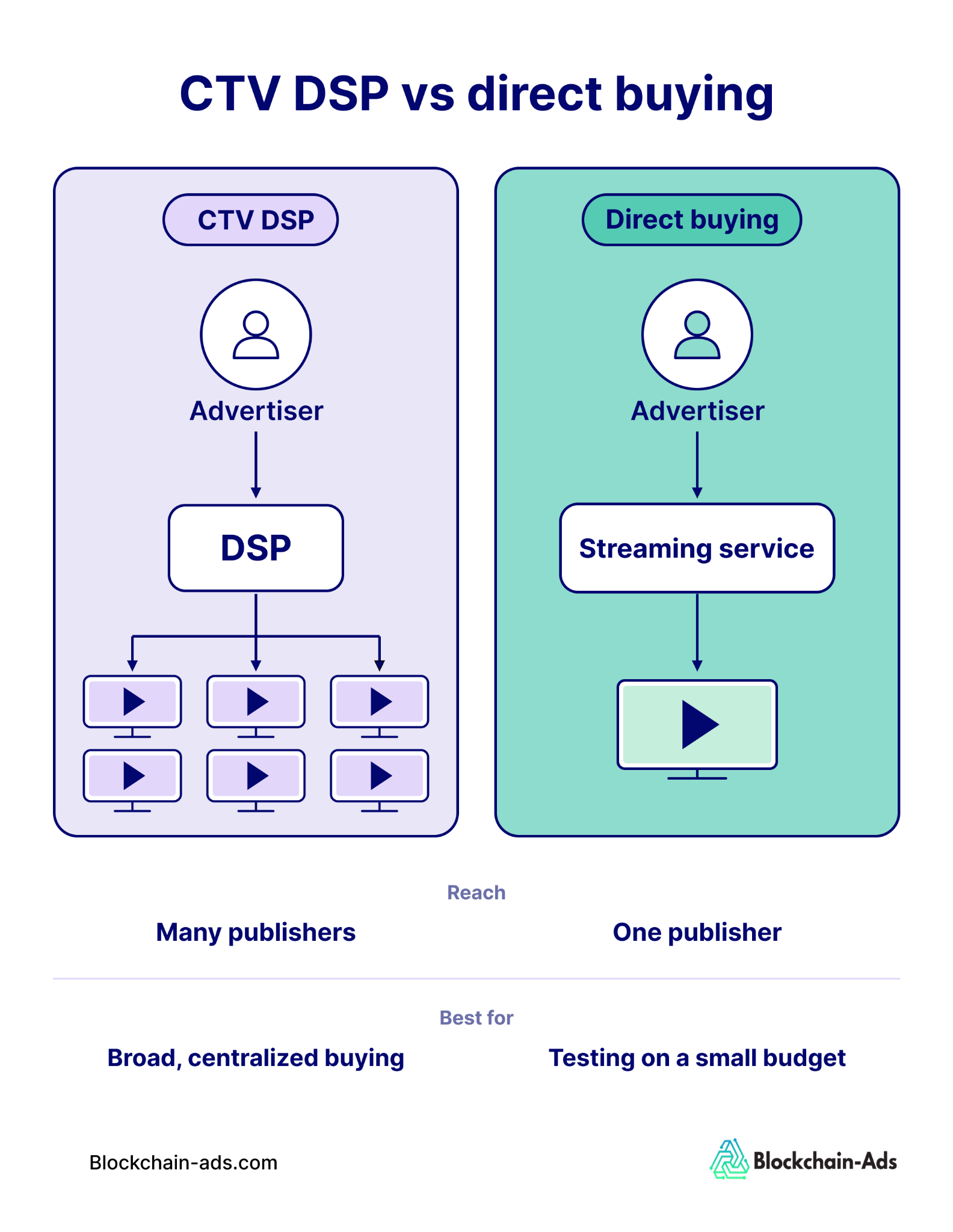
DSPs generally make more sense when you need broader streaming inventory, centralized campaign management, or coordinated programmatic media buying across TV, mobile, and desktop.
Whichever route you choose, compare how conversions are attributed and whether you can measure incremental results. The same household-matching limitations apply to both DSPs and direct-buy OTT advertising platforms.
How CTV Platforms Track Conversions From a TV Screen
CTV platforms typically track conversions by matching television ad exposure to later activity on another device, often at the household level. The challenge is that a matched conversion doesn't necessarily mean the TV ad caused it.
How Household Attribution Works
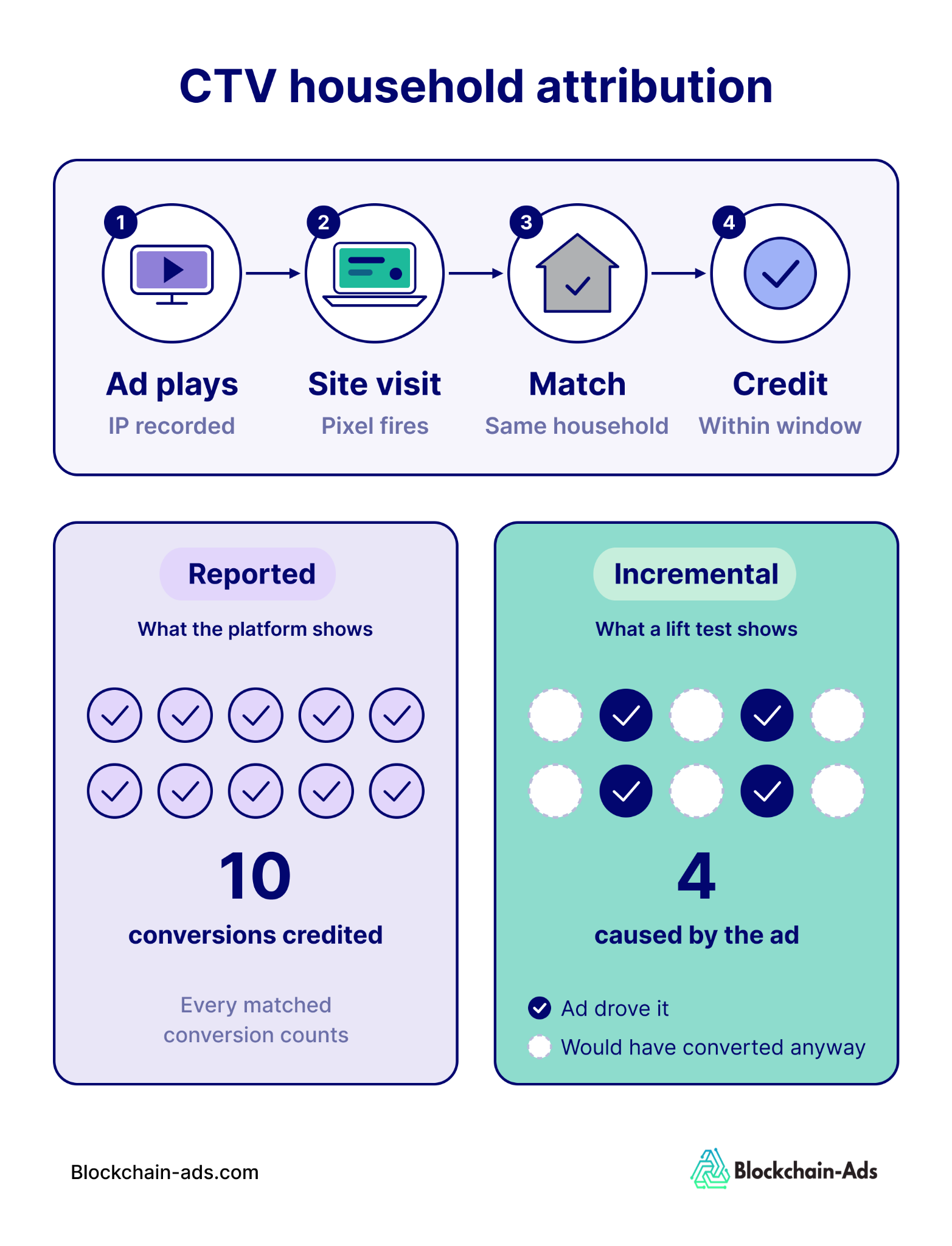
In a common IP-based attribution model, the process follows four steps:
- Ad exposure: A CTV platform records the household's IP address or another available identifier when the TV ad plays.
- Website activity: Someone visits the advertiser's website, where a tracking pixel records the visit and relevant conversion events.
- Household matching: The platform matches the website activity to an exposed household using the available identifiers.
- Conversion credit: If the activity falls within the attribution window, the platform credits the conversion to the CTV campaign.
Larger platforms may also use signed-in account data and identity graphs to match activity across devices, rather than relying exclusively on IP addresses.
Household matching can produce misleading results:
- Mobile data: A viewer who switches from home Wi-Fi to cellular data may no longer share the household's IP address.
- VPNs and Private Relay: These services can mask or replace IP addresses, making household matching less reliable.
- Shared or rotating IPs: Multiple households may share an IP address, while changing addresses can disrupt matches.
- Long attribution windows: A conversion that happens days or weeks after an ad may be credited to the campaign even if the customer would have converted anyway.
These limitations mean that reported view-through conversions can include organic activity or other marketing-driven conversions.
How Lift Testing Helps Verify CTV Performance
Lift testing estimates how many additional conversions your CTV campaign generated by comparing outcomes between an exposed audience and a comparable control group.
For example, a randomized holdout test withholds ads from part of the eligible audience. If the exposed group generates more conversions than the control group, the difference, after accounting for group size differences, estimates incremental conversions.
That gives you a stronger basis for evaluating acquisition costs than view-through attribution alone. When reviewing CTV results, compare attributed conversions with incremental conversions and calculate your cost per incremental acquisition where a reliable lift study is available.
FAQs
Which Platforms Support Real-Time Bidding for TV Ads?
The Trade Desk, Amazon DSP, Google Display & Video 360, StackAdapt, Viant, and Blockchain-Ads support programmatic CTV buying. These real-time bidding TV ad platforms let you compete for available streaming impressions through automated auctions, although some inventory is sold through private or guaranteed deals.
Auction access, available publishers, and buying arrangements differ by platform.
Is Self-Serve or Managed CTV Buying Better?
Self-serve CTV buying is better when you want direct control over campaign setup, budgets, targeting, and optimization.
Managed buying makes more sense when you need help with campaign execution, creative requirements, or ongoing optimization. Compare service fees, account minimums, and how much control you'll retain before choosing either option.
Which CTV Ad Formats Work Best for Performance Campaigns?
15- and 30-second in-stream video ads are practical starting points for performance campaigns. Use shorter spots to communicate a single benefit and a clear call to action, while longer spots give you more time to demonstrate a product or explain an offer.
Some platforms also support home-screen placements and interactive formats. The best choice depends on your conversion goal, creative, and available inventory. See our guide to video ad formats for more options.
Can You Run CTV and Mobile Ads in One Campaign?
Yes. Platforms such as Blockchain-Ads, The Trade Desk, and StackAdapt support CTV alongside mobile advertising, allowing you to reach audiences across screens.
For example, you can introduce an offer through a TV ad and follow up with mobile display or video ads, using first-party data where supported. However, cross-device retargeting depends on the platform's identity matching capabilities and available inventory. Track the results across both channels to assess their combined contribution to conversions.
Start With a CTV Campaign You Can Measure
Before committing your budget to CTV, choose one conversion event you want to improve, such as a sign-up, first deposit, or purchase. Then make sure your tracking is configured to capture it.
Start with a focused campaign:
- Define your conversion goal: Choose the action that matters to your acquisition targets.
- Set up tracking: Verify that your pixel or postback captures the conversion before launching.
- Prepare your creative: Use a 15- or 30-second video with a clear offer and call to action, then apply ad creative testing to compare variations.
- Plan your measurement: Monitor attributed conversions and use a lift test where possible to estimate incremental results.
If you're advertising a crypto, iGaming, or finance product, Blockchain-Ads lets you run CTV campaigns alongside mobile, desktop, and in-app advertising.
Request access to Blockchain-Ads to launch CTV campaigns with conversion tracking and cross-device retargeting.
Raphael is a B2B SaaS and technical SEO writer covering digital advertising, Web3, fintech, and growth strategy.
View full profile →