How to Build a Programmatic Audience From Segments and Your Own Data
Key takeaways
- Start with segments: Launch with the platform segments closest to your customer, then refine as the campaign produces data.
- Track first: Set up conversion tracking before launch, since tracked advertisers reached a first deposit or trade 92% more often.
- Layer your data: Segments plus your own data recorded a deposit-stage event 62% of the time, against 53% for segments alone.
- Exclude and check: Leave existing customers out of acquisition campaigns and review the estimated audience size before launch.
- Test one variable: Keep the audience stable while you test creative, and split markets or audiences only when the data shows a clear difference.
Programmatic audience targeting starts with deciding who should see your ads.
If you come from paid search, you may be used to starting with keywords. In programmatic, you start with people. You choose audience segments based on their interests or behavior and set the countries and devices you want to reach. As the campaign gives you more data to work with, you can add your own customer data.
You can launch before the audience is final. A good audience targeting strategy starts with a first audience you can describe, then improves as the campaign gives you data.
In The State of Advertising in Crypto, iGaming, and Finance 2026, ad sets that combined platform segments with the advertiser’s own data recorded a trade 62% of the time. By comparison, ad sets using platform segments alone recorded a trade 53% of the time.
Advertisers reached that combination in stages, launching with platform segments and adding their own data once the campaign had produced some. This guide shows you how to build that audience inside a DSP, from the first segment you select to the point where one audience becomes several ad sets.
What Is Programmatic Audience Targeting?
Programmatic audience targeting, or programmatic targeting for short, uses data about a person or their context to decide whether they can see an ad. How DSPs target audiences comes down to one check: a demand-side platform (DSP) compares each available impression with your defined audience and buys the ones that match.
That data can come from several places:
- Behavioral data: actions that suggest what someone does or buys
- Interest data: topics and content someone regularly engages with
- First-party data: data you collect from your own visitors, leads, and customers
- Second-party data: first-party data another company shares directly with you
- Third-party data: audience data collected and packaged by an outside provider
- Contextual data: the topic or content of the page where the ad may appear
- Location and device: where someone is and the device they are using
Past interactions add two more options, since you can retarget people who already engaged or build lookalike audiences from people who converted. Programmatic ad targeting matches impressions to people, which is the key difference between buying ads around keywords and building an audience for programmatic advertising.
1. Start With the Platform Segments Closest to Your Customer
Begin with what you already know about the person you want to reach. Audience segmentation and targeting start here: you group people by the signals they show, then pick the groups closest to your customer.
A sportsbook may want people who already bet on sports, while a crypto exchange might look for traders with recent on-chain activity. For a broker, the starting point could be people interested in forex, CFDs, stocks, or other financial products.
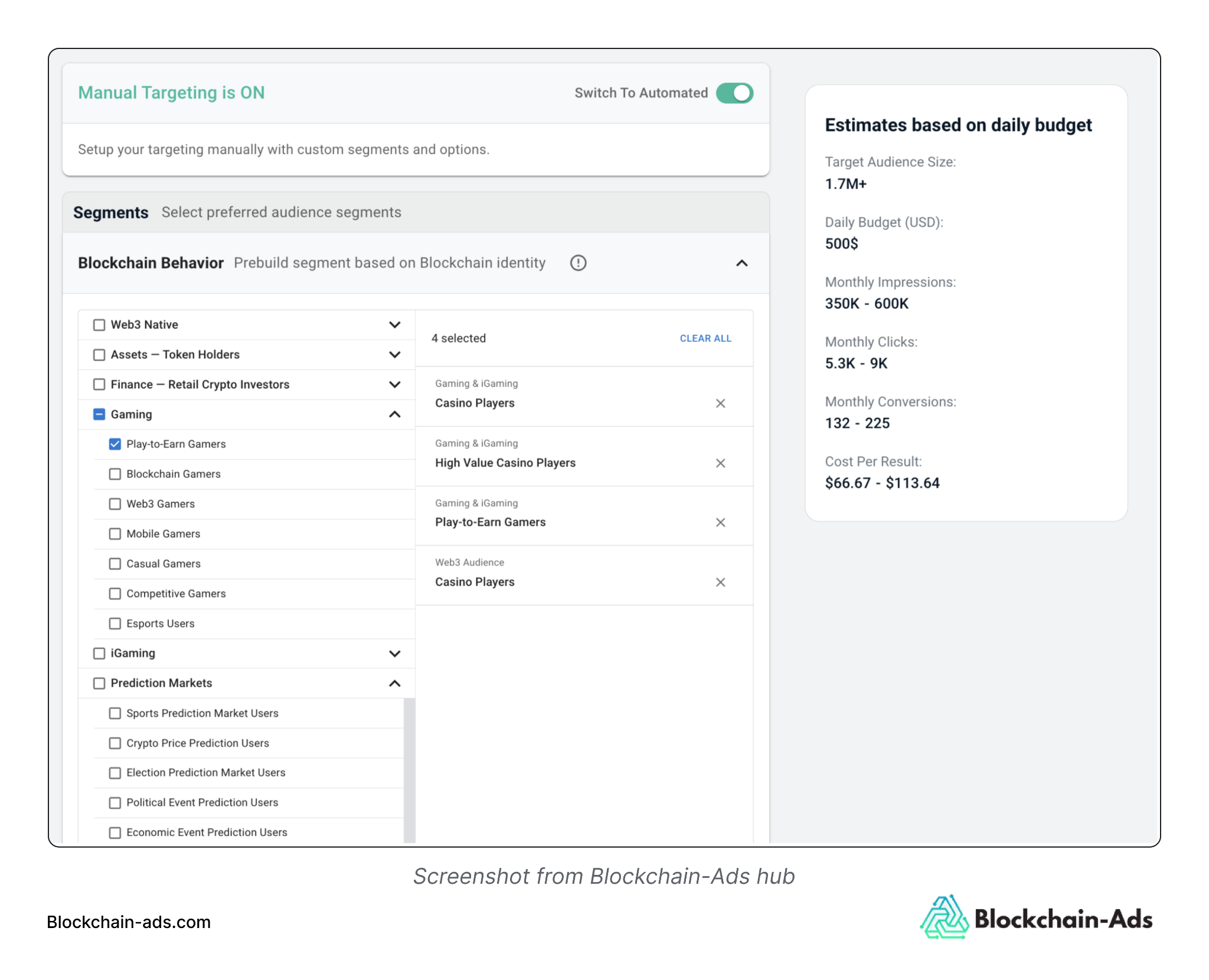
Inside Blockchain-Ads, you can build those audiences from two main data groups.
Blockchain Behavior segments use signals such as wallet activity, holdings, transactions, and protocol usage. Available audiences include sports bettors, casino players, DeFi protocol users, perpetual traders, stablecoin holders, and other groups built from observed blockchain activity.
You can browse the available Blockchain Behavior audiences and select the ones that match your customer.
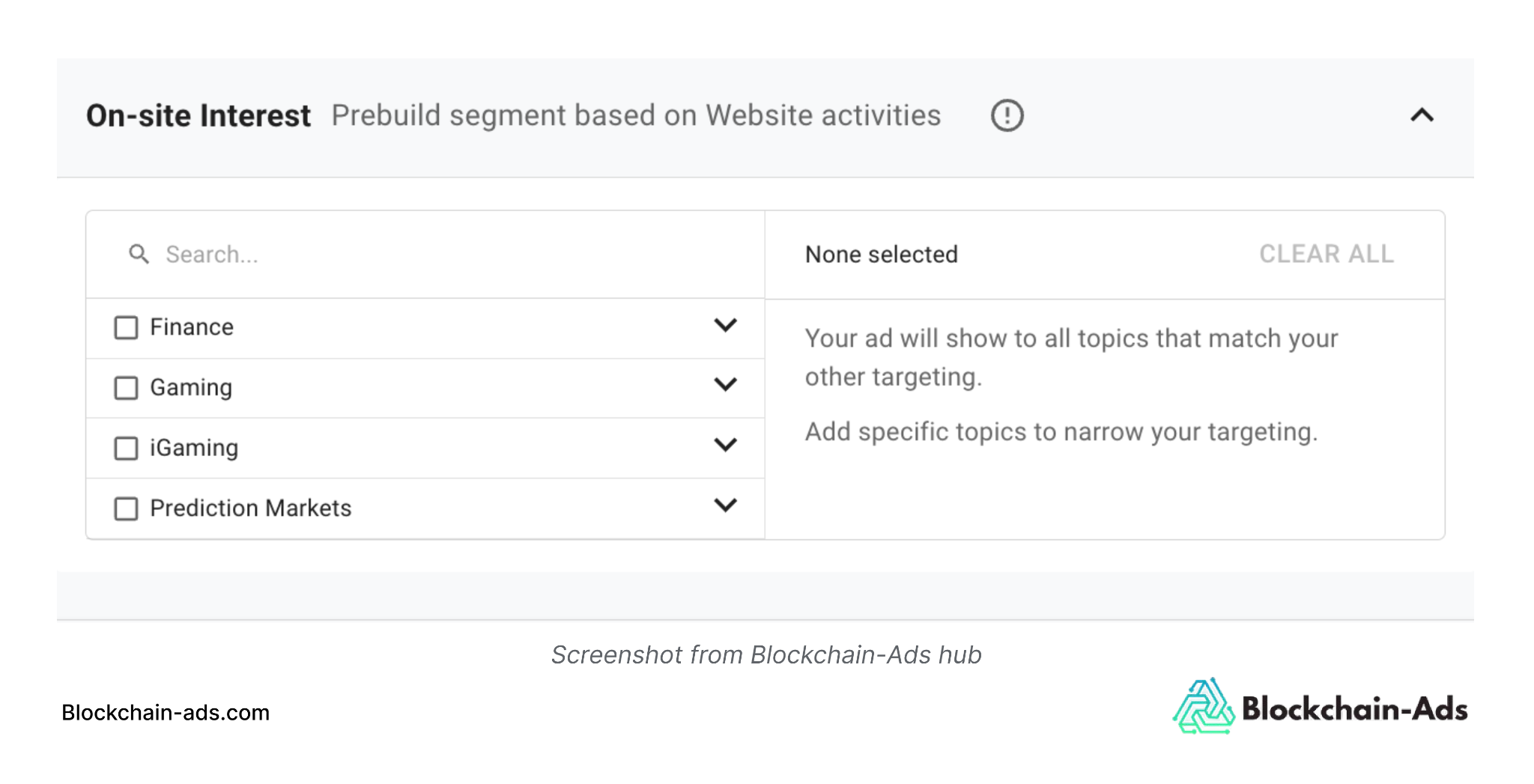
Interest Graph segments use the content and topics people engage with across the web. Categories include Finance, Gaming, iGaming, and Prediction Markets.
Both groups can run in the same audience. An exchange campaign might start with Active DEX Traders, for example, then add a finance or crypto interest segment if it sharpens the buyer description. Resist the urge to select every segment that could apply, though.
The State of Advertising 2026 analyzed 218 advertisers, 1,371 ad sets, and 1.4 billion impressions across crypto, iGaming, and finance campaigns from 2024 to 2026. In that dataset, 66% of ad sets used selected platform segments, with a median of six segments per ad set.
Among ad sets using bettors, gamers, asset holders, and active traders, 72% combined at least two of those audience types. A handful of relevant segments gives the campaign several signals to match against while keeping the first audience simple enough to diagnose when results come in.
2. Set the Countries and Devices You Want to Reach
Once you have the starting audience, decide where you want the campaign to run. GEO targeting lets you choose the countries or regions where the audience can see the ad.
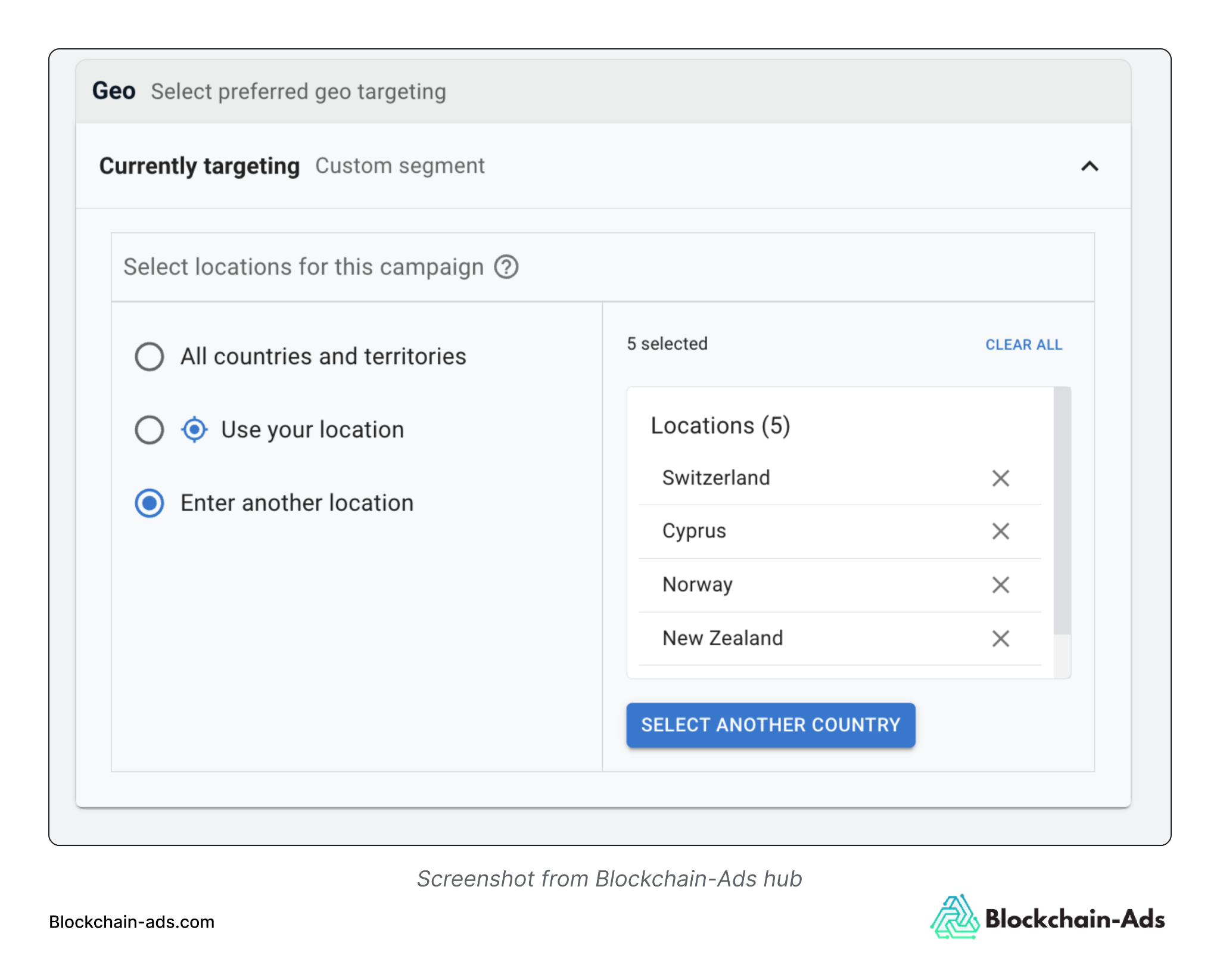
For a crypto exchange, sportsbook, casino, or broker, the country list usually comes down to:
- Where your product is available
- Where you’re allowed to advertise
- Which markets you want customers from
Device targeting is also considered at this stage. Running on all devices gives the first test the most reach, though your product experience or past campaign data may suggest separating mobile and desktop traffic.
Whatever you choose, give the campaign room to deliver. Combining a small audience segment with a limited country list and multiple filters can restrict delivery so much that the campaign barely spends. If performance falls short, you may not have enough data to identify which restriction caused the problem.
Blockchain-Ads lets you set GEO and device targeting in the same campaign-building workflow. So, start with the markets where you’re ready to acquire customers and split individual countries into their own ad sets once the data is enough.
3. Choose the Conversion Event You Will Use to Read the Audience
Decide what a useful response looks like before you launch. Depending on the campaign, that could be a registration, deposit, purchase, first trade, or another action inside your product. Pick the conversion that matches the campaign goal and confirm it’s tracked before any spend goes out.
As The State of Advertising 2026 studies show, advertisers who set up tracking before launch reached a first deposit or trade 92% more often than those who didn’t (46% compared with 24%).
You can still follow several events at once. A campaign might optimize for registrations because they happen often enough for the system to learn, while your reporting follows those users further into KYC, deposits, and trades. Reading those deeper events gives you a clearer view of audience quality, because clicks barely separate one audience from another.
In The State of Advertising 2026 report, audience-targeted ad sets recorded almost the same click-through rate as country-and-device-only ad sets when compared within the same advertiser. The audience-targeted ad sets clicked at 1.01 times the rate.
The larger difference showed up at deposit, purchase, and trade events. So decide what you will use to judge the audience before the campaign starts. A high CTR can still come from people who never complete the action you wanted.
4. Launch With Platform Segments and Get Your First Read
You may already have a large customer database, but many advertisers start without one. Platform segments give you an audience to launch with while the campaign builds first-party data.
To see how that played out, the study looked at 664 ad sets that generated at least 100,000 impressions and had tracking set up before launch. It then measured how many recorded a deposit, purchase, or trade within 30 days.
Here’s what it looked like:
| Audience setup | Ad sets | Recorded a deposit-stage event |
|---|---|---|
| Platform segments + advertiser’s own data | 92 | 62% |
| Platform segments only | 416 | 53% |
| Advertiser’s own data only | 57 | 28% |
| Country and device only | 43 | 16% |
| Interest categories only | 56 | 11% |
Treat these figures as a record of how the study’s advertisers built their audiences. Your own results will depend on your product, markets, and creatives. Platform segments were the usual starting point, and the highest share of deposit-stage events came from ad sets that layered the advertiser’s own data on top of them, which is the next step.
OANDA’s 60-day campaign on Blockchain-Ads shows a first read in practice. It launched four segments together (Perpetual Traders, Token Swappers, Investment and Trading, and Personal Finance) and A/B tested regional variants in the first two weeks. Perpetual Traders and Token Swappers outperformed the traditional finance segments, spend consolidated behind them, and CPA fell 61%, from $401 to $155.
5. Add Your Own Data When You Have Enough of It
Audience data targeting puts your own visitor, event, and customer data to work, and it gets sharper as your lists grow. Your first-party data comes from people who have already interacted with your business.
That can include:
- Website visitors
- People who completed tracked events
- CRM contacts
- Customer or address lists
- Previous ad-click audiences
- Saved retargeting audiences
You can upload or create custom audiences in Blockchain-Ads, then use them alongside the platform segments already in the campaign.
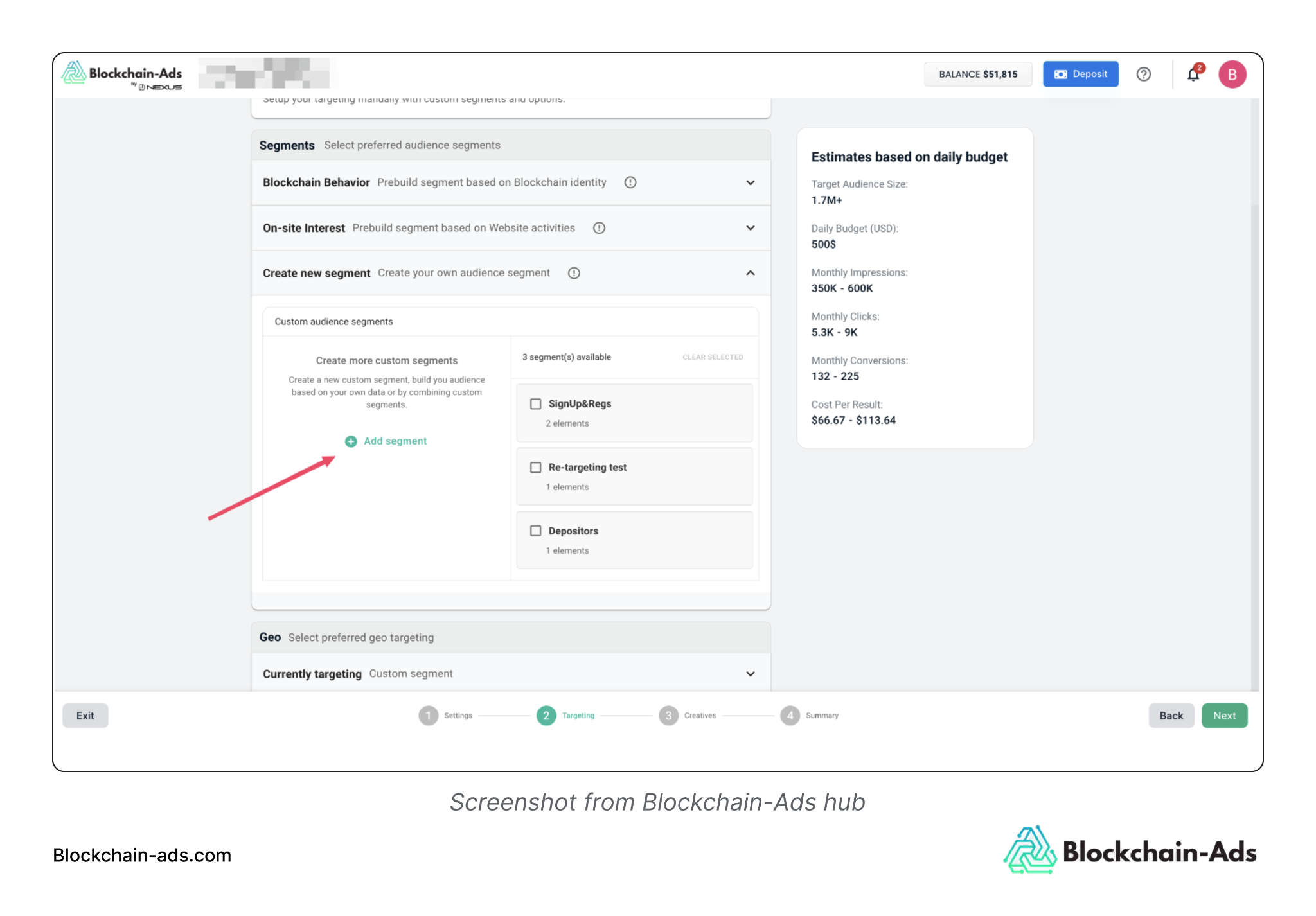
You do not have to wait until you have this data before advertising.
Among the 218 advertisers in the Blockchain-Ads study, 92 eventually used first-party audiences. Their first first-party ad set appeared a median of 25 days after their first platform-segment ad set. When that data arrived, they kept their original targeting.
Of the 316 first-party ad sets in the study, 77% still included platform segments, meaning advertisers layered their own data onto audiences they had already built.
You can follow the same sequence. Start with platform data, then add your visitors, converters, depositors, traders, or customers as those lists grow.
Advanced audience targeting builds on the same data. First-party data can give you a source audience for lookalike modeling, which finds new prospects who resemble people who already completed a useful action.
Blockchain-Ads supports first-party audiences, retargeting, exclusions, and lookalikes, along with behavioral and on-chain data.
6. Exclude the People You Already Have
Audience building also means deciding who shouldn’t see your campaign. In a new-customer acquisition campaign, that usually includes existing customers and anyone who has already completed the campaign’s conversion event, so prospecting spend goes only to people you still need to acquire.
You can move those excluded groups into separate campaigns built to reach them again. Someone who visited your sportsbook without depositing may belong in a retargeting audience, while a current depositor can be left out of the acquisition campaign entirely.
Separating the groups also keeps reporting clean, because your new-customer measures acquisition and your retargeting campaigns focus on people who already know your product.
7. Check the Audience Size Before You Launch
Every segment and restriction you add changes how many people you can reach. Blockchain-Ads shows the estimated audience size in the campaign builder as you add targeting, so keep an eye on that panel as you build.
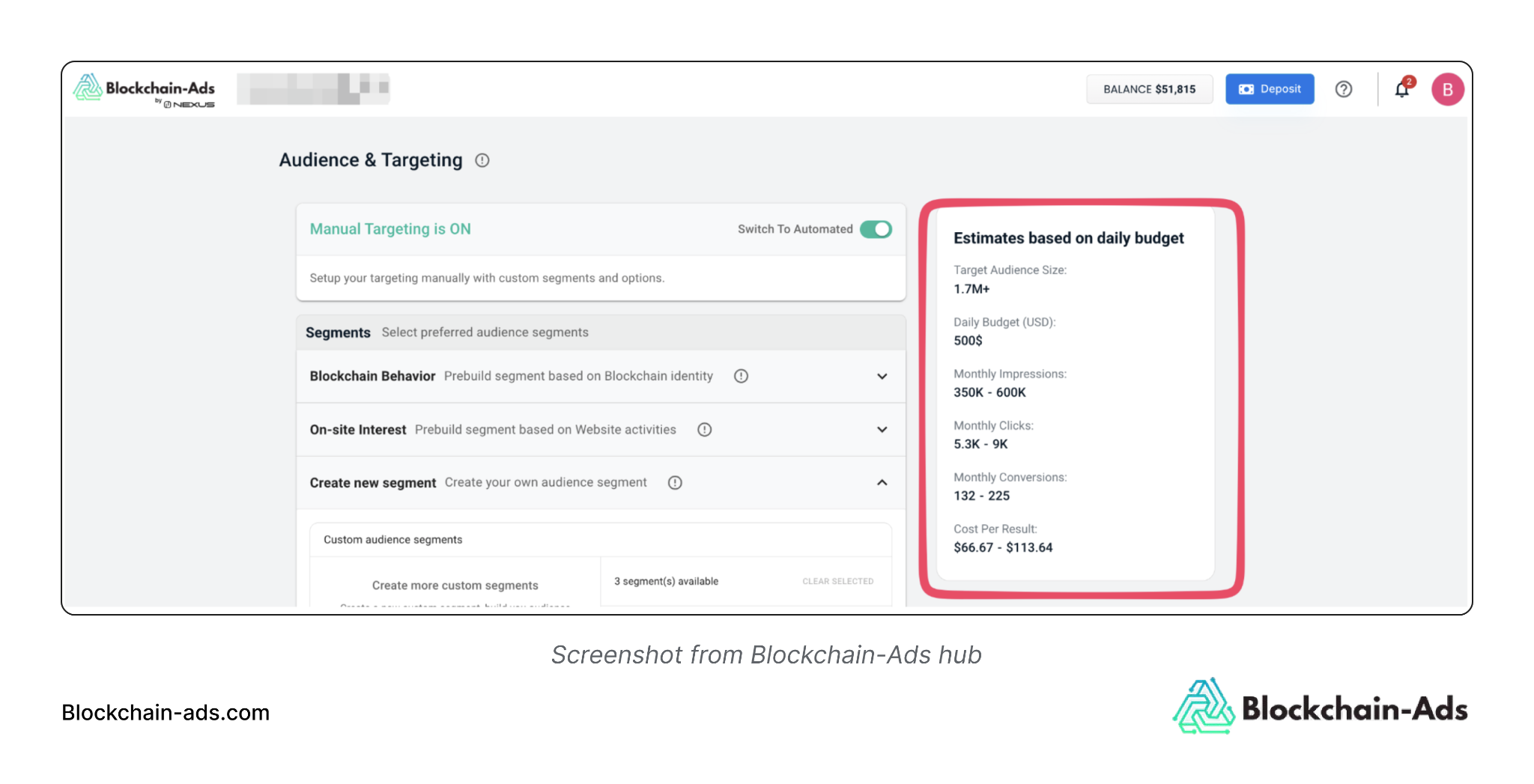
When one extra segment makes the audience shrink sharply, ask whether the first ad set needs that condition, because testing it separately may give you a cleaner read. If the audience stays very broad, revisit the signals you selected, since they may not describe your buyer closely enough. Keep in mind that the estimate measures size alone. You’ll only see how the audience performs once the campaign goes live.
8. Watch Frequency Once Delivery Starts
Programmatic campaigns can reach the same person several times, and frequency tells you how often that’s happening. No single frequency level suits every campaign, because the useful range depends on the creative, the audience size, and how quickly performance changes as exposure rises.
Read frequency alongside your conversion data. If it keeps rising while conversions flatten or CPA climbs, you’re probably reaching the same people too often. A larger audience, fresh creative, or a different segment can give the campaign room to grow.
Smaller retargeting and first-party audiences need the closest watching, since they saturate faster than broad prospecting segments. Even then, frequency alone can’t tell you whether an audience is good, so judge it against the result the campaign was built to generate.
9. Keep the Audience Stable While You Test Other Variables
Once you have a starting audience that delivers, hold it steady while you test creative and landing pages, so each result traces back to the variable you changed.
Changing the audience every time you change the creative makes each new result harder to interpret. In their first month, advertisers who kept launching campaigns changed the creative on nearly every launch. The country list or landing page changed about half the time, and the audience segments held steady. That stable audience gave them a constant to measure everything else against.
Apply the same discipline to your own tests. When you’re trying a new creative or landing page, keep the audience steady so any change in results traces back to the variable you changed. You’ll still adjust targeting when the data calls for it, but make those changes one at a time so you can see what each one did.
10. Split Markets and Audiences When the Data Gives You a Reason
Start with a few ad sets and add more as the data justifies them. In the study, advertisers running five or more ad sets in their first month captured a first deposit 87% more often than those running one (56% compared with 30%). Launch with several ad sets that can each reach around 100,000 impressions, then compare their results.
A split makes sense when one part of an ad set produces clearly different numbers. One country may convert at half the CPA of the others, or one segment may drive most deposits. Giving that country or segment its own ad set lets you set its budget, targeting, and measurement separately.
The study looked at 46 advertisers with at least six ad sets and eventually broke them down by market. Across those advertisers, 174 markets received their own ad set, and 59% of those markets were later split again, most often by audience. Splitting tends to happen in stages, first by market and then by audience within the markets that justify it.
What Your Programmatic Audience Should Look Like Before Launch
By the time you finish building each ad set, you should know:
- Which platform segments you selected
- Which first-party or custom audiences you added
- Who you excluded
- Which countries you want to reach
- Whether you need device restrictions
- Which conversion event you will use to judge the audience
- How large the estimated audience is
How that audience performs is something the first campaign will show you. Once results come in, use them to build the next audience by adding your own customer signals. Exclude people you no longer need to acquire, and split markets or audiences when a blended result hides real differences between them.
Blockchain-Ads lets you build programmatic audiences from behavioral, interest, on-chain, and first-party data in one campaign workflow. Set up your first campaign on Blockchain-Ads.
Nathan Ojaokomo is a B2B SaaS writer and content strategist specializing in SEO, product-led content, and AI search.
View full profile →