
Behavioral Targeting: How It Works, Examples, and How to Build an Audience
Key takeaways
- Behavioral signals: Previous actions help advertisers infer interest and intent before an ad is served.
- Intent: Recency, frequency, and repetition separate lasting behavioral patterns from temporary interest.
- Performance: Ad sets built from platform audience segments recorded a deposit, purchase, or trade 53% of the time, against 16% for country-and-device targeting and 11% for broad interest categories.
- First-party data: Adding the advertiser's own data to platform segments raised that rate to 62%.
- Audience building: Start with the conversion, then choose only the behaviors that support it.
Behavioral targeting decides who sees an ad based on what that person has already done online. Pages visited, apps used, and wallet transactions all count as signals, but they don't all point to the same level of intent.
When I spoke with Jack Colaianni, SVP of Product at Blockchain-Ads, about which behaviors advertisers should prioritize, he was clear:
“Recency and action beat everything. A wallet that was funded or made swaps in the last few days is a far better signal than one that holds a large balance.”
The real work, then, is deciding which signals should qualify someone for an audience and how to use that audience in a campaign.
This article covers how behavioral signals become audience segments, the main segment types, examples across industries, and a step-by-step audience build for a real campaign.
What Is Behavioral Targeting?
Behavioral targeting is a digital advertising method that uses data about a user's previous actions to infer their interests and intent. It groups users with similar behavioral patterns into audience segments that advertisers can then target with ads.
The main behavioral signals include:
- Browsing behavior: Pages visited, products viewed, and searches made
- Purchase behavior: Products bought, subscriptions, deposits, and other transactions
- App behavior: Sessions, feature usage, registrations, and in-app events
- Content behavior: Articles read, videos watched, and repeated engagement
- On-chain behavior: Wallet transactions, token activity, and protocol interactions
These behavioral signals can be used to create audience segments around previous activity, current intent, or predicted future behavior.
How Does Behavioral Targeting Work?
Around 80% of U.S. consumers prefer ads for products or services they're interested in or actively shopping for. Behavioral targeting tries to find that relevance in the signals people generate before an ad is served.
Collecting the signals is the easy part. The harder part is deciding what each one actually means.
Behavioral Signals Have Different Strengths
A page view, a search, an app session, and a purchase all produce behavioral data, but they don't carry the same weight.
Visiting a brokerage homepage shows some interest. Comparing account types, returning to the pricing page, or starting an application is much stronger evidence that the user is weighing up the product.
Recency and frequency add context. An action repeated several times this week tells an advertiser something different from the same action recorded six months ago.
Repetition still needs to be read in context, a point Sophie Grigoryan, Content Specialist at ScraperAPI, raised when I asked her about short-lived trends:
"Trends, for example, have a short cycle of behavior and engagement. Activity around them spikes quickly and then disappears, so this is something we should keep an eye on to avoid using poor predictors."
Her advice is to check whether interest holds up over time and across several sources before treating a spike as a lasting pattern.
Once advertisers know which behaviors are worth tracking, they capture them through cookies, pixels, SDKs, on-chain data, and their own first-party data.
Patterns Help Identify Intent
A single action can be ambiguous, so behavioral targeting combines related signals into a more meaningful pattern.
Someone who reads one article about Ethereum may simply be curious. Someone who checks ETH prices daily, reads trading content, and visits exchange pages shows real trading intent and is a far better fit for an audience of active crypto traders.
Patterns like these let platforms classify users by interest, past activity, or purchase intent, then group people with similar behavior into the same segment.
Audience Rules Determine Who Qualifies
Every audience needs rules that decide who enters the segment. Those rules can look at the action itself, how recently it happened, how often it happened, or a combination of signals.
Repeated flight searches over a few days, for example, may qualify someone for an in-market travel audience. Once the trip is over, the same searches lose their value, so users move in and out of behavioral audiences as their activity changes.
Note: This is different from retargeting, which reaches people based on a previous interaction with the advertiser's own site or app. Read more about how to run a retargeting campaign.
What Types of Behavioral Audience Segments Can You Use?
Behavioral segments can reflect past activity, current intent, or the likelihood of a future action. The right type depends on what the campaign needs to identify.
These categories overlap because the same behavioral data can support more than one classification. What changes is what the signals let the advertiser infer.
Recent product comparisons point to active consideration, while a longer history of related actions reveals broader patterns or the likelihood of a future conversion.
The campaign goal decides which type is useful and which behaviors are strong enough to put a user in the segment.
Predictive and AI-Built Audiences
Predictive audiences reverse the usual process. Instead of an advertiser choosing which behaviors qualify a user, a model studies the people who already convert and looks for more users like them.
On Blockchain-Ads, this works in two ways. Lookalike models start from a seed, such as an uploaded CRM list or pixel data, and find people with matching traits. Discovery models surface new segments from behavioral and on-chain signals the advertiser may not have thought to target. Read more about audience targeting on Blockchain-Ads.
Automated Targeting, the default setting in HUB, applies the same idea at campaign setup. The platform reads your landing page, creatives, and campaign goal, then builds the targeting itself. Once your tracking starts reporting conversions, it learns from each one and moves budget toward the people most likely to act.
That's why conversion tracking needs to be live before launch. A predictive model can only learn from the conversions it can see, so the first deposit or funded account has to be recorded from day one. See how Blockchain-Ads uses AI to build and optimize audiences.
Behavioral Targeting Examples Across Industries
The behaviors worth targeting depend on the product and the action the advertiser wants users to complete. Here's how that plays out across industries:
The useful signal depends on what the campaign needs to find. For a crypto platform, that's demonstrated on-chain behavior. For a sportsbook, it's previous betting activity, and for a retailer, active product consideration.
Behavioral Targeting vs. Contextual Targeting
Behavioral targeting uses previous user activity to build an audience, while contextual targeting places ads based on the content a user is viewing right now. The table below shows the difference:
In practice, this changes where and how advertisers can reach an audience:
- Behavioral targeting follows the user beyond the place where the behavior happened. Someone who recently searched for running shoes can later see a shoe ad while reading the news.
- Contextual targeting depends on the page where the impression is served. A finance ad may appear because the article discusses investing, whatever the reader browsed or bought before.
Pro tip: You can combine the two by using behavior to decide who to reach and context to decide where to reach them.
How Does Behavioral Targeting Affect Campaign Performance?
Building audiences from segments gives advertisers a much stronger link between who they reach and what those users do next.
The State of Advertising in Crypto, iGaming, and Finance 2026, which analyzed about 1,400 ad sets from more than 200 advertisers on Blockchain-Ads, shows how much the targeting method matters.
Among ad sets that delivered at least 100,000 impressions with conversion tracking in place, this is the share that recorded a deposit, purchase, or trade within 30 days:
Segment-built ad sets recorded a conversion more than three times as often as country-and-device targeting, and nearly five times as often as broad interest categories.
These figures show how often an ad set recorded a conversion, not how many conversions it produced or what they were worth.
Conversion rate alone also doesn't tell you whether an audience brings in valuable customers. Jack drew that line when describing how he evaluates campaign performance:
"In iGaming, a registration or a first deposit is just the start. I look at the registration-to-FTD rate, first deposit value, repeat deposits, and retention at day 7 and day 30."
Adding more segments has limits too. In Blockchain-Ads campaign data, reach kept climbing as advertisers added segments, while conversion capture stayed flat. The walkthrough below shows how to build an audience around one conversion without stacking unnecessary layers.
How to Build a Behavioral Audience
Let's put this into practice with a crypto trading platform that wants to acquire funded traders.
We'll build the audience around one conversion event, choose behavioral signals that support it, and add a segment only when it gives us a stronger reason to include a user.
Here's how to build a programmatic audience in Blockchain-Ads HUB.
Step 1. Define the Action You Want
Start with the action you want the audience to complete. For this campaign, that's funding a trading account, not just visiting the site or registering.
This gives you a clear test for every segment that follows. If a signal says something meaningful about a user's likelihood of funding an account, it belongs in the audience, and if it doesn't, leave it out.
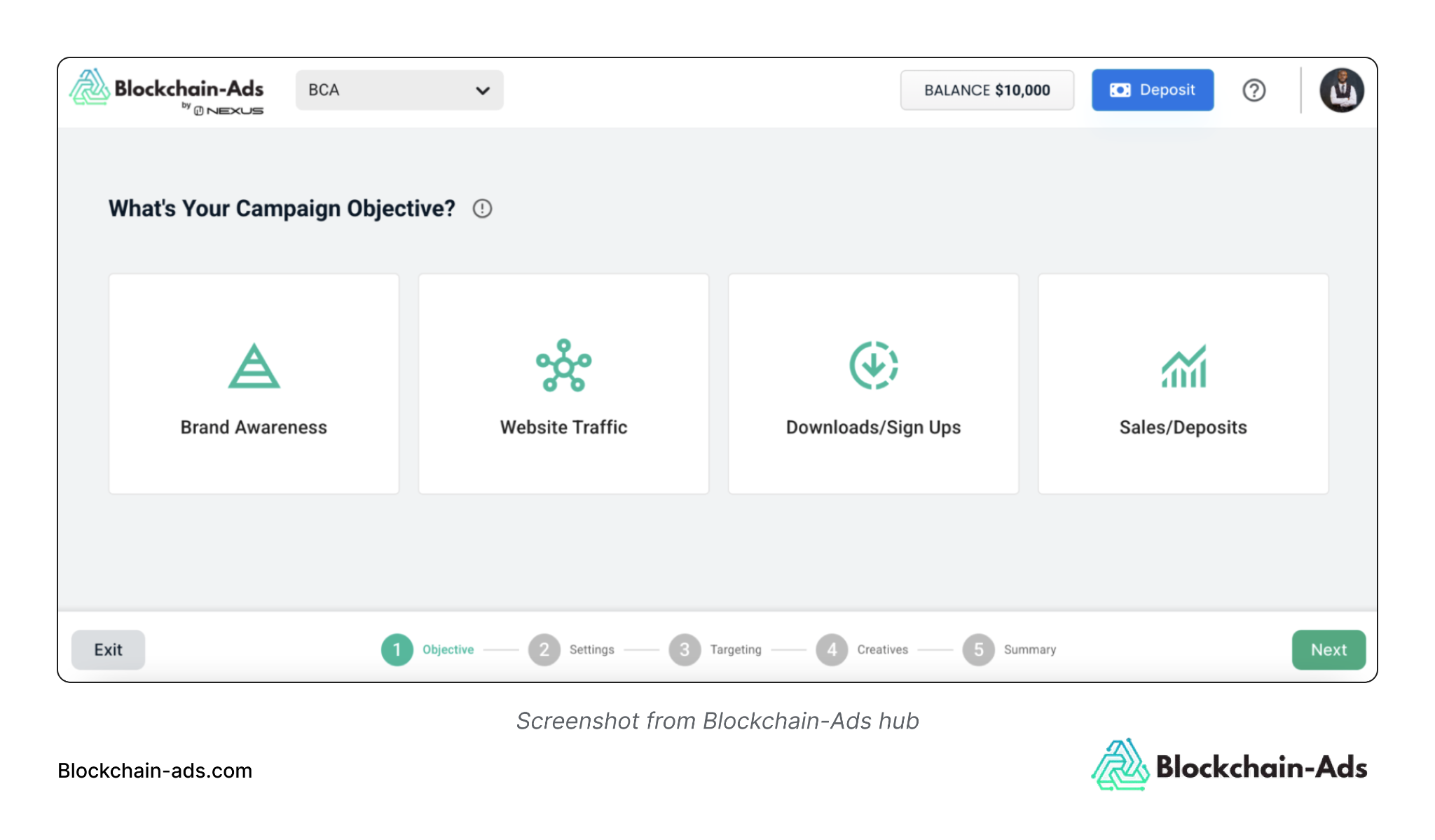
In HUB, you choose the campaign objective before you reach audience targeting. Here, Sales/Deposits is the right choice because it's built for campaigns that optimize toward purchases or deposits.
Note: Set up conversion tracking for the first deposit before launch, so HUB can measure the event the campaign is working toward.
Step 2. Choose Behavioral Signals Tied to the Action
With the funded-account conversion defined, you can choose the behaviors that fit it. In HUB, open Audience & Targeting and switch from Automated Targeting to Manual Targeting so you can select segments yourself.
Note: If this is your first campaign, the automated and manual targeting guide suggests starting with Automated Targeting and moving to manual once your reports show which segments convert.
Under Blockchain Behavior segments, you can target users based on on-chain activity, holdings, and transaction history. For a crypto trading campaign, relevant options include:
- Perpetual Traders: Wallets with perpetual trading activity
- CEX Users: Users who interact with centralized exchanges
- Token Swappers: Wallets that regularly swap tokens
- Investment Platforms Users: Users who interact with investment platforms
You don't need all four. Go back to the funded-account action from Step 1 and pick the two or three behaviors that give you the clearest reason to include a user.
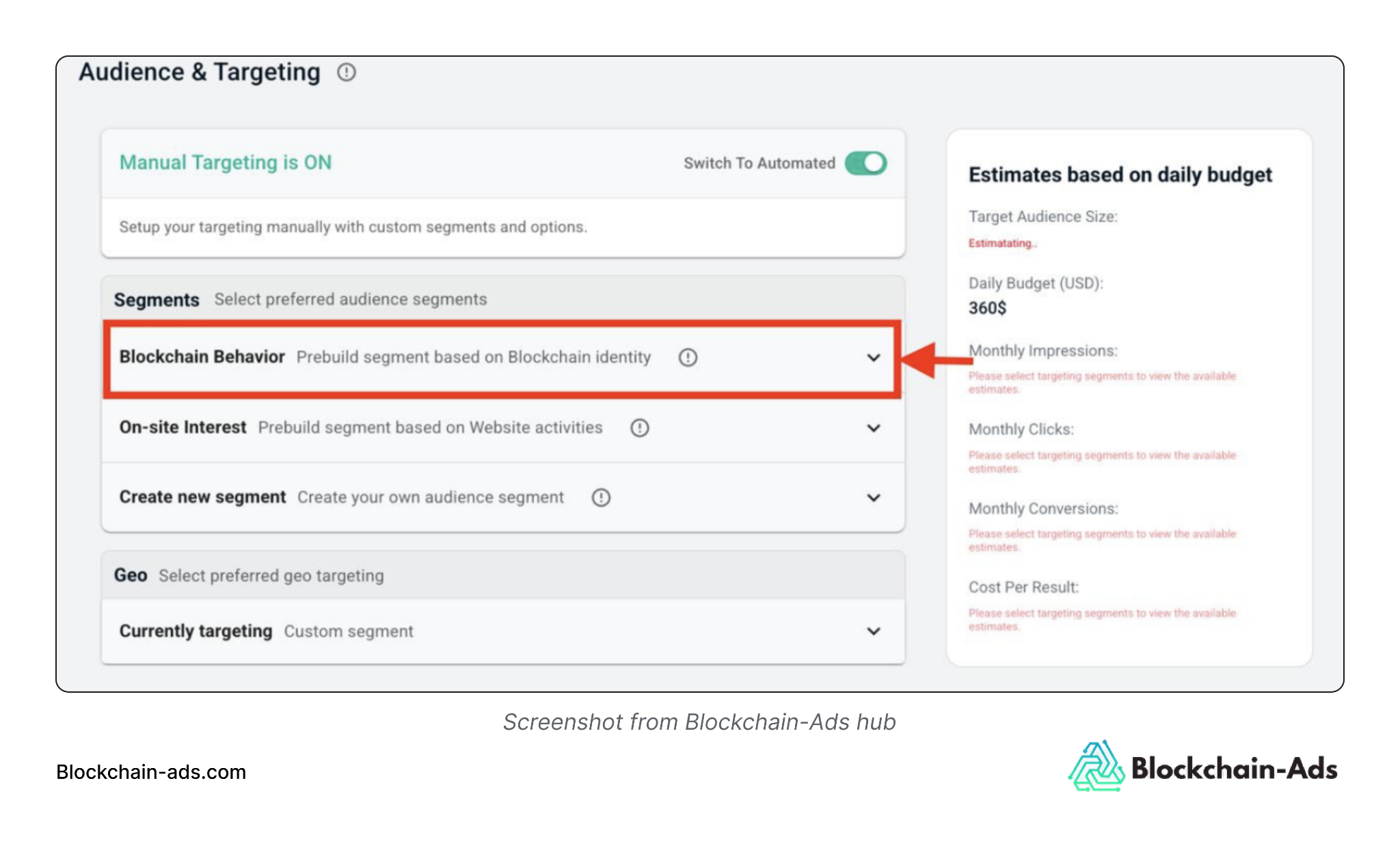
As you select segments, HUB updates the estimated audience size and impressions in the panel on the right. Check those numbers before you add the next targeting layer.
Step 3. Add Another Audience Type
Alongside your Blockchain Behavior segments, you can add Interest Graph segments, shown as On-site Interest in HUB. These are based on the websites and content users engage with. For a trading campaign, Investing, Wealth Management, and Forex & Trading are the most relevant.
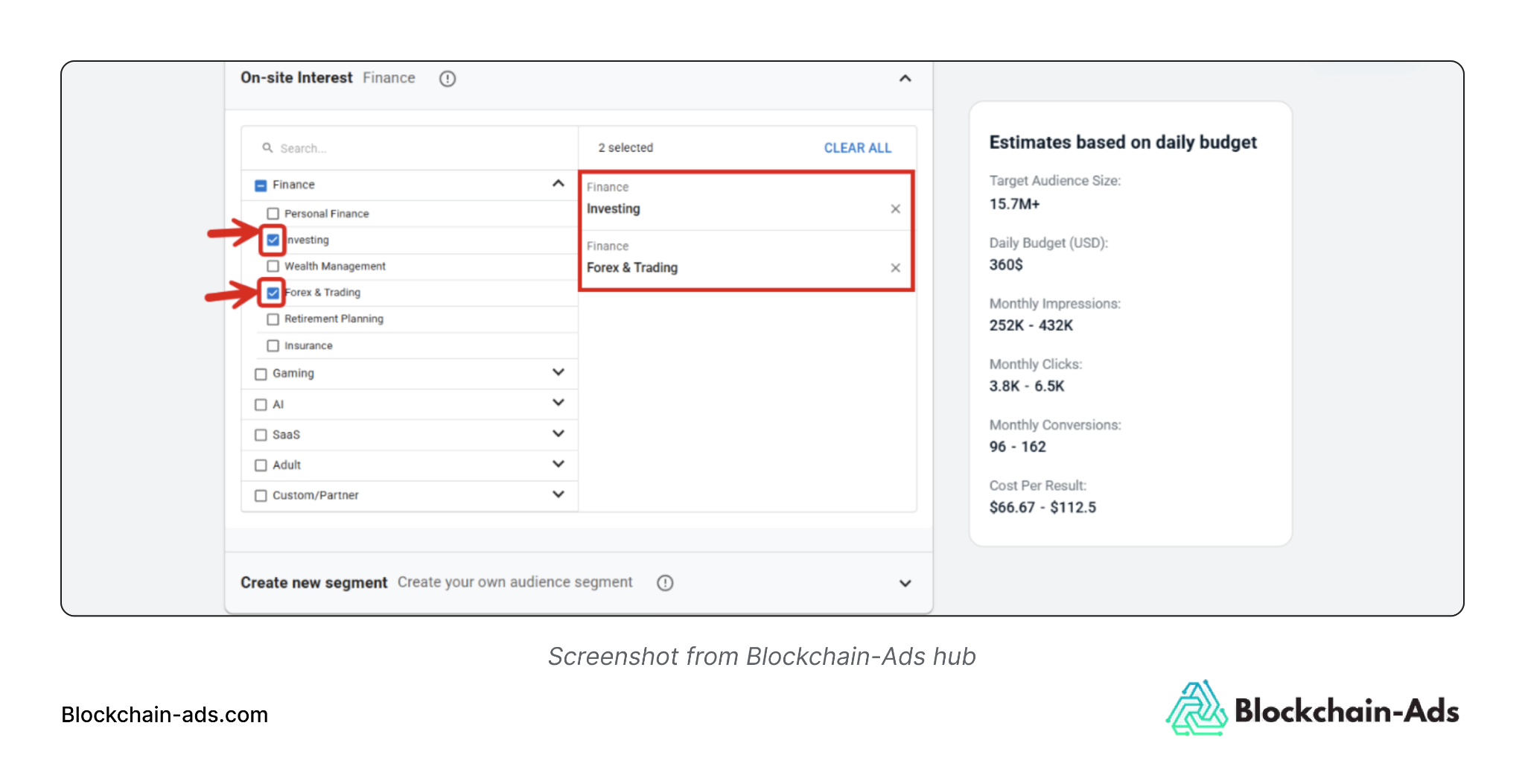
Keep in mind that every segment you add widens the audience rather than narrowing it. A user only needs to match one of your selected segments, whether they come from the same category or a different one.
That's why reach climbs as you stack segments, even when the extra users are no more likely to convert.
Whether a new layer adds reach or trims it, Jack judges it by the same test:
"My rule is to add one layer at a time and measure CPA against reach lost. If cost per conversion doesn't improve meaningfully, the layer isn't earning its place."
For this campaign, that means checking whether the interest segments actually help you find users who are more likely to fund an account.
Step 4. Create a Custom Segment
Pre-built segments won't cover every audience you want to reach. When your own data identifies a group they miss, create a custom segment from the Manual Targeting section in HUB. You can also combine custom segments you've already saved.
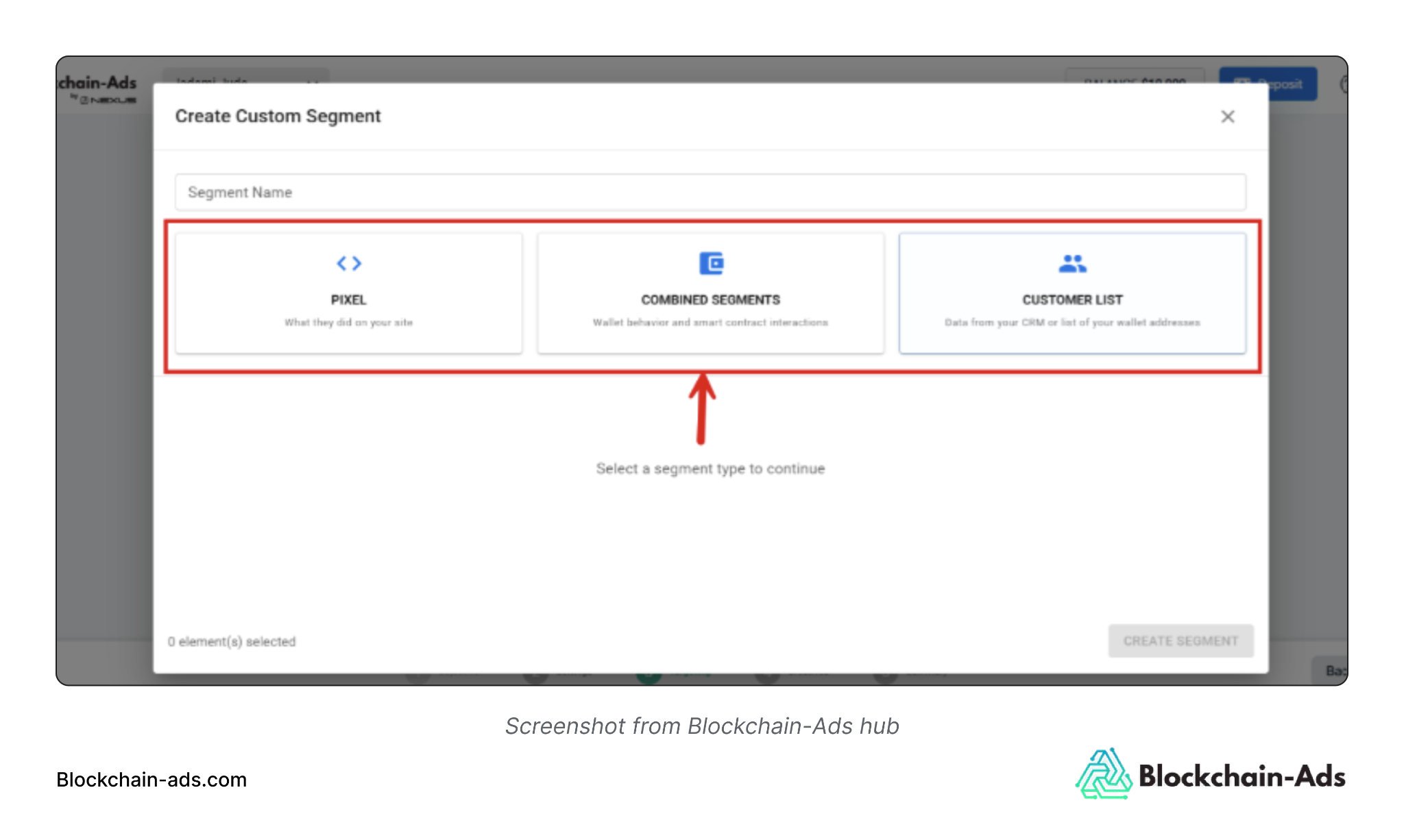
Use a custom segment when your own data identifies an audience that the pre-built options don't capture. In our example, that could be users who completed registration or KYC but haven't yet funded their trading account.
Once saved, custom audience segments become available for targeting and can be reused in future campaigns.
Step 5. Know When to Stop
By this point, you have behavioral, interest, and custom segments. But that doesn't mean you need to keep adding them.
So why do advertisers continue adding segments? As Jack pointed out,
“Adding segments feels like control, and reach numbers go up, which looks like progress on a dashboard. But many segments overlap heavily, so you're often paying to reach the same people through a different label.”
Before adding another segment, check how much it overlaps with your existing audience, whether your current segments are saturated, and which ones are already driving conversions.
Blockchain-Ads campaign data shows what happens as advertisers add more segments:
- Conversion capture: Adding more segments widened reach, while conversion capture remained flat.
- CTR: Click-through rate fell from 0.62% with one or two segments to 0.44% with eleven or more.
- Segment count: Advertisers used a median of six segments per ad set, drawn from more than one audience type.
Note: Six isn't a recommended target. It's the median observed in the dataset, not a number every audience should reach.
For the audience we've built here, start broad and add segments only while they give you a meaningful distinction in who you're targeting or how you'll convert them.
Common Behavioral Targeting Mistakes to Avoid
Even a well-built behavioral audience loses value when its signals or segments become too broad or too complicated. Before launching, watch for these mistakes:
- Treating every action equally: Rank behaviors by recency, frequency, and how closely they relate to the conversion you want.
- Narrowing too early: Keep the audience large enough to deliver and collect conversion data before you start cutting it down.
- Relying on one signal: Look for a pattern across related behaviors before treating a single action as intent.
- Using stale behavior: Give recent activity more weight when older actions no longer reflect what the user is likely to do next.
- Over-segmenting: Add a segment only when it changes the message, the offer, or the path to conversion.
Putting Behavioral Targeting Into Practice
Behavioral targeting works when the behaviors you target have a clear connection to the action you want users to take. That means choosing signals for what they reveal about intent, not using every signal available.
Past behavior won't always predict what someone does next. When the signals are relevant, recent, and backed by a pattern of activity, though, they give you a far stronger basis for deciding who to reach.
If you're planning a campaign around a deposit or funded account, tell us about it and we'll show you which Blockchain-Ads audiences fit your goal.
Srijan Sharma is a B2B writer specialising in SaaS, FinTech, MarTech, and data integration.
View full profile →