iGaming Media Buying: How and Where to Run Casino & Betting Ads
Key takeaways
- Who buys: you can build a team, hire an agency, or use a platform's managed service. Most operators keep strategy in-house and let specialists run the buying.
- Where: programmatic finds new players at scale. Search catches people already looking. Affiliates bring players you pay for one at a time. Run each only where your license allows.
- How to measure: check what each first-time depositor costs you, channel by channel, against one CAC target.
- How budget moves: agree your own scale-or-cut rule before launch.
Casino media buying is how a licensed casino or sportsbook turns its ad budget into first-time depositors (FTDs). The hard part is deciding who runs the buying, which channels get the money, and how to tell which ones pay back.
Most heads of acquisition work from a fixed budget and a CAC (customer acquisition cost) target per depositing player. Blockchain-Ads runs programmatic campaigns for licensed casinos and sportsbooks and measures each one against that kind of CAC target. In our 2026 State of Advertising report, advertisers who set up tracking before launch reached a first deposit or trade 92% more often.
This guide covers who should run your buying, where your budget should go, and how to measure each channel against one target.
What Is Casino Media Buying?
Casino media buying is planning, buying, and optimizing paid ad space to win players for a casino or sportsbook. In general, media buying means paying for ad placements and audiences, then managing that spend against a goal. For an operator, that goal is first-time deposits (FTDs): players who register and make their first deposit.
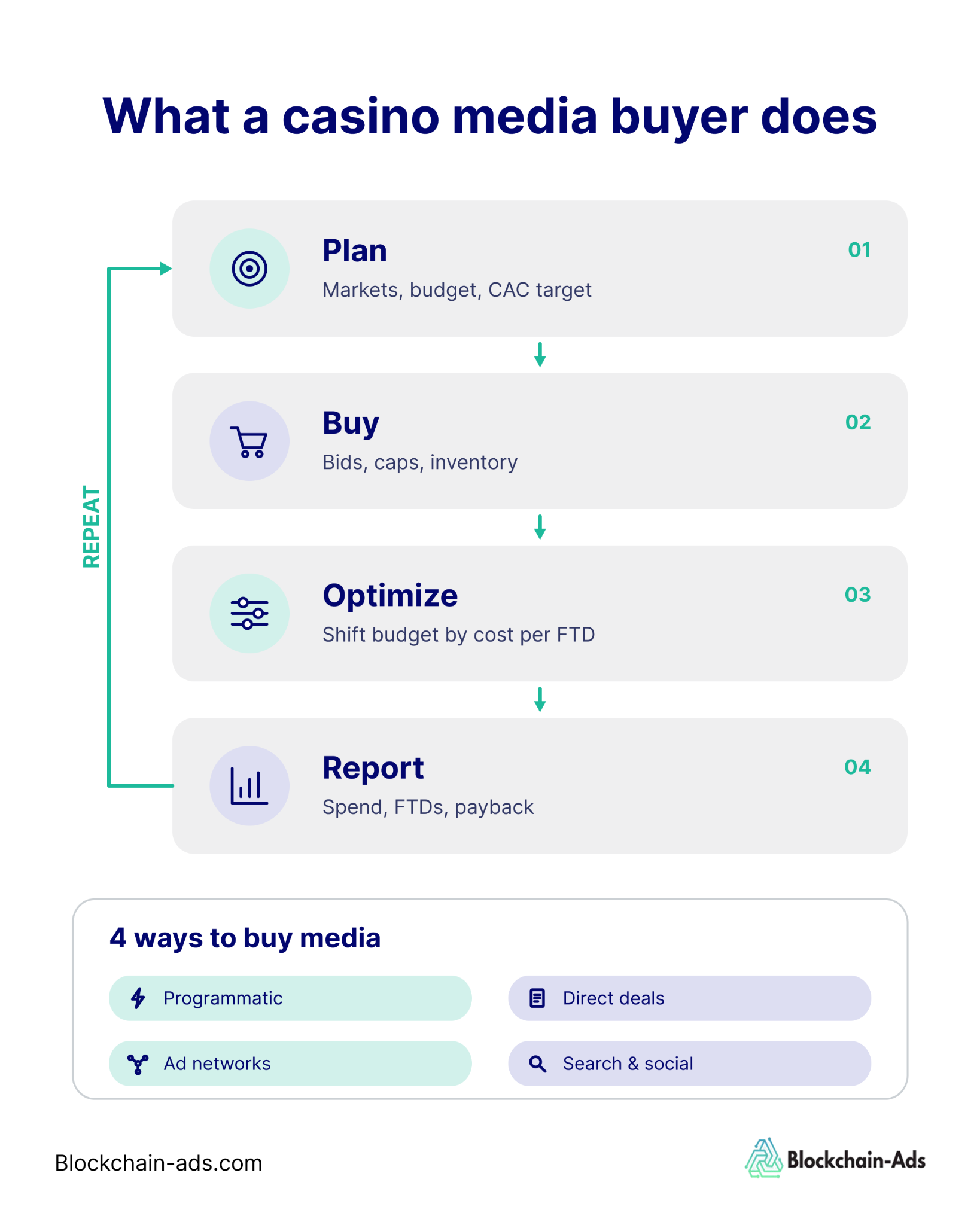
A media buyer working for an operator does four jobs:
- Plan: Set the markets, channels, audiences, and budget split from the CAC target and the license.
- Buy: Launch campaigns, set bids and caps, and secure inventory through auctions or direct deals.
- Optimize: Shift budget between audiences, creatives, and channels based on cost per FTD.
- Report: Show spend, FTDs, deposit value, and payback by channel to the head of acquisition and finance.
Gambling media buying differs from affiliate marketing in how you pay. With affiliates, you pay per player through CPA or revenue share, and the affiliate owns the traffic. With media buying, you pay for the media and own the data. When campaigns convert well, each player costs you less.
Operators buy media through four main methods:
- Programmatic: automated buying of ad space through real-time auctions, across many publishers at once.
- Direct deals: fixed placements bought from a publisher or sports media brand at an agreed price.
- Ad networks: bundled inventory sold by a network, often by format such as push or pop.
- Platforms with their own inventory: search engines and social networks, open to licensed gambling advertisers in approved markets under certification.
Media buying is one part of the wider marketing mix. For CRM, bonuses, and retention, see casino marketing strategies.
In-House, Agency, or Platform: Who Should Run Your Media Buying?
Who should run your media buying depends on your budget, your team's skills, and how much control you want. You can build an in-house team, hire an agency, or use a platform with managed service. With managed service, the platform's own team runs campaigns on your account.
Agencies come in three models. Full-service agencies handle media, creative, and brand together. Performance agencies run your paid ads to one goal: new depositing players at an agreed cost per acquisition (CPA). Specialist iGaming agencies know gambling licenses, markets, and channels in depth.
Here's how the three options compare and who each one suits best.
| In-house team | Agency | Platform with managed service | |
|---|---|---|---|
| Cost | Salaries, tools and tracking stack; fixed cost from day one | Fee or percentage of spend on top of media | Media spend; managed service from $30,000 a month in ad spend, with creative included |
| Control | Full control of strategy, bids and budget | Shared; the agency runs day-to-day decisions | Your team sets targets and approves plans; the platform team executes |
| Speed to launch | Slowest; hiring and setup take months | Fast once the contract is signed | Fast after account approval and tracking setup |
| iGaming expertise | Depends on hires | High with a specialist iGaming agency, varies with others | High within the platform's own channels and audiences |
| Data ownership | Full | Check the contract; some agencies keep account and audience data | Your account and conversion data stay with your brand |
| Best suited to | Large operators with steady budgets across many markets | Brands that want one partner for media, creative and brand | Operators that want programmatic scale with a lean internal team |
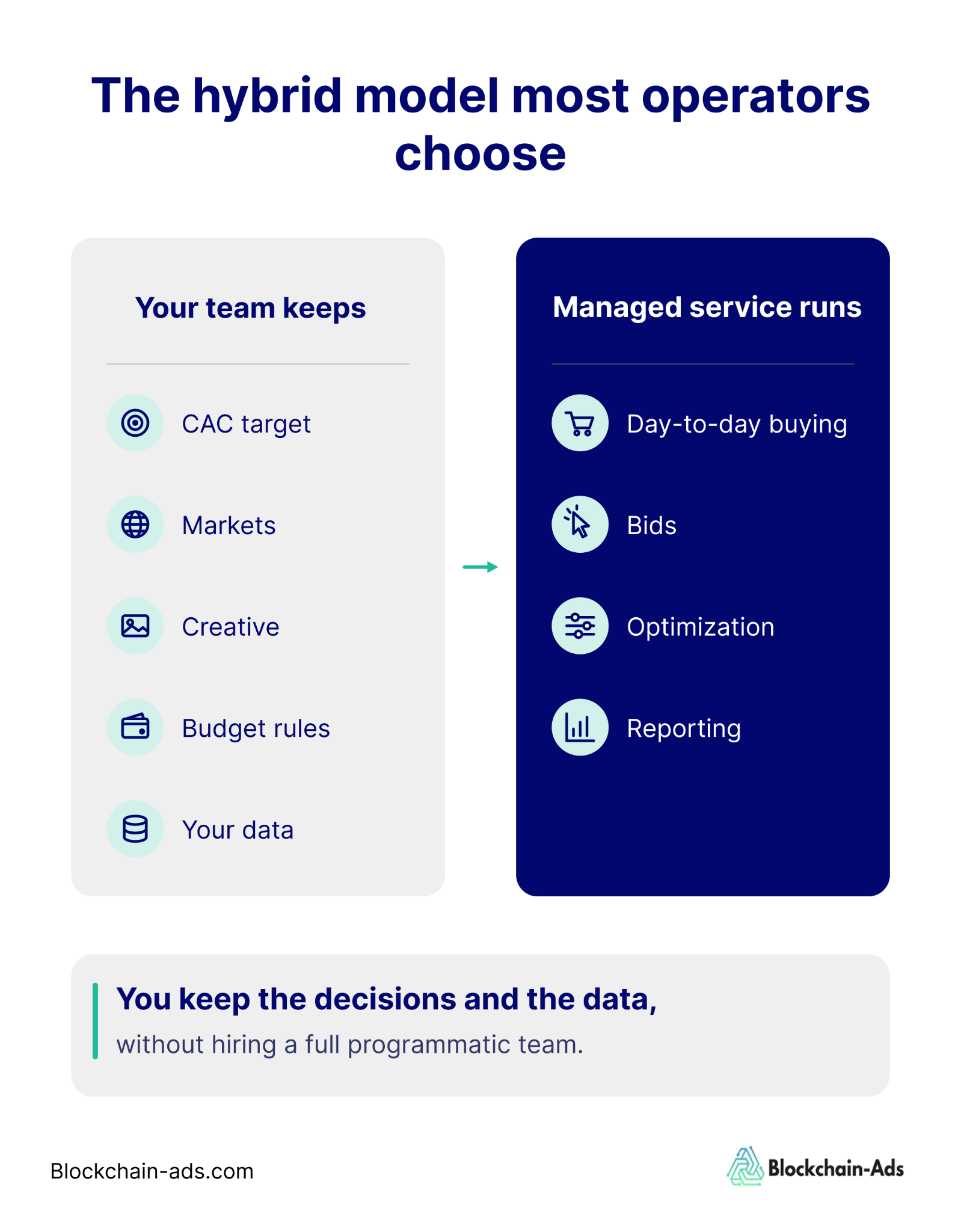
Still not sure? Most operators choose a hybrid. Your team keeps the strategy: the CAC target, markets, creative, and budget rules. An advertising platform's managed service runs the day-to-day buying. This way, you keep the decisions and the data. You also save on the salaries, tools, and long hiring process of a full programmatic team.
Where to Advertise an Online Casino
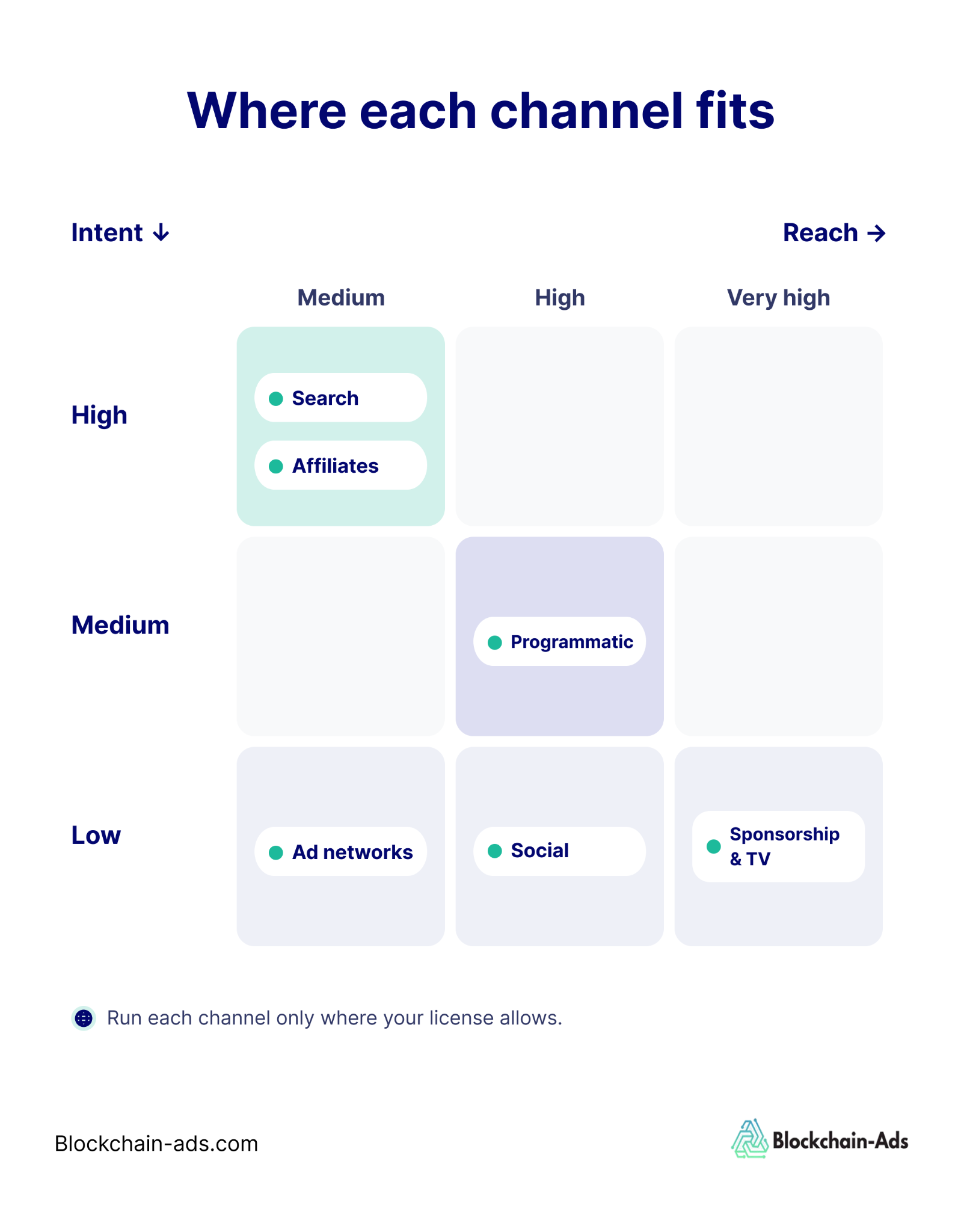
These are the main channels where you can advertise an online casino: programmatic, ad networks, search, social, affiliates, and sponsorship and TV. Here's how each one rates on reach, player intent, cost, and how well you can measure it.
| Channel | Reach | Intent | Cost | Measurement |
|---|---|---|---|---|
| Programmatic | High | Medium | Medium | High |
| Ad networks | Medium | Low | Low | Medium |
| Search | Medium | High | High | High |
| Social | High | Low | Medium | Medium |
| Affiliates | Medium | High | Per player | High |
| Sponsorship and TV | Very high | Low | Very high | Low |
If you want more detail on where each type of player comes from, see where to buy gambling traffic. And if you'd like to compare networks that sell by ad format, like push, pop and native, check out the best iGaming ad networks.
Programmatic Advertising for iGaming
Programmatic advertising for iGaming uses a DSP (demand-side platform) to buy ads automatically across many ad exchanges at once. You choose the audience, such as casino players or sports bettors, and the DSP finds them. Your ads run as display, native, video, in-app, and CTV.
When you're choosing a programmatic platform for your iGaming campaigns, ask about its inventory. Find out which filters it uses to keep bots out, so your budget reaches ideal players.
Many operators feel safer sticking with search and social because they know those channels well. But search ads only reach people already searching, and they tend to search for casinos they already know. If your brand is new or less known, your casino rarely makes their list.
Social has its own limits, too. Many platforms restrict gambling ads, which keeps your casino from being seen by the players you want to reach.
That's where programmatic fills the gap. It reaches casino and betting audiences wherever their interests take them online. So your casino gets found, whether it's new or already well known.
How to Advertise a Casino With a Media Plan
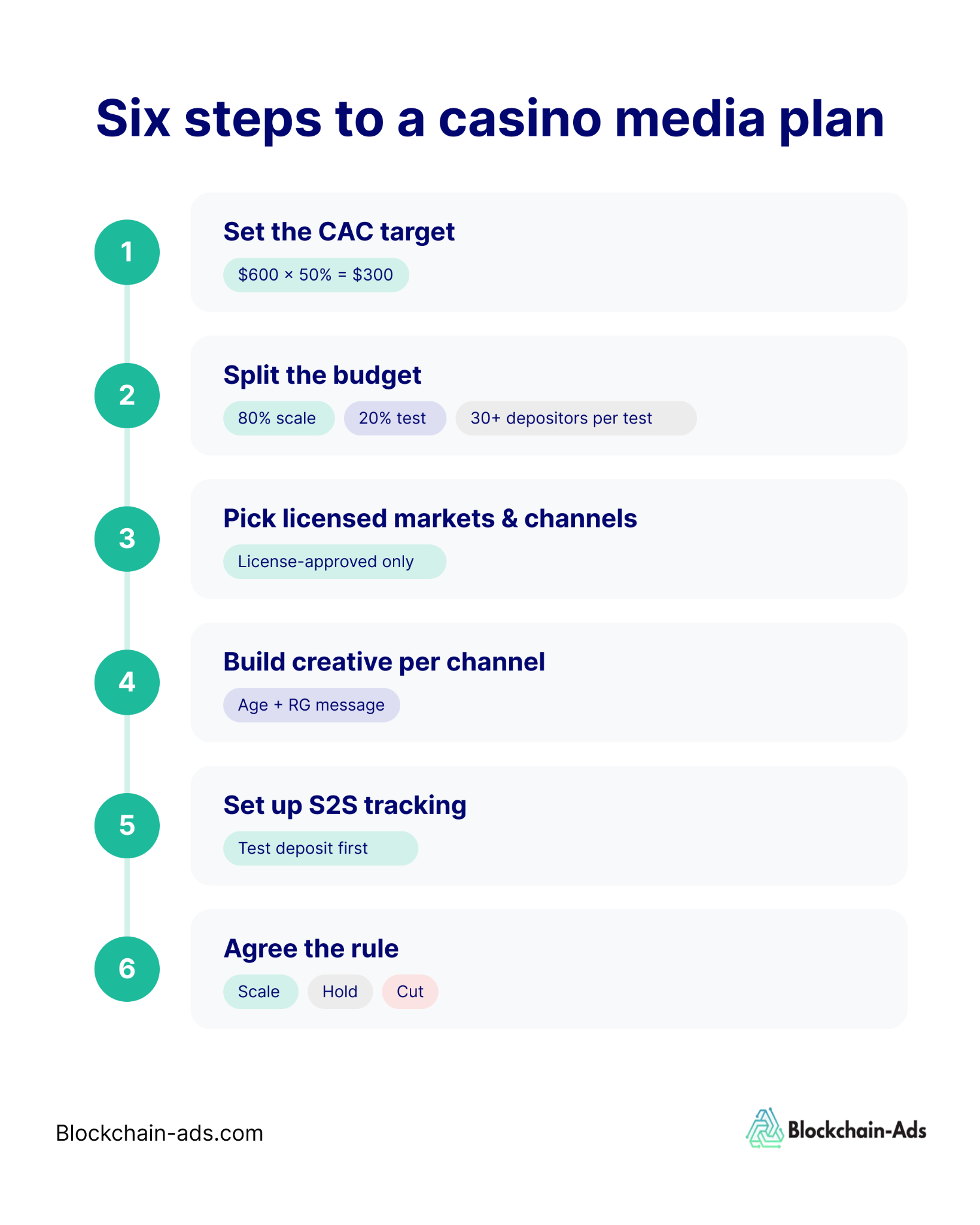
Your media plan ties every ad you buy to your CAC target. Here's how to advertise a casino with one, in six steps.
Step 1: Set the CAC Target from Player Value
Your CAC target is the most you'll pay to win one new player. To set it, look at player value: how much a new player brings your casino in their first year. If that's $600 and you want to keep half as profit, your CAC target is $300.
Step 2: Split Budget Between Testing and Scaling
Split your budget in two: about 80% for channels already hitting your target, and 20% to test new ones. Give each test enough budget for at least 30 depositors, since just a handful can swing your cost per FTD. Our guide on how to allocate a paid media budget into tests you can read shows you how.
Step 3: Choose Channels and Markets Your License Allows
List the markets where your brand holds a license and can advertise. Then check each channel's gambling policy and each market's ad rules, using our guide on how to advertise gambling online. Apply your self-exclusion lists and age checks to every audience before it goes live.
Step 4: Build Creative per Channel
Make creatives for each format you'll run. Native needs a headline and image, display needs every banner size, and video needs short clips. Every ad also carries the age and responsible gambling message your market requires.
Step 5: Set Up Server-to-Server Tracking for Registrations and First Deposits
Set up tracking so you know which ads bring in depositors. Server-to-server (S2S) tracking sends every sign-up and first deposit, with its amount, straight to your ad platform. Run one test deposit before launch to make sure it works.
Step 6: Agree on the Rule for Scaling or Cutting a Channel
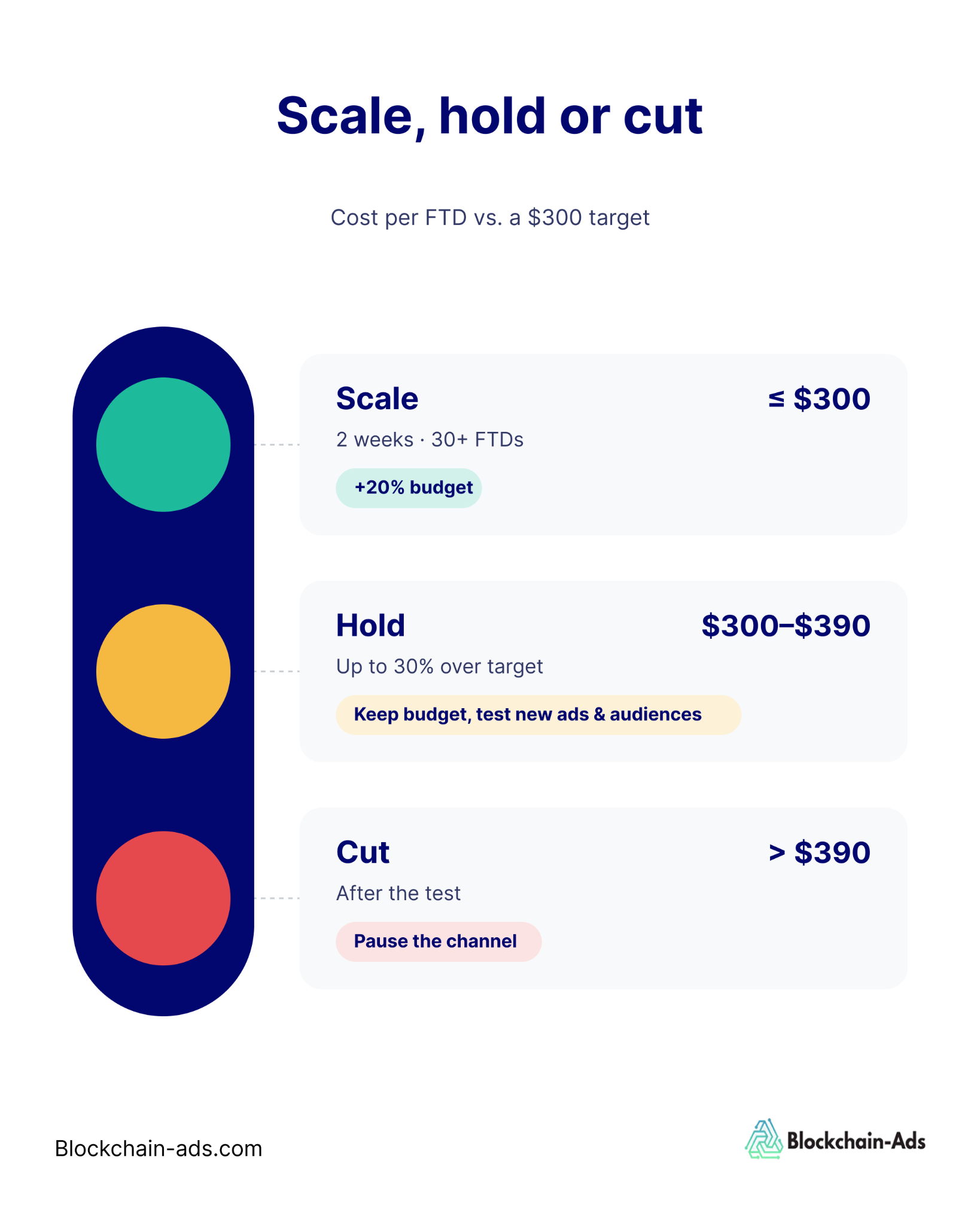
Before launch, agree when a channel gets more money and when it gets cut. Here's a simple rule you can adapt, using the $300 target from Step 1:
- Scale: cost per FTD stays at or under $300 for two weeks, with at least 30 FTDs. Add 20% to its budget.
- Hold: cost per FTD runs up to 30% over target, so up to $390. Keep the budget and try new ads or audiences.
- Cut: cost per FTD stays above $390 after the test. Pause the channel.
How to Measure Media Buying Against a CAC Target
To measure media buying against a CAC target, divide each channel's spend by the first-time depositors it brought. Compare that cost per FTD with your CAC target and with player value. A channel at or below target earns more budget. A channel above it gets fixed or cut. To set the target itself, see how to calculate customer acquisition cost and set your target CPA.
To get that comparison right, you need four things in place.
1. Track every deposit accurately with S2S tracking: Your CAC comparison is only as good as your depositor count. The S2S tracking from Step 5 credits every depositor to the right channel, so your cost per FTD is accurate.
2. Compare cost per FTD and ROAS: Cost per FTD is spend divided by first-time depositors, and it's the number you check against your CAC target. ROAS (return on ad spend) is what those players bring in, divided by what you spent. It tells you whether they were worth the cost.
3. Check how fast you earn it back: A channel can hit your CAC target and still take too long to pay off. Payback is how long new players take to earn back what you paid to win them. The shorter it is, the sooner you can reinvest that budget.
4. Test whether the channel really added players: Some depositors would have joined anyway, like players searching your brand name. Incrementality shows how many depositors a channel actually added on top of those. To test it, pause ads in one region and compare, as our guide on incrementality testing explains.
Checking all four is easier when they sit in one report. Blockchain-Ads measurement and attribution shows depositors, deposit value, and cost per FTD for every campaign in one place.
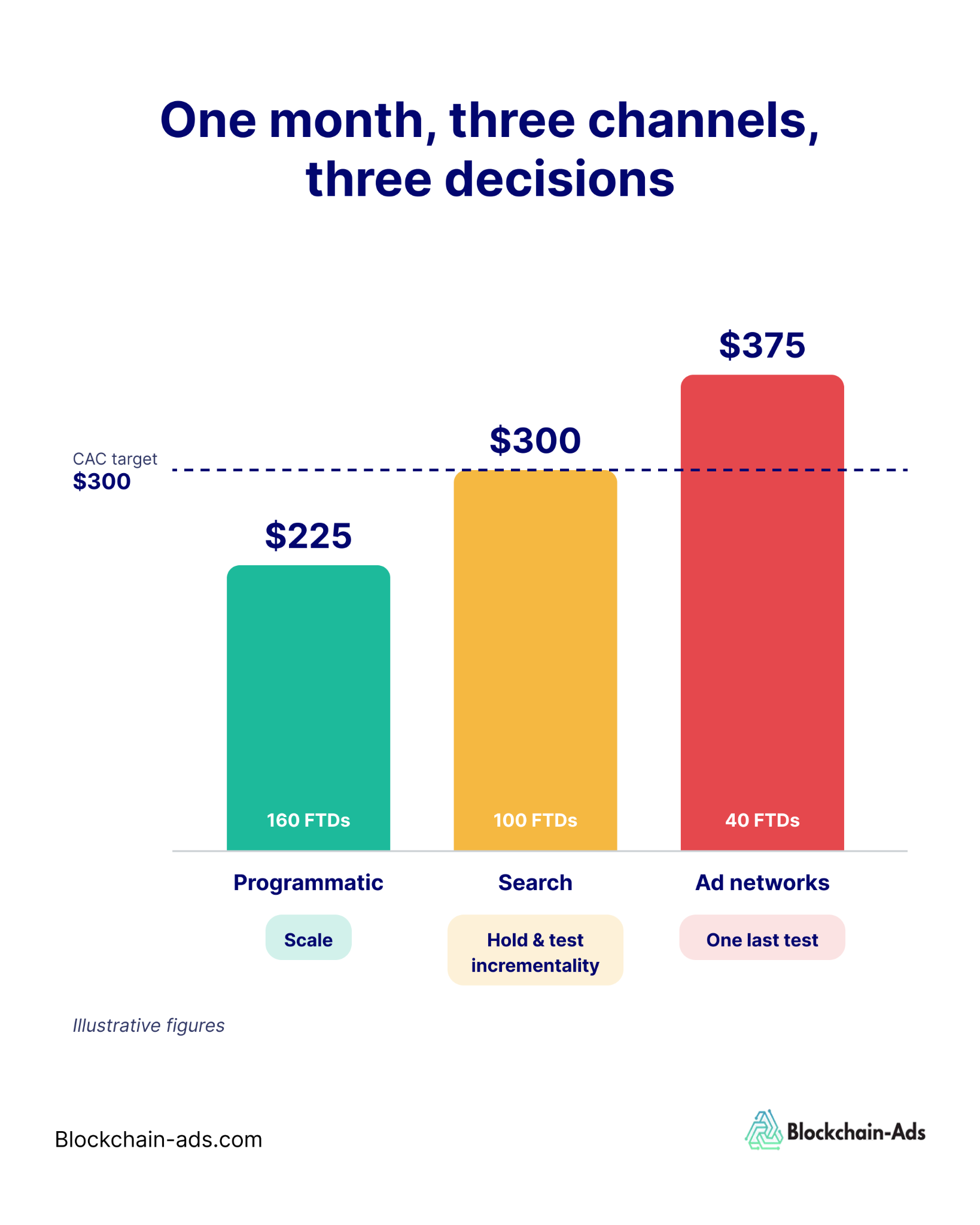
Here's how it all comes together, in a worked example with illustrative figures. Say an operator runs three channels from its media plan: programmatic, search, and ad networks.
Set the target. As in Step 1, a new player is worth $600 to this operator in their first year. Keeping half as profit gives a CAC target of $300:
CAC target = $600 × 50% = $300 per FTD
Check the first month's results. After one month, the operator divides each channel's spend by the depositors it brought. Here's what that gives:
| Channel | Spend | FTDs | Cost per FTD |
|---|---|---|---|
| Programmatic | $36,000 | 160 | $225 |
| Search | $30,000 | 100 | $300 |
| Ad networks | $15,000 | 40 | $375 |
Move the budget. Next, the operator compares each cost per FTD with the $300 target, and each channel gets a different decision:
- Programmatic scales. It brings players in $75 under target, so it gets the next 20% budget increase.
- Search holds. It's on target, but brand search often captures players who would have deposited anyway. Pausing it in one region shows how many of its 100 FTDs it really added.
- Ad networks get one last test. At $375 per FTD, it's $75 over target. It gets one rebuild with new ads and a narrower audience, then is paused if it stays over.
Casino Media Buying With Blockchain-Ads
Blockchain-Ads provides an iGaming advertising platform for licensed casinos, sportsbooks, and their agencies who measure programmatic against a CAC target. You can run campaigns yourself from a $10,000 minimum deposit. Or the Blockchain-Ads team can run them for you through managed service, from $30,000 a month in ad spend with creative production included.
Whichever you choose, every account is reviewed before launch, and approval takes 24 to 48 hours after the call. The team checks your license and target markets, and campaigns run only in the countries your license covers.
Once you're approved, your ads run through the Blockchain-Ads DSP, which finds players by their interests and behavior. You can start from about 1,000 ready-made audience segments, like casino players and sports bettors. Your ads reach them across display, native, video, in-app, and CTV, plus push, pop, and Telegram mini apps. Every impression is verified by DoubleVerify.
When campaigns go live, S2S tracking sends every sign-up and first deposit back to the platform. Campaigns then optimize toward more first deposits, and you see cost per FTD and ROAS for every campaign and country.
Here are the results from two separate operator campaigns on Blockchain-Ads:
- Stake.com acquired 1,128 first-time depositors at a $250 CPA, with 2.5x ROAS across 13 markets.
- Roobet drove 990 first-time deposits worth $110,470 at a $23 CPA.
You can open either case study to see how each campaign went from setup to results. When you're ready, request access to talk through your own programmatic goals with the Blockchain-Ads team.
FAQs
What Does an iGaming Media Buyer Do?
An iGaming media buyer plans, buys, and optimizes paid ads that bring in new players for a casino or sportsbook. They then move the budget to the campaigns with the lowest cost per FTD.
Is It Better to Hire an Agency or Run Media Buying In-House?
It depends on your budget, your team's skills, and how much control you want. Many operators keep strategy in-house and hand day-to-day buying to a platform's managed service.
How Much Budget Do You Need for Casino Media Buying?
It depends on your markets and your CAC target. On Blockchain-Ads, self-service starts at a $10,000 minimum deposit, and managed service at $30,000 a month in ad spend, with creative included.
What Is a Good Cost per First Deposit?
A good cost per first deposit is one that stays below what a new player is worth to you. Since that varies by market, set your own target from your player value.
Can You Run Programmatic Ads for a Casino?
Yes, as long as your license allows gambling ads in the markets you target. Your account is verified before launch, and campaigns run only in those markets.