Germany iGaming Market: The Operator’s Guide to Acquiring Players
Key takeaways
- Germany is a big market: Online made €3.5 billion of the €14.4 billion in licensed GGY in 2025.
- Casino ads run at night: Slots, poker, and casino ads can run online only from 21:00 to 06:00, under GlüStV § 5(3).
- Affiliates get a fixed fee: RevShare is banned for Germany traffic.
- The grey market is real: About 23 percent of online play went to unlicensed sites in 2024, per a GGL study.
- Value builds slowly: Deposit limits keep first deposits small, so judge players over months.
The Germany iGaming market is one of Europe’s largest, with €14.4 billion in licensed Gross Gaming Yield (GGY) in 2025 across online and land-based play.
But you can’t buy players there the way you do in most markets. The online rules in Germany are among Europe’s strictest, and a good chunk of play still goes to unlicensed sites.
So before you spend a single euro in the Germany online gambling market, you need to know how it works. This guide will show you all you need to know about the market’s size, its rules, and the grey market. It also covers what a player actually costs from Blockchain-Ads campaign data and how to buy one within the rules.
How Big Is the German iGaming Market?
The Germany online gambling market size was €3.5 billion in GGY in 2025, about a quarter of the €14.4 billion licensed market, according to the GGL activity report for 2025.
The GGL (Gemeinsame Glücksspielbehörde der Länder) is the joint regulator of Germany's 16 states based in Halle. Its licensed products made about €4 billion of that GGY.
Wondering what these terms mean? Here's a look:
- GGY (Gross Gaming Yield): Stakes minus winnings paid out, so it shows what players actually lost.
- Stakes: Every euro wagered, including winnings bet again.
- Virtual slots: The licensed online slot category.
In Germany, sportsbooks took €8.3 billion in stakes in 2025 and kept €1.89 billion in GGY. In comparison, the GGY for virtual slots rose by 11 percent to €543 million, while online poker took €786 million in stakes.
And you won’t have these players to yourself. The GGL counted 29 sportsbook operators in 2025 (27 active), 40 virtual slots operators (37 active), and five online poker operators.
The GGL’s Marktmonitor shows where demand is heading. Online sports betting stakes rose from €1.59 billion in Q1 2025 to €1.81 billion in Q1 2026, while virtual slots rose from €1.10 billion to €1.20 billion.
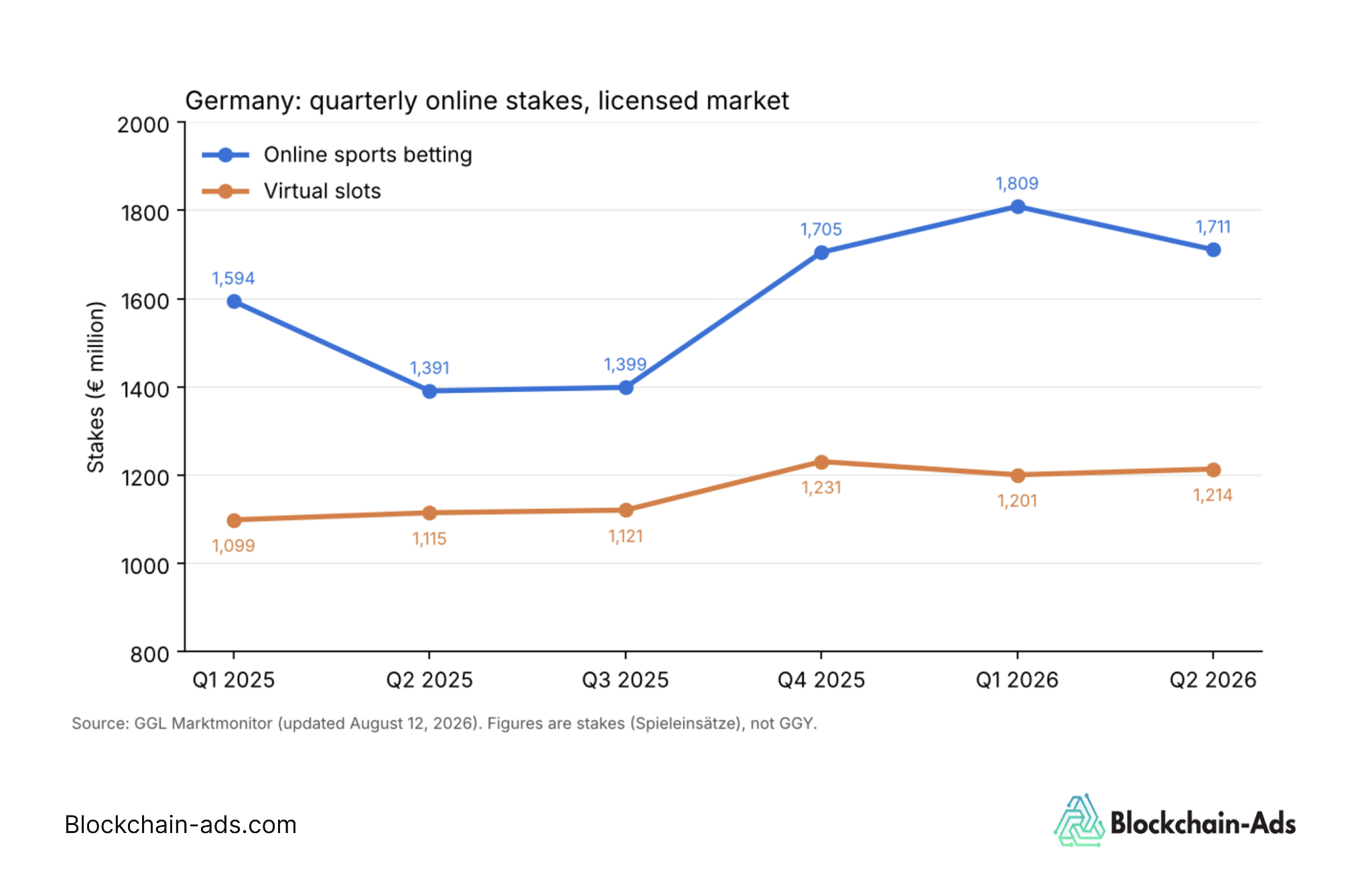
Sports betting stakes rise and fall based on the movements of the football calendar, but slots climb slowly and steadily. That makes slots volume much easier to forecast.
Germany Gambling Regulation Under the GlüStV
Since July 1, 2021, Germany's gambling regulation has let private operators offer sports betting, virtual slots, and online poker with a GGL license, under strict player-protection and advertising rules.
The full name is Glücksspielstaatsvertrag 2021, which translates to “State Treaty on Gambling 2021," the 2021 interstate treaty on gambling between Germany’s 16 states.
Eight rules shape acquisition more than any others. Each one changes what you can sell, how and when you can advertise, or how much a new player can spend.
These rules may change soon. Under GlüStV § 32, the states must deliver a full evaluation of the treaty by December 31, 2026, and a separate amendment treaty that strengthens the GGL’s tools against illegal sites is being ratified state by state.
Why Online Casino Is Different From Virtual Slots
Online casino games are licensed by each state, while virtual slots get one national license from the GGL. In Germany, “online casino” means table games like roulette and blackjack, and your GGL license doesn’t cover them.
Under GlüStV § 22c, each state can run table games as a monopoly or sell a few concessions. Most have kept them closed.
A Noerr legal review found six states chose a monopoly, only North Rhine-Westphalia and Schleswig-Holstein chose concessions, and the other eight did nothing.
A GGL license for virtual slots lets you advertise virtual slots and nothing more. So, unless you also hold a state concession for table games, don’t show roulette or blackjack in your ads or on your landing pages. Also make sure to call your product “virtual slots” rather than “online casino.”
The Grey Market and the Channelization Problem
Nearly one in four euros lost online in Germany still goes to unlicensed sites. These sites offer higher stakes, no deposit limits, and table games that licensed operators can’t.
The regulator tracks this with channelization, the share of play that happens on licensed sites. A GGL-commissioned study published in March 2026 put it at 77.03 percent for 2024.
The study conducted a comprehensive survey and estimated unlicensed GGY at €547 million. Industry groups say the real gap is bigger, especially for slots, so treat 77 percent as the regulator’s best estimate for one year.
So why do players leave? The treaty itself gives them three reasons:
- Stake caps: slots are capped per spin, while offshore sites let players bet as much as they want.
- Deposit limits: licensed sites cap deposits at €1,000 a month across all operators, while offshore sites have no limit.
- Stake tax: the 5.3 percent tax hits every bet, so licensed sites pay out less, and players who re-bet winnings feel it fast.
The GGL’s July 2026 stake decision is partly a response. It raised the cap for some players aged 21 and over, and that guideline runs until December 31, 2027.
The GGL is also hitting offshore sites directly. In 2025, it:
- Checked 2,662 websites for illegal gambling or advertising;
- Made 1,843 of them unreachable from Germany through prohibition orders and network blocks;
- Opened 178 payment-blocking cases.
Note that courts shape what the GGL can do. In March 2025, Germany’s Federal Administrative Court ruled that the treaty didn’t let it force internet providers to block sites, a gap the amendment treaty is meant to close.
The only route to German players runs through the GGL whitelist, and the GGL treats publishers that carry unlicensed offers as advertisers too, so check every partner’s other placements.
Ads alone won’t close the gap. However, trust, fast payouts, and a clean product could narrow it.
What It Costs to Acquire a Player in Germany
While campaign costs vary by audience, targeting, and conversion performance, Blockchain-Ads' global iGaming benchmarks provide a useful starting point for estimating acquisition budgets.
How to Acquire Players in Germany
To acquire players in Germany, run your ads within the legal hours and pay your affiliates a fixed fee. Track first deposits server-to-server, and judge players on long-term value, since deposit limits keep early spend small. That’s four moves, and getting any one of them wrong costs you money or your license.
Here’s how to handle each one:
Plan Campaigns Around the Ad Hours
Run virtual slots and poker ads online only between 21:00 and 6:00, as GlüStV § 5(3) requires, and let sports betting run all day. Keep each product in its own campaign so slots budgets can’t spend outside the window.
Nine hours isn’t much, so your slots spend lands in a tight overnight slot. Pace daily budgets across the whole window, or you’ll exhaust your reach before midnight.
The short window increases the risk of the same people seeing your ads each hour. So, consider setting frequency caps lower than you would in markets where slots run all day.
What your ads say matters as much as when they run. Under § 5, slots creative can’t promise wins or pitch gambling as a fix for money problems. So lead with what offshore sites can’t offer: a licensed brand, a trusted game library, and real player protection.
Set the window in German time, because ads that deliver outside it break § 5(3) whatever your platform’s default time zone is.
Sports betting runs on a different clock. You can’t advertise a bet on a match on the channel broadcasting it right before or during the broadcast, so put fixture-based creative on other placements.
Pay Partners a Fixed Fee
Pay affiliates and media partners a fixed CPC or a fixed CPA per new customer. GlüStV § 5(6) bans revenue-, deposit-, and stake-based pay for internet advertising of slots, poker, and casino games.
The logic is simple: a partner shouldn’t earn more when your players lose more. So RevShare is out for German traffic, and so is any deal with a variable piece, even if that partner runs RevShare with you in other markets.
Write the fixed-pay structure into every partner contract and review it each year. A deal that quietly adds a deposit-based bonus for the partner breaks the rule just as a RevShare deal would.
Track Registrations and First Deposits Server-to-Server
Send registration and first-deposit events from your backend, with the click ID and the deposit value. Server-to-server tracking survives browser privacy blocks and ties each deposit to the ad that drove it.
Capture the click ID when the player lands, store it with their account, and return it in the postback when they register and when they first deposit. This guide to setting up conversion tracking events walks through the setup.
Judge Players on Value, Not First Deposit
First deposits in Germany are small by design. The €1,000 monthly limit across all operators and the stake caps keep early spend low. So a cost per first deposit that looks expensive on day one can pay back well over a year.
Measure payback at three, six, and 12 months, and compare cohorts by acquisition source. Run incrementality testing before scaling a channel to confirm it adds players you wouldn’t have won anyway.
In the first 30 days, judge traffic quality on deposit frequency, verification completion, and second deposits. These early signals show which sources bring active players long before payback is clear.
Acquiring German Players With Blockchain-Ads
Blockchain-Ads suits GGL-licensed sportsbooks and virtual slots operators and the agencies and affiliates that serve them, buying paid traffic at volume. Campaigns target Germany as one country GEO through geo and device targeting.
The first weeks are volatile, so let campaigns learn before judging them. Schedule a verification session with Blockchain-Ads today to gain access to licensed operators and affiliates and reach German casino players and sports bettors.
FAQs
Is online casino legal in Germany?
Virtual slots and online poker are legal with a GGL license, but under Germany gambling regulation, online table games such as roulette and blackjack are licensed state by state. Most states keep them as a monopoly or haven’t opened them to private operators.
How big is the Germany online gambling market?
The Germany online gambling market made €3.5 billion in GGY in 2025, about a quarter of the €14.4 billion licensed market. Sports betting is the largest online product, followed by virtual slots.
When can online casino ads run in Germany?
Internet and broadcast ads for virtual slots, online poker, and online casino games can run only between 21:00 and 6:00. Sports betting ads aren’t covered by that window.
Can affiliates earn RevShare on German players?
No. GlüStV § 5(6) bans revenue-, deposit-, and stake-based pay for internet advertising of these products. Affiliates can earn a fixed fee per click or per new customer.
How much does a first-time depositor cost in Germany?
It depends on your campaign budget. For other markets, see the best markets for iGaming affiliates and the UK iGaming market.
Freelance content writer/editor for B2B SaaS, AI, technology, partnerships brands.
View full profile →