
10 Best Markets to Target for iGaming Affiliates in 2026
Throughout the years iGaming shows significant expansion across markets worldwide, and by 2026 it doesn’t seem to slow down one bit. More and more regions come to terms with the sector, accepting its development and letting it shape the new digital era. And in 2026 the best markets to target for iGaming affiliates have also changed.
Learn the current global landscape of promising regions for your iGaming affiliate efforts in the insightful material provided by Blockchain-Ads.
Why Your Choice of Market Matters More Than Your Choice of Offer
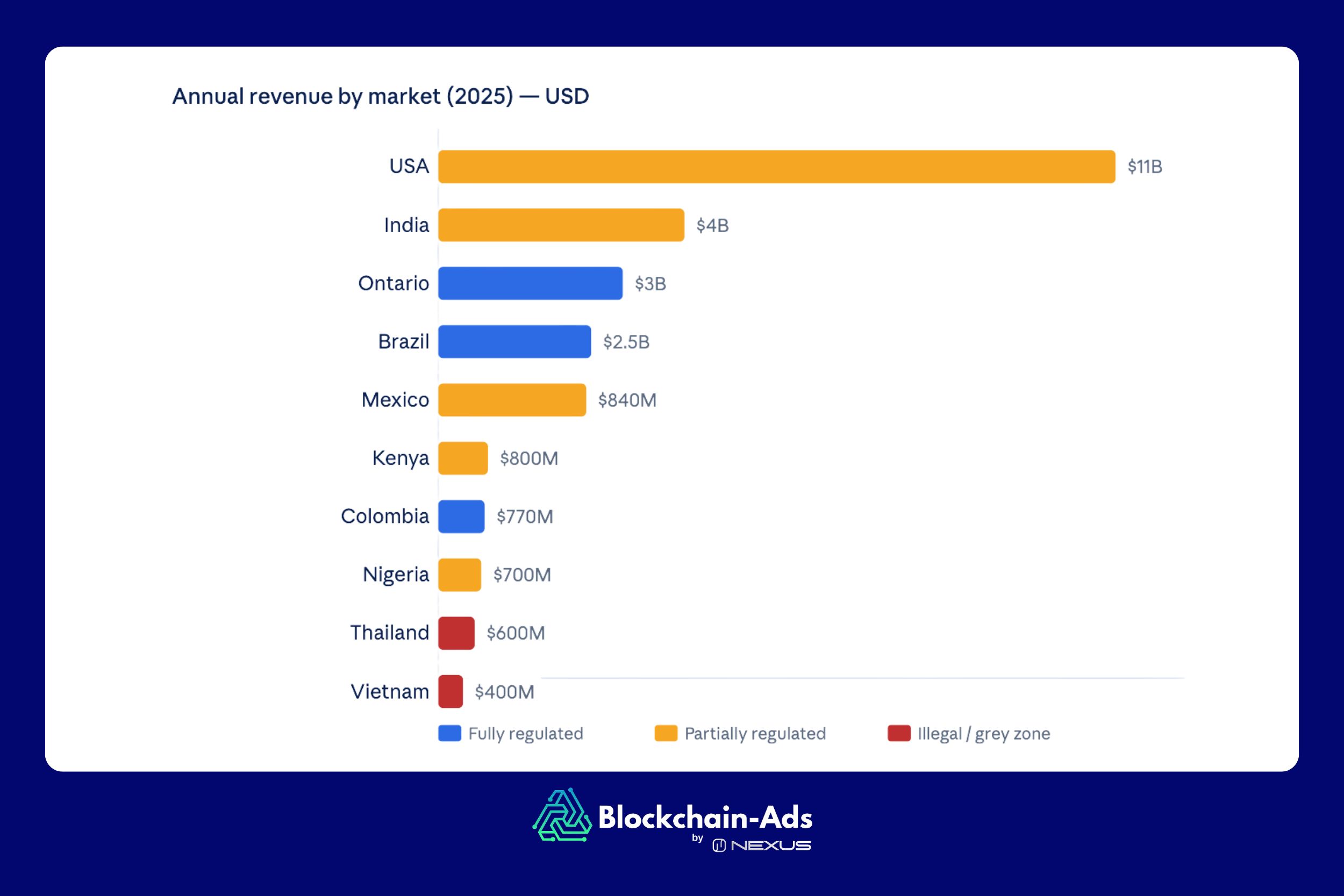
On the contrary to popular belief, a lucrative offer in hand doesn’t guarantee the best results by itself. It’s the harsh truth to embrace while entering affiliate marketing, and especially a niche so complex as iGaming. How so?
For starters, despite the iGaming vertical’s noticeable growth worldwide, the industry’s representation by regions is extremely diverse. That is due to various economical, demographic and cultural differences expected to appear in each market as working with iGaming products. It's most visible in industry coverage, since there is no clear monopoly of one online casino or kind of gambling game that dominates the entire world undoubtedly.
That is followed by regulatory statuses. There is still no global consensus whether online gambling should be legal or not, so it’s only natural to take that in priority consideration. Obviously, governments and their peoples are two separate entities, yet they impact each other drastically. And when it comes to such sensitive entertainments that involve money as iGaming, local regulations define a lot.
Finally, it’s the matter of competition for a region. Even some big iGaming brands struggle to take their place within a particular market, and that’s with all the resources at their disposal. Fierce competition affects not only the scale of possible representation, but the entry threshold itself, along with audience penetration and advertising costs. So it’s best to think twice before contending for a saturated market, despite the promised payout on what is an unlikely success.
In summary, picking the top market for iGaming campaigns is not the matter of affiliates getting the best product, but how well they know where they operate.
1. Brazil: The #1 Emerging iGaming Market
For a long period of time Brazil remained a two edged sword of a market for iGaming involvement. On one hand, the natural audience demand was always there, starting from known dedication to sports like soccer, and followed by natively cultural practices to back it up. On the other hand, it was raw in terms of convenient development of iGaming-related businesses: legal status remained problematic along with compliance complications.
In 2023 with the updated policies regarding sports betting Brazil almost instantly experienced a rapid growth of the iGaming industry within its borders. By 2026 it’s reportedly over thousands of brands legally operating in Brazil, generating over $2.5 billion in projected annual revenue in 2025. No more off-shore market or ‘grey zone’ for those who comply, but a tax according operating that supports the local economy.
But in terms of competition for audience, Brazil remains a go-to top market for iGaming affiliates with over 22 million active bettors, about 10% of the entire country’s populace. The digital market there is as developed as anywhere in the modern world with 84%+ internet penetration, active usage of multiple digital channels and strong mobile devices connectivity. Audience solvency there is also one of the highest across South American countries: monthly income varies ~$560-650 by average.
Key facts on Brazil as iGaming market:
- Audience size: ~22 million active users (sports betting);
- Market size: $2.5 billion annual revenue (2025);
- Regulations: fully regulated sports betting sector since 2023;
- Key iGaming vectors: sports betting, online gambling.
2. United States: High-Value, State-by-State Opportunities
The United States of America is not only a ‘dream land of freedom’, but one of the most lucrative iGaming markets in the entire world. Deep roots to gambling culture resulted in Las Vegas as a globally known resort city full of casinos. Diversity of the states, where everything from tax policies to social dynamics might vary, provided some regions within the US with the ability to race the entire world by iGaming market development. Only in 2025 the projected online gambling market revenue there exceeded $11 billion annually.
Regarding the iGaming regulatory status in the United States, it’s as diverse as the states themselves. Despite that only two states among the fifty, Hawaii and Utah, maintain a total ban on all forms of gambling. And that is what makes the US a top choice of market for iGaming affiliates by the amount of legally operating brands: hundreds of unique digital platforms. Almost any taste of gambling is represented there from slots, live dealing and sports betting to poker skill-based and arcade games, of course if compliant to a certain state’s laws.
But where the lucrativeness and accessibility are, there’s the downside of saturation. Despite the rough monthly income of ~$2000-4000 averagely in the US, competing for this solvent audience is very hard. There’s all kinds of odds, starting from traffic prices and strict compliance requirements to the obvious struggle to creatively overcome experienced colleagues. Yet, even all of that is compensated by truly high payout amounts on iGaming offers and 100+ million of audience to target.
Key facts on the United States as iGaming market:
- Audience size: ~100 million active users (among adults of age from 21);
- Market size: $11 billion annual revenue (2025);
- Regulations: state-dependent / semi-regulated;
- Key iGaming vectors: sports betting, poker, online gambling.
3. Ontario, Canada: A Regulated Market Already Generating Billions
A new market to surely hit the top of interest for iGaming affiliates in 2026. Ever since introducing iGO (iGaming Ontario) and sorting out the regulations for private operators, this province of Canada has become the North American gambling powerhouse. Eliminating iGaming ‘grey zone’, in 2025 its market size reached almost $3 billion in annual revenue, up to 34% over previous year.
Now Ontario in Canada is a place for over 40 private operators providing licensed platforms with online casino, sports betting and poker to the audience of 1.3 million monthly active users. And the numbers just keep growing.
Since leaving the off-shore domination behind, competition for the iGaming market in Ontario has obviously risen. No wonder, a genuine Tier-1 country that opened itself to a clean market has made affiliates deal with increasing efforts to compete, yet provided a more valid path to benefit off.
Key facts on Ontario, Canada as iGaming market:
- Audience size: ~1.3 million active users monthly;
- Market size: $3 billion annual revenue (2025);
- Regulations: fully regulated;
- Key iGaming vectors: online casino, sports betting, poker.
4. India: 140M+ Bettors and Growing
Being the most populated country in the world with over 1.4 billion residents, India is a well-known top choice for iGaming affiliates desiring to enter a lower threshold market. Despite continuous online gambling restrictions, including the restructuring of the real-money gaming sector regulations in 2025, the annual projected revenue there was reaching $4 billion. That’s about 85% of the entire gaming industry’s market size in India.
And the reason behind the iGaming market’s growth in India is simple: huge natural demand. Cricket being the national sport has been playing a crucial role in popularity of sports betting, which peaks in active users involved during IPLs (Indian Premier League). Reportedly, the constant audience size of iGaming there counts in 140+ million monthly, yet during such events as IPL it easily overcomes half a billion of concurrent bettors.
Apart from sports betting, India is fond of many kinds of online gambling activities, including online casinos, poker, skill-based and casual games. So that is why regardless of 8000 websites blocked since August 2025, the iGaming industry presence there is still alive and kicking. Though, for most affiliates operating in India such popular solutions as Facebook became even less appropriate, and gambling ad networks have seen the rise.
Key facts on India as iGaming market:
- Audience size: ~140 million active bettors;
- Market size: $4 billion annual revenue (2025);
- Regulations: partially regulated;
- Key iGaming vectors: sports betting, online gambling, skill-based games, poker.
5. Nigeria: Africa’s Mobile Betting Powerhouse
Nigeria is truly one of the leading countries in Africa that embraced the mobile era for iGaming purposes. In 2025 the region reportedly generated up to $700 million in annual market revenue as sports betting dominates the sector. Mobile devices usage makes up to 80% of all online gambling activities in Nigeria with up to 60 million active daily audience size, mostly bettors.
The key to the region’s iGaming development is quite standard: great dedication to following sports, particularly soccer. Nigerian youth is tech-savvy, passionate about their favourite teams and fresh forms of entertainment, which easily drives big brands’ attention to the region. Conveniently, since 2024 the regulatory body in the country is decentralized, thus licence issuing is handled by states and giving opportunity to enter the market legally.
Yet the greatest feature of Nigeria that puts it in the line of other top markets for iGaming affiliates to operate in is the traffic costs. Developed digital landscape of Africa’s most advanced mobile user smoothly coexist with simplified entry-point for marketing.
Key facts on Nigeria as iGaming market:
- Audience size: ~60 million active bettors;
- Market size: $700 million annual revenue (2025);
- Regulations: state-dependent / partially regulated;
- Key iGaming vectors: sports betting, online gambling, poker, skill-based.
6. Kenya: High Engagement, Low Competition
Following Nigeria, Kenya is another largest iGaming market in Africa, approximately generating over $800 annual revenue to the online gambling industry. That is with reportedly about 79% of the entire country’s population having placed a bet at least once throughout the year in 2025, as 35% of the audience is active weekly. Conclusively almost 45 million bettors of 58 million total populace.
Just like in Nigeria, the online sports betting industry is booming in Kenya, as well as mobile devices usage reaching up to 72%, especially among youth. Following the Gambling Control Act 2025, about 80% of the active players in the region transferred to newly licensed platforms. Nonetheless, this hardly affected the segment dominance of sports betting taking up to 75% of the local iGaming market.
But what Kenya truly stands out for among its peers in Africa as a top market for iGaming affiliates, is the noticeably lower competition. Relatively recent updates to regulations, developing digital space and pulsing audience engagement are setting a high pace to follow in the region.
Key facts on Kenya as iGaming market:
- Audience size: ~45 million active bettors;
- Market size: $800 million annual revenue (2025);
- Regulations: partially regulated;
- Key iGaming vectors: sports betting, online gambling.
7. Mexico: LATAM’s Next Big Regulated Market
One the most promising iGaming markets in Latin America, Mexico delivered about $840 million in 2025 only by licensed sector, and estimated $2.4 billion in total revenue that year. Fast-paced expansion is evaluated by an impressive 15% CAGR annually, and by 2031 is expected to reach up to 17.8%, foreseeing upcoming regulations updates.
In 2026 Mexico will be undergoing a massive iGaming regulations shift the region has seen in ages, including responsible gambling acts and ad restrictions during day time. The changes are expected to take place prior to FIFA World Cup 2026, yet will hardly affect peak activity stimulated by the event. Online sports betting in Mexico traditionally takes up a major chunk of the iGaming market, making it a top region for the niche-oriented affiliates.
With its yet to untap potential, Mexico’s becoming a fully regulated market puts it into the spotlight. Competition in the ‘grey zone’ will be smoothly decreasing, while legal operators will seek marketing solutions to strengthen their positions.
Key facts on Mexico as iGaming market:
- Audience size: ~15 million active online gamblers;
- Market size: $840 million annual revenue (2025);
- Regulations: partially regulated;
- Key iGaming vectors: sports betting, online gambling, poker.
8. Vietnam: Early Signs of Regulatory Opening
A firmly mobile-first iGaming market in Asia that is yet to experience clear legislative status for local users, but already reaching over $400 million annual revenue only in 2025. Despite the ongoing ban on almost all forms of online gambling activities in the region, the recent ‘pilot programs’ for land-based casinos show a decent shift to future changes. And Vietnam would be ready to take them on.
Traditional roots to gambling in Vietnam are very deep, resulting in numerous local dice games dating centuries back. Betting is also quite popular among Vietnamese audiences, as some laws regulate legal waging on horse racing and greyhound racing. All of that by natural demand makes Vietnam a potential top market in Asia for iGaming affiliates to look after.
Yet the competition there is already fierce. Most off-shore iGaming websites are accessible in Vietnam through various VPN and proxy solutions, regardless of regular bans enforcements. The audience there is driven, passionate, which respectably makes foreign brands target the region.
Key facts on Vietnam as iGaming market:
- Audience size: ~10-15 million active iGaming participants;
- Market size: $400 million annual revenue (2025);
- Regulations: illegal;
- Key iGaming vectors: sports betting, online gambling, card games.
9. Thailand: First-Mover Advantage in Southeast Asia
One of the most spending regions in Southeast Asia with mobile dominance and eSports betting dedication that approximately generated $600 million annual revenue in 2025. Thailand remains not so keen on changing the current regulatory landscape for iGaming, and despite recent intentions of legalization instead proceeds with previous policies. Nonetheless, gambling is not completely banned in Thailand, but is under a government held monopoly over authorized only lottery and horse racing bets.
As 2025 was the year when Thailand came closest to serious discussion of legalizing gambling and establishing a regulatory program, these intentions still remain in public. The giant potential that the market holds for iGaming integration is already visible, as about 34.5 million are active participants of gambling activities among a total 71.6 million population.
Until then, Thailand is definitely one of the top markets across Southeast Asia to pay attention to for iGaming affiliates that sadly benefits only the ‘grey zone’ side of the industry.
Key facts on Thailand as iGaming market:
- Audience size: ~34.5 million active gamblers;
- Market size: $600 million annual revenue (2025);
- Regulations: illegal;
- Key iGaming vectors: sports betting, online gambling.
10. Colombia: A Proven Regulated Framework in Latin America
Colombia is the region’s pioneer in introducing the legal iGaming landscape dating back to 2016 and becoming the first regulated market in the entire Latin America. As of now it’s the top market in South America, third the largest after Brazil and Mexico that attracts iGaming affiliates across the world and itself is estimated close to $770 million annual revenue in 2025.
Sports betting accounts for roughly 70% of iGaming market share in Colombia, while such trends as eSports and crash games emerge rapidly there. The market supports over 9.5 million unique users, a mobile-first youth that shows one of the highest engagement in the region: about $800 annual revenue per user. Approximately 60% of the Colombian population reported betting at least once a year.
In terms of market competition, Colombia is a proven choice for many by 2026, so contending for it could be harder than in some less discovered regions. Yet with constantly emerging trends, mobile engagement and audience passion it doesn’t seem to settle for break proof strategies any time in the future.
Key facts on Colombia as iGaming market:
- Audience size: ~9.5 million unique users;
- Market size: $770 million annual revenue (2025);
- Regulations: fully regulated;
- Key iGaming vectors: sports betting, online gambling, skill-based, lottery & bingo.
How to Choose the Right Market for Your Affiliate Strategy

Settling down to a top market for your iGaming affiliate campaigns is a matter of thorough consideration, yet it can be broken to simple key factors to pay attention to. So, before taking an offer in any geo, just evaluate these:
- Legality.
The regulations rule out most of the marketing strategies that come to iGaming products if the market itself is strict or illegal. It’d be very unpleasant if a good amount of traffic goes to waste as campaigns get banned and payments lost. - Audience engagement.
It’s obvious that engaging users not one bit familiar with iGaming services is hardly possible. But likewise building strategies around a natural demand is more effective, so take a look whether the market is responsive, how much users spend, what’s the audience penetration, etc. - Competition.
Highly saturated markets are hardest to enter, so it’s best to look for ones that are broad enough for new players to adapt. - Advertising costs/benefits ratio.
If the efforts to compete for a market break zero or come close to it compared to profit with no ability to reinvest the surplus, it’s not a good idea to start there. Many regions treat the iGaming market sensitively which drastically affects the costs of promotion despite decent payouts. - Market’s potential.
Whether the iGaming market seems to be evolving in the region is essential. Its coverage across current global trends, amount of operators, brands and revenue growth showcase such. Otherwise, it’s as good as never touched in the first place.
How to Reach Players in These Markets
Regarding the marketing solutions to attract iGaming users from these regions, in 2026 the advertising landscape is experiencing a shift towards more specialised options. It’s due the overall effect that targeting a precise audience through tailored channels proves a better solution than adjusting broad coverage.
iGaming advertising platforms
Specialised gambling advertising platforms like Blockchain-Ads are facing significant growth along with the iGaming industry expansion worldwide. Ability to target precise users in top markets for iGaming affiliates via push, video, pop ads, native, display channels drive quality results cost-effectively with broad outreach.
YouTube and influencer marketing
The video hosting has been a major part of many marketing strategies for iGaming promotion. It’s highly valued by free access to global audiences along with partnering abilities to market through influencers on the platforms.
Social & In-App ads
A decently popular solution to reach iGaming players via such social medias as Facebook and X (formerly Twitter). Yet with tightening regulations introduced by the platforms not only regarding compliant products by in general make it harder to achieve high outreach results.
Search engine promotion
Free-at-first-sight access to endless prospects in the iGaming market. In fact, search engine marketing demands a lot of resources, constant content strategies update and deep expertise with frequently changing algorithms of Google.
Key Trends Shaping iGaming Affiliate Markets in 2026
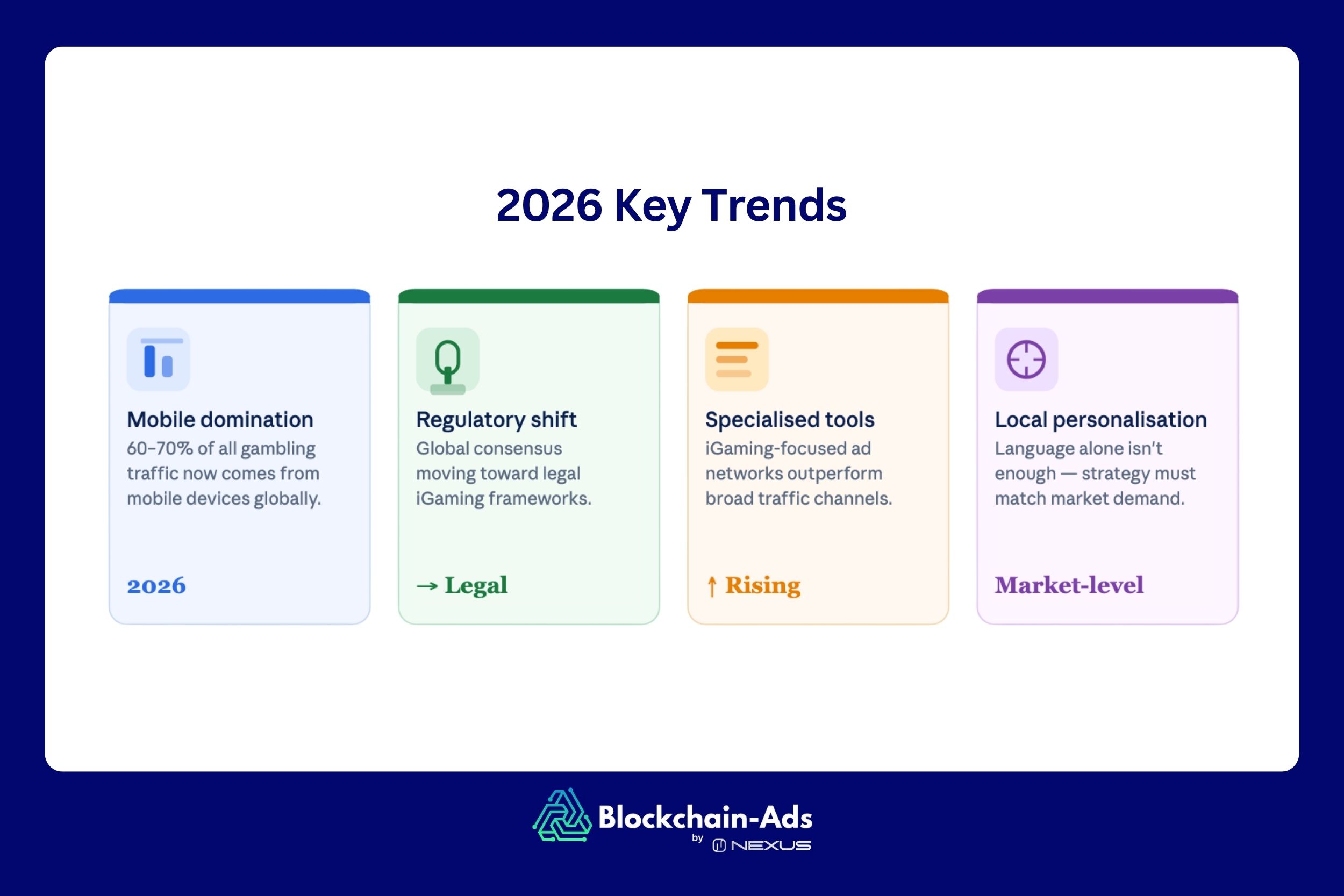
Along with changes and trends within the global iGaming industry, the affiliate marketing side of it changes as much accordingly. Here are the top valuable trends in the iGaming market by 2026 that should be considered by affiliates dedicated to work within the niche:
- Mobile domination era.
Along with an increasing shift to mobile devices usage among iGaming participants around the world, this highly affects the affiliate strategies. According to various reports, mobile devices account for about 60-70% of the entire Gambling traffic. - Regulatory orientation.
Despite some driven iGaming markets still prevent the legality for the industry, over the recent years there’s been a confident shift of global regulatory approach. Many regions oversaw their previous policies, now making the iGaming affiliate era closer to full legal status than ever. - iGaming specialised approach.
As the market keeps embracing exactly iGaming oriented marketing strategies, the solutions that focus the industry as their specialty will grow. The old-time’s options to outreach a drop of audience in the flow of traffic still remain popular, but specialised Gambling-focused tools are rapidly climbing the major ranks. - Local personalisation.
Considering regulations shift it’s only natural that iGaming markets might get slightly isolated in their local ecosystem. Personalisation is not only about language anymore, it’s the strategy that meets demand on the market level.
Final Thoughts
2026 has brought some massive changes in the top markets landscape for iGaming-oriented affiliates, as new regulations were introduced along with digital space transformation. And as, for instance, Brazil entered its gold era back in 2023, by now it’s become one of the most emerging markets across the Americas. Along with newly spotlighted iGaming markets in Asia, Latin and North America, learn what’s the current state of promising countries to take your affiliate efforts in by Blockchain-Ads expertise.
A professional content marketer with 3+ years of experience in iGaming and affiliate marketing.
View full profile →