What to Know About Gambling Ads on Facebook Under Meta's Rules
Key takeaways
- Ad account authorization: Meta authorizes specific ad accounts for online gambling ads by territory and gaming type.
- Market eligibility: Meta excludes 19 markets from gambling and social casino ads, even for licensed advertisers.
- Product exceptions: Some offline gambling, qualifying lotteries, and social casino games can run without authorization.
- Adult targeting: Gambling and social casino ads must target people 18 or older, or older where local rules require.
- Affiliate rules: Affiliates running gambling ads need their own authorization and the operator’s license.
Casino ads on Facebook can face rejection or account restrictions when gambling authorization, targeting, or destination requirements are missed. Can you advertise gambling on Facebook? Yes, provided the account has the required authorization and the activity is lawful in a supported market.
Facebook gambling ads require more than an operator's license. Meta authorizes specific ad accounts, while advertisers remain responsible for each jurisdiction and gaming type they promote.
In this article by Blockchain-Ads, you will find the current requirements, excluded markets, and application process for operators and affiliates.
What's Changed in Meta's Gambling Ad Policy
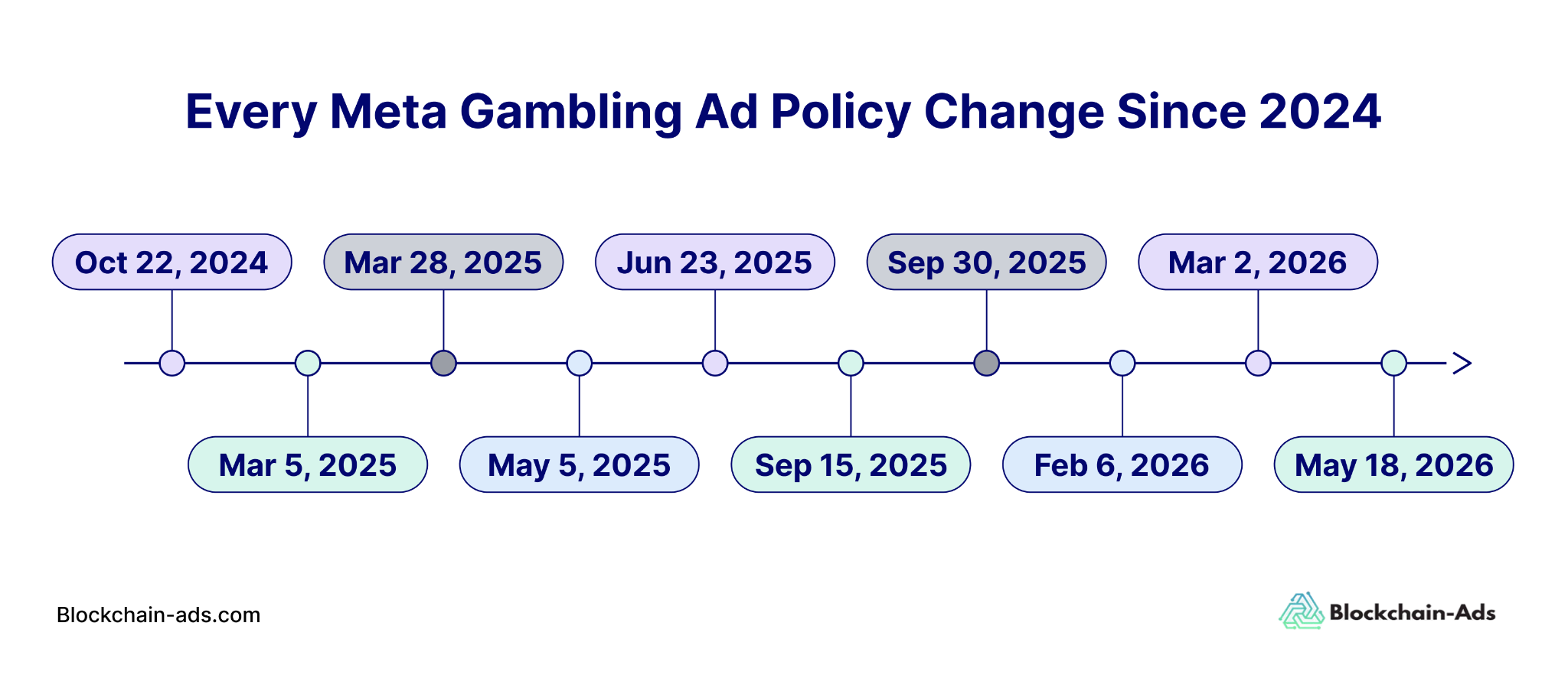
The Meta gambling policy now uses account authorization through Business Suite and excludes 19 markets from online gambling and social casino advertising.
Meta’s change log records ten dated revisions from October 2024 through May 2026. Older explanations of the Facebook gambling policy can therefore describe application routes or country lists that no longer apply.
The following changes appear in Meta's policy history, listed newest first. All dates are the version dates in the change log selector.
Change log last checked: 20 October 2026.
Gambling Ads That Need Meta Authorization
Meta authorization is required for online gambling promotions, including ads that send users to affiliate or aggregator pages.
The policy considers both entry and prizes when deciding whether a game involves monetary value. That value can include digital currencies, so accepting Bitcoin does not exempt a casino from authorization.
Facebook casino ads fall within this requirement alongside several other products:
- Online casino games and betting: Slots, poker, bingo, sports betting, and other online gambling products require authorization.
- Lotteries, raffles, and sweepstakes: These appear within Meta's covered gambling categories, subject to the specific exceptions below.
- Fantasy sports and skill tournaments: A skill component does not automatically remove a paid-entry game with valuable prizes from the policy.
- Purchases that affect valuable prizes: Authorization applies when purchases extend gameplay or improve the chance of winning something with monetary value.
- Affiliate and comparison destinations: A page promoting gambling requires authorization even when users can’t place a bet on that page.
- Trials followed by payment: Meta also lists games offering a limited trial before requiring payment.
For iGaming Facebook ads, reviewing only the banner or video misses part of the requirement. A neutral-looking ad creative can still contain ambiguous messages and direct users to a gambling promotion. So, the account, promoted product, and destination all need to fit the authorization together.
Authorized campaigns can’t target anyone under the age of 18. Where local rules demand a higher age, the advertiser must follow that threshold.
Authorization also leaves the advertiser responsible for local licensing and gambling advertising requirements.
Gambling and Social Casino Ads Meta Allows Without Authorization
Meta allows specific gambling-related categories without prior gambling authorization, provided they meet the conditions attached to each exception. For Meta gambling ads, the distinction depends on the product, promotion, and destination together.
These exceptions come from Meta's policy and application guidance. They do not exempt an advertiser from local law or the remaining Advertising Standards.
Social casino games deserve particular attention because simulated poker, slots, and roulette can resemble real-money products. Yet, virtual coins can also qualify when they have no monetary value. But if prizes can be traded for money within the game or on secondary markets, Meta directs advertisers back to its gambling policy.
For the exempt gambling-related promotion, Meta also says ads should not depict or target minors. Social casino advertising specifically requires an audience aged 18 or older and compliance with the unsupported-market list.
Countries Where Meta Doesn't Allow Gambling Ads
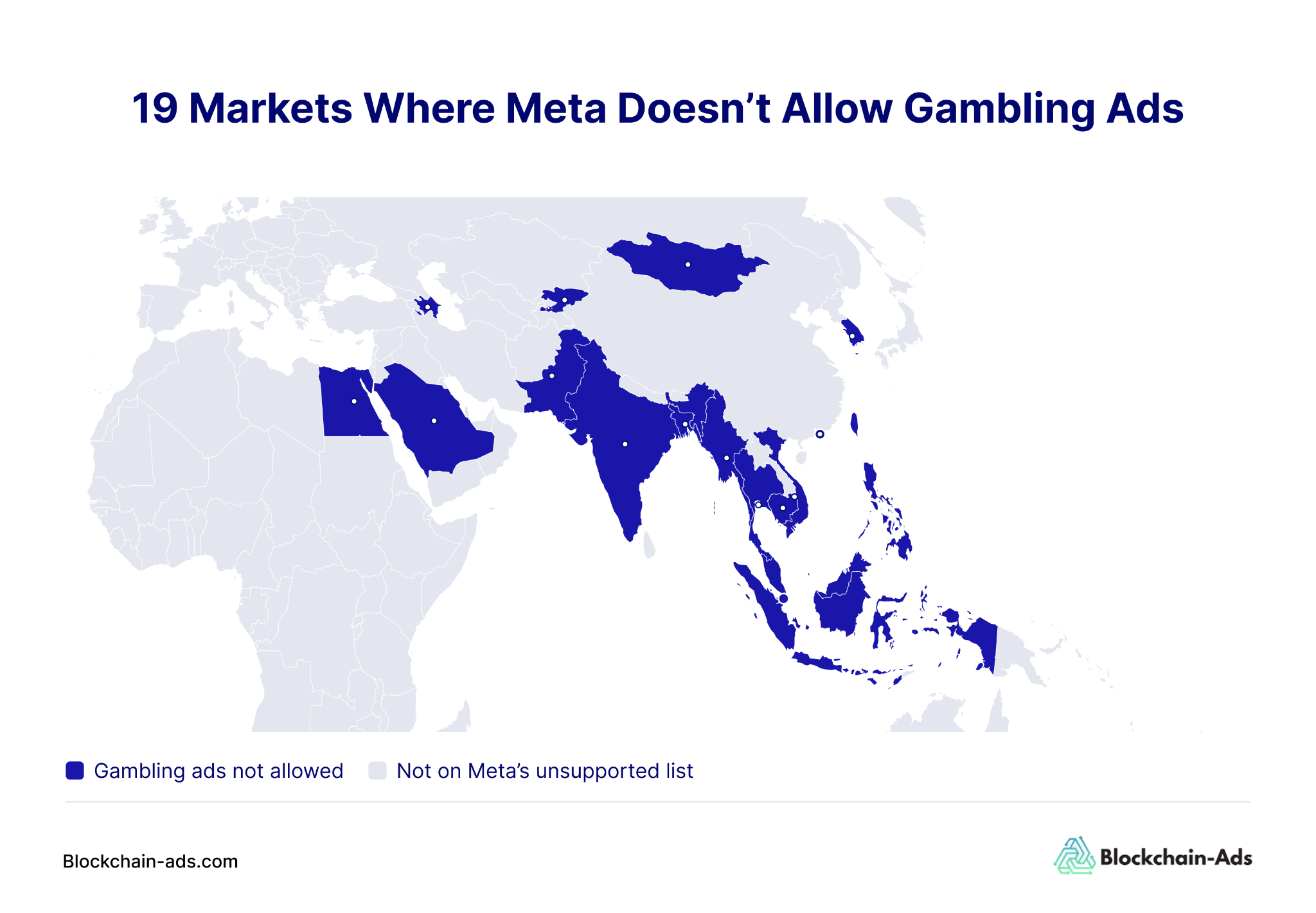
Meta does not allow online gambling ads or social casino ads to target the following 19 markets, even when an advertiser holds a license. Its current policy applies the same list to both categories.
- Azerbaijan
- Bangladesh
- Cambodia
- Egypt
- Hong Kong
- India
- Indonesia
- Korea
- Kyrgyzstan
- Malaysia
- Mongolia
- Myanmar
- Pakistan
- Philippines
- Saudi Arabia
- Singapore
- Taiwan
- Thailand
- Vietnam
Last checked: 20 October 2026. Source: Meta's complete unsupported-market lists. Market names follow Meta's wording, including “Korea.”
For readers in Vietnam, the Philippines, Malaysia, Thailand, Cambodia, India, or Indonesia, note that a gambling license does not override this platform restriction. Just as switching from real-money gambling to a social casino promotion does not remove it either.
The reverse also matters. Absence from this table does not establish that every gambling product can be advertised there. Operators targeting the US, Mexico, or Argentina still need lawful permission for the specific activity and territory they intend to promote.
How to Get Meta Authorization for Gambling Ads
To understand how to run gambling ads on Meta, start with account authorization through Business Suite's Authorizations and Verifications tab. Meta's application asks for the business type, territories, gaming categories, destinations, and supporting documentation.
Searches for the Facebook real money gambling application form can lead to older standalone forms. Meta's current instructions direct applicants to Authorizations and Verifications instead.
The current process is as follows:
- Open the gambling authorization request. Under Online gambling and gaming ads, select View details, then Request authorization and Get started.
- Choose the request and business type. Confirm a new application, then identify as an operator, aggregator, affiliate, or agent.
- Select territories and gaming types. Include the eligible jurisdictions and products the business is licensed or otherwise lawfully permitted to advertise.
- Identify the business and destinations. Enter the legal business name matching the documentation, the advertised URLs, and the ad accounts requiring authorization.
- Upload supporting evidence. Submit gambling licenses or other documentation establishing lawful activity. Requirements vary by business type, territory, and gaming category.
- Acknowledge the gambling addendum. Complete the application and follow its status in the Business Suite.
A Facebook advertising account for casino promotions receives authorization against its account ID. Other accounts in the same business portfolio can receive an extension through a separate request. Meta requires admin or advertiser access to both the authorized account and the additional account.
Expansion into new jurisdictions or gaming types also requires a declaration through the Business Suite. Meta says that many existing authorized accounts can receive instant approval for these requests.
Certain jurisdictions, including Brazil, are exceptions. An automatic decision still leaves the advertiser legally responsible for the expanded activity.
What affiliates and partners need
Affiliates running gambling ads need authorization even when they send traffic to an operator rather than accept bets themselves. The application includes an affiliate business type, and Meta requires partners to upload the operator's license as supporting documentation.
Partnership ads have a narrower exception. A partner does not need separate authorization when the operator runs the partnership ad and the partner is only tagged. But when the partner launches gambling ads, they need to apply themselves.
An operator's existing authorization does not automatically cover every affiliate's ad account. Before submitting, the affiliate should align its destinations, promoted operator, and supporting documents with the requested territories and gaming types.
Using Blockchain-Ads as an Alternative to Meta for Gambling Ads
Blockchain-Ads is an option for licensed operators considering acquisition outside Meta, including those in unsupported markets, awaiting authorization or refused permission. Crypto casinos can also access their audience targeting. Eligibility depends on lawful advertising in each target market after completing the platform's qualification process.
The platform is a DSP (Demand-Side Platform) that reaches audiences in regulated markets across display, native, video, in-app, and connected TV inventory. The audience-targeting page already lists available prebuilt segments, such as:
- Casino players: 1.4 million users associated with casino play and deposits.
- High-value casino players: 220,000 users associated with above-average deposits and frequent play.
- Sports bettors: 1.1 million users associated with bets placed during the previous seven days.
- Lapsed players: 480,000 users associated with no play during the previous 30 days.
For crypto casino and betting advertising, the platform also offers targeting based on wallet activity and on-chain behavior. Conversion tracking covers registrations, first-time deposits, and revenue, allowing acquisition reporting to follow player activity beyond the click.
Licensing and lawful promotion in each market remain the advertiser's responsibility. A Meta restriction does not establish eligibility elsewhere. Operators with the appropriate permissions can explore iGaming advertising through Blockchain-Ads.
FAQs about iGaming ads on Meta
Why does Meta reject gambling ads, even after authorization?
Authorization does not exempt individual ads from review. Targeting destinations or promoted gaming types may fall outside the authorized scope or breach another advertising standard. Expired licensing can also affect eligibility.
Review the stated rejection reason against the account's authorization and current requirements before requesting another review.
Are Meta's gambling ad rules the same on Facebook and Instagram?
Yes. Meta's Advertising Standards govern ads across Facebook and Instagram, including gambling authorization and adult targeting.
Changing placement does not remove those obligations. The advertised product, destination, and target jurisdiction still need to meet the same gambling requirements.
Can you promote gambling on a Facebook Page or Group without running ads?
Meta requires prior written permission to promote online gambling through a Page, Group, or Event. Its Community Standards also restrict visibility of online gambling content to adults aged 18 and over.
Publishing ads organically as content does not remove the applicable permission or audience requirements for gambling set by Meta in the first place.
Do sweepstakes casinos need Meta authorization?
Meta explicitly includes sweepstakes within its covered gambling categories.
A sweepstakes casino should not assume the ordinary retail prize-promotion exception applies. That exception requires a normal retail purchase and excludes businesses whose primary model is online gambling.
Eligibility also depends on the product and target jurisdiction.
How long does Meta gambling authorization take?
Meta's application guide does not give a fixed turnaround for initial applications. You can track the request in the Business Suite and check the decision by email.
Existing authorized accounts may receive instant approval when adding jurisdictions or gaming types, with exceptions including Brazil. That expansion process does not guarantee instant initial authorization.
Can an agency apply for gambling authorization for a client?
Yes. Meta's application includes an Agent option and asks whom the agent represents.
The submission still needs the relevant business details, destinations, account IDs, and supporting documents. Authorization attaches to the selected ad accounts, so an agency relationship alone does not authorize every account it manages.
Can you advertise iGaming software or B2B services on Meta?
A software or B2B label does not automatically determine eligibility.
Meta requires gambling authorization when an ad's destination promotes online gambling, including aggregator or affiliate pages.
It’s subject to evaluation of the actual service and landing page. For a page that sells iGaming software or B2B services to operators without promoting gambling to players, confirm the classification with Meta before launching.
Can you use cloaking or rented ad accounts to run gambling ads on Facebook?
Using cloaking or replacement accounts to evade review can lead to restrictions on accounts, pages, and business assets.
Renting an account also does not replace gambling authorization and will lead to sanctions by the platform.
Meta's Circumventing Systems policy now redirects to Account Integrity, which also covers assets used to evade enforcement.
A professional content marketer with 3+ years of experience in iGaming and affiliate marketing.
View full profile →