How to Start an Online Casino and Actually Get Players
Key takeaways
- Launch path: A white-label casino can launch in 6–8 weeks for $100K–$250K, while a custom build takes 12+ months and $2M+.
- Licensing: The license shapes product, payments, and advertising from day one, with $25,000–$100,000+ as an early cost estimate.
- Compliance: Non-compliance can lead to ad account suspensions, payment processors withdrawing service, or license revocation.
- Acquisition cost: Blockchain-Ads iGaming campaigns average $40–$81 per registration and $170–$340 per first-time deposit.
- One market first: Launching in one GEO makes registration, KYC, deposit, and withdrawal problems easier to diagnose.
Starting an online casino is not as simple as buying a platform, uploading a games library, and waiting for deposits.
Based on iGaming statistics, the global online casino market is estimated at $23.9 billion in 2026, while regulated US iGaming alone generated $3.03 billion in Q2 2026 revenue, up 16.5% year-on-year. The money is there, but so is the competition.
Rush Street Interactive, for example, reported average monthly revenue per player in North America at $320, an impressive figure that a new brand will not get that simply. Yet, most online casinos fail not on licensing in regulated markets but at building a functional player acquisition strategy there.
In this article by Blockchain-Ads, you will find the 7-step path to starting an online casino, what each route costs, and where to discover that licensing is only the beginning.
A quick answer? The usual path is to choose a model, get the license, source the platform and games, arrange payments, build the compliant product, and secure acquisition channels for further expansion. A bare white-label setup can begin around $25,000, but a realistic first-year launch plan can take up to $2 million+. Timelines range from 6+ weeks for a narrow white-label launch to 12+ months for a custom build.
Step 1: Choose Your Business Model
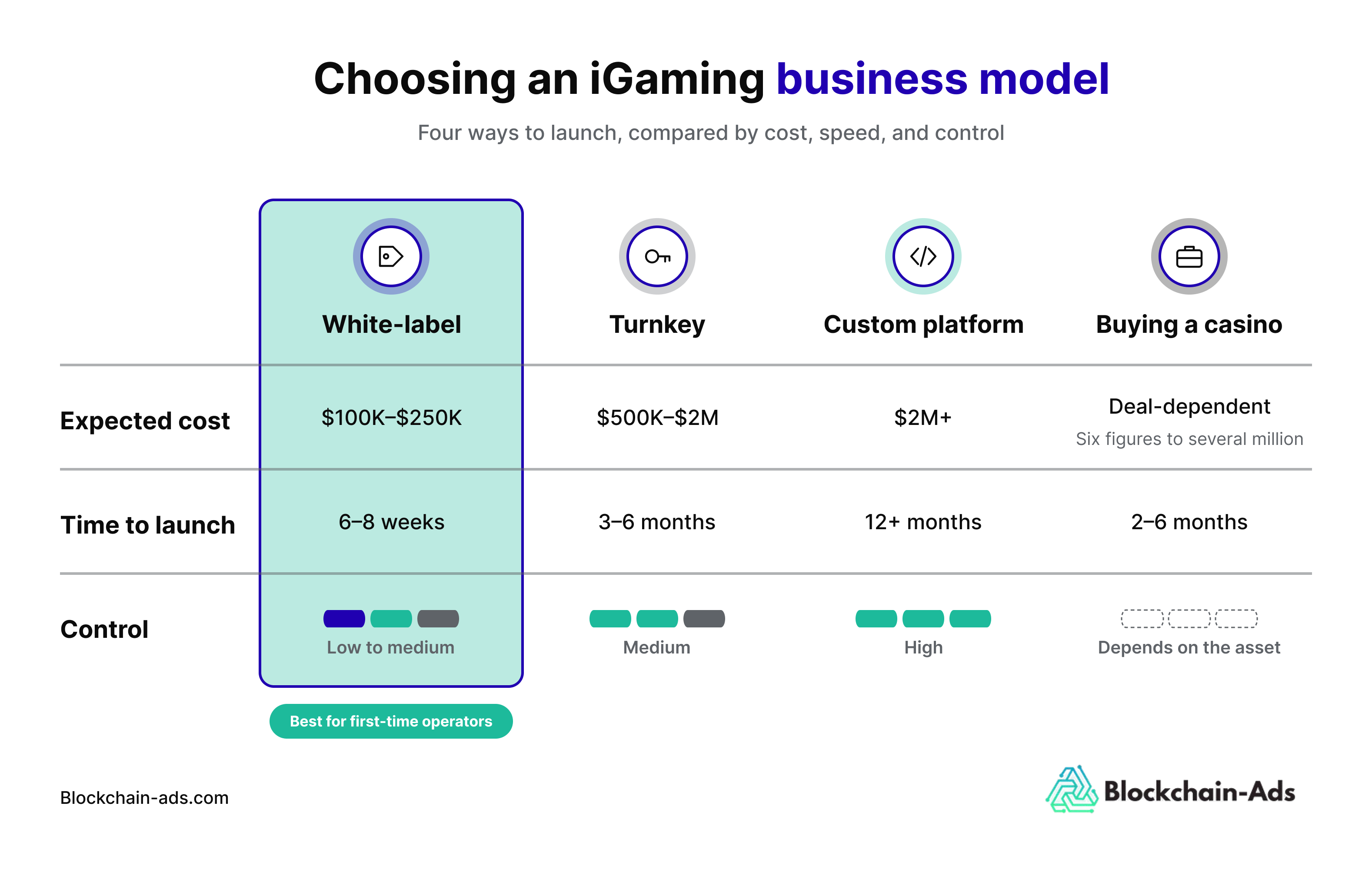
The business model determines almost everything that follows: how much control you have over the product, how quickly you can enter a market, and whether you are paying for an operating system or building one. There are four common options.
White-label means launching under your own brand on a licensed provider’s platform, usually with pre-made payments, game integrations, and back-end tools. It is the fastest way to validate one market, though profitability, product line, and data access are constrained by the agreement terms.
A turnkey setup gives more room to choose providers and operate independently but brings more implementation work.
Custom development makes sense only when an operator already has a proven acquisition model, dedicated technical resources, and a reason to own the stack.
Buying an existing casino may save some time, but the license, player data, contracts, retention quality, and technical debt all need due diligence before any acquisition is treated as a shortcut.
For most first-time operators, a white-label launch of the iGaming platform is the starting point. This model allows the business to learn whether the brand can attract valuable players, for example, in one permitted market before committing to a fully custom build.
The market choice is also to be considered by this stage, as a locally regulated market can limit the available product line, yet offer clearer payment and advertising terms. Curaçao-licensed operators may have a lower entry threshold in some international GEOs, yet an offshore license does not give an operator permission to target every country.
Step 2: Get a Gambling License
The license is not just a badge that gets added after the website is finished. It shapes the product, payments, advertising, and player-protection requirements from day one. There are broadly three licensing routes:
- Strict local licensing.
Major markets like the US states, the UK, Malta, and the like require locally recognized approval, providing the clearest route into a high-value regulated market, but usually the slowest and most costly. - International licensing.
Curaçao and Anjouan are commonly used by internationally focused brands, as they can reduce the initial barrier. However, they do not remove market restrictions or platform policies where local licensing is a legal requirement. - Unregulated markets.
Strictly speaking, this is not a licensing route, as an operator may find consumer demand where the industry is not regulated. But it usually means there is no lawful way to offer gambling, process payments, or advertise there.
The license line can range from tens of thousands of dollars for an international setup to far more for local legalization. It is best to treat $25,000–$100,000+ as an early estimate, though the jurisdiction and product combination decide the actual price. For the market-by-market picture, use our iGaming regulations guide alongside local legal advice.
Step 3: Choose Software and Games
Software is where the casino turns from a brand concept into a usable online gambling product. In short, what an operator needs to launch an online casino:
- Platform provider.
Supplies the player account, wallet, bonus engine, reporting, CRM connections, and operational controls. - Game aggregator.
Builds the connection to a catalogue of slots and table games without forcing the operator to negotiate with every studio separately. - Live-dealer supplier.
Provides the streamed roulette, blackjack, baccarat, and other live-action products in many casino lobbies. - Casino slots library.
Should be built for the target market, not merely for the largest possible game count. RTP disclosures, language, providers, promotions, and mobile performance all affect whether players stay.
The software matter, including platform, integration, and content costs, can take roughly 15-30% of the non-media launch budget. The figure highly depends on the particular set of games and exact providers, as well as the required license, level of custom work, and revenue share terms.
Step 4: Set Up Payments
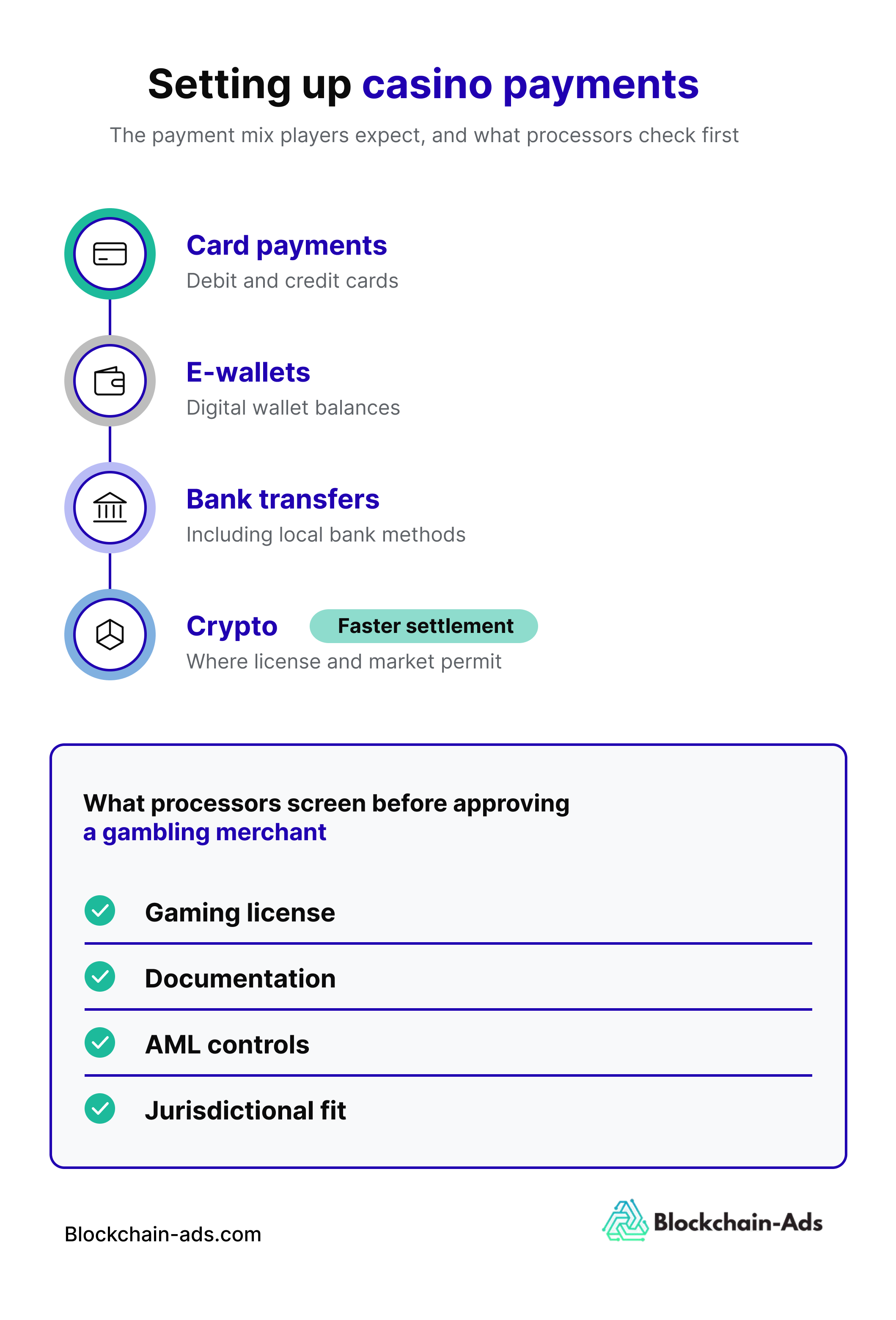
An online casino without options to deposit and withdraw has no viable player journey. The usual mix includes:
- card payments,
- e-wallets,
- bank transfer or local bank payment methods,
- crypto, where the license and target market permit it.
Payment processors screen gambling merchants carefully; otherwise, they themselves might face legal troubles, so an operator without the right license, documentation, AML controls, or jurisdictional fit may be declined straight away.
Crypto rails can be quicker to connect than traditional payment options in some markets, with fewer banking layers and faster settlement, yet they still require a clear compliance position.
Step 5: Build Your Website and Compliance Setup
What any online casino needs, by definition, is the online platform it’s accessed through, but it’s not as simple as ordering one from a developer. The bare minimum launch scope includes:
- a website (also adapted to mobile devices) or app with a clear registration, deposit, and withdrawal flow;
- integrated KYC and AML controls that match the license and payment processor requirements;
- responsible gambling tools such as limits, time-outs, self-exclusion, and age gates.
Non-compliance is not an abstract concern and could cause operational and legal issues. Such issues include advertising account suspensions, a payment processor withdrawing service, or even a regulator revoking the license itself.
Step 6: Plan Your Marketing and Player Acquisition
This is where many launch plans become vague. A platform provider can get a casino online, but it cannot create a reliable stream of depositing players by itself. Affiliate agreements take time to negotiate, tracking needs to be tested, and gambling advertising accounts can require certification before a campaign is even reviewed. All of that needs to be in motion before launch.
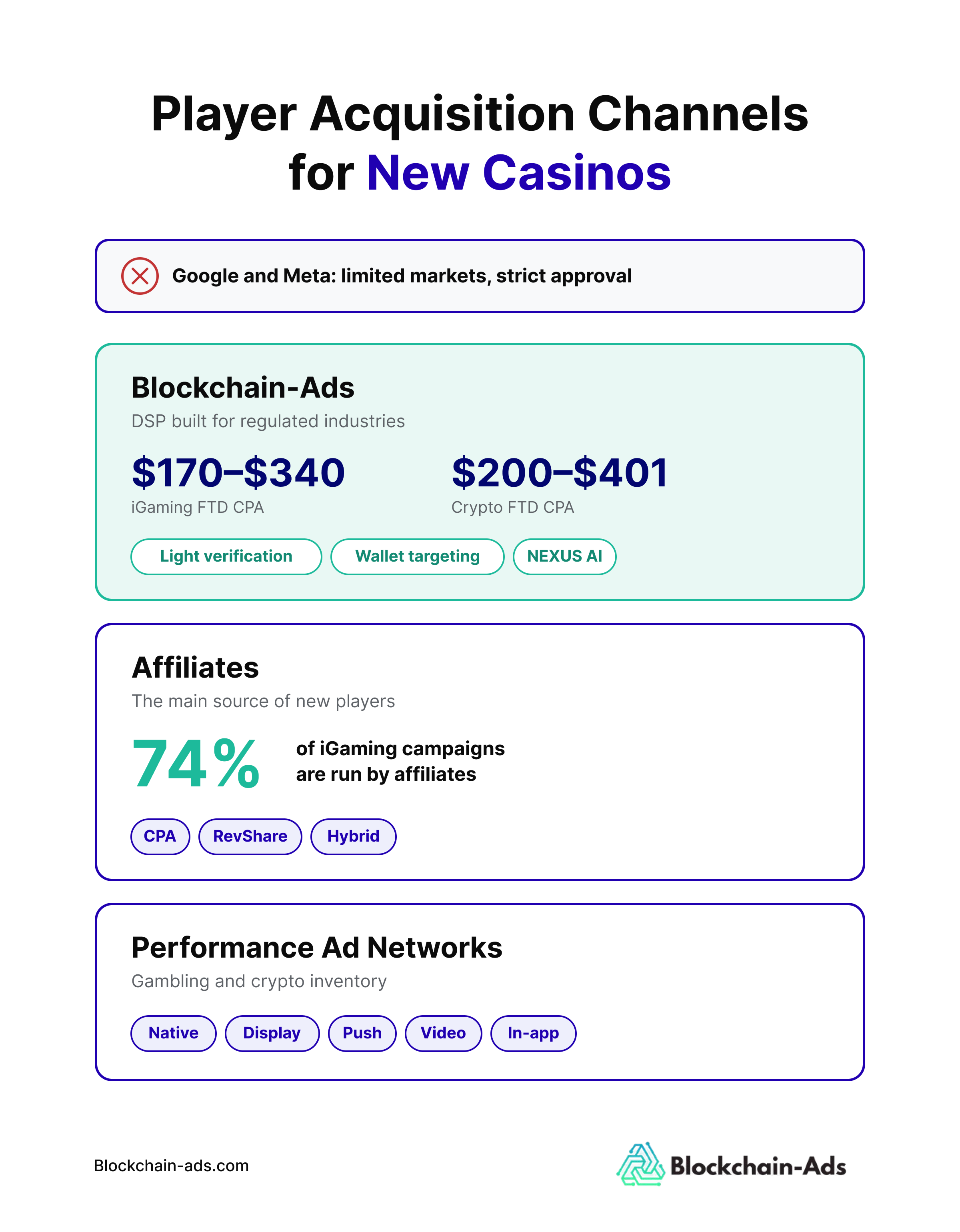
Google and Meta allow gambling advertising, but only in selected markets and under specific certification rules, while the iGaming industry overall is heavily restricted on these platforms. A new casino might not get an approval there, even if it has the right license, as the rejection rate for such is high. That does not make direct acquisition impossible but demands a careful exploration of marketing alternatives that present comparable traffic volume and coverage.
1. Blockchain-Ads
Blockchain-Ads is a DSP (Demand-Supply Platform) designed for advertising regulated industries, focusing on iGaming and crypto-gambling. It also has a verification procedure for advertisers, allowing only licensed operators to run compliant campaigns, yet the certification process itself is lighter. Audience targeting includes regular geo-demographic and interest-based layers, as well as behavioral wallet targeting for precise player acquisition. Tracking, blockchain attribution, ad measurement, and optimization powered by NEXUS AI are to provide an all-in-one advertising hub for complete performance.
The platform presents an industry-leading solution among specialized advertising traffic providers for casino, sportsbook, and crypto-native operators.
Average CPA on Blockchain-Ads:
- iGaming: $40-$81 (Reg), $170-$340 (FTD)
- Crypto-gambling: $200-$401 (FTD)
Average first-time deposit (FTD) value by real examples:
- Stake.com Case Study: ~$623 (based on 1,128 FTDs at CPA $250)
- Roobet Case Study: ~$112 (based on 990 FTDs at CPA $23)
2. Affiliates
Affiliate marketing is a major part of iGaming player acquisition, delivering traffic through paid traffic campaigns, SEO, SMM, email marketing, etc. Nowadays it’s the central source of new players, as 74% of iGaming operators’ campaigns are run by affiliates in 2026 (based on Blockchain-Ads platform data). This reflects how well the model is established for industry-specific marketing purposes.
For the operator, affiliate marketing is a big chunk of operational amends to be taken, requiring an affiliate program and management built internally. In some cases, providing affiliate offers is possible without its own partner management department but through affiliate networks that work with iGaming advertisers. Either way, to have effect from this channel, one needs to have clear CPA, RevShare, or hybrid partnership terms. They also need a precise definition of a qualified FTD; GEO restrictions; promotional materials (like landing pages); and fraud controls.
3. Performance ad networks for gambling and crypto
Specialized performance advertising networks can provide access to gambling and crypto-relevant publisher inventory across native, display, push, video, in-app, and sometimes pop formats. They also require license checks and compliant advertising setup, yet not as strict as on Google Ads and Facebook. Some ad platforms might even lack or neglect following those obligations in full, which would make them unreliable options for new iGaming operators who want to run a legitimate business.
The right approach is to treat each network as a controlled performance test, and only after thorough examination. They are useful for testing a particular GEO or scaling a working offer where Google and Meta restrictions make traffic unreliable. Nevertheless, campaign approval, inventory quality, targeting capacity, and compliance level can differ considerably between networks.
Step 7: Launch in One Market, Then Expand
Launching in one GEO makes it possible to test the product under real conditions: registration, KYC pass, deposit rate, withdrawals, bonuses, and customer support. It is much easier to diagnose a payment or retention problem in one market than across five countries with different currencies, regulations, and traffic sources appearing right from the start.
Once the first market is covered and stable, then the expansion can follow: Add another GEO with a compatible license and payment options, expand the affiliate program accordingly, and establish CRM and retention basics. Expanding over new game verticals should be considered only when the data strongly supports that decision. Casinos and sportsbooks can work well together when the same target market permits both products and the operator can support the extra odds. But they can’t work based on pure desire for new lucrative angles.
How Much Does It Cost to Start an Online Casino?
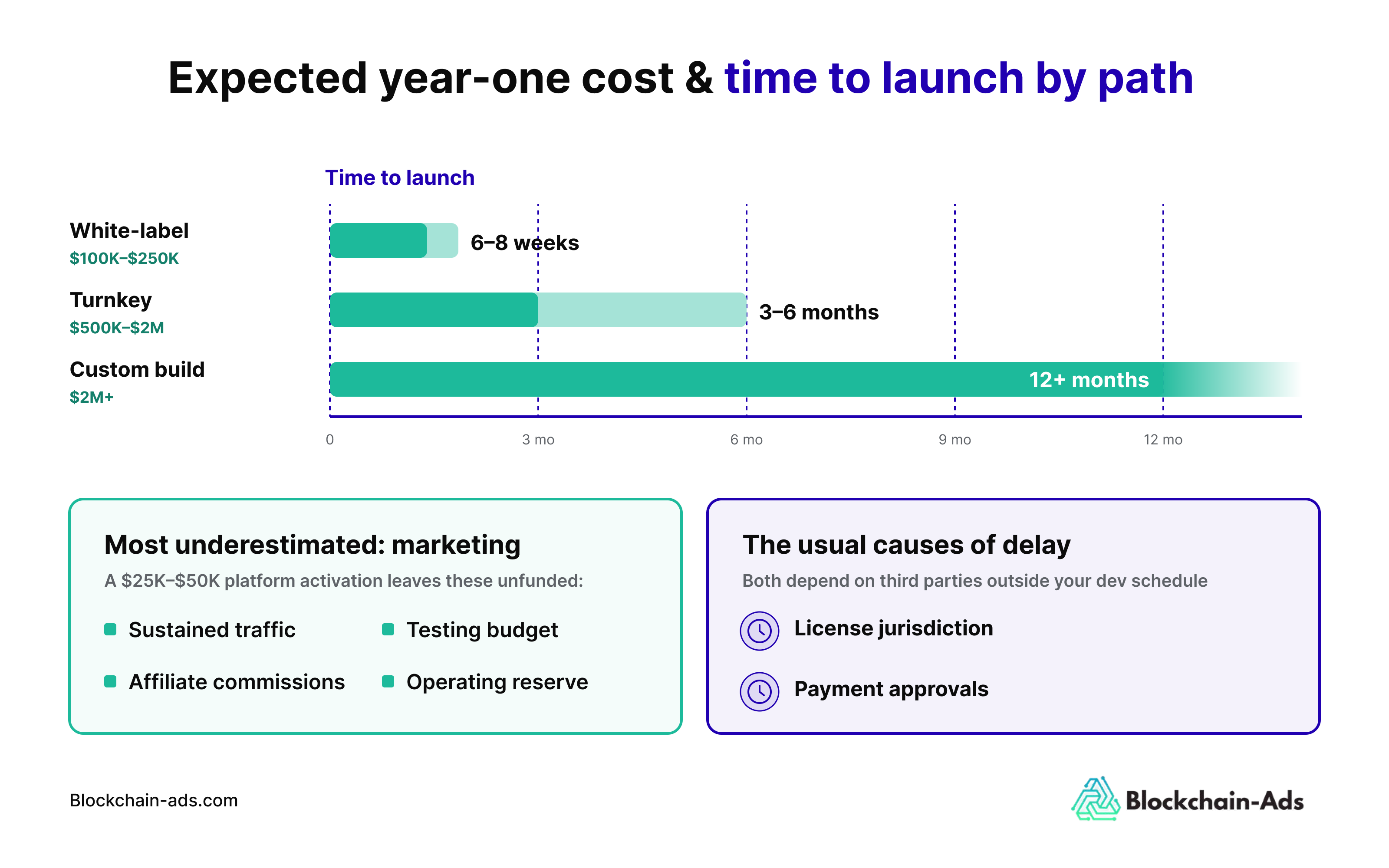
Published estimates run from $15,000 to more than $2 million because they are counting different things. A cheap number may mean a white-label activation only, while the highest may include a local license, custom software, staff, payment reserves, content, and the first year of acquisition. The table below is a more useful planning view.
Marketing is the line item first-time operators most often underestimate. A platform can be activated for $25,000–$50,000 in a low-cost route, but that does not buy sustained traffic, testing budget, affiliate commissions, or the operating reserve needed while cohorts mature.
How long does it take to launch?
White-label casinos can go live in six to eight weeks when the legal route, product scope, and payment providers are already available. A turnkey launch more often takes three to six months, while a custom casino takes 12 months or more.
The two usual causes of delay are the license jurisdiction and payment approvals: both depend on documents, ownership checks, technical controls, and third parties outside the operator’s development schedule.
What About Starting a Crypto Casino?
A crypto casino can have a lower cost floor and a faster product setup where the intended market and license permit it. Crypto wallets can reduce the number of payment integrations, and many crypto-native players value quick deposits and withdrawals.
The trade-off is acquisition. Google and Meta often restrict crypto-gambling advertising even harder than traditional gambling ads, so crypto casinos usually rely on audience-based platforms such as Blockchain-Ads or crypto-native ad networks. The legal question remains the same: an operator must be allowed to offer the product to the user’s GEO, regardless of whether the deposit arrives in fiat or digital assets.
What About a Sportsbook or Betting Site?
The same seven steps apply to launching a sportsbook, with three material differences. First, an odds and risk-management supplier replaces the casino game aggregator as the critical content layer. Second, some GEOs use a different license class for sports betting than for casinos. And third is that sports betting needs its own trading, integrity, and event-timing controls even though the player acquisition problem remains the same.
A combined casino and sportsbook proposition can make sense when the license covers both products and the same player base is likely to use them. It is less compelling when the additional product creates a new compliance burden without a clear retention or acquisition benefit.
Starting a Casino FAQs
Is it legal to start an online casino in the US?
Only in the states where online casino gaming is authorized and only with the required state-level approvals. In 2026 there are seven US states that allow legal iGaming activities: Connecticut, Delaware, Michigan, New Jersey, Pennsylvania, Rhode Island, and West Virginia.
Offshore servicing US users is technically possible but also requires a state-specific license, geo-fencing, compliant payments processing, and legal permission to advertise.
Do you need a license to start an online casino?
Yes, if the casino is intended to operate legally in its target market. Without the appropriate license, payment processors and advertising platforms may reject the operator, while regulators can take enforcement action. A lower-cost international licensing route may start in the tens of thousands of dollars, but it still has to fit the laws of the GEO being targeted.
Can you start an online casino with a small budget?
A white-label package can start around $25,000–$50,000, depending on its scope and jurisdiction. That amount does not include the marketing budget, an equally essential part of running an online casino that should be considered on top of the platform setup. A small setup budget is not the same as a small viable business budget.
How do online casinos make money?
Online casinos earn gross gaming revenue (GGR): stakes received minus winnings paid to players. Their margin comes from the house edge across the game mix, but revenue becomes a real business only after payment fees, bonuses, affiliates, advertising, software, tax, and support are covered. The payback period on a player depends on retention and net revenue, not merely the first deposit.
Can you buy an existing casino instead of building one?
Yes, though an existing casino can cost as much as or more than building a new one, depending on how much a seller values its license, player base, revenue, and brand. A smaller asset may be available for low-to-mid six figures, while an established licensed operator can run into several million, compared to the typical $2M+ for a custom build. The buyer still needs to verify whether licenses, payment contracts, player data, and key staff can transfer. Check Step 1 for more details on business models.
How do you get players to a new online casino?
The core channels are specialized DSPs for iGaming and crypto-gambling (Blockchain-Ads), affiliates, and gambling or crypto performance networks, supported by additional brand-awareness and acquisition paths. CPA varies widely: Blockchain-Ads case study examples range from $23 per FTD (Roobet) to $250 per FTD (Stake.com).
A professional content marketer with 3+ years of experience in iGaming and affiliate marketing.
View full profile →