
iGaming Regulations Around the World: Where It's Legal (2026)
iGaming regulation differs sharply by country, and it keeps changing. A model that's legal today can face new restrictions within months, as recent updates in Brazil, Ireland, and Canada show.
Blockchain-Ads works with iGaming campaigns across 195+ GEOs, so market entry and compliance questions are daily operational work.
This guide covers where iGaming is legal in 2026, how each region regulates it, the advertising rules that follow from that status, and which licensing jurisdictions fit different business models.
How is iGaming regulated?
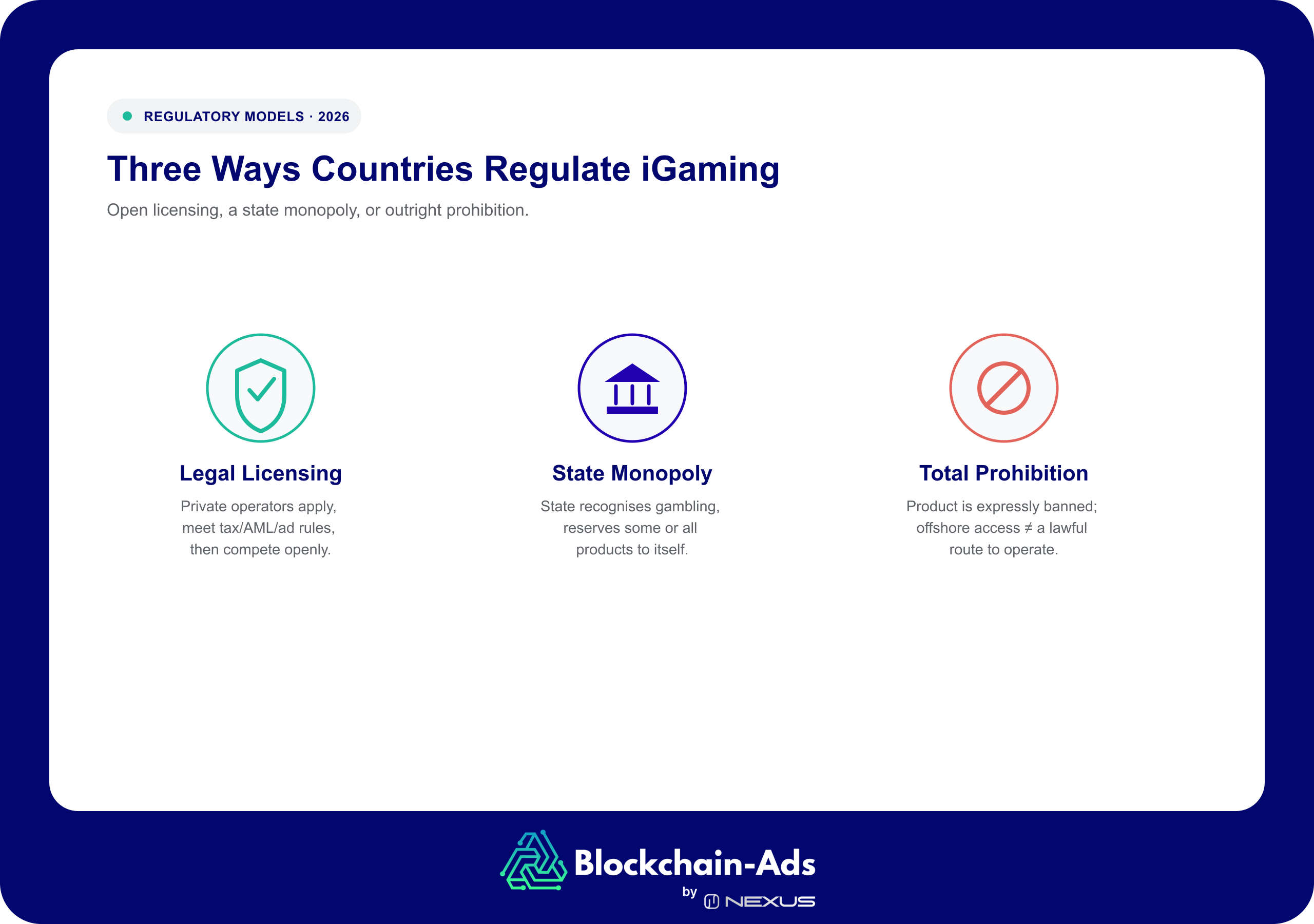
Generally, online gambling regulations fall into three broad models: open licensing, a state-held monopoly over some or all market products, and prohibition of online gambling.
Where is iGaming legal?
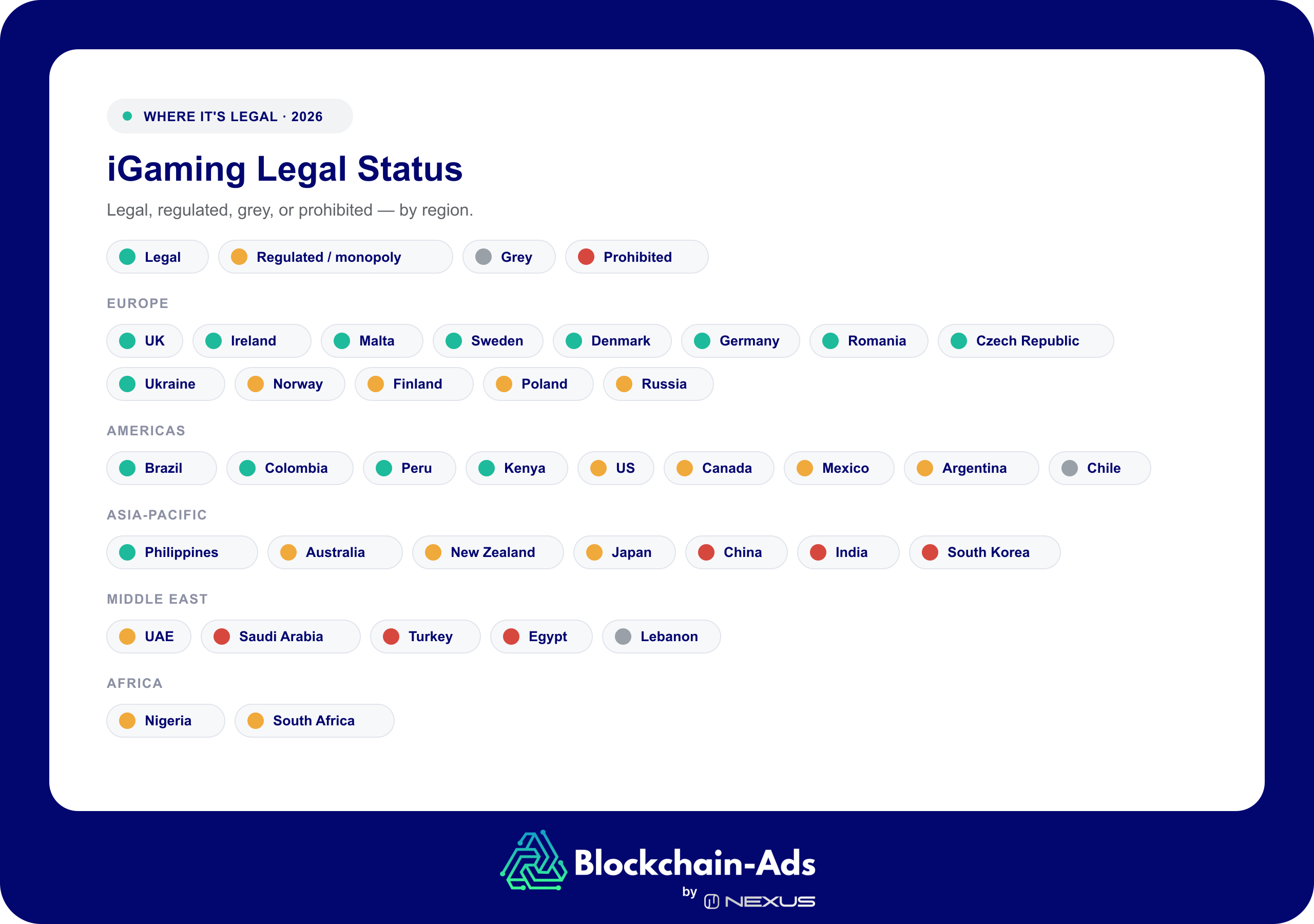
The answer depends on the product. Casinos, poker, sports betting, lottery or other forms of games of chance with stakes all count as 'online gambling', even though each may have a different legal status in the same country.
Latest iGaming regulation updates around the world
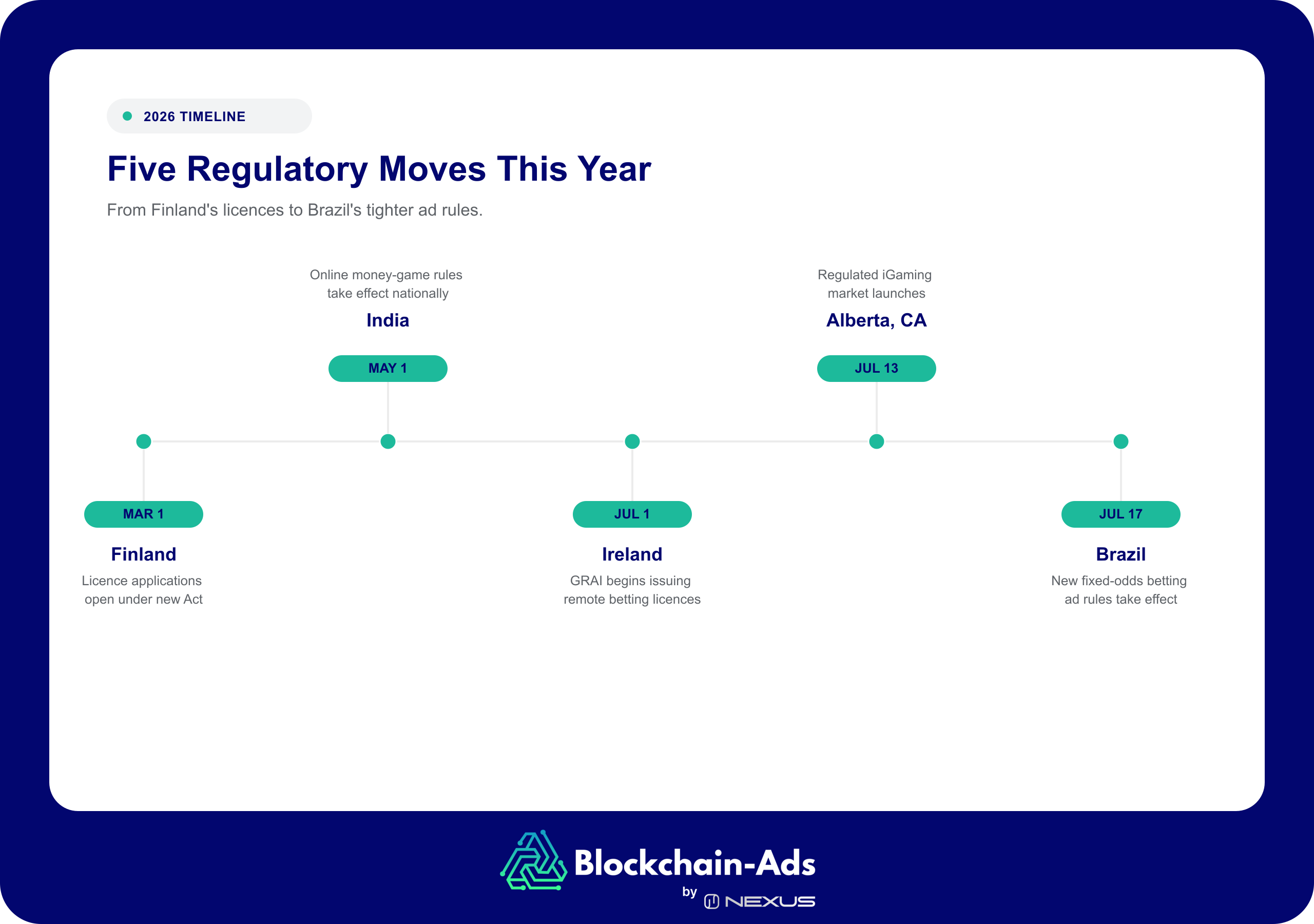
iGaming regulation news needs continual checking because material changes can arrive within weeks. These are five material updates to online gambling regulations by country in 2026:
Brazil tightens rules on betting ads: 17 July 2026
Brazil’s new federal advertising rules for fixed-odds betting took effect on 17 July 2026. Such campaigns now must contain the Ministry of Finance’s warning that is clear, legible and occupies at least 10% of the ad area. The rules also prohibit misleading advertising, marketing to minors and promotion of an unauthorised operator.
This matters to iGaming operators, affiliates, creators and media buyers because the earlier requirements now have clearer enforcement expectations.
Alberta, Canada launches its regulated iGaming market: 13 July 2026
Following Ontario, Alberta officially launched its regulated iGaming market on 13 July 2026, creating a route for private providers to move from the grey market into a legal framework. The Alberta iGaming Corporation oversees the market, while Alberta Gaming, Liquor and Cannabis regulates it.
The model combines a centralised self-exclusion system, advertising restrictions and a revenue split that allocates 80% of net iGaming revenue to operators.
Ireland introduced remote operator licensing: 1 July 2026
Ireland’s Gambling Regulatory Authority of Ireland (GRAI) began issuing remote betting licences from 1 July 2026 under the Gambling Regulation Act 2024. The new framework brings stronger enforcement powers, restrictions on credit card gambling, protections for children and account-level consumer safeguards.
Ireland is now a market with a clearer route for operators targeting Irish consumers, provided the relevant product and licence scope are met.
India’s online gaming rules take effect: 1 May 2026
India’s Promotion and Regulation of Online Gaming Rules 2026 took effect on 1 May 2026. The rules implement the 2025 Act’s distinction between permitted e-sports and social games and prohibited online money games, making the country’s national position materially clearer for iGaming operators, payment partners and advertisers.
State-level rules still matter, but for online gambling the new rules replaced much of the earlier grey-zone uncertainty created by incomplete classification under the Public Gambling Act 1867.
Finland opens licence applications: 1 March 2026
Finland began accepting applications under its new Gambling Act on 1 March 2026. The privately owned licenced sports betting, casino games and online bingo will be able to operate starting on 1 July 2027. Until then, the state retains its monopoly, but for iGaming operators this is a genuine window for initiating the licensing process in the soon-to-be competitive market of Finland.
iGaming regulations in the EU
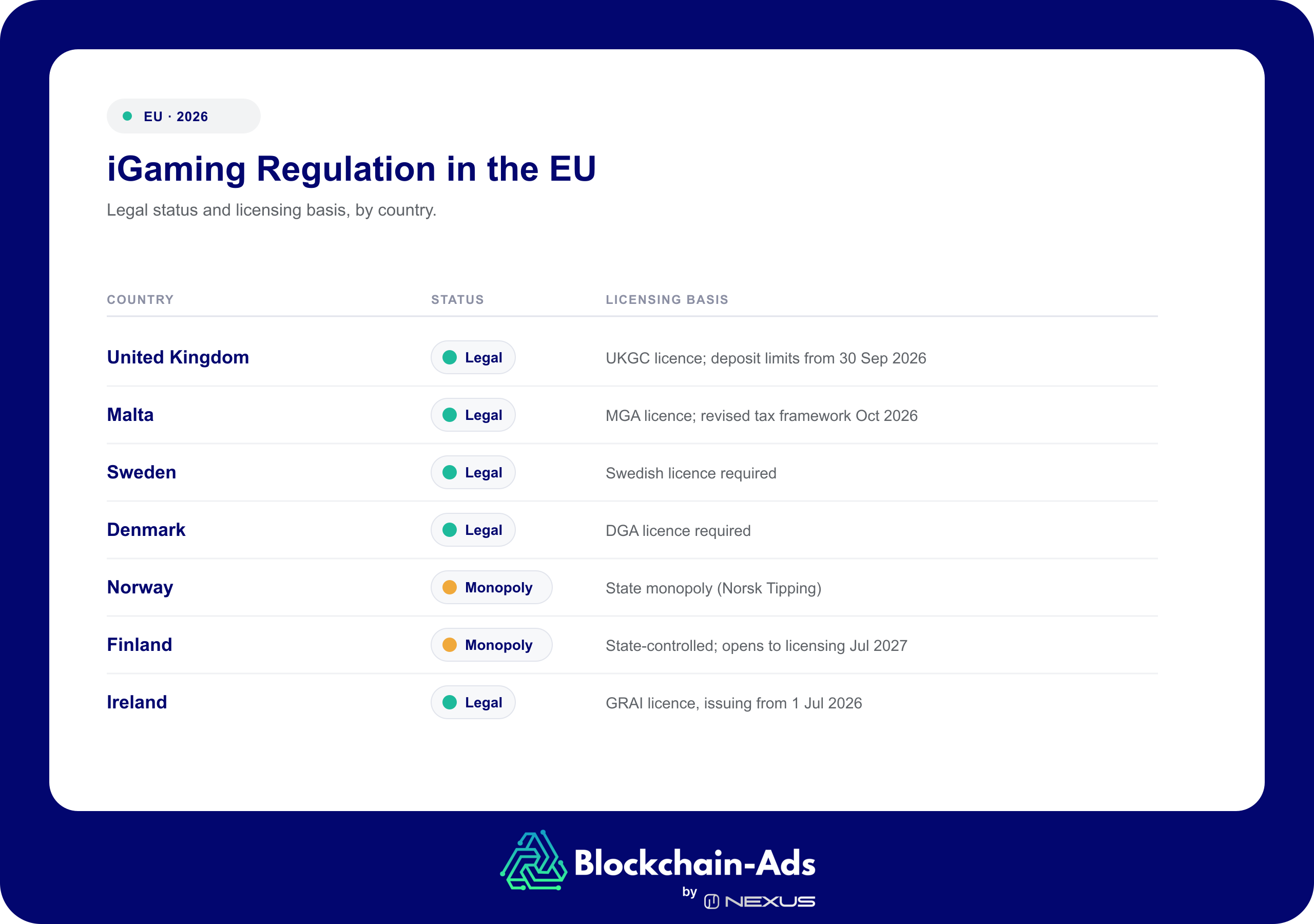
Europe does not have a single iGaming licence covering the entire region, but iGaming regulations in Europe are among the world’s clearest and most developed.
The UK
The UK is one of the world’s most developed remote gambling markets and also one of the least forgiving when an operator neglects local requirements. UK online gambling regulations, led by the Gambling Act 2005 and the UK Gambling Commission’s Licence Conditions and Codes of Practice, cover customer identity verification, AML controls, fair and open terms, protection of customer funds, product design and marketing.
A business based in Malta, Curaçao or elsewhere still needs a UKGC licence if it offers remote gambling to consumers in the UK.
The current reform cycle is primarily about safer gambling and consumer controls. Operators must make financial limit tools easy to use, while the next RTS 12B stage takes effect on 30 September 2026 and standardises the gross deposit limit. Advertising must not target children or vulnerable people, mislead consumers about winning or detach gambling from risk.
This makes the UK commercially attractive but operationally expensive: compliance, monitoring and creative approval must be built into the product and campaign workflow from day one.
Malta
Malta remains the European licensing benchmark for an internationally orientated iGaming business. The Malta Gaming Authority has developed a mature framework for gaming services, as well as software and critical suppliers, which is why the jurisdiction remains familiar to banks, payment providers, game studios, affiliates and B2B partners. Its value is not that it creates a universal right to accept players but gives an operator a widely recognised jurisdiction while local licences are added for locally regulated markets.
An MGA application is a thorough exercise, as the authority lists a €5,000 application fee and a standard €25,000 annual B2C licence fee, alongside compliance contributions and gaming tax. From October 2026, Malta’s revised VAT and gaming-tax framework changes the treatment by activity, so an applicant should model the precise product rather than rely on a generic flat-rate assumption.
The Nordic countries
The Nordic region shows why ‘Europe’ is too broad a regulatory label. Denmark runs a relatively open licensing model for online betting and casino products through the Danish Gambling Authority. Sweden likewise permits licenced online gambling, although consumer-protection expectations and supervision make a Swedish licence more than a simple market-entry formality. Both are regulated private-operator markets, with local requirements around product, tax, technical controls and marketing.
Norway is different. Its core gambling model remains state-led, with Norsk Tipping and Norsk Rikstoto holding the principal rights to offer the permitted products. That means an operator cannot translate demand from Norwegian players into an ordinary acquisition market.
Finland is the major change: the new Gambling Act opens licence applications from 1 March 2026, but Veikkaus remains the monopoly operator until the end of June 2027. From 1 July 2027, licenced betting, online casinos, online slots and online money bingo can enter the competitive market, being subject to the new supervisory system.
iGaming in Central and Eastern Europe
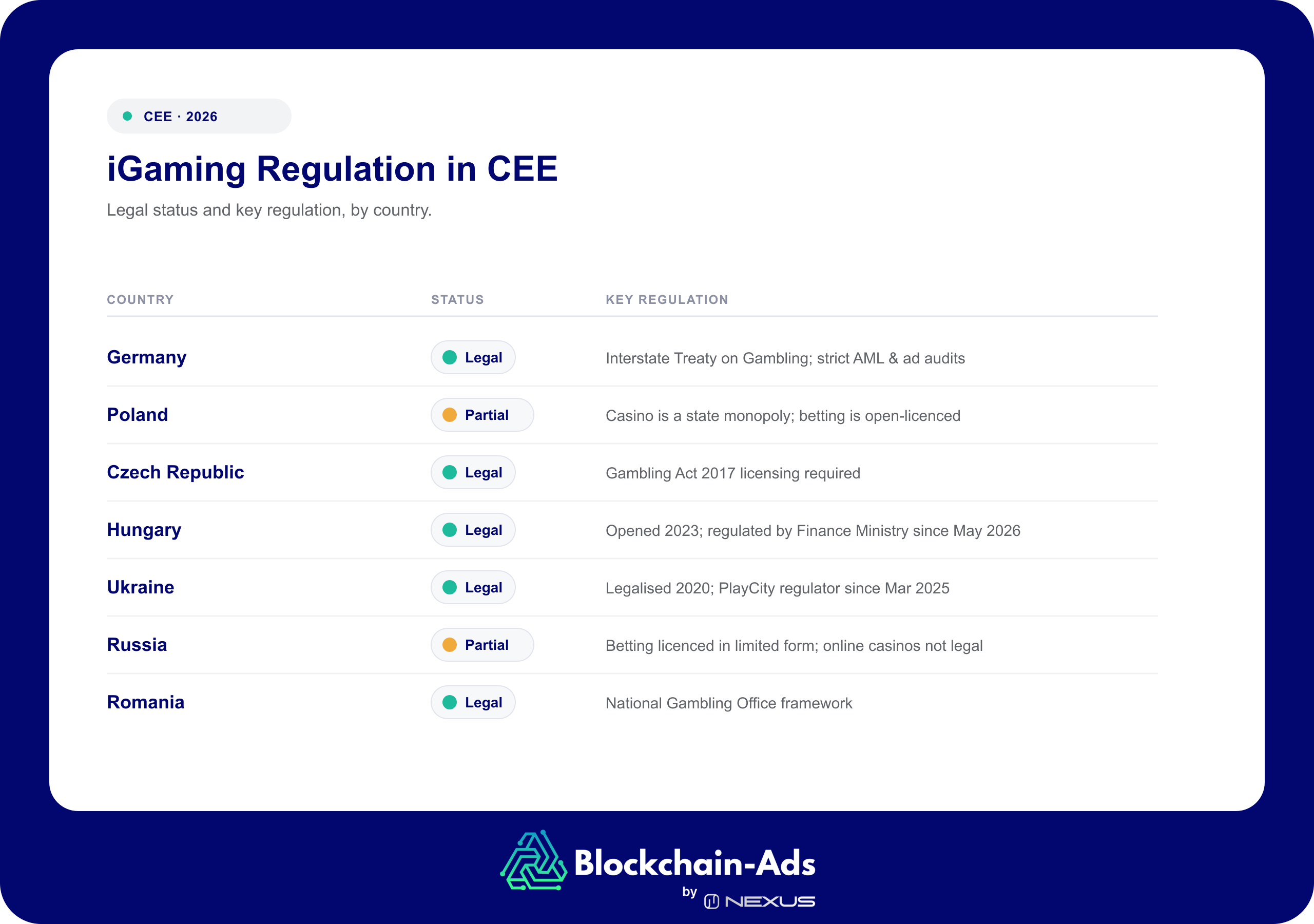
Central and Eastern Europe is where mature licence markets, state-monopoly systems and politically constrained jurisdictions sit side by side. Gambling laws by country can look similar at first glance, yet each product and licence route is materially different. The table shows the regulatory landscape in several major CEE online-gambling markets:
Germany is a useful example of a licenced market that is still difficult to enter. The Interstate Treaty on Gambling allows the specified online products under national supervision, but stake limits, product controls, advertising rules and technical obligations can make a German licence very different from general ‘inter-market’ approval.
Poland, by comparison, keeps online casinos within a state-monopoly structure while permitting licenced betting, so a sportsbook and a casino do not have the same route to market.
The Czech Republic and Romania are established regulated iGaming markets, although both continue to tighten responsible gambling policy. Hungary’s 2023 opening created a lawful route for qualifying operators, but restructuring and Ministry of Finance supervision still make entry more demanding than a simple licence application.
Ukraine’s 2020 legalisation of iGaming did not remove the operational questions created later by several major operational shifts in regulating authorities in later years. Russia should be classified separately: licenced betting exists, but the wider online casino sector remains prohibited.
iGaming in North America
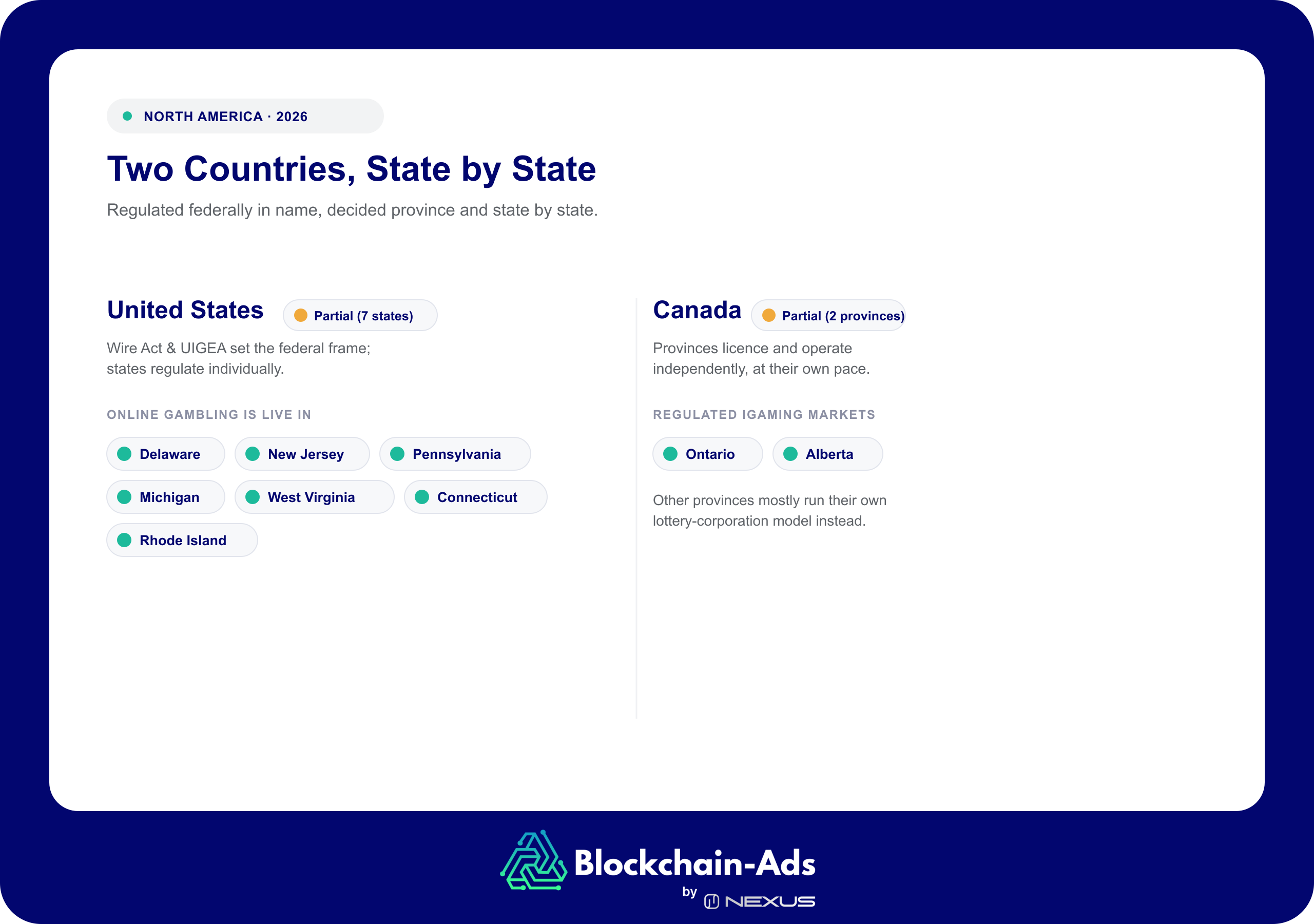
The North American iGaming market is represented by two major jurisdictions: the US and Canada. But if looking closer, these are not just two jurisdictions, but a variety of state and province level regulatory frameworks:
The US
iGaming in the US is not legal through one federal licence. The online gambling laws in the US, including the Wire Act and the Unlawful Internet Gambling Enforcement Act, set important boundaries around interstate activity and payments, but each state decides whether it will legalise casino, poker, sports betting or lottery products. The result is a patchwork in which a national-looking brand must still operate, licence, geo-fence and advertise state by state.
As of 2026, iGaming activity is regulated and authorised in Delaware, New Jersey, Pennsylvania, Michigan, West Virginia, Connecticut and Rhode Island. Nevada is known for its land-based gambling industry, yet it more represents an online poker framework rather than a digital casino market.
Online sports betting has spread more widely in the states, but it is a separate product category with its own state approvals and regulations. For advertisers, the working rule is simple: the creative, landing page, offer and audience must match the state where the product is actually licenced.
Canada
Canada, like the US, operates at a provincial rather than federal level. Provinces have long managed lottery and land-based gambling, and online products now follow the local model. Ontario was the first and clearest private-operator example: iGaming Ontario and the Alcohol and Gaming Commission of Ontario supervise a regulated market where approved businesses can contract into the province.
It has become a reference point for other provinces, including Alberta, which launched its regulated framework on 13 July 2026.
Other provinces have different structures, often based around a provincial lottery corporation. A Canadian entity, a Canadian payment method or general online visibility is not evidence that a brand can market nationwide. The province, product, licence arrangement and ad policy must all be checked before launch.
iGaming in Australia and New Zealand
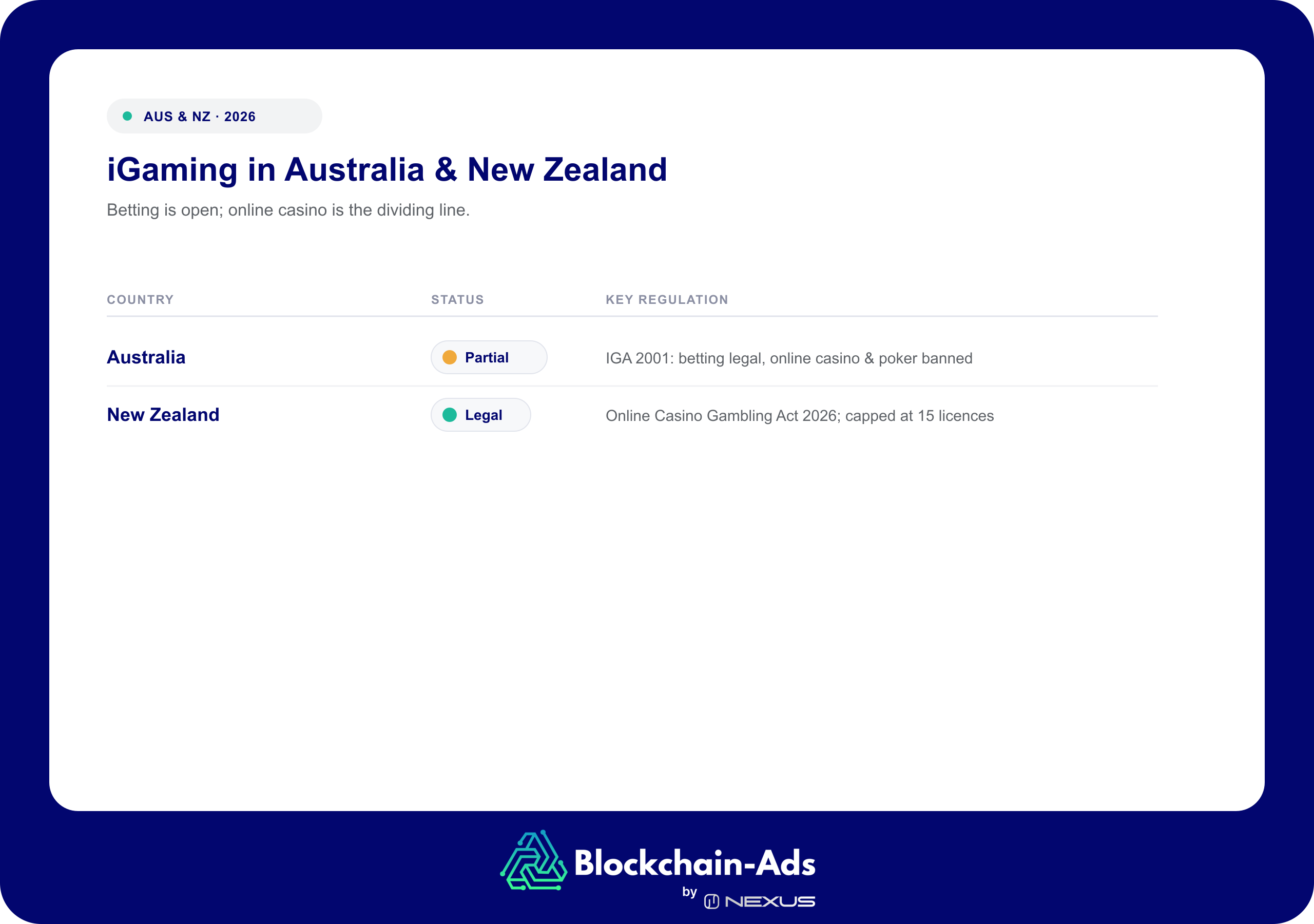
The gambling regulatory landscape in ‘down-under’ and neighbouring New Zealand has been actively evolving in recent years, here’s what it makes now:
Australia’s Interactive Gambling Act draws an important line between online wagering and online casinos. licenced betting and racing services can operate under the relevant state and territory permissions, but interactive casino games and poker can’t be offered to Australian customers.
New Zealand is now moving away from its former position, where domestic online gambling was tightly limited around TAB and Lotto NZ while consumers could access hundreds of overseas casino sites without a dedicated online casino licensing. The Online Casino Gambling Act 2026 took effect on 1 May 2026, creating the country’s first specific framework for iGaming.
It’s also one of the strictest in terms of suppliers, as it allows no more than 15 of the total licences issued across the entire country, making it a market for a close circle of operators.
iGaming in Asia
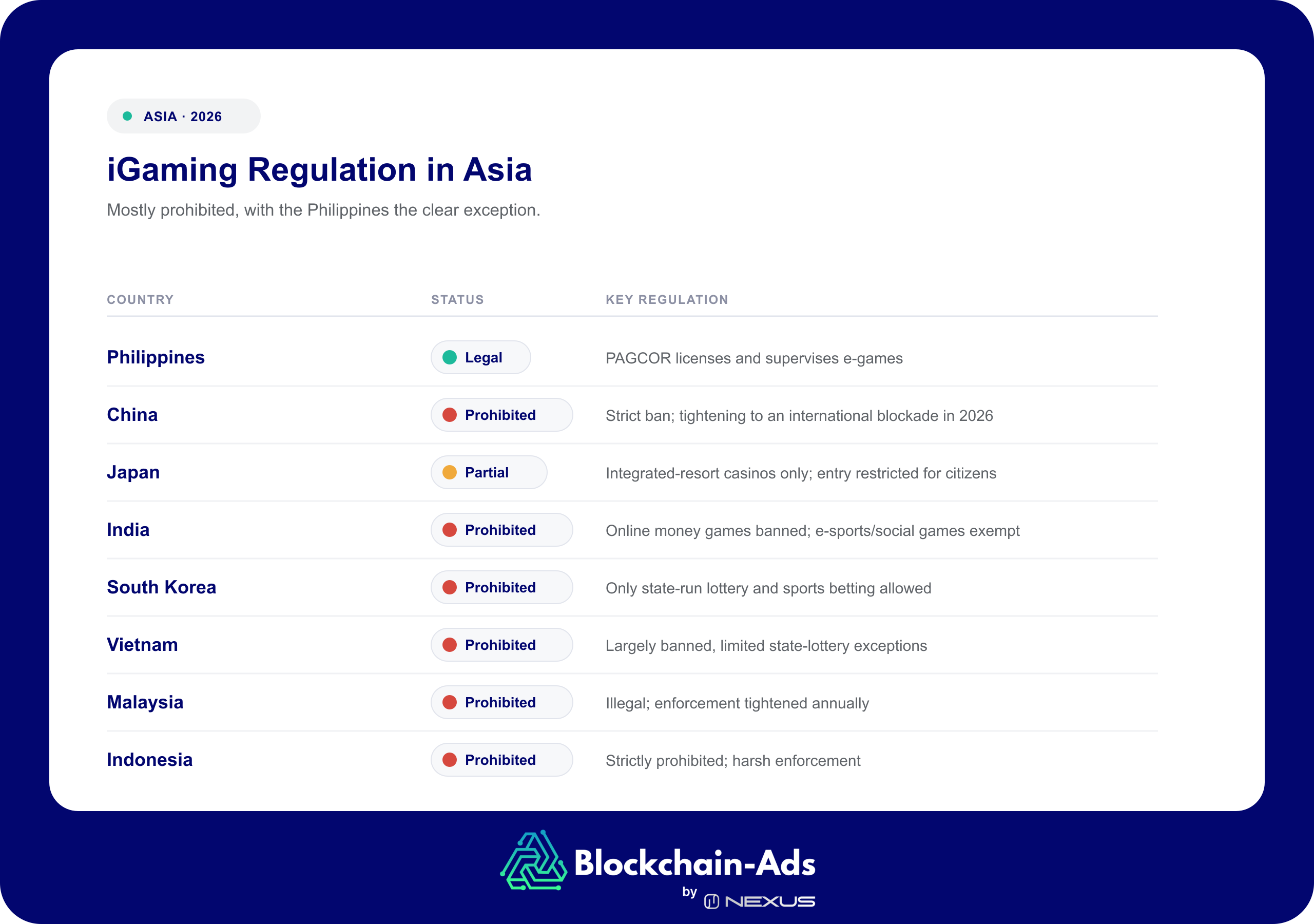
Asia iGaming regulation does not follow a uniform route. The region has large digital audiences, but most Asian markets prohibit online casino and sports betting, making it difficult commercial terrain for otherwise eligible iGaming advertisers:
The Philippines is the most clearly regulated iGaming market in this group: PAGCOR licences and supervises e-games and related activity. The rest are mostly highly restricted markets, such as Malaysia, which has not only prohibited online gambling but also keeps tightening it annually with various government initiatives. China also follows that path, expecting in 2026 to transition from localized web filtering to an international blockade aimed at completely dismantling the offshore supply chain.
Japan permits tightly controlled integrated-resort casinos but does not yet have a broad regulated iGaming consumer market. India has clarified the classification of real-money gaming: e-sports and social games are treated separately, while the earlier online-money-game grey zone is now addressed by the Promotion and Regulation of Online Gaming Rules 2026.
iGaming in Latin America
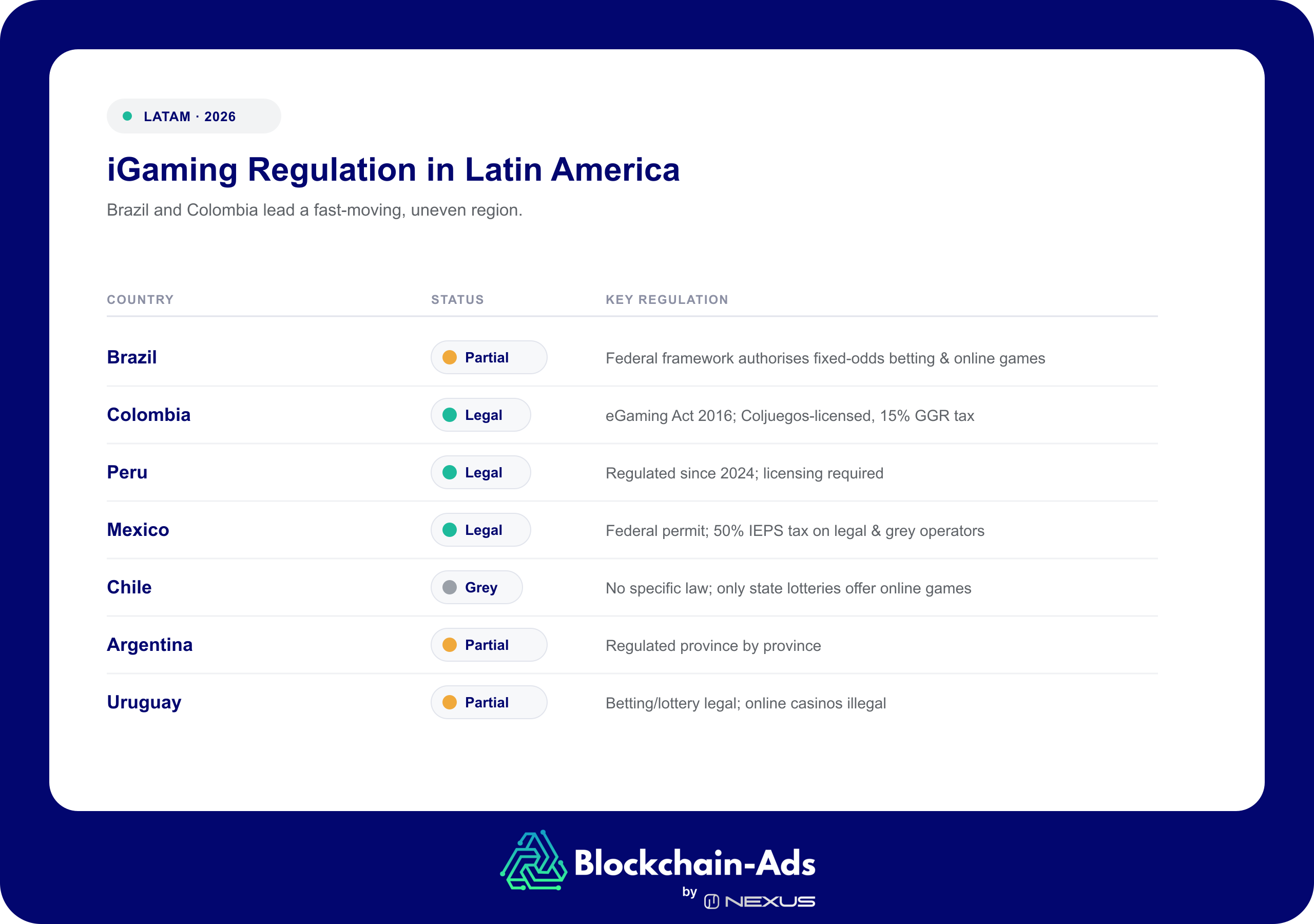
LatAm is a dynamic iGaming market, with several regulatory frameworks still taking shape and Brazil and Colombia standing out as major growth stories:
The region's growth is real, but the licensing picture still varies sharply by country. Peru regulated the iGaming market in 2024 and since then has established a practical framework for permitted online gaming and betting operators. Mexico permits online gambling through a federal permit structure but keeps tightening that window on the operators level with a 50% IEPS tax that also loops in offshore ventures. Chile is moving toward a more open framework but still has only a state-led monopoly on some forms of iGaming. Argentina is provincial: an operator may be authorised in one province and absent from another.
Brazil
Brazil’s gambling licence framework for fixed-odds betting and online games has been live since 1 January 2025, with the Secretariat of Prizes and Bets (SPA) authorising companies to operate nationally. An authorised operator can use up to three brands, while player-facing authorised sites use exclusively the .bet.br domain. The fee and approval process are substantial enough that an operator should confirm the current SPA requirements, permitted products and brand allocation before committing to the market.
For 2026, the advertising framework is particularly important. From 17 July, fixed-odds betting ads must include a prescribed Ministry of Finance warning, occupying at least 10% of the ad area, and must not mislead consumers, target minors or promote an unauthorised operator. Brands, affiliates, creators and agencies all need a shared approval process, because the rules reach beyond the operator’s own media buy.
iGaming in the Middle East
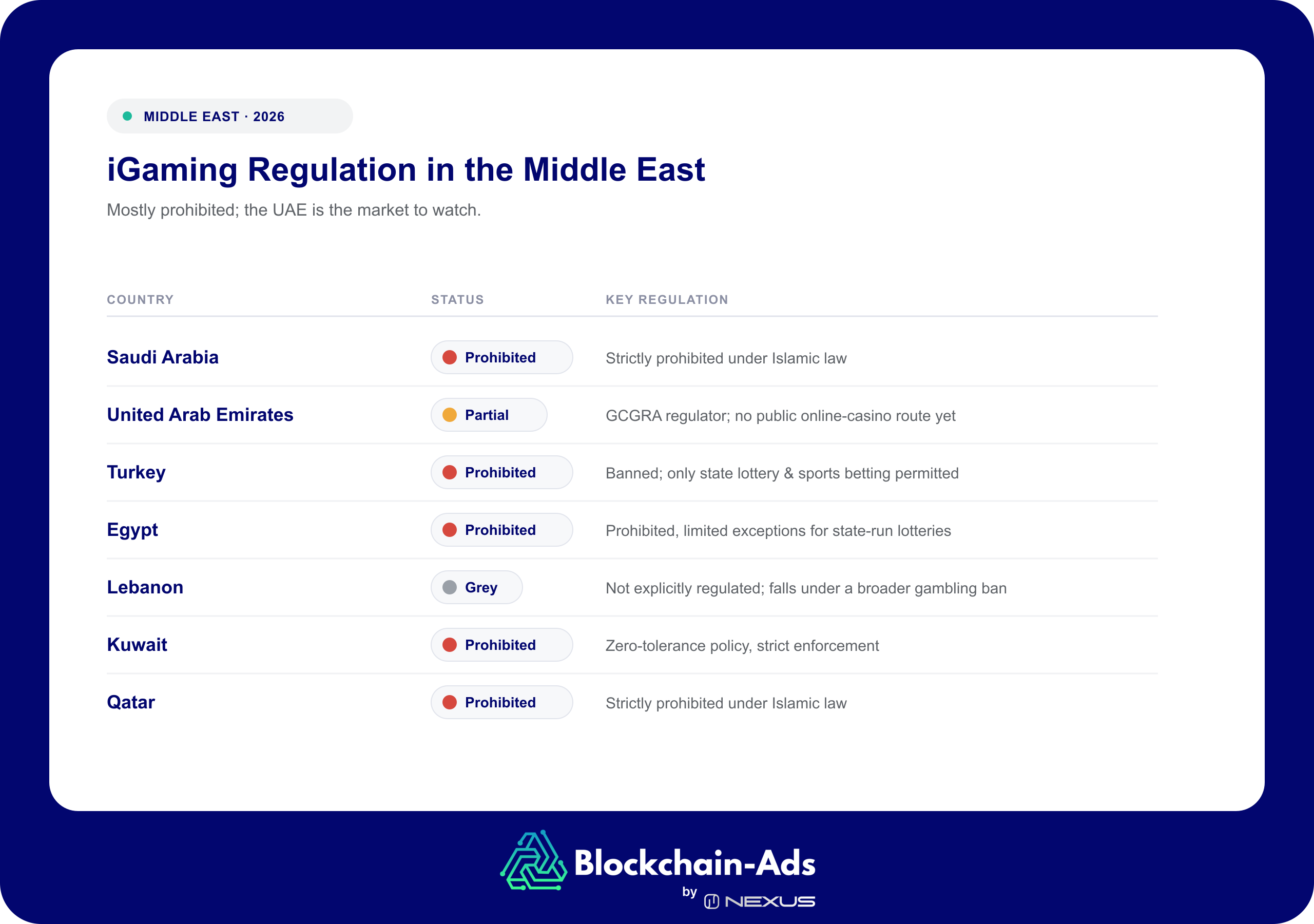
The Middle East has perhaps the widest gap between online demand and lawful iGaming access. Most countries prohibit gambling through religious or other laws, while only a small number are building controlled commercial-gaming systems. Turkey iGaming regulations, for example, leave no general private route to offer online casino or betting.
Egypt generally prohibits gambling with limited exception for state-led lotteries. Kuwait also implements a zero-tolerance policy for any form of gambling, issuing penalties for illegal providers and the consumers of such services. Lebanon has a more ambiguous practical environment, not specifying the iGaming particularly, thus leaving a grey zone market.
The UAE is a market to watch, not yet a general online-casino launch market. The General Commercial Gaming Regulatory Authority (GCGRA) and the first national lottery developments demonstrate an emerging federal structure, but commercial gaming activity remains permission-based, and unlicenced online activity is illegal. Operators and advertisers should wait for a licence route that clearly covers their product before treating the country as accessible.
iGaming in Africa
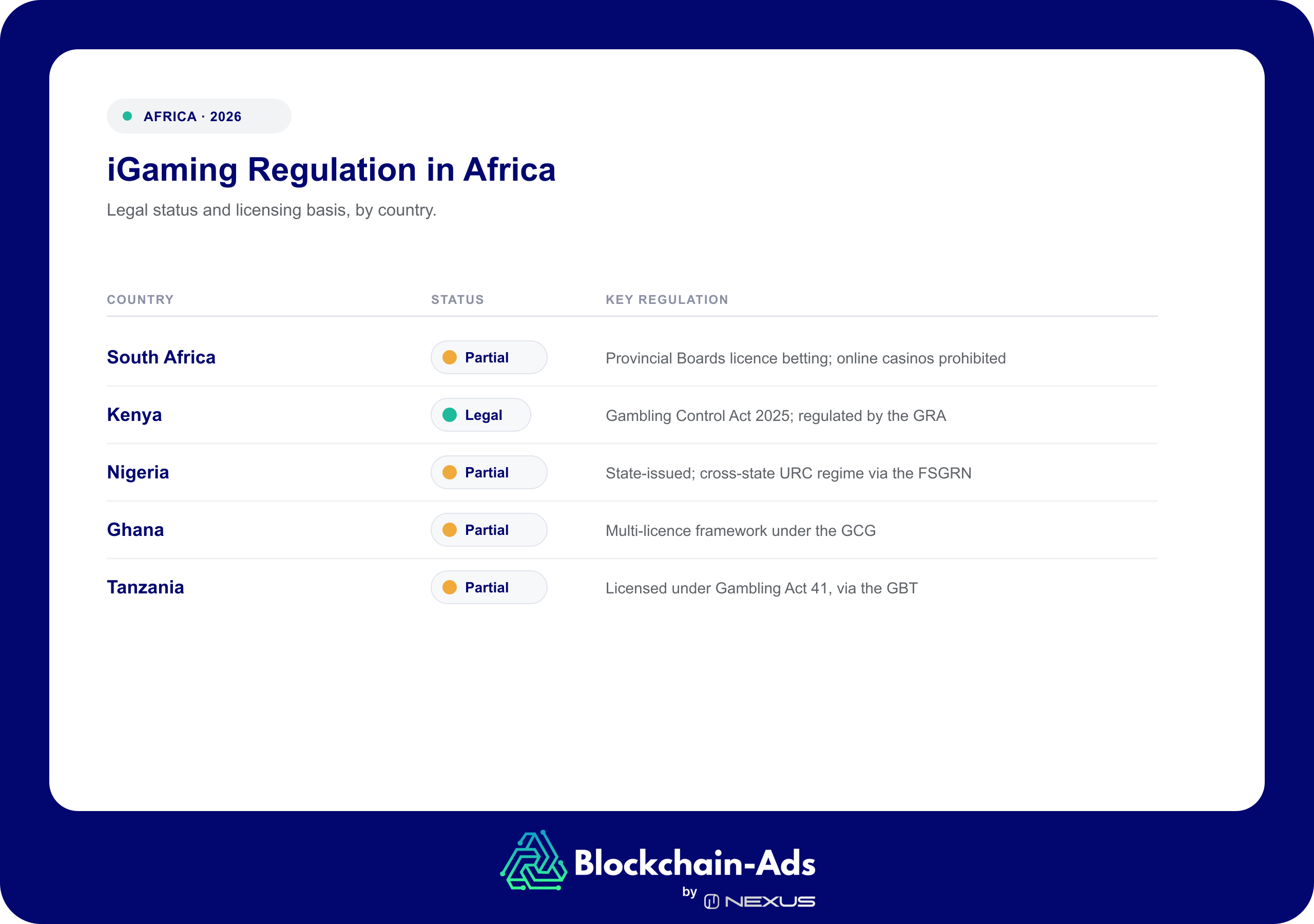
Africa is one of the most active regions for emerging iGaming regulation. Although much of the continent remains legally restrictive toward digital gambling, the jurisdictions that permit it are building more formal licensing, advertising and responsible gambling requirements.
South Africa has one of the continent’s most developed gambling sectors, but its structure is often overstated. Online betting is lawful only where the operator is licenced by a Provincial Gambling Board and the customer is over 18. The National Gambling Board’s February 2026 notice on remote gambling servers is a reminder that remote infrastructure itself is under regulatory watch.
Kenya is a more direct iGaming regulatory story. The Gambling Control Act 2025 provides for licences covering online gambling, gambling software/platforms, and foreign-based operators. The Gambling Regulatory Authority’s (GRA) 2026 implementation work includes dedicated licensing, conduct, advertising, and foreign operator regulations. The Act requires approval for gambling advertising, prohibits misleading claims and child targeting, and requires responsible gambling information. For affiliates and media buyers, Kenya is therefore a licenced market with a formal approval and disclosure framework.
Nigeria remains commercially important but legally fragmented. National oversight sits alongside state-level lottery and betting practice, so a local partner or approval in one part of the country should not be presented as a nationwide route to market.
Best countries to launch an iGaming business
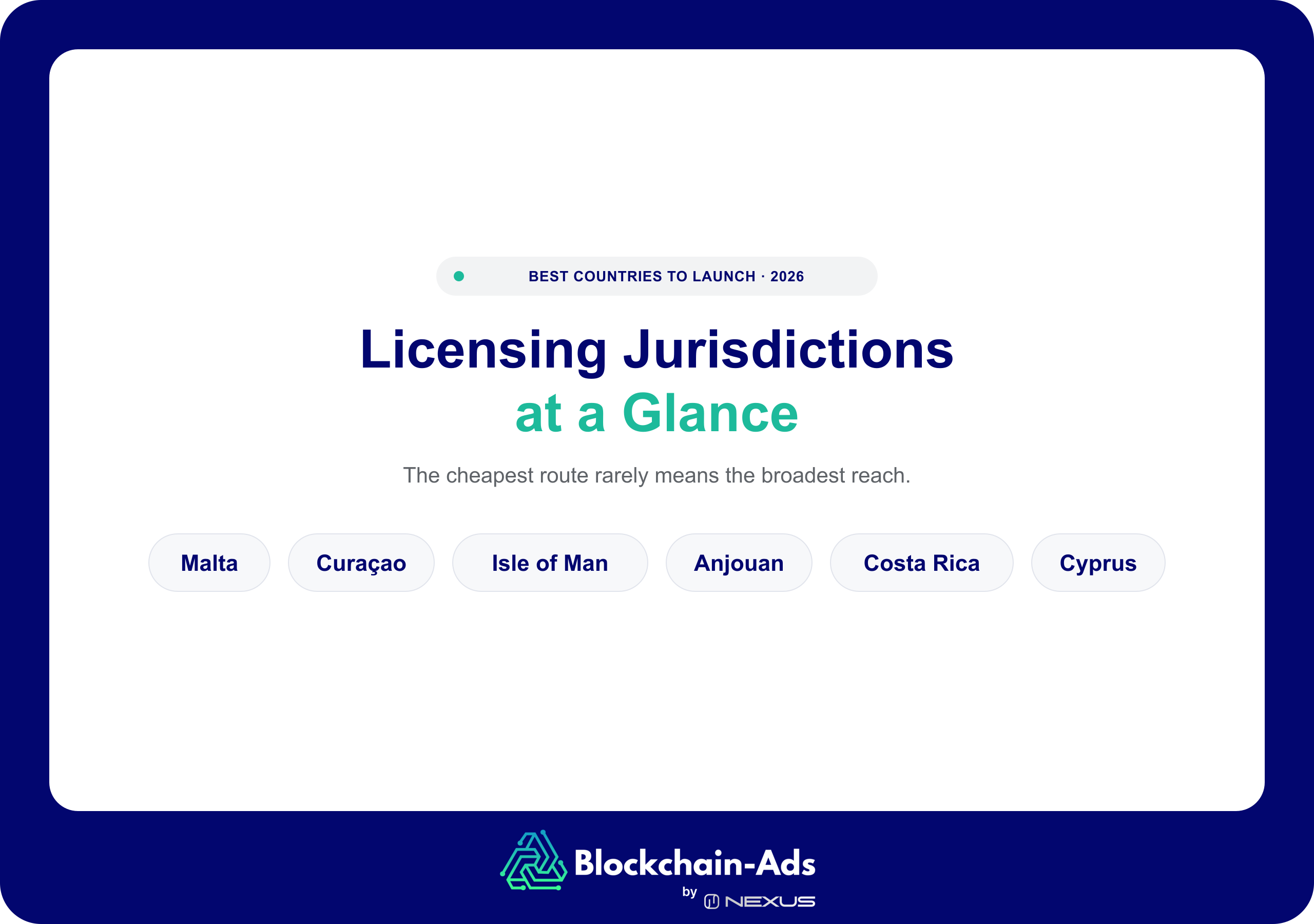
The best iGaming jurisdiction is not simply the cheapest licence but the one that gives the business a workable route to operate, bank, take payments, and enter its intended markets. The comparison below covers the most recognizable and commercially usable licensing jurisdictions in 2026:
For the operational next step, see how to start an online casino.
Malta
Malta is the EU benchmark when an operator needs a recognised gaming jurisdiction that partners understand. A Malta gaming licence can support relationships with suppliers, payment providers, studios and investors, and the framework covers both B2C and B2B iGaming activity. The catch is cost and substance: applicants need robust ownership, business, AML, technology and responsible gambling arrangements to obtain and maintain approval.
The official entry threshold is lower than in many offshore jurisdictions: €5,000 to apply and €25,000 as the standard annual B2C fee, before the relevant compliance contribution and taxation. Malta works best where its regulatory reputation is part of the commercial plan. It is not the right answer for an online gambling enterprise whose only strategy is to reach a market that itself requires a domestic licence.
Curaçao
Curaçao remains important to international and crypto-oriented casino operators, but the previous master-licence narrative is no longer appropriate after the 2024 reform. The National Ordinance on Games of Chance (LOK) created a direct Curaçao gambling-licence model for local legal entities, with B2C and B2B licences, business-plan requirements, domain controls and visible licensing status. The practical application should be made through the CGA portal and assessed as a compliance project.
The appeal is international positioning and familiarity with crypto models. Crypto-gaming regulations and AML/KYC obligations still apply, while an operator must respect excluded territories and obtain local approval wherever a target market requires it. Curaçao can be the home licence, but it does not authorise a product or advertising campaign in a prohibited market.
Isle of Man
The Isle of Man is a reputation play. Its value is usually strongest for operators that want recognised supervision, governance and a more credible route to banking and supplier relationships, rather than the lowest nominal first-year cost. The Gambling Supervision Commission expects real due diligence, beneficial-owner disclosure, systems controls and continuing compliance.
That makes it suitable for a business building a long-term regulated footprint, according to the current Online Gambling Licence Fees Regulations.
Anjouan
Anjouan is often promoted as a fast, lower-cost online gaming option. The authority’s published B2C fee schedule lists €17,828 for licence issuance and €17,828 for annual renewal, with €500 for each additional domain. That is a clear starting cost, but it is not the whole commercial calculation.
Recognition by banks, payment providers, game suppliers and target jurisdictions matters more than the first invoice. Its own licensing materials identify excluded territories, including major regulated markets. Anjouan therefore suits an operator only where its actual target markets and compliance all support it.
Costa Rica
Costa Rica is frequently described as a ‘no-licence’ jurisdiction, which is not so far from the truth. The country has domestic casino permissions and corporate structures, but no single Costa Rican document functions as a universal iGaming licence for a business accepting players abroad. The legal question is not only whether a company can be incorporated or obtain a local permit, but whether its player-facing activity is licenced where the player is located.
Costa Rica can work as part of a corporate or operational structure, but the trade-off is market access. A business that uses Costa Rica as a base still needs local legal analysis for every jurisdiction it targets, especially for payments, advertising and remote online casino products.
Cyprus
Cyprus provides a regulated EU route for online betting through the National Betting Authority’s Class B licence. The authority publishes fees of €30,000 for one year and €45,000 for two years, making the upfront licence cost more transparent than some offshore alternatives. The jurisdiction can be useful for an operator focused on the product that Cyprus actually permits.
The licence can be a lighter EU setup than Malta for the online betting products Cyprus actually permits, but it is not a general online casino licence.
How iGaming regulations affect advertisers
Regulation does not stop at the operator’s licence. It determines which offer can appear in which GEO, which product claims can be used, what age and responsible gambling controls a platform requires before accepting the campaign. Neglecting these demands can lead to campaign rejection, licence consequences and regulatory action.
How licensing requirements affect advertisers
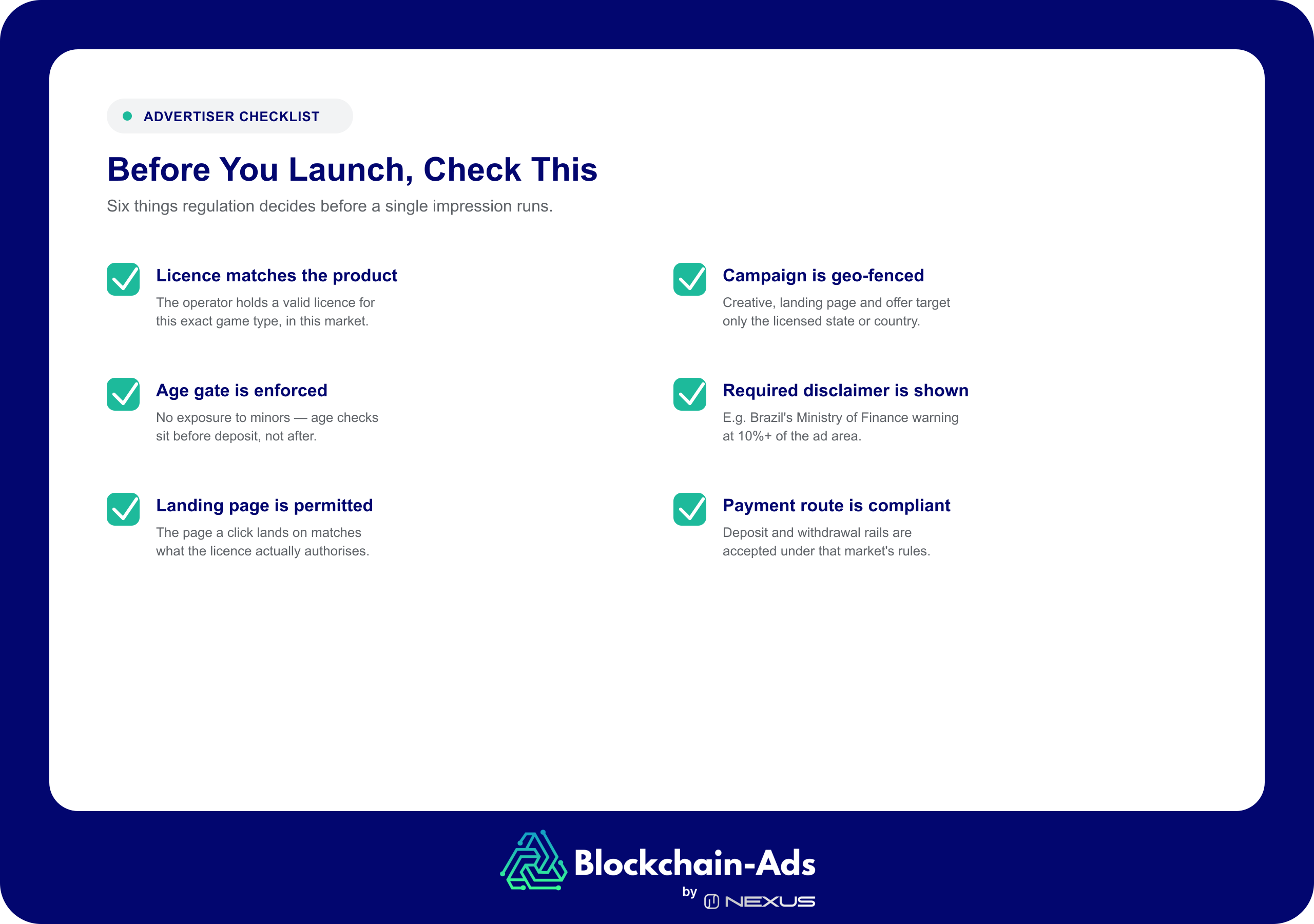
Licensing requirements decide more than whether a brand can run an ad. They decide which legal entity is named in the creative, whether a bonus can be shown, which player can be redirected to the landing page and what type of user authorisation is required. In the US, for example, a casino offer must be geo-fenced to the licenced state. In Brazil, an authorised .bet.br operator and the required warnings must be present. In the UK, the operator’s safer-gambling and consumer-protection duties shape the entire customer journey.
The practical result is a licence-to-GEO matrix. Before spend begins, the advertiser should document the operator, product, target territory, age rule, disclaimer, permitted landing page, payment route and exclusion list. This prevents a campaign from being compliant in its account setup but non-compliant at the moment a user clicks through.
The risks of advertising in gray markets
Are gambling ads legal?
Yes, in a regulated market, when the operator holds a valid licence and the campaign follows that market's advertising rules.
Why is gambling advertising allowed at all?
Regulators generally accept licenced advertising as the trade-off for channeling demand toward controlled, taxed, and consumer-protected operators instead of unlicenced offshore ones.
An offshore website being accessible to consumers does not make its advertising lawful, though.
- Regulatory exposure: A regulator may block domains, pursue local partners or impose penalties when an unlicenced iGaming brand is promoted into its market.
- Commercial exposure: Payment providers can stop processing, platforms can suspend the advertiser, and the brand can face reputational and legal consequences.
- Affiliate and creator exposure: A promotion can be treated as advertising even if the person publishing it is not the licence holder. Brazil’s 2026 rules show that agencies, influencers, and other parties in the promotion chain can be caught by compliance obligations.
Cross-jurisdictional checks are not theoretical: entering a grey market without a defensible legal basis can cost an operator its payment access, partners, and licence standing.
Best practices for advertising under regulation
Navigating the iGaming advertising landscape requires a strategic approach to comply with various regulations and consumer protections. Here are key best practices:
- Understand the regulatory landscape: A campaign can be lawful in one market and non-compliant in the next, so the licence, product, and GEO should be checked together before spending begins.
- Align with responsible gambling duties: The required warning, age gate, offer terms, and harm-minimization message should match the market’s rules and the operator’s licence conditions.
- Comply with platform-specific policies: Major platforms such as Google Ads and Facebook Ads can impose additional certification, country, and disclosure requirements beyond the local regulator’s rules.
- Avoid aggressive marketing tactics: Exaggerating potential wins or outcomes, even within legal limits, can be treated as misleading and create a compliance dispute.
- Use compliant targeting: Specialist gambling ad networks, including Blockchain-Ads, can help advertisers reach permitted GEOs, but they do not replace the operator’s own licensing review.
Emerging markets advertisers should watch
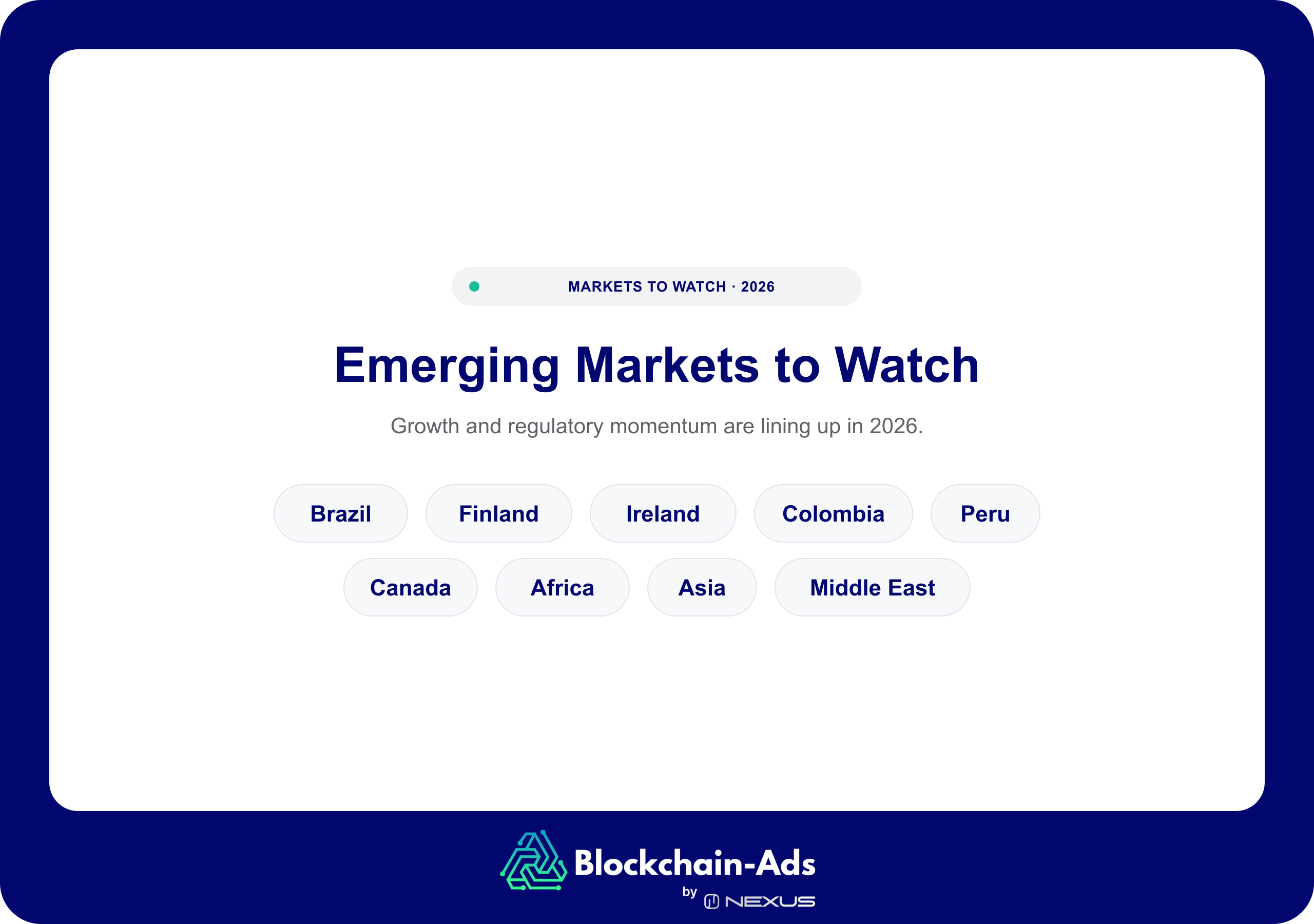
In 2026 it’s best for iGaming advertisers to pay close attention to several emerging markets due to their current and forecasted industry growth, as well as regulatory development:
- Brazil: It is a licenced market, and the .bet.br structure and 2026 advertising rules make the opportunity clear but tightly controlled.
- Finland: It has been transitioning from a state monopoly since 1 March 2026, with competitive licenced activity scheduled for July 2027.
- Ireland: The Gambling Regulatory Authority of Ireland began issuing licences in July 2026, creating a newly actionable regulated market.
- Africa: Kenya’s developing licensing and advertising framework, South Africa’s provincial online-betting model, and Nigeria’s fragmented national/state structure make the region commercially interesting but uneven.
- Asia: The Philippines remains a PAGCOR-regulated eGaming market, while India’s 2026 framework distinguishes permitted e-sports and social games from prohibited online money games.
- Colombia: Implemented a regulatory framework for iGaming, leading to significant market growth.
- Peru: Regulated its online gambling market in 2022, resulting in substantial growth.
- Canada (Ontario + Alberta): Ontario’s regulated market contributed almost C$2.7 billion to provincial GDP in its second year. Alberta is the next clearest regulated province to watch after its July 2026 launch.
- Middle East: The UAE's GCGRA is developing a federal commercial-gaming framework, but a general online-casino licensing route is still absent. Additionally, Egypt's shift towards explicit criminalization of online betting increases enforcement risks in the region.
FAQ
Is online gambling legal in the US?
Online gambling is legal only where a state authorizes the specific product. Online casinos are currently available in a limited group of states, while online sports betting is legal in more states under separate regulatory status.
Where is online gambling banned?
Some of the countries where online gambling, particularly online casino, is broadly prohibited:
- China
- South Korea
- Malaysia
- Indonesia
- Cambodia
- Thailand
- Vietnam
- Bangladesh
- Pakistan
- Saudi Arabia
- Kuwait
- Qatar
- Turkey
- Egypt
- India
- Australia
- Russia
The exact iGaming product and enforcement position should still be verified locally before any campaign.
Do you need a licence to run an online casino?
Yes, in any properly regulated market. An online gambling licence from an offshore or home jurisdiction may support the business, but it does not replace the licence required in the country or state where customers are accepted.
What is the easiest gambling licence to get?
Malta, Curaçao, Isle of Man, Anjouan, Costa Rica and Cyprus are considered the most appropriate international licensing jurisdictions by speed-to-market execution.
Are gambling ads legal?
They can be legal in regulated markets when the operator is authorised and the campaign complies with local age, content, placement and responsible gambling rules. See how iGaming regulations affect advertisers before launching.
A professional content marketer with 3+ years of experience in iGaming and affiliate marketing.
View full profile →