Why AI Search Names Your Brand for One Query, Not the Next
Key takeaways
- Niche matters: The same brand was named in 44% of ad agency buyer answers but only 6% of informational ones.
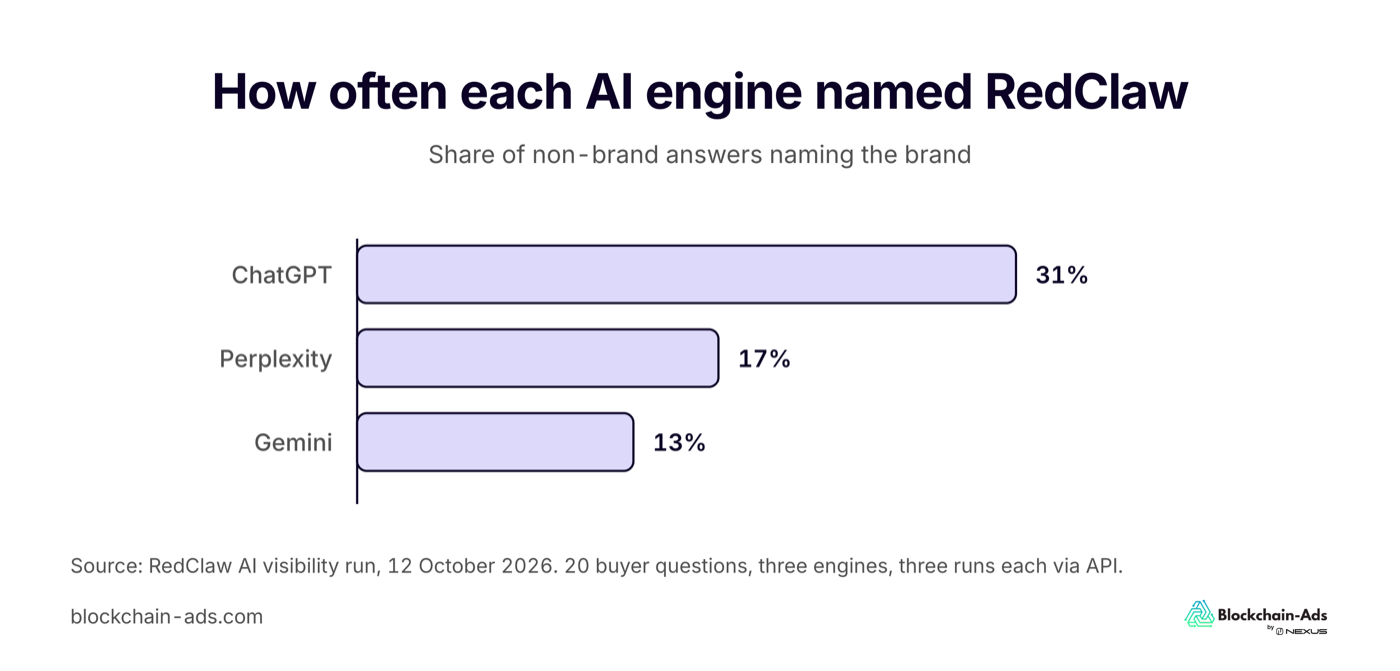
- Engines disagree: ChatGPT named the brand 31% of the time, Perplexity 17% and Gemini 13% on the same questions.
- Read is not named: At least 39 answers read the brand's own site and still left its name out.
- One check misleads: The overall mention rate moved between 16% and 23% across three runs in eight days.
- Measure properly: Run each question at least three times per engine and log whether the engine searched the web.
Many crypto, iGaming and fintech marketers now check what ChatGPT says about their brand. Most of them run one question once and take the answer at face value.
We think that habit gives marketers a misleading picture of where they really stand. At RedClaw, we have measured our own agency in AI answers regularly since September 2026, and one check rarely matches the next.
This article shares the numbers from one full run on October 12, 2026. It covers how we measure, what the data showed, and the changes we are now testing.
How We Measured
We wrote 20 questions that a real buyer or researcher might type into an AI assistant. Eighteen of them never mention our name, and the other two are direct brand checks.
Each question went to three engines through their APIs, with web search turned on. We asked every question three times per engine, which gave us 180 answers in total.
We used the API versions of ChatGPT (gpt-5-mini), Gemini (gemini-2.5-flash) and Perplexity (Sonar) for every call. Consumer apps can answer differently, so treat our numbers as a measurement of these APIs.
For each answer, we recorded three things that matter to anyone buying visibility. Did the engine name us, where did we rank in any list, and which pages did it read or cite?
We kept the two brand-check questions out of the headline rate on purpose. Asking "Is RedClaw legit?" will always produce our name, so counting it would inflate the result.
Finding 1: The Overall Number Hides Everything
Across 161 usable non-brand answers, the engines named us 21% of the time. The 95% confidence interval for that rate runs from 15% to 27%.
That single number tells you almost nothing useful when you read it on its own. The rate changed sharply depending on what kind of question the buyer asked.
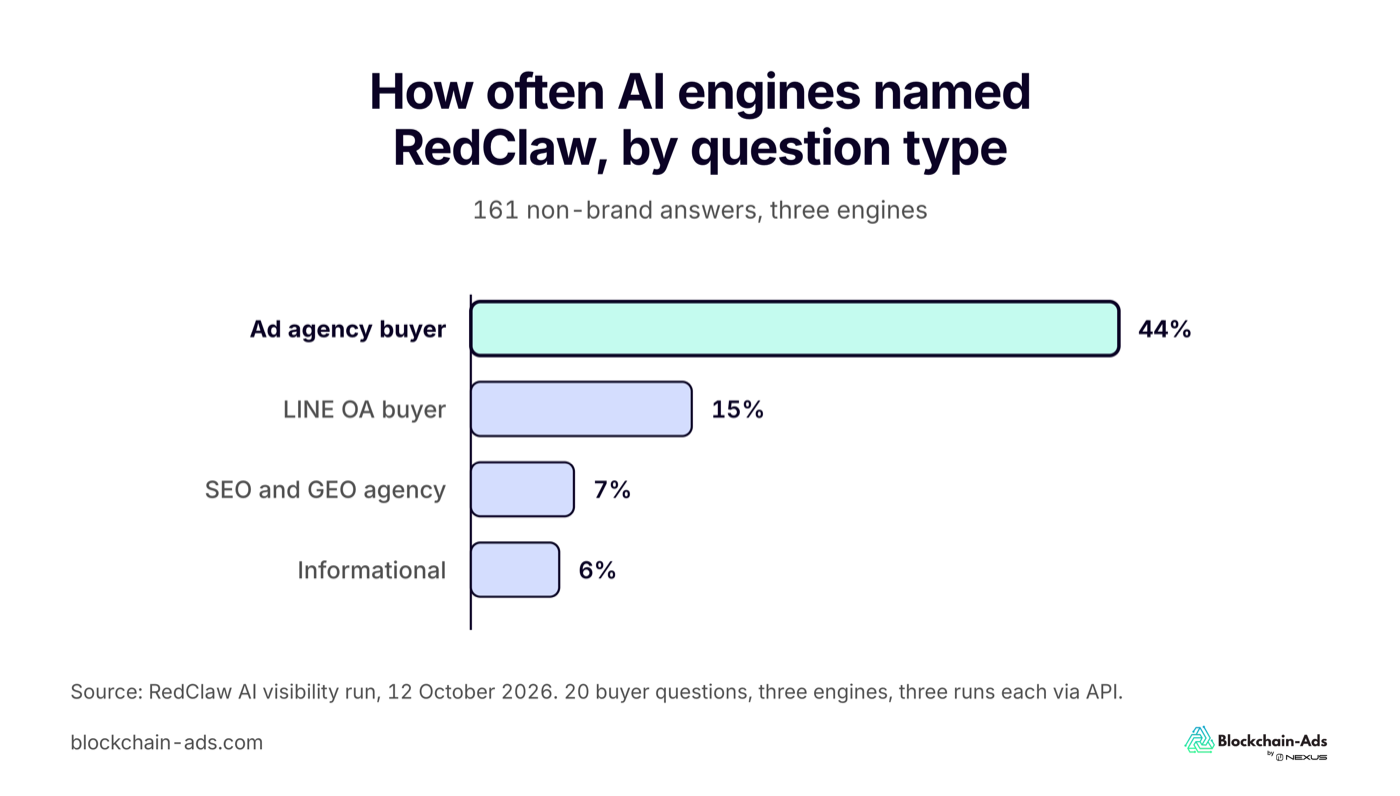
The three engines also disagreed with each other on the same questions. Across their non-brand answers, ChatGPT named us 31% of the time, Perplexity 17% and Gemini 13%.
Finding 2: One Niche Is Strong, the Next Is Empty
Our best and worst questions sat right next to each other in our own service list. The contrast between them is the most useful thing this run taught us.
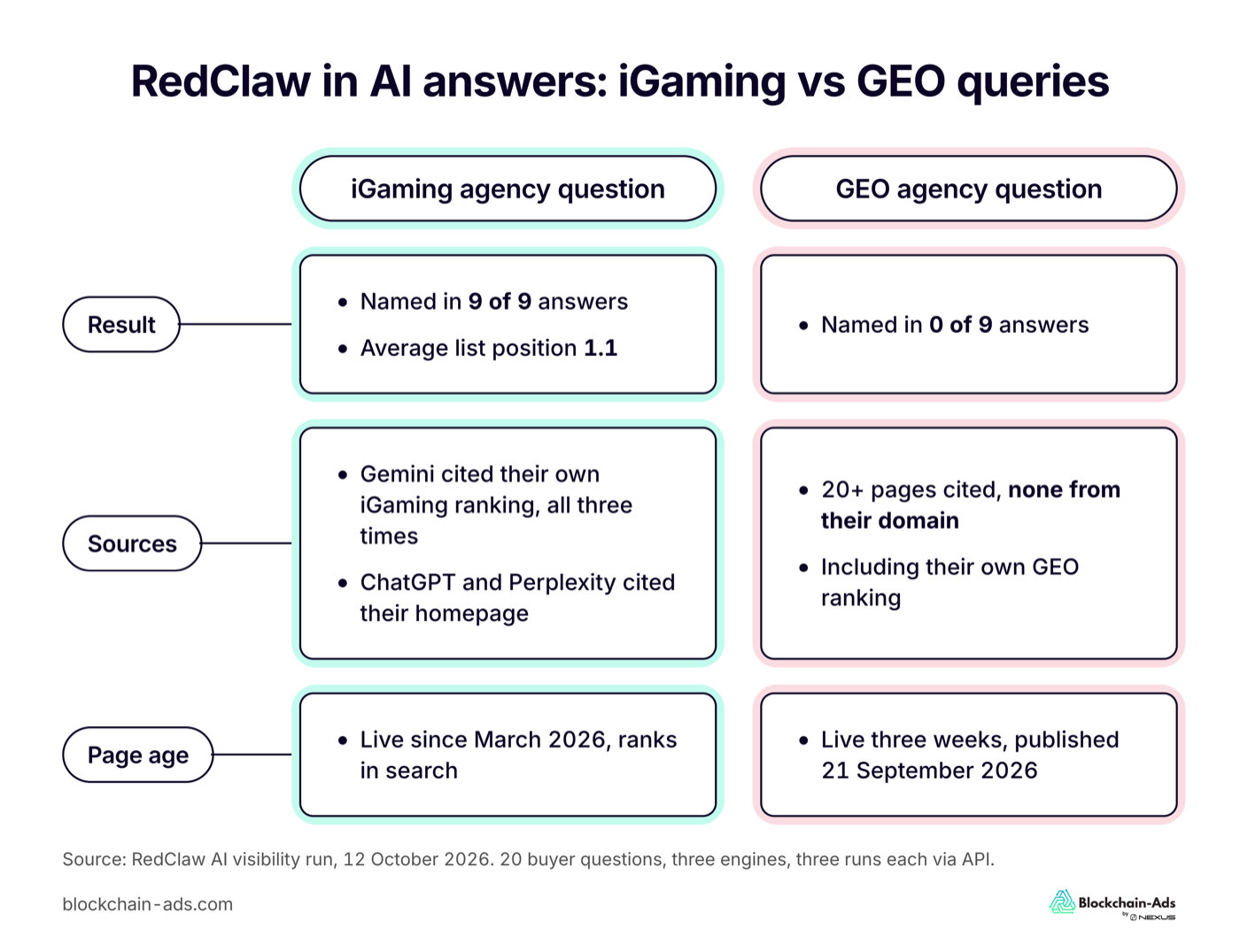
The first question was about online casino marketing in Asia, asking which agencies can run Meta ads for iGaming brands. All three engines named us in 9 of 9 answers, with an average list position of 1.1.
The second question asked for the best generative engine optimization (GEO) agencies in 2026. We did not appear in a single one of the 9 answers.
That second result surprised us, because we publish our own ranking of GEO agencies. We also sell GEO work, so this is a niche where we expected at least some mentions.
The cited sources explain most of the gap between those two questions. On the iGaming question, Gemini cited our own iGaming agency ranking in all three of its answers.
ChatGPT and Perplexity cited our homepage on that question, next to third-party guides on iGaming ad compliance. In other words, the web already connected our name to that exact topic.
On the GEO question, the engines cited more than 20 other pages, mostly agency rankings. Not one of those cited pages came from our domain, including our own GEO ranking.
Our iGaming ranking page has been live since March 2026 and ranks in regular search. Our GEO ranking went live on September 21, 2026, only three weeks before this run.
Our working theory is that page age and existing search rankings decide which lists get read. We have not proven this yet, so treat it as a hypothesis to test on your own brand.
Finding 3: Being Read Is Not Being Recommended
Many teams assume that if an engine reads their site, the answer will mention them. Our October 12 run shows that this assumption is often wrong.
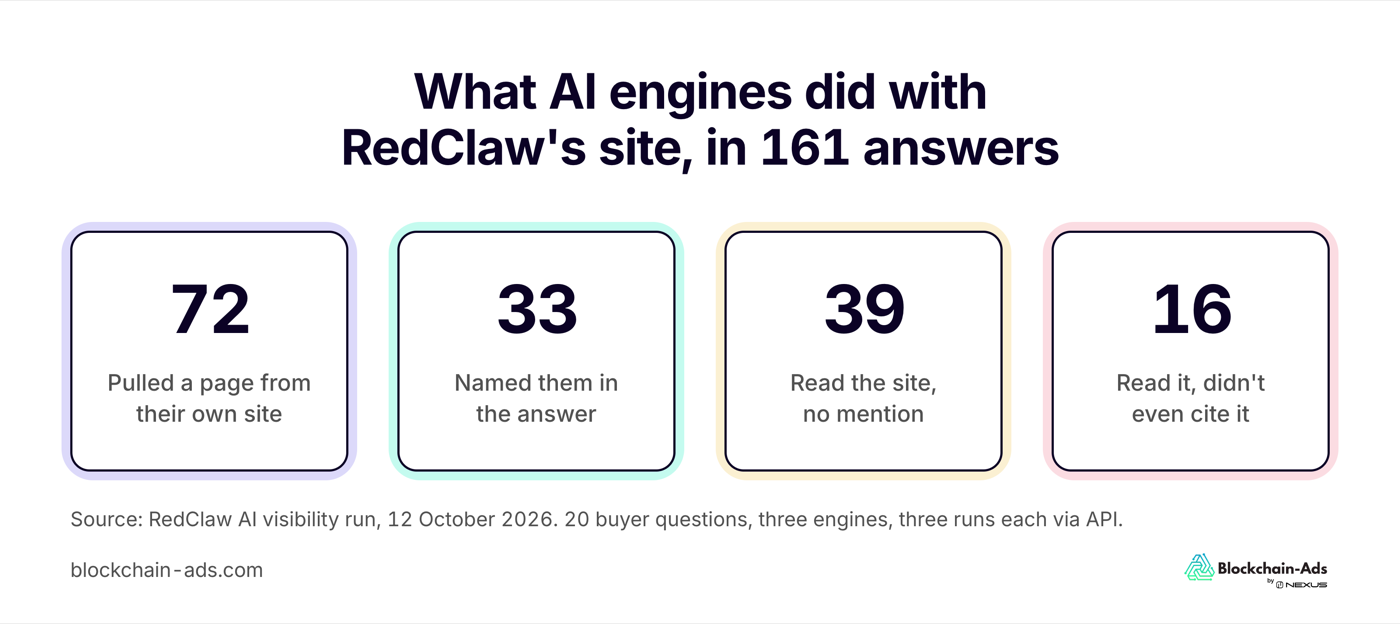
In 72 of the 161 usable non-brand answers, the engine pulled at least one page from our domain. The engines named us in only 33 answers, so at least 39 answers read our site and still left our name out.
In 16 answers, the engine read one of our pages and then neither cited it nor mentioned us. Our page shaped the answer without earning us any visible credit.
One example stood out, on a question about LINE Official Account automation tools in Thailand with pricing. Six answers read our LINE OA service page or our Thai LINE OA comparison tool.
Yet none of the nine answers to that question named us anywhere in the text. The engines used our page as background and then recommended other tools.
The likely reason is a mismatch between the question format and the page format. The buyer asked for a tool comparison with prices, and our page mainly describes an agency service.
The same pattern showed up on a benchmark question about average ROAS for iGaming affiliates. ChatGPT and Gemini read our ROAS benchmark article, and Perplexity read a related budget guide.
Even so, we were named in only 2 of the 9 answers to that benchmark question. Being used as a source and being named as the recommendation are two different outcomes.
Finding 4: A Single Check Can Point the Wrong Way
We asked for the best Meta ads agencies for ecommerce brands selling in Asia, and we were named 4 times out of 9. ChatGPT and Perplexity each named us twice, while Gemini did not name us in any of its three answers.
Run that question once on Gemini, and you would conclude that your brand is invisible. Run it once on ChatGPT, and you might believe you already own the category.
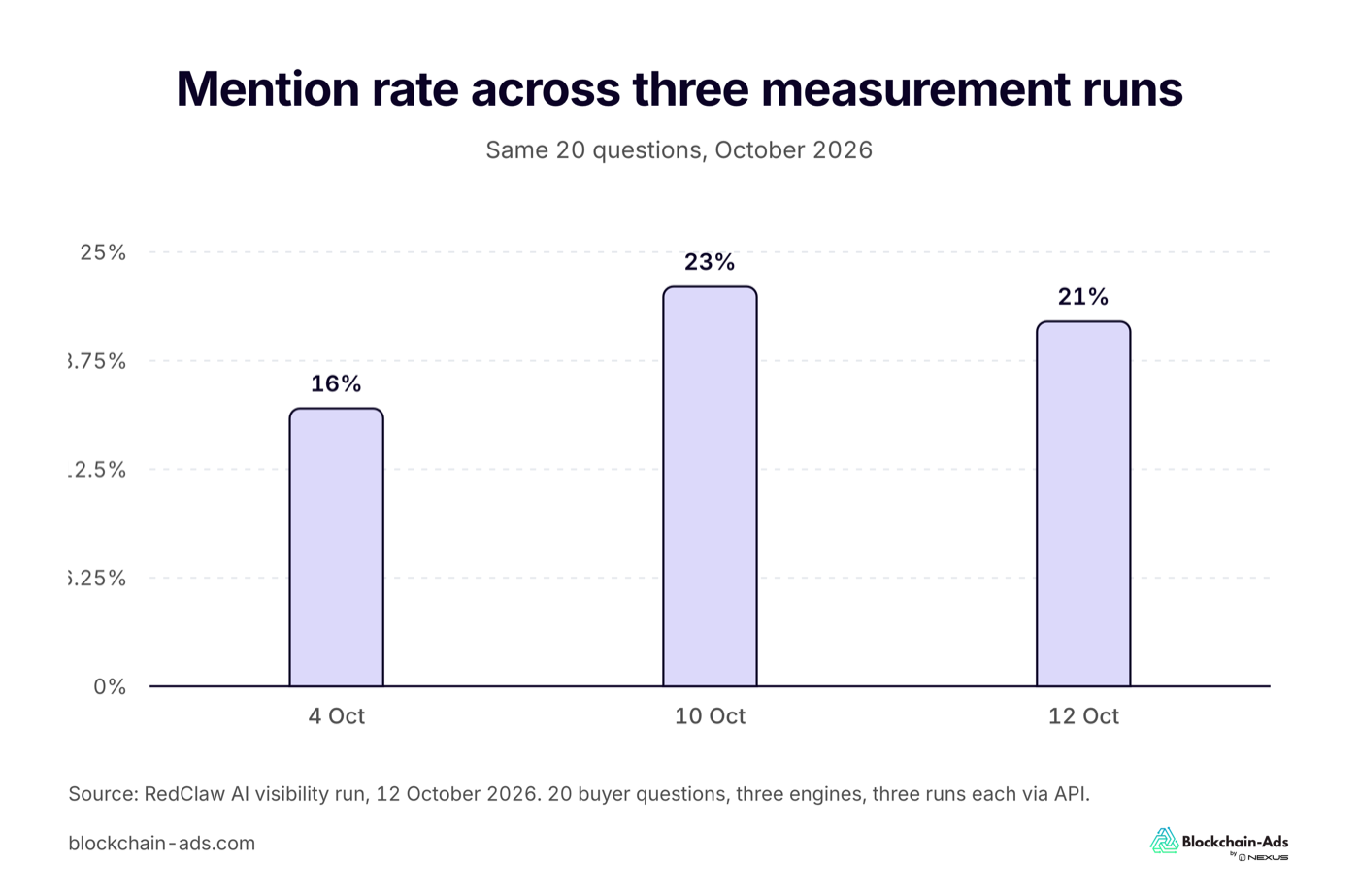
The full question set also shifted from one run to the next. Our overall rate was 16% on October 4, 23% on October 10 and 21% on October 12.
The ChatGPT numbers hide a quieter trap as well. In 12 of all 60 ChatGPT answers, brand checks included, the model replied without running a web search.
Those answers came from training data alone, so a recently published page could never appear in them. If you do not log this, a run where the model skipped search can look like a real loss of visibility.

Three Changes We Are Testing
Each of these changes comes from a pattern in the findings above. We will report the results once we have several weeks of comparable runs to judge them.
1. Build the Third-Party Trail Where You Want to Be Named
On the GEO question, every cited source was a ranking or guide on another domain. Earning a place on those lists likely matters more than publishing your own.
For regulated brands, that means earning places on independent comparison pages inside your exact niche. A general marketing list will rarely carry you into a crypto exchange or online casino query.
2. Match the Page to the Format of the Question
Buyers ask for comparisons with prices, so a plain service page often gets read and then ignored. We are adding direct answer passages with clear numbers, and with our name inside the sentence itself.
The goal is a single quotable line that an engine can lift without rewriting it. If the engine has to rebuild the sentence, your name is the first thing it drops.
3. Measure Like an Analyst, Not Like a Spot Checker
Ask each question at least three times on every engine your buyers actually use. Report rates with confidence intervals, and always split them by question type.
Log whether the engine actually searched the web before it answered each question. Track "read our site" separately from "named us", because those two numbers move independently.
A Quick Checklist for Your Own Brand
- Write 15 to 20 questions that a real buyer would ask, without your brand name in them.
- Add two brand-check questions, but keep them out of your headline mention rate.
- Run every question at least three times on ChatGPT, Gemini and Perplexity.
- Record whether you were named, your list position and the sources each answer cited.
- Group your results by question type before you look at the overall rate.
- Flag every answer that read your site but never named your brand in the text.
- Repeat the run weekly on the same questions, so you always compare like with like.
If you want a quick first read before building this yourself, you can run our free AI visibility check. It runs a smaller version of the same test against your own domain.
The Takeaway
AI engines do not hold one single opinion about your brand that you can check once. They hold many small opinions, one for each niche and one for each engine.
Start with the niches where the web already connects your name to the buyer's question. Then work outward from there, one measured question and one better page at a time.
Disclosure: RedClaw is a performance marketing agency that runs paid campaigns for iGaming, crypto and fintech brands. All data in this article comes from measuring our own brand with our own tools. We have no affiliate relationship with any company or tool mentioned in this article.
Eric Yu leads RedClaw, a performance marketing agency for iGaming, crypto and fintech brands across Asia and Latin America.
View full profile →