
10 Effective Sports Betting Marketing Strategies for Sportsbooks in 2026
Key takeaways
- Paid media: Sportsbet.io's display campaign reached 15.5M+ crypto sports bettors and converted 812 players at a $71.81 blended CPA.
- Localization: Dafabet's six-market campaign cut CPA 32%, from $357.11 to $241.85, using native-language creative per market.
- Video: Short video ads helped XTP Casino grow CTR by 34% over 12 months across Asian, European, and Oceanian markets.
- Affiliates: 74% of iGaming campaigns on Blockchain-Ads run through affiliates, so they need the same oversight as paid acquisition.
- Loyalty: A Stake.com $100,000 daily race promotion closed at 2.5x ROAS across a thirteen-market portfolio.
Sportsbook marketing is a system for acquiring eligible players, converting them responsibly, and retaining them through relevant betting moments. It fails when each marketing channel optimizes for volume alone.
Sportsbet.io reached 15.5M+ crypto sports bettors across three markets. Its seven-month display campaign produced 812 conversions at a $71.81 blended CPA.
Those figures do not make marketing through display ads universally superior. They show why a sportsbook needs defined audiences, market controls, and a conversion event before it increases spend.
In this article by Blockchain-Ads, you will find ten sports betting marketing strategies for scalable, compliant player growth. The guide also covers advanced acquisition and retention tactics.
Each strategy has a different role in the player journey. The best sportsbook digital marketing plan connects them rather than treating them as competing alternatives.
Why Marketing Is Important for Sports Betting Platforms
Marketing gives a sports betting platform a way to reach eligible players, explain its product, and convert interested users into clients. A sportsbook alone, regardless of how attractive its branding or product, without any marketing would be left only hoping to grow.
The digital marketing field allows sportsbooks to promote and reach players from different angles. Paid media coverage, search content, social activity, and partner channels; all of these can be viable strategies. Each serves its particular purpose, providing ways to grow your particular online sportsbook.
So, what are the key features that make a good sportsbook marketing strategy effective? They include clear market eligibility, a recognizable brand, converting channels, measured acquisition, and retention paths.
A good sports betting marketing system needs one reporting view. It should connect an impression to registration, first deposit, repeat betting, and the actual value of the acquired player.
10 Effective Sports Betting Marketing Strategies
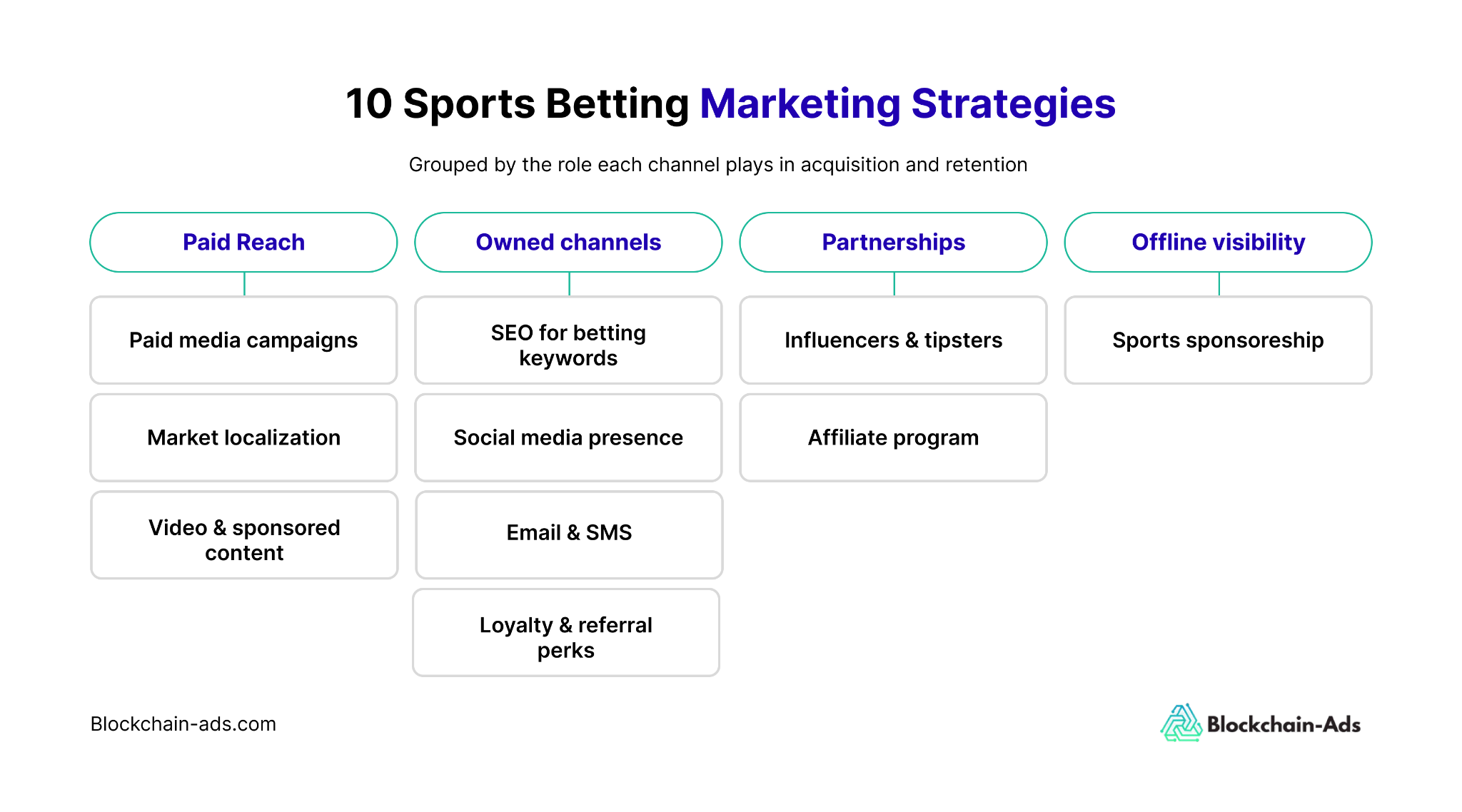
The ten sports betting marketing strategies below cover paid reach, owned channels, partnerships, and offline visibility. Each serves a different stage, so the order of investment depends on license coverage and commercial maturity.
In general, it’s best to start with channels that can prove deposit quality. Add broader online marketing activity after the GEOs, player segments, and compliant offer structure are clear from the sportsbook operator perspective.
1. Run Paid Media Campaigns for Your Sportsbook
Paid media is the fastest controllable way to test sportsbook advertising and acquire players. It can compare audiences, offers, formats, and approved landing pages at scale.
The main strategy cornerstone is where to run such ads for sportsbooks. Most common paid media sources include major platforms (like Google and Meta) and specialized advertising networks like Blockchain-Ads. Mainstream solutions, Google Ads and Facebook Ads, are more strict to any kind of iGaming, crypto-gambling, and sportsbook ads, even with eligible licensing and certification.
Industry-oriented programmatic advertising, on the contrary, tends to provide a more in-depth sportsbook audience and targeting signals. For example, a Sportsbet.io case study by Blockchain-Ads showed 15.5M+ display impressions and achieved 812 conversions. Its blended CPA was $71.81 across Canada and worldwide inventory. The campaign relied on a defined crypto-sports audience, accessible through wallet-based targeting and on-chain behavioral player activity.
The best ad formats in sports betting depend on the provided context. If the main goal is pushing brand awareness, then it’s video, native, and banners. While for direct-response sportsbook ads and acquisition, it's the in-page push inventory and the like.
Here are some best practices for geo-targeting sports betting ads:
- Start with one licensed GEO, then scale only after deposit quality and policy approval remain stable.
- Test one priority audience per ad set, so results show which signals are driving player quality.
- Map the funnel from ad to a compatible landing page, registration flow, and deposit method.
- Review creative performance throughout the campaign, replacing fatigued messaging before frequency weakens response.
2. Localize Campaigns for Every Market You Enter
Localization is not a simple translation task. It adapts the language, betting terminology, sports references, payment methods, and promotion mechanics to one regulated market.
Use a GEO launch sheet before buying traffic. It should record:
- Approved products, license conditions, and age restrictions.
- Local copy, odds formats, and sports with genuine audience relevance.
- Available currencies, payment methods, and withdrawal expectations.
- Offer rules, advertising disclosures, and responsible-gambling wording.
For example, an affiliate-managed Dafabet campaign delivered 43M+ impressions across six Asian markets in five months. Its blended CPA fell 32%, from $357.11 to $241.85, after market-specific audience and creative testing. The campaign used separate native-language approaches rather than one regional message.
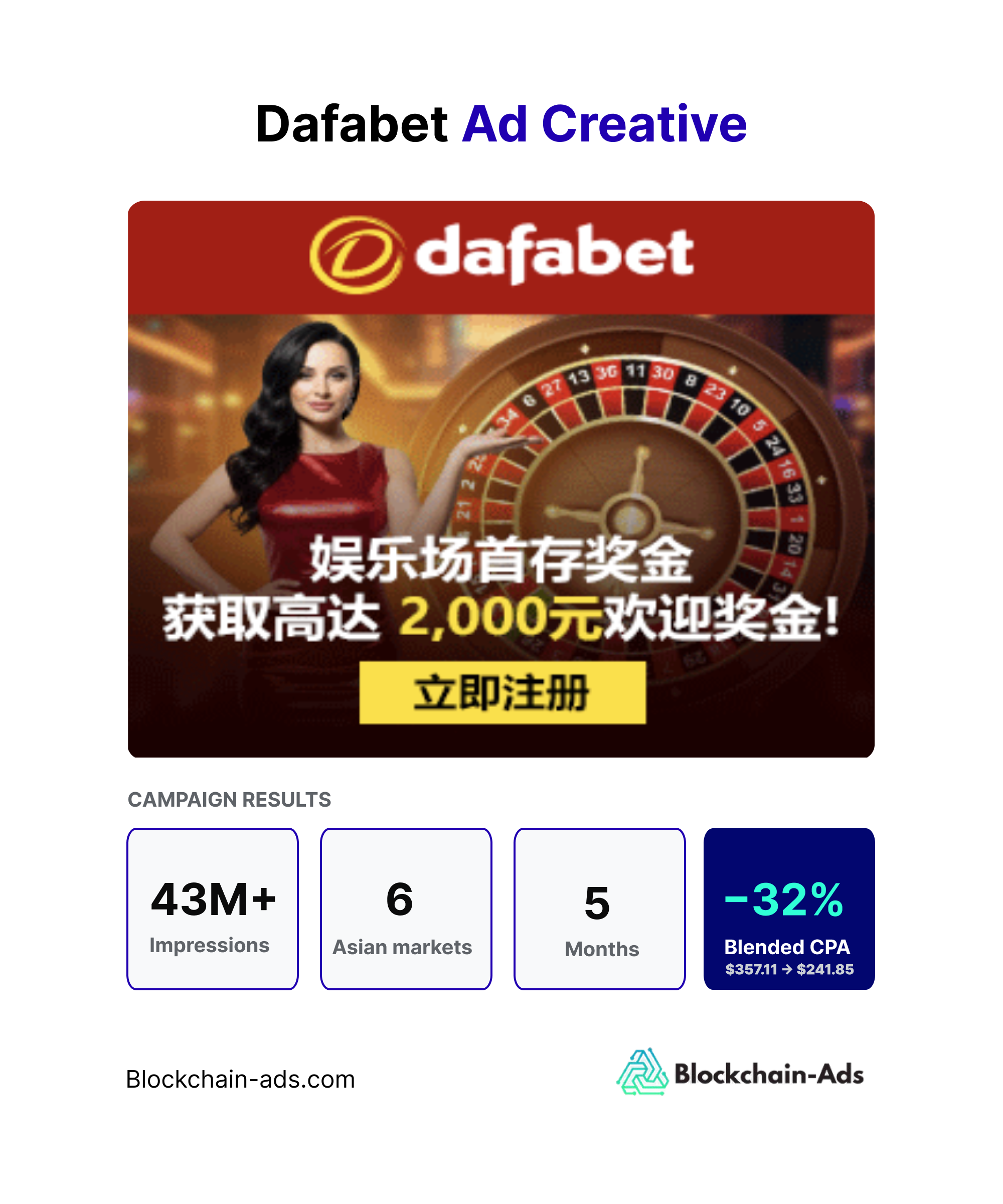
Localization should also change what an offer emphasizes. One market may respond to regional football coverage, while another needs a familiar payment method or clearer withdrawal explanation.
3. Rank on Search Engines for Betting Keywords
Sportsbook SEO captures players who are already looking for an answer, a market, or a legal betting product. It takes longer than paid media, but useful pages can keep bringing qualified traffic after publication.
A practical sportsbook SEO strategy usually has three content layers:
- Commercial pages for the sportsbook, its app, betting markets, and approved offers.
- Informational content covering odds, bet types, fixtures, payment methods, and responsible gambling.
- Local pages that explain legal availability, product limits, and market-specific payment options.
A sportsbook backlinks strategy should favor relevant editorial references over link volume. Useful options include digital PR, original data, expert commentary, and references from sports, payments, or regulated-gambling publications. Irrelevant linking and paid schemes, on the contrary, might decrease organic performance and lead to long-term reputation loss.
In general, marketing through SEO for sportsbooks might take months, even up to a year, to get results compared to paid media acquisition. For example, if a Dafabet display campaign could achieve over 43M+ impressions in 5 months, this hardly could be pulled off with SEO only.
4. Invest in Video and Sponsored Content
Video and sponsored content can explain a sportsbook feature when a banner cannot carry the necessary context. They are particularly useful for new products, complex offers, and event-led propositions.
Usually, the types of video content that best increase sportsbook turnover are the ones published and promoted on video hosting services like YouTube. There, the platform’s content and SEO algorithms try to match audience interests and queries. Yet, the video content is not exclusively limited only to specific platforms to post them. Video production might apply to supplying sponsored content or displaying it on digital ad inventory.
For example, XTP Casino implemented several videos into its campaign run across Asian, European, and Oceanian markets. Short video assets that introduced an offer and brand with catchy visuals, getting XTP +34% growth in CTR in 12 months. Sometimes a 15-30 second video can tell more than a three-line creative.
.png)
Sponsored content should solve a reader's question first. It can explain a league, betting feature, or local payment route before disclosing the sportsbook's role and offer.
Plan content approval before production. Legal copy, age controls, brand disclosures, and product availability should be checked before a publisher, creator, or media buyer receives the asset.
5. Build a Presence Where Bettors Spend Time on Social
Social media marketing keeps a sportsbook visible between paid campaigns and major events. It is most useful for building familiarity, explaining product features, and responding to community interest.
For example, Blockchain-Ads' 2026 benchmark shows operators increase spending by up to 82% before major sporting seasons. So, social calendars should be built around those moments without becoming a stream of untested promotions.
Content production and social media campaigns for sportsbooks might come in pairs with paid media, SEO, or other marketing. A message that receives meaningful engagement may become a testable hook, but it still needs compliant targeting and conversion measurement. So social media marketing for sports betting is a unit to add to marketing, not build everything around it.
6. Partner with Influencers and Tipsters
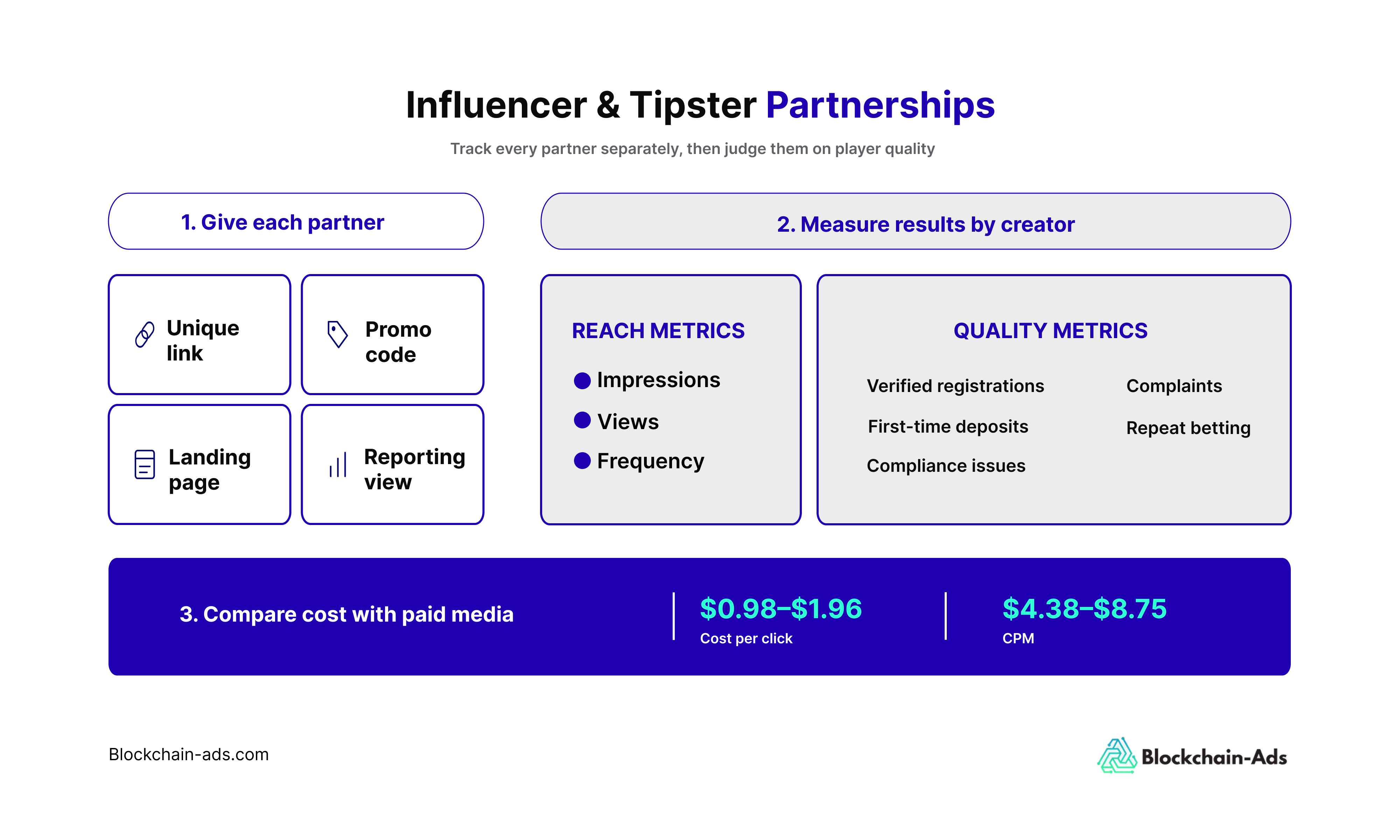
Influencer marketing and tipster partnerships can introduce a sportsbook through people bettors already follow. They only become dependable growth channels when the operator can verify who joined and deposited.
Each partner should have a unique link, code, landing page, and reporting view. Otherwise, there’s no way of attributing costs to results. Measure verified registration, first-time deposit, repeat betting, complaints, and compliance issues by the creator. Views and likes can explain reach, but they can’t demonstrate commercial quality.
Also, compare the cost of partnering with influencers with other marketing channels. For example, according to Blockchain-Ads’ platform’s data, iGaming ad clicks cost $0.98-$1.96 on average, and CPMs are between $4.38 and $8.75. If these figures are recalculated based on influencer reach and show a higher cost for budget, then it may be time to adjust the approach.
Some iGaming marketing agencies might offer in-house networks of influencers to partner with. Yet, each collaboration should be reviewed per measurable metrics.
7. Launch a Sportsbook Affiliate Program
An affiliate program gives a sportsbook access to delegating practical promotion to specialists and performance marketers. It can scale quickly, but weak governance can also scale misleading claims and low-quality traffic.
For example, Blockchain-Ads' 2026 platform benchmark found that 74% of iGaming campaigns were run by affiliates. Affiliate operations therefore deserve the same oversight as paid acquisition.
Any sportsbook affiliate program should first define approved GEOs, traffic sources, conversion events, brand terms, and prohibited claims. Onboarding partners with half-thought entry data equals low-quality traffic, at best. Pay commissions only after the agreed player action has passed verification.
Additionally, monitor traffic for duplicate accounts, self-referrals, incentive abuse, and misleading pre-landers. A high registration count is not valuable if deposit quality, retention, or compliance collapses later. This has nothing to do with trust but basing data-driven conclusions on performance-led acquisition.
8. Sponsor Teams, Leagues, and Stadiums
Sponsorship works when a sportsbook gains access to a real fan community and a usable media package. But a logo alone rarely creates enough measurable action to justify a large commitment.
For example, Sportsbet.io's display campaign at Blockchain-Ads reached 15.5M+ crypto-sports bettors. A sponsorship should have equally clear reach, activation rights, and player measures before the operator commits.
So, it’s best to build a sponsorship around assets that support the full funnel. These can include broadcast mentions, digital inventory, match-day content, opt-in capture, and locally eligible offers.
Sportsbook advertising in stadiums is considered among top strategies itself. It usually poses timed messages, in-match polls, or supporting physical presence. Yet, it still needs age, GEO and local advertising controls. The page behind a stadium QR code should be appropriate for the market and product, not only the event it was shown at.
You can track branded search, approved offer claims, consented leads, post-event registrations, and the downstream deposit rate. Smaller regional teams can offer a sensible first test. They may provide deeper local relevance than an expensive global deal with limited activation rights.
9. Bring Players Back with Email and SMS
Email and SMS marketing work best for sportsbooks as player retention tools, not shortcuts around consent or advertising restrictions. They work when messages reflect an existing relationship, a clear preference, and an eligible market.
Retention is itself a core of any viable sports betting platform marketing. For example, FortuneJack’s retargeting phase of the campaign accounted for 73% of all conversions during a 5-month period. If a similar lifecycle of messages to re-engage users already on radar is built through emails or SMS, that could show similarly impressive results.
Each flow should have frequency caps, quiet hours, clear opt-outs, and promotion terms. SMS is suited to short reminders that need immediate attention. Email has more space for account information, odds context, educational material, and conditions that won’t fit into a text.
While setting up a sportsbook email campaign management, it’s best to:
- Take clear measurements: reactivation, repeat deposits, betting frequency, complaint rates, and long-term player value, not just opens and clicks.
- Segment campaigns by preferred sport, recent activity, geography, and deposit status.
- Not messaging self-excluded players or sending promotions where the product is unavailable in order to avoid compliance issues.
10. Reward Loyalty with Promotions and Referral Perks
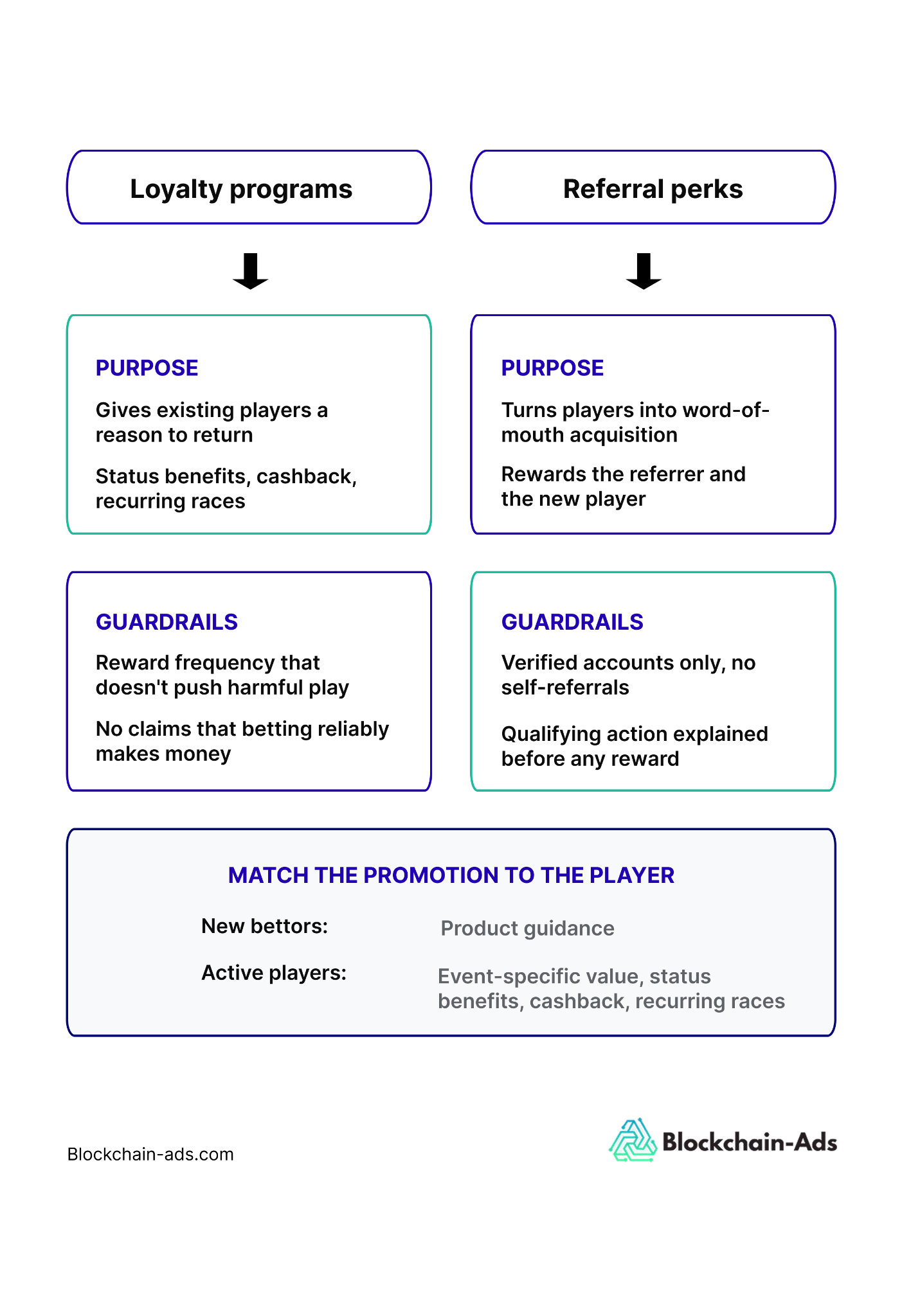
Reward loyalty, referral perks, and a loyalty program itself are useful promotional tools for sportsbook operators seeking to retain the audience. Such promos create a clear reason for an existing player to return.
For example, a Stake.com campaign’s creative promoted a $100,000 daily race that closed with 2.5x ROAS across the thirteen-market portfolio. A large number may attract attention, but the rules determine whether the offer feels credible.
Yet, each promotional tool is separately valuable to a sportsbook. Loyalty programs are to constantly re-acquire players in a sense, building bridges for return. While referral perks can create efficient word-of-mouth acquisition.
Note that reward frequency should not encourage harmful play or imply that betting is a reliable way to make money. This would be a catch where compliance fails. Also, it’s best to require verified accounts, prevent self-referrals, and explain the qualifying action before either participant receives a reward.
Don’t forget to match the promotion to the player. New bettors may need product guidance, while active players may prefer event-specific value, status benefits, cashback, or a recurring race.
Advanced Tactics for Sportsbook Player Acquisition and Retention
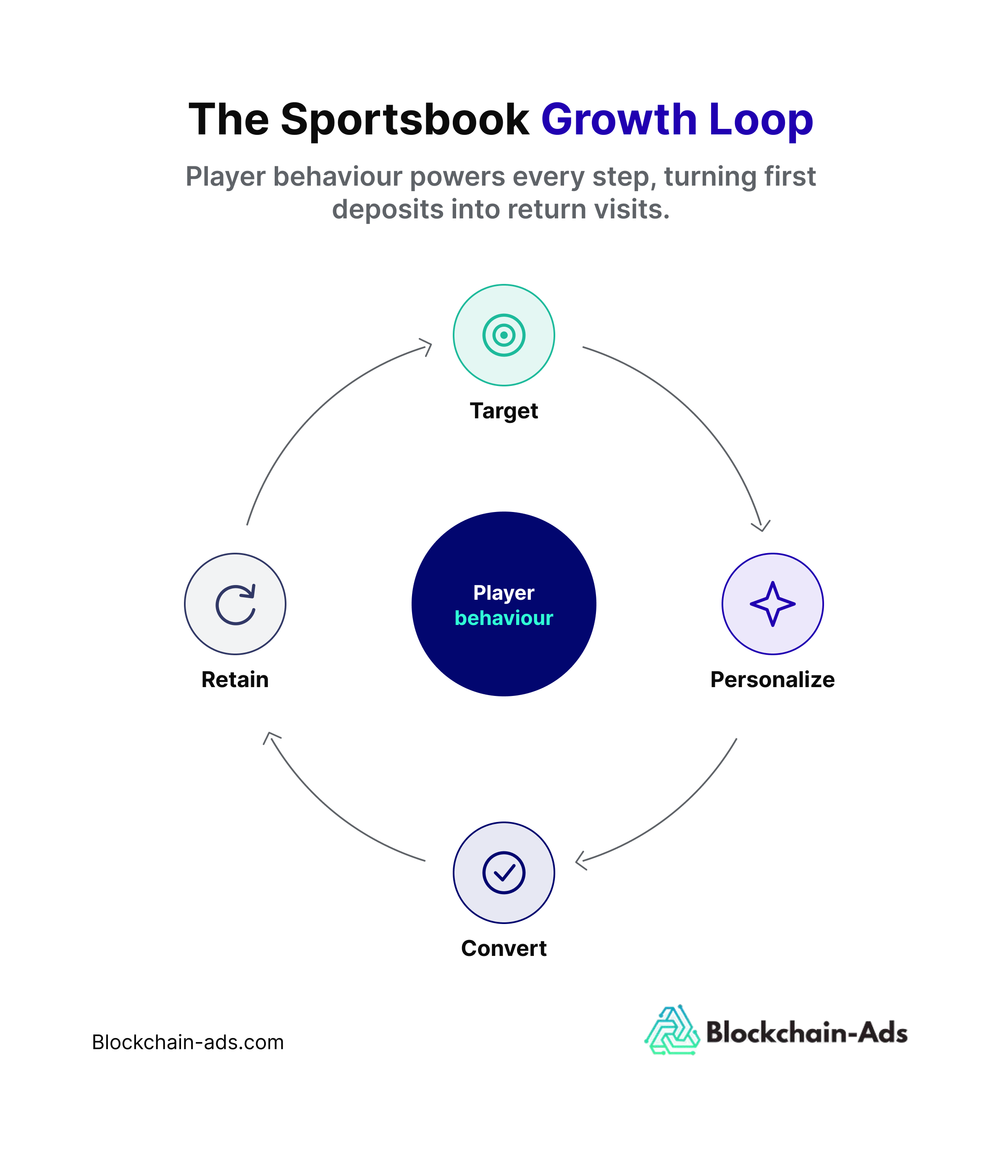
Buying traffic can start sportsbook customer acquisition, but it does not complete it. A registration or first deposit only becomes valuable when the operator understands player intent and earns a return visit.
What are the most effective sportsbook customer acquisition strategies? They combine eligible paid reach, relevant product messages, and follow-up based on real player behavior. Player retention tools for sportsbooks then use accumulated data to make the next interaction more useful. And most of this eventually comes down to targeting and personalization.
Target Bettors by Behavior and Intent Signals
Broad sports interest does not automatically mean betting intent. A sportsbook player segmentation is as crucial as knowing who you’re targeting. They might be general fans who bet occasionally, social players, active depositors, or even competitor customers. Without proper attribution, an ad would not reach the desired bettor.
For example, the Blockchain-Ads platform provides wallet-based targeting. It allows grouping users by their real on-chain behavior, based on used protocols and transaction history. Such segments display not only players that have a confirmed activity at sportsbooks or relative gambling resources but also provide the frequency of such interactions.
Those segments can be layered with first-party data, GEO, device, and site-interest signals. An approach that narrows users down not by general suggestions, but based on data.
To empower this, use reporting to identify which segment produces verified registrations, deposits, and sustainable player value. Exclude underage users, self-excluded players, and non-eligible GEOs at the campaign level.
Personalize Ads and Offers in Real Time
Real-time personalization should respond to a documented player state, not vague assumptions about an individual. Useful signals include viewer data, incomplete registration status, eligibility for an event, or an established sport preference.
Flux Campaigns on Blockchain-Ads generate a fresh creative for each eligible impression from advertiser-approved brand assets and copy inputs. The feature currently supports two variants: Display and Native. It’s AI-powered to adapt creatives to the viewer, context, and placement without uploading a single fixed banner.
The conversion to sportsbooks can be improved with various approaches: personalized bet recommendations, on-time heads-up on preferred matches, events, etc. The top real-time marketing for sportsbooks is not in telling a player what they want to hear at that particular moment. It’s about making it relatable enough for them to stay.
In the end, compare personalized delivery with a control group where possible. This shows whether the approach improves verified deposits, rather than simply reaching people who would have converted anyway.
Future of Sports Betting Marketing
The future of sports betting marketing will rely less on maximum reach and more on accountable delivery. Regulation, measurement, and player expectations are changing how sportsbooks earn attention.
In 2026, it’s more or less clear what sportsbook marketing is going to face:
- Advertising will become more responsible: As rules develop, operators will need clearer offer terms, stronger age controls, and more visible responsible gambling information. Responsible positioning will become part of campaign quality, not a legal footnote.
- Digital channels will grow as other routes become restricted: TV, sponsorship, and outdoor activity can face tighter timing, audience, and geographical limits. Digital buying remains subject to regulation, but its GEO controls and measurement make it more adaptable.
- Performance-led acquisition will overtake awareness-only promotion: Traditional media can lift recognition, yet it is often difficult to connect it with a verified player action. Performance-oriented campaigns can optimize toward registrations, first-time deposits, and player value.
- Precise targeting will replace blind reach: Large campaigns aimed at everyone interested in sports waste budget and create compliance risk. Interest, intent, device, GEO, and consented first-party signals will make audience selection more specific, especially with appropriate technology.
- Marketing will become more streamlined across channels: Paid media, SEO, affiliates, CRM, and social content need a one-offer logic, conversion definition, and reporting view. A player should not receive conflicting terms after moving between channels.
- Interactive formats will challenge broad advertising: Personalized creative, live content, and useful product tools can hold attention better than static blanket messages. The interaction still needs appropriate controls, transparent terms, and a compliant destination.
More on Sportsbook Marketing
What Is the Most Effective Sports Betting Marketing Strategy?
Paid media is usually the fastest way to scale sportsbook customer acquisition because targeting, budget, formats, and conversion events can change quickly. Yet, no standalone strategy wins in every GEO or product. The durable approach combines multiple sources like paid reach with local SEO, affiliates, CRM, and promotions that retain qualified players.
How Do Regulations Impact Sports Betting Marketing?
Regulations shape licensing, permitted products, audiences, copy, bonuses, and media access. Rules can tighten in US and European markets, especially around minors, live sports, and responsible gambling. Basically, the more regulated the market for sports betting products, the stricter the rules to advertise would be.
For example, Google and Meta follow regulatory requirements thoroughly for all iGaming, which makes it hard even for an eligible operator to run campaigns there. One step out of line, even by accident, and the campaign faces disapproval. So, marketing for sports betting is very dependent on current regulations.
For wider market guidance, read our guide to iGaming regulations. It provides a starting point, but legal review remains essential before launch.
What Are the Biggest Sports Betting Markets for Advertising?
The biggest markets for sports betting advertising appear to be those that not only have the most audience intent but also a clear regulatory status. This is due to the fact that eligible operators can market freely without the risk of having campaigns or licenses suspended.
Among such markets for sportsbooks are regions such as:
- North America (US; Ontario and Alberta in Canada).
- UK, Mexico, and LatAm (Brazil, Peru, and Colombia).
- Europe (most of Central Europe and Nordic countries).
Also, a market that responds well to one type of sports betting advertising might not be the best fit for another product. So, check whether the license, local specifics, and bettor expectations are met in a particular GEO. Sometimes the best match for a certain product might open a market bigger than an already established one would reveal.
Can You Run Sports Betting Ads on Google and Facebook?
Yes, but only under strict guidelines and compliance checks. Google demands having separate licensing for each type of product and brand, certified locally by each regulatory body of targeted countries. This can easily turn an operator with two brands into a holder of numerous papers just for Google. Formats, products, and availability also vary by country and can change with policy updates.
Meta’s Facebook Ads also apply product and market restrictions. The advertiser must satisfy the platform's certification, licensing, destination, and audience requirements. So, check current permissions and licensing requirements and review outcomes before treating either platform as a reliable launch channel.
Ready to Reach Your Ideal Customer?
Blockchain-Ads helps licensed sportsbooks reach eligible audiences through display, native, video, mobile, and other programmatic formats. Campaigns can be measured from impression through first-time deposit and deposit value.
Access is available to qualified advertisers. Request access to Blockchain-Ads to discuss a compliant sportsbook acquisition plan and get real results.
A professional content marketer with 3+ years of experience in iGaming and affiliate marketing.
View full profile →