What is iGaming? Definition, Verticals & Industry Guide (2026)
iGaming is the industry built around real-money online gambling. This includes casinos, sportsbooks, poker rooms, lotteries, and betting platforms accessed through a website or app.
But that only covers the player-facing side.
The iGaming sector encompasses the operators that manage gambling brands and the software and game studios that develop the products.
It also includes payment processors that facilitate transactions, regulators that establish the rules, and specialized advertising platforms like Blockchain-Ads that connect everything to players.
In this article, you will find a clear definition of what iGaming is as an industry. More to that, you will find out how its verticals break down, who operates in the ecosystem, and how real-money online gambling actually works as an industry in 2026.
What does “iGaming” mean?
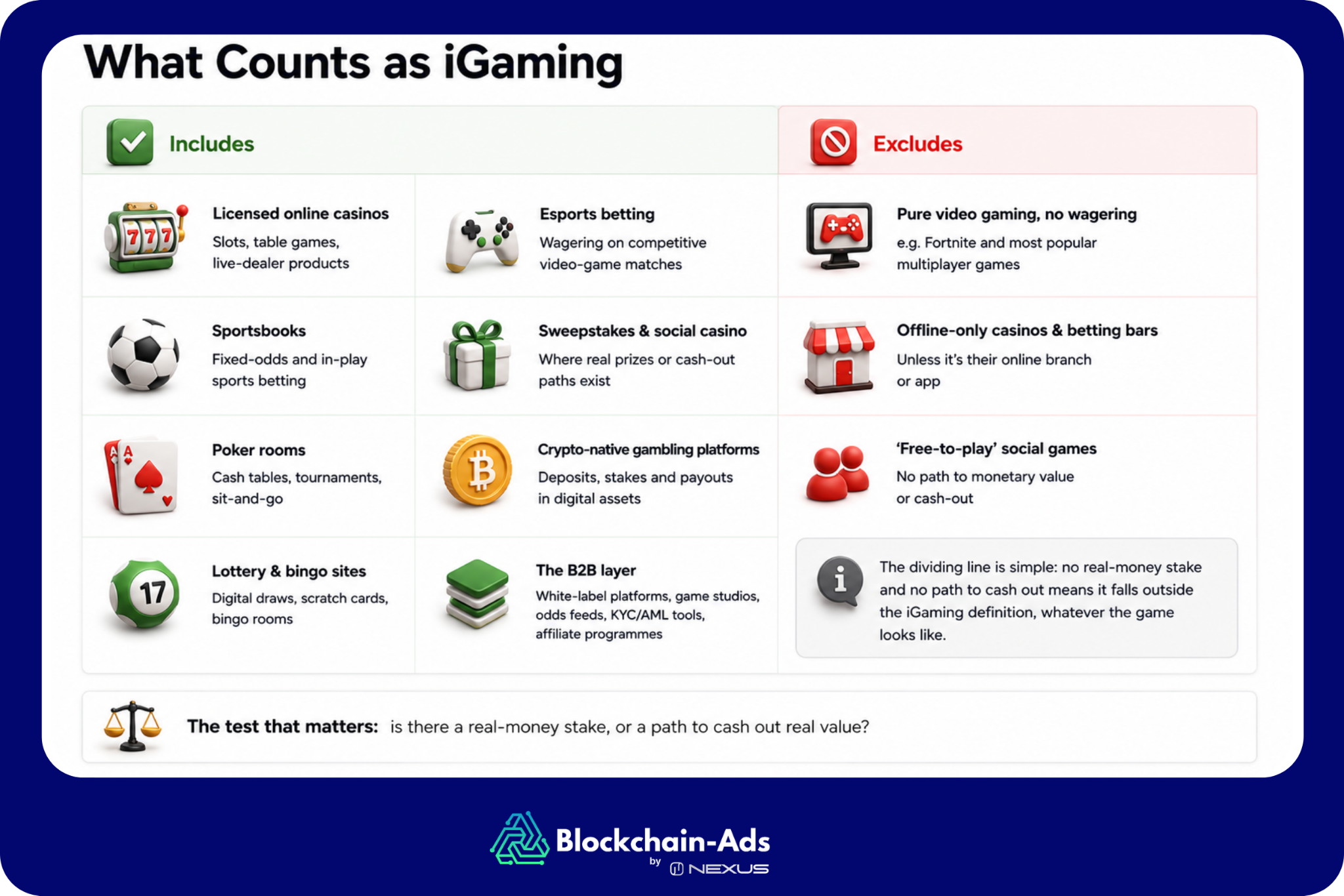
iGaming is an umbrella term for interactive, internet-based gambling, i.e., any activity where users stake money (or equivalent value) on uncertain outcomes through a digital channel.
The 'i' stands for interactive, while the 'gaming' here is served under a more archaic meaning that includes placing bets, spinning reels, or playing poker at tables, yet now specifically through websites and apps rather than at a physical venue.
That definition covers the player-facing side, but the industry itself is wider, spanning operators, software and game providers, payment processors, regulators, affiliates and specialised advertising channels (the full ecosystem breakdown is further down this page). A single bet on a mobile slot is placed at the very end of that entire chain.
iGaming vs Online Gambling vs Gaming
These three labels overlap heavily, but they are not interchangeable.
'Online gambling' is the broadest, plain-language term: wagering money on a game of chance or skill for a monetary outcome over the internet.
iGaming is the industry's preferred shorthand for that same activity, but it also names the commercial ecosystem around it: providers, platforms, affiliates, ad tech and regulators.
Gaming without a qualifier usually means video games. iGaming borrows that word, which is where the confusion starts: a crypto casino and a mobile RPG can look alike in an app store, but real-money stakes and gambling licensing set them apart immediately.
Types of iGaming (The iGaming Verticals)
The verticals below break down gambling activity into segments, each with its own rules for regulation and advertising.
Online Casino & Slots
Online casinos are usually the first product most people connect with iGaming. They offer slots, table games like blackjack, roulette and baccarat, and live-dealer tables where a real dealer runs the game on camera. Slots bring in the most revenue because they are easy to play, and bonus mechanics keep players spinning on mobile.
The casino vertical carries heavier technical compliance than most. Regulators require RNG certification from independent testing labs, like eCOGRA or iTech Labs, to prove every spin is fair.
Ads for this vertical must carry licence badges, responsible-gambling messages, and age gates wherever the market requires them.
Sports Betting
Sports betting lets users wager on football, basketball, tennis, cricket, MMA and many other sports. Some platforms extend this to any event with an uncertain outcome, even politics, but that depends on the operator's licence.
Sports betting often leads the way when a country first regulates iGaming. Brands already known from TV or sponsorship deals, like Bet365, DraftKings and FanDuel, turn that recognition into new players fast.
In-play betting and same-game parlays keep players engaged, but they add compliance work around event integrity and ad timing.
Poker & Skill Games
Online poker rooms focus on player-versus-player games like Texas Hold'em, Omaha, tournaments, and sit-and-go tables. Players compete against each other, and the house earns a rake instead of betting against anyone.
Skill-based games sit next to poker and casino products in the iGaming world. Crash games like Aviator, arcade hybrids, and instant-win games let players' choices affect timing or cash-out, though randomness still decides most outcomes.
These games have grown fast in recent years, especially on mobile, and regulators sometimes treat them as casino products.
Lottery & Bingo
Digital lottery and bingo are some of the oldest products in the gambling vertical. Online lottery mirrors state or national draws and adds instant-win scratch cards, while bingo rooms bring in chat and social features. These products tend to attract older players and reward convenience over flashy design.
Many users who would never download a full casino app still buy lottery tickets on a site they already trust.
Esports Betting
Esports betting is an iGaming vertical that lets users wager on competitive video game matches. Popular titles include CS2, Dota 2, League of Legends, and Valorant, all offered through licensed sportsbooks. It follows the same event-driven model as sports betting, but the audience skews younger.
Not every regulated market treats esports betting as its own separate category. Where it is allowed, live-stream integration and data feeds from odds providers matter just as much as they do in traditional sports.
Sweepstakes & Social Casino
Sweepstakes and social casinos let players enjoy casino-style games using virtual currency instead of real cash. Players buy virtual coins or get free sweeps entries, then redeem wins through a legal sweepstakes or prize system. This usually means no direct cash wager, though the rules change from state to state.
The category faces heavier regulatory pressure with each passing year, especially in the US. Several US states have moved to restrict or ban sweepstakes-style casinos through 2025 and into 2026.
Affiliates and operators should treat sweepstakes as their own compliance area and watch it closely.
Crypto Casino
Crypto casinos use digital assets like Bitcoin, Ethereum, stablecoins, and platform tokens for deposits, stakes, and withdrawals. Many operators offer these payment options alongside fiat money, while others run crypto-only. Game libraries look a lot like mainstream online casinos, with slots, live dealer tables, and provably fair originals.
Onboarding, KYC and advertising rules follow a different pattern here than in fiat casinos. Ad platforms also apply sharper policy risk to crypto brands, and players expect fast, reliable wallet connections.
Blockchain-Ads covers this vertical in depth in its crypto gambling and betting guide. It is one of the few guides that treats crypto-native iGaming as its own serious segment, not a casino footnote.
How Big is the iGaming Industry in 2026?
For segment breakdowns, regional splits, and year-on-year trend data, it’s best to look at the iGaming statistics in a global scope to know the scale of industry changes.
Headline figures worth knowing at the overview level:
- Global online gambling revenue is projected to reach roughly $130 billion in 2026, with platform and operator investment following player demand in mobile-first markets.
- Longer-range forecasts put the broader online gambling market toward $153 billion by 2030, at roughly 11-12% CAGR from the mid-2020s, driven by new licenses, mobile share, and product diversification.
- Mobile accounts for about half of online gambling revenue worldwide; in some geos the share is higher still.
Who Makes Up the iGaming Ecosystem
iGaming is not only about players placing bets. Every product on the market sits on a stack of specialised roles:
Operators and platforms: Brands such as Bet365, DraftKings, and FanDuel (and hundreds of white-label or regional operators) run the consumer-facing site or app: registration, wallet, game lobby, bonuses, and support. The platform is the technical backbone; the operator holds the licence and commercial relationship with the player.
Platform and game providers: Studios and aggregators supply the actual games. Pragmatic Play, Evolution, NetEnt, Spribe, and iGaming software providers integrate slots, live tables, and sportsbook engines into operator front ends. Without this layer, an operator would have nothing to sell beyond an empty shell.
Payment providers: Skrill, Neteller, PayPal (where permitted), card acquirers, bank-transfer rails, and crypto processors move money in and out. Gambling is high-risk for payments; availability varies by licence, geo, and player verification status.
Regulators: Government and tribal authorities (UKGC, MGA, state gaming commissions, and others) issue licences, audit fairness, enforce responsible gambling, and define where advertising may run. Compliance is not a one-time checkbox — ongoing reporting and product approvals are part of the operating cost.
Affiliates: Partners or media buyers who drive traffic via SEO, paid ads, streams or communities and earn commissions through affiliate programs such as 1win Partners or networks like 3SNET. Affiliates sit between operators and players; their abilities determine which geos and creatives get scale.
Specialised advertising platforms and programmatic DSPs: General platforms (Google, Meta) restrict gambling heavily, while specialised gambling/iGaming ad networks and programmatic DSPs for regulated industries like Blockchain-Ads fill the gap with licence-aware onboarding and category-specific placements. This layer is where media buyers connect compliant creatives to audiences at scale.
What's Driving Growth
Several forces keep the iGaming sector expanding in 2026:
- Regulatory expansion: US state-by-state legalisation, Brazil’s regulated market, and ongoing European framework updates open new licensed channels. Regulation cuts both ways: it creates addressable market size but also raises compliance and acquisition costs.
- Mobile and product UX: Smartphone penetration and faster connectivity (over 74% global internet use by late 2025, ITU) lowered the entry threshold for betting and casino sessions. Short-form skill games and app-native onboarding broadened the audience beyond desktop casinos.
- Crypto and alternative payments: Digital assets and e-wallets reduce banking delays and support crypto-casino verticals. They also introduce new policy and fraud considerations for operators and ad platforms.
- Data and acquisition maturity: Performance marketing, affiliate tracking, and platform-side optimization tools make player acquisition more measurable than a decade ago, which in turn attracts capital and competition into the vertical.
How Does iGaming Work?
For newcomers, it helps to separate what players see from what operators build. A typical real-money iGaming business runs through five linked stages:
- Licence: The operator obtains (or rents via white-label) permission to offer defined products in specific jurisdictions. Without a valid licence for the target geo, payment processors and ad platforms may not even consider onboarding the brand.
- Platform: The operator deploys a front-end site or app and connects to a platform backend: player accounts, bonuses, responsible-gambling tools and CRM integration for games and sportsbook data.
- Games and odds: Game providers supply RNG slots and live tables, sportsbooks plug into odds feeds and risk-management tools. Content libraries are contracted, not built in-house in most cases.
- Payments: Deposits and withdrawals flow through PSPs with gambling MCC support. KYC/AML checks run at registration and at payout thresholds. Payment success rates strongly affect LTV.
- Players: Acquisition teams and affiliates drive registration and FTD through SEO, paid media, partnerships, etc. Retention and cross-selling happen inside the product after the first deposit.
None of these stages is trivial, a breakdown in payments or compliance can slow down growth even when games and creatives perform well. Operators planning a launch from scratch should read the step-by-step how to start an online casino guide for operational depth beyond this overview.
iGaming Regulation & Licensing
iGaming regulations are fragmented by design: every country decides whether online gambling is prohibited, monopolised, licensed to private operators or left in a grey zone. There is no single global licence, operators often hold multiple permits or use market-specific certification.
The table below is a high-level regional overview only. Rules change frequently, so always verify with official regulator sources and legal counsel before launching or advertising in a geo.
Europe is often described as ‘mostly regulated’, but that hides important differences: advertising caps in some markets, deposit limits in others, and outright bans on certain products. Treating Europe as a single geo is a common compliance mistake.
How iGaming Companies Acquire Players
Products do not find audiences by themselves. In iGaming, acquisition is a core discipline and channels are usually split between paid media, affiliate partnerships and owned/organic work.
Paid acquisition: Media buyers and affiliates run display, native, push, video and other advertising campaigns through specialised iGaming platforms and programmatic DSPs that accept gambling categories. Google and Meta allow gambling in selected geos with certification, while disapproval rates and policy churn remain high. Though, the clearer path to certification served to licensed iGaming platforms by programmatic DSPs like Blockchain-Ads provide compliance-compatibility, yet comparable by the acquisition scale to major platforms.
Social media marketing: Social platforms are used for building brand presence and community, not usually as a primary FTD channel. Facebook and Instagram dominate consumer reach in licensed geos but need Meta certification for gambling ads. LinkedIn fits B2B and partnerships. TikTok suits sports and esports clips, direct gambling promos are heavily restricted.
Organic traffic: SEO and YouTube bring players without ad network gates, but results take months. Teams publish reviews, guides, bonus comparisons and geo landing pages, and there’s no guarantee it would work either. At YouTube there are video, previews and clips that rank in search. Both need steady output and clear licence or affiliate disclosures.
Other channels: TV, radio, influencer or event sponsorship still build mainstream trust in regulated markets, though attribution is weak. Influencer and streamer promotions like casino sessions, tipsters, podcasts run on flat fees or CPA with promo codes, while the overall disclosure rules are strict in the UK, US, and EU.
iGaming Trends to Watch in 2026
Based on what the iGaming statistics have shown throughout the recent years, the most foreseen industry tendencies are:
- Regional regulatory waves: New licences create inventory booms, while sudden restrictions (advertising bans, stake limits) compress them. Media plans should track rulemaking, not only competitor creatives.
- Mobile-first formats: Crash games, short sessions and app-native onboarding continue to pull spend toward formats that tolerate faster creative testing cycles.
- Crypto crossover: More operators add crypto rails or stand up crypto-native brands, yet ad policy and payment regulations drift further from fiat-only brands.
- Acquisition efficiency pressure: Rising CPAs in Tier-1 geos push operators towards emerging markets, tighter affiliate offer and better LTV measurement rather than raw sign-up volume.
FAQ
What is the iGaming industry?
The iGaming industry is the global sector built around online gambling: operators, game and software providers, payment services, regulators, affiliates and advertising infrastructure. A single brand site and person who places a bet is almost the last stage of the entire industry.
Is iGaming the same as gambling?
iGaming refers to internet-based gambling and the business ecosystem around it. ‘Gambling’ is the broader concept (including offline venues), while iGaming is purely online, interactive gaming experience that the digital economy treats as its own vertical with regulation coverage.
What is an example of iGaming?
Examples include a licensed online sportsbook app, a real-money slots site, an online poker room, a state-licensed lottery website and a crypto casino accepting Bitcoin deposits. Basically if it involves staking on uncertain outcomes via the internet and has the right to host that, then yep, that’s iGaming.
What is considered iGaming?
Any online product where users wager money or redeemable value on games of chance or betting markets, plus the B2B services that power those products. Pure video gaming without stakes does not fall under the term in most cases.
Is iGaming legal in the US?
Partially. There is no single federal licence for all online gambling: sports betting and iCasino depend on state law. Some states allow online sports betting, fewer allow online casinos, others prohibit both. Operators must hold state-specific licences and advertise only where permitted and by set restrictions to avoid bans and legal disputes over licensing.
What is an iGaming platform?
An iGaming platform is the software stack operators use to run a gambling site or app where player accounts, wallet, game integration, bonuses, compliance tools, and reporting reside, often supplied by B2B providers and customised under the operator’s brand and licence.
A professional content marketer with 3+ years of experience in iGaming and affiliate marketing.
View full profile →