
How to Target Casino Players and Sports Bettors
Key takeaways
- Audience signals: Interest, on-site behavior, and blockchain activity can help identify potential casino players and sports bettors.
- Operator fit: Wallet-based segments suit crypto operators, while fiat operators can prioritize interest-based and first-party audiences.
- First-party data: Depositor lists and on-site conversion events can support custom audiences and retargeting.
- High-value targeting: Deposit values help advertisers evaluate whether audience segments attract valuable customers.
- Performance measurement: Cost per first-time deposit is more useful than clicks when comparing acquisition audiences.
iGaming audience targeting helps you reach potential depositors based on their interests, online behavior, and, for crypto audiences, wallet activity. But reaching these audiences isn't always straightforward. Google restricts gambling advertising to eligible, certified advertisers and markets.
If you’re looking to expand your reach beyond search and social, the open web offers another way to target potential casino players. And it involves choosing the right audience signals, building segments around them, and measuring which audiences generate First-Time Deposits (FTDs).
This guide covers how to identify casino players and sports bettors. You’ll also learn how to build audiences using behavioral and first-party data, then evaluate them based on acquisition performance.
Who Are Casino Players and Sports Bettors Online?
The casino player audience includes people interested in online slots, table games, and live dealer games. The sports bettor audience follows sporting events, betting odds, and related content.
These audiences can overlap, but their interests and betting journeys give you different signals to work with. For example, someone researching slot games may respond to casino-related content, while someone checking football odds may be more interested in a sportsbook offer.
Casino Players vs. Sports Bettors
Here’s a comparison of both audiences based on several criteria:
These are useful starting points for audience segmentation, rather than fixed behaviors that apply to every player.
For acquisition campaigns, use the differences to determine which interests and behaviors are worth testing. Casino campaigns can prioritize signals associated with casino content, while sportsbook campaigns can focus on sports-related interests and betting activity.
The Signals That Identify Casino Players and Bettors
You can identify potential casino players and sports bettors through three main signals. Each signal offers a different level of insight into a user's likelihood of depositing.
- Interests inferred from online activity.
- Behavior on your own website.
- Blockchain wallet activity.
Interest Signals
Interest signals help identify people who engage with gambling-related content, even if they haven't visited your casino or sportsbook.
You can infer these interests from browsing activity, content consumed, and ad interactions:
- Casino interests: Slot reviews, casino comparisons, and live dealer content.
- Sports betting interests: Match predictions, betting odds, and sports analysis.
- Related interests: Gaming content and other activities that may overlap with gambling audiences.
For example, Blockchain-Ads uses an interest graph to group users based on their online activities and content interests. You can use these segments to reach potential players who aren't already in your customer database.
On-Site Behavior
On-site behavior shows how visitors interact with your casino or sportsbook, including whether they've registered or made a deposit.
Using tracking pixels or server-to-server events, you can capture actions such as:
- Website visits: People who have shown interest in your platform.
- Registrations: Users who created accounts but haven't necessarily deposited.
- First deposits: Users who completed their first deposit and can be excluded from new-depositor acquisition campaigns.
These events help you build retargeting audiences and identify which visitors are progressing toward a deposit. You can even retarget registered users who haven't deposited with a relevant offer, while excluding existing depositors from that campaign.
On-Chain Wallet Signals
On-chain signals use blockchain transaction history, token holdings, and wallet activity to identify potential players.
They're particularly useful for crypto casinos and sportsbooks because they can reveal relevant blockchain behavior before someone visits your website.
With wallet activity targeting, Blockchain-Ads allows you to select audiences based on signals such as:
- Transaction activity: Wallets showing relevant on-chain transaction behavior.
- Token holdings: Wallets holding specific cryptocurrencies or stablecoins.
- Wallet characteristics: Active wallets, high-value holders, and users interacting across multiple blockchains.
These signals can help you reach crypto users with relevant financial activity. However, holding valuable tokens doesn't necessarily mean someone is interested in gambling or likely to deposit.
For crypto acquisition campaigns, start with gambling-related behavioral segments, then test whether additional wallet signals improve first-deposit performance.
Casino Player Segments to Start With
Choose casino player segments that reflect your acquisition goal, the signals available to your advertising platform, and whether you're promoting a crypto or fiat gambling product.
Blockchain-Ads offers pre-built audiences based on blockchain behavior and online interests. You can also create custom audiences using your own customer data.
Here are six audience segments worth testing:
Start with segments that closely match your offer, but avoid narrowing your audience too early.
A crypto sportsbook could test Sports Bettors against Gambling Watchers to compare on-chain betting behavior with broader gambling interests. A fiat casino could start with Gambling Watchers and retarget visitors who register but don't deposit.
Run your initial segments separately so you can compare their performance. As conversion data becomes available, prioritize audiences that generate first-time deposits at an acceptable cost rather than those delivering the most clicks.
How to Find High-Value Casino Players
You can identify high-value casino players through larger deposits, frequent play, or higher revenue contribution over time. To reach them, identify signals associated with valuable players and track the value of new depositors.
Track Deposit Value
Two audiences may generate the same number of first-time deposits but deliver different deposit values.
When setting up conversion tracking, pass the deposit amount alongside each completed deposit event. Blockchain-Ads supports transaction value reporting through server-to-server tracking, allowing you to compare the deposit amounts attributed to different campaigns.
Use this data alongside cost per FTD to identify segments that attract higher-value depositors. However, an initial deposit alone doesn't establish a player's long-term value.
Use Wallet Signals and Existing Depositor Data
For crypto casinos, Blockchain-Ads offers a High Value Casino Players segment based on previous on-chain gambling activity.
You can test this segment against broader Casino Players audiences to see whether it attracts depositors with higher initial deposit values.
Your existing customers provide another useful starting point. Identify your highest-value depositors using historical deposit activity, then use that data to create a custom audience for re-engagement campaigns.
Keep these audiences separate from new-player acquisition campaigns, and compare their performance using deposit value, acquisition cost, and subsequent player activity.
Build Audiences From Your Own Depositors
Use first-party data from existing customers to create custom audiences, while retargeting visitors and registered users who haven't made their first deposit.
First-party data is information you collect directly from your players, such as registration details, deposit history, and website interactions. It helps you identify audiences based on their engagement with your platform.
Create Custom Audiences From Customer Data
With Blockchain-Ads, you can create custom audience segments from your customer data.
Prepare your customer list using the supported identifiers, such as names and email addresses, or wallet addresses for crypto audiences. Make sure the data was collected with appropriate consent and complies with your privacy policy.
The platform matches uploaded identifiers against its audience data. The proportion successfully matched is your match rate, which determines how many customers you can reach.
For wallet lists, Blockchain-Ads reports typical match rates of 10%–40%. Aim for at least 1,000 matched users when building a custom audience, and check the estimated reach before launching.
Retarget Players Who Haven't Deposited
You can also build audiences from previous ad interactions and tracked conversion events.
Blockchain-Ads supports three retargeting strategies:
- Impression-based: Re-engage people who previously saw your ads.
- Click-based: Reach users who clicked through to your website.
- Conversion-based: Re-engage registered users or existing depositors with relevant campaigns.
For first-deposit acquisition, prioritize registered users who haven't deposited and exclude existing depositors from that audience.
Retargeting becomes available once an audience reaches approximately 15,000 users. Run it as a separate campaign with its own creative so you can measure its performance independently.
How to Judge an Audience by First Deposits
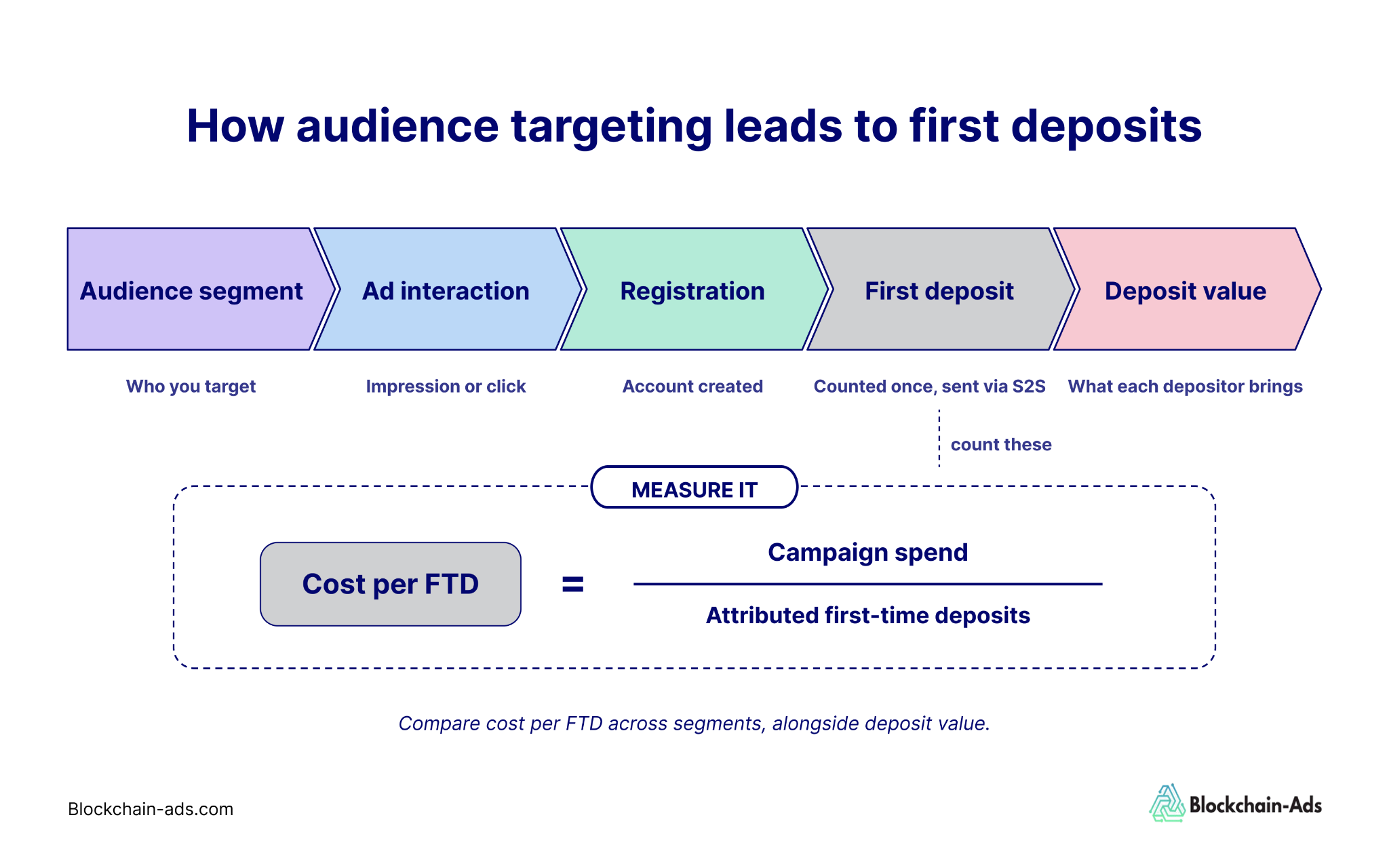
To compare audience performance, run segments side by side, send first deposits server-to-server, and keep the segments that generate first-time deposits at an acceptable cost. Clicks and registrations show interest, but first deposits show which audiences bring in paying players.
Compare Segments Under Similar Conditions
Start by testing two or three audience segments with comparable budgets, creatives, and campaign settings.
For example, a crypto casino could compare Casino Players, High-Value Casino Players, and Gambling Watchers to see which generates more first deposits.
Keep each segment in a separate campaign or ad group, where supported, to make performance comparisons easier. Allow time for the initial learning period, when campaign results may fluctuate as the platform optimizes delivery.
Measure Cost per First-Time Deposit
Set up conversion tracking to record each player's first deposit and pass the event through S2S postbacks.
Then calculate:
Cost per FTD = Total campaign spend ÷ Number of attributed first-time deposits
Compare this figure across segments alongside deposit values. A segment with a slightly higher acquisition cost may still be worth retaining if it consistently attracts more valuable depositors.
Check Whether Ads Generate Additional Deposits
Attributed deposits don't necessarily represent deposits caused by your advertising. Some players may have deposited without seeing an ad.
You can use incrementality testing to estimate the additional deposits your campaigns generate.
For example, compare a group eligible to receive your ads with a similar holdout group excluded from them. Track first deposits in both groups to estimate the lift attributable to advertising.
Use these results alongside cost per FTD before increasing budgets or removing underperforming segments.
How to Target Casino Players With Blockchain-Ads
Blockchain-Ads helps casino and sportsbook operators, agencies, and affiliates reach potential players across the open web using interest-based, behavioral, and first-party audience targeting.
You can run iGaming advertising campaigns across display, native, video, and in-app inventory, with targeting options for both crypto and fiat gambling products.
Set Up Your Audience Targeting
Here's how to configure an acquisition campaign in Blockchain-Ads:
- Choose your objective: Create a campaign in HUB and select Sales/Deposits to acquire first-time depositors. Make sure your deposit conversion event is installed and verified.
- Select a targeting mode: Keep Automated Targeting on to let the platform optimize audiences based on your landing page, creatives, and objective. Switch to Manual Targeting if you want to choose specific segments.
- Build your audience: Under Manual Targeting, select relevant Blockchain Behavior or On-site Interest segments. You can also use custom audiences created from your own data.
- Set your target countries: Choose markets where your gambling offer can legally operate and advertise.
- Review audience estimates: Check the estimated audience size and impressions before launching.
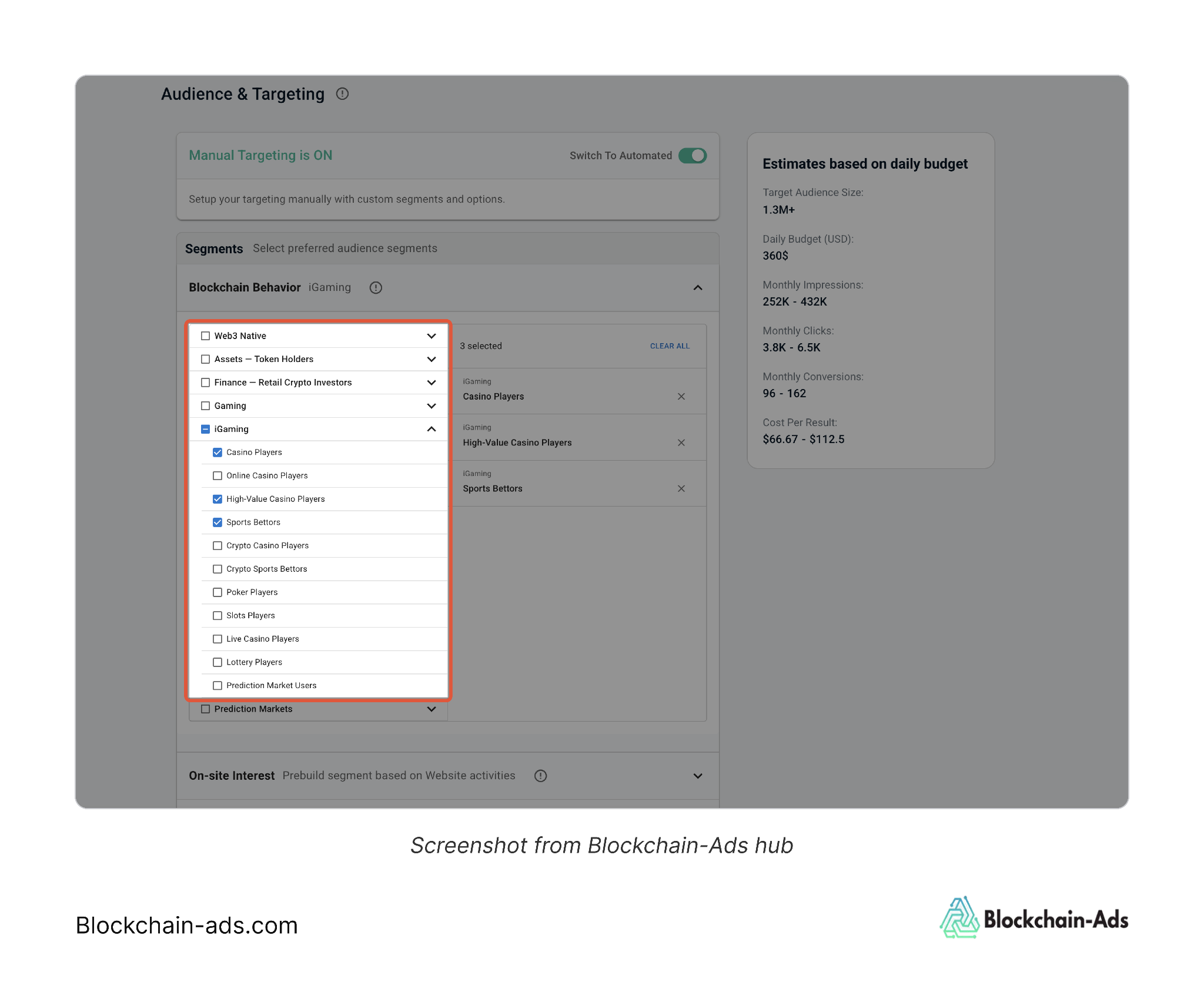
Automated targeting is a useful starting point when you have limited conversion data. As your campaigns generate results, you can test manual targeting to determine whether specific segments deliver better acquisition performance.
Before launching, verify that your conversion tracking captures first deposits and that your campaigns comply with the advertising requirements in your selected markets.
Request access to Blockchain-Ads to start building and testing casino or sportsbook audiences.
FAQs
What Is the Best Way to Target Casino Players?
The best way to target casino players is to combine relevant interest or behavioral signals with first-party customer data. Start with audiences that match your casino offer, then compare their cost per first-time deposit. For casino affiliate marketing, focus on segments that attract players likely to complete the operator's required conversion.
Can You Target Gamblers on Google and Meta?
Yes, but both platforms restrict gambling advertising. Google requires certification for eligible gambling advertisers, while Meta requires prior written permission. Advertisers must also comply with applicable licensing, geographic, and age restrictions.
Is Wallet Targeting Only for Crypto Casinos?
Wallet targeting is most useful for crypto casinos and sportsbooks because it identifies users through blockchain activity. Fiat operators can also reach crypto-active audiences, but wallet signals may be less relevant to their offers. Interest-based targeting and first-party customer data are often better starting points.
How Large Should a Casino Audience Be?
There's no universal ideal audience size. Your audience needs enough reach to deliver ads and generate meaningful conversion data without becoming too broad. Start with relevant segments, monitor estimated reach and cost per FTD, and narrow your targeting based on performance.
How Do You Keep Self-Excluded Players Out of Your Audiences?
Use your operator's self-exclusion records to suppress affected users wherever the advertising platform supports customer-list exclusions. Apply age and geographic restrictions, and enforce identity and age checks. Never use gambling-risk indicators to target vulnerable players.
Raphael is a B2B SaaS and technical SEO writer covering digital advertising, Web3, fintech, and growth strategy.
View full profile →