Brazil iGaming Market: The Operator's Guide to Acquiring Players
On September 25, 2026, a nationwide ban shut down the Brazil iGaming market, less than two years after its regulated launch made it one of the world's largest.
The reversal was abrupt. Brazil had generated approximately R$37 billion in gross gaming revenue in 2025, but Provisional Measure 1,394/2026 halted betting operations and advertising. The market's future now rests with Congress and the Supreme Federal Court (STF).
This guide explains where the Brazil iGaming market stands, where operators can acquire players while it's closed, and how to prepare if it reopens.
Is Online Gambling Legal in Brazil Now?
No. As of November 2026, Brazil still bans online betting and casino games under Provisional Measure 1,394/2026, effective September 25.
A Provisional Measure (medida provisória) is a presidential act with immediate force of law that lapses unless Congress approves it within the constitutional deadline.
The measure prohibits the operation, offering, intermediation, and advertising of fixed-odds betting (apostas de quota fixa), the legal category covering sports betting and online casino games.
The prohibition also covers:
- Offshore operators: Businesses based outside Brazil that serve people in the country.
- State-authorized operators: Betting businesses previously licensed by individual states or the Federal District.
- Advertising and sponsorships: Promotions connected to prohibited betting services.
Other lottery products separately authorized by law, including traditional lotteries, remain exempt.
What Happened After the Ban?
The measure introduced a shutdown timetable for operators previously authorized under Law 14,790/2023:
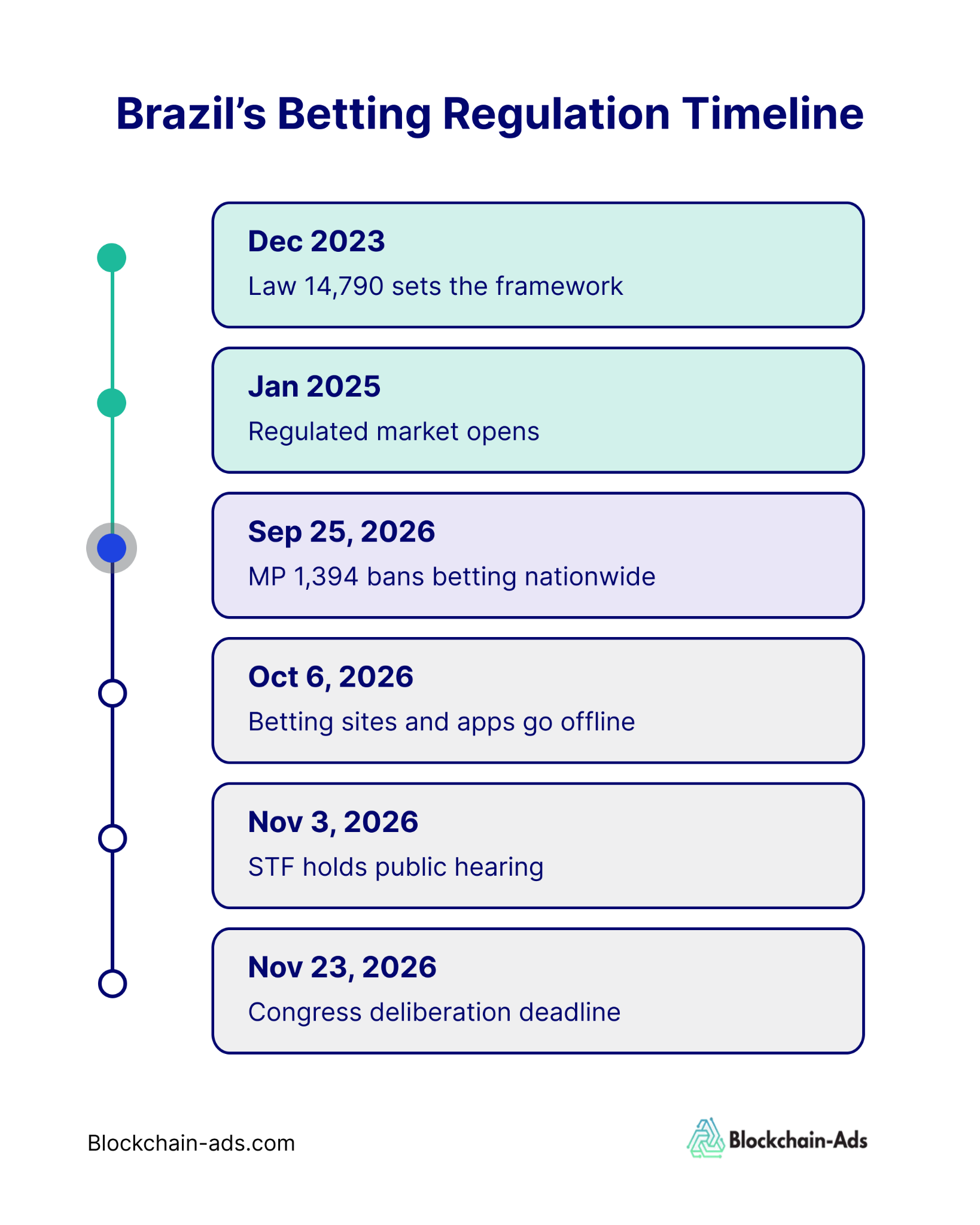
- September 25: New player deposits stopped.
- October 5: The deadline for voluntary withdrawals passed at 11:59 p.m.
- October 6: Betting websites and apps had to go offline.
- October 9–14: Financial institutions were required to return remaining balances.
- October 25: The 30 days for ending existing authorizations expired.
Players were entitled to a full refund of their available balances and of stakes on bets still unsettled at shutdown.
The ban also ended the licensing pipeline. New authorizations were prohibited, and applications still pending on September 25 could no longer proceed. Operators were not entitled to refunds of their authorization fees or government compensation.
Closing a platform didn't end its regulatory obligations. Operators remained responsible for outstanding player payments, taxes, anti-money laundering, responsible-gambling, and sports-integrity requirements. They also had to retain records for at least five years and continue reporting historical activity through SIGAP to the Secretariat of Prizes and Bets (Secretaria de Prêmios e Apostas, or SPA), the Ministry of Finance body responsible for licensing and supervising betting operators.
Source: Brazilian Ministry of Finance.
Could Brazil Reverse the Ban?
Two legal processes matter:
- Congress: Congress has an initial deliberation deadline of November 23, 2026. It can approve, amend, or reject the measure. If Congress does not finish its review, the measure can be extended once for another 60 days, and the count pauses during the congressional recess.
- Supreme Federal Court (STF): The court held a public hearing on November 3, 2026, to examine constitutional challenges and the ban's effects. The hearing did not suspend the prohibition.
Operators cannot offer or advertise fixed-odds betting to people located in Brazil while the measure remains in force. Any future acquisition plans depend on what Congress and the courts decide.
How Big Is the Brazil iGaming Market?
The Brazil iGaming market size reached approximately R$37 billion in gross gaming revenue (GGR) in 2025, equivalent to about US$6.7 billion at the exchange rate checked on November 7, 2026.
The figure covers January 1 to December 31, 2025, Brazil's first full year of regulated betting, as reported by the Secretariat of Prizes and Bets (SPA).
GGR means total wagers minus winnings paid to players, before taxes and operating costs. Here's what the regulator reported:
Sources: SPA's full-year 2025 report and SPA's H1 2025 report.
A few details matter when interpreting these numbers:
- Bettors: The 25.2 million figure counts unique people who placed at least one bet in 2025, not monthly active users or betting accounts.
- Brands: The 182-brand figure is from H1 2025, not a verified year-end count.
- Government collections: The R$9.95 billion already includes approximately R$4.5 billion in statutory GGR allocations, so the figures should not be added together.
SPA's published annual figures also don't provide a verified revenue split between sports betting and online casino games. Both contributed to the R$37 billion total.
Note: These figures show the historical scale of the Brazil online gambling market before the September 2026 ban, not revenue currently available to operators.
Where Operators Can Acquire Players While Brazil Is Closed
Operators can continue acquiring players in other regulated markets where they hold the required licenses and advertising permissions.
In Latin America, the options include:
- Colombia: Coljuegos authorizes online casino and sports betting operators. Players must be at least 18 years old and reside in Colombia.
- Peru: MINCETUR licenses online casino and sports betting, with authorized platforms and registered games.
- Argentina: Licensing is jurisdiction-specific, not national. Operators need authorization from the relevant gaming authority, including Buenos Aires City or Buenos Aires Province.
- Mexico: Online betting operates under federal permits issued by SEGOB's Dirección General de Juegos y Sorteos. Operators must confirm that their permits cover the specific online activities they intend to offer.
Outside Latin America, operators can consider:
- United Kingdom: The UK Gambling Commission requires the appropriate remote operating license to serve consumers in Great Britain, including when the operator is based overseas.
Check out the UK iGaming market guide for licensing and advertising requirements.
- Canada: Ontario requires AGCO registration and an agreement with iGaming Ontario. Alberta has its own registration and operating-agreement requirements. The Canada iGaming market guide explains both provincial markets.
Licensing alone doesn't clear every campaign. You must also follow local advertising rules, including restrictions on targeting, promotions, and responsible-gambling messaging.
💡The best markets for iGaming affiliates guide provides a broader comparison of jurisdictions worth evaluating.
Continue acquiring players in markets where you're authorized while preparing for Brazil's reopening. Campaigns targeting Brazilian players, however, must wait until the prohibition is lifted.
How Brazil Licensed Online Betting and Casino
From January 1, 2025, operators needed authorization from Brazil's Secretariat of Prizes and Bets (SPA) to legally offer or advertise fixed-odds sports betting and online casino games nationwide.
Under Law 14,790/2023, businesses had to meet financial, technical, and player-protection requirements before entering the regulated market.
Here's what the framework required before the September 2026 ban:
Sources: Law 14,790/2023, Complementary Law 224/2025, SPA payment rules, and SPA advertising rules.
Licensing also required certified betting systems, customer identity checks, and player-protection controls. Operators were responsible for compliant advertising, including promotions published by influencers and affiliates.
MP 1,394/2026 subsequently prohibited fixed-odds betting nationwide and ended the former licensing route.
How to Launch Gambling in Brazil if the Market Reopens
New fixed-odds betting authorizations remain prohibited while the ban is in force, so there is currently no legal route to launch gambling in Brazil.
If the market reopens, the former SPA process offers a starting point for preparation, subject to any new requirements:
- Establish a local entity: Register a company that meets the country's pre-ban ownership and management requirements.
- Prepare the application: Gather corporate records, ownership disclosures, financial statements, and compliance documents for submission through SPA's SIGAP system.
- Budget for authorization: Account for the historical licensing fee, capital requirements, and financial reserve.
- Arrange technical certification: Identify an SPA-recognized laboratory to test your betting system and applicable online games.
- Prepare the platform: Plan .bet.br domains, permitted payment integrations, customer identity verification, and player-protection controls.
- Review marketing compliance: Check advertising, affiliate promotions, sponsorships, and responsible-gambling requirements before launching campaigns.
Sources: SPA authorization guidance, Ministry of Finance's betting regulations.
These are historical preparation steps, not a current licensing route. Operators must verify the applicable framework before entering any reopened market.
What Player Acquisition Could Cost in Brazil
Blockchain-Ads' global iGaming benchmarks put the average cost per first-time depositor (FTD) at approximately $78. Operators considering Brazil's potential reopening can use these figures to estimate initial budgets and set acquisition targets.
Here's how the benchmarks break down:
Note: These are global averages, not historical Brazil results or guaranteed costs.
If Brazil reopens, start with a controlled budget, track registrations and first deposits, and compare your actual customer acquisition cost against revenue per player before scaling.
How to Prepare to Acquire Players if Brazil Reopens
Keep your licensing setup, conversion tracking, and ad creative ready, but launch campaigns targeting Brazil only when betting and its advertising are legally permitted again.
The global acquisition benchmarks above can help you plan an initial budget. You'll also need to prepare the systems that measure what your campaigns deliver.
Track Registrations and First Deposits Server-to-Server
Registrations show who's signing up. First-time deposits (FTDs) show who's becoming a paying player. Tracking both separately helps you measure acquisition quality.
Blockchain-Ads supports server-to-server (S2S) tracking, using a unique click ID to connect ad clicks with conversion events.
The conversion tracking setup guide covers event creation, while the S2S installation instructions explain postback configuration and testing.
Plan Creative for Stricter Rules
Brazil had strict betting advertising requirements before the September 2026 ban.
Under SPA/MF Ordinance 1,231/2024 and subsequent amendments, advertising faced restrictions on misleading claims and content appealing to minors.
The rules tightened in July 2026. From July 17, SPA/MF Ordinance 1,964/2026 required every betting ad to carry a Ministry of Finance risk warning, such as "Betting is not an investment," covering at least 10% of the ad's area.
That gives you a practical starting point for creative preparation:
- Warnings: Reserve at least 10% of the ad area for the required risk warning.
- Minors: Avoid imagery, characters, or messaging appealing to minors.
- Claims: Remove messaging presenting gambling as an investment or reliable income source.
If Brazil reopens, check the latest advertising rules before using these requirements.
Source: Brazilian Ministry of Finance, July 2026 advertising requirements.
Start Small and Measure the Players Your Ads Add
Once Brazil permits advertising again, begin with a controlled test budget and give campaign delivery time to stabilize.
Monitor registrations, but judge acquisition performance using first deposits and cost per FTD. Low registration costs mean little if those players never deposit.
Once conversion volume is sufficient, consider a holdout test to measure incremental FTDs. Compare a group eligible to receive your ads with a comparable group excluded from them, using backend conversion records for both.
This helps distinguish depositors generated by advertising from those who might have deposited anyway.
💡Read the incrementality testing walkthrough for the measurement approach.
Acquiring Players With Blockchain-Ads
Blockchain-Ads suits licensed casino and sportsbook operators, plus their agencies and affiliates, buying paid traffic at scale in permitted markets.
The platform runs iGaming campaigns only in authorized jurisdictions. Brazil-targeted campaigns cannot run while the ban remains in force. Here's what you can do in eligible markets:
- Target by country: Include or exclude countries using GEO targeting.
- Choose your channels: Run display, native, video, in-app, and connected TV (CTV) ads.
- Track conversions: Use server-to-server (S2S) tracking to capture registrations, first-time deposits (FTDs), and deposit values.
- Optimize acquisition: Optimize campaigns toward registrations or FTDs, not clicks alone.
- Choose your setup: Self-service requires a $10,000 minimum deposit, while managed service starts at $30,000 monthly, subject to account approval.
Cheaper registrations don't necessarily mean cheaper depositing players. Compare cost per FTD and deposit value by country before increasing spend.
Talk to the Blockchain-Ads team about your campaign goals and targeting options.
FAQs
Is online betting banned in Brazil?
Yes. Since September 25, 2026, Provisional Measure 1,394/2026 has prohibited fixed-odds sports betting, online casino games, and related advertising nationwide. The ban also covers offshore operators serving people located in Brazil. Traditional lotteries remain exempt.
How big was the Brazil online gambling market?
The Brazil online gambling market generated approximately R$37 billion in gross gaming revenue in 2025. According to the Secretariat of Prizes and Bets (SPA), 25.2 million people bet through 79 authorized companies. The equivalent was approximately US$6.7 billion at the exchange rate checked on November 7, 2026.
Will Brazil's betting ban be overturned?
The outcome remains undecided. Congress has an initial deliberation deadline of November 23, 2026, with a possible 60-day extension. The Supreme Federal Court (STF) held a public hearing on November 3, 2026, but had not suspended the ban.
What happened to licensed operators after the ban?
Operators stopped accepting deposits on September 25, 2026, and took their platforms offline from October 6. Their authorizations ended after 30 days, without reimbursement of authorization fees under MP 1,394/2026. They remained responsible for player refunds and outstanding regulatory obligations.
How much could a first-time depositor cost in Brazil?
Blockchain-Ads' global iGaming benchmarks put the average cost per first-time depositor (FTD) at approximately $78. Operators planning for Brazil's potential reopening can use this as an initial budgeting reference, although it does not represent historical acquisition costs in Brazil. Actual costs will depend on campaign performance and market conditions.
Srijan Sharma is a B2B writer specialising in SaaS, FinTech, MarTech, and data integration.
View full profile →