How to Advertise in Canada’s iGaming Market, Province by Province
Key takeaways
- Ontario’s market is growing fast: Players wagered $98.3 billion on licensed sites in 2025, up 26 percent on 2024, four years after it launched on April 4, 2022.
- Alberta opened on July 13, 2026: It launched with 22 registered sites.
- Every other province is government-run: Their lottery corporations are the only legal online operators.
- Age limits differ by province: It’s 19 in Ontario and 18 in Alberta, Manitoba, and Quebec.
- Blockchain-Ads helps licensed operators and affiliates reach Canadian players: You can run display, native, video, in-app, and CTV ads to casino and sports-bettor audiences.
The Canada iGaming market is open to private casinos and sportsbooks in only two provinces, Ontario and Alberta. Every other province runs online gambling through its own lottery corporation, so private operators have nowhere else to advertise legally.
That makes iGaming in Canada a province-by-province business. The license, the ad rules, and even the legal gambling age change at each provincial border, so every campaign has to be planned, bought, and measured one province at a time.
This guide covers:
- Where private operators can advertise in Canada
- What your ads can say in each province
- Where to buy traffic in Canada
- Tactics that work in Canada
The Canadian iGaming Market at a Glance
The Canadian iGaming industry is run by the provinces, and each one decides whether private operators can offer online gambling or whether its lottery corporation runs it alone.
Put simply, the online gambling market in Canada is two open provinces surrounded by government-run sites. The table shows who runs online gambling in each province and territory and the legal gambling age you target there.
Can Casino Operators Advertise in Canada?
Yes, but an online gambling license in Canada comes from a province, not the federal government, so operators can advertise only where a province registers them: Ontario and Alberta. Each province sets its own rules, so a license in one gives you no rights in the other.
Licensing stays with the operator, and no traffic source changes that.
Ontario
The Ontario iGaming market is open to private operators that register with the Alcohol and Gaming Commission of Ontario (AGCO) and sign an operating agreement with iGaming Ontario.
On April 4, 2022, Ontario opened its regulated market to private operators after the province found that most of Ontarians’ online gambling was happening on sites the province didn’t run.
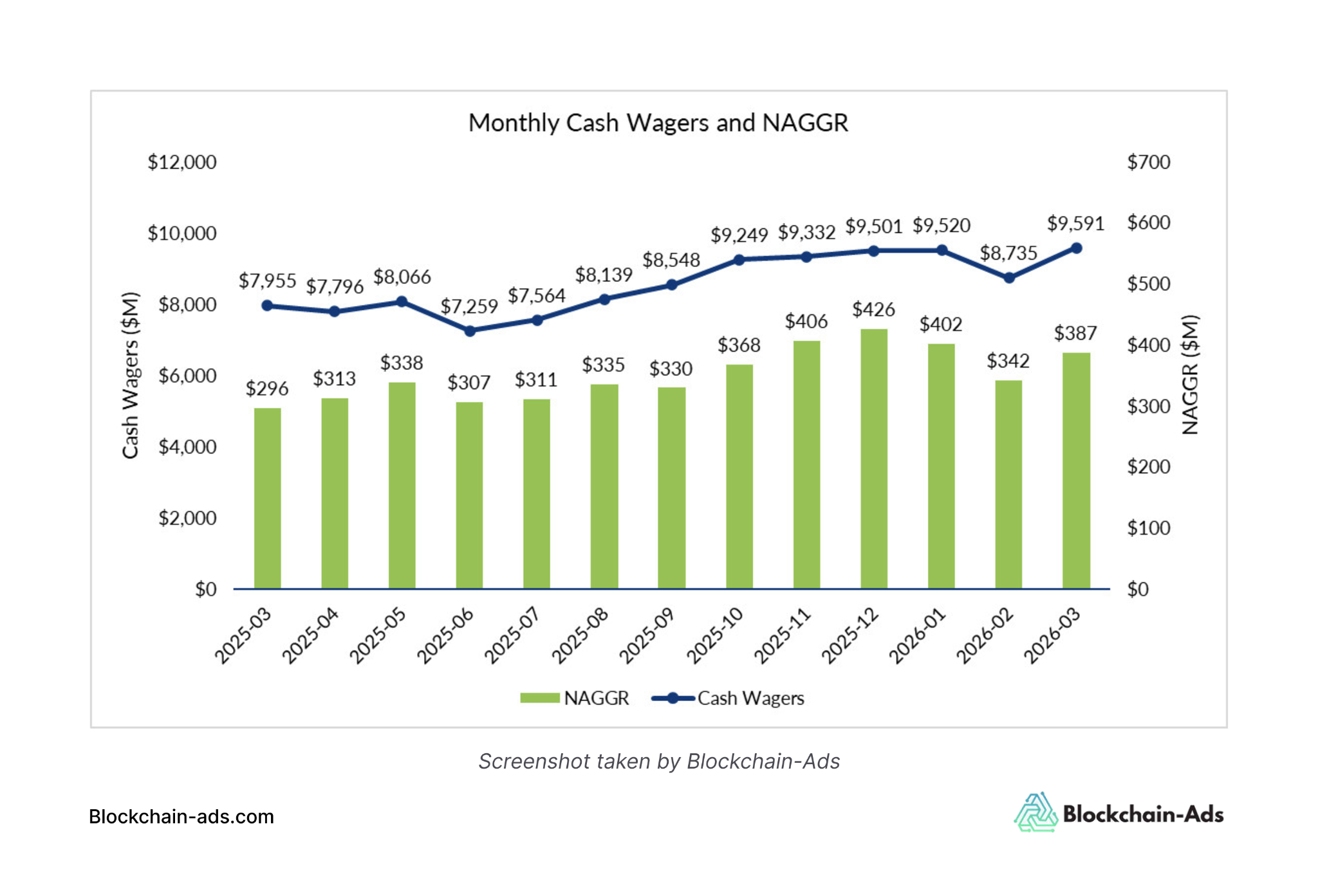
The move worked. Ontarians wagered about $98.3 billion on licensed sites in 2025, up 26 percent from 2024, and the market brought in $4.0 billion in gaming revenue, up 34 percent.
iGaming Ontario lists 49 regulated operators running 84 gaming sites. Those iGaming Ontario operators are the only private brands that can advertise to players in the province, who must be 19 or older and physically in Ontario to play.
The Ontario iGaming regulations that shape your ads sit in the AGCO’s Registrar’s Standards for Internet Gaming. The two that matter most are a ban on public bonus ads and a ban on athletes, both covered in the rules section below.
The AGCO enforces these standards. In May 2022, a month after launch, it issued monetary penalties to two operators for alleged advertising and inducement infractions.
Alberta
The Alberta iGaming market follows Ontario’s model, and the regulated market went live at midnight on July 13, 2026, with 22 platforms ready to take bets on day one.
Operators must register with Alberta Gaming, Liquor and Cannabis (AGLC) and then sign an agreement with the Alberta iGaming Corporation (AiGC).
AGLC regulates the market, and AiGC manages the commercial side, including operator agreements and complaints. Registration alone doesn’t let you take bets, so you need both steps before you can run real-money campaigns.
Alberta estimates only about 30 percent of its residents’ online gambling went through the government site, Play Alberta, and it expects roughly $76 million in revenue from the market’s first year.
The transition period for operators ended on October 13, 2026. Operators that aren’t authorized by then must stop offering online wagering in the province until they go live.
Affiliates should note one rule in particular. Operators must make sure the marketing partners who promote them don’t offer similar services to unlicensed operators in Alberta, so one unregistered brand in an affiliate’s portfolio can cost it regulated partners.
The Rest of Canada
Everywhere outside Ontario and Alberta, online gambling is run by the provincial lottery corporation, and private operators can’t offer it. That covers British Columbia, Saskatchewan, Manitoba, Quebec, and the four Atlantic provinces.
BCLC’s PlayNow platform serves British Columbia, Saskatchewan, and Manitoba. Quebec, the largest of these provinces, has Loto-Québec as its only legal online operator, and Atlantic Lottery covers New Brunswick, Nova Scotia, Prince Edward Island, and Newfoundland and Labrador.
For private operators, these provinces are off limits for real-money campaigns. Exclude them in every campaign so your budget stays in the markets where you’re licensed.
Read more: See our guide to iGaming regulations.
Where to Run Gambling Ads in Canada
To buy gambling ad traffic in Canada, use a platform that accepts licensed operators and their affiliates, lets you target casino or sports-bettor audiences, and reports deposits back to your campaigns.
Blockchain-Ads is built for this. It serves online casinos, sportsbooks, and crypto casinos, plus the agencies and affiliates that work with them, and approves every account before launch.
You can run display, native, video, in-app, and CTV ads with self-service from a $10,000 minimum deposit or managed service from $30,000 in minimum monthly ad spend.
Its prebuilt segments cover casino players and sports bettors, and you can combine them with your own first-party data. Server-to-server conversions can carry the deposit value, so campaigns optimize toward registrations and first-time deposits.
In The State of Advertising in Crypto, iGaming, and Finance 2026, ad sets across crypto, iGaming, and finance that combined platform segments with first-party data captured first deposits 17% more often than platform segments alone (62% against 53%).
See more on how it works on our iGaming advertising page.
7 Tactics That Work for iGaming Advertising in Canada
iGaming advertising in Canada works when it respects licensing and local habits. Run ads only where you’re licensed, speak to players in their language and currency, and measure every step to the first deposit.
Run Campaigns Only Where You’re Licensed
Split your campaigns by province, with a separate budget, creative set, and landing page for each market you’re licensed in. Ontario and Alberta have different ages, regulators, and rules, so one national campaign can break the rules in either one.
Platforms enforce this too. Google requires Canadian sports betting and casino advertisers to be licensed by the province and target only that province, and iGaming Ontario only lets players physically in Ontario play.
Set location targeting in your own campaign setup to the province your license covers, and exclude the rest of Canada. Name campaigns by province so reporting stays clean, then check delivery reports in week one to confirm no spend leaked into other provinces.
Price in Canadian Dollars and write in English and French
Show every offer, deposit limit, and balance in Canadian dollars in the ad and on the page. Alberta’s standards go further and require the player’s net balance in Canadian dollars to stay visible during play, according to Gaming News Canada.
Quebec’s online market belongs to Loto-Québec, so don’t target it, but French-speaking players still live in Ontario and Alberta. Run French creatives where they fit, and send them to a French landing page so the ad and the page match.
Lead With Interac Deposits and Withdrawals
Interac is Canada’s domestic payment network, and many players look for an Interac casino by name. If you support Interac e-Transfer, say so in your ad copy, on your landing pages, and at checkout.
Cover withdrawals as well as deposits, because players want to know how they get their money out before they sign up. Only state payout times you can meet, since both provinces ban misleading claims.
Build for Mobile First
Design every ad and landing page for a phone screen first, since live bets happen on phones during the game. Keep forms short, load pages fast, and make the deposit button easy to reach with one thumb.
Test the full path on a phone before launch: ad, landing page, sign-up and first deposit. Use vertical video for in-app placements, and keep key text away from the bottom of the frame where buttons sit.
Find Creative Ways to Promote Your Offers
Ontario and Alberta both ban bonus ads in public media, but you can still show offers on your own site and in direct marketing to players who opted in. So use public ads to drive sign-ups, then present the offer once players are on your site.
Promote what makes your product different instead, such as game range, payout speed, live betting, or Interac support. Responsible gambling messages fit naturally into this kind of creative, and both provinces require them. Test several angles at once: across crypto, iGaming, and finance, advertisers who ran five or more ad sets in month one captured a first deposit that month 87% more often than those who ran one (56% against 30%).
Build Around Hockey and Canada’s Sports Calendar
Hockey sits at the center of Canada’s sports calendar, and the NHL has seven Canadian teams. In Leger’s fall 2025 survey, 41% of Canadian sports bettors had bet on the NHL in the past year, ahead of the NFL at 26% and the NBA at 21%.
Plan budgets around the regular season from October to April, then the playoffs and the Stanley Cup Final in spring.
Canadians also bet on the CFL, whose season ends with the Grey Cup in November; the NBA’s Toronto Raptors; the MLB's Toronto Blue Jays; and the Canadian MLS clubs. Use teams, fixtures, and odds in your creative; shift your budget toward game nights and leave athletes out, since both provinces ban them in ads.
Track the Path From Sign-Up to First Deposit
Send a server-to-server conversion for each step, from registration to first deposit, and optimize to the event your team actually reports on. If your target is depositing players, optimizing for sign-ups will fill your funnel with players who never fund an account.
Pass the deposit value with each first-deposit event, so you can compare provinces on real revenue. Set this up before launch: across crypto, iGaming, and finance, advertisers who set up tracking before launch reached a first deposit or trade 92% more often (46% against 24%).
Canada’s Gambling Advertising Rules
Gambling advertising in Canada is regulated province by province. Ontario and Alberta both ban public bonus ads and athletes in ads, and require responsible gambling messaging. Here’s how they compare:
Both provinces also ban content likely to appeal to minors, including celebrities, influencers and cartoons. Every other province has no private market, so these rules apply only to Ontario and Alberta.
Alberta’s regulator can also order you to amend or remove any ad or promotion in the interest of integrity and social responsibility. Build your approval process so a pulled ad doesn’t stall the whole campaign.
Federally, Bill S-211 would require the Minister of Canadian Heritage to create a national framework for sports betting ads. It passed the Senate on October 21, 2025, and reached second reading in the House of Commons on February 12, 2026. On April 22, 2026, the House voted to send it to the Standing Committee on Canadian Heritage, where it remained in October 2026.
Google Ads
Google allows sports betting and online casino ads in Canada only from operators licensed by the relevant province, and those ads can target only that province. You also need Google’s gambling certification and a landing page with responsible gambling information.
In May 2026, Google began allowing Alberta brand awareness ads ahead of launch for operators with proof of their AGLC application.
Learn more: Our guide to gambling ads on Google.
Meta
Meta requires written permission before you run online gambling ads on Facebook or Instagram, and you must show you’re licensed in each region you target. Ads can’t target anyone under 18, and affiliates need their own approval.
Meta’s 18 minimum is lower than Ontario’s, so set your Ontario audiences to 19 and older yourself. For the full process, see our guide to advertising online gambling on Facebook.
What’s Changed in Canada’s iGaming Rules
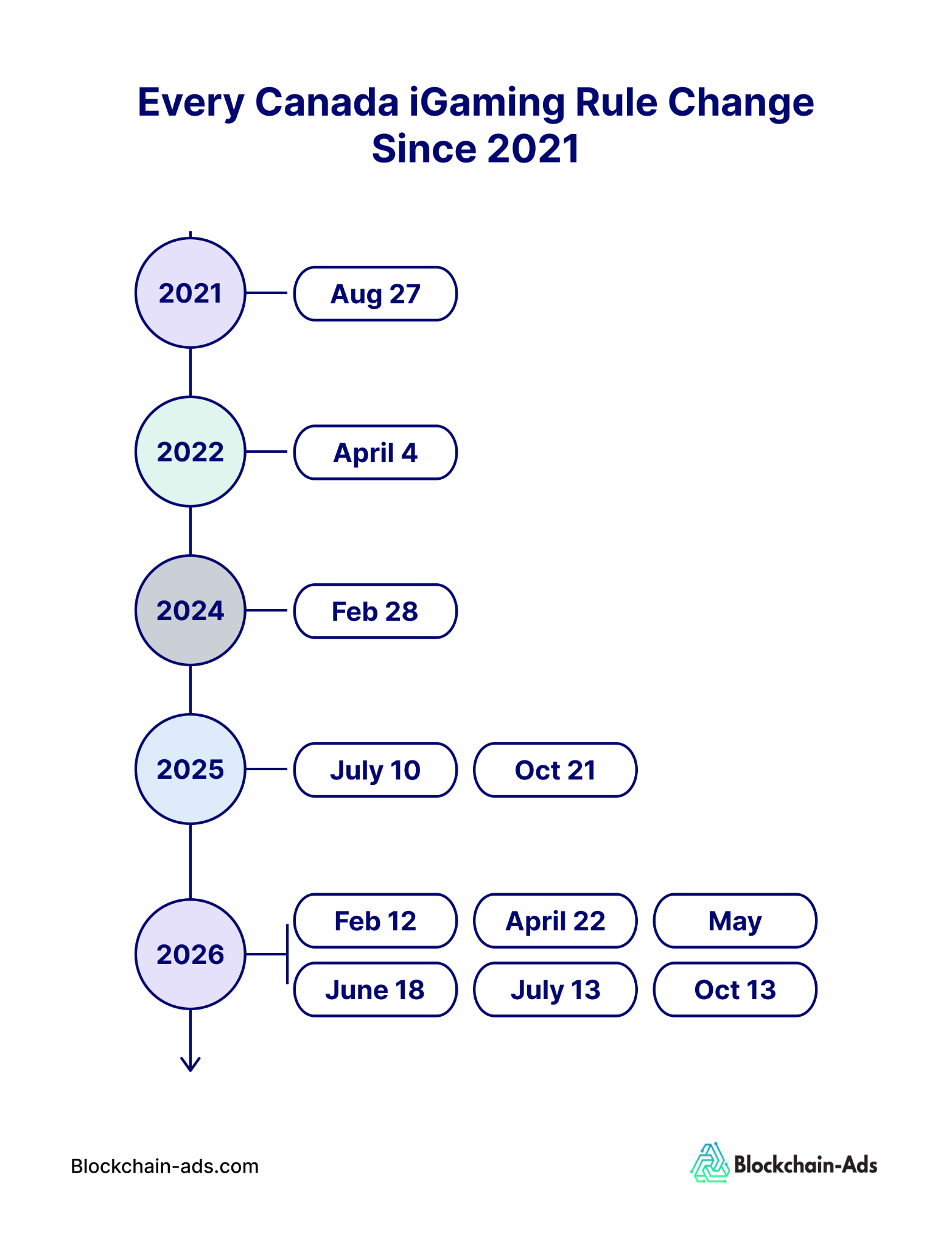
Canada’s iGaming rules have changed fast since single-event sports betting became legal in 2021, with Alberta’s market the biggest recent shift. Here’s each change, newest first.
- October 13, 2026: Alberta’s transition period ends, and unauthorized operators must stop offering online wagering in the province (Covers).
- July 13, 2026: Alberta’s regulated market launches with 22 registered sites (AiGC).
- June 18, 2026: AGLC adds advertising rules to its iGaming standards, including the public bonus ad ban (Canadian Gaming Business).
- May 2026: Google allows Alberta brand awareness ads for operators that have applied to AGLC (Yogonet).
- April 22, 2026: The House of Commons votes Bill S-211 through second reading and sends it to the Standing Committee on Canadian Heritage (LEGISinfo).
- February 12, 2026: Bill S-211 reaches second reading debate in the House of Commons (LEGISinfo).
- October 21, 2025: The Senate passes Bill S-211, the proposed national framework for sports betting ads (LEGISinfo).
- July 10, 2025: Meta requires written permission for all online gambling ads (Canadian Gaming Business).
- February 28, 2024: Ontario bans athletes in iGaming ads (AGCO).
- April 4, 2022: Ontario’s regulated iGaming market launches (AGCO).
- August 27, 2021: Single-event sports betting becomes legal in Canada (Canada Gazette).
What Is the Future of the Canadian iGaming Market?
Advertising is the next battleground. Within weeks of Alberta’s launch, gambling ads were everywhere in the province, and experts warned they could push more young people toward problem gambling. Before launch, Carrie Shaw, chair of the Alberta Gambling Research Institute, told CTV News that Alberta would be “flooded with advertising, just as Ontario was.”
With Bill S-211 still before Parliament, that pressure is likely to grow. So plan for tighter rules: run only where you’re licensed, keep bonuses out of public ads and track every step to the first deposit. Apply to see how Blockchain-Ads helps licensed operators and affiliates reach Canadian casino players and sports bettors.
FAQs
Is online gambling legal in Canada?
Yes, online gambling is legal in Canada, but each province decides who offers it. Ontario and Alberta license private operators, while the other provinces offer it only through their lottery corporations.
What is the legal gambling age in Canada?
There’s no single legal gambling age Canada uses. It’s 18 in Alberta, Manitoba, and Quebec, and 19 everywhere else, including Ontario. Set your ad targeting to each province’s age instead of the platform default.
Can offshore casinos advertise in Ontario?
No, only operators registered with the AGCO and contracted with iGaming Ontario can advertise there. In May 2025, the AGCO asked media platforms to stop advertising unregulated sites, so publishers and affiliates that carry those ads take on real risk.
Can you advertise casino bonuses in Ontario?
Not in public ads. You can show bonuses on your own site and in direct marketing to players who opted in.
Do you need a license to advertise in Alberta?
Operators need AGLC registration and an AiGC agreement before they can take bets. Affiliates work under the operator, which must make sure its partners don’t promote unregistered sites.
Is Canada banning sports betting ads?
Not yet, and Bill S-211 wouldn’t ban them outright. It would create a national framework for sports betting ads, and while it sits in committee, Ontario’s and Alberta’s rules are the ones you follow.
Freelance content writer/editor for B2B SaaS, AI, technology, partnerships brands.
View full profile →