Google Ads Gambling Policy: What it Means for You (2026)
Google's gambling ad policy changed 18 times in 2025, more than any other year. If you rely on Google Ads for casino, sports betting, or social casino campaigns, those updates now decide whether your ads keep serving or get shut down overnight. The Blockchain-Ads team researched all 18 policy changes Google implemented between April and December 2025 to bring you this comprehensive 2026 guide.
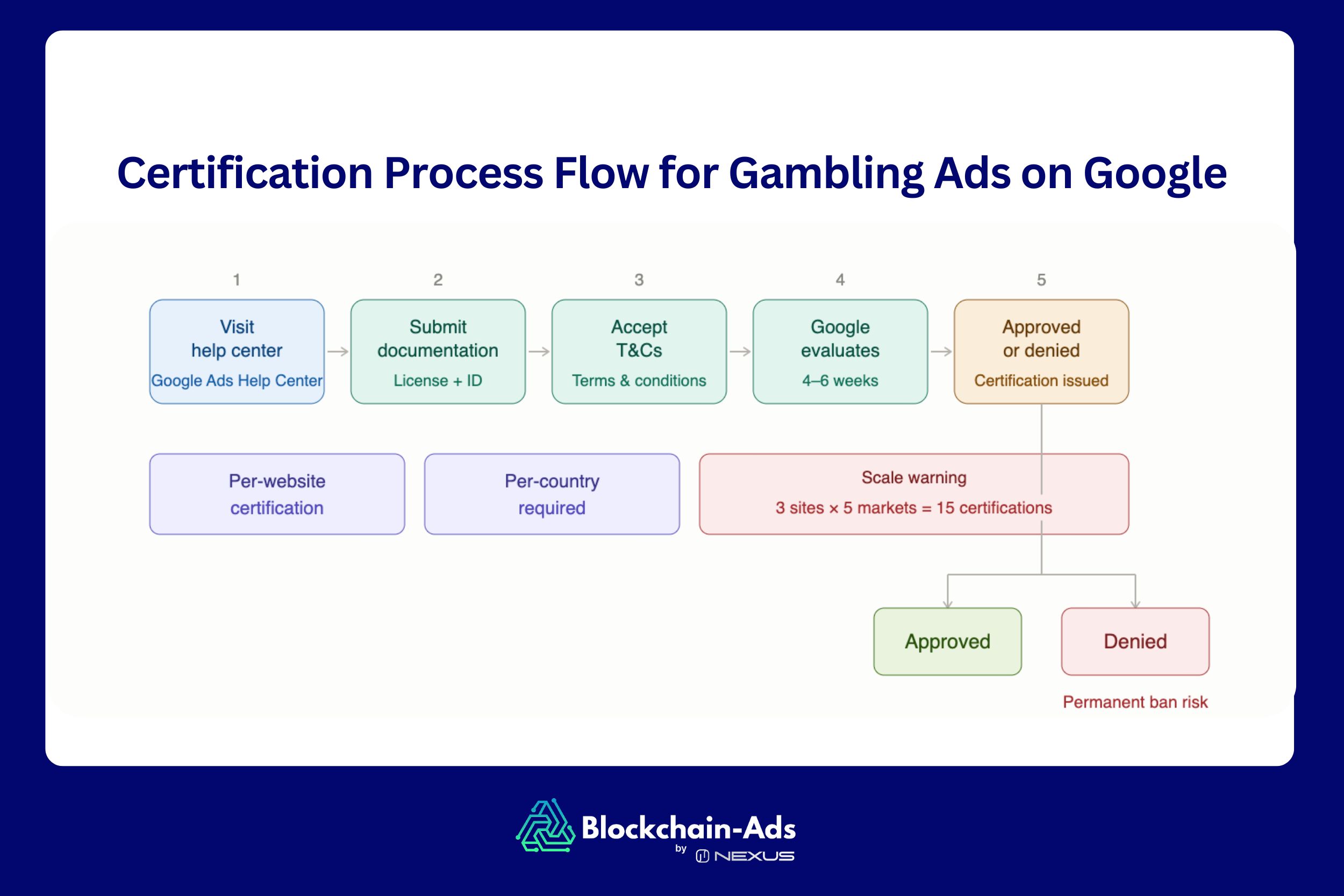
The headline changes are hard to ignore. Sweepstakes casinos are no longer treated as social casino games, so many existing certifications have already been revoked or must be reapplied for under stricter rules. Offline gambling ad restrictions extended coverage to 35 countries. The certification is locked to individual websites and countries, which means an operator with 3 sites in 5 markets now needs 15 separate approvals instead of one.
Fortunately, operators use many alternatives to create gambling ads that sidestep Google's expanding restrictions. These include social media platforms and specialized ad networks like Blockchain-Ads. Blockchain-Ads offers all the unique targeting features of Google Ads without the restrictions. You get access to 195+ countries, including the US, the UK, and Germany, with no certification hoops to jump through.
There's also the option of targeting based on the following:
- Device/OS
- Browser
- Wallet activity and on-chain behavior
The most advanced feature which makes it a better alternative to Google Ads is its crypto targeting capabilities, allowing casino operators to reach players who prefer privacy-focused gambling options. That said, let's get started with Google's gambling ad policies and what changed in 2026.
What Are Google's Gambling Ad Policies?
Google Gambling Ad policies are rules Google put in place to control the promotion of online gambling content. They prevent iGaming advertisers from running harmful, false, and illegal ads. An important Google gambling ad policy is responsible targeting, which prevents gambling ads from getting to minors and vulnerable individuals.
Another policy is that gambling ads can only be used in countries where gambling is legal. Next, advertisers must get a Google ads certification, which proves they have fulfilled the legal requirements in the area they want to target. Furthermore, ads should always feature responsible gambling messages where necessary.
Google also restricts the type of gambling content advertisers can promote. While it supports online casinos, sports betting, and others, illegal gambling, like unlicensed betting sites and lottery scams, is prohibited.
2025-2026 Update: Google's definition of gambling now explicitly includes games using virtual currencies or items with real-world value. This means crypto casinos, skin gambling sites, and NFT-based gaming platforms now fall under full gambling advertising restrictions.
Major 2025 Change: Sweepstakes Casinos Reclassified as Gambling
The October 28, 2025 policy update represented the most impactful single change for North American operators. Google explicitly excluded sweepstakes casinos from the social casino games category.
This reclassification meant dual-currency systems, platforms offering Gold Coins for play and Sweeps Coins redeemable for prizes, triggering Real Money Gambling classification. Sweepstakes operators must obtain full online gambling certification, which requires state-specific gambling licenses that most sweepstakes platforms lack.
The change effectively ended the "social casino loophole" that previously allowed sweepstakes platforms to advertise without traditional gambling licenses. Most social casino certifications for sweepstakes apps were retroactively revoked, forcing operators to either obtain proper gambling licenses or cease Google advertising entirely.
Bottom line: If you operate a sweepstakes casino, Google Ads is likely no longer an option for you unless you hold state gambling licenses.
Allowed Countries and Gambling Types
Google allows gambling ads in approximately 55 countries with limitations as per local regulations. The table below covers some of these countries, along with the gambling activities supported:
| Country | Permitted Gambling Type |
|---|---|
| Argentina (State-specific) | Lotteries, Online gambling, Online casino games, Sports betting. NEW: Entre Rios, Mendoza, Santa Fe provinces added (Dec 2025) |
| Australia | Sports betting, Lotteries. New: Reopening accepting certification applications (Apr 2026) |
| Austria | Online gambling, Online bingo, Sports betting, Online casino games |
| Belgium | Lotteries, Online casino games, Online bingo, Online gambling, Sports betting |
| Brazil | Lotteries, Horse racing, Online casino games. NEW: Requires Ministry of Finance license and .bet.br domain (June 2025) |
| Cameroon | NEW (Aug 2025): Lotteries, Sports betting. Requires ARJ registration |
| Canada (State-specific) | Lotteries, Daily Fantasy Sports, Sports betting, Online casinos. NEW: Allowing gambling advertisements in the province of Alberta if authorized by AGLC license (April 2026) |
| France | Online gambling, Online bingo, Sports betting, Lotteries |
| Germany | Sports betting, Horse betting, Lotteries, Virtual slot-machine games, Online casinos, Online poker |
| Mexico | Online casino games, Bingo, Lotteries, Sports betting |
| Namibia | NEW (Aug 2025): Lotteries, Sports betting. Requires dual licenses from Gambling Board and Lotteries Board |
| Nigeria (State-specific) | Lotteries, Sports betting, Online casino games. EXPANDED: Lagos, Cross River, Ekiti, Oyo added (Oct 2025) |
| Puerto Rico | NEW (Dec 2025): Lottery courier advertising permitted |
| UAE (State-specific) | NEW (Feb 2026): Internet gaming and sports wagering services. Requires GCGRA authorization. First gambling ads permitted in UAE. |
| Ukraine | NEW (July 2025): Poker, Casino, Sports betting, Lotteries. Requires state licenses |
| United Kingdom | Online bingo, Sports betting, Online casino games, Lotteries |
| United States (State-specific) | Daily Fantasy Sports, Horse racing, Sports betting, Online casinos, Lotteries. NEW: Missouri sports betting added (Aug 2025). BANNED: Horse racing aggregators (Dec 2025) |
Federal and state laws also determine which gambling ads get approval, and only those that meet the set legal requirements make it through.
Offline Gambling Restrictions Expanded to 35 Countries
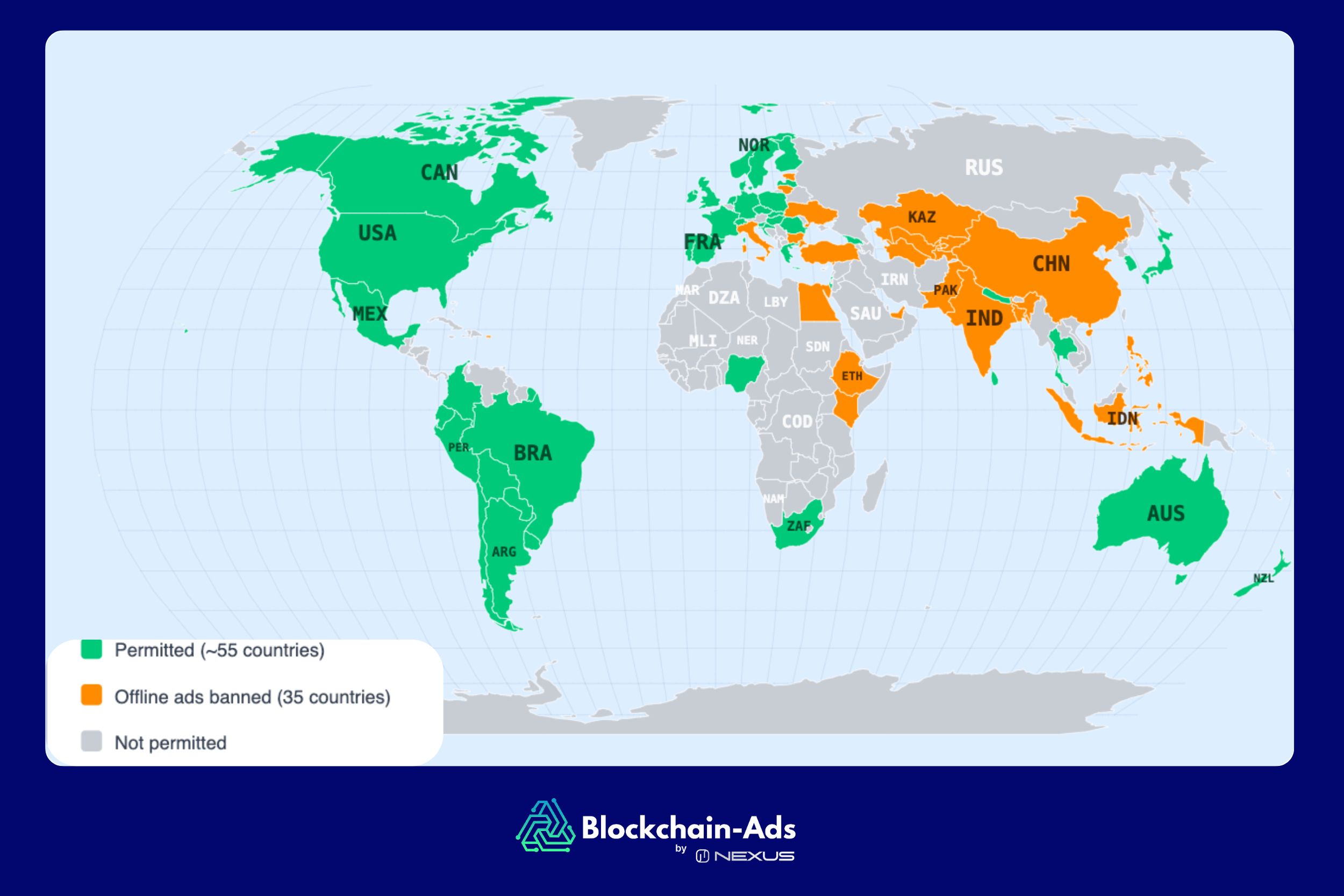
The November 19, 2025 update expanded offline gambling advertising prohibitions from 21 to 35 countries. Google has implemented additional country-specific restrictions that gambling advertisers must be aware of:
- Offline gambling advertising is now prohibited in 35 countries including China, India, Indonesia, Egypt, UAE, and the eight newly added countries: Bulgaria, Estonia, Italy, Lithuania, Northern Ireland, Philippines, Turkey, and Ukraine
- Real-money Mahjong gambling promotion in the Asia-Pacific region is prohibited
- Mexico now requires gambling advertisements to include explicit warnings about gambling harms
- Texas and New Mexico banned lottery courier advertising (March 2025)
- US Horse racing aggregator/affiliate ads banned effective December 1, 2025
Key Policy Requirements (Updated for 2026)
Advertisers who want to run gambling ads on Google must meet these essential policy requirements:
- Website-Specific Certification: As of April 2025, certification is limited to the specific website included in your application. Each website requires individual certification.
- Country-by-Country Applications: Operators targeting multiple markets must submit separate certifications for each country.
- Targeting Restrictions: Ads must not include minors and vulnerable individuals.
- Permitted Countries: Ads can only target countries where gambling is legal.
- License Reporting: Operators must proactively report if their gambling license is revoked, suspended, or terminated: failure triggers immediate ad suspension.
- Responsible Advertising: Ads must have information relating to responsible gambling prominently featured.
Enforcement is now stricter: Falsified certifications result in permanent platform bans. Related accounts may also face permanent suspension, and new accounts automatically suspend if linked to previous violations.
Ad Format Restrictions
Not all Google ad formats are available for gambling content. The Blockchain-Ads team verified the following restrictions are in effect for 2026:
- Gmail ads: Gambling promotion prohibited
- Shopping ads: Gambling promotion prohibited
- Reservation display ads: Gambling promotion prohibited
- Google TV Masthead: Limited to USA, UK, and Brazil for sports betting only
- Demand Gen/Discovery ads: Available in 18 approved countries through the Global Certified Publisher Partner Portal
How Do You Get Certified for Gambling Ads on Google?
The Google Ads Gambling Certification is proof that you've been approved to advertise gambling-related services on Google. This certification also shows that you comply with local gambling laws when running ads.
As of 2025, Google has made the certification process more rigorous. Certification is now limited to the specific website included in your application, and you must obtain separate certifications for each country you wish to target.
Google offers three types of certifications:
- Privately licensed operators
- State-run entities
- Social casino games
Application Process for Private Operators
Private operators are individuals or companies with a gambling license from the appropriate regulatory body like the Malta Gaming Authority or the UK Gambling Commission.
To apply for certification as a private operator:
- Visit the Google Ads Help Center and fill out the application form
- Provide your information including documentation like your gambling license and ID
- Accept the T&Cs and submit for review
- Wait for Google's evaluation (typically 4-6 weeks)
Warning: Under the 2025 policy updates, falsifying certifications or submitting inaccurate documentation results in permanent bans from the platform. Google now conducts more thorough verification of licensing documentation against official databases.
Social Casino Game Certification (Updated Rules)
Social casinos are play-for-fun platforms that let players enjoy casino-style games using virtual currencies instead of real money. The rules for social casino advertising changed significantly in 2025.
Good news for social casino operators: Google removed social casino apps from the "Gambling" sensitive interest category for personalization purposes. This means you can now use:
- Custom audiences and lookalike targeting
- Interest-based targeting and demographic segmentation
- Machine learning optimization and user behavior analysis
However, compliance requirements are strict: Games must include age disclaimers, cannot target minors, must state no real-money gambling is offered, must disclose in-app purchases, and cannot use branding associated with real-money gambling operators.
Critical: Affiliates and aggregators are now explicitly prohibited from promoting social casino games.
Zero-tolerance enforcement: Google states that social casino policy violations result in immediate account suspension without prior warning, and you will not be allowed to advertise with them again.
YouTube Gambling Content Restrictions
YouTube implemented two major policy updates affecting gambling content in 2025 that every advertiser and affiliate needs to understand.
March 19, 2025 Update
YouTube now prohibits creators from directing viewers to non-Google-certified gambling sites through:
- URLs in descriptions or comments
- Embedded links or cards
- Logo displays
- Text references or verbal mentions
- Promo codes for unapproved sites
Content promising "guaranteed returns", even from approved sites, faces removal. All online gambling content is now age-restricted to 18+ viewers, with signed-out users and users under 18 blocked entirely.
November 17, 2025, Update
The November update extended enforcement to cover gambling with digital goods, including
- Video game skins
- NFTs
- Virtual currencies with real-world value
Social casino content now faces the same age restrictions as real-money gambling. Live streams featuring illegal gambling content risk removal with channel penalties for influencers.
What's Happening in 2026?
Google has announced policy changes that will affect gambling advertisers in 2026:
January 28, 2026: Google Play Age-Restricted Content Policy
Apps with real-money gambling features must use Play Console features to block minors. Requirements include:
- Mandatory age-screen prompts
- Parental-gate overlays
- Geofenced access restrictions
Non-compliant apps face removal or suspension. The policy was initially announced October 30, 2025, with a 30-day compliance window.
State-Level Age Verification Laws
Several US states are implementing age verification requirements that will affect gambling apps:
- Texas: January 1, 2026
- Utah: May and July 2026
- Louisiana: July 1, 2026
What Are the Challenges of Running Gambling Ads on Google?
Running gambling ads on Google could be challenging due to strict regional regulations and policies. Understanding these challenges is crucial to overcoming them.
1. Strict Policy Restrictions
Google ads feature strict policies that aim to protect users from exploitation and keep advertisers in check. These policies determine how you plan, execute, and monitor your ads. The restrictions can limit who can see your ads and cause delays in approval due to the extensive evaluation process. These can lead to missed opportunities that could have resulted in more conversions.
2. Geographical Limitations
Google Ads policies and local legislation prohibit gambling ads in specific markets. With 35 countries now banned from offline gambling advertising and Australia pausing new certifications entirely, the geographic playing field continues to shrink.
3. Certification Complexity
The website-specific and country-by-country certification requirements mean operators expanding to new markets face weeks of paperwork for each website and each country combination. A single operator with three websites targeting five countries now needs fifteen separate certifications.
4. Account Termination Risk
With zero-tolerance enforcement for social casino violations and permanent bans for falsified documentation, one mistake can end your Google advertising permanently, including related accounts you may operate.
What Are Alternatives to Google for Gambling Advertising?
Due to the strict Google restrictions attached to gambling ads, many advertisers opt for other ways to get gambling traffic on alternative platforms. The Blockchain-Ads team has analyzed the best alternatives for 2026.
1. Using Blockchain-Ads for Gambling Advertising
Due to Google's strict and constantly changing restrictions, many gambling operators are turning to Blockchain-Ads as their primary advertising platform. Here's why it's becoming the go-to choice for casinos, sportsbooks, and iGaming operators:
Access to 195+ countries
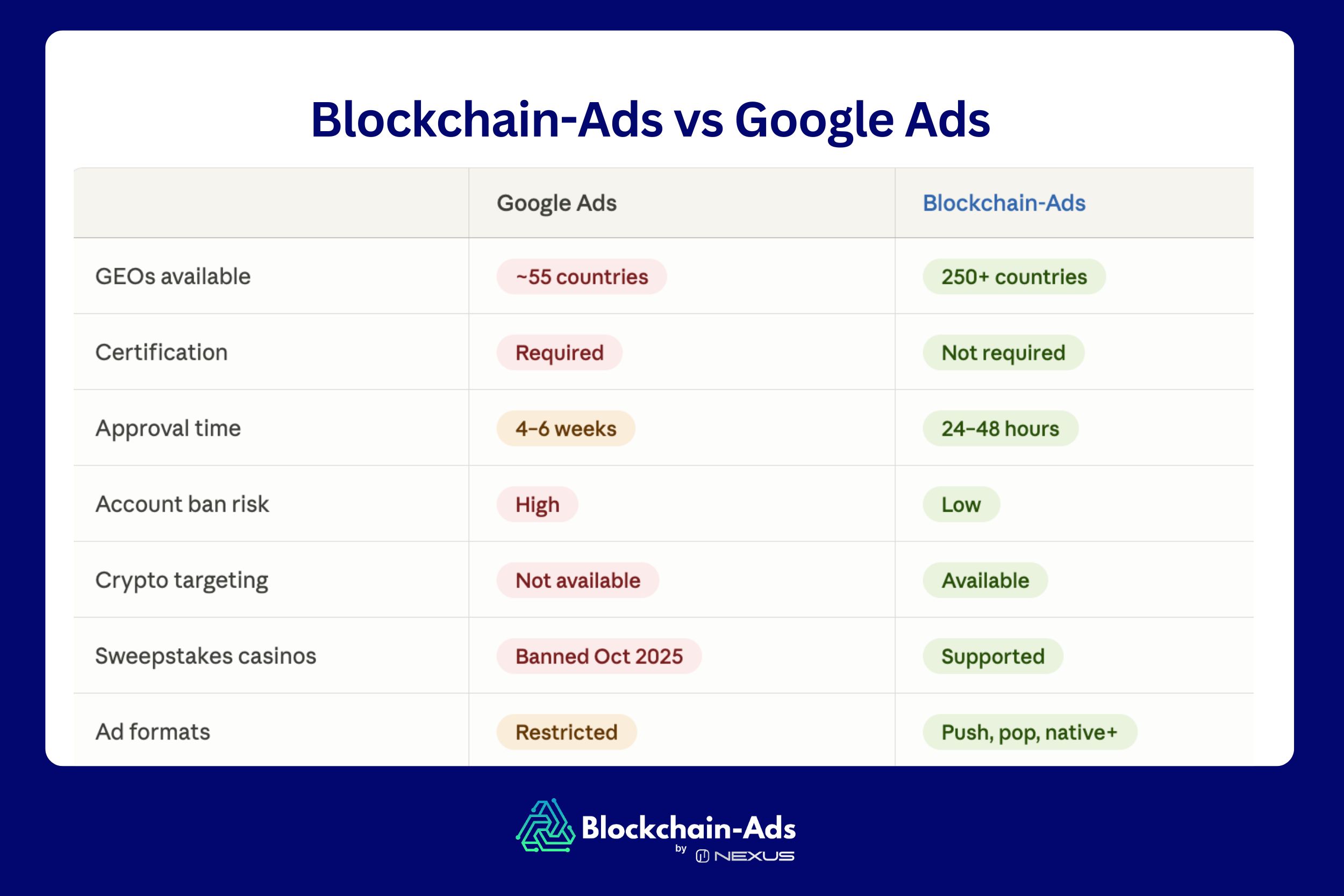
While Google restricts gambling ads to approximately 55 countries with heavy limitations, Blockchain-Ads opens the door to 195+ countries, including high-value markets like the US, UK, Germany, and Brazil and emerging markets where Google blocks gambling advertising entirely.
Multiple Traffic Sources
Blockchain-Ads offers diverse ad formats optimized for gambling conversions:
- Push notifications: High-engagement format that reaches users directly on their devices
- Pop and popunder ads: Guaranteed visibility with full-page exposure
- Interstitial ads: Full-screen ads that capture attention during natural transition points
- Display banners: Standard formats across premium publisher inventory
- Native ads: Content-style placements that blend with publisher sites
This variety lets you test and optimize across formats to find what converts best for your offers and GEOs.
Advanced Audience Targeting
Go beyond basic demographics with targeting options, including:
- Geographic targeting down to city level
- Interest and behavioral segments
- Custom audience creation
- Retargeting capabilities
Real-Time Reporting & Optimization
Track campaign performance with detailed reporting dashboards showing impressions, clicks, conversions, and ROI in real time. The data granularity helps you identify winning combinations of creatives, GEOs, and traffic sources quickly, so you can scale what works and cut what doesn't.
Stable Policies
Google implemented 18 major policy changes in 2025. Blockchain-Ads offers stable, predictable policies that don't change overnight. Your campaigns won't suddenly get disapproved because of a policy update you didn't know about.
Getting Started with Blockchain-Ads for Gambling Ads
The onboarding process is straightforward:
- Request access at blockchain-ads.com/verification
- Complete compliance review (typically 24-48 hours)
- Fund your account
- Launch campaigns with help from your dedicated account manager
Most operators have their first campaigns live within 48 hours of approval. See our case studies to learn how operators like you are scaling without Google.
2. Specialized Gambling Ad Networks
Besides Blockchain-Ads, there are other ad networks that work strictly within the gambling industry and offer properly targeted ads. These networks fully understand the market and gambling regulations, allowing them to create legal targeted ads without the certification bureaucracy.
You can see our list of top gambling ad networks to check out the best options that would suit your campaign goals.
3. Social Media Platforms
Social media is a powerful tool for directly connecting with your target audience with gambling ads. Some platforms to consider include Facebook, X (Twitter), Instagram, and YouTube. Before settling for any of these, note that all platforms also have their own policies and restrictions. For instance, gambling ads on Facebook require advertisers to get a written permission for games offering a limited trial period and require payment after.
4. Affiliate Marketing Programs
Affiliate marketing for advertisers involves collaborating with promoters who will publicize gambling services using their websites, channels, or social media pages. With iGaming affiliate marketing, advertisers can broaden their reach at relatively small costs.
How Can You Ensure Ongoing Compliance?
Maintaining compliance is crucial when creating Google Gambling ads to avoid penalties, loss of account, and other legal problems.
1. Monitoring and Updating Ads
Regularly monitoring your ads is one of the best strategies to ensure continuous compliance. Leverage Google Analytics for accurate insights into your ads' performance. Then, update your campaigns if you notice areas that need improvements.
2. Staying Informed of Policy Changes
Google changes its policies frequently: 18 times in 2025 alone for gambling ads. As such, keeping track of these changes will ensure your campaigns continue to stay in line with Google's requirements.
Helpful resources:
- Google Ads Policy Center: Visit frequently to keep up with changes
- Google Notifications: Subscribe to email notifications for instant updates
- Industry News: Follow blogs and forums covering gambling advertising regulations
- In-Account Notifications: Check notifications from Google in your Ads account
Reaching Your Target Audience Effectively
To run gambling ads and effectively reach your target audience, respecting Google's policies is important. Remember that getting the Google ad certification is the first step, and with the new website-specific and country-by-country requirements, this process takes longer than ever.
If you don't want to deal with the stress of getting Google Ads approval, try a specialized ad network like Blockchain-Ads. It fully understands gambling ad regulations and can create targeted campaigns to help you convert, without the 6-week certification wait, without the geographic restrictions, and without the constant fear of policy violations ending your account.
Regardless of how you choose to approach it, comply with local regulations and only run accurate ads that are not misleading.
A professional content marketer with 3+ years of experience in iGaming and affiliate marketing.
View full profile →