
Casino Player Retention: How to Retain and Reactivate iGaming Players
Key takeaways
- Lifecycle first: Each lapsed player must be bought again at full cost, so track whether players are new, active, at-risk, dormant, or reactivated.
- Spot drift early: Set a dormancy window for each product and reach at-risk players before they pass it, while they still remember your brand.
- Leave some players alone: Remove self-excluded, limited, harm-flagged, and opted-out players from every reactivation audience before each upload.
- Use CRM and retargeting together: CRM keeps active players depositing, retargeting reaches dormant ones, with one message per segment and a stop rule.
- Prove it with a holdout: Judge reactivation on deposits returned against a group you left alone, not on clicks or opens.
Casino player retention is the work of keeping depositors playing after their first deposit and bringing back the ones who stop. A player registers, deposits, plays for a few days or weeks, then drifts away.
Each player who leaves has to be bought again, at full acquisition cost, by you or by a competitor. Good retention comes down to three things: knowing where each player sits in their lifecycle, reaching the ones drifting away before they go dormant, and judging every reactivation effort by the deposits it brings back.
This guide covers why players churn, how to spot them early, the lifecycle audiences and levers that keep them active, and how to bring lapsed players back with CRM (customer relationship management: your own channels, such as email, SMS, push, and on-site messages) and paid retargeting together.
Why Casino and Betting Players Churn
Churn is when a depositor stops playing, and it usually happens once the reason they came is gone. The bonus runs out, a losing run sours the experience, or another operator gives them a better reason to play. The causes are usually visible in your own data:
- Players who came for the bonus often stop once it is used or expires.
- A big loss, or a long stretch of small ones, is one of the most common points where players stop logging in.
- Players hold accounts with several operators and move to whichever offer suits them that week.
- The sports season ends. Many sportsbook players are seasonal. A football bettor who goes quiet in June is following the calendar, and the same player may return on their own when the league restarts.
- Slow withdrawals and verification holds leave players waiting for their money and push many toward an operator that pays faster.
- A poor app or site experience. Failed deposits, slow game loads, and confusing navigation push players toward an operator where depositing takes fewer steps.
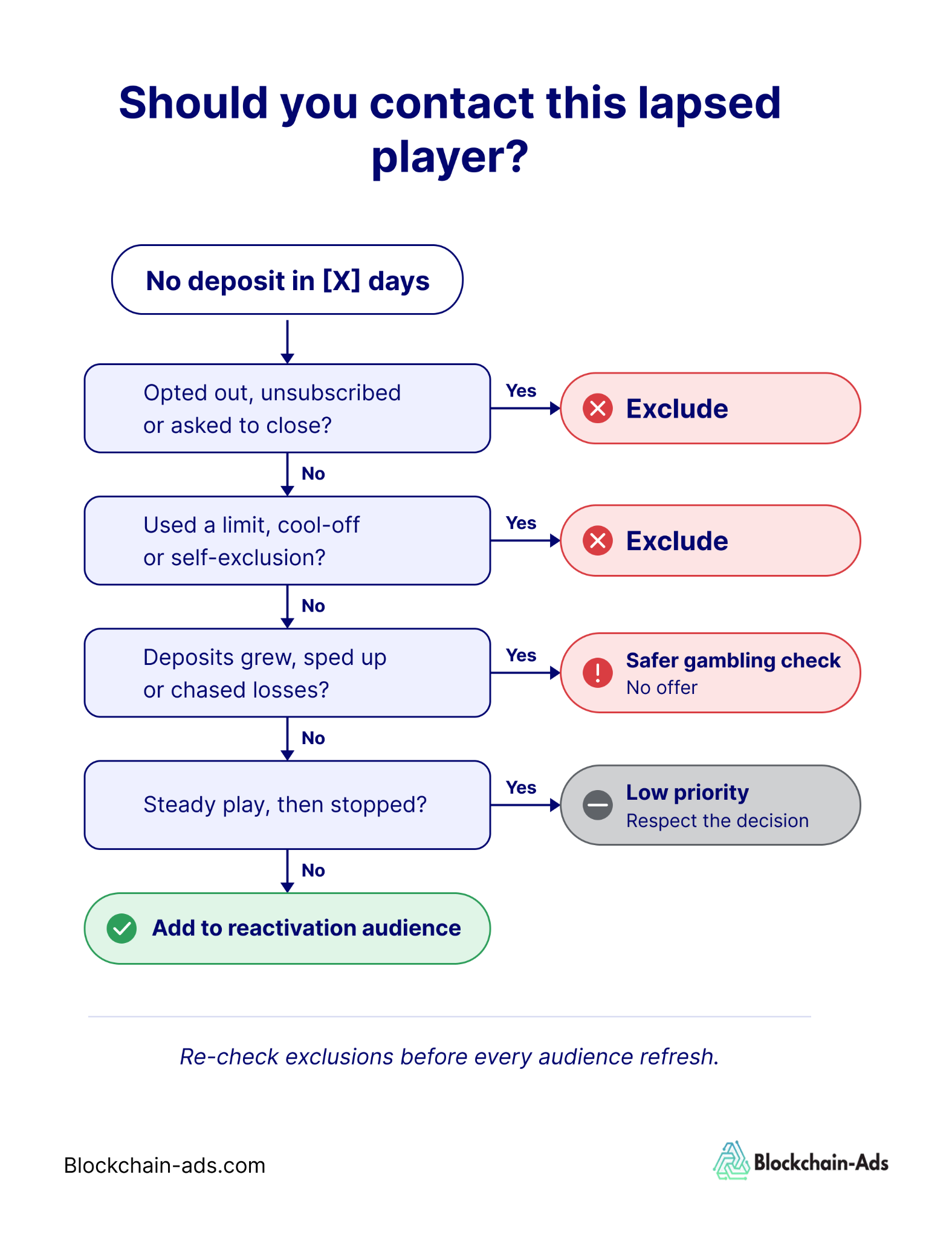
Some players stop for healthy reasons: they set a budget and kept to it, decided to play less, or lost interest. Those players should be left alone. Most operators contact them anyway, because in a dormant list they look the same as every other lapsed player. Your own data can separate many of them out:
- They told you. They unsubscribed, opted out of a channel, asked to close their account, or gave a reason in an exit survey or a support conversation.
- They used a safer gambling tool before stopping. Deposit limits, time limits, reality checks, and cool-offs show a player managing their own play. Keep these players on your exclusion list and out of every reactivation audience.
- Their play was steady, then stopped. A player whose deposits stayed at a regular, stable level and then ended is more likely to have made a decision. A player whose deposits grew, came closer together, or chased losses before stopping shows a harm pattern, and that player needs a safer gambling check, not another offer.
A retention program that chases every lapsed account will eventually reach people who chose to stop, which is a responsible gambling risk and a waste of budget.
How to Spot Dormant Players Before You Lose Them
With the players who chose to stop set aside, the rest of your lapsed list is where retention pays off. The way to keep them is to set a dormancy window, then watch for the signs that show a player is drifting before they reach that window.
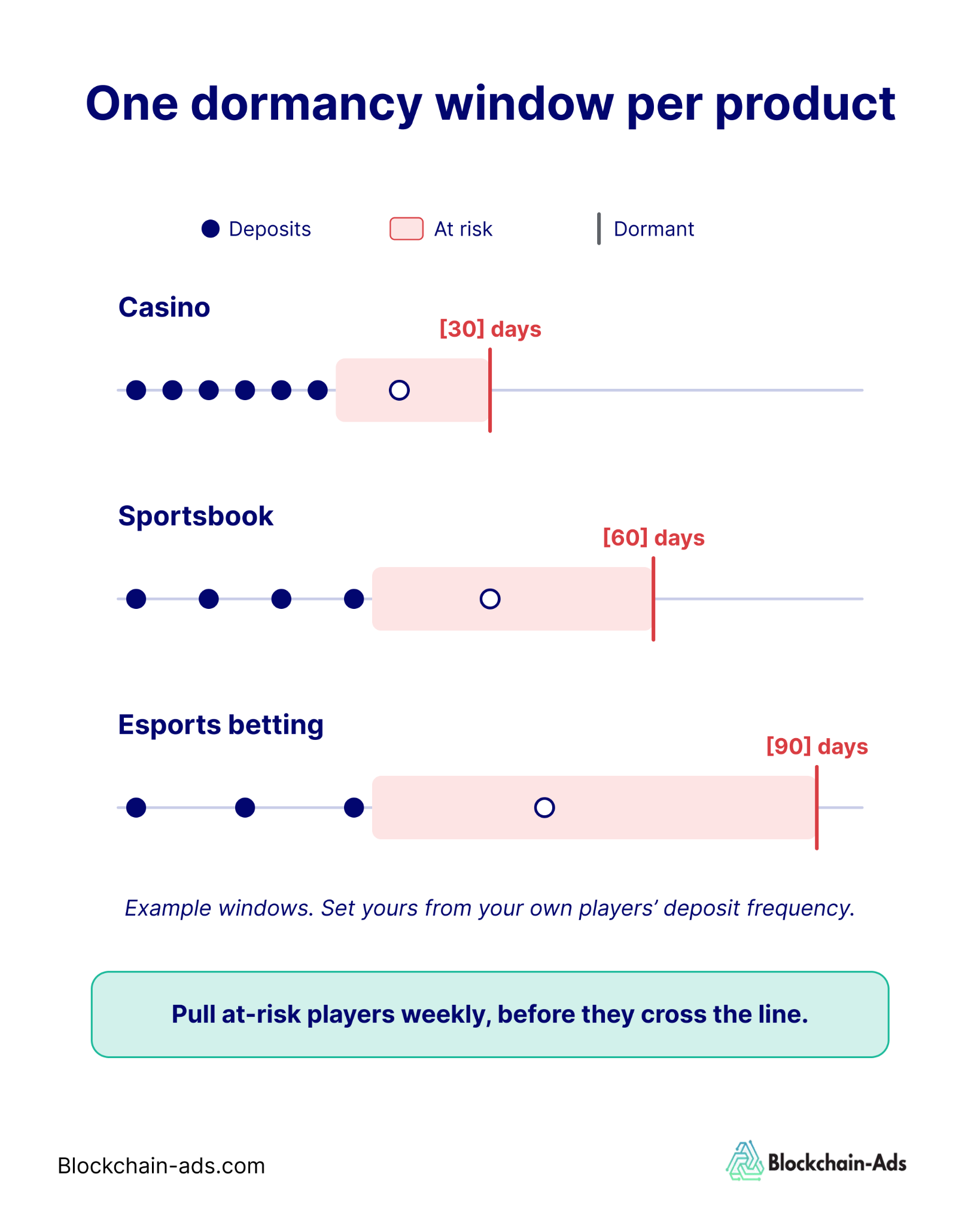
A dormant player is a depositor with no activity for a set period that you define, such as 30, 60, or 90 days, depending on how often your players usually deposit.
Casino, sportsbook, and esports betting players deposit on different schedules, so one window for the whole database will either flag bettors too early or casino players too late. Give each product its own window. Once each product has its window, you can see which players are heading toward it. Every week, pull the players who now deposit or log in less often than they usually do.
These are your at-risk players, and the time to reach them is before they hit the window. While they are only slowing down, they still remember your brand and still notice your messages. Once they go dormant, many have already moved on to another operator's offer, and bringing them back can cost as much as acquiring a new player.
Lifecycle Audiences That Keep Players Active
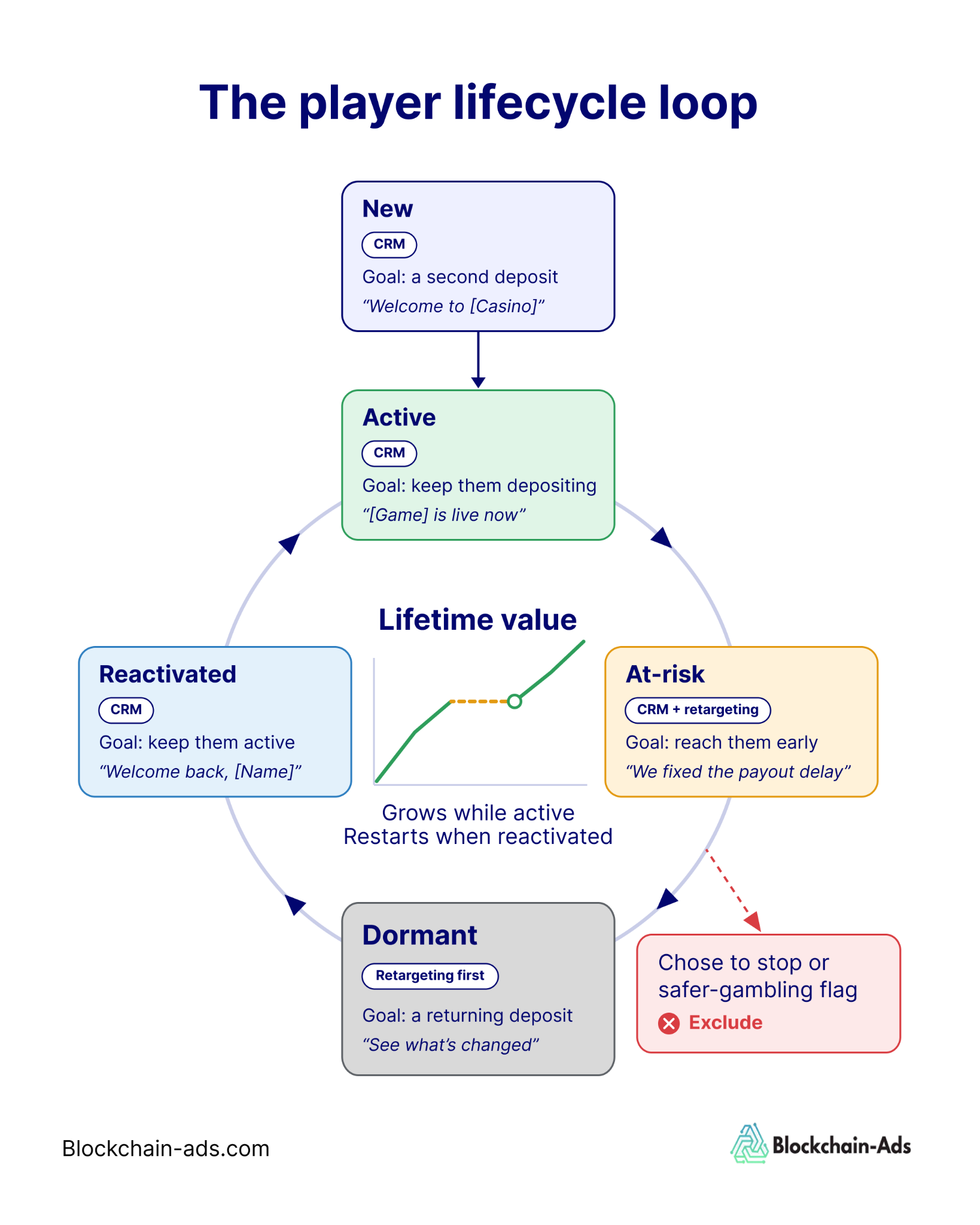
A lifecycle is where a player sits in their relationship with you: new, active, at-risk, dormant, or reactivated.
Every stage needs its own goal and message. A player who just made a first deposit and a player who has been quiet for two months need different things from you, so one message sent to both fits neither.
Here is what a casino might send at each stage:
- New: a welcome email. "Welcome to [Casino]. Here are the three slots most new players start with, plus a 30-second guide to withdrawing your winnings."
- Active: a push alert when something they like is released. "New from [their favorite provider]: [Game] is live now."
- At-risk: if something went wrong, fix it and say so. "Your last withdrawal took longer than it should have. We've fixed the cause, and payouts now arrive within [time]." If nothing went wrong, a catch-up email. "Since your last visit: [number] new slots, including two from [provider you play]."
- Dormant: a retargeting ad, since most no longer open your messages. "New slots, new live tables, faster payouts. See what's changed at [Casino]." Email or SMS goes only to players whose consent is still valid. This is also the stage where casinos most often add a reactivation offer.
- Reactivated: a welcome-back email. "Welcome back, [Name]. Here are the games added since you were last here."
These stages are also how you measure lifetime value. LTV, or lifetime value, is the revenue a player brings over their time with you. Every player you keep in the active stage longer adds to it, and every dormant player you bring back restarts it.
How to Keep Active Players Depositing
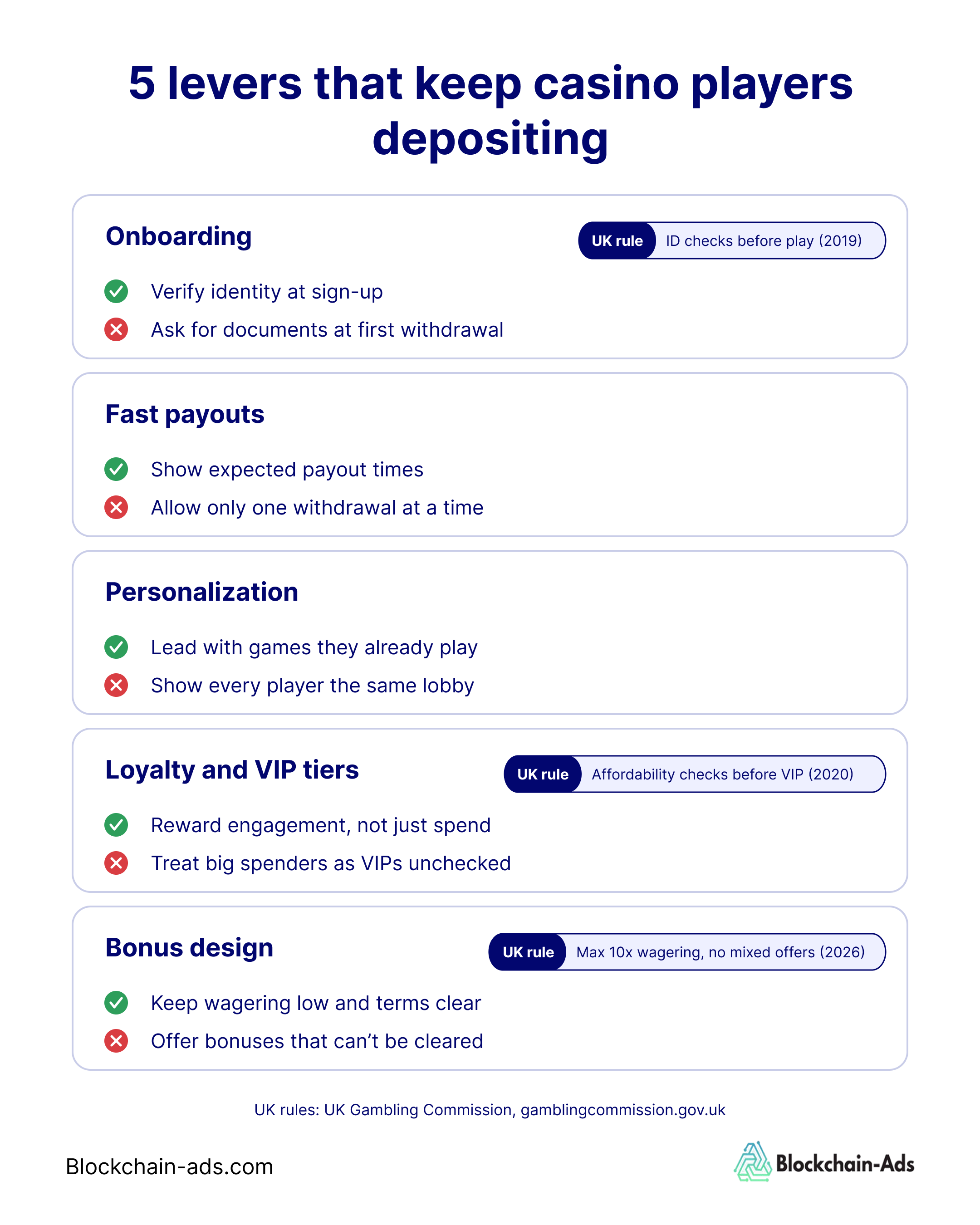
Retention starts while players are still active, not when they go quiet. These five levers keep players depositing without pushing them past safe play:
- Onboarding. The first days after a first deposit decide whether a player makes a second one. Verify identity at registration, so the first withdrawal doesn’t stall on a surprise document request.
- Fast, predictable payouts. Withdrawals are where players decide whether to trust you, so pay out quickly and show expected processing times. Avoid friction such as allowing only one withdrawal at a time.
- Personalization. Use each player’s own history to decide what they see first: their game types, providers, and betting markets. A slots player who sees a new release from a provider they already play has a reason to return.
- Loyalty and VIP tiers. Reward ongoing play with tiers, points, or perks, and build them around engagement rather than spending alone. High-value players need extra care, not just bigger rewards.
- Bonus design. A bonus that can’t realistically be cleared teaches players to leave once it expires. Keep wagering low and terms clear so players can see exactly what it takes to clear a bonus.
Casino CRM Marketing: The Owned Channels
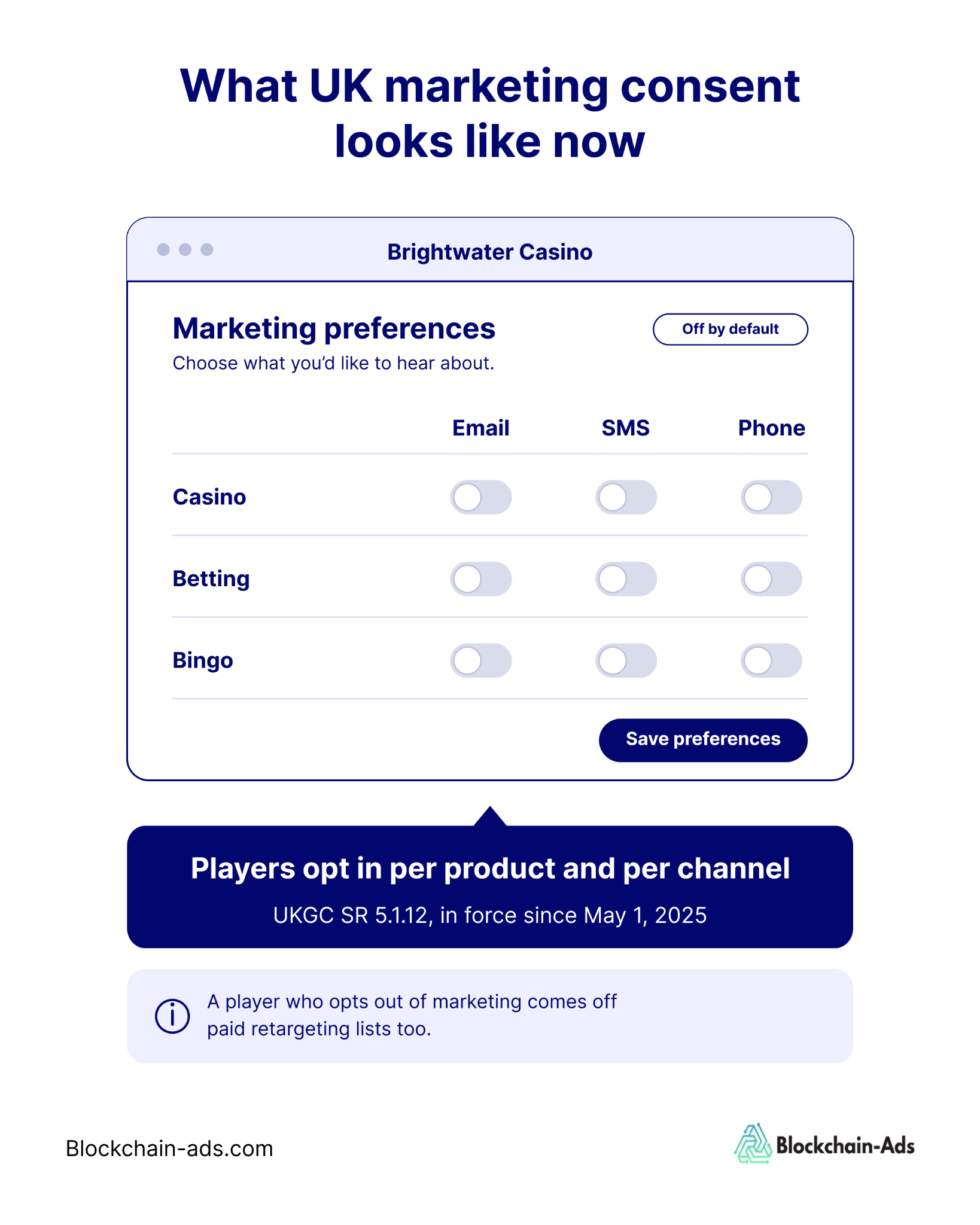
Casino CRM marketing uses the channels you own (email, SMS, push, and on-site messages) to keep players active and bring lapsed players back. Each channel has a different job:
- Email suits longer messages: new game launches, product updates, and offers that need terms explained.
- SMS suits short, time-sensitive prompts, such as a reminder that a sports event they usually bet on starts today.
- Push notifications reach players who still have your app installed and notifications turned on.
- On-site and in-app messages reach players while they are logged in, which makes them the strongest channel for active and new players.
Every CRM message needs the player's consent. In the UK, for example, online casinos must let players opt in separately for each channel (email, SMS, phone) and each product (casino, betting, bingo), with every option switched off by default.
CRM only reaches players who still open it, and by the time a player goes dormant, many have unsubscribed, turned off push, or deleted the app. Reaching them again takes paid retargeting.
How to Reactivate Dormant Players With Paid Retargeting
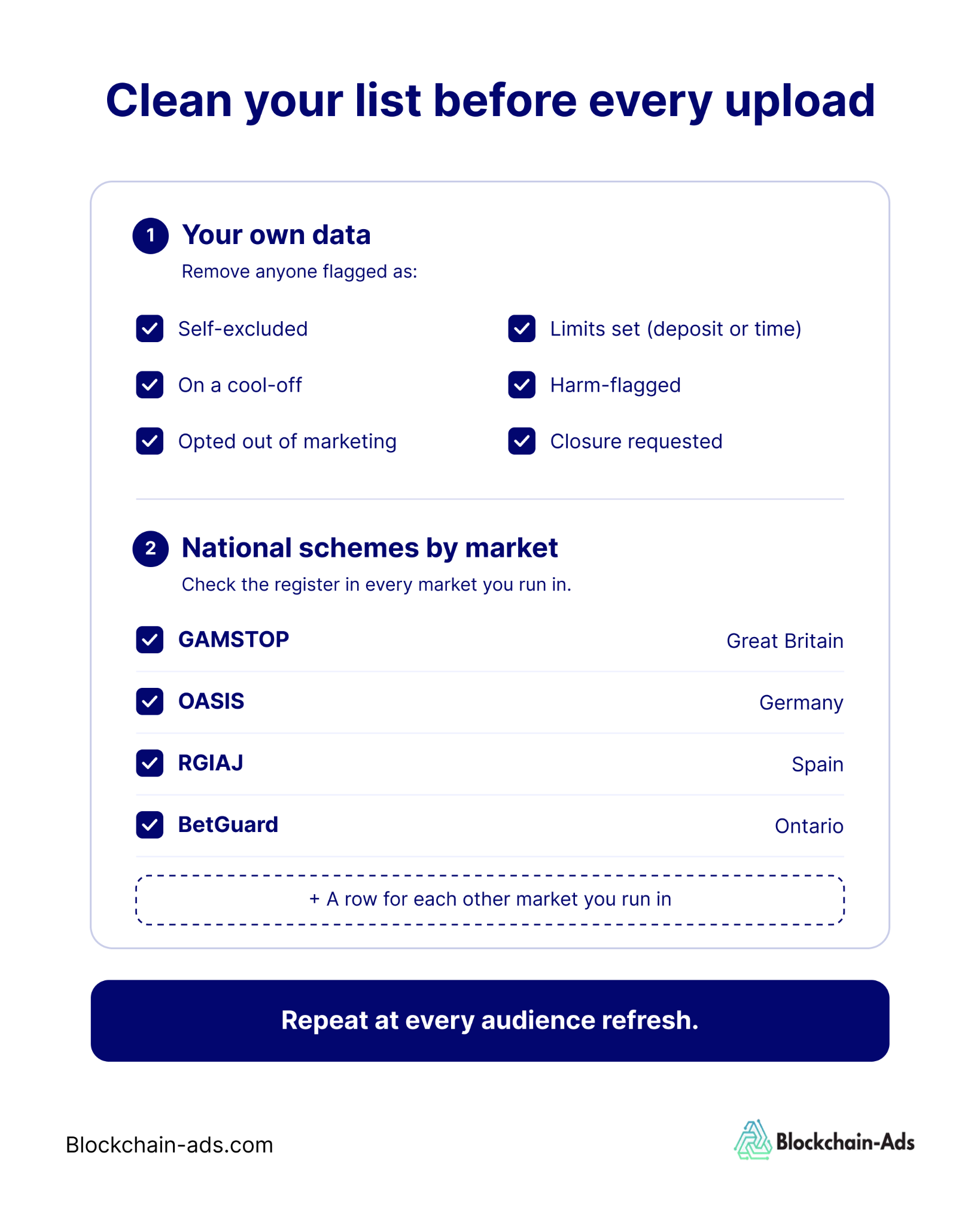
To reactivate dormant players, upload them as a custom audience and retarget them with ads on the websites and apps they use. Retargeting means showing ads to people who have already visited your site, registered, or deposited. Four things decide whether player reactivation through paid ads works:
- The audience. Export your dormant depositors and upload them as a custom audience, following the steps in Creating Custom Audience Segments. Blockchain-Ads matches the list to user profiles in its audience data.
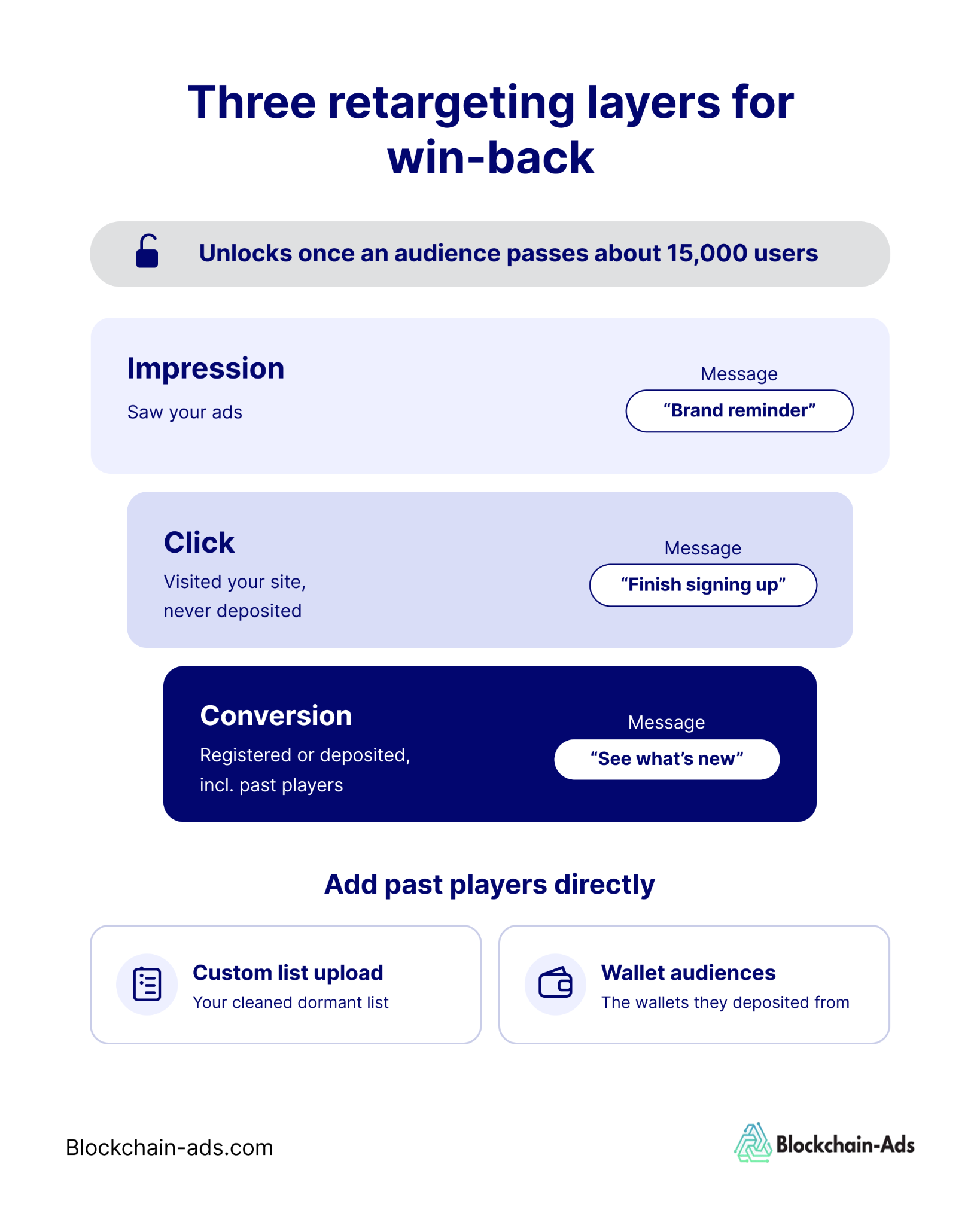
You can also retarget players by what they did on your site: visited, registered, or deposited. Give each group its own message, since a player who registered and never deposited needs a different reason to return than a past depositor.
These behavior-based layers become available once an audience passes about 15,000 users, and Retargeting Strategies explains how to set up each one.
- The exclusions. Remove self-excluded, limited, cool-off, harm-flagged, and opted-out players before every upload and every audience refresh, since a player who was safe to contact last month may have self-excluded since.
In the UK, licensed online operators must take part in GAMSTOP, the national online self-exclusion scheme. In Germany, personally addressed advertising to players in the OASIS blocking system is prohibited, and advertisers must check the block file first. Paid ads follow the same consent and bonus rules as email and SMS.
- The creative. Use ads made for lapsed players, separate from your acquisition ads, and refresh them about every 15 days. A dormant audience is small, so the same players see the same ads often and tire of them quickly.
- The frequency. Keep the frequency cap low. A dormant audience is small, so a lower cap keeps your brand in view without the player feeling chased.
Reaching Crypto Players Who Moved Their Funds
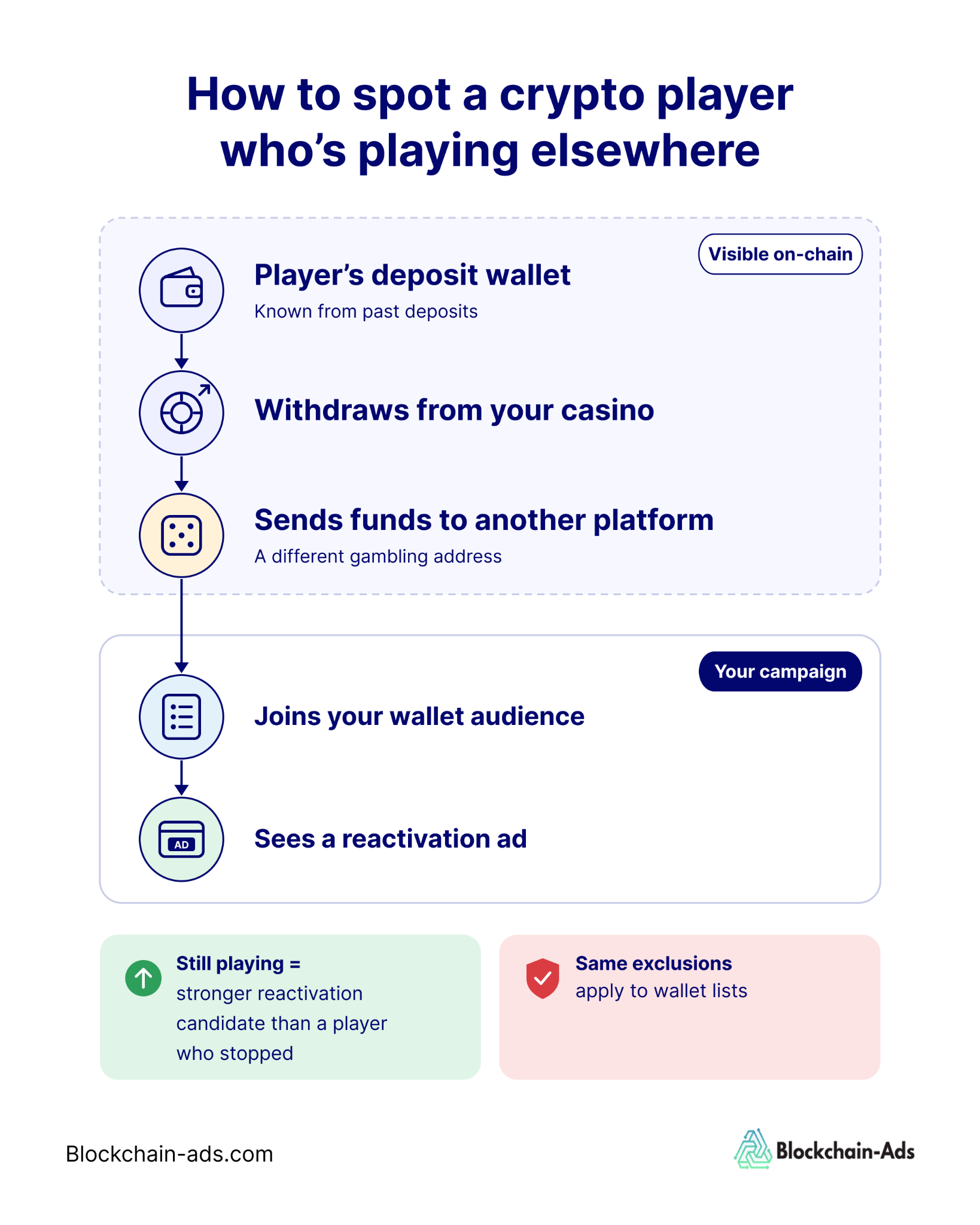
Wallet activity can show when a crypto player has moved funds and is playing somewhere else: a withdrawal from your casino followed by a transfer to another platform is visible on-chain. That player is still playing, which makes them a stronger reactivation candidate than one who has stopped.
If you hold your past players' deposit wallets, you can upload them as a wallet audience and show ads to those wallets. Blockchain-Ads covers more than 11 million active wallets across 82 blockchains, and uploaded wallet lists usually match at 10 to 40%. Apply the same exclusions to every wallet list.
How to Win Back Casino Players: A Five-Step Plan
To win back casino players, define who counts as dormant, clean the list, split it by value and product, reach each segment through CRM and retargeting together, and count the deposits that come back.
- Define dormancy. Set one window per product, as covered above, and use it in every report.
- Clean the list. Apply the exclusions above before any segmenting, so excluded players never reach a campaign.
- Split by value and product. Separate high-value past depositors from occasional ones, and casino players from bettors.
- Run CRM and retargeting together, with one message per segment. Send the CRM message to players with valid consent and run retargeting to the same segment, with the same message across both. Set a stop rule: after a fixed number of touches or weeks with no response, take the player out of the sequence.
- Measure deposits returned, using the measures in the next section.
How to Measure Retention and Reactivation
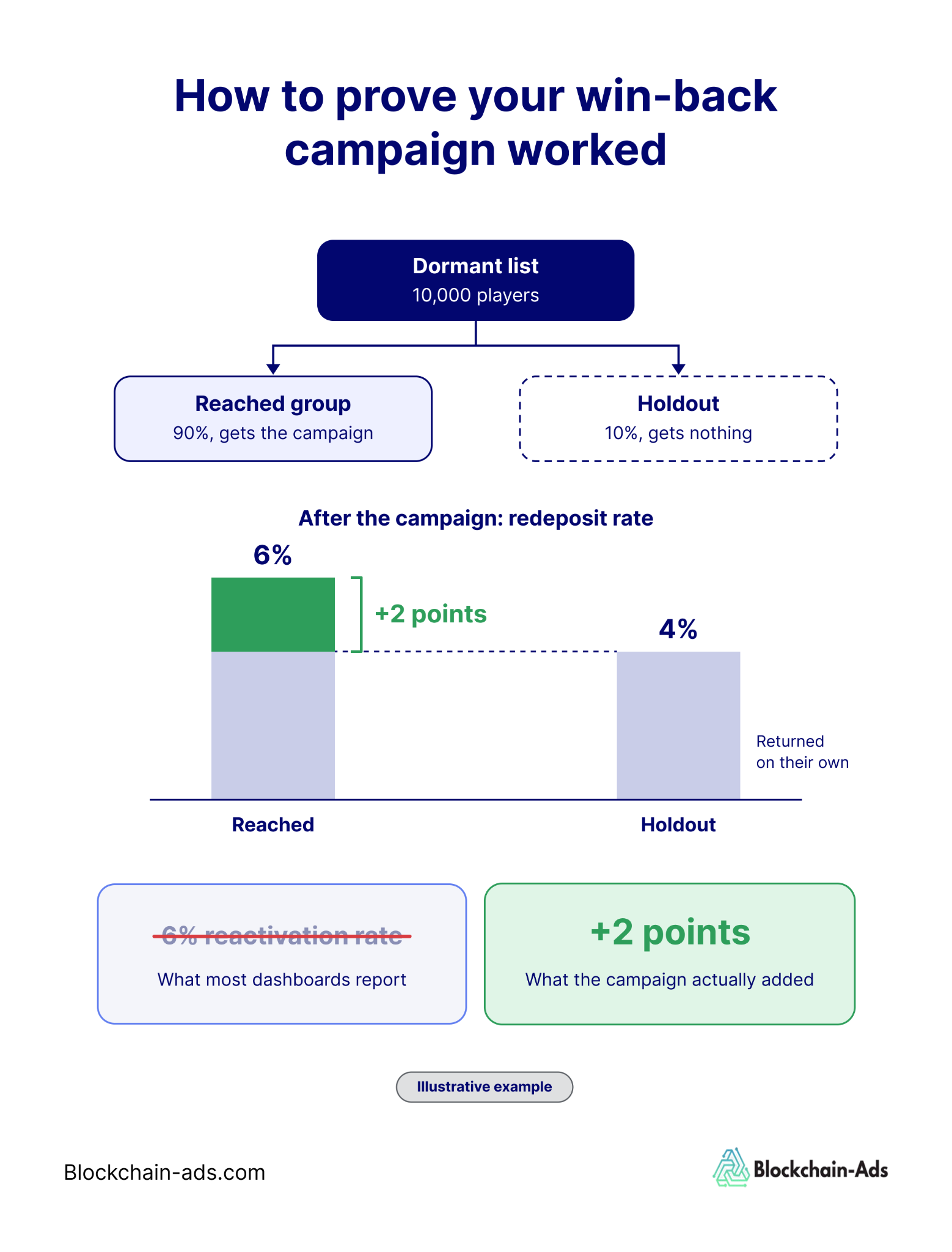
Count the deposits and revenue reactivated players bring back against what it cost to bring them back. Four measures cover it:
- Retention rate by monthly cohort. Group players by the month of their first deposit and track what share of each cohort is still depositing 30, 60, and 90 days later. This shows whether retention is improving over time.
- Reactivation rate. The share of your dormant list that deposits again within a set period after the campaign starts.
- Revenue per reactivated player. What each returning player deposits over a fixed period after coming back. A player who deposits once and lapses again is worth far less than one who returns to active play.
- Cost per reactivated depositor. Total campaign spend divided by the number of players who deposited again. Compare it with your cost to acquire a new depositor, using the method in How to Calculate Customer Acquisition Cost and Set Your Target CPA.
These numbers only mean something against a holdout group, because some dormant players come back on their own, such as a bettor, when the season restarts. Before the campaign starts, randomly set aside a share of your dormant list and send it nothing, CRM or paid.
When the campaign ends, the gap between the deposit rate of the reached group and the holdout is what the campaign actually added. This is incrementality testing, covered in full in What Is Incrementality Testing? How to Measure the Real Lift From Your Ads.
Reactivating Players With Blockchain-Ads
Blockchain-Ads suits casino and sportsbook operators with a base of past depositors they want to bring back at volume. It is an audience-based advertising platform. It builds audiences from the interests people show, such as following sports betting or casino games.
For crypto players, it adds on-chain activity from 11M+ active wallets across 82 blockchains. It then reaches those players with display, native, video, and in-app ads.
- Custom audience uploads. Upload your cleaned dormant depositor list, and your account manager can help you set up the match.
- Retargeting layers. Retarget by impression (people who saw your ads), click (people who visited your site), and conversion (people who registered or deposited, including your existing players). Once an audience is large enough, retargeting is consistently the strongest-performing layer on the platform.
- Wallet audiences. Reach crypto players through the wallets they deposited from.
- Server-to-server conversions with deposit value. Send the conversions server-to-server so each reactivated deposit is counted with its value. That lets you report reactivation in deposits and revenue and compare it with your holdout.
- Country targeting. Set campaigns by country, so each campaign runs only in markets where you are licensed and follows that market's rules.
Blockchain-Ads works with licensed iGaming operators and their affiliates, in permitted jurisdictions only. Follow the iGaming Audience Targeting guide for how to build the audiences behind these campaigns.
FAQs
What is a good casino player retention rate?
There is no reliable industry benchmark, so track your own monthly cohorts and use them as the baseline every campaign is judged against.
When is a player considered dormant?
When they pass the inactivity window you set, commonly 30, 60, or 90 days without a deposit, with a shorter window for casino players than for bettors.
Can you retarget players who opted out of marketing?
No: opted-out, self-excluded, and limited players must be removed from every reactivation audience, including paid retargeting lists.
Is it cheaper to reactivate a player than to acquire a new one?
Usually, you already hold their data, and they know your brand, but confirm it by comparing your cost per reactivated depositor with your cost to acquire a new one.
How often should reactivation creative change?
About every 15 days, because a small dormant audience sees the same ads often and tires of them quickly.