
iGaming Ad Fraud: How to Protect Your Spend from Bots and Bonus Abuse
Key takeaways
- iGaming ad fraud is rising: 82.9% of iGaming operators said fraud had increased over the past year, in a 2025 industry survey
- Four main types: Bot traffic, affiliate fraud, PPC fraud, and bonus abuse each drain operator budgets in a different way.
- Costs rise with depth: Fraud enters at every funnel stage, and it costs more the closer it gets to a first deposit.
- Prevention beats cleanup: Detection finds fraud you’ve already paid for, while verified supply keeps much of it out of your funnel.
- Clean traffic isn’t enough: Bonus abuse happens after sign-up, so it still needs KYC, device and payment checks, and tight bonus terms.
iGaming ad fraud doesn’t look like fraud at first. It looks like a great week: clicks and sign-ups climb, and affiliates report new players, but first deposits from real players don’t follow.
Several casinos in Latin America saw a version of this. Sign-ups spiked, and the people behind the new accounts were real, but they had no plan to play.
An Ad Trust Group investigation traced them to Instagram reels where a creator claimed to have gone from broke to winning with a “casino prediction bot.” Viewers who sent a DM were moved to Telegram and told the bot would only work once they registered through a tracked link and deposited a set minimum.
The casinos saw first deposits spike, many landing at the exact minimum soon after sign-up. They paid a CPA on each one, and few of those players ever played again.
The pattern is getting more common. In a June 2025 survey by a fraud-prevention vendor, 82.9% of iGaming operators reported increased fraud over the previous year. The same vendor’s 2026 report found that suspicious transaction volumes rose 4.5 times between Q1 2025 and Q1 2026.
Blockchain-Ads buys traffic for licensed casinos and sportsbooks, and keeping invalid traffic out is part of every campaign. This guide covers where each type of iGaming ad fraud enters your funnel; what it costs; and how to protect your spend before it eats your budget.
What Is iGaming Ad Fraud?
iGaming ad fraud is any scheme that makes a casino or sportsbook pay for impressions, clicks, leads, or players that aren’t genuine.
The ad industry calls the media side of this fraud invalid traffic (IVT), which means any click or impression that doesn’t come from a real, interested person.
So why target iGaming? High CPAs and generous welcome bonuses mean every fake sign-up pays someone, so a script that fakes registrations by the hundreds pays for itself pretty fast.
Most of it comes from bot operators selling fake traffic, dishonest publishers and affiliates inflating their numbers, and bonus hunters cashing out promotions. Fraud in the media is the fake impressions and clicks you pay for before anyone reaches your site, while fraud in the product is the fake or duplicate accounts that get through registration.
Not every weak-deposit campaign is fraudulent, though. Poor targeting, clumsy onboarding, or a weak offer can open the same gap.
The Main Types of iGaming Ad Fraud
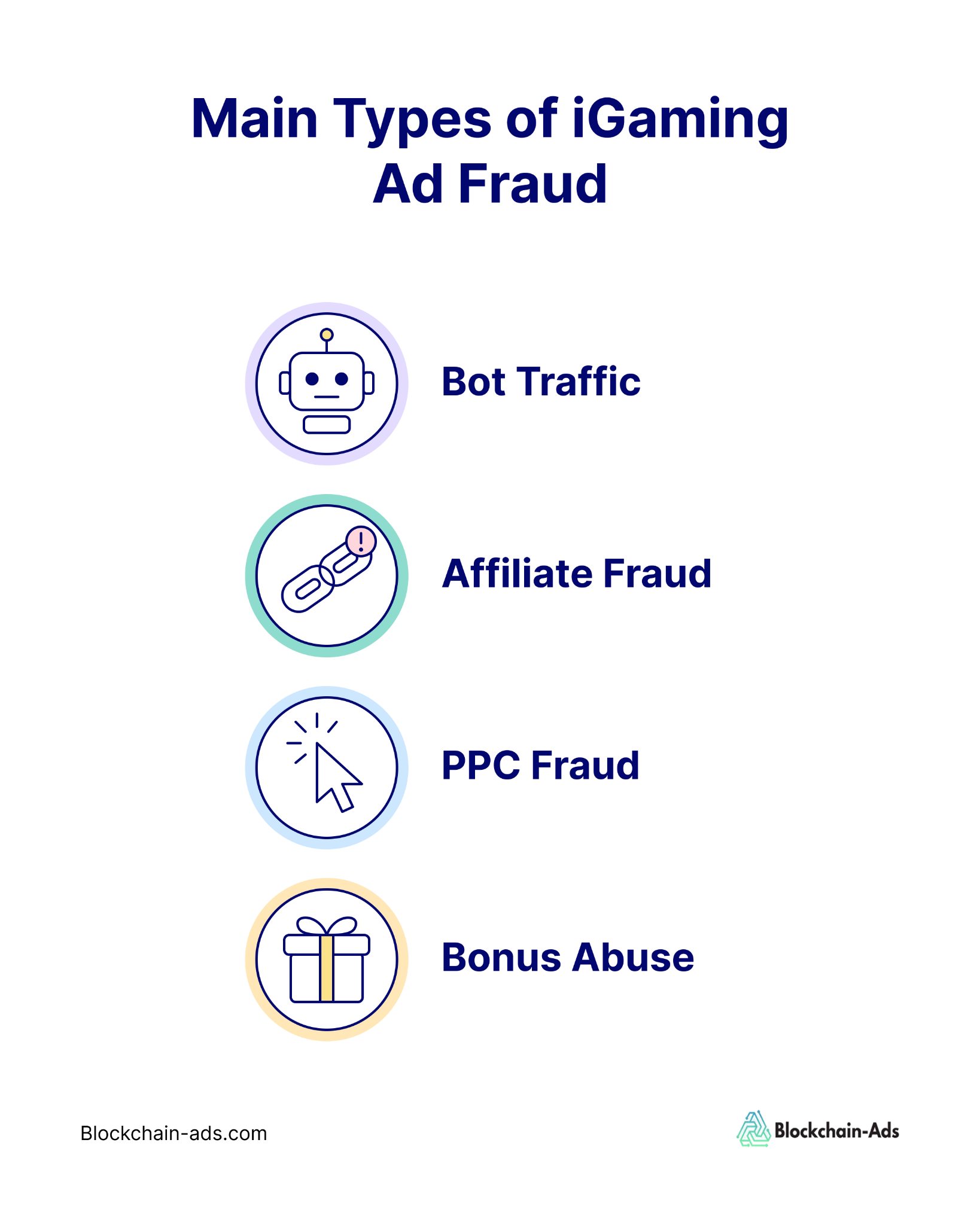
Fraudsters keep finding new ways to drain acquisition budgets, but most iGaming ad fraud falls into four types: bot traffic, affiliate fraud, PPC fraud, and bonus abuse.
Here’s how each one works and which controls can help defend against it:
Bot Traffic
Gambling bot traffic is automated software that views ads, clicks them, and, in advanced cases, completes sign-up forms while imitating a real user. It can travel from impression all the way to registration.
The Media Rating Council’s guidelines split bot traffic into two groups:
- General invalid traffic (GIVT) is the easy kind, like search engine crawlers and traffic from known data centers. Standard filters catch it.
- Sophisticated invalid traffic (SIVT) is the expensive kind. It’s built to look human, so catching it takes deeper analysis or an expert personally reviewing the traffic.
SIVT hides in two main ways. Some run from data centers but route through home internet connections to look like real users, and some use emulators, which let one computer pose as hundreds of different phones.
Here’s what that looks like in practice. A display campaign suddenly brings in 600 registrations in a week, but the sessions look almost identical, and hardly anyone deposits.
You’ve paid for every one of those bot impressions. If the deal is CPL or CPA, you’ve also paid for every fake account, and your bidding system now thinks that placement is your best performer.
The good news is that bot traffic is the easiest fraud type to stop early. Verified supply filters out much of it before you pay, and tracking every player to first deposit exposes the bots that slip through.
Affiliate Fraud
iGaming affiliate fraud occurs when a partner inflates the clicks, leads, or players it reports to earn commission it didn’t generate. Most affiliates send real players; the fraud comes from a minority exploiting how CPA deals define a conversion.
The most common forms of online casino affiliate fraud are:
- Fake leads: Bots or paid workers register with stolen or invented details.
- Cookie stuffing: A site drops an affiliate’s tracking cookie on visitors who never clicked a link, so it gets credit for players who arrived on their own.
- Click spam and click injection: Click spam generates large volumes of fake advertising clicks in the background, hoping that one of them will be attributed to a user who eventually installs the advertised app organically. Click injection is a more sophisticated method, where the click is fired just before an install completes.
- Incentivized sign-ups: Users are paid or rewarded to register, so they meet the CPA definition with no plan to play.
- Brand bidding: An affiliate bids on your brand terms against program rules and earns commission on players already searching for you.
The worst part is that it looks like success. An affiliate’s players might deposit at twice your average until an audit shows most of them came to your site directly before the affiliate’s cookie appeared.
In the end, you pay commission for players you already had. However, your commission structure can make this fraud easier or more difficult to pull off.
Gambling affiliate marketing deals that pay affiliates for registrations are the easiest to exploit because fake registrations are easy to generate. Marketing deals that require a qualified deposit before paying commissions, on the other hand, make this type of fraud harder to carry out.
PPC Fraud
PPC fraud in sports betting is clicking on paid search ads with no intent to bet, usually by bots, click farms, or competitors draining a rival’s budget. It enters at the click and stops there.
It looks ordinary because the clicks never even touch your registration data.
Betting keywords attract this fraud because they’re expensive. A 2026 report from a click-fraud vendor links the sector’s high invalid traffic rate to high costs per click and aggressive competition. So even a small share of fake clicks moves the real budget.
Competitor clicking adds a second loss. A rival can repeatedly click on your ads to burn your budget, so the ads stop running, potentially before evening fixtures when betting interest is high.
Most platforms filter some invalid clicks, while exclusion lists catch more. Google Ads for gambling also narrows your keywords through its own certification rules.
Bonus Abuse
Bonus abuse is claiming welcome offers, free bets, or other promotions in ways your terms forbid, for the purpose of extracting value without real play. It enters after registration, which makes it the one fraud type that lives inside your product.
Three patterns cover most of it:
- Multi-accounting (one person or ring opening many accounts for the same offer).
- Bonus hunting (moving between operators to collect offers).
- Withdraw-and-go (cashing out once a bonus clears).
Say one person opens five accounts with five email addresses, each claiming a welcome offer. Each one triggers a bonus, and if an affiliate referred them, a CPA too.
In the same vendor survey, 63.8% of operators named bonus abuse among the most dangerous fraud schemes they face.
Clean traffic can reduce the bot-driven share of bonus abuse, but it can’t stop a real person on a real device. That takes KYC (Know Your Customer checks that confirm a player’s identity), device intelligence, payment checks, and bonus terms written to close loopholes.
Where Fraud Enters the Funnel
Fraud enters at every step from impression to deposit, and the earlier you stop it, the less it costs. The four types above stack along it, one stage after another.
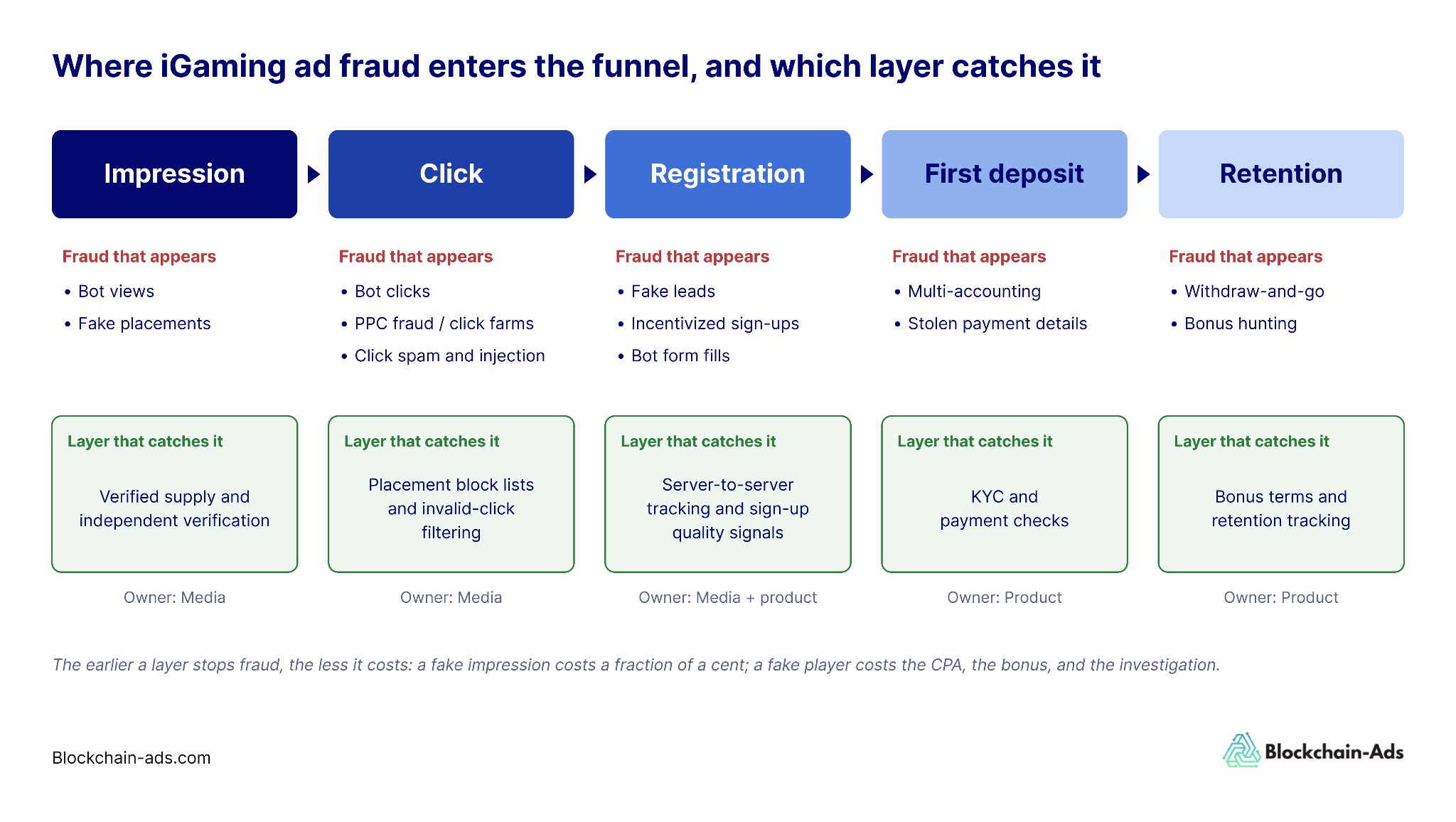
Read left to right; the graphic is also a price list. A fake impression costs a fraction of a cent, while a fake player costs a CPA, a bonus, and investigation time.
What Ad Fraud Costs an Operator
Ad fraud costs operators through wasted media spend, bonuses and CPA commissions paid to fake players, and campaign decisions based on false conversion data.
Juniper Research estimated global ad fraud losses at $84 billion in 2023. A click-fraud vendor also reported an 18.49% invalid traffic rate for gaming and iGaming between August 2024 and August 2025.
Here’s how each cost shows up:
- Wasted ad spend: Bots and fake clicks consume budgets without bringing in genuine players.
- Fraudulent payouts: Fake registrations and bonus abuse trigger affiliate commissions and promotional costs without delivering legitimate player value.
- Misleading campaign data: Fake conversions teach bidding algorithms to buy more of the same traffic, making fraudulent channels look more profitable than those bringing in real depositors.
The third cost is particularly damaging. Even after fraudulent traffic stops, the decisions made using its data can continue to waste your acquisition budget.
Detection After the Click vs. Prevention at the Source
Detection identifies fraud after you've paid for the traffic, while prevention reduces the chances of buying it.
But checks often happen after the click. By then, you've spent money on the traffic. Buying verified supply helps block invalid traffic before it reaches your campaigns.
Most operators need both. Prevention lowers how much fraud reaches the funnel, and detection catches what still gets through, including bonus abuse that no traffic source can filter.
Your choice of platform is the biggest prevention decision you’ll make, because gambling ad networks differ widely in how they vet publishers, qualify advertisers, and measure traffic. Fraud you never buy costs nothing.
How to Protect Your Ad Spend From Fraud
Protect your ad spend by buying verified supply, measuring every player to deposit, and keeping account controls tight.
These six steps follow the funnel in order:
- Buy from verified, qualified supply: Ask how a platform vets publishers and advertisers, who verifies its traffic, and what happens when a placement is flagged.
- Track every conversion server to server, through first deposit and retention: Pixels miss events and are easy to spoof, while server-to-server tracking sends registrations and deposits straight from your backend. Pair it with measurement and attribution that reports deposit value by placement, so sources that send sign-ups without deposits stand out.
- Treat sign-ups without deposits as a quality signal: A registration spike without deposits is a warning, however cheap it looks. Set a registration-to-deposit baseline per channel and investigate sources well below it.
- Review results by placement: Flag placements whose clicks never engage or deposit, and ask your platform how it acts on them.
- Audit affiliates against program terms: Check for brand bidding, conversions with no prior click, and incentivized traffic, and hold commission until players deposit and stay active.
- Keep KYC, device checks, and bonus terms tight: Verify identity before the first withdrawal, match devices and payment methods across accounts, and limit each offer to one per person, device, and payment method, so multi-accounting stops paying.
How Blockchain-Ads Keeps Invalid Traffic Out
Blockchain-Ads is built for licensed operators and the agencies and affiliates behind them, who want their spend to buy depositing players.
Blockchain-Ads starts by controlling who gets in. All advertisers must pass advertiser verification and brand safety checks before a campaign goes live. These campaigns reach audiences built from more than 420 million verified user profiles, and DoubleVerify and Integral Ad Science verify every impression.
Blockchain-Ads watches out for patterns like delivery spikes, conversions that never retain, clicks that never engage, and traffic that behaves like a script. Flagged activity goes to a human reviewer, and the campaign can be paused while the non-compliant traffic investigation protocol runs.
However, Blockchain-Ads won’t stop bonus abuse or multi-accounting, which happen after sign-up and still need your own KYC, device, and payment checks. This means you need to hold the rest of your casino media buying plan to the same standard.
If you want that standard built into your next campaign, request access to Blockchain-Ads. The team will take you through qualification on a call, and approval takes 24 to 48 hours after it.
FAQs
How Much iGaming Ad Traffic Is Fraudulent?
Estimates range from under 20% to over 40%, depending on who measured, which channel, and the sample. One click-fraud vendor put gaming and iGaming at 18.49% across paid clicks from August 2024 to August 2025.
Another vendor reported in March 2025 that up to 44% of traffic in sports betting paid acquisition campaigns was invalid, according to AdNews. Both are fraud-detection vendors, so treat these as vendor estimates.
How Do You Spot Bot Traffic on a Casino Campaign?
Look for activity that never deposits: registrations without first deposits, very short sessions, forms completed at identical speeds, and traffic from data centre IP ranges. Odd-hour spikes and shared devices are giveaways too.
How Do You Prevent Bonus Abuse?
Combine KYC, device intelligence, payment checks, and bonus terms that limit each offer to one per person, device, and payment method. Wagering requirements and a hold before withdrawal make withdraw-and-go unprofitable, and clean traffic cuts the bot-driven share.
Are CPA Deals Safer than CPM Against Fraud?
Neither deal is safe by default. CPM exposes you to fake impressions, while CPA invites fraud on whatever event you pay for, so define the conversion as a qualified first deposit and hold commission until the player passes a retention window.
Can You Get Refunds for Fraudulent Traffic?
It depends on each platform’s terms. Under the Blockchain-Ads advertising agreement, verified invalid traffic is remedied by restoring the advertising credit paid for the affected events. Note that the refunded advertising credit can only be used to fund other campaigns.
Claims must be made in writing within 14 days of the relevant report, so check your numbers early. A credit recovers part of a loss afterward, so cleaner traffic coming in and verified accounts after registration remain your best protection.
Freelance content writer/editor for B2B SaaS, AI, technology, partnerships brands.
View full profile →