Best GEOs for Prediction Market Advertising in 2026
Key takeaways
- Ranked by demand: traffic, search interest, and where campaigns convert.
- The anchor: the U.S., the largest market by volume.
- Developed and emerging markets: United States, United Kingdom, Germany, Nigeria, Serbia, Brazil, and India.
- Disclaimer: Demand identifies opportunity to test; it does not determine whether advertising is permitted.
If you're deciding where to put your prediction market advertising budget, you need to start with the GEOs where demand is strongest. Thankfully, demand signals can show you where the largest opportunities are and which markets are worth testing.
In this article, we review and rank the best countries for prediction market advertising based on the following signals:
- Search interest and growth
- Traffic
- Competition
- Campaign conversions
- Legality and advertisability.
We also cover how to evaluate a GEO yourself, from search interest and competition to conversions and legality.
Keep in mind that demand only shows the opportunity. Whether you can legally advertise in a market is a separate question you have to confirm for each one.
How to Evaluate a Geo for Prediction Market Advertising
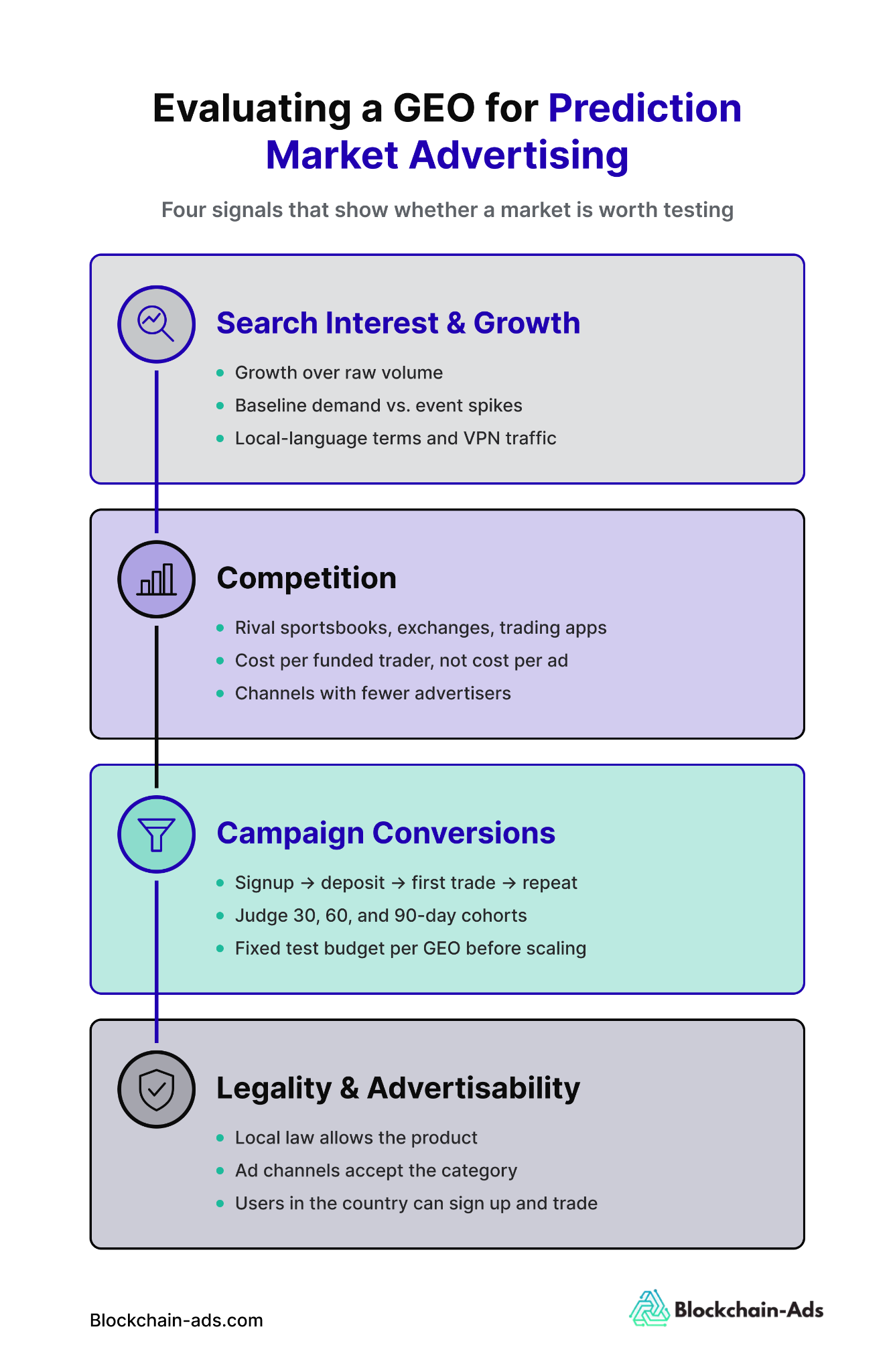
Here’s how these signals can help identify markets with meaningful demand and determine whether they are worth testing.
Search Interest and Growth
Search demand shows where prediction markets are gaining attention. When you look at this data, compare branded searches for Kalshi and Polymarket with event terms like election odds.
Here's why: branded searches signal intent to use a specific platform, while event searches come from a wider audience that hasn't chosen one yet.
When reading the data, focus on:
- Growth over volume: A mid-sized market growing steadily year over year is often a better test than a large one that has flattened.
- Baseline vs. spikes: Elections and major tournaments inflate searches for a few weeks. If one event drives most of a market's demand, plan a campaign around that window, not an always-on budget.
- Local-language terms: Platform names in English undercount demand in non-English markets.
- VPN traffic. Visits from countries where a platform is blocked can look like demand you can't legally acquire.
Competition
Competition decides what it costs to reach traders and hold their attention. Check the number of advertisers, CPMs, and CPCs, and how established the leading platforms are in each GEO.
Keep these three factors in mind:
- Competition beyond prediction markets: Sportsbooks, crypto exchanges, and trading apps target the same traders as prediction markets. Ad costs also go up quickly in the weeks before big events like elections or finals.
- Low ad costs vs. real value: Not always. Ads cost less in many emerging markets, but users there often deposit smaller amounts, so compare what it costs to get a trader who funds an account, not what it costs to show an ad.
- Fewer channels, fewer competitors: Fewer advertisers can compete. In markets where Google and Meta limit prediction market ads, crypto ad networks can still reach these users, often with less competition.
Where Your Own Campaigns Convert
Your campaign data shows whether demand in a GEO has commercial value. Track the path from registration to funded account, first trade, and repeat trading, then tie it to cost per funded trader and LTV.
Judge markets on 30, 60, and 90-day cohorts, since a GEO that looks expensive at signup can pay back well later.
Before cutting a weak market, check local payment options, KYC friction, and landing page language, because these often decide whether a signup ever deposits. Give each GEO a fixed test budget and a minimum number of funded accounts before you scale or drop it.
Legality and Advertisability
Demand doesn't decide whether you can advertise in a GEO. Before launch, confirm that:
- Local law allows the product, since countries classify event contracts differently, as financial products, as gambling, or as blocked outright.
- Your ad channels accept the category in that market.
- Your product lets users from that country sign up and trade.
A market that fails any one of these will waste budget, however strong its demand. Rules change quickly, so recheck each GEO before every major campaign. Keep restricted high-demand markets on a separate watchlist rather than in your launch plan, and confirm all legal and platform requirements independently.
Read more: Google Ads Prediction Market Policy: Who Can Advertise & How
The Top GEOs for Prediction Market Advertising by Demand
The countries below combine measurable prediction-market demand with large betting audiences who already understand odds and event outcomes. Brazil and India also show strong demand, but current restrictions put them on a watchlist, which we cover in the next section.
We ordered them by Polymarket and Kalshi organic traffic from Semrush, cross-checked with Ahrefs, and by monthly branded searches for Polymarket in each country. For Nigeria and Serbia, where traffic estimates are thin, we gave more weight to branded search, live event markets, and betting adoption.
Treat all traffic and search figures as directional estimates rather than exact visitor counts. Competition is our relative view of how contested each market is, not a tool score.
Monthly searches: Ahrefs average monthly searches for "polymarket," September 2026.
United States
The U.S. is the leading GEO for prediction market advertising, with the largest audience and the deepest activity across the major platforms. For most operators deciding where to allocate acquisition spend, it's the natural starting point.
Demand signal: The U.S. is the anchor market by a wide margin. In August 2026, it accounted for 72 percent of Kalshi's organic search traffic, with an estimated 307,300 organic visits. Polymarket recorded 663,400 organic visits from the U.S., representing 51 percent of its global organic traffic, according to Semrush.
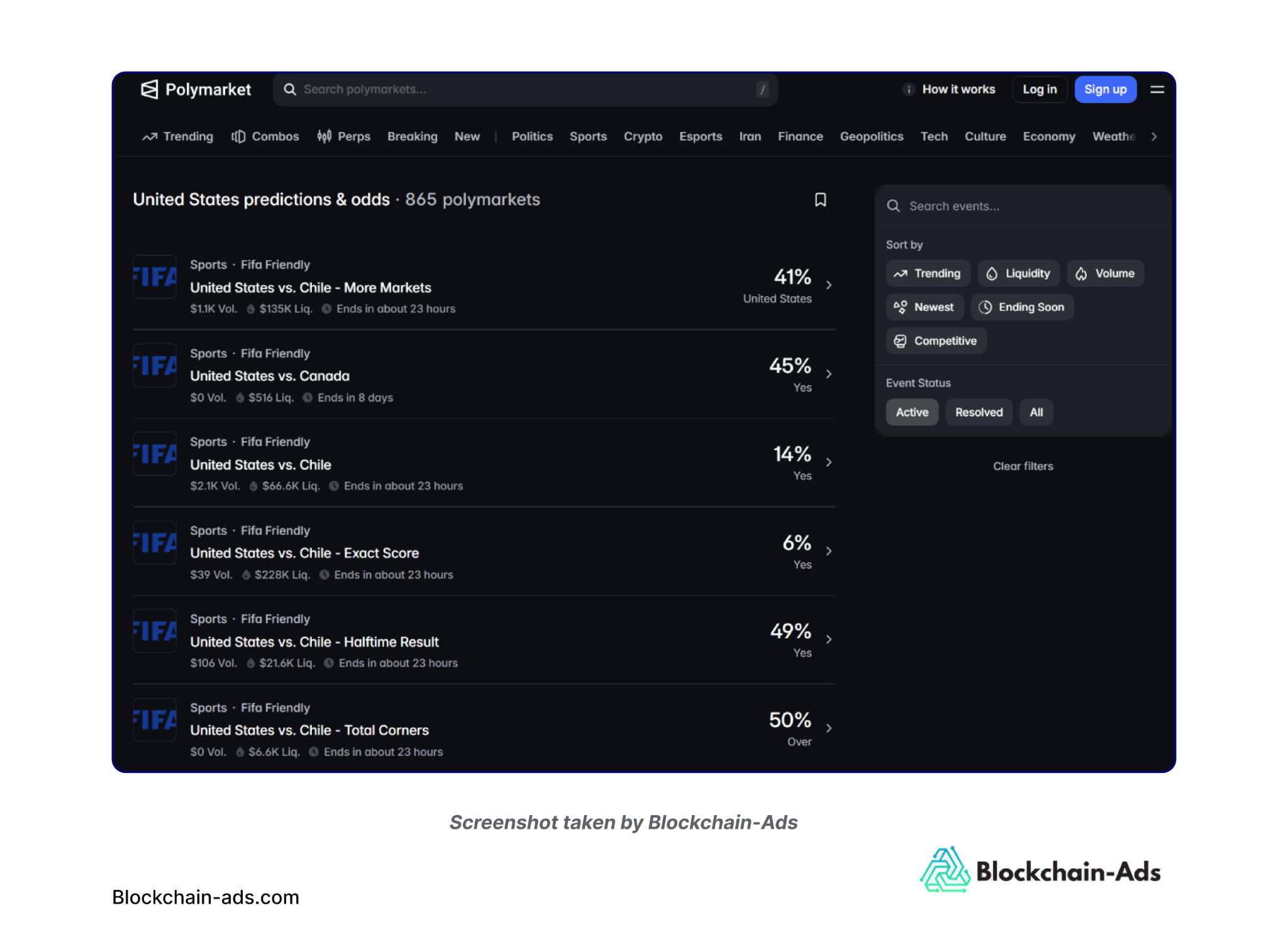
What drives it: The U.S. has the largest regulated sports betting audience in the world. Americans legally wagered $166.94 billion on sports in 2025, and sportsbook revenue rose 22.8 percent to $16.96 billion, according to the American Gaming Association.
That same sports audience drives prediction markets. Pew Research Center found that sports was the largest trading category on both Kalshi and Polymarket in June and July 2026, helped by the FIFA World Cup.
Why it's a top country to advertise in: The U.S. combines the largest audience pool on this list with sustained activity across multiple prediction-market categories. That gives operators enough demand to test different audiences, events, and creative angles, then measure which segments produce registrations, funded traders, and trading activity.
United Kingdom
The U.K. is a strong prediction-market GEO, with both Polymarket and Kalshi showing meaningful organic search activity from British users. Its long-established betting and exchange market means a large audience already knows how to trade on outcomes.
Demand signal: In August 2026, Polymarket ranked for 4,400 organic keywords in the U.K., while Kalshi ranked for 2,800. British users also search for Polymarket about 143,000 times a month, second only to the U.S., according to Ahrefs.
What drives it: Gambling is mainstream in Britain. In the Gambling Commission's survey for January to May 2026, 28 percent of adults had gambled in the previous four weeks, excluding lottery-only players. Sixteen percent of men and 4 percent of women had placed a bet.
Why it's a top country to advertise in: The U.K. combines measurable search demand with an audience already comfortable with event-based betting and exchanges. That shortens the path from interest to a first trade.
Germany
Polymarket attracts substantial organic traffic from Germany, and both major platforms rank for hundreds to thousands of relevant keywords.
Demand signal: In August 2026, Polymarket generated an estimated 41,600 organic visits from Germany and ranked for 2,700 organic keywords. Kalshi generated 5,700 organic visits and ranked for 946 keywords, according to Semrush.
What drives it: Germany has one of Europe's largest regulated gambling markets. The Glücksspiel-Survey 2025, run by researchers in Hamburg and Bremen, found that 36.4 percent of people aged 16 to 70 had gambled in the previous year.
Gross gaming revenue across permitted gambling held steady at €14.4 billion in 2025, according to the national regulator (GGL).
Why it's a top country to advertise in: Germany combines substantial organic traffic with broad keyword coverage on both platforms and a large, established gambling audience. That gives operators enough activity to test which campaign themes turn interest into registrations and funded traders.
Brazil
Brazil is South America's most populous country and one of Polymarket's largest organic audiences. In April 2026, regulators blocked Polymarket, Kalshi, and 25 other prediction-market platforms.
Demand signal: In August 2026, Brazil generated 98,700 organic visits to Polymarket, accounting for 8 percent of its organic traffic across the countries shown in Semrush's comparison. Kalshi recorded 9,800 organic visits from Brazil, up 243 percent over the previous period.
What drives it: Betting went mainstream in Brazil when its regulated market opened in 2025. Licensed operators reported that 25.2 million Brazilians placed bets that year, generating R$37 billion in gross gaming revenue, according to Finance Ministry data reported by Meio & Mensagem. Football anchors much of that activity.
Why it's on the watchlist: Brazil's demand is real, but offshore platforms can't legally acquire users there right now. Track local alternatives and recheck the rules before planning any campaign.
India
India has one of the largest betting audiences in the world, and it showed strong prediction-market demand before the 2026 restrictions.
Demand signal: In Semrush's late-2025 estimate, taken before the ban, India was Polymarket's second-largest traffic source, with 7.22 percent of visits. Similarweb data also placed India among Kalshi's five largest audiences in April 2026.
What drives it: Cricket drives most of the interest. A single IPL match on May 7, 2026, drew $27.7 million in trading across Kalshi and Polymarket, Bloomberg reported, though the data doesn't show how much came from inside India.
Why it's on the watchlist: India's cricket audience makes it one of the largest demand pools on this list. Since May 1, 2026, rules under the Online Gaming Act, 2025, prohibit online money games and restrict their advertising, so get legal advice before any activity here.
Nigeria
Nigeria shows more search interest in Polymarket than any other country in Africa. Its next presidential election, on January 16, 2027, is already drawing money on prediction markets.
Demand signal: Nigerians search for Polymarket about 16,000 times a month, according to Ahrefs, ahead of South Africa at 14,000 and Kenya at 7,300. Polymarket's market on the 2027 presidential election has traded more than $128,000 since it opened in June 2026.
What drives it: Football, politics, and crypto. In GeoPoll's 2026 survey, 54 percent of Nigerian respondents had placed a bet in the past 12 months, and football reaches 81 percent of bettors. Nigeria also ranks sixth in the Chainalysis 2025 Global Crypto Adoption Index, so many users already hold the stablecoins these platforms settle in.
Why it's a top country to advertise in: Nigeria pairs a large, crypto-literate betting audience with a clear event window. INEC moved the presidential vote to January 16, 2027, so campaigns can be planned around a fixed date. Start with small football and election-led tests, and scale once they produce funded traders.
No Nigerian law directly addresses prediction markets. Gaming licensing has sat with the states since a 2024 Supreme Court ruling, and gaming ads follow a unified framework agreed upon by ARCON and state regulators in 2026, so confirm both before launching.
Serbia
Serbia is a small country with a large interest in prediction markets. Its snap parliamentary election has pulled more than $800,000 into Polymarket's Serbia markets within weeks of being called.
Demand signal: Serbians search for Polymarket about 5,500 times a month, according to Ahrefs. For a population of under seven million, that's roughly double Germany's search rate per person.
That interest carries real money. By late September 2026, Polymarket's next prime minister market had traded more than $600,000, and its parliamentary winner market close to $190,000.
What drives it: A heated election on top of an everyday betting culture. Serbia votes on October 25, 2026, after nearly two years of protests. At the end of 2025, the country had 2,849 betting shops and 25 licensed online betting operators (Vreme).
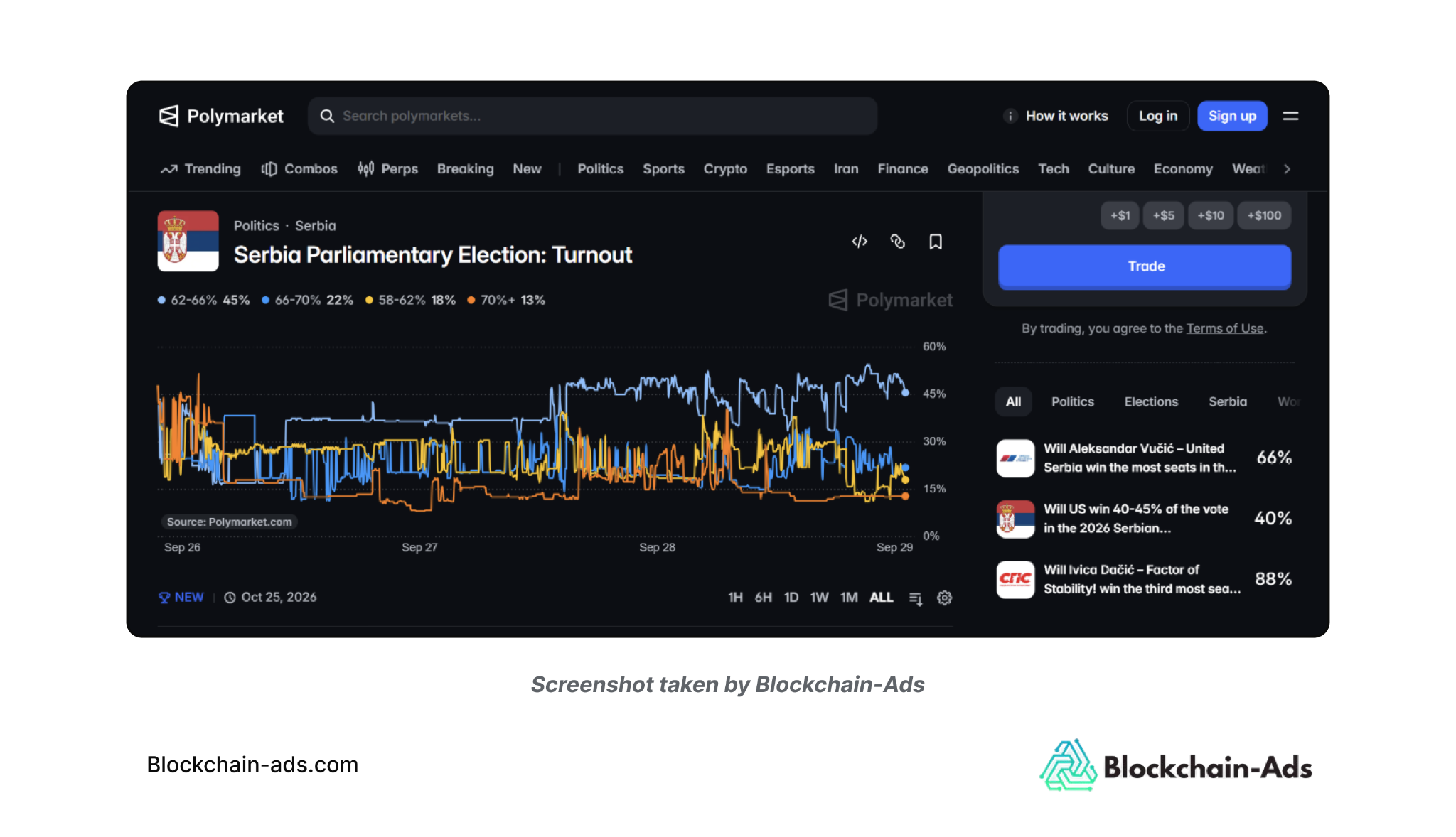
Polymarket’s turnout market for Serbia’s October 2026 parliamentary election. Source: Polymarket
Why it's a top country to advertise in: Serbia offers a live, heavily traded election in a market where few advertisers compete for prediction-market audiences. That makes it well suited to short, event-led tests around the vote.
Polymarket doesn't block Serbian users, but local law is stricter than that access suggests. Serbia prohibits taking part in unlicensed games of chance, and it isn't settled whether prediction markets fall under that rule, so confirm how your product is classified before launching.
How to Validate Prediction Market Demand in a GEO
Traffic data tells you where interest in prediction markets already exists. Only your own campaigns tell you where that interest turns into funded traders. Use these four steps to move from one to the other.
Reverse-Engineer Competitor Traffic
Run Kalshi and Polymarket through a traffic tool such as Semrush or Similarweb, and note which countries send them the most visits and how that changes over time. Countries that rank highly on both platforms make the strongest shortlist, because one platform’s audience mix can skew the picture.
Check Search Demand
Use Google Trends and keyword tools to see whether people in each GEO search for “prediction market” and for platforms like Kalshi and Polymarket. Look for consistency as well as volume. Steady interest supports ongoing acquisition in a way a one-week spike can’t.
Follow the Events
Prediction-market demand follows the event calendar across events like sports and politics. Sports is one of the biggest drivers; Pew Research Center found that sports became the largest trading category on both Kalshi and Polymarket in June and July 2026, as the FIFA World Cup pushed volume sharply higher. Elections do the same on a smaller scale; just recently, Polymarket opened markets in Serbia’s October 2026 parliamentary election weeks before the vote.
Track which GEOs respond to elections, tournaments, and central bank decisions, then check whether those spikes show up as registrations and trading on the platforms.
Run Small Test Campaigns
Your own campaign data is the final test. Run small campaigns across your shortlist and measure the full funnel: clicks, registrations, funded accounts, and trading activity. Give each test long enough to produce funded traders, not just clicks.
The GEO with the most clicks isn’t necessarily the one to scale. You’re looking for the market with the lowest cost per funded trader. For what to track and how to read the results, see our guide to measuring prediction market campaigns.
Scaling Your Prediction Market Advertising with Blockchain-Ads
Start by scaling bit by bit. Firstly, decide what a funded trader is worth to you, raise your spending a little at a time, and stop when you hit that number.
Before moving to target another country, maximize the one that works for you. Test new audiences and creatives, then scale the campaigns that perform around major events.
You can't do that one test at a time. That's why Blockchain-Ads lets you run up to 500 campaigns at once, with custom audiences by GEO and programmatic reach across web and in-app inventory worldwide. If you want the full playbook, our guide to prediction market media buying walks through it.
Request access to Blockchain-Ads and start scaling the GEOs you've validated.
Freelance content writer/editor for B2B SaaS, AI, technology, partnerships brands.
View full profile →