How to Test Prediction Market Ad Campaigns at Scale
Key takeaways
- Find the best combination of GEO, audience intent, and creatives that drive conversions.
- When structuring tests, keep conversion objectives constant, and don't call a test too early.
- Kill a campaign if it doesn't show enough conversion for its budget, traffic, and above-average CPA.
- Performance of a creative should always be checked against the event timeline.
Once you’re running dozens of prediction market campaigns at the same time, reading performance gets harder than launching the campaigns themselves.
Demand can change quickly as an event approaches, and the creative that looked weak earlier in the week can suddenly start converting. A broad audience may also give you cheap traffic while a smaller, higher-intent segment produces the traders you actually want.
You need to know which result to trust before you cut spend or put more money behind it.
For this guide, we spoke with Marko Rendevski, Head of Performance at Blockchain-Ads, about how he handles that problem across prediction market campaigns. His process starts by keeping the first tests focused.
“We usually start with the fundamentals: audience, GEO, and creatives. For prediction markets specifically, audience intent matters a lot, so we first want to understand which user segments are responding. Next, we look at which event or market angle is generating the strongest engagement.”
From there, Marko looks at whether those signals hold further down the funnel. He looks at how performance changes as the event gets closer and whether the chosen creative keeps working as you increase spend.
The rest of this article breaks down that testing and optimization process step by step.
Key takeaways:
- Find the best combination of GEO, audience intent, and creatives that drive conversions.
- When structuring tests, keep conversion objectives constant, and don't call a test too early.
- Kill a campaign if it doesn't show enough conversion for its budget, traffic, and above-average CPA.
- Performance of a creative should always be checked against the event timeline.
Why Prediction Market Campaigns Need a Different Testing Rhythm
Prediction market demand doesn’t move evenly. Interest often builds as an event approaches, which means the same campaign can look weak early and improve quickly as the event gets closer.
Marko sees this regularly:
“A campaign can perform poorly several days before an event and improve dramatically as interest increases closer to the event.”
That changes how you should read early results. A weak campaign three days before a high-interest event isn’t automatically a bad campaign. At the same time, “the event hasn’t peaked yet” can’t become an excuse to keep funding campaigns indefinitely. You need enough structure to separate bad targeting from bad timing.
Creatives also introduce another constraint. Prediction market ads often revolve around the same event, so audiences can see very similar messages repeatedly within a short window.
Marko and his team watch frequency, CTR, CPA, and conversion rate for signs that a creative is deteriorating. As the event approaches, they can also move the messaging from broader awareness toward something more immediate and event-specific.
Your prediction market advertising setup should make that shift possible without turning every change into a completely new test.
Start With Audience, GEO, and Creative
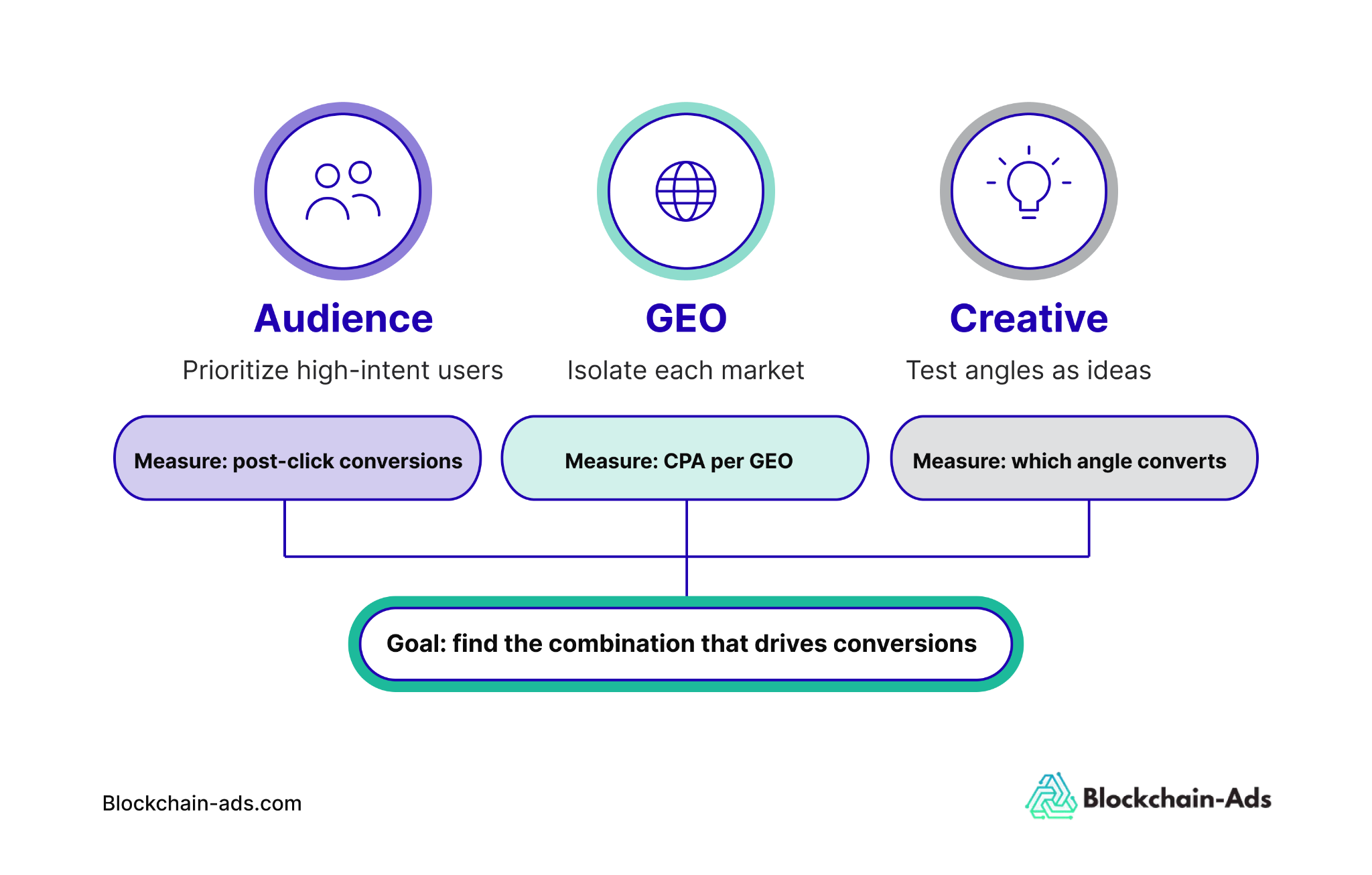
When there are hundreds of variables available in an ad platform, it’s easy to test the things that are easiest to change instead of the ones most likely to affect the result.
Marko keeps the first round simple:
“We normally avoid changing too many variables at once. The initial goal is to establish a baseline and identify which combination of audience, creative, and GEO is actually driving conversions.”
These three variables tell you most of what you need to know early. Below is a simple guide on how to get started with these variables.
Test Audience Intent Before Chasing Cheap Traffic
Prediction market audiences can look strong at the top of the funnel and fall apart after the click.
Marko shared a test where the broader prediction-market audience generated good traffic and engagement. Judging on CTR, it looked like the better campaign.
The conversion data told a different story.
“Once we had enough conversion data, the higher-intent audience was generating substantially better downstream results.”
The team shifted budget toward the audiences, GEOs, and creatives producing actual conversions rather than continuing to optimize around engagement. That’s the kind of signal your prediction market user acquisition strategy should prioritize.
CTR can tell you an ad attracted attention. It can’t tell you whether that person registered, deposited, funded an account, or completed whichever conversion your campaign was built to produce.
Keep GEO Differences Visible
Geography should be isolated enough that you can tell when it changes performance. If one campaign contains several GEOs, multiple audiences, and different creative concepts, a weak blended CPA won’t tell you much.
Marko’s team separates campaigns using variables such as GEO, audience, event, creative concept, and funnel stage. That makes it easier to see where the difference actually comes from.
You don’t need a separate campaign for every minor variation, but you do need enough separation to know when one market is pulling down the average.
Treat Creative as an Idea, Not a File
A useful creative test tells you which angle gives the audience a reason to act.
For one event, that might mean testing the event itself against a product-led angle. Another test may compare a broader market message with something more immediate as the event approaches. Marko’s team also rotates multiple creatives and messaging angles to curb ad fatigue as much as they can.
Hence, your prediction market ad creatives have two jobs. First, to generate conversions, and second, to tell you which message is worth carrying into the next round.
How to Structure Tests When You’re Running 100+ Campaigns
Once campaign volume climbs, organization becomes part of performance.
Marko’s advice here is straightforward:
“Campaigns are separated by clear variables such as GEO, audience, event, creative concept, and funnel stage.”
They also use standardized naming conventions and keep the primary conversion objective consistent wherever possible. That consistency is what makes comparisons useful.
If Campaign A and Campaign B differ only by audience, you can learn something about the audience. If they differ by audience, GEO, creative, event, placement, and conversion goal, you may know one performed better without knowing why.
A campaign naming convention should make the test obvious before someone opens the reporting view.
For example, it could identify:
- GEO
- Audience
- Event
- Creative concept
- Funnel stage
- Conversion objective
The exact naming format is less important than everyone using it the same way. Good prediction market media buying becomes much easier when an operator can move from campaign name to hypothesis to result without rebuilding the context every time.
Keep Conversion Objectives Consistent
Marko also recommends keeping the main conversion objective consistent wherever possible.
That prevents you from comparing a campaign optimized for registrations directly with one optimized for funded accounts as though they’re solving the same problem.
You can still use different events at different stages. A new campaign may need to optimize toward registrations because there aren’t enough bottom-of-funnel conversions yet. What matters is that you continue measuring what those registrations do next.
As Marko puts it:
“The closer we get to the bottom of the funnel, the more valuable the signal becomes. Registrations are useful, but deposits, funded accounts, or other primary conversions give us much more information.”
That should shape how much confidence you place in the result.
Don’t Call a Test Too Early
A few clicks don’t tell you much. Neither does a single conversion.
Marko typically waits for enough spend and conversion volume to see whether a pattern is consistent. He also compares the result with the campaign’s target CPA and historical benchmarks.
One useful rule is to look at how much the campaign has already spent relative to the expected CPA.
“If a campaign has spent several times the expected CPA without producing the intended conversion, that becomes a much stronger signal than simply seeing a low CTR.”
That doesn’t mean there’s one universal spend at which every prediction market campaign should be killed. The answer depends on where the campaign sits in the event cycle.
A campaign with healthy upper-funnel signals may deserve more time if interest is still building toward the event and conversions are beginning to come through. The same numbers may look much worse once the event has already entered its strongest demand window.
When measuring prediction market campaigns, the event timeline should therefore sit next to CPA and conversion volume rather than being treated as an afterthought.
Know When to Kill a Campaign
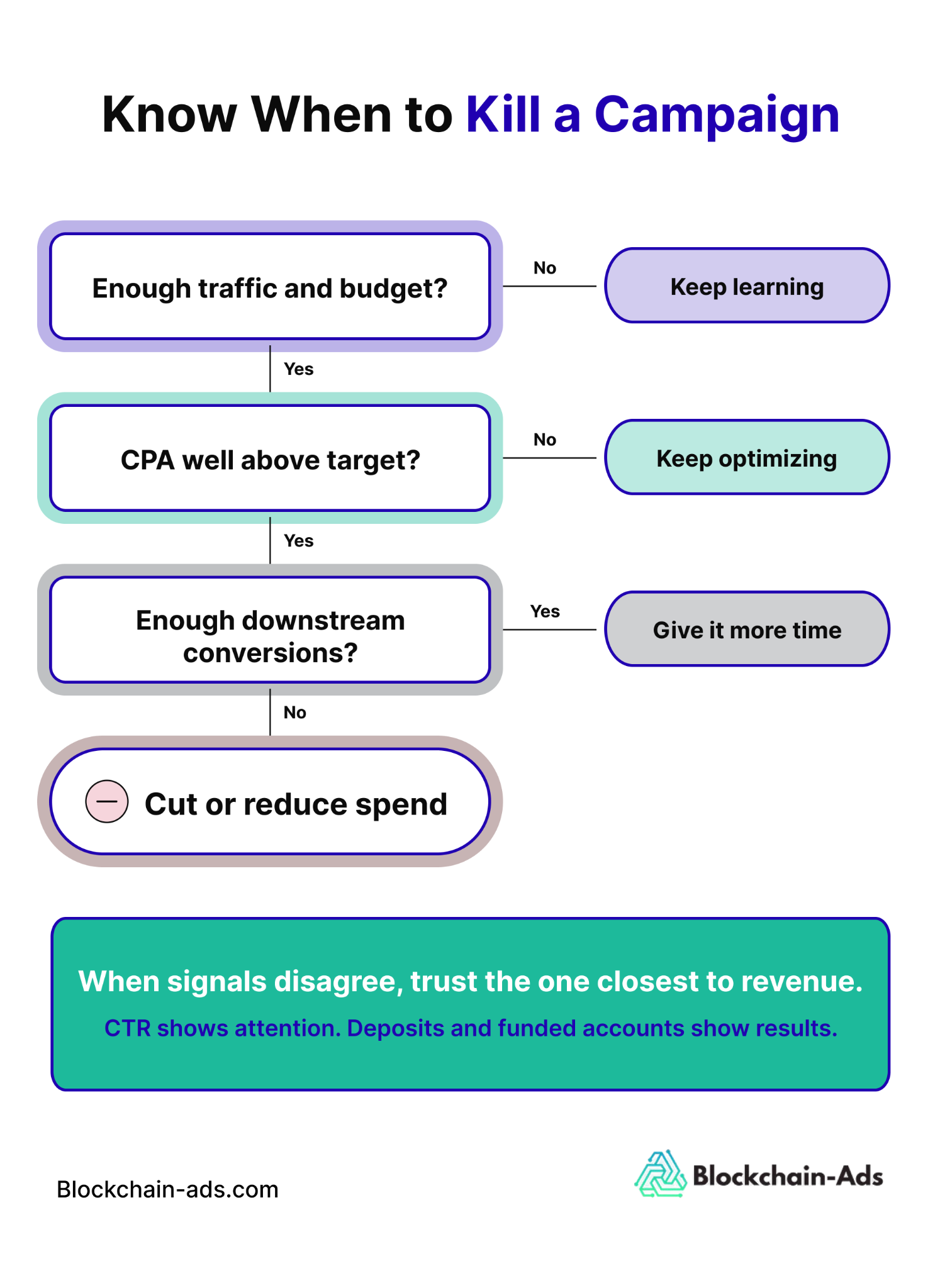
Cut or significantly reduce spend when the campaign has already received enough traffic and budget but still shows weak conversion intent. The biggest warning sign is usually a CPA materially above target without enough downstream conversions to justify giving the campaign more time.
Healthy upper-funnel metrics can earn some patience, especially during the learning period. But they shouldn’t override what’s happening further down.
The broad-audience test Marko described earlier is a good example. Engagement suggested one winner, while conversion data showed another.
“The main learning was that with prediction markets, engagement can be misleading.”
A strong CTR can make a weak campaign feel productive for much longer than it should. The closer the metric sits to revenue or funded activity, the more weight it should carry when signals disagree.
Scale When Performance Starts to Repeat
Marko doesn’t treat one cheap run of conversions as enough evidence to scale.
“The strongest signal is repeatability.”
That means conversions keep coming in, CPA stays inside an acceptable range, and the audience is large enough to absorb more spend. Performance also needs to hold as the budget rises.
Marko also looks beyond one creative or placement.
“If multiple creatives, audiences, or inventory sources are producing conversions around the same event or offer, that gives us much more confidence. It suggests we’re seeing genuine demand rather than a temporary spike.”
That distinction becomes important with prediction markets because a hot event can make almost everything around it look better for a short period. If only one creative on one placement is producing the result, you may have found an isolated winner. When several combinations convert around the same event or offer, you have more evidence of real demand to scale into.
Increase Budget Gradually
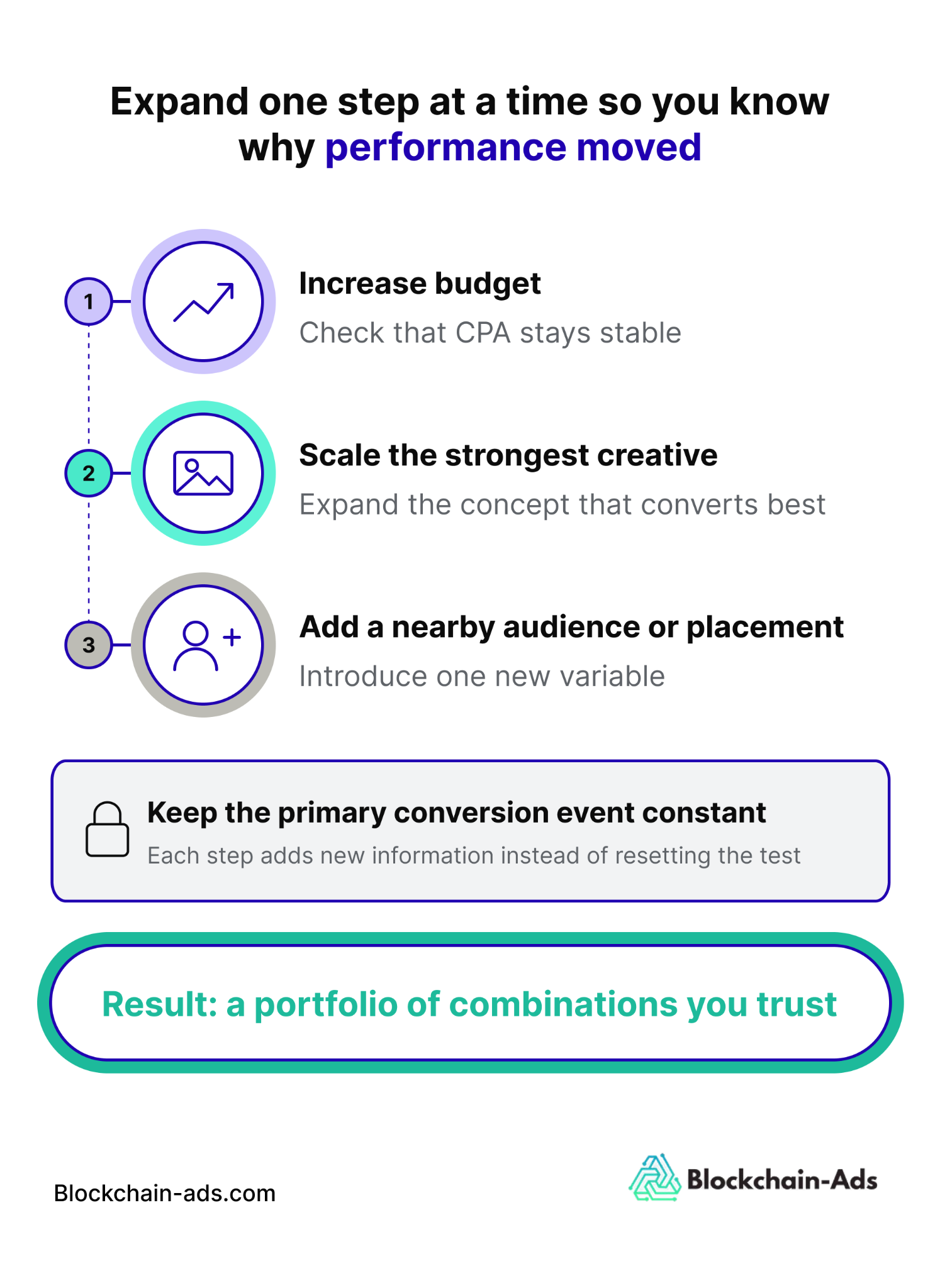
Once you find a combination that repeatedly converts, protect what you learned. Don’t immediately open five new GEOs, swap the creative, change the audience, and double the budget. Expand deliberately enough that you can still tell why performance moved.
You might increase budget first and see whether CPA stays stable. Then expand the strongest creative concept. Another step could introduce a nearby audience or another placement.
Keep the primary conversion event constant while you do it. That way, each expansion produces new information instead of resetting the test.
At a larger scale, this process becomes less about finding one perfect campaign and more about building a portfolio of combinations you trust. Some will be tied to one event. Others will reveal an audience, message, or placement pattern that keeps working across several markets.
This second group is where the most valuable insights emerge.
Read Creative Performance Against the Event Timeline
Creative performance also has to be read against the event timeline. The same audience and ad can behave very differently depending on how much time remains before the market closes.
As Marko explains:
“We therefore look at performance relative to the event timeline rather than treating every day equally.”
If CTR and conversion rate jump two days before an event, the creative may not have improved. Interest in the event may simply be peaking. The same thing happens in reverse once attention moves on.
That makes creative fatigue harder to read in isolation. Frequency, CTR, CPA, and conversion rate still matter, but they make more sense when you know where the campaign sits in the event cycle.
The messaging should move with that cycle too. As Marko puts it:
“As the event gets closer, we can also shift messaging from broader awareness toward more immediate, event-specific messaging.”
The goal is not to force one creative concept to last from early awareness through the final hours. Adjust the message as intent builds, then retire it when the event no longer gives traders a reason to act.
Automation Should Narrow the Field, Not Replace Judgment
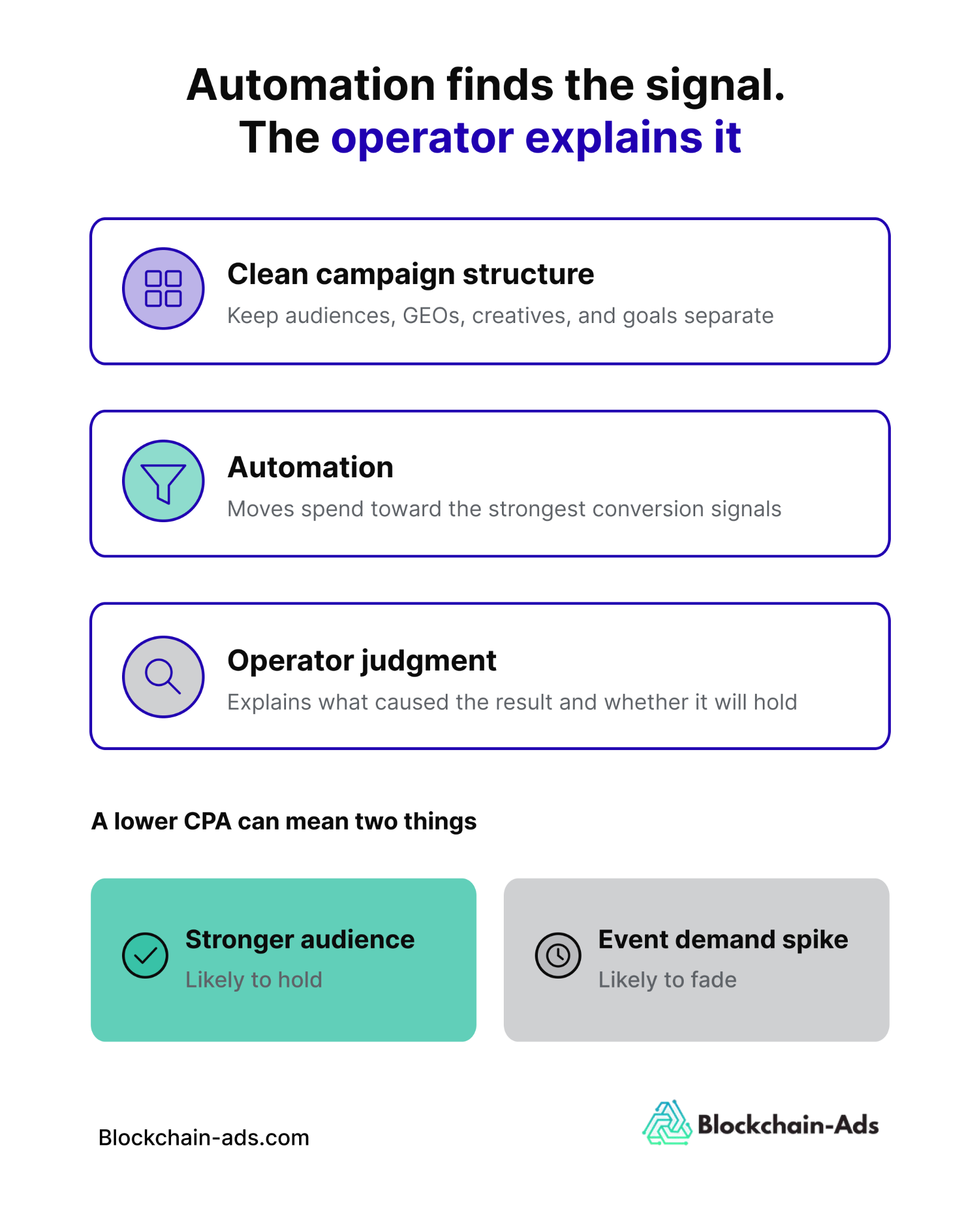
At 100+ campaigns, optimizing everything by hand becomes a poor use of the performance team.
Marko says automation becomes more useful at that scale because it can gradually move spend toward the audiences, creatives, GEOs, and placements, producing stronger conversion signals. But it can only act on the signals available.
A lower CPA might come from a genuinely stronger audience or from a temporary spike in demand as an event approaches. The system can respond to the performance difference, but the operator still has to understand what caused it and whether it will hold.
That is why clean campaign structure comes first. If audiences, GEOs, creatives, and conversion goals are mixed, automation simply moves money around without giving you a clear reason for the result.
Testing at Scale With Blockchain-Ads
Blockchain-Ads supports up to 500 campaigns per account. This gives you room to separate audiences, GEOs, events, creatives, and funnel stages instead of blending them into a few large campaigns.
The campaign count itself is not the advantage. The useful part is isolating the variables you want to test while keeping enough structure to compare results.
Once that structure is in place, automation can direct more spend toward combinations producing stronger conversion signals. The performance team can then focus on the decisions automation cannot make. This includes whether a campaign needs more time, whether an event is driving the result, and whether a winning ad still holds up as the budget increases.
For operators managing that level of campaign volume, Blockchain-Ads provides the targeting, campaign capacity, and optimization tools to run those tests without collapsing the results into one blended view.
Nathan Ojaokomo is a B2B SaaS writer and content strategist specializing in SEO, product-led content, and AI search.
View full profile →