Prediction Market User Acquisition: The 6-Step Framework
Key takeaways
- Set the goal: Make the funded first trade your acquisition event, then price CAC against what a trader earns across several event cycles.
- Track first: Fire separate events for KYC, deposit, and first trade before spending, so you can see which step is losing traders.
- Build audiences: Start from traders who already fund and keep trading, then narrow to the ones with a live event worth acting on.
- Feed creative: Run a production process that turns each live event into several angles, and refresh before the market resolves.
- Test and scale: Compare what persists across events, then raise budget only after a cohort has had a full event cycle to show its quality.
Prediction market demand arrives in waves. An election, a title fight, or a Fed decision pulls in a surge of new traders, then attention moves on. That standard is what makes acquisition the hardest part of a prediction market marketing strategy to get right. It has to keep producing as the events driving demand change.
Prediction market user acquisition isn’t as easy because registrations are a weak measure of whether it's working. The outcome that matters is a funded first trade, followed by a trader who returns for the next market. Everything upstream should be judged against that.
Getting there takes a system, and that’s what we’ll cover in this article. You need a conversion event that matches the campaign goal and tracking that shows what happens after the click. You also need audiences built around traders who fund and creative that move as fast as the events do.
Here's the framework in short:
- The funnel: Awareness → consideration → conversion → retargeting and re-engagement
- The economics: CAC measured against trader LTV, not against registration volume
- The six steps: Set the goal → build attribution → define audiences → build creative → test → scale
- The rule: Match the conversion event to the campaign goal, then scale only once trader quality is clear
Read: What Are Prediction Markets? How the Industry Works
What is prediction market user acquisition?
Prediction market user acquisition is the process of turning relevant audiences into funded traders who keep trading across events. And it's very important the traders are funded; here’s why.
Someone can register, stall at KYC, and never place a trade. They've entered your funnel, but they haven't produced the behavior your media budget was spent to generate. So the funded first trade becomes your acquisition event, which your campaigns should optimize toward.
The distance from registration to a funded trade is unusually long in prediction markets. A trader often signs up because one event caught their attention, then waits for a market worth acting on. Onboarding stretches the delay further, whether that means regulated verification or funding a wallet.
Now this doesn't mean earlier conversions do not matter. For instance, registrations and KYC completions tell you where in the delay traders fall out. These early conversions also give ad platforms enough volume to work with while funded trades are rare.
You can use the early data you get from your campaign to diagnose and to train, but judge the campaign on what those sign-up fund accounts are.
Why prediction market user acquisition is getting harder
Pew Research Center put combined monthly trading volume on Kalshi and Polymarket at about $24 billion in April 2026, up from under $5 billion eight months earlier.
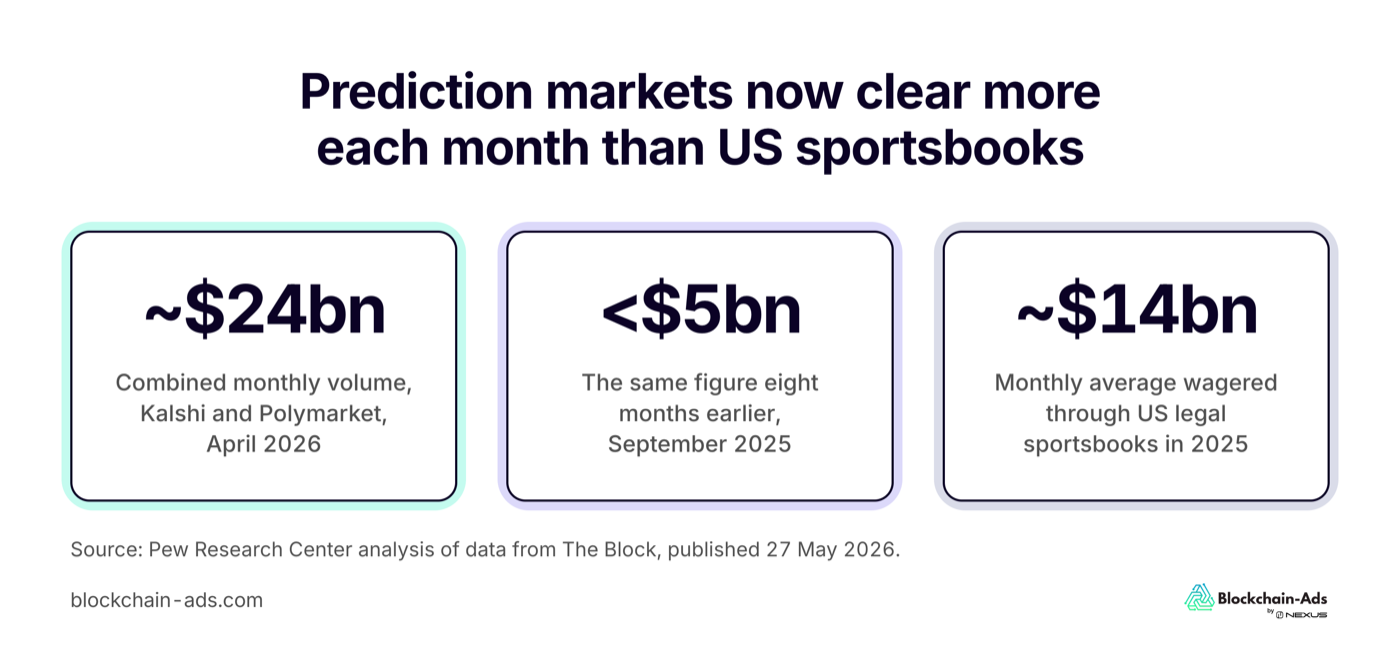
Sports, politics, and cryptocurrency accounted for most of it, each category moving with its own events rather than on a steady curve.
Whatever is pulling traders in this month gives way to a tournament, a rate decision, or an election within weeks. Your message has roughly that long to work before the reason behind it expires. Campaigns built around a single evergreen angle spend most of the year slightly out of step with what traders are actually watching.
In March 2026 the CFTC opened a rulemaking process covering event contracts, and followed it with a proposed rule in June. The perimeter you advertise inside can shift while a campaign is still running.
Acquisition in this category has to absorb a demand curve set by the calendar and a compliance perimeter that can move underneath it. That favors a system you adjust over a campaign plan you rewrite every quarter.
The prediction market acquisition funnel
Most acquisition funnels begin with someone looking for a product, and this one begins with an event. A trader follows an election, a title fight, or a rate decision, then works out where they can take a position on it. Your funnel opens somewhere you don't control, and that shapes every stage after it.
Awareness
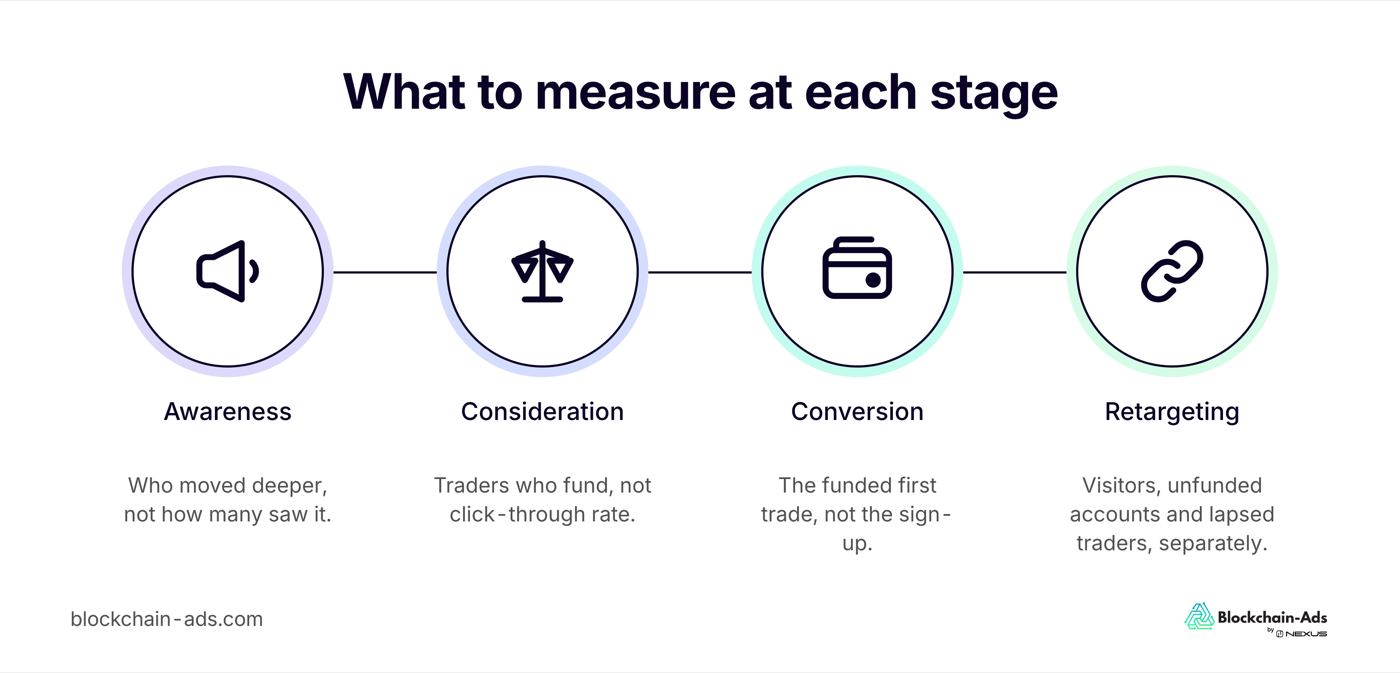
The creative has an easier job when it opens on something the audience already follows. Rather than building interest in a new platform, it connects an interest that exists to the fact that the outcome is tradable. Repeated exposure across a run of events builds familiarity with the market and the operator together.
Reach around a big event can produce a lot of attention and very few traders. Judge awareness campaigns by the quality of the people they move deeper rather than the size of the audience they touched.
Consideration: Give the Trader Enough Reason to Evaluate Your Platform
Once someone understands they can trade on an event, the decision becomes more practical. They weigh liquidity, fees, payout structure, and how hard it is to fund an account before they create one. Trust carries more weight here than in most categories, because the trader needs confidence the contract will settle fairly.
The ad doesn't have to answer all of that. Its job is to bring the right trader into the evaluation with enough context to continue. Click-through rate reads poorly at this stage, because a cheap click from someone who will never fund costs the same as an expensive one.
Conversion
Account creation opens the conversion stage, and the first funded trade closes it. The distance between them holds most of the useful diagnostic information.
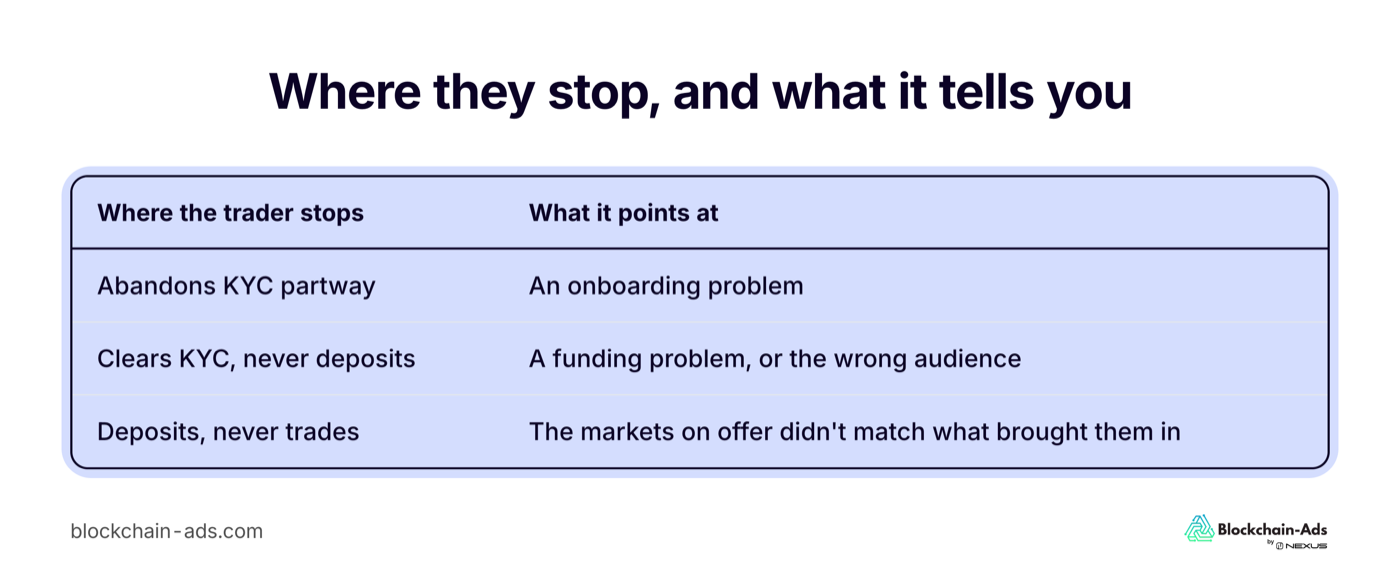
A campaign can produce plenty of sign-ups and very few funded trades, and the fix depends entirely on where those traders stopped. For example, traders abandoning KYC halfway could point to an onboarding problem. Accounts that clear KYC and never deposit point at a funding problem or the wrong audience.
Furthermore, deposits that never turn into a trade suggest the markets on offer didn't match what brought that trader in.
Retargeting and Re-Engagement: Use New Events to Bring Traders Back
The first trade shouldn’t be the last useful signal in the funnel. New events give operators recurring opportunities to bring back people who visited without registering, created an account without funding, or previously traded and later became inactive. Good prediction market retargeting should reflect those different states rather than treating every previous visitor as the same audience.
Sustained trading also builds the LTV that supports acquisition. If traders acquired through one campaign continue returning for relevant markets, you can evaluate that source differently from one that produces a similar first-trade CAC but weak retention.
The 6-Step Prediction Market User Acquisition Strategy
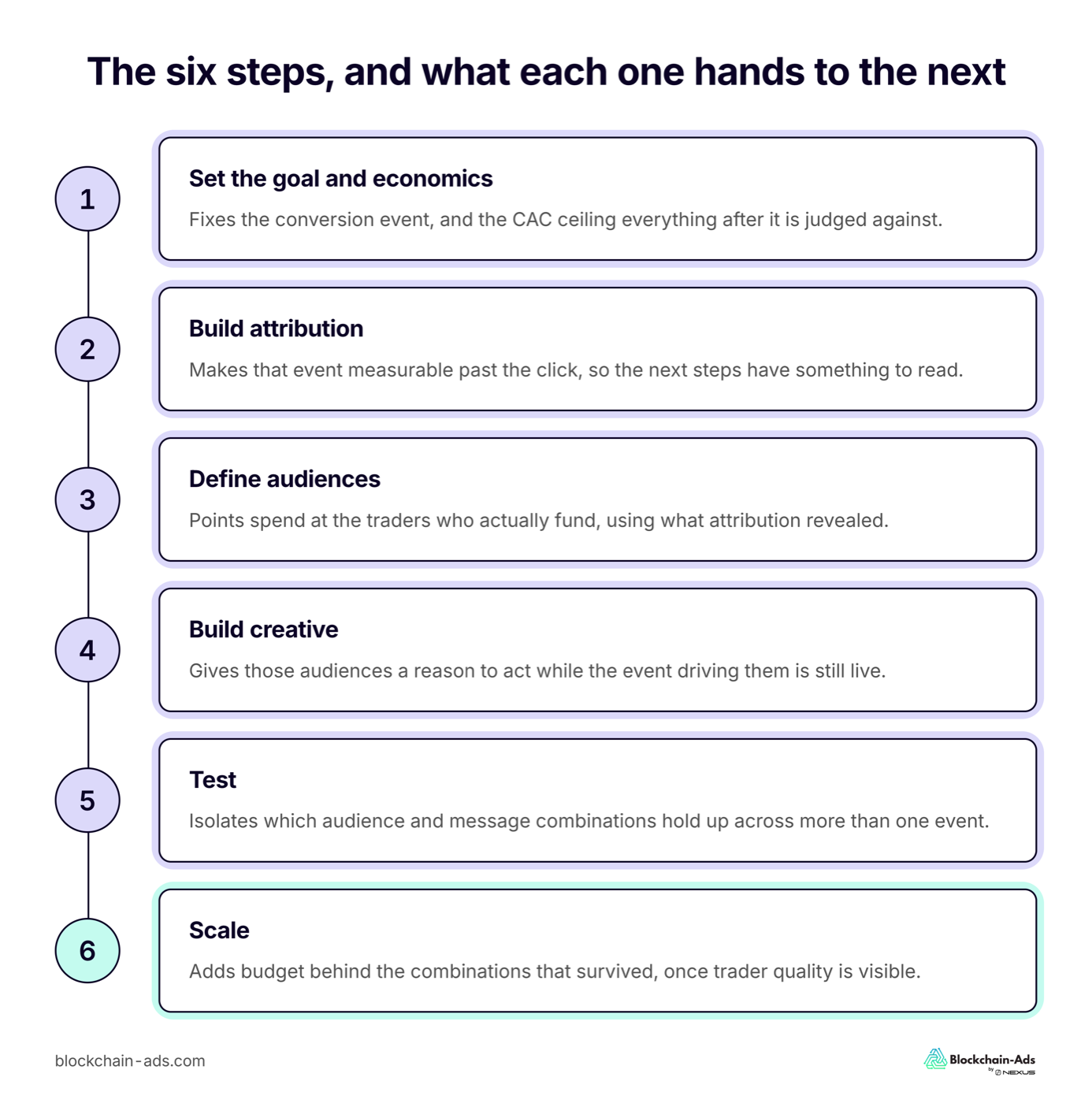
The six steps below describe what you build, and the order matters because each supplies what the next one needs.
1. Set the goal and acquisition economics
Every campaign needs one action it is responsible for producing. Awareness campaigns answer for whether the interest they generate shows up in later conversions. Performance campaigns should sit on registration, funding, or the first trade, depending on how much volume you have at each.
Once the action is fixed, the cost you're willing to pay for it follows.
CAC = acquisition costs ÷ new traders acquired
The word carrying the risk in that formula is "acquired." Cost per registration and cost per funded trade both tell you something real, but they answer different questions. A CAC quoted without saying which one it measures is close to useless.
LTV is what tells you whether that cost is sustainable, and it behaves unusually here. Trader revenue arrives in bursts tied to the events they follow. Someone acquired during an election cycle can produce nothing for months, then a great deal in a single week.
Measuring payback in calendar months will make those cohorts look worse than they are. Measure across event cycles instead, and set the acquisition ceiling from what a trader produces over several of them.
2. Set up Conversion Tracking and Attribution Before Launch
You need to know which campaign produced a registration and what that trader did next. Fire separate events for KYC start, KYC completion, first deposit, and first trade. The campaign can then optimize against whichever has enough volume while you watch the steps further down.
Keep attribution windows and conversion definitions consistent across campaigns and channels. Otherwise a measurement difference reads as a performance difference, and you shift budget on the strength of a reporting artifact.
Blockchain-Ads tracks attribution across eight dimensions and follows performance past the click into sign-ups and deposits. That matters most when a campaign looks efficient at the top of the funnel and produces weak traders underneath it.
Build this before the first significant spend. Traffic you can't connect to later actions still costs money and tells you nothing usable for the next budget decision.
3. Build Audience Segments Around the Traders You Want
Start from your strongest existing traders rather than the targeting menu in the ad platform. First-party data will show which geographies, interests, behaviors, and acquisition sources cluster around traders who fund and keep trading. Where wallet activity is relevant, on-chain behavior adds a signal web and app data can't give you.
Event relevance narrows it further. Someone can match your trader profile exactly and still have no interest in the contract you're promoting this week. The segment worth paying for sits where a valuable profile meets a live event that gives that person a reason to act now.
Blockchain-Ads combines behavioral, interest, geographic, and wallet data in a single audience, so on-chain behavior sits alongside broader web and in-app signals rather than in a separate campaign.
[Screenshot: building an audience in the Blockchain-Ads hub with behavior, interest, geographic, and wallet data combined]
Keep the first few GEO tests tight. Changing country, audience, and message at the same time leaves you with a performance drop and no way to attribute it.
4. Build a Creative Engine Around Live Events
Prediction market creative has to move at roughly the speed of the events being traded. A quarterly batch of generic ads leaves you with nothing to say when attention moves. What matters is a production process that turns a live event into several usable messages while interest is still high enough to spend against.
Each creative should connect the event to an action available on your platform in language that survives compliance review. Variation also tells you why an audience responded, which a single winning ad never will.
Test different ways into the same market. The event itself, what's available to trade on it, the product experience, and a specific offer are four distinct angles. Knowing which one brings in better traders is worth more than another dozen near-identical variants.
Refresh before momentum goes. Once a market resolves or attention moves elsewhere, the message ages faster than the reporting will show you.
5. Test Messages and Audiences at Enough Scale to Learn
A useful test isolates enough of the campaign that you can explain why performance changed. Keep audience and message combinations distinct, then compare them on the conversion event tied to the campaign goal. Judging on CTR rewards ads that collect attention from people who will never fund.
The harder problem here is time. An event-led test has a deadline set by the market itself, and many markets resolve before a campaign gathers enough funded trades to read confidently. So test the things that persist across events, such as audience definitions, creative angles, and landing page treatment. Treat individual events as the conditions a test runs under rather than as the variable being tested.
Give each test enough spend and conversion volume to say something. Once the same audience or angle holds up across several events, you have a case for more budget behind it.
6. Scale Only After Trader Quality Is Clear
Volume alone is a weak reason to raise spend. If the campaign optimizes for registrations, check funding rate and first trades in that cohort before you add budget. When the funded first trade is already the event, look further down into repeat trading, volume per trader, and retention across the next event cycle.
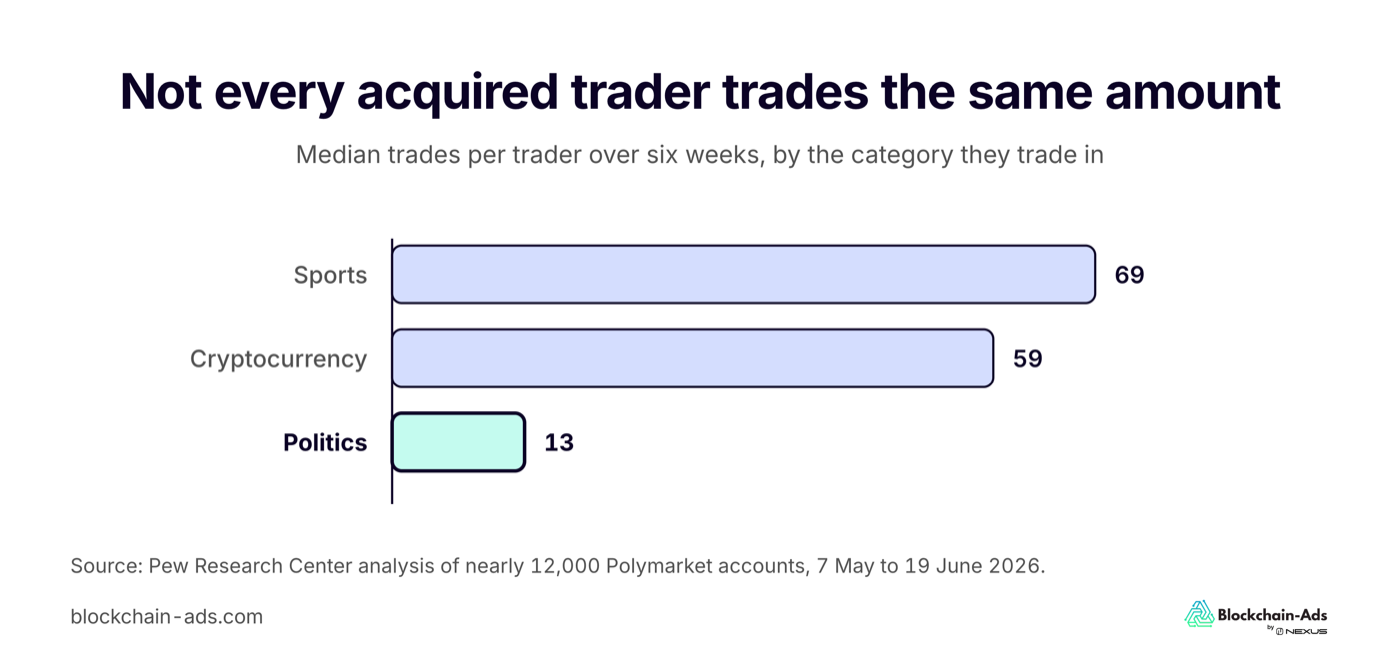
That check needs time to be worth anything. A cohort acquired this week has not yet had a second event to come back for. A funded-trade CAC that looks excellent on day three can still sit on traders who never return. Waiting one full event cycle before scaling a source costs less than scaling a cheap one that produces nobody.
When the signals disagree, the deeper one wins. A source with higher CAC and better repeat trading usually beats a cheap one with neither. The cheap source also gets more expensive as you scale it, since the easiest conversions go first.
Common Prediction Market User Acquisition Mistakes
Several acquisition problems come from moving to the next stage before the previous one is working.
Optimizing for a Metric That Doesn’t Match the Goal
Registration CPA can look healthy even when very few of those users ever fund an account. Choose the conversion event based on what the campaign is supposed to accomplish. When you need an earlier event for optimization volume, keep evaluating the cohort against the deeper actions that determine trader value.
Expanding Into Too Many GEOs at Once
Broad geographic expansion can increase reach quickly while making weak performance harder to explain. Prove enough of the audience, message, and conversion path in a smaller set of markets before adding more. You can then compare new GEOs against an existing baseline rather than introducing another variable into an already noisy campaign.
Launching Before Attribution Is Ready
Campaign data loses much of its value when you can see spend and registrations but can’t connect them to funding or trading. Set up the events, naming conventions, attribution rules, and internal reporting before the first significant media spend goes live.
Producing Too Little Creative
Event-led acquisition needs more than a handful of evergreen assets. Creative should change as the markets receiving attention change, while stronger evergreen messages can remain in rotation where they continue producing good traders. Without enough variation, you can’t tell whether an audience is weak or the message simply failed to give that audience a reason to act.
Scaling Before You See Quality Signals
Early conversion volume can make a campaign look ready for more budget before you know whether the cohort is valuable. Give downstream behavior enough time to emerge. Funding rate, first trades, repeat activity, and LTV can change the story your top-of-funnel CAC tells.
How to scale prediction market user acquisition
Scaling should increase the reach of a proven acquisition system, not compensate for one you haven’t figured out yet.
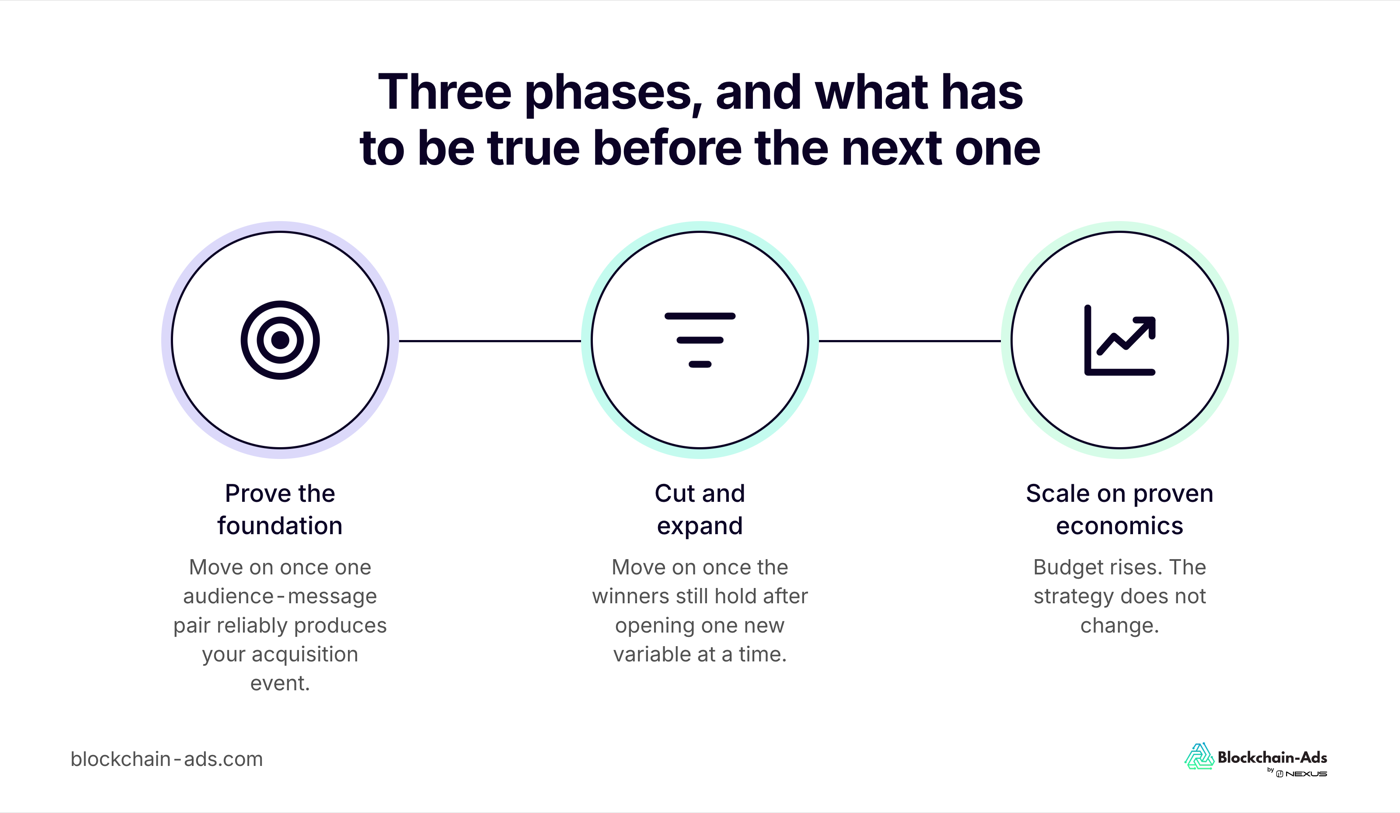
Phase 1: Prove the Foundation
Start with a focused set of audiences, GEOs, and campaigns. At this stage, your goal is to establish attribution, confirm traders can move through the conversion path, and build a repeatable creative process. You will also need to identify at least one audience-message combination that can produce your target acquisition event.
Keep your prediction market media buying narrow enough to still identify what’s driving the result. Budget alone doesn’t define when you’re ready for the next stage. Move forward when the data starts producing repeatable signals.
Phase 2: Cut Weak Combinations and Expand the Winners
Once you’ve seen enough data, cut the campaigns that keep producing weak traders and put more budget behind the combinations that hold up further down the funnel. From there, expand one variable at a time.
That might mean testing a new audience, opening another GEO, and building more creative around a proven angle. You could also add a channel like prediction market affiliate marketing where payouts can be tied to verified trader actions instead of clicks.
Keep an eye on the economics as you go. An audience that looks efficient at a small scale can get more expensive once the easiest conversions are gone.
Phase 3: Scale Around Proven Trader Economics
Larger acquisition programs need the same discipline with more moving parts. By this point, you should know which audiences consistently fund and trade, which event categories produce stronger acquisition windows, which messages convert those traders, and how much CAC your LTV can support.
Increase spend where those signals remain intact, then add reach without losing attribution. Retargeting and re-engagement become more valuable as the acquired trader base grows because you have more users to bring back when relevant markets open.
The budget can rise substantially while the strategy stays the same. It starts with finding people with a reason to trade, moving them toward a funded first trade, and measuring cohort quality. You can then put more money behind what continues to produce value.
Build the Acquisition System Before Increasing Spend
Strong prediction market user acquisition starts with a clear definition of the trader you want to acquire and the economics that make that acquisition sustainable. So, get the basics working before you scale. This includes attribution, audiences that reflect the traders you actually want, enough creative to keep up with changing events, and conversion tracking tied to the campaign goal.
Blockchain-Ads fits into that setup when you need to combine behavioral and wallet-based targeting with deeper attribution and larger-scale testing. Once you can see which campaigns are bringing in traders who fund and keep trading, budget decisions get much easier.
Nathan Ojaokomo is a B2B SaaS writer and content strategist specializing in SEO, product-led content, and AI search.
View full profile →