Google Ads Prediction Markets Policy: Who Can Advertise & How

Google Ads prediction markets access is available in the U.S., but only for qualifying operators. To run ads, your business must meet Google’s regulatory requirements, target an approved location, and receive Google certification before launching campaigns.
For operators, the first question is whether your platform, target market, and products qualify. This guide breaks down those requirements and how to get approved, prepare compliant campaigns, and choose another prediction market advertising route if Google Ads isn’t available to you.
Google Ads prediction market policy at a glance
- Live since: January 21, 2026.
- Where: United States, excluding Michigan, Nevada, New York, and Ohio.
- Allowed: Qualifying CFTC-authorized Designated Contract Markets (DCMs) and NFA-authorized brokerages.
- Required: Google certification and any applicable financial, commodity, or gaming licenses.
- Not eligible: Operators that don’t meet Google’s regulatory and certification requirements, the four excluded U.S. states, and markets outside the United States.
Can you advertise prediction markets on Google Ads?
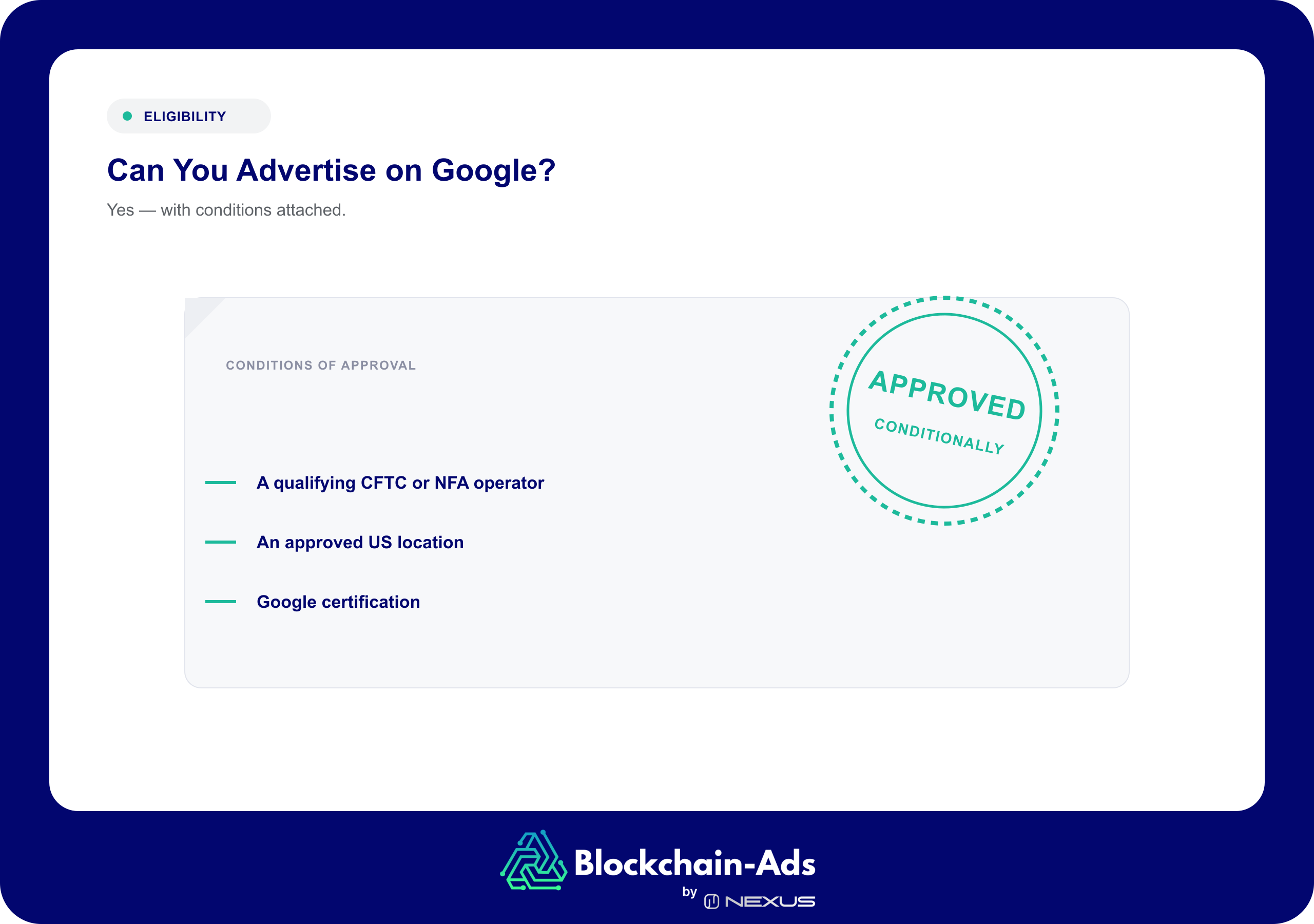
Yes. Google has allowed ads for qualifying prediction market operators since January 21, 2026, but only under its prediction markets policy.
Google’s prediction market advertising policy covers platforms that list or provide customer access to exchange-listed event contracts related to economics, sports, or current events. Google limits these ads to approved U.S. locations and requires the advertising account to receive certification and approval before running them.
Being a prediction market operator doesn’t automatically make you eligible for Google Ads. Your regulatory status, target locations, licenses, and the products you plan to advertise all affect whether you can run a campaign.
Who can run ads for prediction markets on Google?
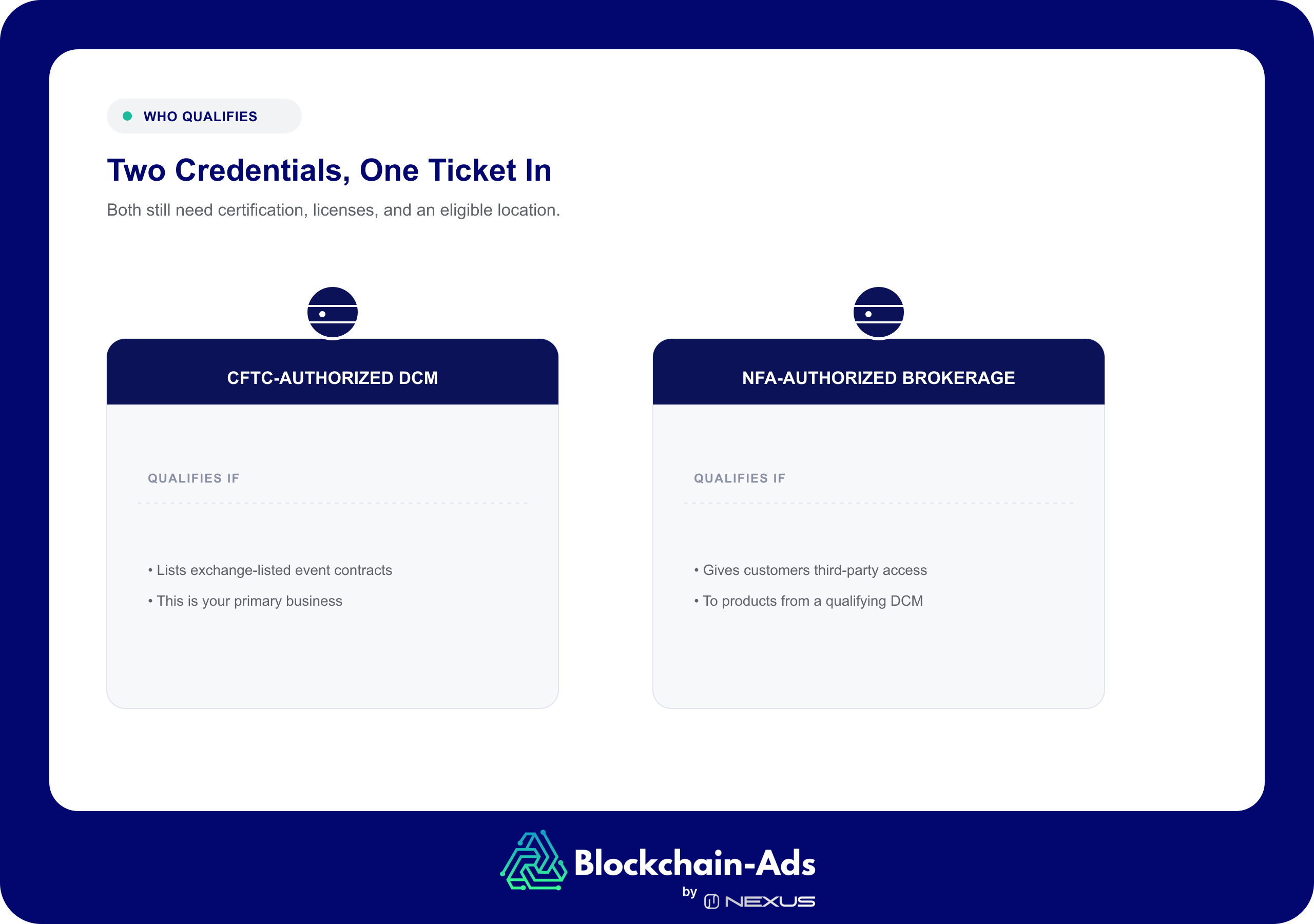
Google limits prediction market advertising to two types of federally regulated operators in the U.S. You can qualify if your business is:
- A CFTC-authorized Designated Contract Market (DCM) whose primary business is listing exchange-listed event contracts.
- An NFA-authorized brokerage that gives customers third-party access to products listed by a qualifying DCM.
In both cases, you also need Google certification before you can run prediction market ads. Google further requires prediction market providers to hold any applicable local financial, commodity, or gaming licenses for the locations they target.
Prediction market advertising isn’t currently supported outside the United States. Qualifying operators can advertise in approved locations across the U.S., except in:
- Michigan
- Nevada
- New York
- Ohio
Operators that don’t fall into either qualifying regulatory category, don’t receive Google certification, or want to target unsupported locations can’t run prediction market ads.
Before targeting an eligible state, check whether additional financial, commodity, gaming, or other local licensing requirements apply to your business and the products you want to promote. Google’s financial products and services policy requires you to comply with the regulations that apply in the locations you target.
Which prediction market ads aren't allowed on Google?
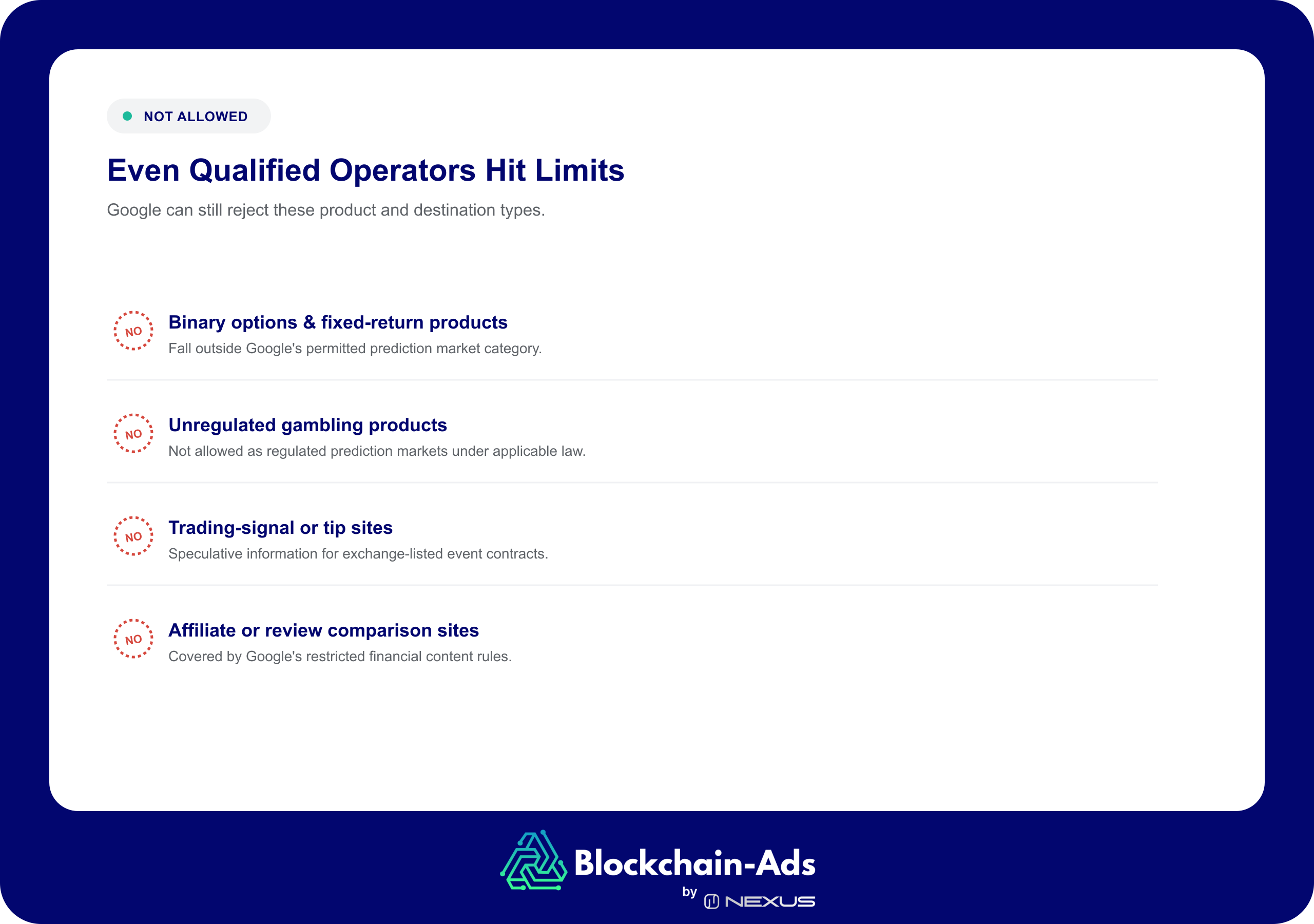
Even if your business qualifies to advertise, Google can still reject ads for certain prediction market products or destinations. Its current policy doesn’t allow ads for:
- Binary options and similar fixed-return products that fall outside Google’s permitted prediction market category.
- Online gambling products or services that are not allowed as regulated prediction markets under applicable law.
- Sites that provide trading signals, tips, or speculative information for exchange-listed event contracts.
- Affiliate or review sites that promote or compare brokers or prediction market services in ways covered by Google’s restricted financial content rules.
How to get approved to run prediction market ads on Google
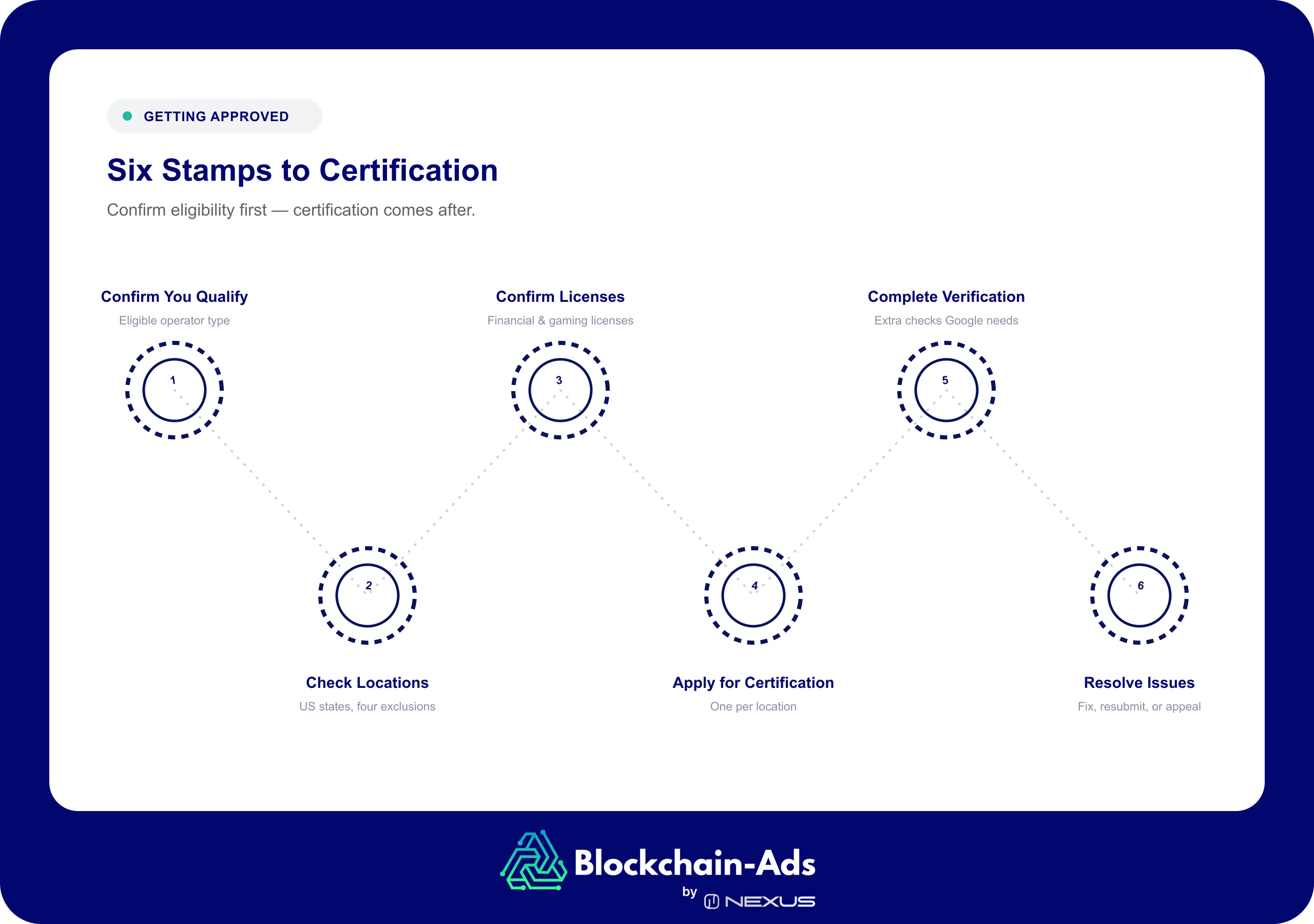
Google’s approval process starts with confirming that your business and target locations meet its prediction market requirements. If they do, you can apply for certification to advertise.
1. Confirm that your business qualifies
You must be either a CFTC-authorized Designated Contract Market whose primary business is listing exchange-listed event contracts, or an NFA-authorized brokerage that provides access to products listed by a qualifying DCM.
If you operate as a brokerage, being NFA-authorized alone isn’t enough for this category. The products you give customers access to must also be listed by a DCM that meets Google’s prediction market requirements. Confirm which route applies to your business before moving on to the certification process.
2. Check the locations you plan to target
Google only accepts prediction market advertising in approved U.S. locations. Make sure your campaigns won’t target Michigan, Nevada, New York, Ohio, or markets outside the United States.
Map out the locations you intend to target before applying rather than treating geography as a campaign-setting decision for later. Google requires a separate application for each location you intend to target, so your planned geographic reach affects the certification process and how you structure your campaigns.
3. Confirm your applicable licenses
Check whether your business needs additional financial, commodity, gaming, or other licenses for the locations you want to target. Google requires prediction market providers to hold the applicable local licenses before advertising.
Review these requirements market by market. Meeting Google’s federal operator criteria doesn’t remove state or local obligations that may apply to your business, the contracts you offer, or how you promote them. Resolve any licensing gaps before applying for locations where those requirements apply.
4. Apply for Google certification
Once you meet the eligibility and location requirements, submit an application to advertise prediction market products. Google requires a separate application for each location you intend to target.
Keep the information you submit consistent with the operator type, products, and locations you plan to advertise. If your planned targeting changes later, check whether the additional location needs its own approval before expanding the campaign there.
5. Complete any additional verification Google requests
Follow any account, business, or financial-services verification requirements Google presents for your account and target locations.
Treat these requests separately from prediction market certification. If Google asks for additional business or regulatory information, complete that review before assuming your prediction market approval is enough to start serving ads.
6. Resolve any policy issues Google flags
If Google flags an ad or asset for a policy issue, edit it to comply and resubmit it for review. You can also appeal a policy decision from your Google Ads account if you believe the ad was incorrectly disapproved.
Check the specific disapproval reason before making changes so you address the issue Google identified rather than editing the campaign blindly. If the problem is with the ad or destination, make the required correction and save it for another review. If you believe the decision was incorrect, use the appeal option instead and track its status in Google Ads Policy Manager.
Check these details before launching prediction market campaigns on Google
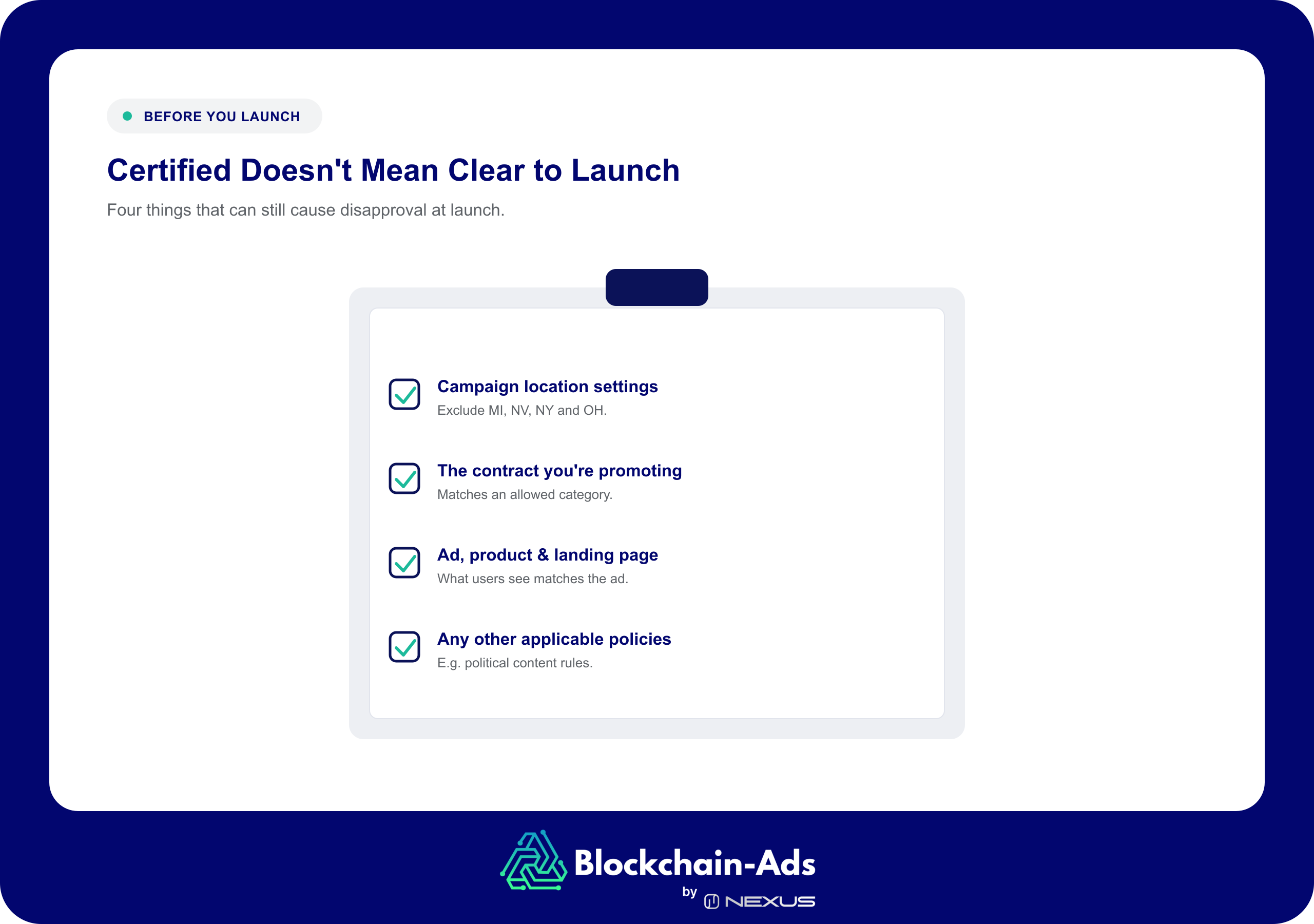
Getting certified doesn’t mean you should launch a campaign without checking it for policy issues first. Focus on the details that can still cause disapproval when you launch your campaign.
Your campaign location settings
Make sure your targeting matches the locations you are approved to advertise in. Exclude Michigan, Nevada, New York, and Ohio, and avoid expanding campaigns into markets that are not covered by Google’s prediction market policy.
Check the location settings in each campaign, in addition to the markets your business intends to serve. If you create separate campaigns for different regions or expand an existing campaign, confirm that every targeted location still falls within your approved scope before publishing the change.
The specific contract you’re promoting
Check the contract against Google’s allowed prediction market categories. Google can still reject a campaign if the promoted product falls into a restricted category such as certain binary or fixed-return contracts.
Review this at the product level, especially if your platform lists different types of event contracts. Operator certification applies to your eligibility to advertise, but each product featured in a campaign still needs to meet Google's requirements. Don’t assume that approval for one compliant contract automatically makes every market on your platform suitable for promotion.
Your ad, product, and landing page
Review the ad copy and full conversion path. Google’s prediction market advertising rules require the ad, promoted product, and landing page to comply with applicable laws and Google Ads policies.
Check that the promise in the ad matches what users see after clicking, and that the landing page doesn’t introduce a product, claim, or offer that falls outside the approved campaign. This is especially useful when one destination covers several markets or product types, because compliance must hold across the path the user actually reaches from the ad.
Any additional Google policies that apply
Check whether the campaign is also subject to another Google Ads policy. For example, prediction markets tied to political or election content may also need to meet Google’s political content requirements and applicable election-ad verification rules.
Do this check based on the campaign's subject matter and the fact that it comes from an approved prediction market operator. A campaign can satisfy the Prediction Markets requirements and still be restricted by another Google policy that applies to its content, targeting, or destination.
What to do if you can't run Google Ads
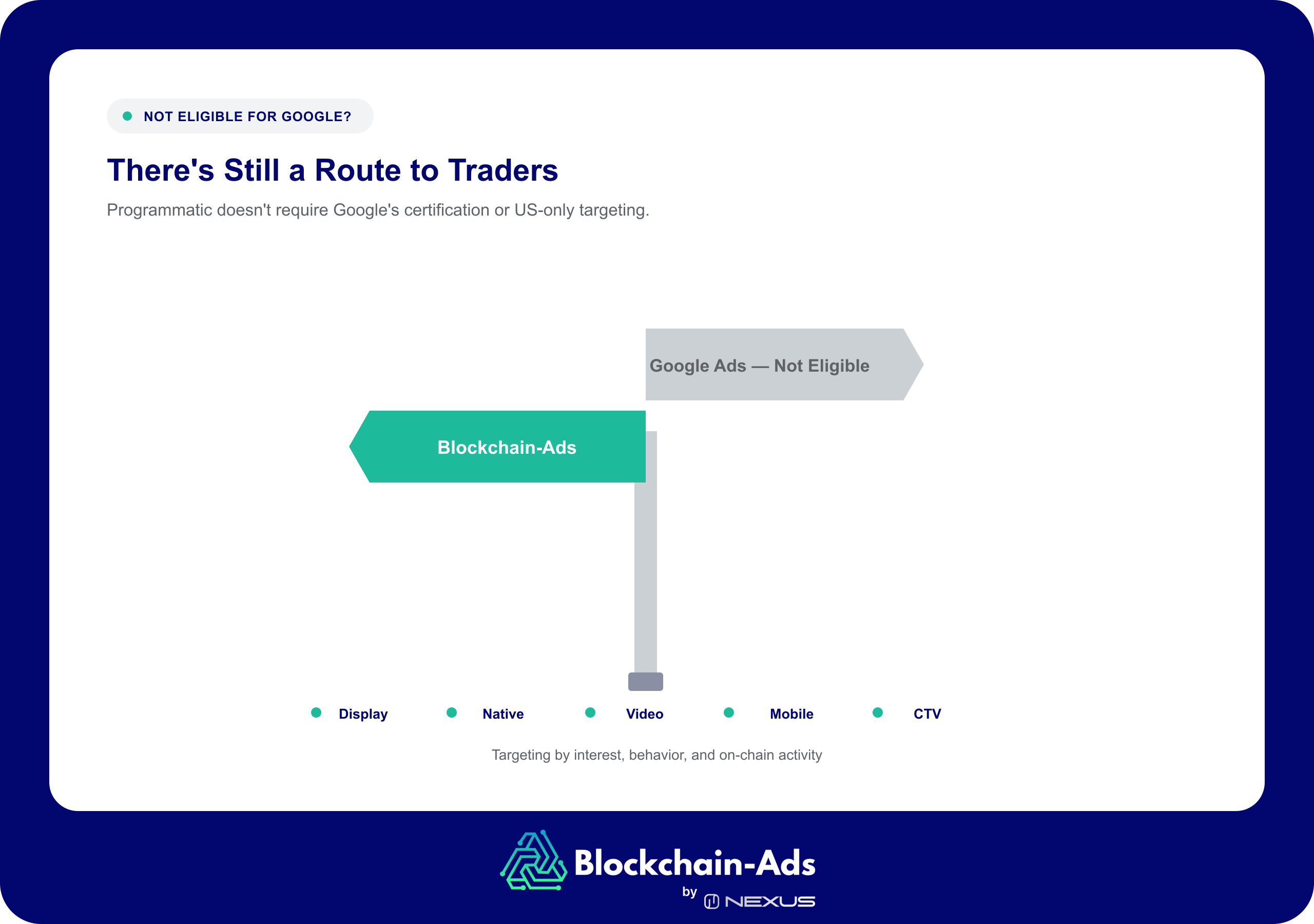
If your business doesn’t meet Google’s eligibility requirements or you need to reach prediction market audiences outside its supported U.S. locations, you’ll need another acquisitio channel.
Prediction market advertising platforms like Blockchain-Ads can give qualified operators another route to reach relevant audiences. Blockchain-Ads supports display, native, video, mobile, and CTV campaigns, with targeting based on interests, behavior, and on-chain activity.
Choose your prediction market advertising route
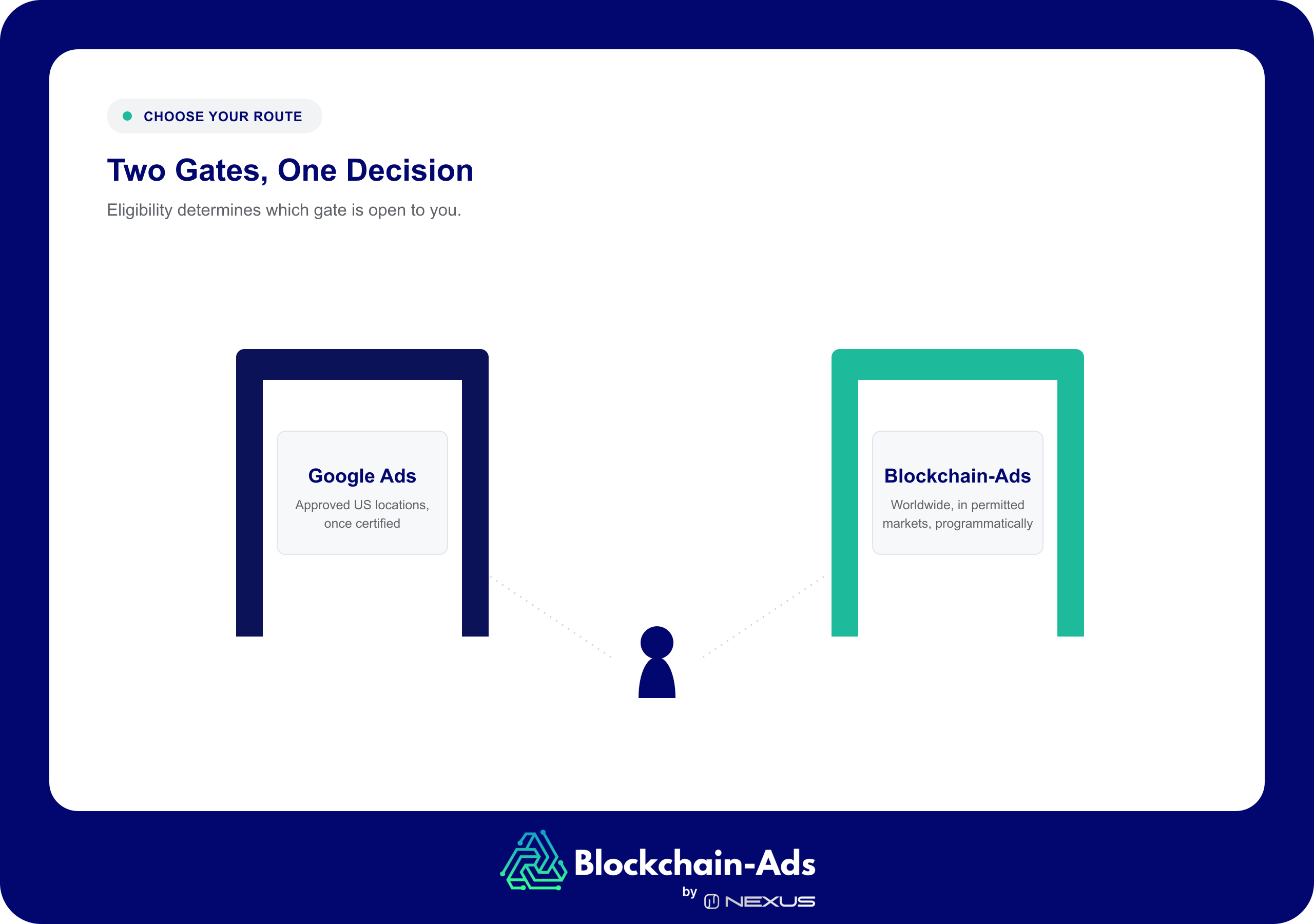
Google Ads can be part of your customer acquisition strategy if you meet Google’s operator, location, licensing, and certification requirements. Stay within the approved markets and make sure each campaign complies before launch.
If Google doesn’t fit your regulatory status or target geography, use a channel that supports your market and campaign requirements. Launch a prediction market advertising campaign with Blockchain-Ads to reach relevant audiences and measure performance against the user actions that matter to your business.