Sports Betting Advertising: Data, Rules, and How to Actually Buy This Traffic (2026)
Sports betting ads keep being reviewed whether they should be as accessible, following ad limitations introduction in the US, Europe and Oceania. The digital ads world also gets affected by these changes, forcing legit advertisers out in the wonderland.
In this article by Blockchain-Ads you will find a practical sports betting advertising landscape review by 2026.
Sports Betting Advertising in 2026: The Key Numbers

Starting in 2021 the legalization domino effect of the sports betting industry drove significant amounts of advertising to all promotional channels, including TV, radio, outdoor and digital ads. Following the saturation backlash, from 2023 the massive advertising coverage of sports betting began to cease, while operators started looking for more financially profitable solutions.
It’s clear by the example of DraftKings that was leading the US market and spent almost $1B on marketing budget in 2021 and grew significantly. But in 2025 they retained the same budgets just with more selective coverage.
In short, the 2026’s sports betting ads landscape can be described as:
- Stabilizing
According to AGA’s research, the sports betting advertising volume declined for the fourth year in a row since the 2021’s peak and now is 27% down. Sudden saturation by betting-related ads is slowly stabilizing, balanced between financial profitability and reasonable coverage. - Adapting
While the major advertising placements like Google and Meta might apply more blunt restrictive policies, sports betting operators come to adapt per digital market regulations accordingly. Some researches claim that in 2025 it was about 22% only of the US population actively engaged in online sports betting, most of them due to advertising. Nobody really wants to lose this market, but tries to adapt to its pace and appropriate advertising channels.
What Is Sports Betting Advertising? (And Who's Allowed to Run It)
Advertising sports betting products has gone far beyond just placing ads aimlessly without measuring the real performance from spent budgets. Essentially, the experience of digital platforms like Google and Facebook made it clear that paying for particular actions like ad impressions and clicks is of more value than vague audience coverage metrics on TV. Sports betting ads with attributed performance just prove more effective, but being serviced by major players demands following tight compliance requirements. By 2026 it’s clear that if a sports betting product wants to buy high-quality volumes of traffic online, they’d need: to be a legit, verified business and ready to prove that in action.
- Operators
Sportsbook platforms and iGaming operators holding regional and international licenses for their brands. They are basically certified for legal advertising buys on all leading platforms, but must accurately comply with all the requirements. - Affiliates
Media buyers partnering with a sports betting operator or brand through affiliate marketing programs. Affiliates run advertising campaigns within preferred traffic sources and get paid commissions for attracted bettors. - Agencies
Advertising agencies that specialise in providing marketing services to sports betting operators. They might represent a roster of clients utilising the same benchmark of advertising stack to acquire ad placements.
Sports Betting Advertising Regulation: What's Changing
Throughout the last few years, the regulatory landscape of advertising the sports betting industry has seen multiple changes. Despite the rapid market expansion of the activity itself, the amendments seek to change how sports betting spreads, including through the ads space.
The SAFE Bet Act and Federal Proposals
Reintroduced in March, 2025 the SAFE Bet Act proposes among many things a limitation of sports betting promotional ads during live broadcasts of major sports events. In fact, it aims to cut off any advertising of gambling activities in the US in the daytime. This is one of many acts towards making the demonstration of betting widely less frequent, as well as prohibiting utilising unrealistic gimmicks.
The AGA Responsible Marketing Code
In 2023 the American Gaming Association introduced updates to the Responsible Marketing Code for Sports Wagering, the self-regulatory industry framework certified by international legal sports betting representatives. In short, it set the baseline in promotional extents, now made to completely exclude college and youth athletes partnerships, any kind of underage audiences and ‘risk-free’ promotional tactics.
Country Rules at a Glance: US, UK, EU Bans, Australia
While the major change in the US’ regulations was just prohibiting relatively deceptive promos like ‘Get a Free Bet’, the European side of paid advertising for sports betting includes this and even pushes it further. After facing the common ban on advertising along with a live broadcasting of a sporting event and on the usage of celebrities, every part of the advertising field turned to motion. Every national authority for gambling standards of Germany, France, the UK and Australia have issued numerous corrections to digital advertising also affecting Google Ads, Meta and other popular platforms.
The Saturation Backlash and What It Means for Advertisers
Following the peak of sports betting advertising activity of 2021-2023 there was a massive backlash to digital promotional campaigns. Many legitimate advertising sources like TV channels were severely limited in broadcasting ads, while the digital space was affected with tightened regulations towards content and user qualifications. For advertisers it means that most of the previously convenient channels could become off limits for sports betting products or get more challenging in terms of following strict guidelines.
Where Can You Advertise Sports Betting?
Despite all the regulations the provision of advertising services to sports betting operators is still legal if it follows compliance demands.
Specialized Betting & iGaming Ad Networks
There are multiple advertising platforms like Blockchain-Ads that serve specifically sports betting advertisers. These iGaming ad networks provide the functionality to launch targeted campaigns and reach out bettors through ads on partnered websites. Most of them cover comparable sizes of audience and prove the same CTR as Google and Meta but don’t apply as strict moderation policies. They still work within acknowledged compliance frameworks securing both advertiser and targeted audience.
Google and Meta
Major advertising platforms for sports betting operators with global coverage. Google Ads operates its own verified advertising network, yet demands following strict rules according to local regulations. Only in 2025 Google’s gambling policies changed 18 times, constantly demanding more approvals for each platform operation in each country. Facebook Ads were also quite a popular choice for international campaigns, yet with strict certification requirement for each product the media buying there ceases.
Programmatic, Native, and Push Traffic
Some general programmatic ads platforms with native and push-notification traffic can also serve sports betting operators. They operate performance-based formats on proprietary inventory, which makes the CPM costs comparable to Facebook and Google. But they are also to comply with local licensing policies and the volumes of betting audiences there fade within numerous distantly attributed categories.
TV, Radio, and Sponsorships
Regardless of many measures aiming to limit sports betting advertising on TV in the US, and while Europe has already done that, the traditional ways of ads on TV, radio and sporting events are still popular. There’s obviously limited opportunity to correctly measure and compare costs and results of such campaigns, yet the coverage is built on the fact that many people still trust these channels. There’s no CTR but an ability to show brands to viewers where they expect to see products that have already passed regulatory requirements.
Best Ad Formats for Sports Betting Offers
Eventually, the choice of many affiliates and advertisers falls upon these traffic sources, considered the most relevant to sports betting goals:
Display and Banners
%20(1).png)
The advertisements are displayed as static images on partnering websites. Though banners or display ads are perceived more like a brand awareness spreading solution, for sports betting ads they can serve real users through proprietary owned networks. Among other things, it’s one of the most volumed ad formats with relatively cheap CPM/CPC for iGaming offers.
Video Ads
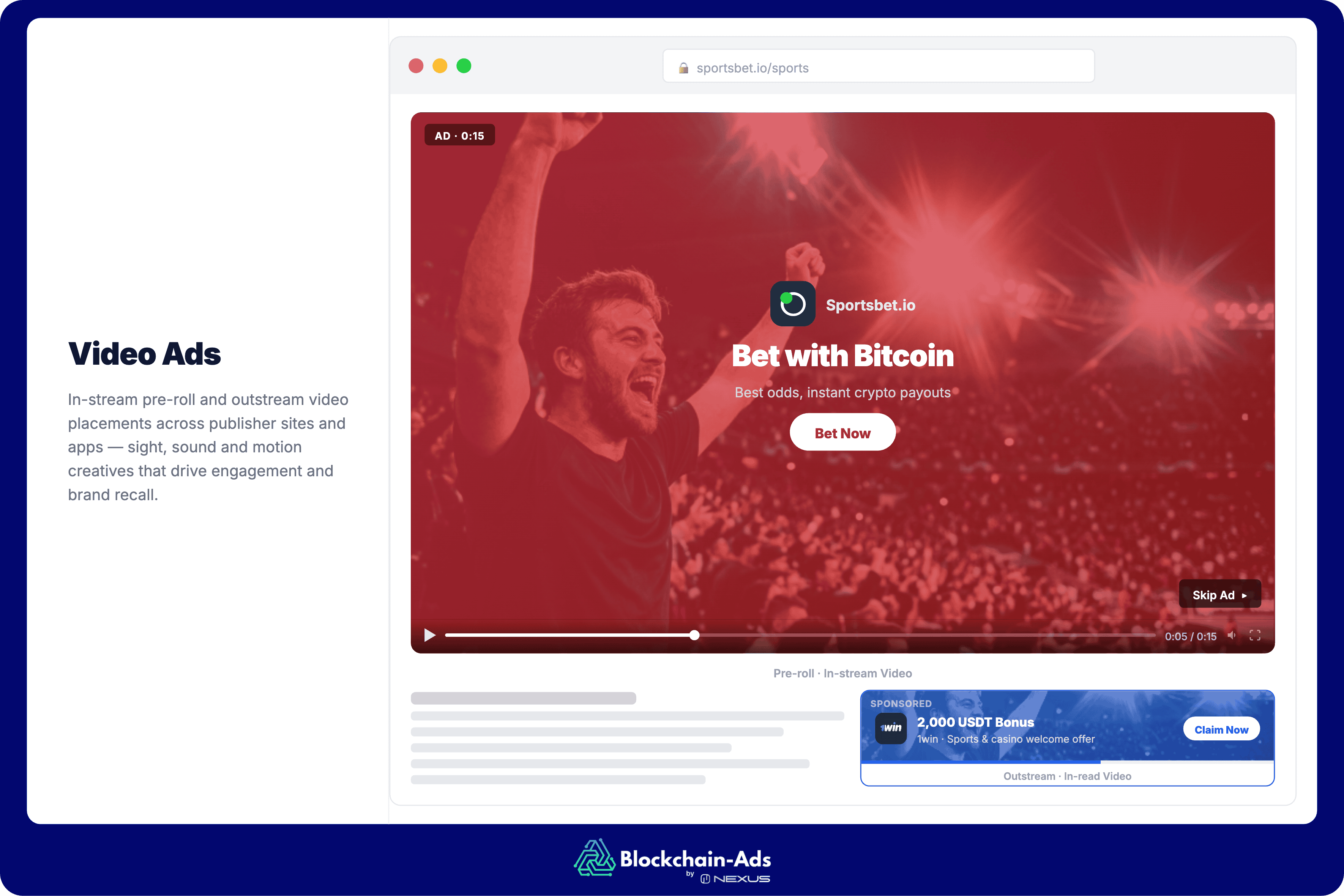
Promotional videos displayed in-page or in-app for users actively exploring the sports betting world. The completion rate exceeds 85% in general, while sufficiently improving CTR in comparison to static banners.
Push, Pop, and Native
Push-notifications, pop and native advertising serve best the performance-based goals of sports betting campaigns.
Push traffic delivers opt-in sports betting users with the ability to schedule campaigns specifically for major events like World Cup. Its CTR is much higher, while coverage might exceed 200M daily active audiences.
While pop ads simplify the sports betting advertising down to only a landing page, they still can drive high-intent audiences by quality publisher inventory. This allows targeting proven iGaming players by lower CPM and with total coverage of over 500M daily ad impressions.
Though native advertising is to blend with user experience, if properly combined with precise targeting, it attracts dedicated bettors with CTR 3-4x higher than regular banners. And while native branding is getting suppressed from displaying in real life sports events, the digital native ads don’t take those that hard.
How Much Does Sports Betting Advertising Cost?
By comparing average CPM/CPC prices, it might seem that many alternatives to Google Ads and Meta advertising platforms are more cost-efficient than their direct competitors. In fact, based on the precision of targeting the betting users, the average costs might differ 5-10x.
For Facebook Ads it’s appropriate to charge over $15 per 1000 impressions and >$1.50 per a click, yet filtering out the audience by relevance takes up a lot of budget. Major advertising campaigns might exceed $100,000 monthly spend.
For precisely targeted campaigns the costs drop and with a proper optimization the entry-level sports betting ad campaigns would require from $10,000 to launch in regulated markets.
How to Launch a Sports Betting Ad Campaign (Step-by-Step)
Here are some practical guideline on advertising sports betting by the example of Blockchain-Ads:
1. Prepare quality creatives and ad copies for your betting audience
Create at least 10 sports betting creatives following the best practices for the required format (e.g. size standards) and campaign’s goals. Optionally, you can address Flux campaigns, a mode at Blockchain-Ads that can generate unique sports betting creatives upon each ad impression based on provided brand assets and copy. In any case, the higher input quality the better the CTR.
If it’s far from a test run and demands a scalable programmatic advertising solution for a massive betting campaign, then you might want to look into Performance Max. An in-house mode to distribute sports betting creatives across other formats like native and display ads and smoothly scale campaigns with automatic budget allocation and optimization per goals.
2. Target sports betting users by verified actions
Most ad networks for targeting sports betting users provide industry-tailored parameters to narrow down the traffic flows. At Blockchain-Ads the targeting options go beyond simple geo-demographic touchpoints and consider behavioral patterns on-chain and interest categories based on verified activity. Targeting the audience can also be built upon a profile based on real high LTV sport bettors already opt-in advertiser’s CRM.
3. Allocate enough budget to cover user acquisition costs
To know if the budget would cover the required impressions/clicks to deliver sufficient volumes of sports betting traffic, you can address the ‘Estimates Based on Daily Budget’ tab. The optimal bid and daily budget can be suggested by a dedicated account manager team, but advertisers can solely evaluate the costs/benefit ratio based on input before the campaign is live. Along with optimization measures the traffic price would come down, which would demand another estimation based on performance metrics.
4. Optimize for the perfect bettor
To reduce costs for attracting sports betting users and boost performance metrics it’s necessary to properly optimize the advertising campaigns. With the help of automated tools to set up optimization flow it’s possible to continuously filter traffic and optimize creatives based on performance triggers. At Blockchain-Ads it’s powered by Nexus AI that prioritizes the CPA goals and high value of attracted bettors while maintaining the optimization.
Sports Betting Advertising FAQs
Still got questions regarding the advertising of sports betting? Here are some quick answers.
Why Are There So Many Sports Betting Ads?
The primary reason is the recent iGaming regulatory landscape shift that resulted in intense market saturation by numerous products and massive ad campaigns. The sports betting advertisements are still present in most of the popular channels for outreach, including Google and Meta platforms. Following a loud backlash to betting promotions, starting in 2023 the authority bodies of the US and Europe took measures to reinstate certain limitations for such ads on TV and digital space to reduce controversy of gambling activities attracting youth and vulnerable individuals.
How Much Do Sportsbooks Spend on Advertising?
A couple of years back, in 2021 for example, the average budget for advertising among sports betting operators suddenly doubled, up to 50% annual spend increase reaching over $1.5B+ annually (DraftKings, FanDuel). Since 2025 it has been facing a 15% decline compared to the previous year’s ad volume, following audience backlash and reappearing restriction for digital promotions. Depending on the chosen traffic source, a massive campaign run by a major sports betting advertiser can hit hundreds of dollars in total budget, while at Blockchain-Ads it’s possible to launch scalable campaigns starting from $10,000.
Are Sports Betting Ads Legal?
That exclusively depends on the targeted market. Most regions in North America and Europe are regulated markets that allow licensed operators to advertise sports betting activities. Even Facebook and Google Ads work with them, but the compliance requirements there are pretty high.
Will Sports Betting Ads Be Banned?
Regardless of many recent initiatives to reduce sports betting ads saturation in the US and Europe, the niche is hardly on its way to get banned entirely. On the contrary, as more regulation frameworks enter iGaming markets and shape the legal landscape of their operation, the advertising side of it is only to come at full capacity. Certain regions in Asia, Africa and LatAm are looking to tighten their grip on sports betting representation in 2026 during worldwide events such as FIFA Cup, but the overall growth of the industry remains.
What Percentage of a Sports Broadcast Is Betting Advertising?
According to various resources the sports betting advertising might account for 20% of total on-screen exposure during live sports broadcasts. It is said that about 1 out of 4 minutes of any sports event is referencing a gambling activity. By 2026 it’s expected to cease as multiple initiatives in the US, UK, Europe and Oceania aim to reduce betting advertising on TV, in digital space and most importantly during live broadcasting and daytime.
What Rules Do Sports Betting Ads Have to Follow?
While there’s no international by which sport betting ads operate, it’s a field of multiple sources of power regulating regional markets and industry-specific codes like American Gambling Association (AGA). They build frameworks dedicated to responsible and fair gambling promotions like excluding attracting people under a certain age or addicted to betting. The recent pack of changes now is less tolerant to ‘risk-free’ approaches that advertise through guaranteed outcomes. Major platforms like Meta and Google might apply their own additional requirements for certified sports betting advertisers, while specialised ad networks work by simplified verification framework.
Where Can You Advertise Sports Betting Online?
Apart from traditional advertising channels like TV, radio and sponsoring events with branding, there are also major digital platforms like Facebook Ads and Google Ads. Each and every advertising resource demands their own set of requirements met to consider a sports betting operator legit and allowed to launch campaigns. The TV, Meta and Google are the most demanding, while there are also specialised sports betting ad networks like Blockchain-Ads that simplify the verification process and provide the same scale solutions. The traffic volumes there match mainstream platforms while targeting betting audiences gets easier due to strong focus on behavioural/consumer signals exactly for iGaming vertical.
A professional content marketer with 3+ years of experience in iGaming and affiliate marketing.
View full profile →