
Tracking Crypto Ad Conversions and ROI With Web3 Attribution
Key takeaways
- Conversion tracking: Connect ad clicks to deposits, trades, and wallet activity to see which campaigns acquire paying customers.
- Campaign identifiers: Preserve UTMs and click IDs through registration so later conversions can be credited to the right acquisition source.
- Tracking setup: Configure and test conversion events before launch so deposits, trades, and other qualifying actions are captured reliably.
- Attribution accuracy: Use verified account or wallet links, consistent attribution windows, and deduplication to avoid misleading results.
- Campaign ROI: Calculate CPA from conversions of your primary event and ROAS from earned revenue, not deposited funds.
Knowing how to track conversions from crypto ad campaigns comes down to tying every sign-up, deposit, trade, or on-chain action back to the ad click that led to it.
Blockchain-Ads' State of Advertising in Crypto, iGaming, and Finance 2026 found that 46% of advertisers who configured conversion tracking before launch reached a first deposit or trade, compared with 24% who set it up later.
But tracking conversions is only useful when you can connect them to the campaigns that acquired those customers. That's where crypto attribution gets complicated, especially when users register on one device, connect a wallet on another, and deposit or trade days later.
This guide walks you through seven steps to set up Web3 attribution, connect on-chain and off-chain conversions, and measure campaign ROI.
What Is Web3 Attribution?
Web3 attribution connects ad clicks and other advertising interactions to actions users take on websites, apps, and blockchain networks. It helps crypto advertisers see which campaigns lead to sign-ups, wallet connections, deposits, trades, and smart contract interactions.
To track these actions, Web3 attribution uses campaign identifiers like click IDs and UTMs alongside website events and wallet activity. When a user connects a wallet, advertisers can link it to the campaign that brought them in and track qualifying on-chain transactions.
It also covers off-chain events, such as fiat deposits and trades recorded in an exchange's internal ledger. By tracking both on-chain and off-chain activity, advertisers get a clearer picture of how their campaigns perform.
How It Differs From Web2 Tracking
Web2 attribution relies on cookies, device identifiers, and website or app events to track actions such as registrations and purchases. Web3 attribution goes further by connecting these events with wallet activity and transactions recorded on blockchain networks.
Here's how the two differ:
- Conversion tracking: Web2 tracks actions such as sign-ups and purchases on websites or apps, whereas Web3 can also track token swaps, wallet connections, and smart contract interactions.
- Identity matching: Web2 identifies users through cookies, device IDs, or account IDs, while Web3 links connected wallet addresses to campaign records without necessarily identifying their owners.
- Transaction verification: Web2 relies on conversion data reported by websites, apps, or servers. Web3 can additionally verify qualifying on-chain transactions using public blockchain records.
However, blockchain for marketing attribution still needs a way to link the original ad click to a wallet or conversion event. Just because a transaction is recorded on-chain doesn't mean you know which campaign brought in that user.
Why Google Analytics Falls Short for Crypto Campaigns
Google Analytics tracks website and app activity, but it cannot independently identify on-chain conversions or attribute them to paid crypto campaigns. This leaves advertisers with an incomplete picture of which campaigns drive deposits, trades, and other revenue-generating actions.
The core limitations are:
- No native on-chain tracking: Google Analytics doesn't monitor wallet transfers, token swaps, or smart contract interactions. These require additional blockchain monitoring and event tracking.
- Disconnected wallet activity: A user may click an ad and connect a wallet, but Google Analytics cannot automatically associate subsequent wallet transactions with that campaign.
- Incomplete conversion visibility: Fiat deposits, exchange trades, and other backend actions require additional event tracking to appear in campaign reports.
Google Analytics can receive server-side events through its Measurement Protocol, provided the necessary identifiers and tracking are configured. Connecting these events to wallet activity and the original acquisition source requires additional implementation.
A Google Analytics alternative for Web3 should support that connection across campaign clicks, wallet interactions, and server-side conversions.
How to Track Conversions From Crypto Ad Campaigns in 7 Steps
Not every crypto conversion can be tracked the same way. A wallet swap, an exchange trade, and a fiat deposit each require different tracking methods, so your setup needs to account for where the conversion happens.
Here are seven steps to track crypto ad conversions:
Step 1: Choose the Conversion Events for Each Campaign
Choose a primary conversion event based on what you want each campaign to achieve. For a crypto exchange, that might be a first deposit or trade, while a DeFi protocol may prioritize completed swaps or liquidity deposits.
Common conversion events include:
- Sign-up: A user creates an account on your exchange, wallet app, or trading platform.
- Wallet connection: A user connects a wallet to your website or dApp.
- First deposit: A user funds an exchange account or deposits assets into a protocol.
- First trade: A user executes their first completed trade on your platform.
- Mint or swap: A user successfully mints a token or swaps assets through a smart contract.
Track earlier actions as secondary conversions to understand where users drop off, but evaluate campaign performance against the primary event.
You also need to define exactly when an event qualifies as a conversion. A wallet connection doesn't confirm a deposit, and a submitted transaction shouldn't count as a completed swap until it succeeds.
For acquisition campaigns, count only each user's first qualifying deposit or trade. Track subsequent transactions separately when measuring trading activity or customer value, so repeat activity doesn't inflate new-customer acquisition figures.
Step 2: Tag Every Ad Click With UTMs
Add UTM parameters to your campaign landing page URLs to identify which sources, campaigns, and creatives drive traffic. Follow consistent naming conventions to keep your reporting accurate.
According to Google's campaign URL documentation, the key parameters are:
- utm_source: Identifies the traffic source, such as an advertising platform.
- utm_medium: Specifies the marketing channel, such as paid_social or display.
- utm_campaign: Identifies the campaign, such as exchange_acquisition.
- utm_content: Distinguishes individual creatives or ad variations.
- utm_id: Records a campaign ID for consistent reporting.
For a crypto exchange acquisition campaign, your tagged URL might look like this:
If your ad platform provides a unique click ID, like Blockchain-Ads does, capture it alongside the UTMs and associate it with the user's session or account record. Preserve these identifiers through redirects and registration so later deposits or trades can be matched to the original campaign.
Step 3: Set Up Conversion Tracking Before You Launch
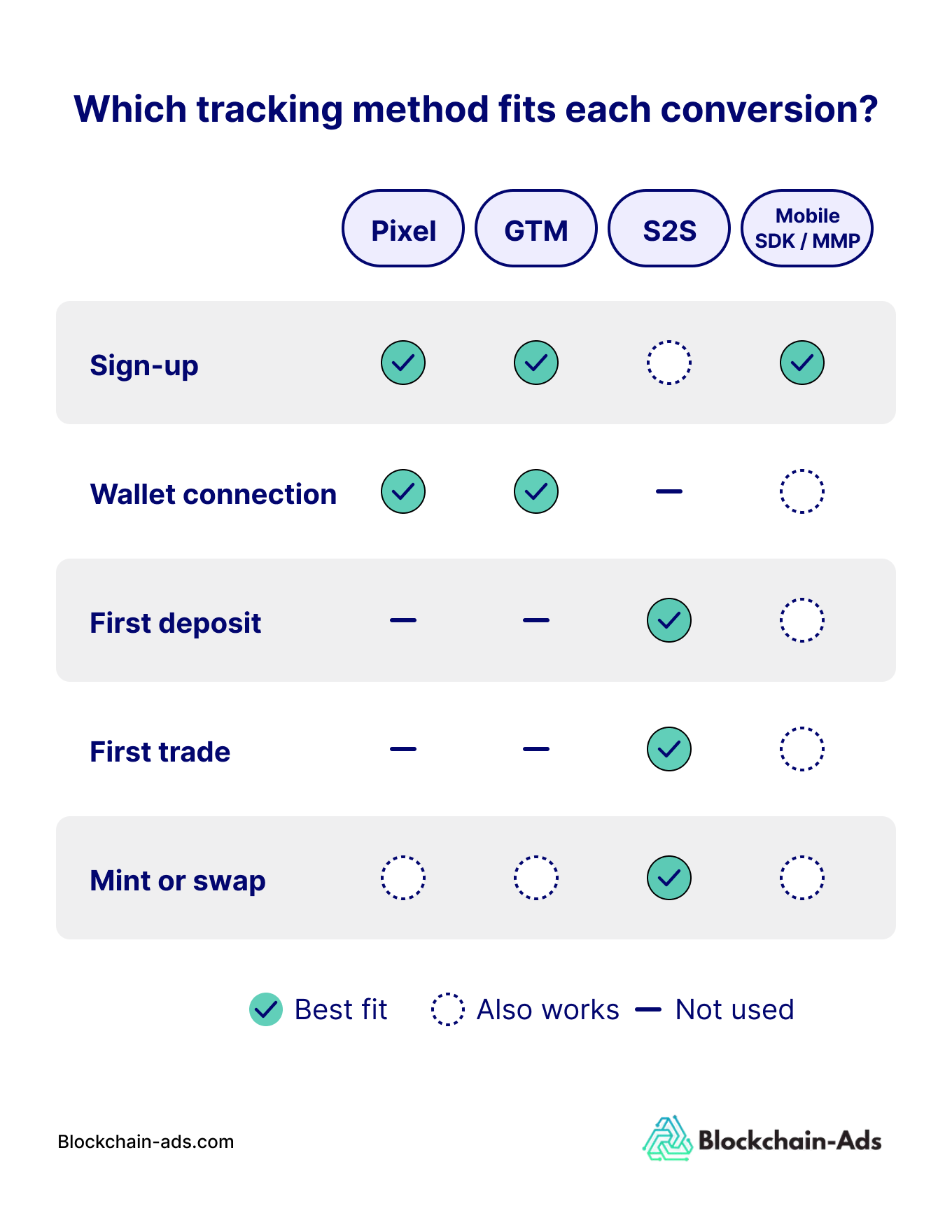
Configure and test Web3 conversion tracking before launching your campaign. Choose the implementation method based on where your conversions occur:
Conversion Pixel
Install your attribution platform's pixel on your website or dApp to capture sign-ups, wallet connections, and other configured events. Trigger conversions only after the action succeeds, not when someone clicks a button.
Google Tag Manager and Data Layer
Deploy conversion tags through Google Tag Manager and trigger them using data layer events. Your developers can push a sign_up event after successful registration, allowing the tag to capture the completed action.
Server-Side Tracking
Use server-to-server (S2S) tracking for backend-confirmed deposits, trades, and account approvals. Send the conversion event with its timestamp, associated click identifier, and transaction value where applicable, so the attribution platform can match it to the campaign.
Tracking in Mobile Apps
Track installs, registrations, and in-app conversions using a mobile SDK, server-to-server (S2S) tracking, or an integration with AppsFlyer. Report backend-confirmed deposits and trades through S2S tracking to capture completed transactions accurately.
Before launching, test each conversion event and confirm that its campaign source, event name, and value appear correctly in your attribution reports. Check for duplicate events across tracking methods so you can launch with reliable conversion data and measure campaign performance from the start.
Step 4: Connect the Ad Click to the Wallet and the On-Chain Action
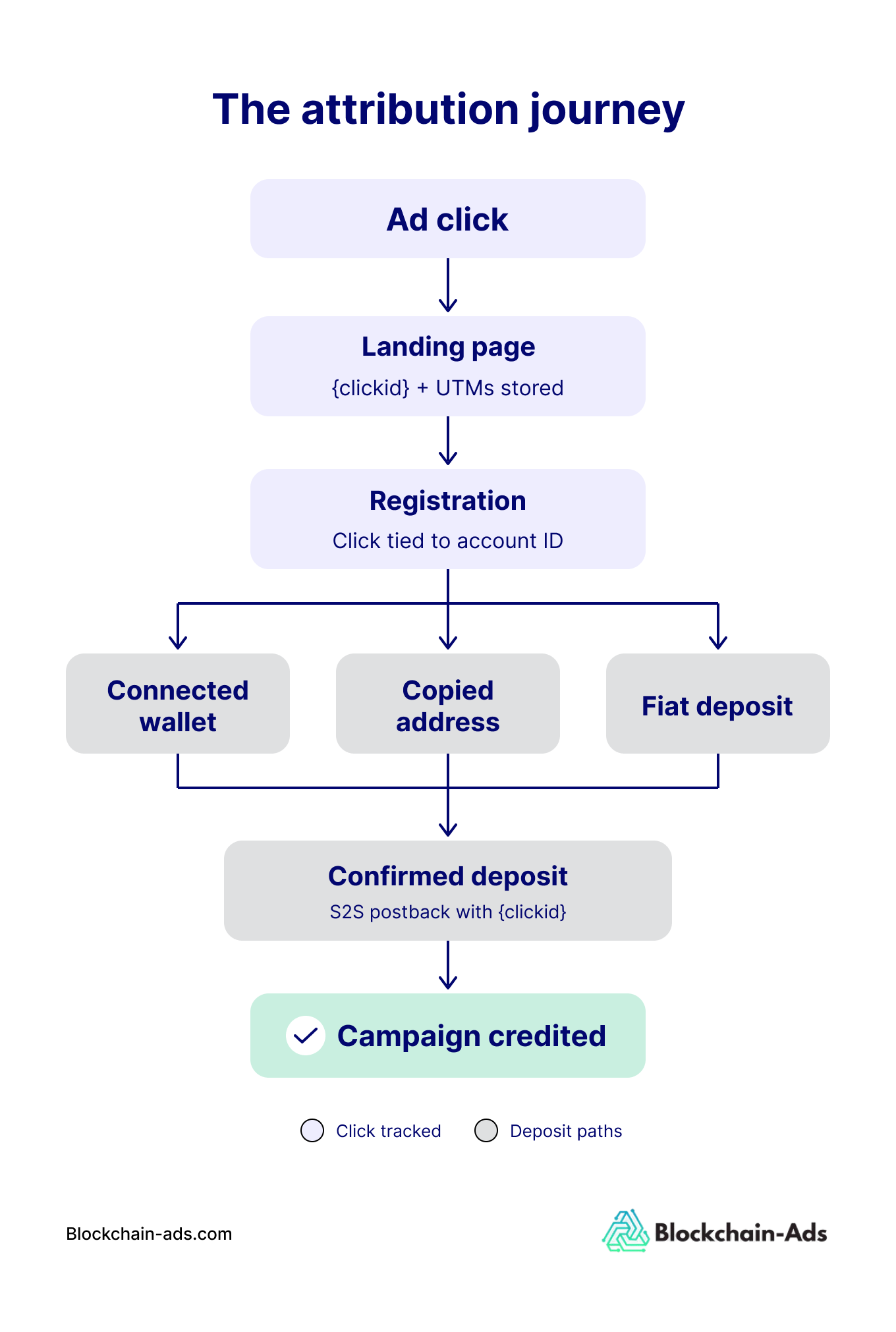
Once tracking is live, link the original ad click to the user’s account or connected wallet. That link is what lets you credit later deposits, trades, and on-chain transactions to the campaign that acquired the user.
The right method depends on how the user funds their account:
- Connected-wallet deposits: Link the wallet to the campaign record, then match confirmed transfers to your smart contracts or deposit addresses back to that wallet.
- Copied-address deposits: Use account records to identify deposits sent from external wallets or exchanges, then report each confirmed deposit through server-side tracking.
- Fiat deposits: Send a server-side conversion once your platform confirms the deposit, including the campaign identifier and the deposit value.
For DeFi marketing attribution, the same link lets you credit completed swaps and liquidity deposits to paid campaigns. It works as long as the interacting wallet traces back to the original click.
On Blockchain-Ads, store the {clickid} from the landing page URL against the user’s account. Return it in the server-to-server postback once the deposit or trade is confirmed. Without it, conversions still reach the platform but can’t be credited to the campaign that drove them.
Wallet addresses can count as personal data, so collect and link them only with the consent your privacy obligations require. If on-chain monitoring and server-side tracking both report the same conversion, deduplicate it so it’s only counted once.
Step 5: Choose an Attribution Model
Your web3 attribution model determines which ad interactions receive credit for a conversion. The right choice depends on how many touchpoints you can reliably track and how long users take to complete the desired action.
Last-Click and Multi-Touch Attribution
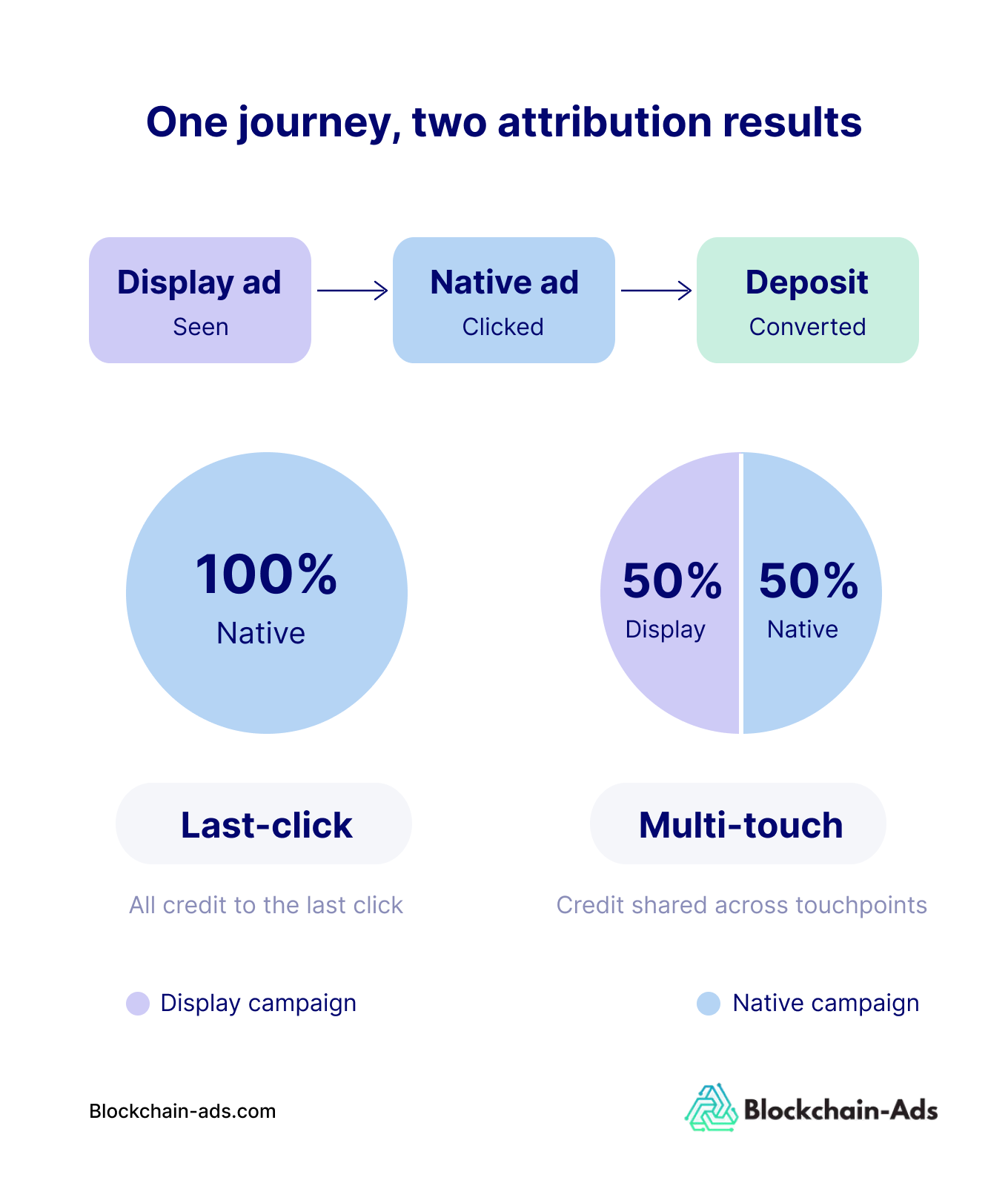
- Last-click attribution: Assigns full credit to the last eligible ad interaction before a conversion. Useful for identifying campaigns that drive deposits or trades directly.
- Multi-touch attribution: Distributes credit across multiple interactions, helping you assess campaigns that introduce users to your platform and those that contribute to conversion.
Use multi-touch attribution only if your measurement platform supports it and captures enough touchpoints to assign credit reliably.
Attribution Windows
An attribution window determines how long after an ad interaction a conversion can receive credit.
Choose your window based on the time between ad clicks and completed conversions. Review historical conversion delays before shortening it, particularly for campaigns involving KYC or delayed deposits.
Keep your attribution model, window, and primary conversion event consistent when comparing campaigns. Otherwise, differences in reported performance may come from your measurement settings rather than the campaigns themselves.
Step 6: Handle Cross-Device, View-Through, and Duplicate Conversions
Users often click an ad on one device, register on another, and deposit days later. Device data alone can’t reliably connect those steps, so use authenticated account IDs or verified first-party identifiers instead.
Three scenarios need particular attention:
- Users with several wallets: Link multiple wallets to one user only when a verified account or reliable first-party record establishes the connection. Avoid counting each wallet as a separate acquired customer.
- View-through conversions: Report conversions attributed to ad impressions separately from click-through conversions. Blockchain-Ads supports view-through attribution for CTV, while display, native, video, and in-app campaigns use click-through attribution.
- Duplicate and bot conversions: Deduplicate browser, server, and on-chain reports using a shared event ID or another stable transaction identifier. Apply invalid-traffic checks and count only qualifying, completed conversions.
When evaluating acquisition performance, report unique converting users separately from total deposits or trades. This prevents repeat transactions from inflating your customer acquisition figures.
Step 7: Measure Campaign ROI
To track ROI for Web3 campaigns, compare what you spend acquiring customers with the revenue those customers generate.
Focus on four metrics:
- Cost per acquisition (CPA):
- Total campaign spend ÷ attributed acquisitions.
- Calculate it against your primary conversion event, such as a first deposit or trade.
- Cost per wallet:
- Total campaign spend ÷ attributed unique wallet connections.
- This measures the cost of generating wallet connections, not necessarily acquiring paying customers.
- Return on ad spend (ROAS):
- Attributed revenue ÷ ad spend.
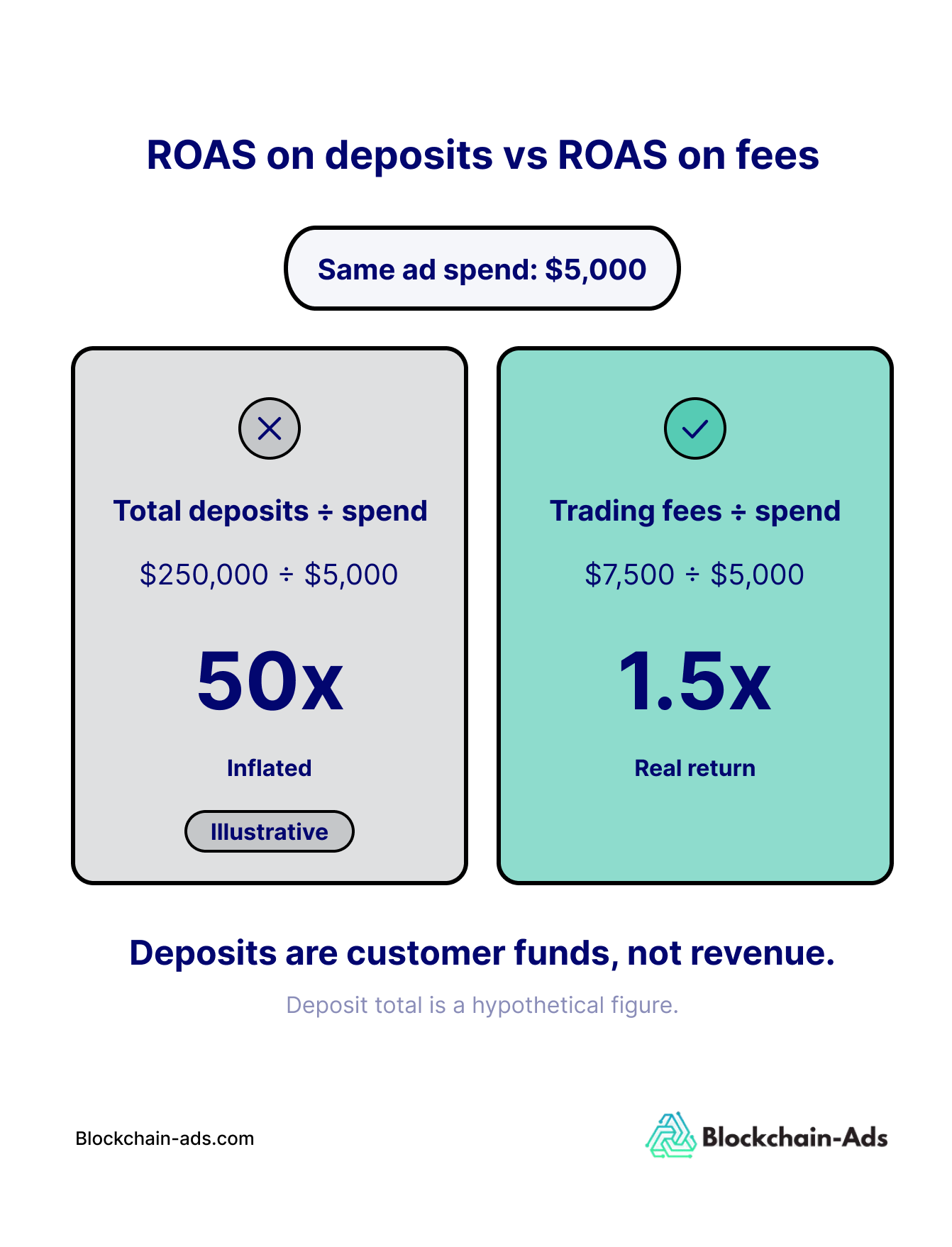
- For exchanges, use trading fees or other earned revenue rather than deposit amounts.
- Return on investment (ROI):
- (Attributed revenue − total attributable costs) ÷ total attributable costs × 100.
- Include campaign spending and other relevant costs without counting any expense twice.
Suppose a crypto exchange spends $5,000 on a campaign that generates 250 unique wallet connections and 100 first-time depositors. Those customers generate $7,500 in trading fee revenue, while the exchange incurs another $1,000 in attributable costs.
The campaign's performance would be:
- CPW: $5,000 ÷ 250 = $20 per wallet connection
- CPA: $5,000 ÷ 100 = $50 per first-time depositor
- ROAS: $7,500 ÷ $5,000 = 1.5x
- ROI: ($7,500 − $6,000) ÷ $6,000 × 100 = 25%
The campaign generated $1.50 in trading fee revenue for every dollar of ad spend. After accounting for the additional costs, it delivered a 25% ROI.
Use these metrics to compare campaigns and optimize toward paying customers. Pass conversion values to your attribution platform to support revenue-based optimization.
Which Tools You Need
You don't necessarily need a separate tool for every stage of Web3 attribution. What matters is whether your setup can connect campaign clicks, wallet activity, and confirmed conversions using reliable identifiers.
The main tool categories are:
- Web and app analytics: Capture visits, registrations, and other user events. Google Analytics can also receive backend events through its Measurement Protocol, but wallet and on-chain attribution require additional integration.
- Blockchain analytics: Monitor wallet transactions and smart contract interactions to verify completed deposits, swaps, and other on-chain actions.
- Attribution platforms: Connect campaign identifiers to website, app, and wallet events, then report conversions, acquisition costs, and attributed revenue.
Before choosing a tool, check whether it supports your primary conversion event, server-side tracking, and the attribution model you intend to use.
You can compare available options in our guide to Web3 analytics tools.
See Every Conversion Tied to Its Campaign
Web3 attribution gives you a clearer picture of which campaigns drive deposits, trades, and other revenue-generating actions. With reliable conversion tracking and consistent attribution rules, you can evaluate campaign performance using the actions that matter to your business.
That visibility helps you identify where acquisition spending generates paying customers and where your budget needs adjusting.
Blockchain-Ads' measurement and attribution solutions help you connect ad campaigns to conversions and identify which investments drive results.
FAQs
Which Web3 advertising platforms can track conversions from paid campaigns?
Blockchain-Ads tracks conversions from paid campaigns through its pixel, Google Tag Manager, or server-to-server postbacks, and integrates with AppsFlyer, Voluum, Keitaro, and Mixpanel. Whichever platform you choose, confirm it supports your specific conversion events, including wallet connections, deposits, trades, and on-chain transactions.
Can onchain conversion tracking software report conversions in real time?
Onchain conversion tracking software can detect blockchain activity as transactions appear, but reporting speed depends on network conditions, transaction confirmations, and the platform's processing time. A detected transaction should not be treated as a successful conversion until it meets your confirmation requirements.
Can you attribute crypto deposits made from a different wallet than the one connected to your dApp?
Yes, if your platform can reliably associate the deposit with the user's account. A transfer from another wallet or custodial exchange may not reveal the original campaign source on-chain, so account-level deposit records are often necessary.
Why can two Web3 marketing channels report different ROI for the same customers?
Different attribution windows, conversion definitions, and credit-assignment models can produce different results. One channel might claim a registration while another receives credit for the eventual deposit. Compare channels using consistent attribution settings and revenue calculations before reallocating budgets.
What can you do if Google Analytics misses crypto conversions and specialized attribution tools are too expensive?
Start by sending backend-confirmed deposits or trades to Google Analytics using its Measurement Protocol.
Preserve campaign identifiers in your first-party records so those events can be matched to acquisition sources where supported.
This won't provide native blockchain monitoring or wallet attribution, but it can improve visibility into paying customers without immediately investing in a specialized platform.
Srijan Sharma is a B2B writer specialising in SaaS, FinTech, MarTech, and data integration.
View full profile →