Meta Cryptocurrency Advertising Policy [2026]: What Is Allowed
You’re here because you want to know for sure if you can run crypto ads on Facebook and Instagram, and if so, how to do it properly, without risking your campaign being rejected or banned.
Good news is - cryptocurrency advertising is allowed on both platforms
The bad news, however: not every category is allowed.
Now what does this mean?
Basically, it confirms what you already knew - that this is a restricted, high-risk advertising area, and that we need to take a deep dive into it to understand all important Meta crypto ads policy details and practical limitations.
So let’s begin.
This guide by the Blockchain-Ads team explains what Meta Ads officially allows, where the limitations are, and what obstacles you may run into when launching campaigns on Meta’s platform.
Does Meta Allow Cryptocurrency Advertising?

Yes, Meta Ads allows crypto advertising. But there are restrictions.
Meta does not treat all crypto campaigns the same way.
Crypto-related content is separated into different risk categories. Some campaigns can be launched without any sort of approval; for others, you will need to submit a recognized regulatory license or registration and a prior written approval from Meta (this is a so-called restricted category), while there are ads that will be rejected on the spot.
In case your ad content is purely educational and informational, but not transactional, it will probably pass without having to submit a written permission.
But if it’s connected to earning, investing, trading, lending, borrowing, mining, or engaging in exchange activity and monetizing crypto assets, you will most likely need to get Meta’s approval.
Keep this in mind: Meta approval is not the same as legal approval. Even if your project is on the right course in the eyes of the law, it still needs to meet all the Meta’s requirements.
Also, understand that written permission is no guarantee that every ad you deliver will be approved. Meta retains the right to reject the ad in case the ad creative, the wording, product claims, or landing page leaves room for a policy risk of any sort.
What the Meta Ads Platform’s Crypto Ad Policy Covers
.png)
Whenever we talk about Meta’s cryptocurrency advertising policy, we refer to rules that paid ads promoting cryptocurrency products and services are obliged to follow across all Meta’s advertising channels: Facebook, Instagram, Reels, Stories, Messenger, and Audience Network, where available.
But the Meta’s policy is broader than many advertisers expect. It’s NOT only focusing on ad copy and targeting the word “crypto” in it.
Where you stand in terms of needing or not needing approval depends on several factors:
- Product category - answers what kind of crypto product or service is being advertised: is it a crypto exchange, blockchain educational course, token presale, staking/yield platform, or crypto news website
- Geography - shows where the advertising will be presented; the campaign might be acceptable in one country, but banned in another
- Licensing - showcases if the company ready to launch a campaign is legally authorized to offer a specific kind of crypto service
- Landing page CTA leads to - it’s not only a question if the ad is safe, but if the landing page it leads to is aligned with all the norms
- Account history - Meta may take into consideration the previous behavior of the ad account, domain, business manager, specific page, or connected assets
Each campaign has a different layout in terms of creative format, ad placement, landing page, distinctive copy and claims, specific targeting, and account history, and all of it can affect the review outcome.
More precisely, advertisers often misunderstand how broadly Meta Ads reviews the campaign. For example, there’s a huge chance of rejection if there’s a mismatch between the ad itself and the landing page it leads to.
Permitted Cryptocurrency Products and Services
Based on Meta Ad’s Transparency Center, we could make a distinction between ad campaigns allowed without written permission and those that require Meta’s written permission.
Disclaimer: This listing should be seen as general guidance, not a guarantee of approval.
Allowed only with written permission
Restricted and Prohibited Categories
It is important to understand that restricted and prohibited are not the same.
Restricted campaigns are the ones that could move forward if the advertiser gets permission and provides licensing. So they are still in the dark, but with a possibility of reaching their audience.
Prohibited campaigns are the ones that are rejected due to a breach of Meta policy.
Here are the types of ads with a high risk of rejection:
Financial claims and personal-attribute-style wording are common rejection triggers. Even if a campaign has permission, ad copy can still fail if it implies knowledge of a person’s financial situation, promises specific results, or suggests guaranteed gains.
Avoid using this type of wording to avoid triggering broader Meta policies:
- “Are you tired of losing money?”
- “Want to grow your portfolio?”
- “For investors who missed Bitcoin early.”
- “Earn passive income.”
- “Protect your wealth from inflation.”
The safest approach is to describe the product’s function rather than the user’s financial condition or expected profit.
Facebook Ads vs Instagram Ads: Same Rules or Different?
Facebook Ads and Instagram Ads follow the same Meta cryptocurrency products and services advertising policy. So the same rules are applied on each platform.
What this means practically is that no crypto campaign will be easier to approve if it runs on Facebook instead of Instagram, and vice versa.
If the advertisements promote any type of restricted crypto products, like trading platforms, lending services, exchange, staking products, or a wallet with transaction features, the same requirements will apply across all Meta platforms and ad placements.
How the Policy Has Changed (2024 to 2026)
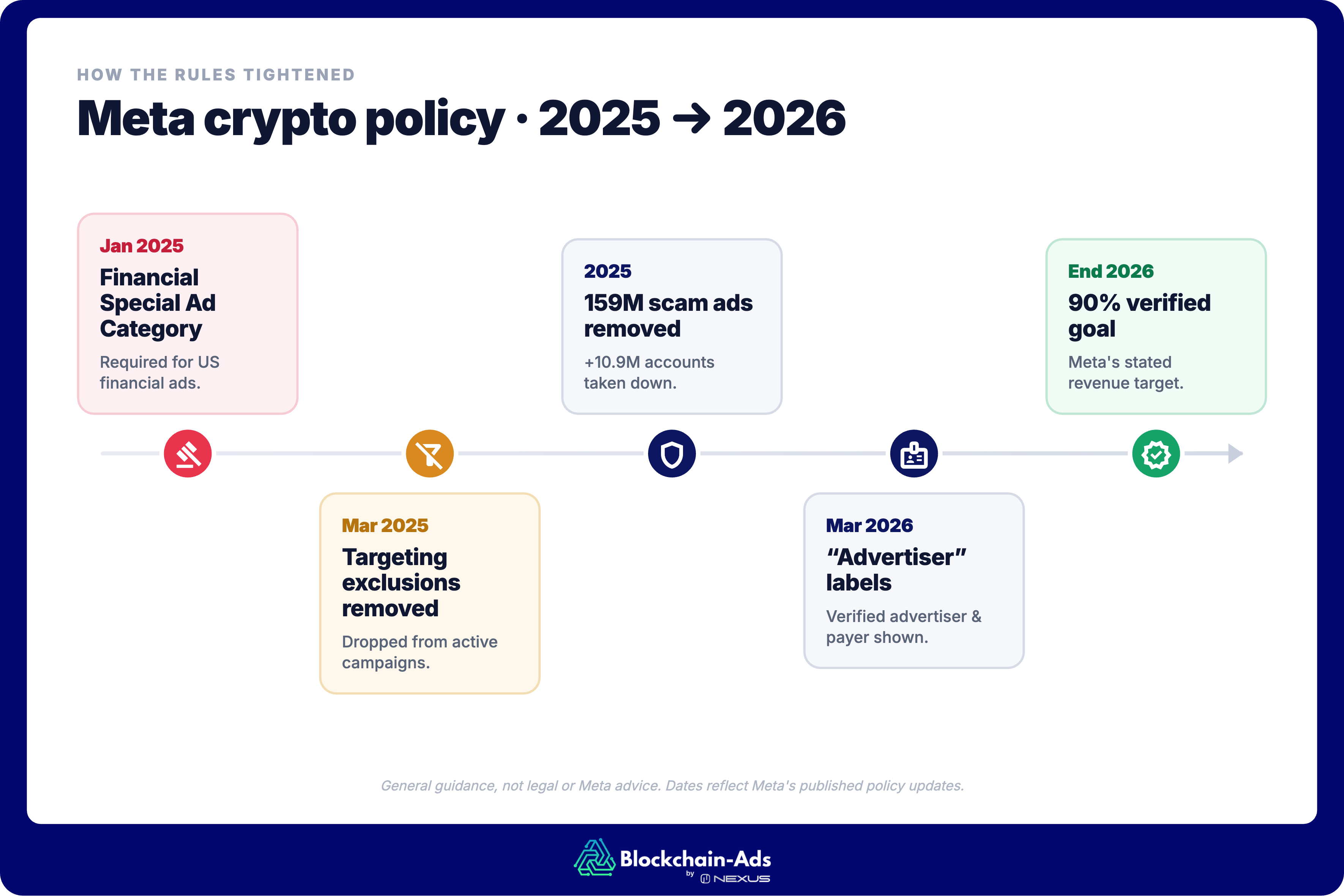
Looking from 2024 to today, the very core of Meta’s advertising policy regarding cryptocurrency remained the same. It was and still is allowed to place crypto ads within its platforms, with restrictions we mentioned above being valid.
If the ad belongs to a restricted category, written permission from Meta is required.
What is different, though, and what advertisers must keep in mind is this - crypto campaigns can now find themselves within a stricter advertising environment, if they trigger financial-services rules, or scam-risk review.
It’s rare for the crypto campaign to sit firmly in only one policy box.
A crypto exchange, staking platform, wallet with swap features, DeFi product, token launch, or yield-based campaign may be reviewed not only as a crypto ad, but also as a financial product or high-risk promotion.
So the approval might be harder to obtain.
In practice, the policy environment has moved in three important directions.
#1 Financial services classification has become more important. Advertisers should know that if an ad promotes trading, investing, lending, borrowing, payments, staking, yield, or other money-related activity, it’s more likely their campaign will fall under Meta’s broader financial products and services rules.
#2 Audience targeting has become more limited in some areas. There’s less flexibility in shaping the audience in sensitive or regulated categories.
#3 Meta has placed more public emphasis on scam prevention and advertiser verification. Advertisers must be aware that if the language they use in copy resembles established scam patterns, it could lead to more attention and observation.
Key Policy Changes in 2025
- Meta’s Financial Products and Services Special Ad Category became required from January 21, 2025 for advertisers based in the U.S. or showing financial products/services ads to people in the U.S.
This means that advertisers need to classify the campaign correctly before launch. If a crypto campaign promotes a financial action and targets the U.S. market, the advertiser may need to select Meta’s Financial Products and Services Special Ad Category in Ads Manager and still check whether separate crypto written permission is required.
Also, they can expect targeting limitations. Advertisers may have fewer options for narrowing or excluding audiences than they would in a standard crypto campaign. The recommendation is to plan broader, cleaner audience strategies and rely more on compliant messaging, landing page quality, and creative testing.
- Meta removed detailed targeting exclusions from active campaigns in Ads Manager starting March 31, 2025, which affects how advertisers control audience exclusions.
Before this change, advertisers could exclude categories of people based on certain interests, behaviors, or demographics available inside Meta’s detailed targeting system. The result is that advertisers lost one specific way of controlling who should not see their ads.
Updates for 2026 So Far
- Meta’s 2026 public focus is scam prevention, impersonation detection, and advertiser verification.
They removed over 159 million scam ads in 2025 and took down 10.9 million Facebook and Instagram accounts linked to criminal scam centers. The novelty is that Meta now uses advanced AI to detect scam patterns, celebrity and brand impersonation, deceptive links, and domain impersonation.
Your ads could face additional checks and reviews if the campaign uses public figures, brand-like domains, aggressive investment claims, what Meta sees as suspicious redirects, or landing pages that resemble fake trading platforms.
Practical meaning for crypto advertisers is this → there’s now more pressure to prove legitimacy, avoid scam-like claims, keep landing pages clear, and make sure advertiser identity/licensing is consistent.
- Meta said it is expanding advertiser verification, with the goal that verified advertisers drive 90% of ads revenue by the end of 2026.
Given that Meta is pushing harder on verification, crypto advertisers should expect more attention on who is behind the ad, who is paying for it, what business is being promoted, and whether those details match the website, license, and campaign claims.
- Beginning in March 2026, Meta uses the term “advertiser” instead of “beneficiary” in ad transparency labels, and ads with transparency now show verified advertiser and payer information.
Meaning, business identity is now more visible to users and regulators. For crypto advertisers, this increases the importance of keeping the Business Manager, payer details, website, legal entity, and licensing information consistent.
Written Permission: What It Means and Why It Matters
You are an advertiser who wants to place crypto ads on Facebook or Instagram, but your campaign falls under the restricted category. That’s fine. Your campaign might still be launched, but what you need now is written permission from Meta.
It’s a prior authorization that allows advertisers to run ads for certain restricted cryptocurrency products or services. To get this permission, advertisers may need to provide recognized licensing or registration details.
Meta may require the advertiser to submit:
- business information
- legal/regulatory status
- the ad account they want to use
- the website or app being promoted
- the GEOs they want to target
- details about the crypto product or service
- destination URLs
- recognized regulatory license, registration, or certification
- proof that the business is authorized to offer that product in the relevant market
However, this permission does not guarantee that every individual ad will pass the review.
The Overview: What to Expect in Practice
The thing with Meta’s advertising policy for cryptocurrency products and services and its requirements is that, even after you get familiar with all the key points and create what you think is a safe path for your ad journey, you still may find it inconsistent in practice.
Meta uses a mix of automated review, human review, advertiser history, domain signals, user reports, account quality, regulatory pressure, and scam-detection systems to determine status for each campaign. As a result, rejection comes more often than you think.
Here’s what advertisers experience:
- Revisions may pass or fail unpredictably
- Ads can be rejected even when the advertiser is licensed
- Educational content can be flagged if the LP contains just a hint of trading or token purchase
- Wallet, staking, exchange, and yield language often trigger review
- A campaign may run for days and later be disapproved
- Similar ads may receive different decisions
- Meta may treat the campaign as financial services even if the advertiser sees it as Web3, SaaS, or community-building
When Meta Ads Is Not the Right Fit for Your Crypto Campaign
Meta is not always the best starting point for crypto advertising.
Sure, for soft-themed campaigns covering crypto news, blockchain events, or promotion of educational content, Facebook or Instagram could be a good fit.
But most crypto advertisers promote exchanges, wallets and other products within the restricted categories that could create significant friction.
If you see yourself among them, maybe you should consider a crypto-native channel that would be more suitable and efficient for your specific campaign.
Blockchain-Ads is a performance network designed specifically for blockchain, crypto, Web3, and fintech campaigns. Instead of treating crypto as a restricted edge case, the ad network focuses on enabling advertisers to reach users who already understand or engage with the category.
Grounding her work at the point where business goals meet audience intent defines Marija’s approach to content. She combines editorial depth with campaign logic, looking at what readers need, where they are in the funnel, and how content can move them from curiosity to clarity. Her experience in AdTech shaped the way she thinks: every piece needs a purpose, an audience, and a reason to exist. It’s the only way to scale.
View full profile →