How to Advertise Crypto on Facebook and Get Approved
Key takeaways
- Most crypto ads need Meta’s written permission: This covers exchanges, trading platforms, wallets with transaction features, lending, and mining.
- Some crypto ads need no permission: Ads for news, education, events, and storage-only wallets can run without it.
- ICOs and binary options are banned: No license or permission unlocks them, and Meta removed more than 134 million scam ads in 2025.
- One permission covers Facebook and Instagram: You apply through Meta Business Suite, and Meta doesn’t publish a review time.
“Can you advertise crypto on Facebook?” Yes, but most ads for exchanges, trading platforms, and wallets need Meta’s written permission and a license from a regulator Meta accepts.
Some crypto ads need no permission, while others can’t be advertised on Facebook or Instagram. So before you advertise crypto on Facebook, find your group first, because Meta checks your product and its license before any of your ads can run.
This guide covers what Meta allows, what needs permission, what it bans, and which licenses it accepts. It also explains how to apply and how to fix a rejection, so you can start advertising crypto on Facebook with the right approvals in place.
What’s Changed in Meta’s Crypto Ad Policy

Meta ads policy cryptocurrency rules have shifted from a full ban in 2018 to a license-based system, with tighter advertiser checks since 2025.
Here’s every change that matters, with the newest first.
All data below were last checked on October 24, 2026.
April 15, 2026: Mining hardware no longer needs permission
- What changed: Meta limited the mining category to software. Mining hardware, such as GPU rigs and other physical equipment, moved to the list of ads that need no written permission.
- Who it affects: Mining hardware advertisers.
- Source: Meta’s Cryptocurrency Products and Services Policy.
March 2026: Meta expands advertiser verification
- What changed: Meta widened advertiser verification based on where ads run, past violations, and how often an ad type is misused for scams. It aims for verified advertisers to drive 90 percent of its ad revenue by the end of 2026.
- Who it affects: All advertisers, including crypto brands applying for written permission.
- Source: Meta
July 28, 2025: India requires SEBI verification for investment ads
- What changed: Securities and investment ads shown to people in India must show the verified beneficiary and payer names and SEBI registration numbers where applicable. Advertisers exempt from SEBI registration can use another verification option.
- Who it affects: Investment advertisers reaching India, including global campaigns.
- Source: Meta for developers
February 2025: Australia’s financial ad verification is fully in place
- What changed: Financial services advertisers targeting Australia must verify who pays for and benefits from each ad. They must also add their Australian Financial Services Licence (AFSL) number, where one is required.
- Who it affects: Financial services advertisers reaching Australia.
- Source: Meta for Business
January 14, 2025: Financial Products and Services becomes a special ad category
- What changed: Meta replaced its Credit special ad category with a broader Financial Products and Services category. Ads in it follow audience limits similar to housing and employment ads.
- Who it affects: Financial advertisers, including crypto lending and borrowing products.
- Source: Meta for Developers
December 1, 2021: Accepted licenses expand from three to 27
- What changed: Meta stopped reviewing crypto advertisers case by case and started checking for one of 27 accepted licenses. The list of products that need permission stayed the same.
- Who it affects: Exchanges, wallets, and other licensed crypto businesses.
- Source: Facebook News
May 2019: News, education, and event ads open up
- What changed: Facebook let ads about blockchain technology, industry news, education, and events run without pre-approval. Ads for crypto products still needed permission.
- Who it affects: Crypto media sites, educators, and event organizers.
- Source: CNBC
June 2018: Pre-approved advertisers can run crypto ads
- What changed: Facebook let crypto businesses run ads after applying and getting approved. Ads for ICOs and binary options stayed banned.
- Who it affects: Crypto businesses willing to go through the application.
- Source: TechCrunch
January 2018: Facebook bans crypto ads
- What changed: Facebook banned ads for cryptocurrency, ICOs, and binary options, citing misleading and deceptive promotion.
- Who it affects: Every crypto advertiser on Facebook and Instagram.
- Source: Investing.com
Crypto Ads Meta Allows Without Written Permission
Meta lets you run crypto ads without written permission when the ad doesn’t offer a way to buy, sell, swap, or stake crypto. Meta’s Cryptocurrency Products and Services Policy lists these ads as not needing written permission.
- Events, education, and news about crypto and blockchain, as long as the ad doesn’t offer a crypto product
- Tax services for crypto companies
- NFTs and other blockchain products that aren’t a virtual currency
- Storage-only wallets
- Crypto products that can’t be used to buy, sell, or trade
- Mining hardware, such as GPU rigs and other physical equipment
What matters is what your ad asks people to do. If it only informs your audience, you don’t need permission. For example, an ad for your crypto newsletter can run without permission. It gets dicey when you add a CTA like a “buy now on our partner exchange” button.
Even though informational or educational ads don't need permission, they still have to follow the rest of Meta’s Advertising Standards. That includes its rules against deceptive claims, which apply to every crypto ad.
Crypto Ads That Need Meta’s Written Permission
You need Meta’s written permission for any ad that promotes crypto trading platforms or software and services that let people make money from, resell, swap, or stake crypto. This is the core of Facebook crypto advertising, and it covers most crypto businesses.
To get permission for these ads, Meta will ask you to prove your business holds a regulatory license or registration it recognizes. Additionally, Meta checks the license, so the product decides whether you need permission, and the license determines whether you get it.
For example, imagine you’re the growth lead at an exchange registered with FinCEN as a money services business. You apply with that registration, and Meta still checks it against its accepted list before your ads can run.
This means permission doesn’t approve every ad you make because each ad still goes through Meta’s normal review, so your copy, ad creatives, and landing page have to follow its rules too.
What type of crypto ads are not allowed on Facebook?
Meta bans ads for initial coin offerings (ICOs) and binary options, and no license or permission makes them eligible. It also rejects crypto ads that use deceptive or exaggerated financial claims.
The bans cover both the offer and the claim. An ICO ad fails however carefully you word it, and a licensed exchange ad still fails if it promises returns Meta sees as exaggerated.
If your project raises money through a token sale, keep the sale out of your ads and landing pages entirely. You can still promote educational content about your project, as long as it doesn’t offer the token.
Meta says it removed more than 159 million scam ads in March 2026, and financial investment ads are among the high-risk areas it focuses its advertiser checks on.
Pro tip: Keep every claim about investment in your ad factual, and make sure your landing page backs it up because Meta names investment and banking opportunities as an area where it often sees violations.
Which Licenses Does Meta Accept?
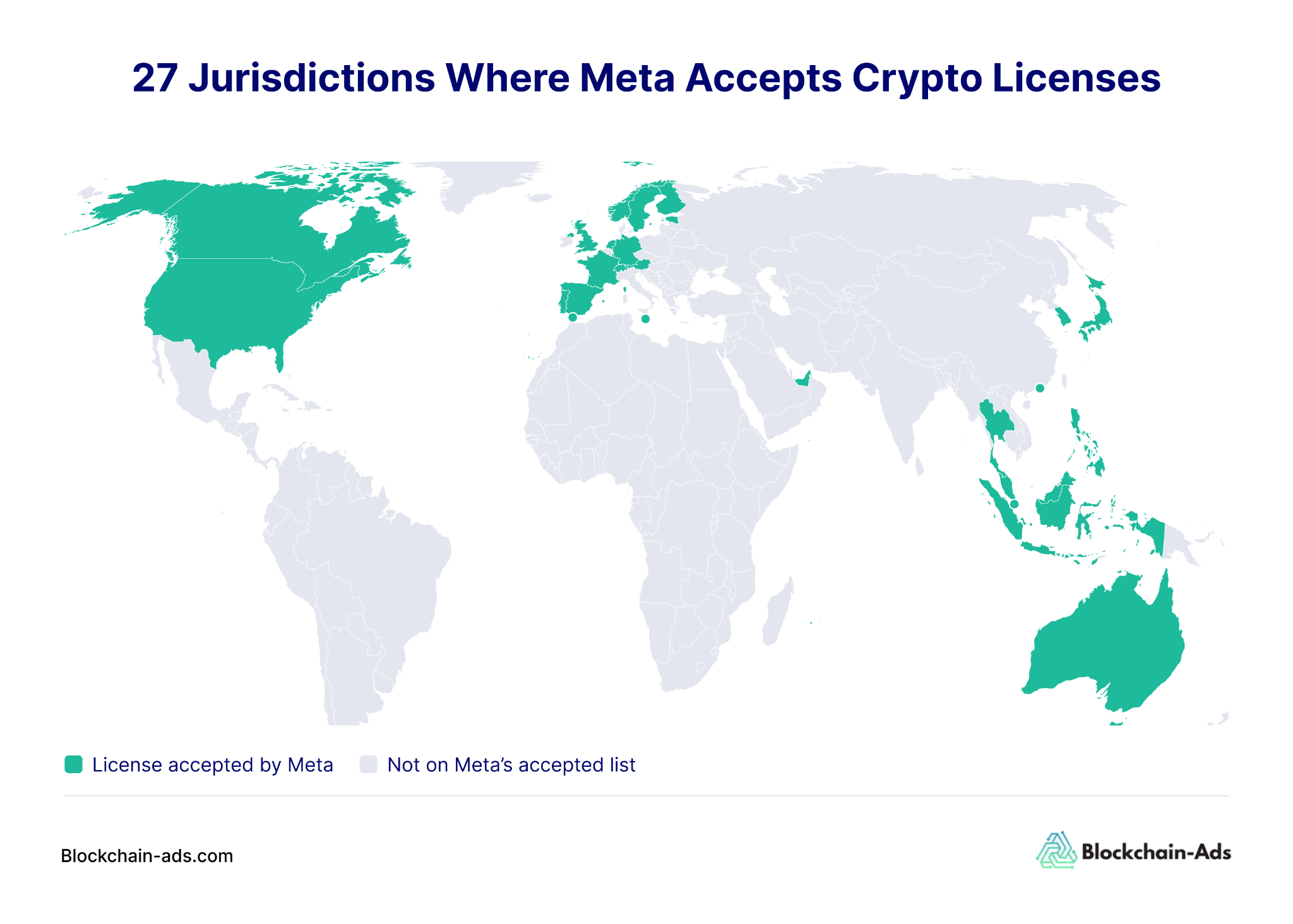
Meta accepts licenses and registrations from a set list of regulators, including those in the US, UK, Canada, Australia, Japan, and Singapore. New Zealand isn’t on the list, so a New Zealand registration alone won’t qualify you for written permission.
Your license has to come from one of these regulators. If your registration isn’t on the list, Meta won’t grant permission, even if another regulator has approved your business.
Meta checks the license against the business that applies. Make sure the legal entity in Meta Business Suite matches the name on your registration.
For Australian advertisers, Meta accepts AUSTRAC registration or an Australian Financial Services Licence or Australian Markets Licence issued by ASIC. If you also run financial services ads to Australia, Meta’s separate verification may ask for your AFSL number as well.
Several EU entries reflect national registrations from before MiCA. If you hold a MiCA license, check Meta’s current list before you apply.
How to Get Meta’s Written Permission for Crypto Ads
Getting Meta’s written permission takes six steps. Here’s how to advertise cryptocurrency on Facebook when your product needs permission, step by step.
Step 1: Confirm you need permission
Check your product against the permission table above and your license against Meta’s accepted list. No application can unlock a banned product, so stop here if yours is on the banned list.
Step 2: Verify your business
Complete business verification in Meta Business Suite before you apply. If you target India or Australia, finish the country-specific financial verification too.
Step 3: Open the crypto permission request
In Meta Business Suite, go to Authorizations and verifications and start the cryptocurrency ads request. The crypto policy page also links to the form.
Step 4: Submit your details
Add your business information, your license or registration, the countries it covers, and the ad accounts that will run crypto ads. Only the ad accounts you name can run crypto ads, so include every account you plan to use.
Step 5: Wait for Meta’s decision
Meta doesn’t publish a standard review time. Send complete, matching documents the first time to avoid follow-up requests.
Step 6: Launch and watch your first ads
Each ad still goes through Meta’s normal review after you’re approved. Check your first ads closely before you scale your budget.
Prepare every document before you start. A license number that doesn’t match your business details is the fastest way to stall an application.
Why Meta Rejects Crypto Ads and How to Fix Them
Meta rejects crypto ads when the advertiser lacks permission, runs from an unapproved account, or breaks a rule in the ad or landing page. Check your ad’s status to find the reason, fix it, then request a review.
For US audiences, a financial ad without the right special ad category can be rejected even when your crypto permission is in place. Pick the category when you create the campaign, since it sets which targeting options you get.
If your license isn’t on Meta’s accepted list, more paperwork won’t change the answer. And dropping the word “crypto” to get past review doesn’t work either: Meta reviews the product and the landing page, not just the copy.
To request a review, open Account Quality, select the rejected ad, and choose Request review. Edit the ad first if it broke a rule, because Meta reviews the ad as it stands.
If the review fails, fix the cause before you try again. Repeated rejections can restrict your ad account, making every future crypto ad harder to run.
Alternatives to Facebook Ads for Crypto Advertisers
If Meta doesn’t fit your product or market, open web and in-app advertising can reach crypto audiences for licensed products. Each channel and country has its own rules, and products Meta bans, such as ICOs, don’t become eligible by switching channels.
For campaign setup across both, see our guide on how to advertise crypto. Before you launch in a new market, check its rules in our crypto advertising regulations guide.
FAQs
Are crypto ad rules the same on Facebook and Instagram?
Yes, Meta’s Advertising Standards and crypto policy apply to ads on Facebook, Instagram, and Meta’s other placements. One written permission covers both apps, and the review and rejection process is the same.
Can you pay for Facebook ads with crypto or a crypto card?
Meta lets eligible advertisers pay with the USDC stablecoin. A third-party payment partner converts it to local currency before the credit reaches your ad account, so check Meta’s help page for availability in your country. A crypto debit card works like any other card if Meta accepts it in your billing country.
What are Facebook’s rules for posting about crypto without ads?
Organic posts follow Meta’s Community Standards, and the ad policies apply once you pay to boost a post. So you can share crypto news and education from your page, but a boosted post that sells a crypto product needs written permission.
Do you need permission to promote a crypto news site or event?
No, ads for crypto news, education, and events run without written permission, as long as they don’t offer a crypto product. Once an ad promotes something people can buy, sell, or trade, it needs permission. However, affiliate and aggregator sites that collect links to partners offering crypto investments are different. Meta treats them as crypto investment promotion, which needs permission.
How long does Meta’s written permission take?
Meta doesn’t publish a standard review time. Finish business verification and send complete license details first to avoid delays.
Can an agency get Meta approval for a crypto client?
Permission is tied to the licensed business, and the ad accounts it names. So the client applies with its own license and adds the ad accounts the agency manages.
Reach Crypto Users With Blockchain-Ads
Blockchain-Ads helps licensed crypto brands reach users across the open web and in-app. Wallet Targeting reads on-chain activity across 11M+ wallets and 82 chains, with prebuilt audiences for on-chain traders, token holders, DeFi users, and crypto app users.
You can run display, native, video, in-app, CTV, push, and Telegram mini app ads. Track results through the pixel, Google Tag Manager, or server-side, and track apps through SDK, server-to-server, or AppsFlyer.
Freelance content writer/editor for B2B SaaS, AI, technology, partnerships brands.
View full profile →