The State of Regulated Advertising in 2026

Regulated advertising in iGaming, crypto, and finance runs on rules most digital campaigns never face. Those rules change what actually works, and Blockchain-Ads studied its own campaigns to find out how.
Our research arm, BCA Labs Institute, analyzed 1,500 campaigns from 250 advertisers across the three verticals.
The campaigns that grow all share five decisions in common, no matter the vertical. Each is broken down below, backed by real results from Stake.com, Coinbase, and Robinhood.
The five decisions:
- Format: graduate from standard display into higher-performing placements.
- Audience: build or borrow a tightly defined audience.
- Market: commit to one licensed market at a time.
- Measurement: install conversion tracking before the campaign launches.
- Cross-vertical signals: reuse audience data built for a different vertical.
Performance formats are where campaigns actually win
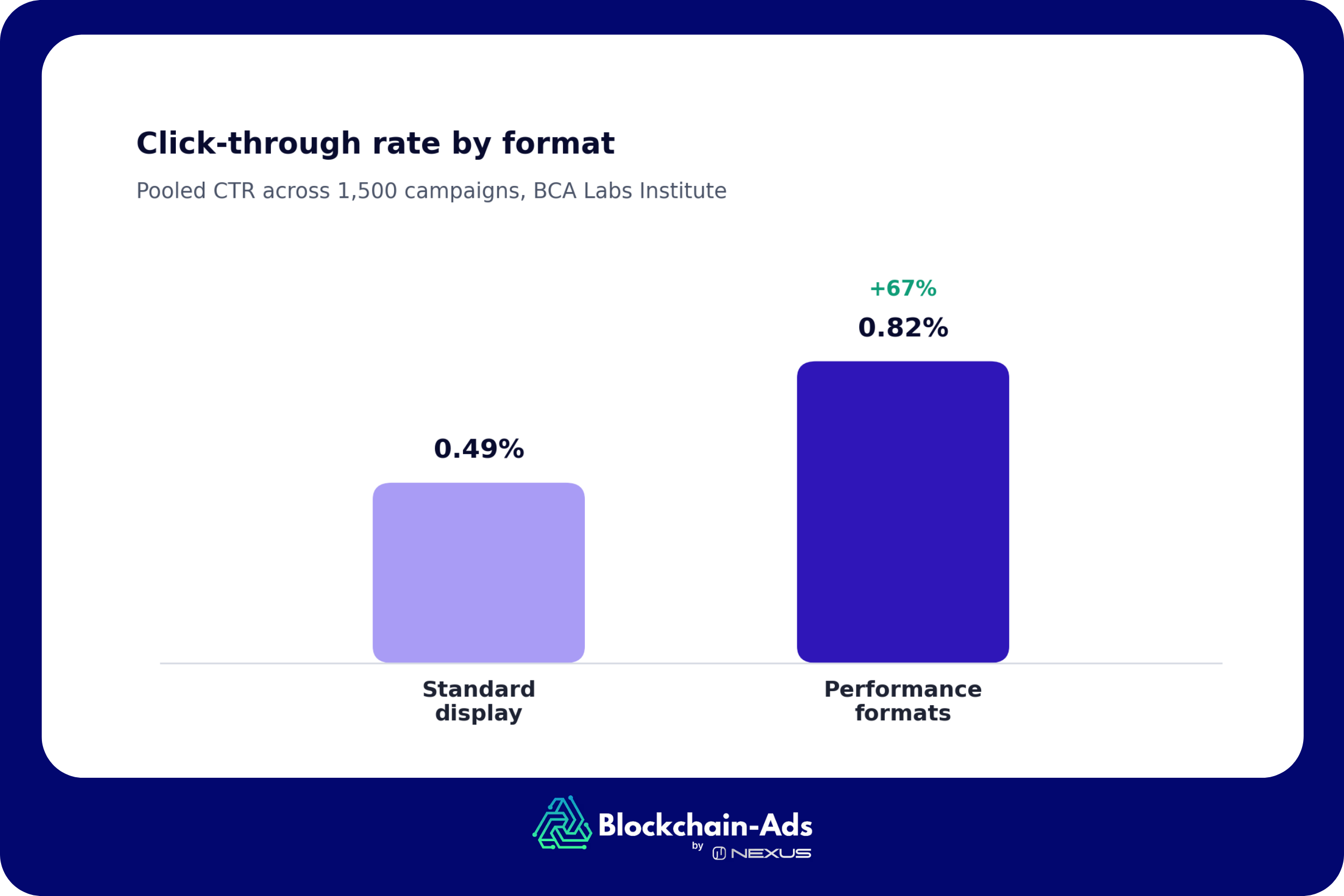
Half of the campaigns in our data still run standard display, the entry format for the category. We see click-through rates rise 67% once advertisers move into Performance Max or native placements. That lift comes at the same media cost, with no extra spend.
That graduation opens a third stage: retargeting. The median advertiser waits 25 days after launching a performance campaign before starting a retargeting phase to re-engage the same audience.
We recommend planning for all three stages from day one so retargeting launches on schedule.
The audience a campaign builds decides more than the format it runs
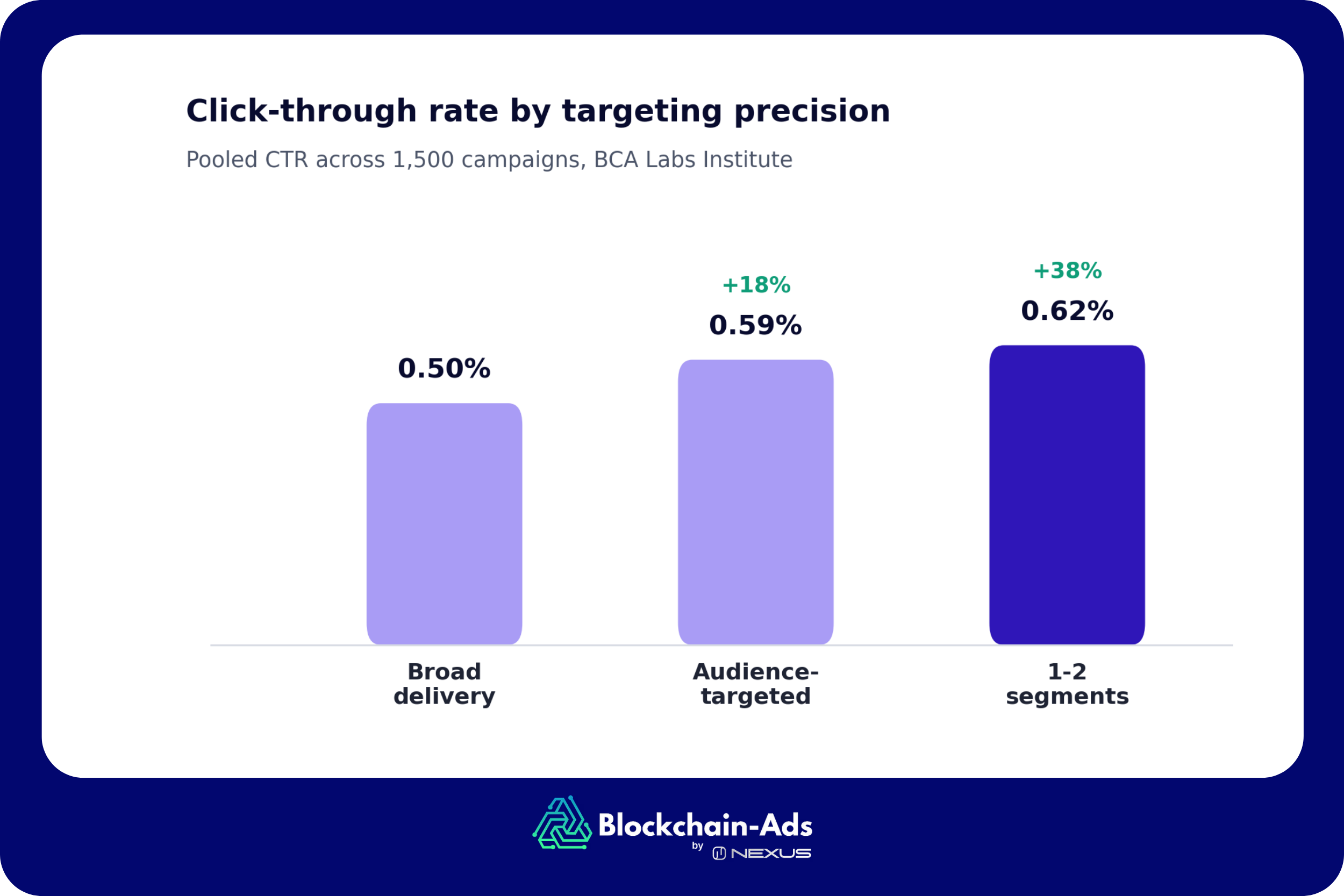
In our data, audience-targeted delivery clicks through 18% higher than broad delivery. Narrow that targeting to one or two segments, and the lift grows to 38%. Custom-built audiences convert at twice the rate of the rest of the pool, and cost 26% less per conversion.
Only 14% of campaigns build a custom audience from scratch today, and those advertisers get the cheaper, higher-converting result.
The license map decides where a campaign can reach
Regulation grants a license to advertise one market at a time, and 63% of geo-restricted campaigns in our data pick exactly one country. Single-market campaigns convert 17% better than campaigns spread across several markets.
Coinbase committed six months of ad budget specifically to one region, Southeast Asia. We turned 41 million impressions into 31,896 new traders, at a $12.85 cost per acquisition and a 19.8x return on ad spend.
Installing conversion tracking changes everything downstream
Installing a conversion tag is a decision every advertiser makes for themselves. Campaigns that install one deliver a median of 606,000 impressions, against 220,000 for untracked campaigns.

Tracked campaigns are 1.7 times as likely to still be delivering a month after launch. Eighty-eight percent of them go on to record at least one conversion.
Tracked campaigns are 1.7 times as likely to still be delivering a month after launch. Eighty-eight percent of them go on to record at least one conversion.
Take Stake.com for example, they tracked every stage of the campaign before scaling spend across Latin America, North America, and Asia-Pacific. That discipline confirmed 1,128 first-time depositors at a $250 cost per acquisition, a 2.5x return on ad spend.
The audience infrastructure built for one vertical carries into the next
In our data, 71% of iGaming audience selections already layer signals originally built for crypto's traders. 42% of crypto selections lead with ownership data, the same signal finance borrows.
Robinhood needed new investing customers in a category where mainstream platforms restrict financial promotion.The campaign was built entirely from behavioral and interest signals borrowed across verticals. It opened 8,275 new accounts at a $123 cost per acquisition, a 4.7x return on ad spend.
What the three verticals cost to reach
These three price points sit on overlapping audience infrastructure, since most iGaming and crypto campaigns already borrow signals across verticals. An advertiser with a working audience in one vertical starts closer to a second vertical than a cold start would suggest.
The pattern behind all five signals
Every campaign in this data faces the same five decisions, and the ones that grow choose each one on purpose. Standard display gives way to performance formats, broad delivery gives way to a custom audience, and several markets narrow to one. A conversion tag replaces guesswork, and a signal proven in one vertical carries into the next.
We run this pattern for advertisers directly, reaching audiences by behavior, on-chain activity, and attention across display, native, video, CTV, and in-app. Request Access to put it behind your next campaign.