



Political Ads on Facebook: How to Run, Requirements, and Best Practices


Heading
- Cointelegraph Formula offers various ad formats to 8 million monthly readers across 190+ countries, leveraging its trusted name in crypto.
Running a political ad campaign isn’t just about throwing money behind a post. It requires a thorough understanding of Facebook policies, including the authorisation process, adding a disclaimer, and all linked accounts.
To set up your political ad correctly you can follow these processes are followed:
- Choosing a campaign strategy and declaring ad content
- Audience targeting
- Budgeting and scheduling
- Ad creative and disclaimer
- Submission and monitoring
Ultimately, transparency is what matters most. Ensure that you present clear, compliant disclaimers and maintain ethical standards at all times.
However, if you experience constant challenges that restrain you from running a successful political ad, then do not hesitate to opt for alternatives like Blockchain ads. They utilise advanced data analytics to ensure your campaign reaches the right audience at the right time, resulting in a better ROAS. Read on for a detailed look at how to run political ads on Facebook, the compliance policies, best practices, and alternative advertising platforms you can opt for.
We also wrote an article about how to run political ads on Google, so you might want to check that out as well.
What Are Political Ads on Facebook?
Political ads on Facebook are paid campaigns designed to raise awareness about candidates, parties, or issues, often around elections or key public debates. Because this type of content can influence public opinion and democratic outcomes, Meta groups it under “ads about social issues, elections or politics” and applies additional transparency and compliance requirements.
Therefore, a Facebook ad is considered a social issue, such as elections or politics, when:
- It is made by, on behalf of, or about a candidate for public office, a political figure, party, or action committee, or advocates for the outcome of an election for a public office
- It’s about an election, referendum, or ballot initiative, such as “go out and vote” or election campaigns
- It's about social issues in any jurisdiction where the ad is to be published
- Regulated as political advertising
Can You Run Political Ads on Facebook?
Yes, you can run political ads on Facebook. However, in an attempt to increase transparency and election integrity, Facebook has established measures to promote authenticity for anyone wishing to run ads on social matters, elections or politics.
Yes, you can run political ads on Facebook in many countries, but only after completing Meta’s authorisation process for “ads about social issues, elections or politics.” In most regions, you must be authorised in the same country where you want the ads to run, which includes verifying your identity and confirming a local mailing address before you can add a “Paid for by” disclaimer and publish political ads.
Requirements for Running Political Ads on Facebook
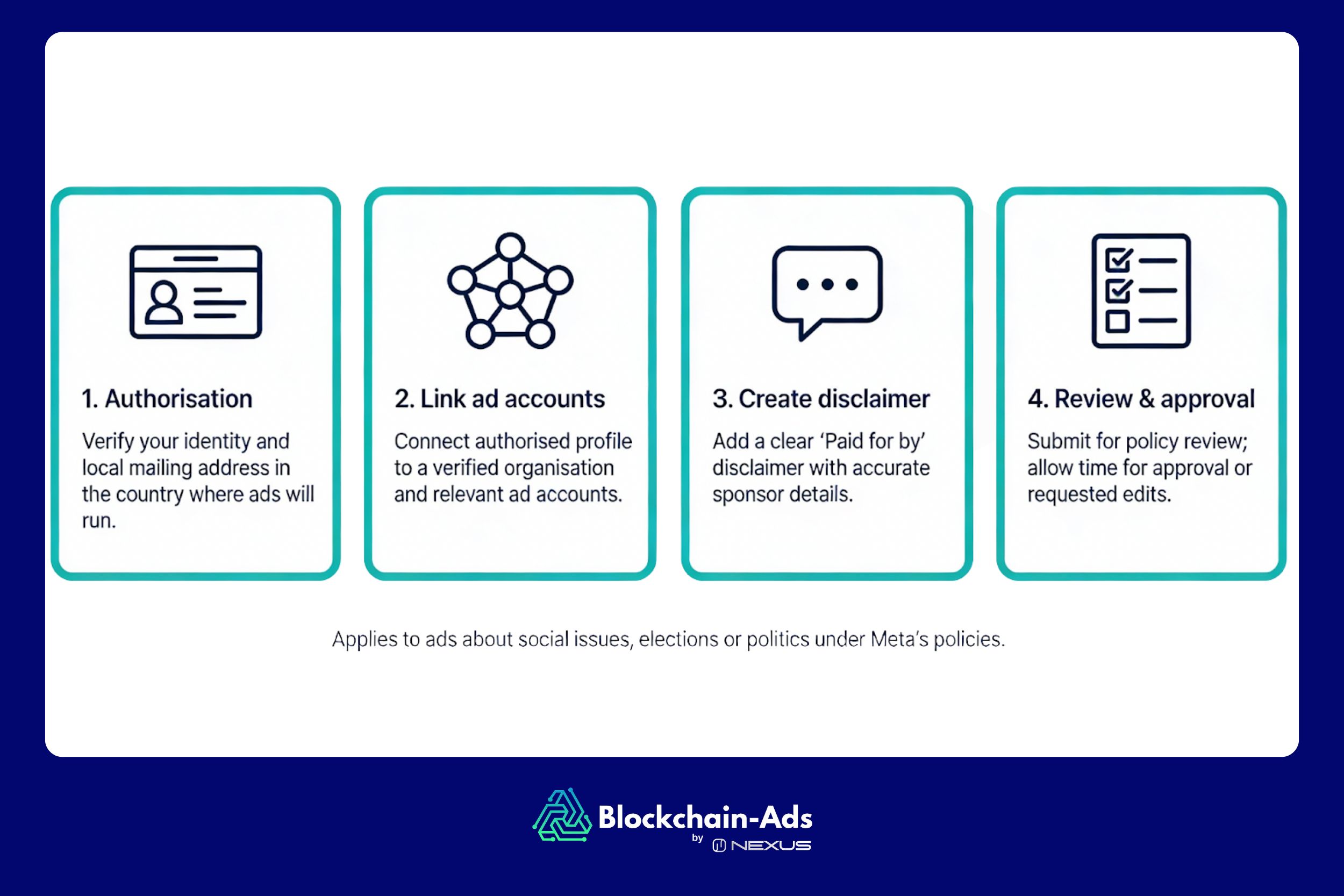
Whether you are creating, modifying, publishing, or pausing ads that reference political figures or parties, you need to go through the authorisation process and place a “Paid for by” disclaimer on the campaign as follows:
Authorisation Process – identity verification, ID, mailing address
Meta treats an ad as being about social issues, elections, or politics when it falls into one of several categories, such as:
- Ads made by, on behalf of, or about a candidate for public office, a political figure, party, or political action committee, or that advocate for the outcome of an election.
- Ads about an election, referendum, or ballot initiative, including “get out the vote” or election‑information campaigns.
- Ads about social issues that are heavily debated or linked to policy or legislation in the country where the ad will run.
- Ads that fall under national rules on regulated political advertising.
This is why even issue‑based and advocacy campaigns often need political ad authorisation and disclaimers, not just candidate campaigns.
Linking Ad Accounts – connecting authorised profile to ad accounts.
To add a layer of authenticity, Facebook will require that you link your political ad to a verified organisation. To do this, you will submit official documents that affirm the organisation's existence and legitimacy.
Disclaimer Creation – Paid for by” requirements and FEC/Tax ID
Including a disclaimer in your political ad is a way to ensure transparency and inform the general public about who is trying to influence them. Ensure that the website, phone number, email address, and address you include here are functional and correct at all times, as Facebook will take your ad down if detected otherwise.
Review & Approval – Meta’s compliance and review checklist.
Before submitting the ad, ensure it complies with community standards and advertising policies, including those related to general and political content. This includes hate speech, violence, and misinformation. You can then proceed to submit it and wait for Facebook to review it and check for compliance.
This process can take time, sometimes even 72 hours. If the ad does not comply, it may be rejected, or you will be asked to make modifications and resubmit it.
How to Set Up a Political Ad Campaign on Facebook
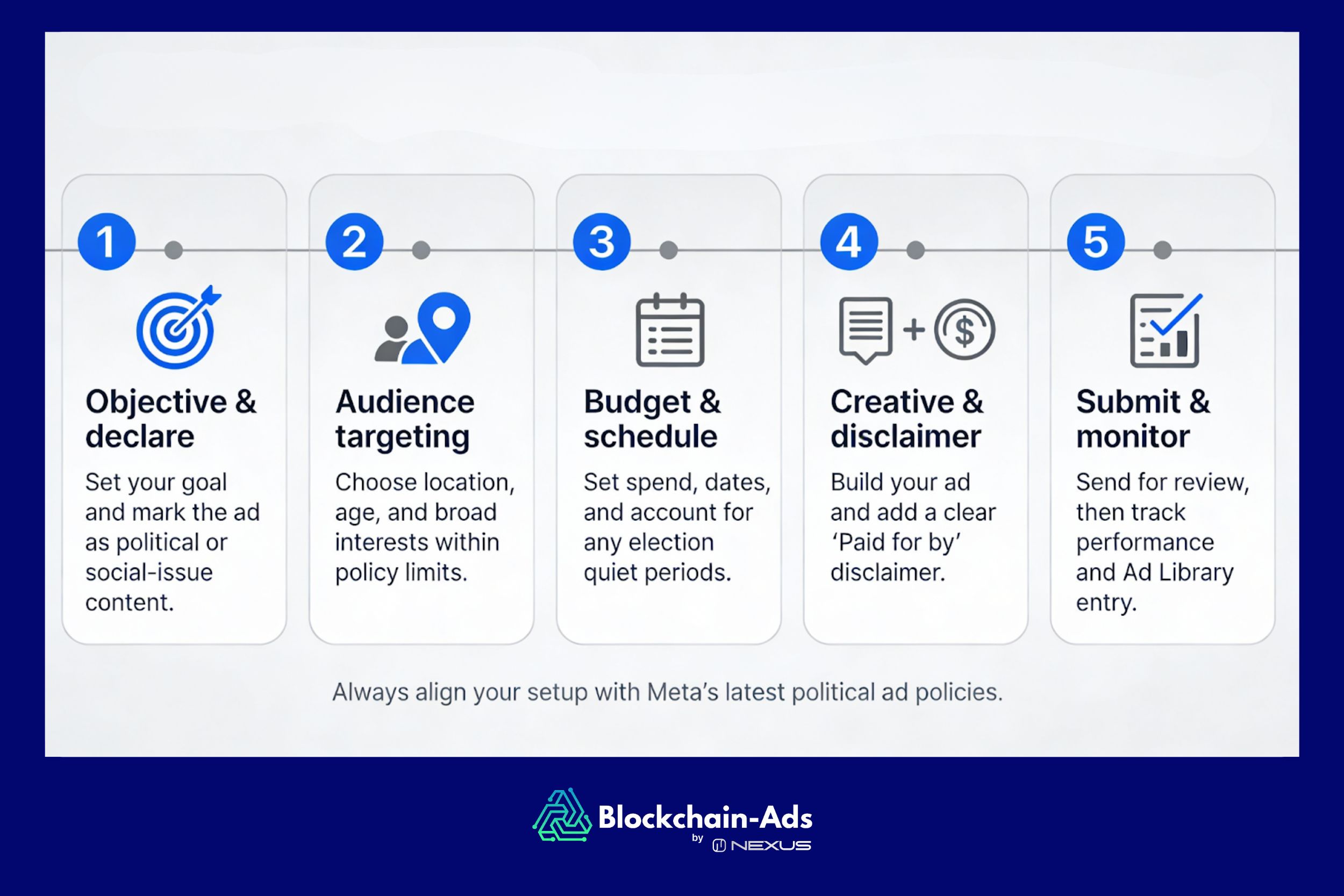
Running political ads on Facebook is very simple. First, you need to decide on your goals, create compelling ad content that adheres to compliance, and refine your approach. Here is a detailed look at the process:
Step 1: Choose Campaign Objective & Declare Political Content
First, you must conduct a thorough analysis of your ad content and then craft a clear purpose. Determine if the ad addresses a political or social matter or is intended to mobilise the public in preparation for an election. If it is a political campaign, also determine if you are in the early, mid-stage, or final stages approaching the election date.
With a clear goal, you can proceed and create an ad that resonates with your audience. Use authentic visuals, keep the content short and clear, and add a strong call to action. You can also employ creative strategies to ensure that your content is engaging and compelling.
Step 2: Audience Targeting – location, age, gender, interests; restrictions on microtargeting.
This is where you balance between precision and inclusivity. Define your target audience and leverage the Facebook targeting tools to get the message to the right people. Here is how you can narrow down your audience targeting:
- Geographic targeting: Select the city, state, county or district that you want your ad to run in
- Demographic: This setting allows you to select your target age and language.
- Interest targeting: Facebook also allows you to let your ad reach those who have recently shown interest in local issues, nonprofits, or community goals
- Lookalike audience: If you have some specific target audience and you already have their email lists, then you can load them here, and Facebook will push the ad to them and find more people like them
Step 3: Budgeting & Scheduling – Funding Transparency and Quiet Periods.
In budgeting, factor in the period you want the ad to run for, the quiet periods, your campaign goals, and the amount you wish to spend then create a balance. Remember, the key is to track performance, make adjustments where necessary, and avoid rushed decisions.
Here is how you can maximise your spend:
- Start with a small budget to test the algorithms and see what resonates
- You can then scale what works by increasing or reducing your spending accordingly
- Spread your spending strategically. According to your campaign schedule, ensure that every campaign message gets adequate funding.
Step 4: Ad Creative & Disclaimer – Sample Ad Specs and Disclaimer Placement.
For maximum engagement, ensure that the ad creatives are working in favour of your campaign. If you are using an image ad, use a vertical format, followed by a headline, primary text, and description copy. Use eye-catching visuals and compelling CTA to drive mass engagement.
Additionally, ensure that your disclaimer is clear, concise and 100% accurate. This puts you on the safe side of the Facebook review process and ensures there are no rejections.
Step 5: Submission & Monitoring – metrics, transparency via Ad Library
Stay compliant with the Facebook restrictions, like audience limits and other policies. Once you’ve passed the compliance checklist, you can submit your ad for review. Remember that Facebook will add it to the ad library to ensure transparency.
If the ad is approved and is up and running, then you can regularly track the performance using metrics like impressions, CTRs and conversion rate.
What are the Key Policies and Restrictions of Running Political Ads on Facebook?
Facebook have adopted some stringent rules about who can run political ads online and has also implemented industry-leading transparency standards. The restrictions include:
Targeting limitations and removing options.
Political campaigns fall under Meta’s “Ads about social issues, elections or politics” policy and, in some regions, may also be treated as a Special Ad Category for compliance and transparency. In general, advertisers must use broad, non‑discriminatory targeting and cannot use political ads to exploit sensitive traits such as race or health.
Where additional restrictions apply (for example, under local election‑transparency laws or when political ads intersect with other Special Ad Categories like housing or employment), you may lose access to some granular levers such as small‑radius or postcode targeting, and must focus more on broader geographies and high‑level demographics. Always check the current rules for your country, because targeting options and legal requirements can change from one election cycle to the next.
Fact-checking exemptions for politicians vs. PACs
Even with the many restrictions on political Ads, Facebook still has a fundamental belief in free expression, respect for the democratic process and the belief that, especially in mature democracies with a free press, political speech remains the most scrutinised. Therefore, Facebook exempts the following type of political content from fact-checking:
- Contents that advocate for ideas and draw conclusions based on the interpretation of facts and data, and tell the general public what the author or contributor thinks
- All posts and ads from politicians, including what they say, whether in a text, photo, video, or any other content that directly quotes the politician
- Former candidates or officials are also covered from fact-checking. This includes organisations like Super PACs, or the advocacy organisations that are still unaffiliated with candidates.
Ad Library transparency and data retention
To promote transparency, all ads about social issues, elections, or politics that run on Meta’s platforms are added to the public Ad Library, usually within 24 hours of receiving their first impression. Each entry shows creative assets, approximate spend, impressions, and high‑level demographic information, and these records are kept for up to seven years so journalists, watchdogs, and voters can scrutinise political ad activity.
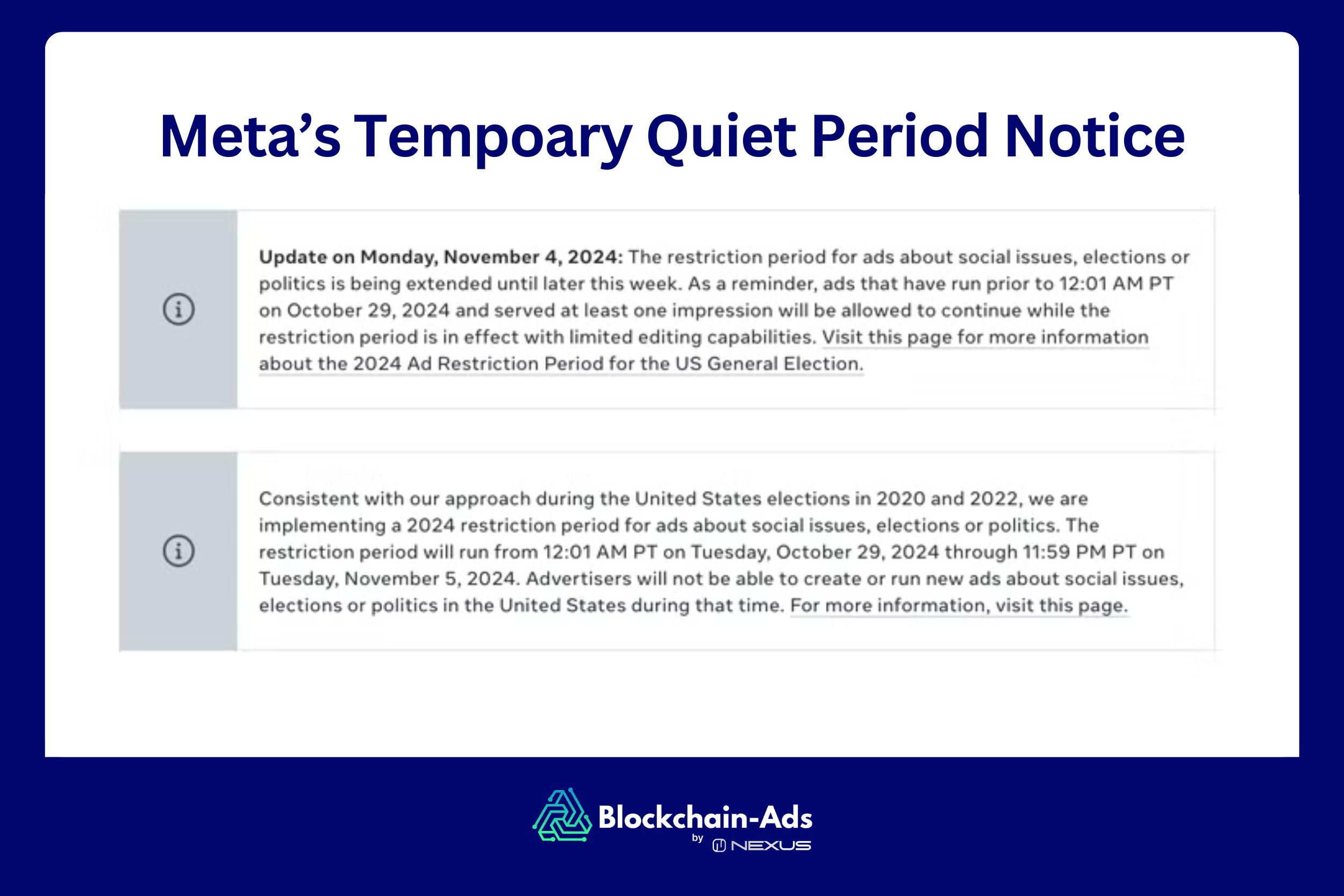
Temporary quiet periods before elections.
In some elections, Meta introduces temporary “quiet periods” when new political, electoral, or social‑issue ads cannot be created or edited, and in some cases cannot run at all. The length and scope of these blackouts vary by country and election; for example, in a previous US election Meta extended its political ad pause from a planned one‑day window to about a week, while other regions have relied on different timelines or rules in coordination with local regulators. Because these measures are time‑limited and may change from cycle to cycle, campaigns should always check the latest election‑specific guidance for their target country well in advance of launch.
Best Practices for Political Ads on Facebook
Here are the best practices to follow when running political ads on Facebook:
Crafting clear, compliant disclaimers
Politics is confusing enough already, so ensure to make things as straightforward as possible when communicating with voters. Go to the Facebook authorisation process and ensure you review the disclaimer policies. It must be 100% accurate. Any misleading or deceptive disclaimer can have disastrous implications for your ad campaign.
Using A/B testing within policy bounds
While testing your political ad campaign to determine what works best, adhere to Meta’s best practices policies. Ensure that you use only one variable for more conclusive results, focus on a measurable hypothesis, use an ideal audience and time frame, and set a budget that will produce enough results. Doing anything outside of these can lead to a violation, which may cause Facebook to reject your ad.
Maintaining transparency and ethical targeting.
Political advertising can be very risky, and every move can have far-reaching consequences. That is why Facebook requires you to be transparent and honest about who is behind a campaign and what messages are being conveyed. You must therefore ensure full disclosure of funding resources, clearly state the issue the ad addresses, be transparent about who your audience is, and indicate how long the ad will be running.
Alternatives: Running Political Advertising on Blockchain-Ads
Facebook is a good advertising platform. However, let’s face reality: this platform primarily relies on demographics to attract your audience, and as a marketer, you know how ineffective that can be. According to Marketing LTB, Facebook has a 1% CTR, which is very low compared to its competitors, such as Google Ads with 6% and YouTube with 4%.
For this reason, you must seek out alternatives like Blockchain Ads. Unlike other platforms that rely on demographics, keyword-based intent, and contextual guesswork, Blockchain Ads goes deeper by combining advanced behavioural analysis, interest graph analytics, and on-chain data to identify your target audience. The platform does predictive targeting with machine learning to forecast audience behaviours and anticipate trends, preferences, and purchasing intentions.
Additionally, to maintain quality and order on the platform, blockchain ads also have a built-in compliance workflow that must be followed to the letter to run a political ad successfully.
Below is how Blockchain Ad compares to Facebook:
Case Studies
It goes without saying that the effectiveness of running political ads on Blockchain Ads is far beyond that of Facebook. If you have your doubts, then go through th following case studies:
Partido Acción Ciudadana Municipal Campaign Case Study
Costa Rica’s political party launched an ad campaign to build grassroots awareness and volunteer infrastructure through authentic, neighbourhood-focused targeting. Throughout the campaign, Blockchain Ads employed four strategies: neighbourhood geography permission, documentary creative approach, multi-optimisation pathway, and phased messaging. The campaign ran for 28 days under a $32,000 budget.
At the end of this period, the campaign achieved a 53% RSVP conversion rate, recruited 347 volunteers, secured 1,680 total event commitments, and gained 4,250 email subscribers. This demonstrated that the strategies, such as the documentary-style approach, were effective as they resonated strongly with the target neighbours. Additionally, the grassroots mobilisation technique was also very effective.
Georgi Dream Parliamentary Campaign Case Study
Georgia Dream aimed to mobilise young voters aged 18-35 years and create awareness of key policy platforms. With a $145,000 budget on the table, Blockchain Ads launched the following strategies: creating a custom audience segment, targeting multi-platform geographic areas, teasing issue-based creative, and ensuring a mobile-first landing experience.
After 42 days of the campaign, the results yielded were quite impressive. A total of 8.2 million impressions were received, 12,780 completed commitments, and 13.6 million pledge completions from the landing page visits. The approach that Blockchain Ads use in those campaigns showcases how they can help political parties mobilise low-propensity voters through strategic digital campaigns that balance broad awareness with conversion optimisation.
FAQs
Can you run political ads on Facebook?
Yes, but you must complete Meta’s authorisation, include a “Paid for by” disclaimer, and comply with transparency rules.
What is the process to run political ads on Facebook?
Get authorised by verifying identity, linking ad accounts, creating a disclaimer, declaring political content, and then submitting for review.
What are the key restrictions for Facebook political ads?
Limited targeting options, no fact-checking of politicians’ ads, mandatory Ad Library storage, and pre-election quiet periods.
How can I block political ads on Facebook?
Use Ad Topic Controls in Settings > Ad Preferences to “See Fewer” social issues, elections, or politics ads.
Conclusion
The key to running a successful political ad on Facebook is understanding and complying with its guidelines and polices. Next, ensure you have creative ad content and set a budget that aligns with the campaign's aim. When selecting your audience, conduct thorough research and do not rely on your basic instincts, because any mistakes will easily result in poor performance. Additionally, if you want the best tactics and audience targeting, then opt for Blockchain Ads.
Qualify and get acess to Blockchain-Ads
Lorem ipsum dolor sit amet, consectetur
.png)
Your best-performing campaign hasn't launched yet
Advertisers on Blockchain-Ads are scaling ROI daily. The only question is when you start.
Read related blogs




Talk with some of our current partners
View all success stories

Reach 12M+
Engaged Web3 users across 10,000+ websites and 37 blockchains.