


How to Run Political Ads on Google: Complete Setup Guide and Best Alternative
Google can be very effective for political advertising because people actively search for news, candidate updates, and ballot information on Google Search and YouTube during elections. However, running political ads on Google is less about simple access and more about staying compliant with strict policy rules.
Google demands strict compliance for political and Election Ads, including:
- Verified advertisers for Election Ads in each eligible region
- Clear “Paid for by” disclosures on every political ad
- Tight limits on targeting (no voter‑file microtargeting) and strict rules on creative claims, especially around voting procedures and synthetic media
Apart from the restrictions, political advertising as seen in the last U.S presidential election was largely everywhere else, not limited to Google ads. Voters in 2024 consumed more election and campaign coverage through traditional television, social media like X and facebook, CTV apps, streaming news, native and display on news sites. Advertisers used programmatic ad platforms like Blockchain-Ads to achieve wider reach across most of these channels with a performance and compliance layer that starts where Google stops.
This guide first simplifies the rules: what counts as political content, how Election Ads verification works, and how disclosures operate. It then shows how to set up compliant campaigns, choose objectives and formats, and structure budgets and bidding. Finally, it explains how to navigate targeting limits, keep creatives approved, and avoid the most common disapprovals.
We also wrote an article on how to run political ads on Facebook, so you might want to check that out.
Why Run Political Ads on Google?
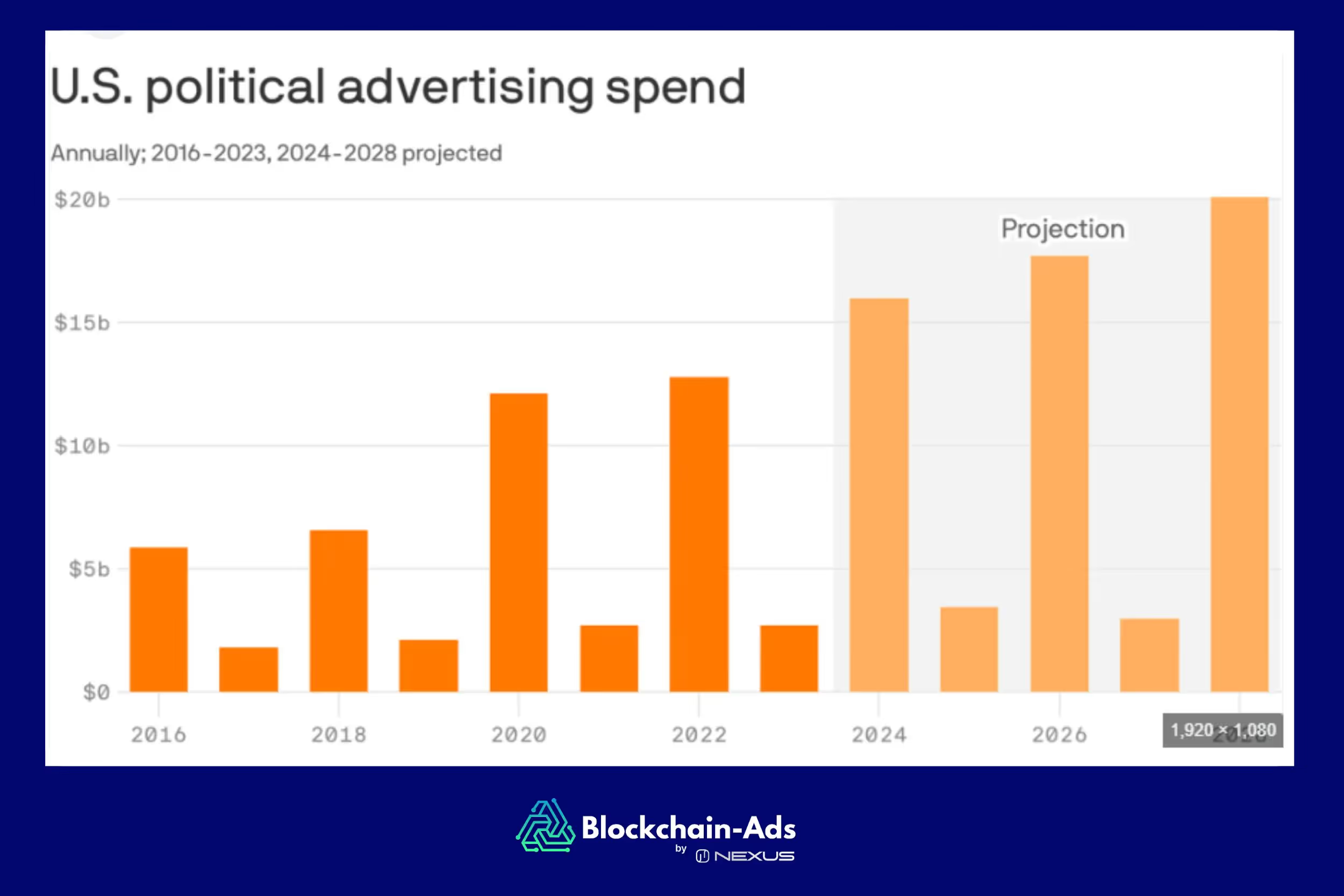
Reach and intent are the main reasons to run political campaign ads on Google. Although social platforms work great for social content, Google includes Search, YouTube and the Display Network. This helps dominate key areas like active information seeking and video consumption. The data below actually confirms that campaigns are prioritizing this shift.
- In the 2024 U.S. election cycle, Google and Meta alone accounted for $619 million in political ad spend.
- Digital ad spending in the 2022 U.S. election surpassed $3.25 billion
- Major campaigns, like those of Trump and Biden in 2020, collectively invested $398 million on Google and Meta platforms
In short, the platform’s global reach is paramount. Google has verified over 10,000 entities in the EU and 6,000 in India for running election-related advertising (Google Transparency Report 2024). This clearly confirms its role in the democratic process worldwide.
Understand Google’s Political Advertising Policy
Google’s policy is built on the principle of transparency. This helps ensure that users know exactly who paid for an ad and why they are seeing it. The policies are mostly not the same and vary significantly by country to show the local election laws and standards.
What Counts as Political Content?
The Google Ads political policy broadly defines political content as Election Ads which feature the following:
- Candidates or current officeholders for elected federal, state, or territory-level offices like President, Governor, Senator.
- National political parties or coalitions at the federal, state, or territory level.
- A question or a call to vote in a national referendum.
- State or territory-level ballot measures, referenda, initiatives or propositions that have qualified for the ballot.
- Government proposals or legislative bills designed to influence an outcome.
Key Policy Requirements – verification, disclosures, targeting limits, prohibited content
To run any of the political content defined above, you must address four important requirements. Political campaign managers should view these as mandatory because false information will lead to immediate revocation of your verification or suspension of your account.
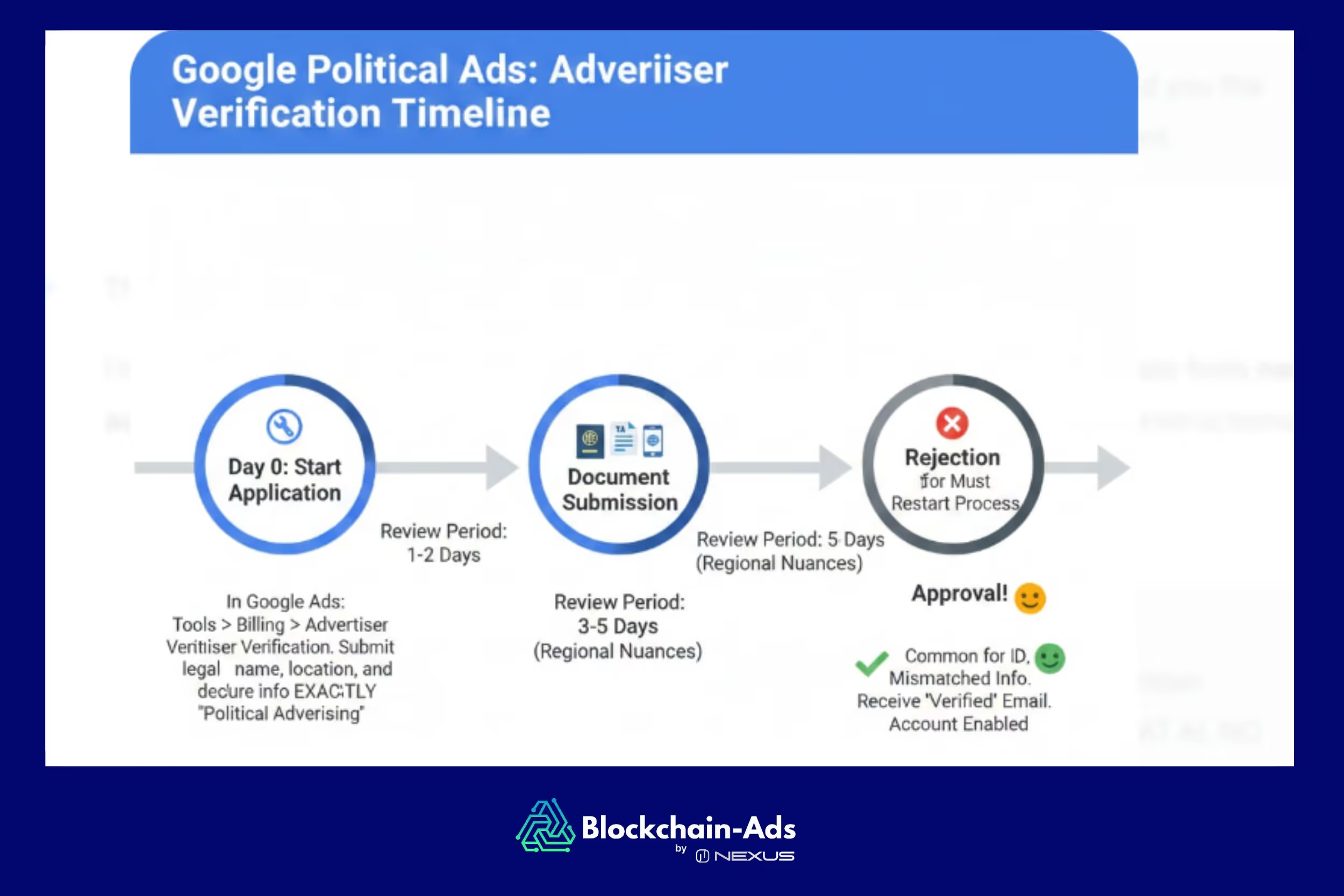
- Advertiser verification: This is the first step. You must successfully be verified by Google to run Election Ads in the region you are targeting. It’s a two-step process that takes up to 5 business days. We’ll discuss it in the next section. Once verified, any substantial change you make, like updating the account or legal name, will require you to redo the verification again.
- Disclosure: Every approved Election Ad must contain a disclosure that clearly identifies who paid for it. For most ad formats, Google automatically generates a Paid for by disclosure. However, for formats like third-party ad serving on YouTube and Display Network, or audio ads, the advertiser is responsible for making the disclosure visible at all times within the creative itself.
Here is how these disclosures appear in different ad formats:
- Google Search/Search Partner network: Disclosure is shown directly.
- Websites/apps: It appears as ‘’Why this ad?’’
- YouTube: Disclosure is shown in ‘’Why this ad?’’
- Targeting limits: Google severely restricts the audience for political ads. They have banned microtargeting based on voter files or political affiliation. You are limited to age, gender, geographic location and contextual targeting.
- Prohibited content: Immediate ad removal and possible account suspension happen when there are false claims, manipulated media or claims about the voting procedure.
Step 1 – Complete Advertiser Verification
Political campaigns should start at least two weeks before their planned launch date to account for potential delays. The reason is that the advertiser verification process requires up to five business days for review.
Starting Your Application – navigate Google Ads interface
Before you start the process, ensure that your account details perfectly match your legal documents, then follow these simple steps.
- Navigate to the Tools & Settings icon in the top menu.
- Click Advertiser verification.
- You will be prompted to start the task. Here, you must select the option for running political advertising and declare whether you are applying as an individual or an organization.
Documentation & Identity Confirmation – personal ID, organization registration
Based on your account type, Google will require different documents. You are required to verify the end advertiser and not the agency or intermediary managing the account. Here are the confirmation details needed:
- Individuals: You need a government-issued photo (Passport or Driver’s License). It helps confirm personal identity and date of birth.
- Organization: Organization registration document and a government-issued photo ID of the authorized representative. This is to confirm the legal existence, name and address of the entity.
Regional Verification Nuances – country-specific rules
Google’s verification is specific to the region you are advertising in. If you want to target the U.S., then, you must pass the U.S. Election Ads verification. If you want to run an ad about the Australian election in Australia, you need Australian verification. Below is the table showing region/country, verification requirements and the key nuances:
Step 2 – Set Up Your Political Ad Campaign
The setup of a political campaign differs from commercial ads simply because your main objective is usually engagement and awareness. Your choices of campaign objective, budgeting and creative must therefore reflect compliance and political goal-setting. Here’s how to do it correctly.
Choose Campaign Objective & Formats – Search, Display, YouTube
Once you’re verified, the campaign objective you choose dictates the format and features available. Here’s what you’ll find:
- Search: It’s high intent and targets users actively searching for candidates or issues. However, the restricted text length limits messaging complexities.
- Display: High reach across millions of websites and apps. It’s great for awareness but expect lower engagement rates.
- YouTube (Video): This is the most impactful format for emotional and long-form messaging. However, the disclosure is only accessible via the info icon (i), therefore, users need to click to view it.
Budgeting & Bidding Strategies – best practices for political budgets
The cost of political campaigns is often high due to increased auction competition, especially in the final weeks before the election day. To budget correctly, here are the political ad best practices:
- Start early: Launching campaigns well ahead of the peak season helps establish a quality score and secure data before the costs increase.
- Use manual bidding: Campaigns often benefit from maximum control over bids when budget stability is paramount. This allows for precise allocation to high-value keywords.
- Expect high costs: US political ad spending hit $12.32 billion in 2024, nearly 29% from the prior presidential election in 2020. This has driven up the cost-per-impression (CPM) substantially, particularly in the 30 days leading up to the election.
A campaign ad budgeting best practice that works is to set an average daily budget and monitor it closely. Google usually calculates the monthly budget by multiplying your daily budget by 30.4.
Crafting Compliant Creative – approval tips, “Paid for by” disclosures
Every ad creative must pass both policy and legal review. So:
- Include disclosures: For most formats (Search/display), Google automatically adds the ‘’Paid for by’’ disclosure using your verified name. However, for certain custom formats, you must manually include the disclosure clearly on the ad itself.
- Avoid false information: Google strictly prohibits ads containing false claims about voting, election outcomes or manipulated content like deepfakes.
Targeting Options & Restrictions
Google limits election ad audience targeting to the general category to improve voter confidence and increase transparency. This policy requires advertisers to fundamentally rethink their digital campaign strategy and move away from voter files towards contextual relevance.
Prohibited targeting criteria
You cannot use the following targeting methods for political Election Ads on Google:
- Voter files or custom lists: No uploading voter registration lists, donor lists or any other campaign first-party data.
- Political affiliation: You cannot target based on a user’s presumed political leaning (e.g., ‘’conservative’’ or ‘’independent’’).
- Remarketing/Lookalike audiences: No targeting people who previously visited your site or create lookalike models based on those visitors.
Allowed targeting criteria
Here are the allowed targeting methods for Political Election Ads:
- Geographic location: Targets down to the postal code level, city, state or region.
- Age: Targets users within standard age (e.g., 18-24, 25-34, 65+).
- Gender: Target uses based on general gender categories.
- Contextual targeting: It’s the most powerful tool. It targets the users based on the content of the page they are viewing (topic, keywords, placements).
Transparency & Ad Disclosure Requirements
The goal of Google’s transparency rules is simple. To give voters confidence in the democratic process by making sure that they know the source of every political message they see. The compliance here is essential and involves the following.
Automated vs. Manual Disclosures – how Google adds “Paid for by”
All Election Ads run by verified advertisers in regions where verification is required must contain a ‘’Paid for by’’ disclosure. And the way this disclosure is added depends entirely on the ad format.
- Automated disclosure: For most political ad formats, Google does the heavy work. The system uses the legal name and location confirmed during your ‘’Advertiser Verification’’ to automatically generate the disclosure text.
- Manual disclosure: For ad formats served by third parties (video, audio, image), the advertisers are legally responsible for including the disclosure in the creative itself.
Ads Transparency Library – using Google’s public report
Apart from in-ad disclosure, Google aggregates all political ad data into a public and searchable database called Ads Transparency Center. This is a powerful library tool for voters, researchers and competitors. It includes:
- Public data: Every Election Ad run by verified advertisers.
- Key insights: Anyone can search and filter the data to view advertisers’ legal names, the amount of money spent, ad creatives, and broad targeting.
What are the challenges of running political ads on Google?
Even with a full compliance strategy, Political campaign managers still face advertising challenges on Google. These include:
- Verification delays: The two verification processes are slow and the average review waiting time is 5 business days per step.
- Disapproved ads: Google provides a strict set of editorial and policy requirements for political content. Your ad will be disapproved due to failure to disclose, destination mismatch and policy violation.
- Regional bans: Not all elections are eligible for Google Ads. You must check the regional ad policies first as some countries have explicit prohibitions on political advertising. For example, Brazil election ads are generally prohibited on Google platforms. The European Union (EU) has additional Google ad restrictions due to regulations like the TTPA.
- Limited targeting: The ban on microtargeting forces campaigns to rely on broad demographics and contextual methods. This leads to higher spending and less-qualified audiences.
Alternatives: Compliant Political Advertising on Blockchain-Ads
Campaigns need an engine that can reach fragmented voters across web, apps, and CTV while staying compliant in sensitive categories. Blockchain-Ads fills that gap for performance‑driven and regulated campaigns that want both control and scale, without geo restrictions.
Blockchain-Ads is a full‑stack, performance‑driven DSP built for regulated industries, including political. It combines programmatic buying, Nexus AI optimization, and a premium publisher network to deliver campaigns across web, in‑app, mobile, and CTV. With Blockchain-Ads, every impression, click, and conversion is verifiable because they are logged on‑chain for audit‑ready attribution.
Unlike Google’s Election Ads framework, which locks you into broad demographics plus contextual signals, Blockchain-Ads gives access to 69+ audience segments mapped to over 420 million profiles, built from behavior, content consumption, device patterns, on‑chain intent, and geo location.
Blockchain-Ads Comparative Benefits vs. Google
Case study/example campaign
The following real-world political ad examples show how Blockchain-Ads allows advanced targeting to achieve specific mobilization goals.
Partido Acción Ciudadana (Costa Rica)
Partido Acción Ciudadana (PAC) conducted grassroots awareness and volunteer mobilization for the municipal election in specific San Jose neighborhoods. The strategy used was documentary-style creative and precise geo-targeting that achieved 347 volunteer signups and 890 verified event attendees.
Georgian Dream (Georgia)
Georgian Dream launched voter pledges and mobilization among urban youth (18-35) ahead of elections. She created a custom first-party audience segment to re-engage past supporters and expand reach to generate political subscribers. Georgian drove 12,780 voter pledges and achieved a 13.6% conversion rate on its mobile-optimized landing page.
Frequently Asked Questions
What is Google's political advertising policy?
Google’s policy mandates transparency for all Election Ads. That includes advertiser verification, clear Paid for by disclosure and limited targeting options.
How do I get verified to run political ads on Google?
Navigate to ‘’Tools & Settings, click ‘’Billing’’ and tap ‘’Advertiser verification’’ in Google Ads. Next, submit identity and organization documents. Select your target region and wait for Google to review.
What types of political ads are allowed on Google?
Display image, search text ads and YouTube political ads are all allowed. However, they must comply with verification, disclosure and strict rules against false content.
Can I target specific voters with Google Ads?
No. Google strictly prohibits election ad targeting based on political affiliation, voter lists, customer matching or remarketing for political ads. The only permitted are broad targeting criteria and contextual relevance.
Conclusion & Next Steps
Basically, running successful political ads on Google is ultimately a function of compliance. The massive reach of platforms like YouTube and Search is great. However, their use is dictated by a strict set of regulations that prioritize transparency and data minimization. Thankfully, alternatives like Blockchain-Ads solve the strategic problems Google creates. The platform offers advanced behavioral targeting that can help maximize your campaign’s ROI, similar to the 13.6% conversion rate achieved by the Georgian Dream campaign.
Read related blogs





Talk with some of our current partners
View all success stories

Reach 12M+
Sign up to become an affiliate today