A Guide to Native Ads for Affiliate Marketing
Key takeaways
- Native ad formats: In-feed ads, recommendation widgets, search ads, and promoted listings place affiliate offers inside the content people already browse.
- Break-even CPC: Multiply the commission per approved conversion by your click-to-approved-conversion rate to find the most you can pay per click.
- Conversion tracking: Use click IDs and S2S postbacks to connect paid traffic to approved, payable affiliate conversions.
- Testing budget: Blockchain-Ads requires a $10,000 minimum deposit and a $360 minimum daily budget per campaign.
- Campaign optimization: Test headlines and images, judge costs against approved commissions, and scale only what turns a profit.
Running native ads for affiliate marketing is profitable only when the commission an offer pays covers what each click costs. You need to work out that break-even point before you launch.
There are three numbers that decide that point: the cost per click, the approved conversion rate, and the payout per conversion.
Once that’s nailed down, track every step from the click to the payout. This guide covers the math, tracking, and setup behind affiliate marketing native ads, then how to test and scale them on Blockchain-Ads.
What Native Ads Are in Affiliate Marketing
Native ads affiliate marketing uses paid ads that match the look and feel of the content people are browsing. They appear in feeds, recommendations, search results, and marketplaces, labeled as advertising.
Affiliates pay to send visitors to an offer, directly or through a bridge page, and earn a commission when those visitors register, deposit, or buy.
Native Ad Formats Affiliates Use
Native advertising includes four common formats:
- In-feed ads: Sit among the articles or posts in a feed, styled like the content around them.
- Recommendation widgets: Display sponsored content alongside or below articles, typically under headings such as “Recommended for you.”
- Search ads: Appear alongside organic search results, with sponsored labels identifying paid placements.
- Promoted listings: Sponsored products or services inside marketplaces and directories, styled like organic listings.
What a Native Affiliate Ad Looks Like
A native affiliate ad combines a headline, image, description, and call to action. Here's a hypothetical one for a trading app:
- Headline: “Explore Trading”
- Description: “See how the platform works before signing up.”
- CTA: “View App”
- Image: An advertiser-approved image showing the trading app interface.
Bridge page: The ad leads to a page covering the app's features, eligibility, and sign-up process, ending in a disclosed affiliate link to the registration page.
Why Native Ads Work for Affiliate Offers
Native ads affiliate campaigns work because they let affiliates introduce offers through content relevant to readers' interests instead of relying on direct sales messages.
Three advantages make native ads useful for affiliates:
- Contextual relevance: Sponsored content reaches readers already researching the topic.
- Room to explain: Articles and comparisons explain fees, features, and eligibility before the reader converts.
- Qualified traffic: Readers who click through have already assessed the offer, which filters out poor-fit visitors.
How Native Compares With Display, Push and Social Ads
Each format reaches people in a different context:
- Native ads: Sit in content feeds and recommendations, with room to explain an offer before the click.
- Display ads: Banners across websites and apps that suit short, direct messages but leave little room to explain.
- Push ads: Notifications sent to opted-in users, with even less space to explain an offer.
- Social ads: Run in social feeds, stories, and video, within each platform's targeting options and ad policies.
💡Our native ads vs. display ads comparison breaks down where each format fits.
What You Need Before You Start
Affiliate marketing and native advertising require four things before launch: an eligible offer with workable payout economics, sufficient testing capital, conversion tracking, and an ad network that accepts the offer.
An Offer That Fits Native Traffic
Choose an offer you can explain through a headline and landing page, with commissions that can cover paid traffic costs. Trading apps, sportsbooks, and crypto casinos can work if the affiliate program allows native traffic in your target countries.
For gambling offers, check the operator's license, affiliate promotion rules, and qualifying deposit requirements.
Affiliates typically earn through CPA, a fixed payment for an approved action, or RevShare, a percentage of qualifying customer revenue. Since you pay per click, calculate your break-even CPC before launching:
Break-even CPC = Commission per approved conversion × Click-to-approved-conversion rate
As a worked example, suppose a trading app pays $100 per approved funded account, and 2% of paid clicks produce approved accounts.
- Break-even CPC: $100 × 2% = $2.
- Traffic cost: At a $2 realized CPC, 100 clicks cost $200.
- Commission: Two approved accounts earn $200, covering the traffic cost before additional expenses.
These figures are illustrative, not benchmarks. A lower conversion or approval rate would make the campaign unprofitable at that CPC.
With RevShare, estimate commission revenue per acquired customer over a defined period. Don't treat projected lifetime earnings as guaranteed payouts.
💡Read the casino affiliate marketing guide to understand the payout models.
A Testing Budget
Budget enough to test your offer, creatives, and targeting before you expect consistent conversions, using your estimated CPC and conversion rate to work out how many clicks you can buy.
On Blockchain-Ads, the minimum initial deposit is $10,000, with a $360 minimum daily budget per campaign. That covers about 27 days of one campaign, or 13 days of two, at minimum spend.
These requirements make Blockchain-Ads best suited to experienced affiliates with a strong offer, enough testing capital, and reliable payout data.
A Tracker
A tracker ties each paid click to the affiliate conversion it produced.
Server-to-server (S2S) tracking does this through postbacks. Blockchain-Ads uses the {clickid} placeholder to match conversions to their original ad clicks. Your affiliate tracker captures the click ID and includes it in the conversion postback sent to Blockchain-Ads.
Keep pending, rejected, and approved conversions separate. If 10 visitors register but only three make approved deposits, measure acquisition cost against those three.
💡You can configure this through Blockchain-Ads conversion tracking.
Set up tracking before launch, not after the first clicks arrive. Blockchain-Ads' 2026 State of Advertising in Crypto, iGaming, and Finance report, drawn from campaigns by 200+ advertisers in those verticals, found that advertisers who did so reached a first deposit or trade 92% more often (46% against 24%).
A Native Ad Network
Affiliate-friendly ad networks must accept your offer, support its target countries, and provide the conversion data needed to evaluate profitability.
Blockchain-Ads supports native campaigns for eligible finance, crypto, and iGaming offers, with the conversion tracking affiliates need to measure acquisition costs.
Before choosing any network, check:
- Offer eligibility: Confirm the network permits your vertical, landing page, and target countries.
- Tracking compatibility: Verify click-ID support and whether conversion postbacks work with your affiliate tracker.
- Performance reporting: Check whether you can identify acquisition costs by campaign, creative, and country.
- Funding requirements: Review minimum deposits, daily budgets, bidding models, and payment conditions.
How to Set Up a Native Campaign on Blockchain-Ads
To understand how to run ads for affiliate marketing on Blockchain-Ads, follow its five-step campaign builder: Objective, Settings, Targeting, Creatives, and Summary.
In HUB, open Advertising > Campaigns > Create Campaign to begin.
Choose the Objective and Native Format
In Objective, select the action that matches your affiliate payout:
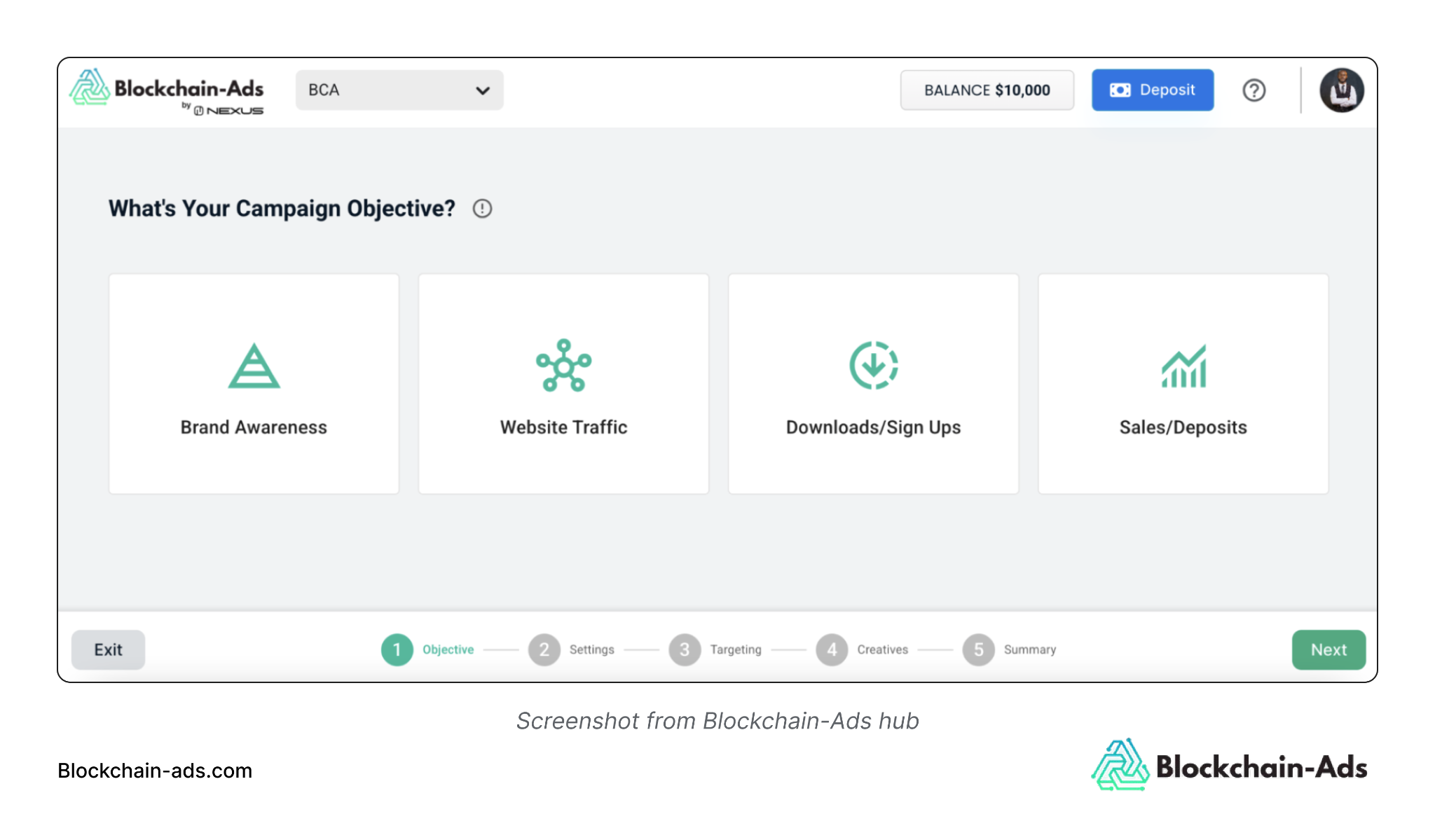
- Downloads/Sign-Ups: For app installs or approved registrations.
- Sales/Deposits: For purchases, funded accounts, or qualifying deposits.
Note: You need an installed conversion event with Verified status before launching this objective.
Next, choose your ad format. Native serves your uploaded creative, while Flux Native uses your brand assets and copy to generate a tailored creative for each impression.
Set Bids and Daily Budgets
In Settings, enter your landing-page URL, select tracking parameters such as ClickID, name the campaign, and choose its dates. Then configure Budget and Bidding.
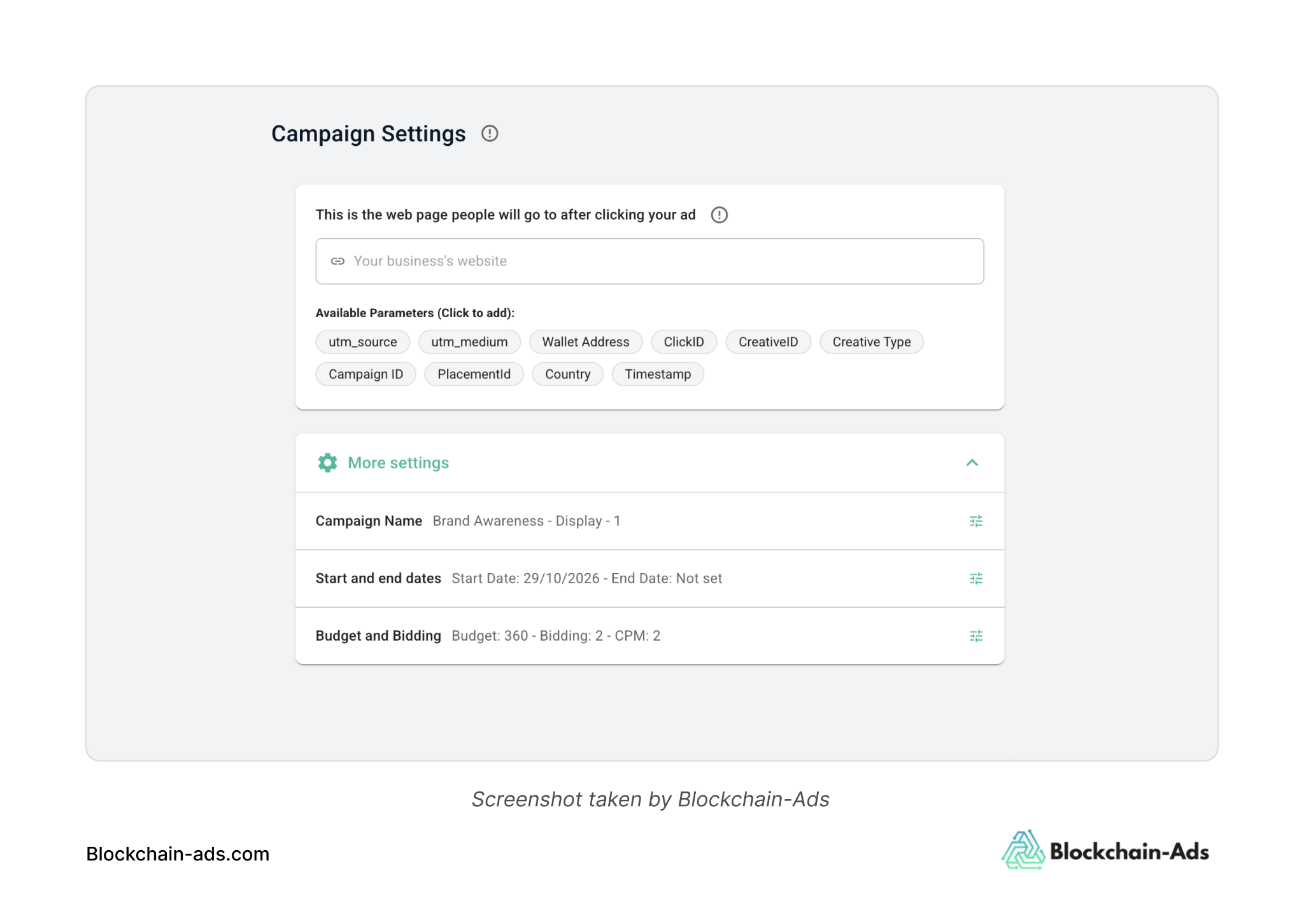
Blockchain-Ads requires a $360 minimum daily budget per campaign and has a $2 default viewable CPC bid. Compare your actual CPC against the break-even CPC calculated earlier.
If your break-even CPC is $1.50 but clicks cost $2, the campaign would lose money at your assumed conversion rate.
Change one setting at a time when testing bids, budgets, or creatives.
Target by Audience and GEO
In Targeting, Blockchain-Ads enables Automated Targeting by default, using signals from your landing page, assets, and campaign objective. Switch to manual targeting to select audience segments and locations yourself.
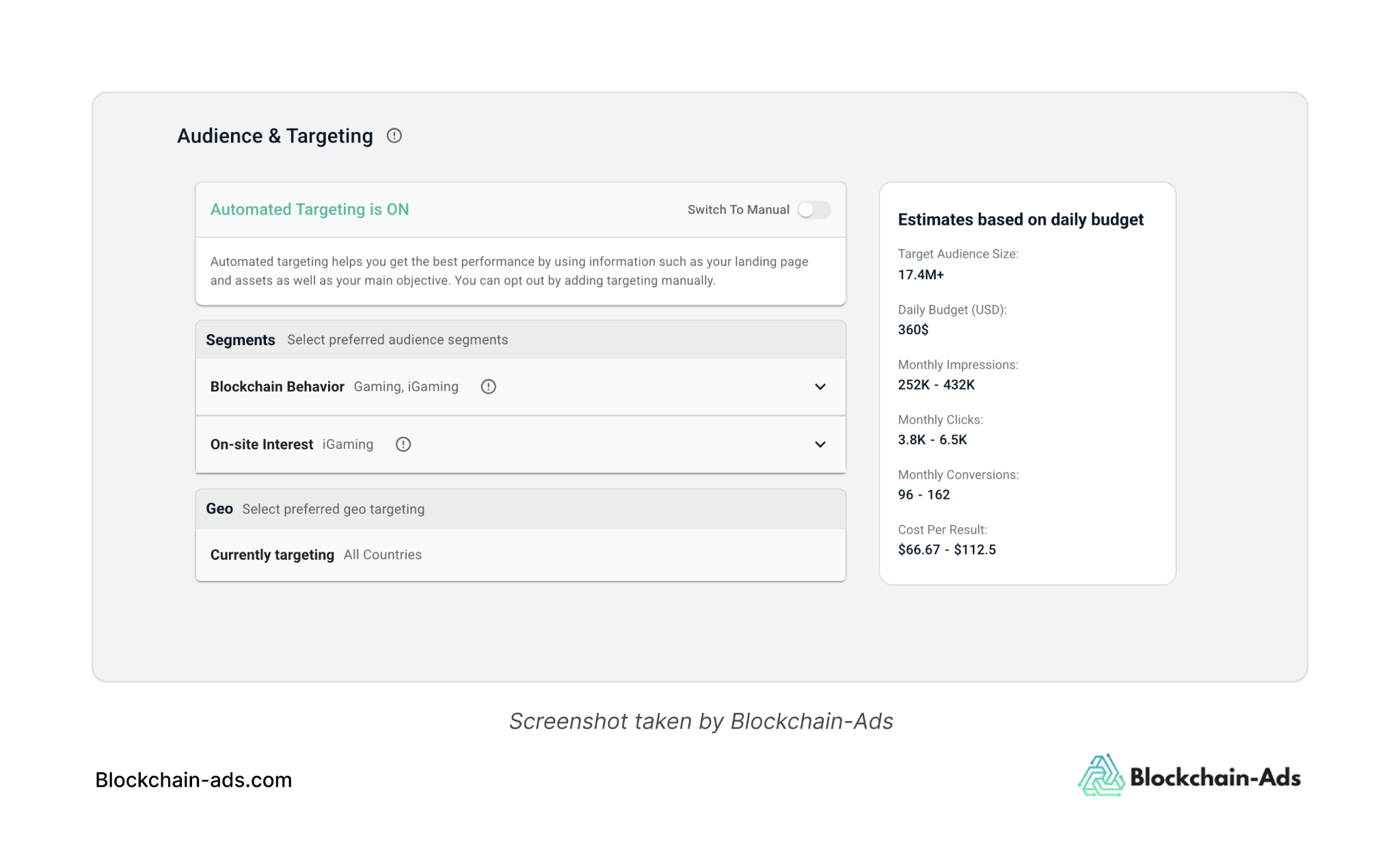
Manual targeting includes:
- Blockchain Behavior: Blockchain-related activity, including Gaming & iGaming.
- On-site Interest: Website activity and content interests, including Gaming.
Narrow your GEO before narrowing your audience. Select countries where the operator accepts customers and permits affiliate advertising. Check the estimated audience size before adding behavioral or interest segments.
Pro tip: If impressions stall because your audience is too narrow, remove a targeting layer before increasing the budget.
Write Headlines and Images That Tell a Story
In Creatives, use the headline to introduce your offer, the description to explain what visitors will find, and the CTA to match their next step.
Blockchain-Ads specifies:
- Headline: Maximum 20 characters
- Description: Maximum 50 characters
- Call to action: Maximum 15 characters
- Image formats: GIF, PNG, or JPG
Avoid unsupported claims about profits, bonuses, or account benefits. Preview the ad before submission because Blockchain-Ads truncates copy that exceeds its character limits.
Bridge Pages and Advertorials
A bridge page explains an affiliate offer before directing visitors to the advertiser through a disclosed affiliate link. In Settings, use it as your destination URL if the affiliate program and ad network permit that funnel.
Keep ad claims consistent with the page, disclose affiliate relationships, and avoid misleading endorsements. Make sure it works on mobile and passes the tracking IDs through.
Account Approval and Ad Policies
Blockchain-Ads verifies advertisers through its Advertiser Qualification & Verification (AQV) process before granting account access. Approval usually takes 24 to 48 hours after the qualification call, depending on the documentation your vertical requires. Regulated offers may require business registration, identity verification, or compliance certificates.
Check the advertising policies before submission:
- iGaming: Confirm licensing, permitted countries, applicable age restrictions, responsible-gaming information, and bonus conditions.
- Crypto and finance: Disclose material risks, fees, and eligibility requirements. Avoid guaranteed-return claims.
- Landing pages: Display accurate terms and required disclosures, support mobile devices, and avoid deceptive redirects.
Finally, review every setting in Summary and click Launch Campaign.
Blockchain-Ads then reviews it for policy compliance, and its status moves from Pending to Active once approved.
How to Test and Optimize Native Campaigns
Optimize native campaigns using approved affiliate conversions and acquisition costs, not clicks alone.
Split-Test Headlines and Images
In Blockchain-Ads HUB, duplicate a campaign and change either the headline or image, keeping the audience, budget, and objective consistent. Run variations at the same time, with enough budget for each to compare fairly.
The same report found that advertisers across crypto, iGaming, and finance who ran five or more ad sets in month one captured a first deposit that month 87% more often than those who ran one (56% against 30%).
More ad sets only help when each one tests a real difference, such as a new angle or image, instead of a minor wording change.
Pause Placements That Don't Convert
Review campaign spend, clicks, approved conversions, and CPA to identify campaigns that aren't generating profitable commissions. High click volume doesn't make a campaign profitable if the traffic fails to produce payable conversions.
Before pausing an underperforming campaign, check conversion tracking and allow time for pending deposits or purchases to receive approval. If the campaign consistently exceeds your target CPA, pause it and revise its targeting or creatives.
Scale What Works
Increase the budget gradually on campaigns generating profitable, approved conversions. Expand GEO targeting one eligible country at a time, keeping the audience and creative consistent to measure the new market's performance.
Blockchain-Ads also recommends:
- Retargeting at around 15,000 users: Run a separate campaign for past visitors, excluding those who already converted.
- Refreshing creative about every 15 days: Swap in new headlines and images before repeat exposure wears down response.
What to Expect as a Beginner
Your first few weeks can feel unpredictable: you pay for traffic immediately, but affiliate programs can take weeks to approve conversions and pay commissions.
Here's what to expect as you get started:
- Delayed payouts: Your tracker might show conversions before the affiliate program approves them. Keep enough working capital to continue testing while commissions remain unpaid.
- Unstable early results: One approved deposit can make a campaign look profitable, followed by days without another conversion. The first weeks are a learning period, so wait for a meaningful sample before treating early returns as reliable.
- Limits to scaling: Even a profitable campaign can reach its audience limit or face restrictions on eligible countries and traffic volume.
Judge a campaign on approved conversions and acquisition cost over a meaningful testing period, not on clicks or a single early deposit.
If your offer clears the break-even math, Blockchain-Ads can help you test it on native traffic once your account is verified.
FAQs
How Much Do Native Ads Cost for Affiliate Marketing?
Costs depend on the network, bidding model, and audience, with most networks charging per click (CPC) or per thousand impressions (CPM). Blockchain-Ads requires a $10,000 minimum deposit and a $360 minimum daily budget per campaign, with a default bid of $2 per viewable click.
Which Native Ad Networks Work Best for Affiliates?
The best network depends on your offer and budget. Content-focused networks suit affiliates using advertorials and comparison pages, while Blockchain-Ads is an option for experienced affiliates promoting eligible crypto, iGaming, and finance offers. Compare permitted countries, tracking capabilities, and minimum spend before choosing.
Can You Track Native Ad Conversions Across Affiliate Networks?
Yes. An affiliate tracker captures each network's click ID and matches it to conversions reported through server-to-server (S2S) postbacks.
Are Native Ads Good for Beginners?
Native ads can work for beginners with enough testing capital and an understanding of affiliate payouts. Start with an offer that permits paid native traffic and a network whose minimum spend fits your budget.
Are Native Ads Better than Facebook Ads for Affiliates?
Native ads suit offers that need explaining through an article or landing page, while Facebook relies on social feeds and Meta's targeting. Compare approved conversion costs and ad restrictions to see which fits your offer.
Can You Run Crypto, Gambling, or Finance Offers on Native Ad Networks?
Yes, if the network permits the offer and the advertiser meets applicable requirements. Network approval doesn't replace operator licensing, country restrictions, or disclosure requirements. Gambling promotions may need age and responsible-gaming notices, while crypto and finance ads may require risk warnings and restrictions on return claims.
How Much Can Affiliates Earn with Native Ads?
Native ads affiliate commissions depend on approved conversions, payouts, and traffic costs. As a worked example, 20 approved conversions at $100 each generate $2,000. With $1,500 in ad spend, that leaves $500 before additional expenses.
Srijan Sharma is a B2B writer specialising in SaaS, FinTech, MarTech, and data integration.
View full profile →