
Coinzilla Review 2026: Features, Pricing, Pros and Cons, and Best Alternatives
Coinzilla positions itself as a "Results-Driven Bitcoin and Crypto Advertising Network." It places ads for crypto projects across a network of crypto and finance websites, built primarily on a CPM model.
For advertisers, the real question isn't whether Coinzilla can generate impressions. It's whether those impressions turn into users. This review covers how Coinzilla works, its pricing, its strengths and limits, and how it stacks up against Blockchain-Ads and other crypto ad networks.
What Is Coinzilla?
Coinzilla is a crypto and finance ad network launched in November 2016, connecting advertisers with over 650 publishers across the crypto ecosystem. It's run more than 20,000 campaigns for 15,000+ advertisers, generating over a billion monthly impressions.
Coinzilla offers:
- Display ads (banner, HTML5) across crypto websites
- Native ad placements within editorial content
- Press release distribution through its Marketplace
It's one of the more established names in crypto advertising, giving projects access to a crypto-reading audience without negotiating publisher deals one by one.

How Does Coinzilla Work?
Coinzilla runs on a CPM model, and rather than broad, general-purpose advertising like Google Ads, it concentrates on vetted crypto media, blogs, and news sites.
Coinzilla runs on a CPM model, and rather than broad, general-purpose advertising like Google Ads, it concentrates on vetted crypto media, blogs, and news sites.
Advertisers sign up, fund an account, and build campaigns through a self-serve dashboard: upload creatives, set geography and device targeting, and launch. Once live, performance is tracked through impressions, clicks, CTR, and traffic quality, and most advertisers iterate on creatives and placements over time to improve cost-per-visit. It's widely used by exchanges, DeFi protocols, and fintech startups, driving awareness and landing-page traffic.
On the publisher side, crypto news sites, analytics platforms, and blogs integrate Coinzilla's ad code and earn CPM (or engagement) revenue from its demand pool, without needing to negotiate sponsorships directly.
Where Ads Appear
Placements are inventory slots on Coinzilla's partner sites, matched to campaigns by format, targeting, and publisher availability. Ads run in article pages, sidebars, and homepage sections, appearing directly alongside the crypto news and content readers are already there for.
Ad Formats
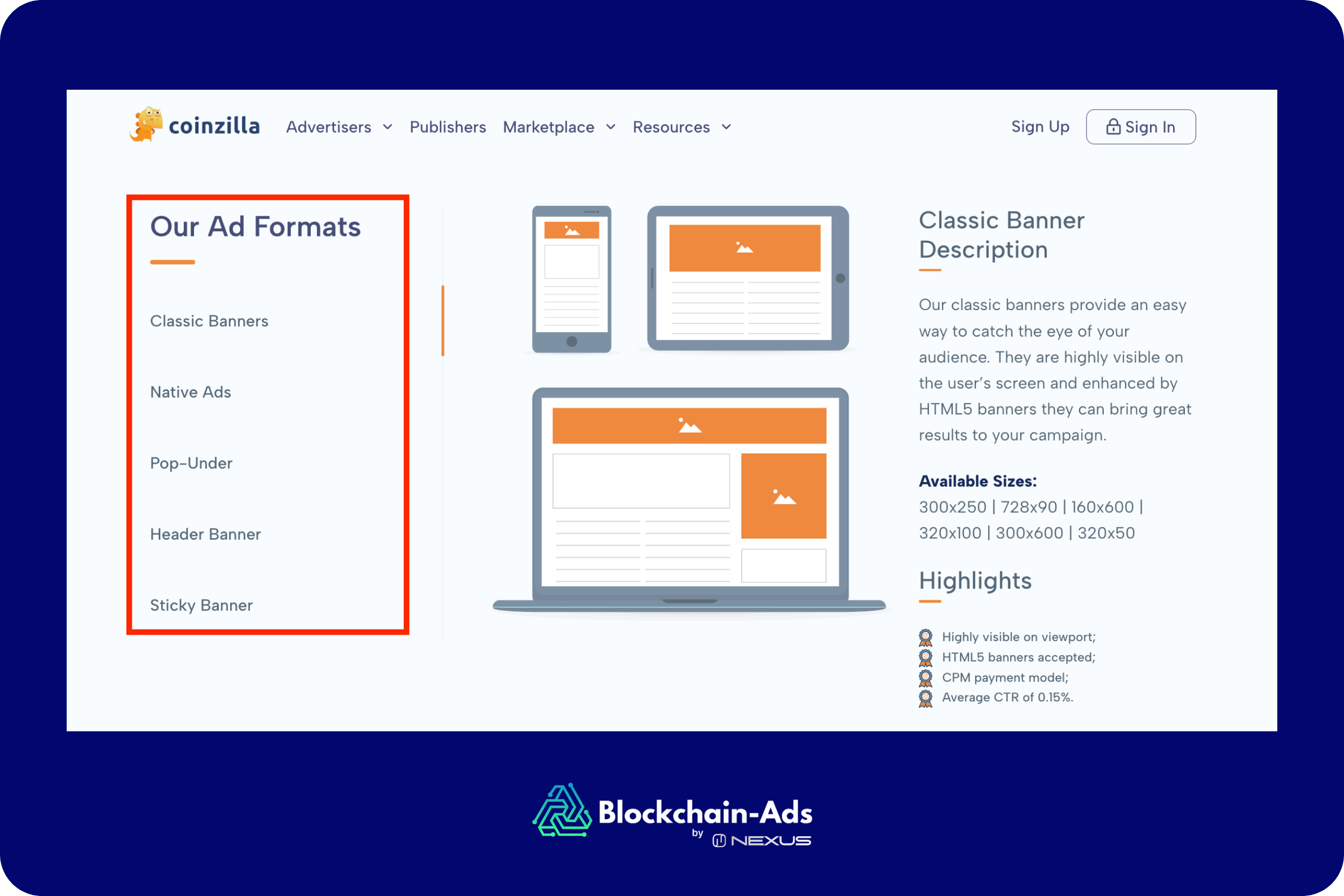
- Display (banner, HTML5): Standard banner slots, used for brand awareness, product and token launches, and driving landing-page traffic.
- Native: Matches the look of surrounding editorial content, appearing within articles and feeds. Less disruptive, generally stronger for engagement than standard display.
- Pop-Under: Opens in a background window behind the active browser tab, surfacing when the user closes or switches away from their current page.
- Sponsored content and press releases: Distributed through Coinzilla's Marketplace for added visibility beyond standard placements.
Who It's Best Suited For
Coinzilla works best for exchanges, wallet providers, DeFi platforms, and blockchain startups, where the traffic is already crypto-aware and relevant. It's also a fit for early-stage or mid-sized projects that want visibility but don't yet have the budget or scale for larger platforms. For publishers, it's a simple, plug-and-play way for crypto content sites to monetize traffic.
Where the model runs into limits is precision: because campaigns buy placement on specific sites rather than target a specific person's behavior or intent, results depend heavily on how well a publisher's audience matches your offer.
Coinzilla Features Review
Coinzilla is best understood as a publisher-based ad platform, and that distinction shapes what advertisers can realistically expect from it.
Audience and Reach
Coinzilla's core value is access to a crypto audience through its publisher network rather than broad, open-web distribution. Ads appear on sites already producing crypto and finance content, so the benefit isn't raw scale; it's alignment: readers see your ad while they're already thinking about blockchain, trading, or digital assets.
This works best when introducing a product to an already crypto-aware audience or when the goal is visibility inside industry-specific media rather than mass-market reach. It's naturally weaker for discovery beyond the crypto space, since publisher-based distribution reaches whoever reads a given site, not a specific person based on their behavior or intent.
Targeting Options
Coinzilla offers geographic targeting, device and placement selection, and website/category filtering. The key mechanic: you're choosing where an ad appears, not who sees it. Performance depends on the relevance of your selected publishers, the quality of surrounding content, and how well your offer fits a "reading-mode" audience rather than a "buying-now" one.
Reporting and Analytics
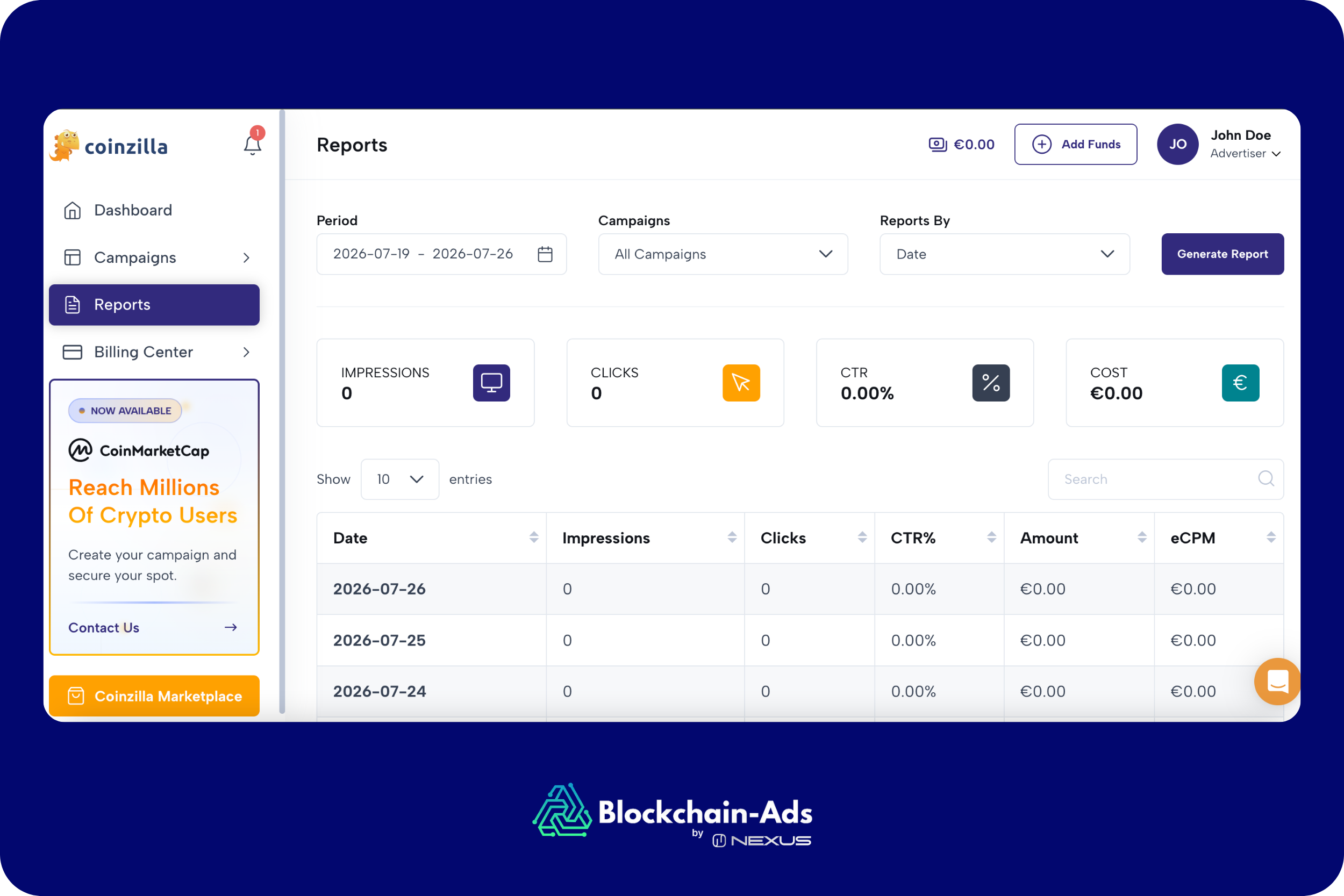
a screenshot from coinzilla home page
The dashboard tracks impressions, clicks, placement performance, budget pacing, and basic conversion tracking depending on setup. It's built for optimizing which sites perform best, more than for deep behavioral analysis or advanced attribution modeling.
Crypto Use Cases
Coinzilla tends to be most effective for projects that benefit from visibility within crypto media, especially when early-stage awareness matters more.
Common use cases include the following:
- Exchanges: Useful for driving awareness and attracting traders already reading crypto news and analysis.
- Wallet providers: Works well for visibility campaigns where trust and familiarity are important.
- DeFi platforms: Effective for reaching users engaged in yield, staking, or protocol research content.
- Web3 projects and tokens: Often used for launches, announcements, and ongoing community visibility.
In a nutshell, rather than being a precision-targeted ad platform, Coinzilla functions more as a specialised distribution network.
It performs best when the goal is contextual exposure inside crypto publications, not when the goal is tightly optimised, intent-driven user acquisition.
Coinzilla Pricing
Coinzilla runs on a CPM model: advertisers pay based on how many times an ad is displayed, not on clicks or conversions.
You fund a campaign upfront with a minimum deposit of €100 and a minimum daily budget of €50 per campaign. Coinzilla offers two tiers: brand awareness inventory starting around €0.2 CPM and premium traffic from top-ranking crypto sites starting around €3 CPM.
Advertisers running headroom tests sometimes push to €5–6 CPM to win earlier ad placement in a user's session, since higher bids compete better for premium slots.
What Affects Cost
Actual spend varies by:
- Ad format (banner vs. native)
- Website and placement tier (premium crypto publications cost more)
- Targeting settings (geo, device, category)
- Campaign duration and pacing
- Demand and competition for specific publisher inventory
At a €500 daily budget and a €3 CPM, for example, a campaign nets roughly 100,000 impressions a day, so two campaigns with identical budgets can produce very different reach depending on where those impressions are bought.
Budgeting for Coinzilla
It works best treated as a testing-and-scaling channel: larger budgets to build exposure and brand familiarity across crypto sites, and smaller ones to test placements, creatives, and geographic performance. Since spend is impression-based, it's worth watching CPM variability across placements and setting frequency caps so budget doesn't burn too fast on high-traffic sites.
Paying for Exposure, Not Outcomes
CPM pricing buys attention, not leads or conversions. The real question isn't "what does a thousand impressions cost," it's whether that visibility is worth it for your stage. For early projects building trust and awareness, that can be valuable on its own. For teams optimizing purely for acquisition efficiency, it's a channel that needs more work layered on top to convert.
Coinzilla Pros and Cons
It helps to frame strengths and limitations in terms of outcomes rather than platform features:
Pros
- Ads appear on established crypto and finance websites, ensuring relevance
- Well-suited for blockchain, DeFi, exchanges, and Web3 products targeting existing crypto audiences
- CPM model allows consistent exposure across multiple publications
Cons
- No on-chain wallet or behavioral targeting, only geo, device, and category filters, so campaigns can't isolate high-intent users the way behavior-based platforms can.
- CPM-only pricing structure limits flexibility compared to platforms offering CPC or hybrid models.
- Performance depends heavily on creative and landing page effectiveness to convert readers
- Attribution can be less direct compared to performance-based systems.
To sum up: Coinzilla’s pricing structure makes the platform most effective when viewed as a visibility and awareness investment, rather than a strictly performance-optimised acquisition channel.
Is Coinzilla Legit?
Yes, Coinzilla is a legitimate and established digital advertising network launched in 2016 by Secura LTD. Its long-standing presence in the market means you receive stability and ongoing advertiser demand, but you still need to assess your performance quality.
The real question is, does it deliver reliable traffic, transparent reporting, and more meaningful results? You should evaluate all of these:
- Traffic quality and engagement
- Audience relevance to the product
- Transparency in reporting and placement data
- Ability to track performance beyond clicks
- Real ROI from campaigns
These factors matter more than raw impression volume, especially in crypto marketing where traffic quality varies.
Traffic Quality and Transparency
Coinzilla's traffic comes from its publisher network, and quality varies by the specific sites and placements a campaign lands on.
On reporting, the dashboard provides real-time data (Coinzilla says it updates every 5 minutes) covering impressions, clicks, and placement performance. Although this is placement-level reporting rather than deep behavioral or wallet-level attribution.
On the transparency side, Coinzilla provides campaign dashboards with core metrics like impressions, clicks, and placement performance.
Overall Trust and Legitimacy
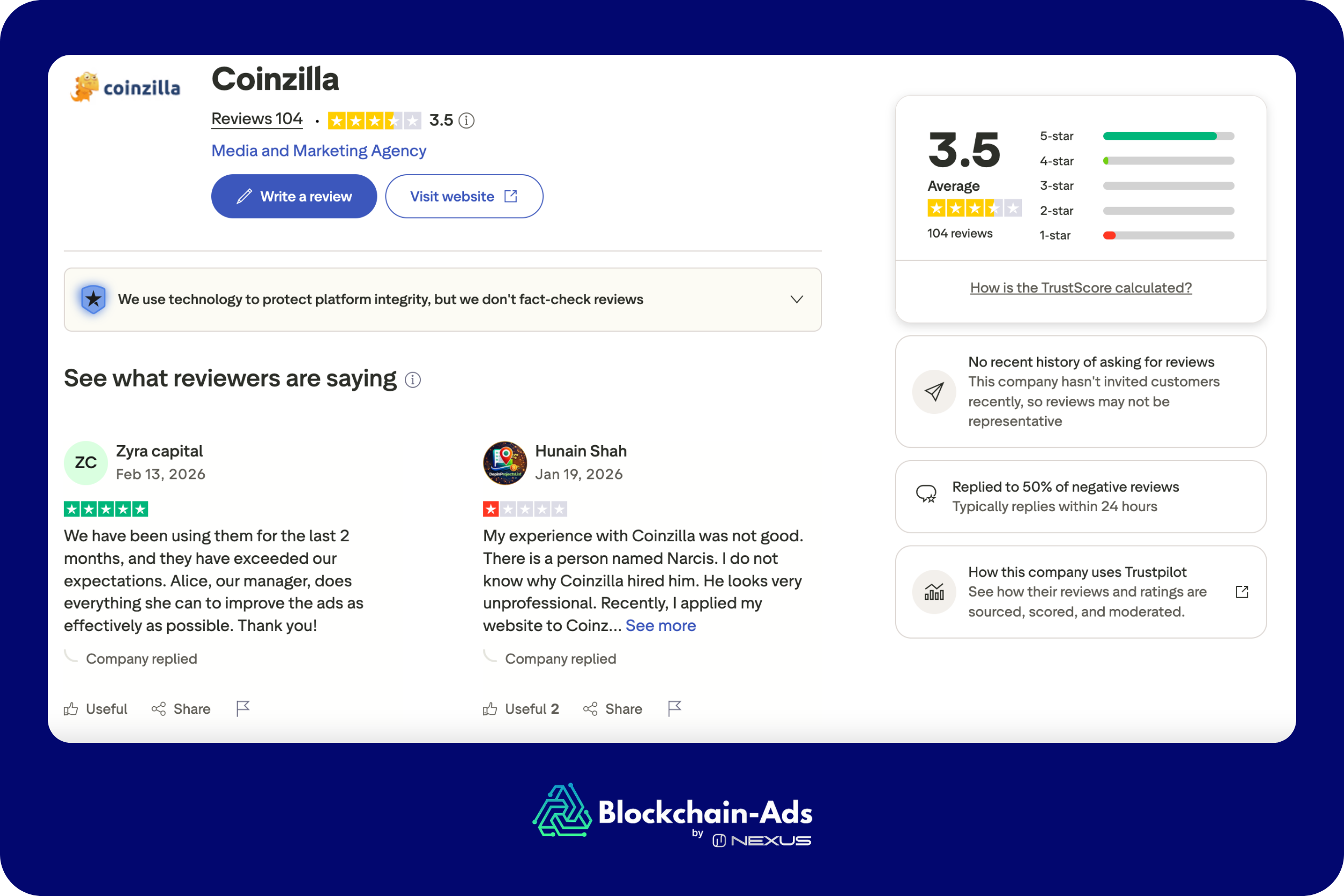
Based on customer reviews on Trustpilot, Coinzilla has a moderate Trustpilot rating of 3.5 from around 100 reviews, which indicates mixed user experiences with some users noting inconsistent support while others find account managers helpful.
Several advertisers describe responsive account managers and a smooth first campaign, but there are also some detailed complaints alleging bot-heavy traffic, poor customer service, and a denied refund request. That's not proof of a systemic issue, but it's a real, verifiable trade-off worth weighing before committing budget: campaigns should be tested small, on the brand-awareness tier, before scaling up.
How to Advertise on the Coinzilla Ad Network
Advertising on Coinzilla is a straightforward process. Here's a step-by-step guide to get you started:
Account Setup Process
To begin advertising on Coinzilla, you'll need to set up an account:
- Visit the Coinzilla website and click on the "Sign Up" button.
- Choose the "Advertiser" option.
- Fill in the required personal details, including your name, email address, and password.
- Once your account is created, complete the KYC (Know Your Customer) procedure to verify your identity and ensure compliance with anti-fraud measures.
- Once your account is approved, access the advertiser dashboard to create a new campaign.
Creating Your First Campaign

Coinzilla's campaign builder runs through four steps:
- General Details: Name the campaign, set the landing URL, and choose Premium Traffic.
- Pricing Details: Set a CPM bid, daily budget, pacing (fast delivery or spread evenly), and frequency capping.
- Audience Targeting: Set country, device, and website/zone targeting (all zones, or specific zones excluded/allowed).
- Upload Creatives: Add banner assets. HTML5 and custom banners outperform static images; account managers help with more advanced setups.
Once your account’s funded, submit your campaign for review. Coinzilla's team will review your campaign, typically within one business day (up to 48 hours during weekends or holidays). After approval, your ads will go live across Coinzilla's network of crypto and finance websites.
Once a campaign is live, it can be managed from the dashboard: creatives added or removed, settings adjusted, and campaigns archived or duplicated for reuse.
Funding Your Account
Campaigns and billing move in parallel, not funding first. A campaign can be created and submitted for approval before billing is finalized; funds are only required once that campaign is ready to launch.
To fund an account, Coinzilla requires a minimum deposit of €100 with a €50 daily minimum per campaign, accepted via bank wire transfer, card payment via Stripe, or cryptocurrency deposit through CoinGate. Campaign review typically happens within a business day or two, though this can vary. Once approved and funded, ads go live across Coinzilla's publisher network.
Coinzilla vs Blockchain-Ads: Which Platform Is Better?
For advertisers comparing alternatives, the main difference is the advertising approach. Coinzilla focuses on crypto publisher placements, while Blockchain-Ads targets users by audience signals like wallet activity and on-chain behavior. On Blockchain-Ads, each campaign is then optimized toward a specific goal, whether that's awareness, traffic, sign-ups, or deposits.
Coinzilla is a great place for businesses to advertise to crypto-savvy people. However, Blockchain-Ads offers a different approach, with a stronger emphasis on performance. Plus, your ads get broader reach across websites and apps and more advanced audience targeting compared to Coinzilla’s more traditional model.
Which Platform Delivers Better Value?
Coinzilla provides solid value for advertisers who are testing the waters and want to reach audiences. Its strength lies in its contextual visibility and straightforward campaign setup.
Blockchain-Ads, on the other hand, focuses more on performance marketing. Its targeting capabilities and broader reach across websites and apps are designed to support acquisition-focused campaigns. This makes it attractive for advertisers looking for more measurable ROI.
For example, Compound achieved a 400% increase in volume using Blockchain-Ads, acquiring 3058 new users.
Coinzilla Alternatives
Advertisers exploring Coinzilla often compare it with other crypto ad networks based on targeting capabilities, performance tracking, and campaign outcomes.
Blockchain-Ads (Performance-Focused)

Blockchain-Ads is a performance-driven alternative to Coinzilla.
Why it’s an alternative
- Focuses on user acquisition and conversions, not just impressions
- Built for Web3 audiences and wallet-based targeting
- Emphasises quantifiable campaign performance over pure traffic volume
How the approach differs from Coinzilla
- Coinzilla is typically used for display visibility
- Blockchain-Ads is structured more around audience segmentation and conversion
- Stronger emphasis on performance tracking and attribution
Best use cases
- Token launches needing verified user acquisition
- Exchanges optimising for sign-ups and deposits
- Performance marketing teams focused on CAC and ROI
CoinTraffic

Best for
- Broad crypto brand exposure and traffic campaigns
Strengths
- Large network of publishers
- Simple campaign setup for display ads
- Good for awareness-stage marketing
Limitations
- Less granular targeting compared to other platforms
- Limited conversion optimisation tools
Bitmedia

Best for
- Crypto advertisers looking for display and native ads
Strengths
- Wide publisher network in crypto and finance
- Multiple ad formats (banners, native, push)
- Flexible pricing models
Limitations
- Performance tracking varies by publisher
- Optimisation tools are less advanced
How to Choose Between Coinzilla Alternatives
When comparing platforms, the decision usually comes down to your overall campaign intent:
- For brand awareness and reach go for CoinTraffic, Bitmedia, Coinzilla
- For performance marketing and conversions go for Blockchain-Ads
- For balanced campaigns go for Coinzilla or Blockchain-Ads depending on your targeting needs
Verdict: Is Coinzilla Worth Using?
Yes, Coinzilla remains a decent option for businesses looking to increase their visibility through advertising.
It’s a suitable choice for campaigns focused on awareness, exposure, and reaching crypto audiences.
However, advertisers looking for more advanced targeting, user acquisition, and performance-focused campaigns may want to consider the alternatives.
Blockchain-Ads provides a different approach built around audience targeting and growth-focused campaigns.
The best choice here depends on whether the priority is reaching crypto audiences more broadly or acquiring quantifiable results.
More ad network reviews:
FAQs
Does Coinzilla have a minimum advertising budget?
Yes, a minimum deposit of €100, with a €50 daily minimum spend per campaign.
What ad formats does Coinzilla support?
Classic banners, native ads, pop-under ads, header and sticky banners, and sponsored content or press releases through its Marketplace. The right format depends on whether the goal is visibility, engagement, or awareness.
Who should use Coinzilla?
Crypto exchanges, wallets, DeFi platforms, and blockchain startups. It's a weaker fit for brands targeting mainstream consumers outside crypto.
Is Coinzilla better for brand awareness or conversions?
Stronger for brand awareness. Campaigns buy placement on crypto sites rather than targeting a specific person's behavior, so it's built to maximize visibility more than to isolate high-intent users.
What payment methods does Coinzilla accept?
Card payment via Stripe, cryptocurrency, and bank transfer.
Jamie is a digital marketer, writer, and editor with 12 years of experience creating online guides and reviews.
View full profile →