



Weight Loss Ads on Facebook: How to Run Compliant, High-Performing Campaigns


Heading
- Cointelegraph Formula offers various ad formats to 8 million monthly readers across 190+ countries, leveraging its trusted name in crypto.
The global weight loss industry is booming, and businesses are seeking to reach more people through Facebook ads. However, given the sensitivity of the weight loss topic, Facebook has implemented strict regulations to protect its users. The platform has restrictions on who you can target with a weight loss ad, as well as the imagery and language you use.
To run a compliant weight loss ad on Facebook, you must:
- Audit your language and imagery for any content that could generate negative self‑perception or promote unrealistic results
- Set up audience targeting that focuses on adults and broad, non‑sensitive interests
- Use authentic storytelling and UGC that highlights healthy lifestyle journeys rather than dramatic “before and after” transformations
While the platform shows how to run a compliant ad, it is still possible to have a violation and get rejected or banned. If you find Meta’s health and wellness restrictions too limiting for certain offers, you can also test alternative platforms such as Blockchain‑Ads.
This platform relies on advanced behavioral and interest analysis, plus AI, to reach audiences based on real engagement and intent signals, while enforcing its own compliance rules for regulated categories like weight loss.
Read on to learn more on how to run a compliant weight loss ad on Facebook successfully. Additionally, we will introduce you to Blockchain Ad, an alternative advertising software.
Can You Run Weight Loss Ads on Facebook?
Yes, Facebook allows you to run weight loss ads, but under specific restrictions. The platform has restrictions on how you frame your ad message. It also restricts you from using specific images, especially those that can depict body shaming or imply a perfect body that people should aspire to have. There are also restrictions on audience targeting, especially on age and the use of users' personal attributes and information.
In practice, these rules mean your campaigns should be designed for users 18 and older, avoid copy or visuals aimed at teens, and stay away from sensitive personal attributes such as health conditions, body size, or appearance when defining your audiences.
Generally, Facebook aims to protect its users, which is understandable, given the sensitivity of health and wellness issues. You should therefore view the restrictions as tools to target the right audience rather than barriers to your marketing.
Facebook's Health & Wellness Policy Explained
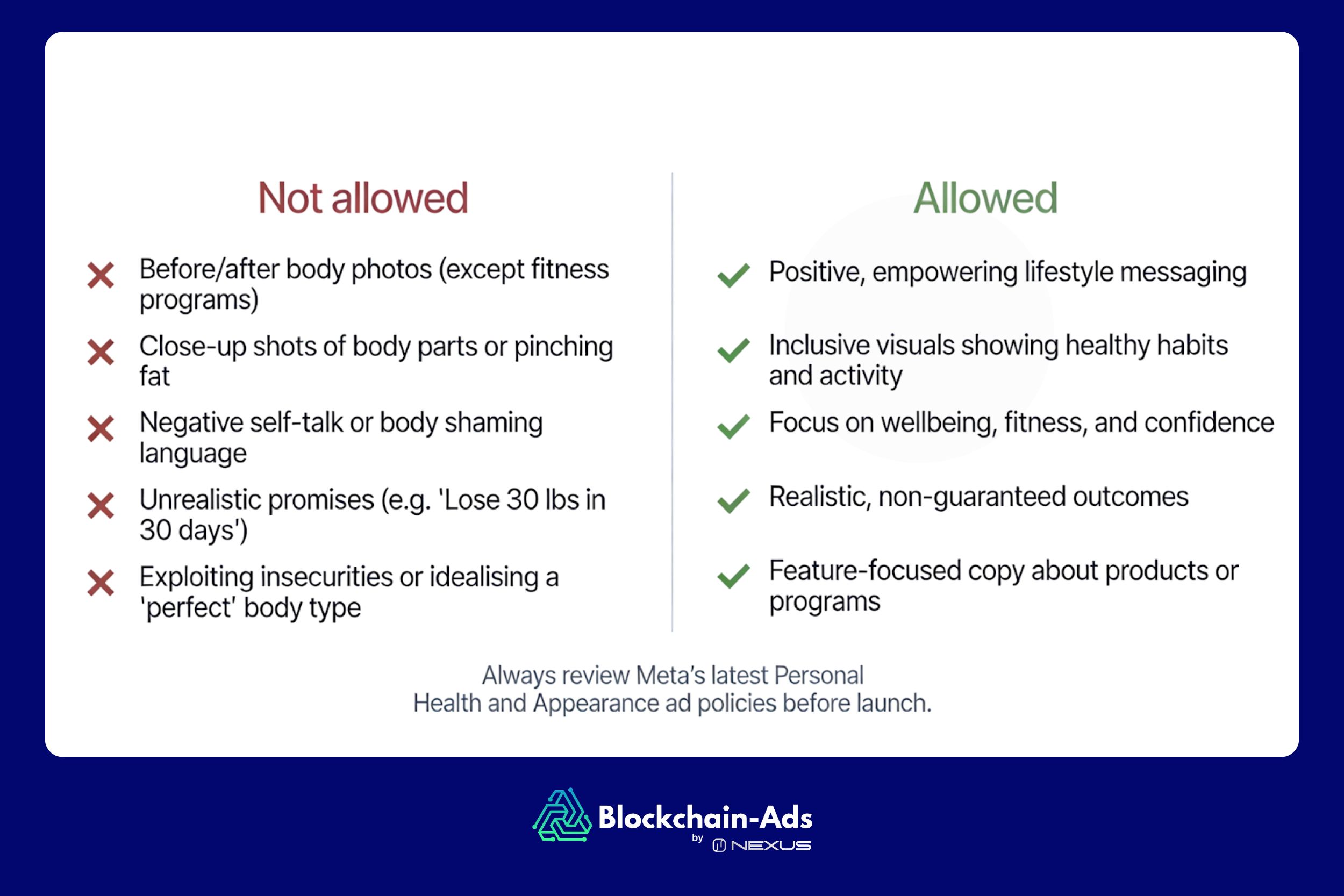
Facebook prohibits its users from running ads that imply or attempt to generate negative self-perception or declare a perfect body type or appearance that users should aspire to have. Facebook policies also have strict regulations that prevent the promotion of unrealistic results and body image issues.
Here is a detailed look at Facebook's health and wellness policies.
Key Prohibitions – Unrealistic claims, negative self-perception targeting.
Facebook requires that your weight loss ad campaign do not imply or attempt to generate negative self-perception or declare that there is a perfect body type that one should aspire to.
Therefore, your weight loss ad campaign cannot promote:
- Side-by-side images comparing before and after use of a product for transformation for weight loss, unless you are promoting a fitness program impact
- Close up on specific body areas, like pinching fat
- The use of distasteful language or messaging that could make users feel negative about their looks
- Exploitation of one’s insecurities to conform to specific beauty standards
- Reinforcing harmful or unhealthy body images
- Feature any signs of body shaming
What Is Allowed – Positive lifestyle messaging, feature-focused copy.
Facebook policies require that you use inclusive and positive language, framed around empowerment and a healthy journey, rather than focusing on a deficiency or struggle.
- Instead of showing before-and-after photos, use high-quality images of your product to accurately represent it in a positive light.
- Focus on a healthy lifestyle, including regular physical fitness and a balanced diet, and cultivate self-love and confidence.
- Ensure you use positive and motivational messaging that shifts the focus from weight loss to one's overall well-being, fitness, and healthy living.
- Use high-quality visuals that not only focus on results but also on the process.
- Show realistic results, such as how the product helps promote a healthy living.
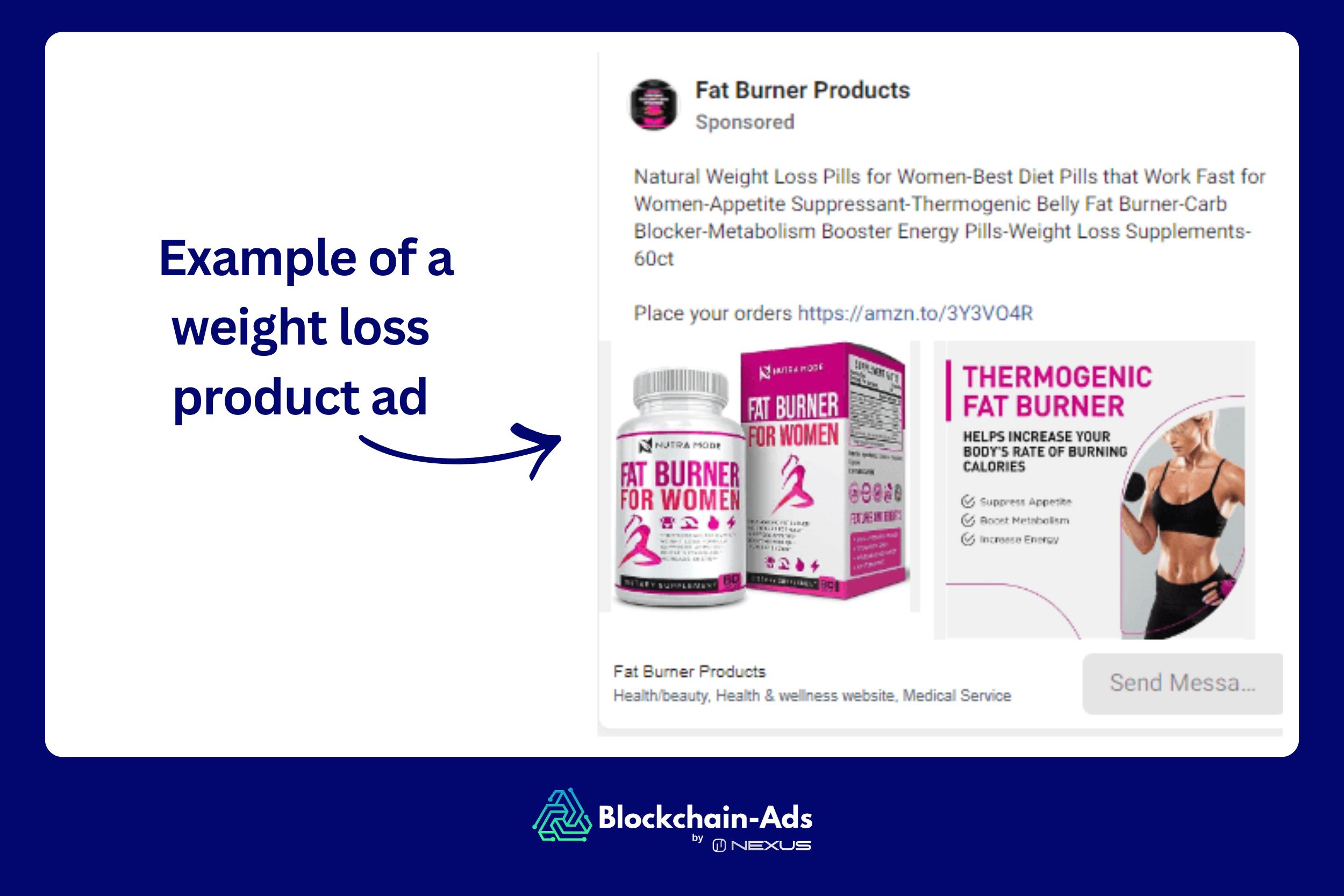
Here is an example of a weight loss product ad, with the correct image representation and compliant language use:
Setting Up a Compliant Weight Loss Campaign
Research by the Harvard Kennedy School indicates that 48% of those who receive targeted ads are more likely to click on them and find out more information. For these reasons, you must do thorough research and ensure the correct setup of the ad. Here is how you can set up your weight loss ad on Facebook:
Auditing Your Language & Imagery – A Checklist for Copy and Creative.
The first step to setting up your ad copy is understanding Meta’s Health and Wellness / Personal Health and Appearance advertising policy. This includes the messaging style, the type of language used, and the imagery included. Below is the language checklist that you must confirm before submitting your ad for review:
- Don’t use languages that promote negative self-perception
- Do not include any misleading or unrealistic claims
- Do not mention or advertise any prescription medicine like weight loss injection or GLP-1
- Ensure you include a disclaimer in cases of testimonials
The imagery checklists to ensure are:
- Do not use before and after images
- Avoid body shaming
- Do not use close-ups of body parts
- Avoid graphic or medical visuals, such as injection pens, or depiction of surgical procedures
Create an inclusive ad copy that focuses on users' goals. For example, instead of writing “Are you struggling to lose weight?” you can frame it as “Achieve your desired body shape using product/ by subscribing to this fitness program”.
Targeting Strategies – Broad interests vs. risky body-image segments
When setting up a weight loss ad, it is essential to opt for broad interest targeting instead of relying on riskier body-image segments. Meta's strict policies prohibit you from running ads that promote negative self-perception or unsubstantiated claims.
You should therefore rely on broad interest targeting, including:
- Targeting users who are interested in healthy lifestyles: You can run ads on topics such as healthy eating, physical fitness, gyms, nutrition, and running or yoga.
- Utilize demographic and geographic segmentation: Most individuals interested in weight loss ads are primarily between the ages of 25 and 34. Other age groups, such as those aged 35-44, are also interested, but at lower rates. In terms of gender, men account for 30.6% while women 60.4% of those who wish to lose weight. You can also target the relationship status, where 52.3% of married individuals are interested in weight loss, compared to only 29.7% of those who are single. Also, target people from specific countries and regions without discriminating against their race or religion.
- Lookalike audience targeting: Facebook allows you to add lookalike adience by logging in as an administrator of the source audience's home page or the Pixel code. When setting up a lookalike audience, you cannot rely on people's personal information, such as their health history or physical appearance
Leveraging UGC & Storytelling – Boost CTR with authentic videos.
Remember that people trust User-Generated Content (UGC) more than brand-created one, as it often feels more authentic and genuine. So, instead of focusing on the final result of using your product or service, use storytelling to show them the journey, from challenges to the wins.
You can also highlight the benefits, such as boosted confidence, improved sleep, and increased energy. Show “day in a life”, use testimonials, and encouraging language without giving unrealistic guarantees. Ensure to hook attention within th first 3 seconds, state the problem, and quickly shift to the solution you offer, and include a CTA.
Common Pitfalls and How to Avoid Them
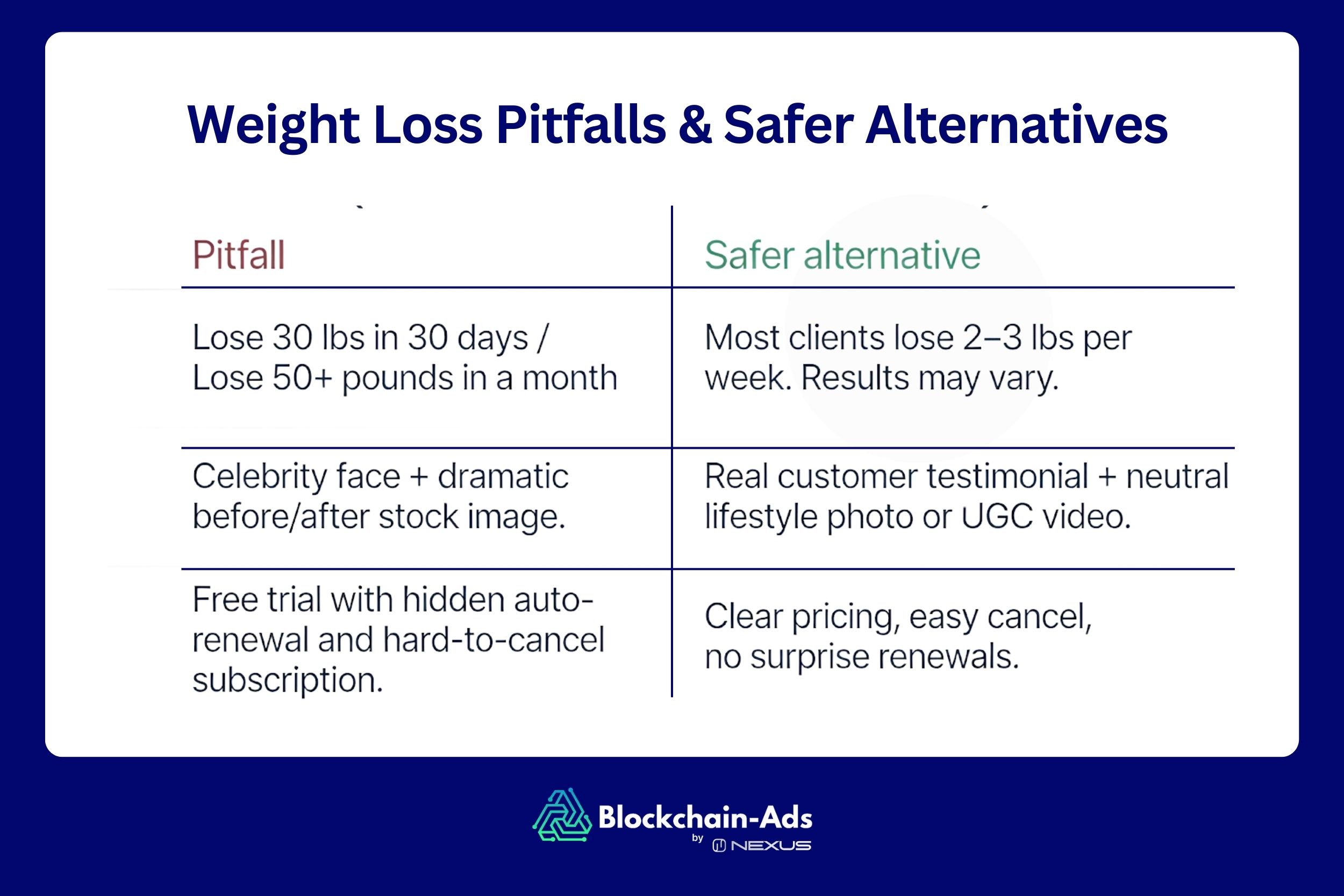
Ad rejections and account restrictions on Facebook can result from mistakes or ignorance, while in some cases, they may be intentional. Apart from violating Facebook weight loss ad policies, below are some other pitfalls that can lead to ad rejection or account restriction.
Spotting False Promises – “Lose 30 lbs in 30 days” myths.
Whenever the Facebook review team identifies a false, misleading, or inaccurate claim, your ad can be removed. While such claims may have some truth in them, they are often presented in an exaggerated manner that is too good to be true. For instance:
- Lose 50+ pounds within a month.
While the product or service you are advertising may be highly effective, it may still be flagged and disapproved by Facebook. Disclaimers like “results may vary” can help set realistic expectations, but they do not legitimize otherwise misleading claims. If your headline promise is unrealistic or “too good to be true,” Meta may still reject the ad or restrict your account, even with an asterisk or fine‑print disclosure.
Here is how you can phrase your ads to avoid being disapproved by Facebook:
- Marina G. - “I lost 19 pounds in a month, by using this product
- Achieve your desired body shape with our weight loss fitness program
- Most of our clients lose 2-3 lbs in a week. But results may vary.
Recognizing Fake Stories & Scams – Stock photos, paid reviews
Apart from the false claims, you should also be able to recognise and avoid fake ads. This may vary from fake celebrity endorsements, to edited and AI-generated images and videos, and claiming that they are the real results of using a product or service.
Some people can also manipulate stock images or stock photos to create dramatic weight loss images. In other cases, known scammers can also copy and paste or create reviews from other legitimate sites or pay others to review their landing pages, to lure people into buying the weight loss product.
Avoiding Bait-and-Switch Offers – Free trial traps and auto-renewals
Bait and switch in marketing is where an ad relies on the sunkcost fallacy. This is where the advertiser has no intention of selling the product or wants to compel you into making a purchase. They can achieve this by advertising a weight loss product/service below-market value, or by withholding vital information that will prompt a user to click and check it out.
An example of bait-and-switch promotion is when an advertiser offers a virtual fitness or dieting program through an app. The advertiser then offers a free 2-week trial period and require you to provide your email address and payment details at the sign-up stage. However, once you are in, you realize that the free version is severely limited, and most features are hidden behind a paywall. You will also receive frequent pop-ups requesting that you upgrade.
Even if you decide not to upgrade, the app may deny you the unsubscribe option or make the sign-out process very difficult, forcing you to continue paying. This often leaves you frustrated or with a subscription that you do not intend to use.
When running ads on Facebook, conversions and engagement shouldn’t be forced. That is why Facebook can reject an ad after it has been approved when it detects deceptive or unacceptable business practices, such as bait-and-switch. You should therefore ensure that your ad does not feature any of these or deceptive promotional tricks.
Alternative Platform: Blockchain-Ads
Blockchain Ad has emerged as one of the top platforms to opt for, especially if you are struggling with Facebook policies. This platform utilizes precision targeting, powered by advanced behavioral analysis and interest graphs, and is verified to deliver the right users.
All you have to do is define your ideal audience using verified data and real behavioral signals, and utilize advanced targeting that combines interest, browsing activity, and device signals to reach people across web, mobile, and CTV. It also offers performance tracking resources that enable you to see who engages with you and which channels perform best, allowing you to improve results accordingly.
Because Blockchain‑Ads focuses on verified behavioral signals and interest graphs rather than appearance‑based traits, it can often deliver strong performance for weight loss advertisers while staying away from body‑shaming or negative self‑perception tactics that would violate Meta’s rules.
Pros & Cons of using Blockchain-Ads
Below are the advantages and disadvantages of running weight loss ads on both Blockchain-Ads:
Pros
- Built for regulated verticals (health, Nutra, finance), with workflows that explicitly account for compliance and policy checks.
- Uses advanced behavioral and interest signals (and, where allowed, pseudonymous identity/on‑chain data) to find users actively researching or comparing solutions.
- Cookieless, on‑chain or server‑side attribution gives durable, cross‑device tracking and audit‑ready logs as third‑party cookies disappear.
- AI‑driven optimization reallocates budget toward the highest‑performing audiences, creatives, and placements for ROAS.
- Clear, verifiable reporting makes it easier to justify spend to compliance, finance, and executive teams.
Cons
- Requires eligibility and verification (including a review call and minimum budget thresholds), so it suits advertisers ready to invest at meaningful scale, not tiny tests.
- Less familiar than Facebook for many teams, so you need onboarding time and internal playbooks to fully use wallet/behavior‑based and cross‑channel capabilities.
- Not ideal for very short, one‑off experiments; the platform is optimized for sustained campaigns where the AI and attribution models have enough data to learn.
How Blockchain-Ads Compare to Facebook Ads for Weight Loss Advertising
How to Get Started
To start your advertising journey on Blockchain Ads, visit the official platform and find the “Request Access” button. Click on it, and you will be redirected to a mandatory verification meeting, where the platform's support team will guide you through the requirements for running a weight loss ad on the software and provide instructions on how to do so.
Before you are verified, the platform will also see that you meet all the compliance requirements and budget threshold. Proceed to select an automated ad service or opt for the managed service to launch goal-driven campaigns. Lastly, scale your ad according to its performance using the Nexus AI. Refine your targeting and adjust the budgets according to the costing method you’ll be using to maximise the ad campaign outcome.
Conclusion & Next Steps
Running weight loss ads on Facebook is easy as long as you have read and understood it’s polices. All you have to do is go to its health and wellness section and understand everything. From policies on self-perception to restrictions like the use of before-and-after images and distasteful messaging. Once complete, use our guide to create compliant ad copy that will deliver high campaign performance. You can also request verification on Blockchain Ad and achieve better ad results. This platform will provide you with a broader ad reach than Facebook, thanks to its advanced audience targeting strategies and AI integration.
FAQ
Does Facebook allow weight loss ads?
Yes, under strict “Personal Health and Appearance” rules. Disallowed: before/after images, unrealistic claims, negative self-perception. Allowed: positive lifestyle, feature-focused copy, healthy living tips.
Can you advertise Ozempic on Facebook?
No. Meta prohibits direct promotion of prescription drugs. Exceptions require prior written permission for qualified pharmacies.
Qualify and get acess to Blockchain-Ads
Lorem ipsum dolor sit amet, consectetur
.png)
The $450B supplements market isn't waiting for you
Buyers are searching for products like yours right now. Reach them with Blockchain-Ads
Read related blogs


Talk with some of our current partners
View all success stories

Reach 12M+
Engaged Web3 users across 10,000+ websites and 37 blockchains.