Taboola Review 2026: Features, Pricing, Pros and Cons, and Best Alternatives
If you've ever dipped your toe into native advertising, you've probably run into Taboola. It's the company behind those "you may also like" widgets under news articles.
Taboola puts your ads in front of readers on news sites, blogs, and apps, with a reach of 600M+ daily users.
But reach only matters if it turns traffic into real business conversion, especially if you operate in crypto or iGaming advertising. We know this because we run native ad campaigns ourselves.
If you're an advertiser considering Taboola, here's our review of how Taboola's reach, pricing, and crypto ad policy actually hold up. Then it goes head-to-head with Blockchain-Ads, the platform built for exactly that.
What is Taboola?
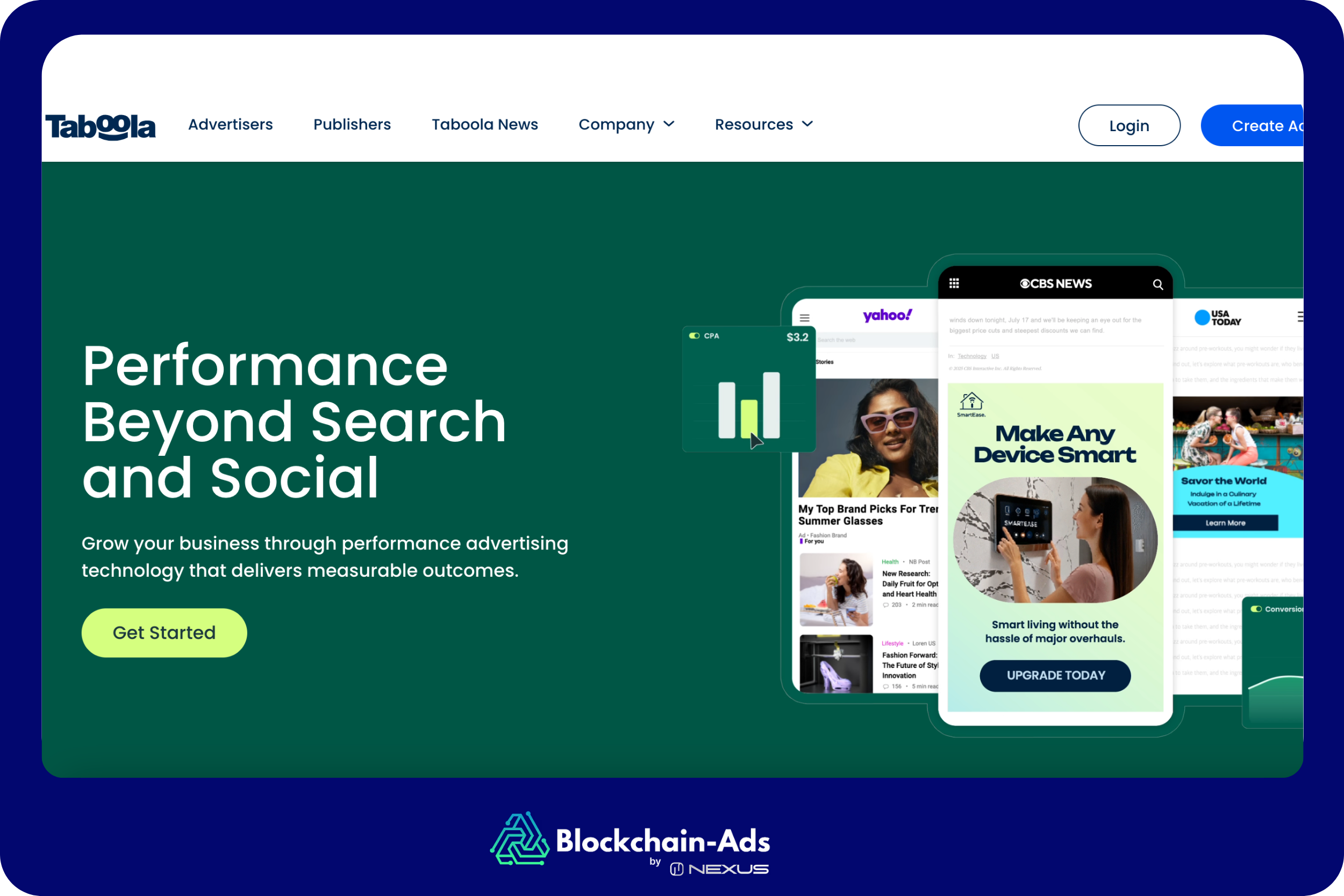
Taboola calls itself a "discovery platform," a plain way of saying it figures out what you're into and feeds you more of it. It uses machine learning that crunches a reader's browsing behaviour to guess what content they'll click.
How It Works
Taboola operates as a two-sided marketplace: publishers supply space on their pages, and advertisers pay to fill it. Publishers add Taboola's widget to their site and earn revenue whenever a visitor clicks a recommendation.
Advertisers fund a Realize account, Taboola's self-serve platform, to get that content in front of those readers.
Where Ads Appear
Ads on Taboola show up in three main spots across a publisher's site:
- On the publisher's homepage
- Mid-article, wedged into the content itself
- Below the article, in that "recommended for you" strip
All three are built to look native, not like a bolted-on ad, reaching roughly 600M+ daily active users worldwide.
The network leans hard into premium, editorial-style publishers rather than a specific vertical like gaming or downloads.

Taboola has long-term, often exclusive partnerships with major digital properties, including CNBC, NBC News, USA Today, Business Insider, and The Independent. That's part of why advertisers chasing brand credibility and content-driven funnels often choose it.
Who It's Best Suited For
Taboola suits advertisers who want brand-safe placement on well-known editorial sites for awareness and content-driven campaigns. It can support lead generation and direct response too, since targeting and bidding options work further down the funnel.
Premium publisher space bids up quickly, so a small budget will struggle to compete. The real requirement is a real budget and the patience to let campaigns build data over time.
Taboola Features Review
A closer look at four things that matter most: ad formats, audience and reach, targeting, and reporting.
Ad Formats
On the ad format side, Taboola gives you a handful of options to choose from:
- Native: the core unit Taboola is known for. Ads styled to match the look, feel, and layout of the surrounding content, so they read as recommendations rather than interruptions
- Display: the more traditional banner format, still available for advertisers who want it alongside native placements
- Carousel: multiple images or cards in a single swipeable ad, useful for showing off a range of products or offers
- Vertical: creatives formatted for mobile placements (and desktops)
- Motion: short videos and GIFs that play automatically when users scroll by
- App Promotion: campaigns aimed at driving fresh app installs rather than the more standard website traffic
- Social Creative: formats built to mirror the look of social feeds, for advertisers running the same creative across both channels
Taboola doesn't run pop-unders, interstitials, or push notifications, formats some competing networks still use.
Audience and Reach
Taboola works on both sides of the marketplace at a real scale: 9,000 publisher sites on the supply side and 15,000+ advertisers on the demand side. That publisher mix spans news, lifestyle, finance, and entertainment content, beyond just the editorial outlets already mentioned.
Targeting Options
Targeting covers geography, device, browser, audience segments, and interest or behavioural signals.
There's also contextual targeting, where an ad's placement is matched to what the surrounding content covers.
On top of that, SmartBid, Taboola's automated bidding tool, adjusts bids in real time based on what's converting.
Reporting and Analytics
Reporting is straightforward: performance data breaks down by placement, so you can quickly see what's working and what needs to pause.
It's built for day-to-day decisions rather than deep analysis, refreshed often enough to act on current numbers.
Taboola Pricing
Taboola runs on both CPC and CPM models, so you're paying either per click or per thousand impressions, depending on your overall aims.
There's no separate platform fee, and billing runs through automatic increments, usually around $100 at a time.
A monthly invoice is available too, if that fits your operation better.
There's no hard minimum to launch a campaign, but Taboola itself recommends coming in with a real budget.
For campaigns using automated bidding, the guidance is a daily budget of at least $50, or ten times your target cost-per-action.
The algorithm needs that much data flowing through to optimise the campaign properly.
Is Taboola Legit?
Taboola is a publicly traded company on the Nasdaq under the ticker TBLA, which means real financial reporting and public scrutiny. It's been around since 2007, giving it a long operating track record.
Taboola has also picked up real industry recognition, including Best Places to Work honors in advertising and marketing.
Case studies feature companies like Mercedes-Benz, Nissan, Nespresso, Bosch, and Vodafone, with reported results such as lower CPAs and higher engagement.
Traffic Quality and Transparency
Taboola runs its own content review team, backed by verification through partners like Integral Ad Science and DoubleVerify. That means ads get checked against brand safety standards before they ever go live.
Advertisers can see exactly which sites their content ran on. Pre-bid filters and negative keyword targeting let them steer campaigns toward brand-safe pages only.
Overall Trust and Legitimacy
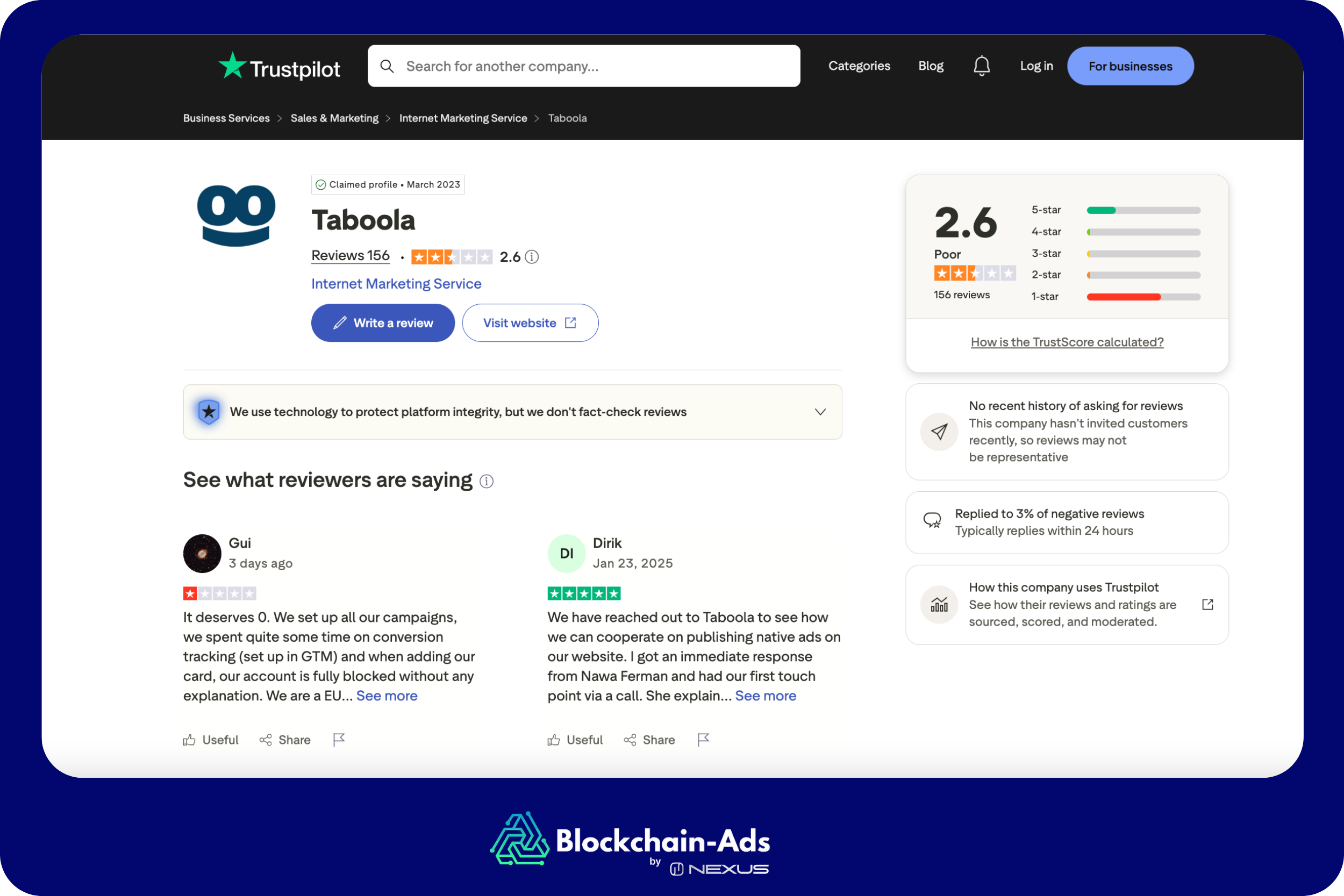
On Trustpilot, Taboola sits at around 2.6 out of 5 from roughly 155 reviews at the time of writing. About 65% of reviews are around the 1-star mark, with a smaller number at 5-star.
The complaints follow a consistent pattern: accounts suspended with little explanation, slow or unhelpful support, and questions about traffic and click quality.
A few reviewers describe positive experiences, praising fast approval and account managers who helped optimise results once assigned.
Taboola vs Blockchain-Ads: Which Platform Is Better?
It comes down to targeting. Taboola puts your ad in front of a lot of people. Blockchain-Ads finds the right people first, then puts your ad in front of them.
Taboola treats crypto like any other category. It can't target by wallet activity or on-chain behavior. That's fine for broad awareness. It's not enough if you need verified crypto users specifically.
Blockchain-Ads is built for that. It tracks interest, behavior, and on-chain activity, then buys ads through NEXUS, a network of 78 supply partners, to reach that exact audience.
Getting started looks different too. Taboola is self-serve. You can launch with $100. Just know that a small budget means slower results; that's Taboola's own advice.
Blockchain-Ads works the other way. You need a $10,000 deposit to open an account, plus $360 a day to keep campaigns running. Every advertiser is also screened first, on budget, brand, and compliance.
Crypto Ads Use Case
Taboola bans crypto ads completely in nine countries: Bangladesh, Bolivia, China, Ecuador, Iceland, Kyrgyzstan, Nepal, Russia, and Vietnam.
Ecuador also shows up on Taboola's own "allowed" list elsewhere in the same policy, so that might just be an error on their end. Worth checking with your rep if Ecuador matters to you.
Blockchain-Ads isn't banned by country. It checks whether the offer is legal in that region, case by case.
Where Taboola does allow crypto, it's strict. Only licensed exchanges, reviewed one by one. You can advertise the exchange, not specific coins. No ICOs, no token sales, no binary options. Every ad needs a risk disclosure.
Blockchain-Ads allows more: exchanges, wallets, custody platforms, DeFi, and even token projects, all with risk disclosures required. One rule both platforms share: no promises of guaranteed returns.
Taboola Alternatives
Advertisers leaving Taboola usually compare it to other native and performance networks, on-reach, targeting, and vertical fit.
Blockchain-Ads (Performance-Focused)

Blockchain-Ads is built for one goal: turning attention into sign-ups, deposits, and funded accounts.
Why it's an alternative:
- Targets verified users by interest and on-chain wallet activity, through WalletTargeting™
- Optimizes for sign-ups and deposits, with attribution tracked back to the campaign
- Measures every campaign against a real outcome: FTDs, funded accounts, or trading volume
How it differs from Taboola:
- Taboola sells space on premium editorial sites. Blockchain-Ads sells access to a specific audience, matched by interest, behavior, and on-chain activity through NEXUS
- Taboola is self-serve, from $100. Blockchain-Ads requires qualification, a $10,000 deposit, and a $360/day minimum spend
- Blockchain-Ads adds crypto-specific tracking: wallet-level data, server-to-server postback, and ROAS/CPA reporting per campaign
For OKX, a Blockchain-Ads campaign delivered $5.16M in trading volume from 3,095 new verified traders.
Best use cases:
- Crypto exchanges and DeFi platforms that need verified users
- Token launches that want real wallet holders, not just clicks
- Teams who tie spend to results: FTDs, funded accounts, or trading volume
Teads (formerly Outbrain)

Teads formally Outbrain is best for advertisers who want an editorial, brand-safe alternative that works like Taboola.
Strengths:
- A long-running native platform with premium publisher relationships, including CNN and The Washington Post
- Focused on engagement, not just raw impressions
- Optimization tools that let advertisers target specific goals, like ROAS or time on site
Limitations:
- CPCs typically run higher than Taboola's, with stricter approval standards
- A smaller publisher network overall, so less reach than Taboola
Verdict: Is Taboola Worth Using?
Yes, if broad reach across trusted sites is the goal.
But for crypto audiences or performance-driven acquisition, look elsewhere. Blockchain-Ads is built for exactly that: wallet-based targeting, paired with tracking down to sign-ups and deposits.
The choice comes down to one question: broad, premium reach, or precise, verified crypto acquisition?
FAQs
How long does it take for Taboola to approve a campaign?
Typically 24 to 48 hours after you submit ads for review. The same timeframe applies to edits made after approval.
Does Taboola support retargeting?
Yes. Installing the Taboola pixel lets you build site-visitor audiences and run retargeting campaigns. Once there's enough conversion data, retargeting tends to be one of the more cost-effective parts of a Taboola account.
How long should I run a new campaign before judging results?
Taboola recommends running a new campaign for at least 7 to 10 days before judging results. That's roughly how long the algorithm needs to gather enough data and optimize properly.
What are the most common reasons a Taboola ad gets rejected?
A Taboola ad usually gets rejected for:
- Misleading or exaggerated claims
- Restricted topics, like health or finance
- Ads that don't match their landing page
- Low-quality images or "gimmicky" thumbnails
- Titles that misrepresent the landing page
Can I fix and resubmit a rejected ad?
Yes. Taboola lets you edit and resubmit rejected ads for review. There's also a built-in tool called Abby that explains rejection reasons and suggests fixes to speed up approval.
What if I want to run crypto ads that Taboola restricts or rejects?
Platforms built specifically for crypto acquisition, like Blockchain-Ads, are a better fit. Blockchain-Ads shares some of the same fundamentals as Taboola's crypto policy, like requiring a licensed platform and clear risk disclosures. But it's less restrictive overall: it allows token projects and DeFi campaigns that Taboola bans outright, as long as they include risk disclosures.