Top 10 Media Buying Strategies in 2026
Media buying in 2026 will involve using data, AI, and privacy-safe signals to place ads where they can actually drive revenue, not just reach. It concerns because attention is dispersed between CTV, retail media, podcasts, in‑game experiences, and smaller social sites, while cookies are disappearing and rules are tightening. Buyers who keep thinking in terms of single channels and cheap impressions instead of systems and outcomes will quickly fall behind.
To stay competitive, media buyers need these ten practical levers they can pull right now:
- AI-powered predictive bidding to cut waste
- Tapping commerce and retail media networks for high-intent traffic
- Treating CTV and online video as one unified video plan for precise reach and frequency.
- Use privacy-first and contextual targeting
- Attention-based buying
- DCO
- In‑game and digital audio
- Hybrid in-house/agency models
- First-party data infrastructure
- Omnichannel measurement
Essentially, Blockchain-Ads sits at the center of this shift as a performance platform for data-driven, compliance-heavy advertisers. It brings media buying, AI optimization via Nexus, and privacy-safe attribution into one stack. This way, buyers can see which audiences, creatives, and placements actually drive revenue instead of just impressions.
In this article, you will walk through the ten most important media buying strategies for 2025, how each one works, and when to use it.
What Is Media Buying?
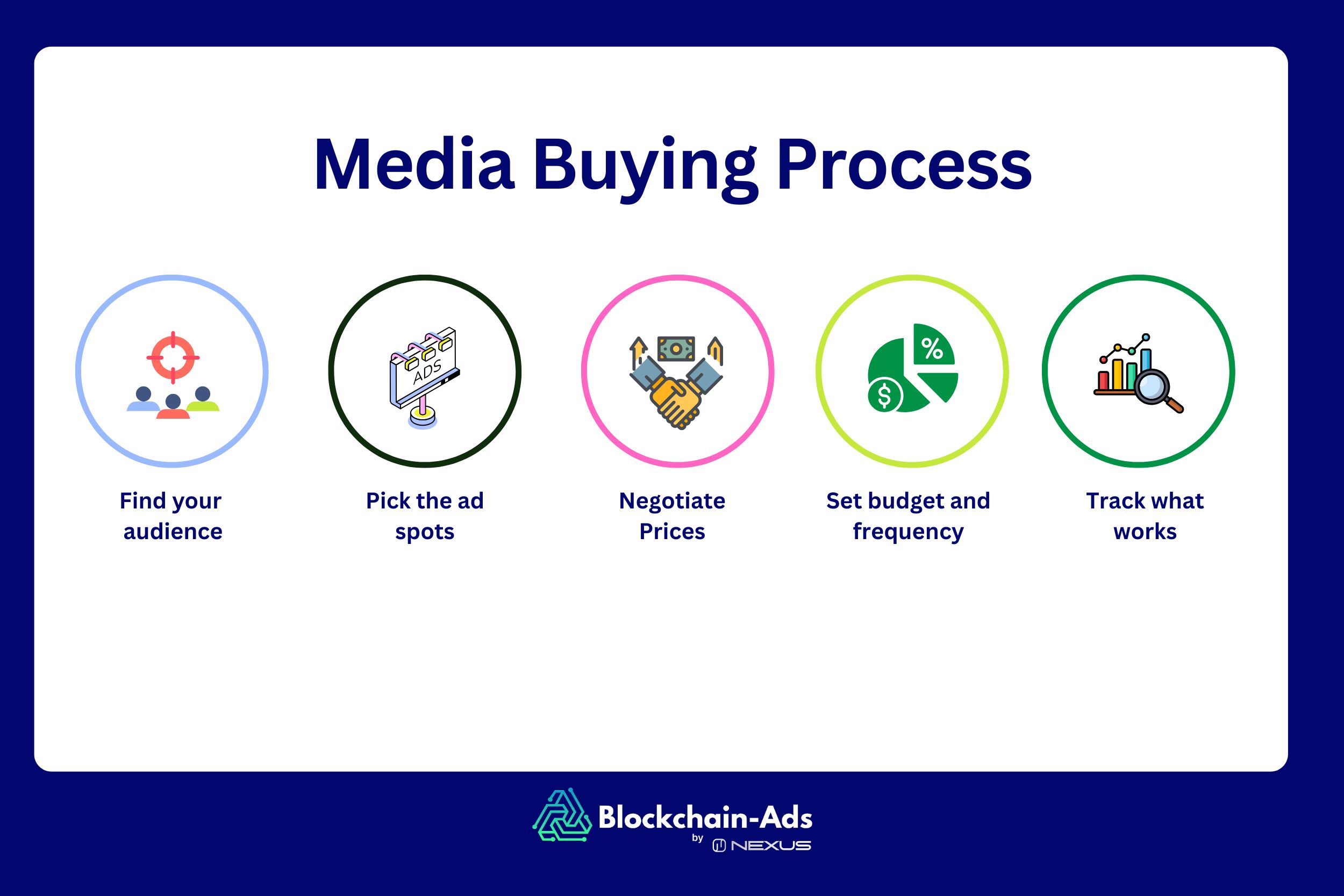
Media buying is the process of purchasing ad placements where your target audience already spends attention, across digital and offline channels. It covers choosing the right inventory, negotiating prices, and allocating budgets so each impression has a real chance of driving revenue.
In practice, media buyers also decide which formats to use, how often people should see an ad, and what environments are brand-safe. A good media buyer will analyze where impressions turn into clicks and clicks turn into customers.
Why 2026 Is a Pivotal Year for Media Buyers
This year feels different and not in a small way. For the first time in decades, one of the foundations of digital advertising, the third-party cookie, is gone. Marketers who’ve leaned on retargeting for years suddenly have to rethink their playbook. No more easy tracking across every site someone visits. That change forces everyone to get sharper about first-party data and real customer relationships. In fact, the 2023 report shows that 79% of advertisers plan to increase their investment in first-party data after cookie deprecation.
Look at the privacy wave. Laws keep tightening. Regulators are paying closer attention. Even users are more aware of what they’re handing over and they’re quick to bail if they feel watched. Then there’s AI. Algorithms can forecast, allocate and optimize faster than any team of humans. But they also hide ‘’why’’ behind performance swings. You hand over the budget, the machine makes the calls and sometimes you’re just left nodding along.
And lets also not ignore the channels themselves. Fragmentation is real. It’s no longer just Google, Meta and maybe some programmatic. Retail media networks are pulling billions. CTV is still growing but so are podcasts, in-game ads and smaller social media platforms that used to be afterthoughts.
Audiences are everywhere and nowhere at once. They’re watching, listening and gaming across many platforms you can’t afford to ignore.
Top 10 Media Buying Strategies for 2026
Let’s break down the 10 strategies that matter most this year.
1. AI-Powered Predictive Bidding
AI bidding is currently the backbone of media buying. Normally, predictive bidding systems analyze billions of data points in real time to decide where every dollar goes. They analyze audience behavior, focus campaign outcomes and shift budget across placements without human control.
This is really paying off. A 2024 HubSpot survey found that 68% of marketers using AI saw higher ROI compared to traditional bidding. Also, platforms report up to 30% reductions in wasted spend when predictive algorithms handle optimization. The only downside is that you’re trusting a machine whose logic isn’t always visible.
2. Commerce and Retail Media Networks
Retailers have become full-scale ad platforms. Examples are Amazon DSP, Walmart Connect and Instacart Ads. These networks allow brands to tap into first-party purchase data to reach customers at the exact moment they’re browsing or ready to buy. That’s why retail media spend is set to hit $166 in 2026, making up 22% of all digital ad spend. That’s bigger than radio, print and even traditional TV in many markets.
So, what’s driving this? Retailers own the data. While cookies are disappearing, loyalty programs and transaction histories remain a gold mine for targeting. For media buyers, this means campaigns that build awareness as well as driving measurable sales. Platforms like Blockchain-Ads make this easier to operationalize by letting you combine retail media audiences with your broader programmatic buys.
3. Connected TV (CTV) and Unified Video Buying
How people watch videos today is totally different. Most people are streaming Netflix, Hulu, YouTube and sports through the apps. This has completely changed how advertisers plan. By the end of 2026, US CTV ad spend is forecasted at $40.9 billion. This is a sharp rise that shows how dollars are moving away from linear TV.
The good thing about CTV is precision. Unlike traditional TV buys where you’re paying for broad reach, CTV allows brands target by behavior or even shopping intent. No paying for wasted impressions. Platforms like Blockchain-Ads help media buyers turn this into performance by combining CTV with display, native and in‑app inventory in one plan.
The bigger play is the unified video buying. It treats CTV, online video, and linear TV as part of the same plan. Instead of fragmented reports, you get a single view of reach, frequency and performance. That means fewer duplicated impressions and a clearer picture of what’s actually working.
4. Privacy-First & Contextual Targeting
The cookie era is finally ending. With Chrome holding more than 60% of the browser market, its phase-out in 2026 forces advertisers to move on from tracking people across the web. Instead of fighting it, smart media buyers are leaning into privacy-first tools that actually make targeting cleaner and more transparent.
Google’s API is one of the big replacements. It serves interest categories such as fitness or travel without exposing individual data. Brands are also investing in data clean rooms. These help publishers and advertisers match data sets safely. According to eMarketer, nearly two-thirds (66%) of US data and ad professionals have embraced data clean rooms.
On the brand side, CDPs (Customer Data Platforms) are becoming the hub for first-party data. This is actually everything from emails to purchase history. It helps campaigns stay personalized while still privacy-compliant.
And then there is contextual targeting which is making a comeback. Instead of chasing users, advertisers are putting ads next to content people are actively consuming. A reliable source reports that contextual ad spend is set to grow 13% in 2026. This is proof that relevance doesn’t need cookies to work.
5. Attention-Based Buying
For years, advertisers judged success by impressions and clicks. But in 2026, those numbers don’t tell the full story anymore. There is attention-based buying. It’s a change toward measuring not just if an ad was seen but how much focus it actually earned.
Rather than paying for ads that load and vanish, buyers now look at viewable time, percentage in-view and even audio-on rates for video and podcast ads. These metrics basically matter because they show whether people truly engaged. A study by Dentsu found that campaigns optimized for attention drove up to 1.4x stronger brand recall than the ones optimized for clicks alone.
Marketers are already moving money in this direction. In fact, global spend on attention-based measurement tools was valued at approximately $1.82 billion in 2024 and is expected to be $8.96 billion by 2033. This shows how serious brands are about ditching ‘’cheap impressions’’ for actual impacts.
For performance-focused teams, using a stack like Blockchain-Ads means being able to align attention metrics with verified, privacy-safe conversions in one place, so attention becomes a lever for ROAS, not just a reporting add‑on.
6. Dynamic Creative Optimization (DCO)
Every brand says ‘’the right message at the right time’’ but DCO is where that idea finally comes alive. Serving one generic ad to everyone is outdated. DCO lets media buyers test and swap creative elements like image, copy, and CTAs in real time based on how people actually respond.
A recent report showed that campaigns using DCO delivered 10%-15% higher CTRs compared to static creatives. And since it adapts automatically, you don’t need weeks of A/B testing to figure out what works. For example, a travel ad might show sunny beaches to one segment and mountain hikes to another, all from the same campaign.
Besides, advertisers using DCO have seen up to 40% lower cost per conversion. This is because budgets shift towards the best-performing creative in real time. That means less wasted spend and more messages that actually stick.
7. In-Game & Digital Audio Advertising
If you’re still thinking of gaming ads as only banner pop-ups, you’ve missed a lot. In-game advertising is now a multibillion-dollar market. In fact, global gaming ad spend is projected to hit $11.5 billion by 2027.
Brands aren’t interrupting gameplay. They’re blending in with it. An example is a digital billboard on virtual racetracks or sponsored jerseys inside sports games. It’s done right and feels like part of the world.
Audio is also having its own moment. Podcasts have exploded with over 500 million listeners worldwide in 2025. And unlike scroll-heavy social feeds, people give podcasts their full attention. That’s why host-read ads often generate recall rates above 70%, a level most display campaigns can’t match.
The best practice in both channels is to respect the environment. Ads need to match the tone of the content and feel natural. In games, that means integrations that don’t pull players out of the experience. In podcasts, it means letting trusted hosts carry the message rather than dropping in a pre-recorded clip.
8. Hybrid In-House/Agency Models
The debate over whether to keep media buying in-house or outsource to agencies has been going on for years. Nowadays, most brands have stopped treating it as an either/or decision. They’re blending the two. Recent ANA data shows about two-thirds of big advertisers (68%) now use a hybrid setup.
The reason why they’re using the model is that in-house teams are fast and close to the brand. They can make small changes fast, adjust copy or spot when a campaign feels off. But when dealing with negotiating rates with publishers, scaling programmatic buys or testing into new areas like CTV or gaming, agencies bring the right skills.
Some companies are even building small centers of excellence. These are internal hubs for analytics or creative strategy that agencies can plug into. So, instead of working in silos, both sides share dashboards, swap insights and move quickly together. The end result is actually about balance. Brands get the speed and intimacy of in-house with the reach and muscle of agencies.
9. First-Party Data Infrastructure
If there’s one thing media buyers can’t escape in 2026 it’s first-party data. Cookies are going away and privacy walls are enhancing. That means brands that haven’t built their own data backbone are already falling behind. According to IAB, 71% of brands, agencies and publishers are currently planning to grow their first-party datasets for campaign planning. This is nearly twice the rate of just two years ago.
The whole process can be achieved using tools like Customer Data Platforms (CDPs), Data Clean Rooms and Activation Pipelines.
- CDPs are home bases where web, app, CRM and even offline purchase data come together.
- Data clean rooms are neutral and privacy-safe spaces that let brands and publishers share insights without exposing user information.
- Activation pipelines help push that data back out into programmatic, addressable TV or retail networks for precise targeting.
With Blockchain-Ads, you can achieve smarter audience targeting by either activate your own first-party audiences (such as CRM or subscriber lists) or tap into around 1,000 pre-built interest, behavioral, attention, and on‑chain intent segments across more than 420 million profiles. This is a lot better than leaving that data sitting idle in a CDP.
10. Omnichannel Measurement & Attribution
One of the hardest parts of media buying is proving what actually worked. With spend spread across search, social, CTV, retail media and podcasts, most marketers are juggling five or more dashboards. This is no surprise that 67% of CMOs say attribution is their biggest measurement headache.
The fix for this is a shift towards unified measurement. That means:
- One dashboard for all channels instead of chasing numbers in silos.
- De-duplicated reach so that you can know if your audience saw an ad three times in one channel or once across the three different ones.
- Incremental lift tests that help cut through vanity metrics and show whether the spend actually made an impact.
Usually, brands that consolidate reporting typically see 20%-30% improvement in budget efficiency. The reason is that they can easily cut wasted impressions and double down on what drives conversions.
How to Implement These Strategies
Not all of these strategies will be easy to implement, or will lead to higher ROI. For perspective, here's how each strategy compare in this regard.
| Strategy | Implementation Complexity | Expected ROI |
|---|---|---|
| AI-Powered predictive bidding | Medium | High |
| Commerce & retail media networks | Medium | High |
| Connected TV & Unified video buying | Medium | High |
| Privacy-first & contextual targeting | High | High |
| Attention-based buying | Medium | Medium |
| Dynamic creative optimization (DCO) | High | High |
| In-game & digital audio | Low | Medium |
| Hybrid in-house/agency models | High | Medium |
| First-party data infrastructure | High | High |
| Omnichannel measurement & Attribution | High | High |
While implementing these strategies wouldn't be easy, media buyers can start small, move fast and learn faster with these simple steps:
1. Audit everything (roughly 2-4 weeks)
- List channels, tech, data source and current KPIs.
- Check tag conversion events and who owns what.
- Look for gaps. These can be missing first-party signals, measurement blind spots or duplicate tracking.
Output. It can be a one-page gap map and a prioritized fix list.
2. Set clear goals and budget rules
- Pick one business metric (ROAS, LTV, new users). Make sure it is measurable.
- Break it down into short-term and long-term KPIs.
- Use the 50/30/20 budget split. This is 50% proven channels, 30% strategic growth and 20% experiments.
3. Choose partners with purpose
- Define your needs. It can be DSP, CTV partner, CDP, clean room and creative platform.
- Shortlist vendors based on integrations, data access and measurement support.
- Run pilots before big commitments. You can ask for clear SLAs and trial pricing.
4. Test
- Build a hypothesis-driven test. If you shift X% to attention-based buys, CAC should drop Y%.
- Use holdout groups and incremental lift tests.
- Test creative, placement, bid strategy and audience. Ensure it’s one variable at a time.
5. Optimize
- Double down on winners. Pull the budget from losers quickly.
- Refresh creative with DCO and rotate audiences.
- Keep a single dashboard for de-duplicating reach and incremental impact.
- Do weekly tactical checks and quarterly strategy reviews.
Essential Tools & Platforms
Stacking the right media buying tools can help you plan smarter, measure cleaner and move budget in real time. Here are the categories that really matter most right now.
1. Demand-Side Platforms (DSP)
This is where programmatic buying happens. You’ll use DSPs to bid across display, video, CTV and more. The best ones include:
- Blockchain-Ads: Best for advertisers in highly regulated industries.
- Google Display & Video 360 (DV360): Works smarter with end-to-end advertising campaign management.
- Amazon DSP: Great to reach new and existing audiences on Amazon and third-party websites and apps.
2. Customer Data Platforms (CDPs)
First-party data is great. CDPs let you unify, clean and activate it across campaigns. Popular ones include:
- Twilio Segment: Developer-friendly and widely adopted.
- Tealium Customer Data Hub: Connect data across mobile, web, offline and IoT.
- Salesforce Data Cloud: Enhance the integration between businesses and their customers using AI.
3. Data Clean Rooms
Now that cookies are gone, collaboration without raw PII is the new norm. Clean rooms let you match datasets securely. Great Data clean rooms are:
- Acxiom: Puts data to work and solves complex challenges.
- Snowflake Media Data Cloud: Enterprise-grade and scalable.
4. Unified Measurement tools
Measuring across CTV, digital and retail can be messy. The following platforms can help.
- Lifesight: Best for mid-to-large DTC, ecommerce, retail and B2B SaaS brands.
- Measured: Best for omnichannel advertisers.
- Recast: Great for analytics-heavy organizations.
5. Attention & Engagement Tech
Viewability isn’t enough. You need tools that can track time-in-view, scroll depth and attention metrics signals. A great option is the Amplified Intelligence that measures human attention with eye-tracking performance.
Measuring Success: Metrics & KPIs
Media buying is only as good as what you can measure. The challenge in 2026 is which numbers actually tell you if your spending is working. Here is what you need to pay attention to:
- Viewability Metric & Attention Seconds: Viewability sets the baseline while attention seconds push deeper, tracking how long a person actively engages.
- Return on Ad Spend (ROAS): If you spend $1 and make $5, you’ll know the channel is working.
- Lifetime Value (LTV) vs. Customer Acquisition Cost (CAC): LTV shows the total revenue a customer is expected to bring. CAC shows what it costs to win them. LTV, therefore, must comfortably exceed CAC.
- CTV Reach & Frequency: Measuring reach and frequency across platforms (Hulu, YouTube, Netflix ads, etc) will ensure you’re not wasting impressions on overlap.
- Incremental lift: If your campaign drove outcomes that you wouldn’t have had, then do incrementality testing. It can be a lift in sales, brand searches or sign-ups.
Common Pitfalls & Mistakes to Avoid
Undeniably, many campaigns still underperform not because of weak ideas, but because of preventable mistakes. A few include:
- Betting everything on one channel: Over-reliance on one channel creates fragility. If costs spike or targeting rules change, your whole strategy is altered.
- Ignoring testing: Without A/B testing creatives, bids and formats, you’re basically guessing.
- Ignoring privacy rules: GDPR, CCPA and now platform-level restrictions have reshaped what data you can use and how. Marketers who ignore this demand risk fines and more importantly, they risk losing audience trust.
Conclusion & Next Steps
Media buying nowadays is more of earning attention, building trust and making every dollar work harder. With AI, retail media and privacy-first tools reshaping everything, the smartest move is to stay flexible. This means auditing your current mix, mapping your goals, building your data foundation, testing, learning and scaling.