


Programmatic Advertising for CBD: A Comprehensive Guide
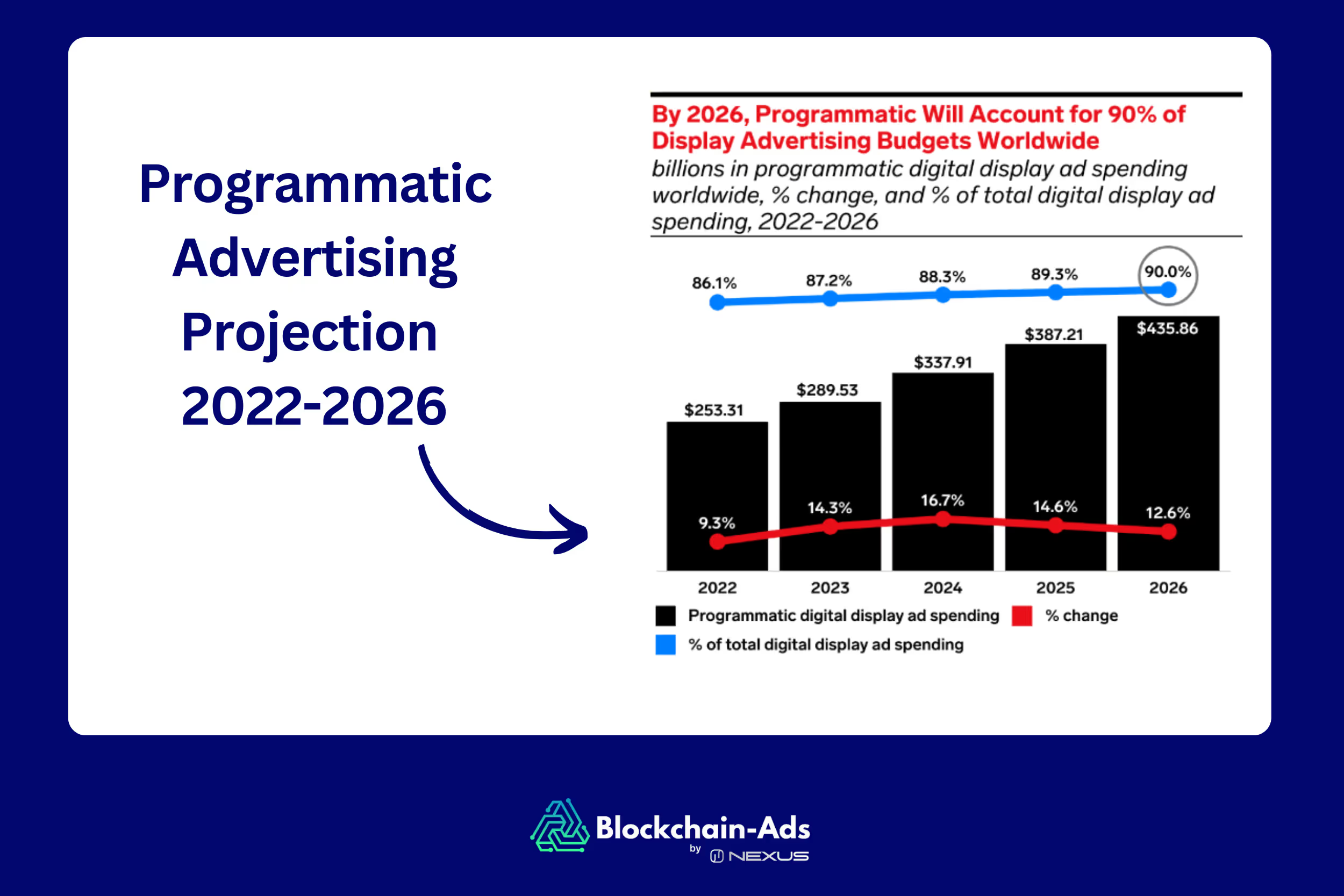
Nearly 4,000 CBD brands now operate in the U.S., all fighting for visibility where ad restrictions are tighter than ever. Yet only a few use programmatic advertising as a competitive advantage to get users and customers successfully. Recent stats show programmatic now drives over 90% of all digital display ad spending in the U.S. so it's obvious advertisers are taking advantage of this method.
But how does programmatic advertising work, and how is it useful for CBD advertising? For CBD marketers, this is good news. Programmatic ad platforms like Blockchain-Ads can run compliant ads specifically targeted at people who've recently searched for CBD products, visited wellness sites or even recently used an online dispensary. This guide will take you through exactly how programmatic advertising works for CBD businesses.
What Is Programmatic CBD Advertising and Why It Matters
Programmatic advertising refers to buying and selling ad inventory through automated bidding that runs in milliseconds. It uses demand-side platforms for brands and supply-side platforms for publishers to match each impression. Every ad call is scored using signals like behavior, location, and interest, then sold to the most relevant bidder.
For CBD brands, programmatic matters because mainstream platforms still treat CBD as a restricted, high-risk category. Policies on Google, Meta, and other major channels limit ingestible products, block medical claims, and frequently reject ads without clear explanations. Programmatic CBD platforms give marketers a way around this, by accessing vetted publishers, enforcing age and geo filters, and keeping campaigns live instead of stuck in review.
Compliance pressure makes programmatic even more important for serious CBD advertisers. Brands must navigate federal rules, state-specific laws, and strict guidelines on language, targeting, and disclosure at the same time. With programmatic, controls for age gating, geo-fencing, brand safety, and messaging are centralized, so campaigns can scale while staying inside policy instead of risking bans or account shutdowns.
Blockchain-Ads for CBD-Friendly Programmatic Advertising
Blockchain-Ads is a programmatic ad platform that gives CBD brands compliance-focused, performance-first media buying. It is built to help regulated CBD advertisers reach health-conscious users across premium publishers without relying on restricted walled gardens. Instead of juggling multiple tools, CBD teams plan, launch, and optimize campaigns from one platform with clear performance goals.
What makes Blockchain-Ads useful for CBD is its audience engine and on-chain attribution rather than generic demographic buckets. The platform combines 69+ audience segments and 420M+ profiles with behavior, interest, and intent signals related to wellness and CBD usage. Nexus AI then shifts budgets automatically toward creatives, placements, and audiences that drive verified purchases or compliant signups instead of surface clicks.
CBD brands can run smart display, native, video, in-app, mobile, and CTV campaigns in a single stack. Tracking merges pixel and server-side events with blockchain-backed logs, so every impression, click, and conversion is auditable for regulated-market stakeholders. With typical minimums around five figures, Blockchain-Ads is best for CBD advertisers ready to scale serious, compliant performance campaigns rather than micro tests.
Other Programmatic Ad Platforms
A few other CBD-friendly programmatic platforms include:
- Mantis: This ad platform focuses exclusively on brands operating in the legal cannabis industry and ancillary markets. It offers contextual targeting and smarter CBD audience segmentation across lifestyle, news and wellness categories.
- Safe-Reach: Safe-Reach is a complete space for online advertising for cannabis and CBD brands. It offers industry-leading integration plus cookieless attribution tools that help you track customer behavior both in-store and online.
- FieldTest: This platform combines AI optimization with cross-channel automation. It makes it easy for CBD marketers to run campaigns across display, video and CTV simultaneously. Also, its dashboard offers audience segmentation tools and unique creative management.
- Adistry: Known for its strong compliance framework, Adistry works with both CBD and cannabis brands that require educational or lifestyle-based advertising. It partners with reliable publishers that allow hemp-derived promotions, thus offering a smooth reach without the risk of ad rejections.
CBD-Friendly Programmatic Ad Platforms: Compared
Programmatic Ad Formats for CBD
The good thing about programmatic technology is that it gives CBD brands freedom to experiment with multiple ad formats. Each format is suited for different goals, audiences and stages of the funnels. Here's the brief on these formats.
Display Ads – A/B testing, dynamic creatives
CBD Display advertising is the foundation of most programmatic campaigns. They work best when paired with A/B testing. So, you can swap headlines, imagery and CTAs to find out which messages earn the most clicks. Modern CBD DSPs also support dynamic creative optimization. This means the ad can automatically adapt to the viewer's interest, browsing behavior or location.
Mobile Ads & Geofencing – Location targeting near dispensaries
Mobile usage still dominates digital traffic, thus, mobile ads are a great fit for CBD marketers. Their key advantage is CBD geofencing: the ability to target audiences within a specific radius such as around dispensaries, wellness stores or event venues.
CBD Native Ads – Blended editorial, normalized messaging
Native advertising is all about blending. The ad matches the surrounding content's tone and design. This makes it feel like a natural recommendation. For CBD brands, native ads are an effective way to normalize cannabis-related messaging. This is especially in health and wellness publications.
CBD Audio Ads – Podcast & streaming, exclusive share of voice
Audio is one of the promising channels for CBD marketers. Podcast and streaming ads can capture a listener's full attention especially when paired with exclusive share-of-voice placements. The format works perfectly for storytelling for example, narrating a customer success story or promoting a new relaxation line on Spotify.
Connected TV Ads – CTV inventory, fewer regulations
CBD CTV ads are quickly attracting compliant brands. Streaming platforms and smart TV basically have less restrictions compared to broadcast networks. So, it's easy for CBD companies to appear on premium inventory like Hulu, Roku or Tubi. With precise audience targeting and real-time metrics, brands can finally merge television-scale storytelling with programmatic precision.
Emerging Channels – DOOH, voice assistants, early adoption benefits
Programmatic advertising is also expanding into DOOH (Digital Out-of-Home) networks. Channels like interactive billboards, mall screens and airport displays offer high visibility without violating digital ad rules. Meanwhile, voice assistants like Alexa and Google Home are opening up early-stage opportunities for conversational CBD marketing. Smart brands using these CBD programmatic benefits early often mean lower costs, less competition and more brand authority.
Targeting Strategies for CBD Advertising
Reaching the right audience is basically what makes a CBD ad campaign successful. Due to industry restrictions, marketers can't simply rely on broad targeting or standard cookie-based methods. Instead, they use programmatic platforms that make it possible to reach high-intent users using the following methods.
Contextual Targeting – Align ads with relevant content
Since cookies are fading out, contextual targeting is the way. According to MAGNA, contextual ads can help boost engagement up to 32% when the ad and the content theme align. It simply works by placing your ads alongside content that matches your niche. Examples are wellness blogs, fitness sites or natural remedy articles. For CBD, this strategy is both compliant and effective.
Geofencing & Location Data – Real-time proximity targeting
CBD Geofencing allows advertisers to draw invisible boundaries around physical locations. It serves ads to users within areas like dispensaries, gyms or yoga studios. For instance, someone who just walked out of a competitor's store or attended a wellness event can be shown your CBD promo within minutes. Real time proximity CBD ad targeting like this will deliver strong ROI simply because it reaches people in the right mindset and location.
Behavioral & Lookalike Audiences – First-party data and modeling
When cookies are restricted, first-party data becomes everything. If you use your own CRM lists, newsletter sign-ups or site activity, then you can easily build behavioral segments of existing customers. For example, users who browse pain relief products or purchase tinctures monthly. From there, programmatic platforms can create lookalike audiences that copy these patterns to find new potential buyers who share similar online behaviors.
CBD Retargeting – Re-engage past visitors compliantly
Usually, most shoppers don't convert on the first visit. That's where CBD retargeting comes in. With proper consent and data handling, you can re-engage users who viewed your site or added products to their cart but didn't complete checkout. The trick for CBD brands is staying compliant. Instead of ''Buy Now'' urgency, use educational or trust-driven messaging. You can be like ''See how CBD can help you sleep better.''
Compliance & Best Practices
When advertising CBD products, one wrong phrase or misplaced claim can get your ad rejected or worse, your account suspended. Every platform has its own rules and most still treat CBD as a high-risk category. That means CBD ad compliance is part of your marketing strategy.
Platform Policies – Google, Facebook, Pinterest, Snapchat rules
Google Ads still restricts most ingestible CBD products though some hemp-derived topicals can be promoted through approved partners. Meta which covers Facebook and Instagram is even tighter. No direct CBD ads. You are only allowed to promote limited ''educational'' or ''non-ingestible'' products.
Pinterest officially bans all ads for CBD and hemp-derived products while Snapchat allows limited promotion for topical hemp goods in specific regions and with heavy review. What this means is that mainstream platforms reach a wall. And this is why so many brands consider programmatic DSP and cannabis-friendly CBD ad networks.
Creative & Copy Guidelines – No health claims, age gates, COA links
When it comes to creativity, avoid making any medical or therapeutic claims. Phrases such as ''treat anxiety'' or ''reduce pain'' will get flagged instantly. Focus on lifestyle outcomes such as relaxation, balance, recovery or better rest.
Your ad should also include age-gating, for example, +21. You also need to provide a link to your Certificate of Analysis (COA) to prove your product's legitimacy. Many publishers and DSP for CBD now request that before approving campaigns.
Legal & State Regulations – FDA, state-by-state disclaimers
Note that CBD legality depends on where your audience is. The 2018 Farm Bill legalized hemp-derived CBD at the federal level as long as it contains less than 0.3% THC. However, state laws vary. Some states like Idaho and South Dakota still restrict CBD in most forms. Meanwhile, others like Colorado and California allow wide distribution.
Still, the FDA hasn't approved CBD as a dietary supplement. This means brands can't market it as a medical treatment. To stay safe, always include disclaimers such as ''This product is not intended to diagnose, treat, cure or prevent any disease.''
Landing Page & Payment Processing Tips – High-risk processors, SSL, privacy
Once a user clicks your ad, your landing page becomes part of the CBD compliance story. So, make sure your site uses SSL encryption, has a visible privacy policy and includes clear shipping and refund terms.
In addition, CBD is considered a high-risk product. So, you'll need a payment processor that supports it such as Square and PayKings.
Measuring Campaign Success & KPIs
The only way to know what's working is to track your data carefully. Measure the following.
Key Metrics – CTR, CPA, viewability, engagement rates
A click-through rate (CTR) above 0.8% is considered healthy for most CBD display ads. CBD Native ads often do better, sometimes hitting 1.5-2% because they blend into relevant content.
Cost per acquisition (CPA) will vary depending on your funnel. But cannabis programmatic campaigns often bring it down by 25-40% compared to direct buys. Viewability is another major one. Aim for at least 70% on display and 90% on video which means most of your ads were actually seen.
Look into engagement rates. Time on page, scroll depth and video completion rate will tell you how genuinely interested users are.
A/B Testing & Optimization – Creative tests, budget reallocation
The key here is to compare small variations. One headline versus another, a product photo versus a lifestyle image or a 15-second video versus a 30-second one.
Once you spot patterns, shift your budget towards what actually converts. Many CBD brands discover their highest conversions come from mobile users or certain time. For example, late evenings when people search for wellness solutions.
Future Trends & Innovations in CBD Programmatic
Contextual Intelligence – Sentiment analysis, AI-driven placement
AI-driven contextual targeting is replacing cookies. Platforms now analyze tone and sentiment across millions of web pages. This ensures CBD ads appear besides positive or relevant content. Smarter contextual advertising CBD tools are boosting ad efficiency and helping marketers build trust in a brand-safe environment.
Regulatory Outlook – SAFE Banking Act, mainstream DSP acceptance
The SAFE Banking Act could change how financial and CBD ad networks view cannabis brands. If passed, it may open access to mainstream DSPs like Google DV360. This would help lower risk classification, reduce ad costs and expand reach. It would also make compliant and large-scale cannabis programmatic advertising far more achievable within the next few years.
Conclusion
Programmatic CBD advertising platforms are opening access to premium ad inventory while giving marketers precise control. Of course, over audience, spend and message delivery. Today, CBD brands can finally scale smartly by pairing data-driven targeting with compliant creative and transparent platforms like Blockchain-Ads or Safe-Reach.
In short, success in CBD or hemp advertising is about spending right. Build your CBD regulatory compliance plan, use contextual intelligence to stay safe and test new CBD ad formats. The brands that embrace programmatic early will share how the next generation of CBD marketing looks and performs.
Read related blogs




Talk with some of our current partners
View all success stories

Reach 12M+
Sign up to become an affiliate today