Crypto Exchange Marketing Strategies That Win New Traders
Key takeaways
- Market selection: Focus on markets where your exchange can compete on fees, trading products, liquidity, or local payment options.
- Trader incentives: Sign-up bonuses and fee discounts can attract users, but the offer must give them a reason to trade.
- Acquisition metrics: Measure KYC completions, first deposits, or first trades instead of relying only on registrations.
- Channel selection: Match paid ads, referrals, influencers, and community campaigns to the traders you want to acquire.
- Scaling strategy: Expand campaigns that acquire trading customers at sustainable costs before increasing your budget.
A successful crypto exchange marketing strategy targets winnable markets, gives traders a reason to join, and converts them into active users.
In this guide, you’ll learn how to build your marketing plan and give traders a reason to choose your exchange. You’ll also learn how to scale acquisition using lessons from Binance, OKX, and Crypto.com campaigns.
Why New Exchanges Struggle to Win Traders
New crypto exchanges compete with established platforms that have deeper liquidity, larger user bases, and stronger brand recognition.
According to CoinGecko's Q2 2026 Crypto Industry Report, Binance accounted for 38.7% of spot trading volume among the ten largest centralized exchanges. Bybit followed at 10%, while the ten exchanges collectively recorded $1.95 trillion in quarterly trading volume.
That concentration creates three challenges for cryptocurrency exchange marketing:
- Liquidity: Traders need enough buyers and sellers to execute orders at competitive prices. Thin order books can widen spreads and increase slippage, giving traders little reason to leave exchanges with deeper liquidity.
- Trust: Traders must feel comfortable depositing funds on an unfamiliar platform. Without a proven track record, transparent fees, credible security measures, and appropriate regulatory authorization, an attractive bonus may not be enough.
- Switching incentives: Traders who already have funded accounts and familiar workflows need a compelling reason to try another exchange. Lower fees, relevant trading pairs, local payment options, or exclusive rewards can help create that reason.
How to Build a Crypto Exchange Marketing Plan
When marketing a crypto exchange, your plan should define your target traders, acquisition offer, and acceptable acquisition cost.
Pick the Markets You Can Win
Start with geographic markets where your exchange can legally operate and offer something traders aren't getting from established competitors.
You can assess each market against four factors:
- Regulatory eligibility: Can you legally serve traders and promote your products in that jurisdiction?
- Trading demand: Is there sufficient demand for the assets, trading pairs, or products you offer?
- Competitive advantage: Can you compete on trading fees, liquidity, local payment options, or a specialized trading product?
- Acquisition feasibility: Can you reach the intended traders through available channels at a sustainable cost?
Prioritize a few promising markets to test demand and acquisition costs before expanding your budget.
Define the Trader You Want
Define your target traders by their experience, trading behavior, and product needs. A first-time spot trader has different priorities from an experienced derivatives trader seeking lower fees and reliable execution.
You can use the following trader segments as a guide when defining your target audience:
- First-time traders: Prioritize accessible onboarding, educational support, and straightforward trading products.
- Active spot traders: Emphasize relevant trading pairs, liquidity, fees, and execution.
- Derivatives traders: Focus on the contract offerings, trading tools, and fee structures that matter to experienced users.
- High-volume traders: Communicate volume-based benefits, liquidity, and execution quality.
Build an Offer That Brings Traders In
Your acquisition offer should give the intended trader a specific reason to register, deposit, or place their first trade. Use incentives that motivate your target audience to convert:
- Sign-up bonuses: Give eligible new users a reason to create an account.
- Fee discounts: Appeal to traders who want to reduce trading costs.
- Deposit matches: Encourage new users to fund their accounts, subject to clear eligibility and withdrawal conditions.
- First-trade rewards: Encourage verified users to complete their first transaction.
An OKX acquisition campaign tested a 15 USDT contract voucher before introducing a mystery-box reward tied to KYC. It recorded 3,095 completed registrations and KYC verifications across four markets.
Test whether incentives drive deposits and trades, rather than just reward claims.
Choose the Conversion Event
Choose a conversion event that reflects the campaign's objective and shows whether your acquisition spending is producing meaningful progress.
- Sign-up: Measures account creation but doesn't confirm that the user can trade.
- KYC completion: Identifies users who have completed identity verification.
- First deposit: Shows that a verified user has committed funds.
- First trade: Confirms that the user has started trading.
Select the deepest event your tracking and conversion volume can reliably support. Then monitor subsequent steps to identify where acquired users drop off.
Set a Target Cost per Trader
Set your target acquisition cost based on what an active trader is worth to your exchange, rather than copying CPA figures from other campaigns.
- Estimate the net contribution you expect from a trader over a defined period.
- Account for trading-fee revenue, rewards, payment processing, verification expenses, and other variable costs.
- Establish the maximum acquisition cost your expected contribution can support.
For example, if your target is first-trade acquisition, calculate:
Cost per first-time trader = Total acquisition spend ÷ Number of acquired users completing their first trade
Our Binance acquisition case study recorded 4,600 verified traders at a $91 blended CPA over four months. That's a campaign result, so don’t use it as an acquisition benchmark.
Use your acquisition economics to adjust spending, offers, and targeting. Include incentive costs when evaluating total acquisition costs.
How to Promote and Advertise a Cryptocurrency Exchange
Choose crypto exchange marketing strategies that match your target traders, acquisition offer, and measurable conversion events.
Paid Advertising
Paid crypto exchange advertising reaches prospective traders through search, display, social, and retargeting campaigns.
Each platform has its eligibility requirements. For example, Google permits eligible cryptocurrency exchange advertising in approved markets, provided advertisers meet applicable licensing requirements and obtain certification.
Check local regulations and platform policies before launching. Review this crypto advertising regulations guide, then learn how to set up crypto ad campaigns.
Structure paid campaigns around the trader's intent:
- Search advertising: Capture traders actively comparing exchanges, trading fees, or supported assets.
- Display advertising: Reach relevant audiences with messages highlighting your exchange's competitive advantages.
- Social advertising: Promote eligible offers to interested audiences using educational content, product benefits, and trader-focused creatives.
- Retargeting: Re-engage visitors who explored your exchange but haven't completed registration, verification, or their first trade.
Referral Programs and Trading Competitions
Referral programs encourage existing traders to bring in new users, while trading competitions use rankings and prizes to attract participants. Set reward limits and eligibility rules to discourage abuse.
For example, Zoomex's trading tournament campaign generated more than 2.5 million impressions at a $0.34 CPC. Its promotional messages connected sign-up rewards with tournament participation.
The results of these campaigns measure reach and traffic costs, not trader acquisition. Always track completed registrations, verification, and trades to assess the impact of the campaign.
Influencer and KOL Partnerships
Choose influencers whose audiences match your target markets and trading products.
Evaluate potential partnerships using:
- Audience relevance: Do followers trade the assets or products your exchange supports?
- Geographic fit: Are followers concentrated in markets you can serve?
- Credibility: Does the creator explain trading products accurately and disclose commercial relationships?
- Measurability: Can you attribute registrations, deposits, or trades through referral codes and campaign tracking?
Community Building
Build communities on channels such as Telegram and Discord where traders can discuss features, receive product updates, and get support.
Focus on activities that support participation:
- Host product walkthroughs and question-and-answer sessions.
- Share updates about trading pairs, fees, and platform features.
- Collect feedback on onboarding problems and trading experiences.
- Run educational discussions and eligible community events.
Track community engagement and its contribution to verified trader acquisition.
Content Marketing and PR
Use content marketing and PR to answer trading-intent questions about supported assets, fees, deposit methods, and liquidity.
Prioritize:
- Search-focused content: Publish exchange comparisons, trading-fee explanations, and product guides.
- Educational resources: Explain account setup, verification, deposits, and trading features.
- Product announcements: Communicate new trading pairs, relevant integrations, and improvements.
- Public relations: Share verifiable company developments, regulatory milestones, and product launches with relevant publications.
Connect each resource to a useful next step, such as viewing trading fees, exploring an available market, or starting verification. Then, measure registrations and trading activity influenced by content alongside organic traffic and referral visits.
How to Scale a Crypto Exchange, With Lessons From Binance, OKX, and Crypto.com
Scale your crypto exchange business by increasing spend on markets, audiences, and campaigns that acquire active traders sustainably. These Blockchain-Ads campaigns for exchanges and crypto platforms show what scaling looked like in practice.
Note: These are results from individual campaigns, not acquisition benchmarks. Conversion events vary.
Expand Into New Markets
Compare KYC completion, first trades, acquisition costs, and trading activity across eligible markets before increasing spend.
- OKX: Targeted Turkey, Vietnam, the Philippines, and Indonesia. After testing several audience segments, the campaign concentrated spending on those generating stronger verified acquisitions and trading activity.
- Crypto.com: Shifted spending toward higher-performing European markets and prioritized creatives promoting perpetual trading and competitive fees. The campaign recorded 4,782 acquired traders.
- Mercado Bitcoin: Focused on Latin American crypto audiences and tested messages around local expertise, security, and fees. The competitive-fees message generated the strongest registration response.
Bring Visitors Back With Retargeting
Retarget visitors who started but haven't completed registration, KYC, or their first trade. Match each audience with a message addressing its next step, then compare retargeting with prospecting to assess its contribution to acquisition.
In the Binance campaign, retargeting delivered 41% of verified conversions using 19% of total advertising spend, at a $42 CPA compared with $125 for cold prospecting.
Let Costs Fall as Campaigns Learn
Start with controlled tests, review conversion quality, and gradually redirect spending toward combinations that acquire traders within your target CPA.
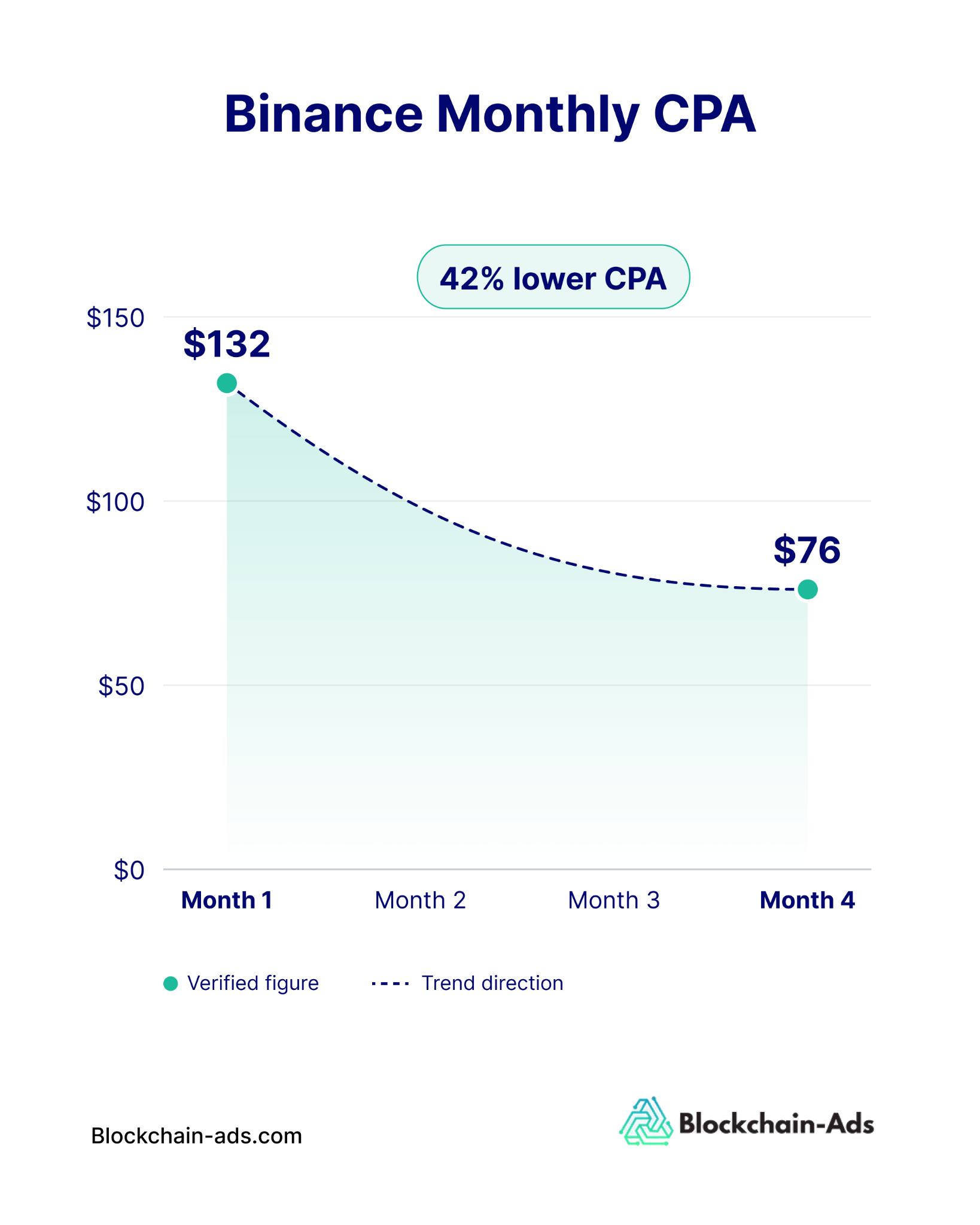
- Binance: Blended CPA fell from $132 in the first month to $76 in the fourth as creative testing and retargeting informed subsequent spending.
- Bybit: Following creative testing and audience optimization, CPA declined by 56%, from $570.57 to $250.19, while sign-ups increased 401% from the first campaign phase.
Campaign costs don't necessarily decrease as you scale. Nevertheless, increase spending only when campaigns continue producing qualified conversions.
Grow Trading Volume per Trader
Increase trading activity by targeting likely traders and monitoring their transaction volume, frequency, and activation rates.
- OKX: Generated $5.16 million in trading volume and 21,470 completed trades after targeting crypto-active segments and optimizing for verified acquisitions.
- RocketX: Targeted DeFi users, token swappers, and higher-value traders seeking competitive swap rates. The campaign acquired 2,180 traders and recorded $2.34 million in transaction volume.
- Nebeus: Promoted crypto-backed lending and yield products to relevant crypto holders. Its campaign acquired 794 users and recorded $157,600 in transaction volume.
These figures reflect campaign-period transaction volume, not advertising revenue or long-term trader value.
What to Fix So New Traders Stay
Focus on three areas that can undermine acquisition performance even when your campaigns attract the right audience.
Liquidity
Your exchange needs enough liquidity to execute trades without excessive spreads or slippage. Thin order books can increase trading costs and discourage users from returning.
Monitor order-book depth, spreads, and slippage across promoted markets. Prioritize trading pairs where you can offer competitive execution.
Trust Signals and a License
Give prospective traders verifiable reasons to trust your exchange before asking them to deposit funds.
Display relevant regulatory authorizations, explain your security measures, publish transparent trading fees, and make withdrawal conditions easy to find.
Licensing requirements vary by jurisdiction and product. The Financial Action Task Force's guidance establishes standards for licensing or registering virtual asset service providers and applying customer due diligence.
Clearly identify which entity holds each authorization and where it applies. Don't imply that a license in one jurisdiction permits your exchange to offer every product internationally.
Onboarding and KYC
Make it easy for eligible users to move from registration through identity verification, funding, and their first trade.
Review unnecessary steps, unclear document requirements, verification delays, and payment failures. Explain what information users need before they begin and provide clear guidance when verification fails.
Track completion and abandonment rates at each stage:
- Registration to KYC: Are users starting verification after opening an account?
- KYC to deposit: Are verified users funding their accounts?
- Deposit to first trade: Are funded users completing their first transaction?
Use these findings to fix friction before increasing acquisition spending. Otherwise, additional traffic may just create more incomplete registrations instead of active traders.
FAQs
How Do Referral Programs Affect the Growth of a Crypto Exchange?
Referral programs encourage existing traders to acquire new users. Reward verified deposits or first trades, then compare referred traders' acquisition costs with other channels.
What Incentives Keep Users Engaged on a Crypto Trading Platform?
Fee discounts, trading-volume rewards, loyalty benefits, and competitions can encourage activity. Track whether traders continue trading after incentives end to determine if the promotions drive lasting engagement or only temporary activity.
How Do Crypto Exchanges Encourage Community Participation?
Host educational sessions, product discussions, trading events, and Q&As. Encourage feedback and share relevant platform updates.
How Do Major Exchanges Attract and Keep Crypto Influencers?
Exchanges offer referral incentives and campaign partnerships. Prioritize creators with relevant audiences and measure qualified trader acquisition.
How Should a Crypto Exchange Split Its Marketing Budget Across Channels?
Test relevant channels, then adjust spending based on acquisition costs and conversion quality. Keep separate budgets for prospecting, retargeting, and testing.
How Do Licensing and Compliance Affect Crypto Exchange Advertising?
Licensing affects where exchanges can operate and advertise eligible products. Verify local regulations, platform certification, and market-specific requirements before launching.
How Can a New Crypto Exchange Compete with Binance and Coinbase?
Target underserved traders with competitive fees, relevant trading pairs, local payment methods, reliable execution, or specialized products.
Acquire Your Next Traders With Blockchain-Ads
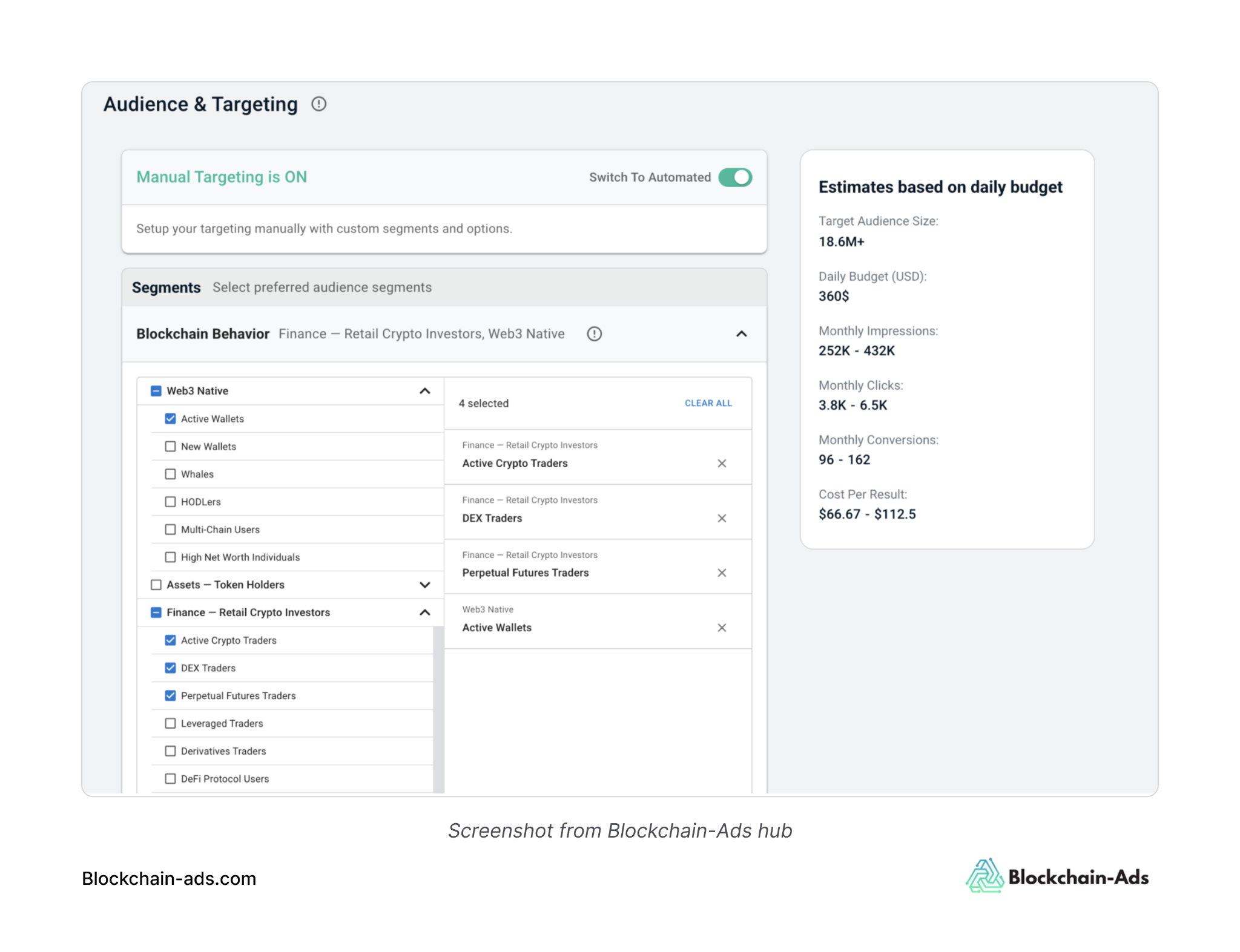
Blockchain-Ads helps crypto exchanges reach audiences based on trading behavior, wallet activity, and interests. You can also measure conversions from registration through first deposit.
Use these signals to find relevant traders, retarget interested prospects, and optimize acquisition campaigns toward the actions that matter to your exchange.
Explore crypto advertising with Blockchain-Ads to see how you can reach and acquire your next traders.
Raphael is a B2B SaaS and technical SEO writer covering digital advertising, Web3, fintech, and growth strategy.
View full profile →